
We’ve all been there. You pour hours into writing what feels like your best blog post yet. You hit publish, sit back, and wait for the traffic to start rolling in.
But days turn into weeks, and your analytics dashboard barely moves. It’s frustrating, right? In today’s crowded digital world, just writing “good” content isn’t enough anymore. If you want results, you need to master content optimisation.
Why does this matter now? Because the search landscape is changing fast. With AI Overviews, Google’s constant updates, and a bigger focus on what users actually want, it’s harder than ever to land on page one.
To optimise your content for SEO, you need a strategy that covers everything from technical basics to connecting with your audience on a personal level.
In this guide, I’ll walk you through 17 proven strategies to level up your content. Whether you’re a seasoned marketer or a business owner trying to boost your online presence, these practical steps will help you climb the rankings and stay there.
Key Takeaways
- Always align your content with the user’s search intent (Informational, Transactional, etc.). Tailor your content to match whether users want to learn, compare, or buy. Meeting intent improves engagement and conversion rates.
- Use H1, H2, and H3 tags to create a logical hierarchy that bots and humans can follow. Clear headings help search engines understand your page structure and topics. They also make content easier for readers to scan.
- Demonstrate first-hand experience and expertise to build trust with Google. Showcase your knowledge with examples, case studies, or original insights. This signals authority and aligns with E-E-A-T guidelines.
- Ensure your site is mobile-friendly and passes Core Web Vitals assessments. Optimise for fast loading, smooth interaction, and stable layouts on all devices. This improves user experience and search rankings.
- Adapt your writing style to be cited by AI engines like ChatGPT and Google AI. Use clear, structured, and factual content that AI can reference. Well-organised information increases discoverability in AI-powered answers.
What is Content Optimisation?

Content optimisation means making your content work harder for you. It’s about improving your pages so they show up in search, keep readers engaged, and drive real results.
This includes everything from using the right keywords and structure to making sure your content is easy to read and technically sound.
Think of it like this: you can throw spaghetti at the wall and hope something sticks, or you can use a targeted approach that actually gets results. Content optimisation is about being intentional, not just hoping for the best.
Content optimisation encompasses:
- SEO elements: Keywords, meta tags, headers, internal linking
- User experience: Readability, formatting, mobile-friendliness
- Engagement factors: Visuals, multimedia, interactive elements
- Conversion elements: Calls-to-action, persuasive copy, trust signals
- Technical aspects: Page speed, structured data, accessibility
The goal is simple: create content that ranks, keeps readers interested, and helps you hit your business goals, whether that’s getting more leads, driving sales, building authority, or boosting your brand.
Understanding Content Optimisation Fundamentals
Before you write a single word, set the foundation. Great content optimisation starts with knowing exactly who you’re writing for and what they’re looking for.
Strategy 1: Master Search Intent Alignment

Search intent (or user intent) is the why behind a search query. Google’s algorithms have become incredibly sophisticated at discerning what a user wants to achieve. If your content does not align with this intent, no amount of keywords will save you.
Generally, search intent falls into four categories:
- Informational: The user wants to learn something (e.g., “what is seo”).
- Navigational: The user is looking for a specific website (e.g., “MediaOne Marketing login”).
- Transactional: The user is ready to buy (e.g., “buy seo services”).
- Commercial Investigation: The user is comparing options (e.g., “best seo agency Singapore”).
Actionable Steps:
- Type your target keyword into Google and analyse the top 3-5 results.
- Are they how-to guides, product pages, or listicles? Match the format.
- If the top results are extensive guides, do not write a short 500-word post.
Pro Tip: If you find a keyword with mixed intent (e.g., both product pages and blogs are ranking), you have an opportunity to create a hybrid page that educates while offering a solution.
Strategy 2: Conduct Strategic Keyword Research

Keywords are the compass of your content strategy. However, the days of stuffing high-volume keywords into every paragraph are long gone. Modern keyword research focuses on identifying topics and phrases that your audience uses naturally.
You need to look for a mix of “head terms” (broad, high-volume) and “long-tail keywords” (specific, lower-volume but higher-conversion). Long-tail keywords often account for the majority of web traffic and are easier to rank for.
Actionable Steps:
- Use tools like Semrush, Ahrefs, or Google Keyword Planner.
- Identify one primary keyword and 3-5 secondary keywords.
- Look for question-based keywords (e.g., “how to optimise content”) to target featured snippets.
Strategy 3: Analyse Your Competition

You can’t outrank your competition if you don’t know what they’re doing. Looking at your competitors shows you what’s working in your space and helps you spot gaps you can fill.
When you check out top-ranking pages, don’t just read the text. Pay attention to how they’re structured, what images they use, where their data comes from, and how easy the page is to use. The goal isn’t to copy them, but to create something much better. Marketers call this “10x content.”
Actionable Steps:
- Identify the top 3 competitors for your target keyword.
- Note their word count, readability score, and content depth.
- Identify what they are missing. Is their data outdated? Do they lack custom graphics? Fill these gaps.
On-Page SEO Content Optimisation
Once your strategy is set, it’s time to get into the details. On-page SEO means adjusting your page’s content and code so search engines can easily understand and rank it.
Strategy 4: Optimise Title Tags and Meta Descriptions

Your title tag and meta description are like your shop window. They’re the first thing people see in search results. If they aren’t eye-catching, users will scroll past, and your click-through rate will suffer.
Your title tag is a big ranking factor, so make sure it includes your main keyword ideally near the start. The meta description doesn’t directly affect rankings, but it does help convince people to click your link.
Actionable Steps:
- Keep title tags under 60 characters to avoid truncation.
- Ensure your meta description is between 155 and 160 characters.
- Include your primary keyword naturally in both the title and the description.
- Use power words (e.g., “Proven”, “Guide”, “Strategy”) to entice clicks.
Strategy 5: Use Header Tags Strategically

Header tags (H1, H2, H3, etc.) provide structure to your content. They help Google understand the hierarchy and context of your information. Think of them as the skeleton of your article.
Using headers correctly also makes your content easier to skim. Most people scan subheadings first to decide if your page is worth reading.
Actionable Steps:
- Use only one H1 tag per page, and ensure it includes your target keyword.
- Use H2s for main sections and H3s for sub-points.
- Work in secondary keywords and related phrases into your H2s and H3s.
Strategy 6: Implement Schema Markup and Structured Data

Schema markup is extra code you add to your site to help search engines understand your content. It can also make your search results stand out with rich snippets like star ratings, images, or FAQ lists.
Adding schema is like giving Google a cheat sheet for your page. It can boost your visibility and get you more clicks.
Actionable Steps:
- Use Google’s Structured Data Markup Helper to generate code.
- Implement “Article” or “BlogPosting” schema for blog posts.
- Use the “FAQ” schema if you have a Frequently Asked Questions section to dominate more SERP real estate.
Content Quality and Structure for Content Optimisation
Technical tweaks matter, but they can’t make up for weak content. Quality is still king. Here’s how to create content that keeps readers engaged from start to finish.
Strategy 7: Write for Humans First, Search Engines Second

It is a cliché for a reason. It’s a cliché for a reason: if your content sounds robotic, people will leave right away. High bounce rates and low time on page signal to Google that your content isn’t hitting the mark.
Be conversational, empathetic, and helpful. Address the user’s pain points directly and offer clear solutions. When you satisfy the human reader, the search engine rankings often follow.
Actionable Steps:
- Use “you” and “we” to create a connection.
- Avoid jargon where possible, or explain it simply if necessary.
- Tell stories or use analogies to explain complex concepts.
Strategy 8: Improve Content Readability and Scannability

People read online differently than they do in books. They scan, skip, and scroll. If they see a wall of text, they’ll leave. Making your content easy to read means your message actually gets through.
Tools like Hemingway Editor can help you check how easy your writing is to read. Aim for a reading level most teenagers can understand, even if you’re writing for professionals. Clear always beats clever.
Actionable Steps:
- Keep paragraphs short (3-4 sentences maximum).
- Use bullet points and numbered lists to break up information.
- Bold key phrases to draw the eye to essential takeaways.
- Use transition words to keep the flow smooth.
Strategy 9: Add Visual Content That Enhances Understanding

Images are powerful in SEO. They break text into manageable chunks, make complex ideas easier to understand, and keep readers engaged. Plus, optimised images can appear in Google Images and drive extra traffic.
But make sure your visuals are relevant. Stock photos are okay, but custom diagrams, screenshots, and infographics add much more value.
Actionable Steps:
- Include at least one image or video for every 300-400 words.
- Compress images to prevent them from slowing down your site (use the WebP format).
- Optimise content for SEO by adding descriptive Alt Text to every image, including keywords where natural.
Pro Tip: Create simple infographics using tools like Canva. These are highly shareable and can earn you backlinks from other sites looking to explain the same concept.
Google’s E-E-A-T guidelines—Experience, Expertise, Authoritativeness, and Trustworthiness are more important than ever for ranking. This matters most for “Your Money or Your Life” topics, but it really applies to all content.
Strategy 10: Demonstrate Experience and Expertise
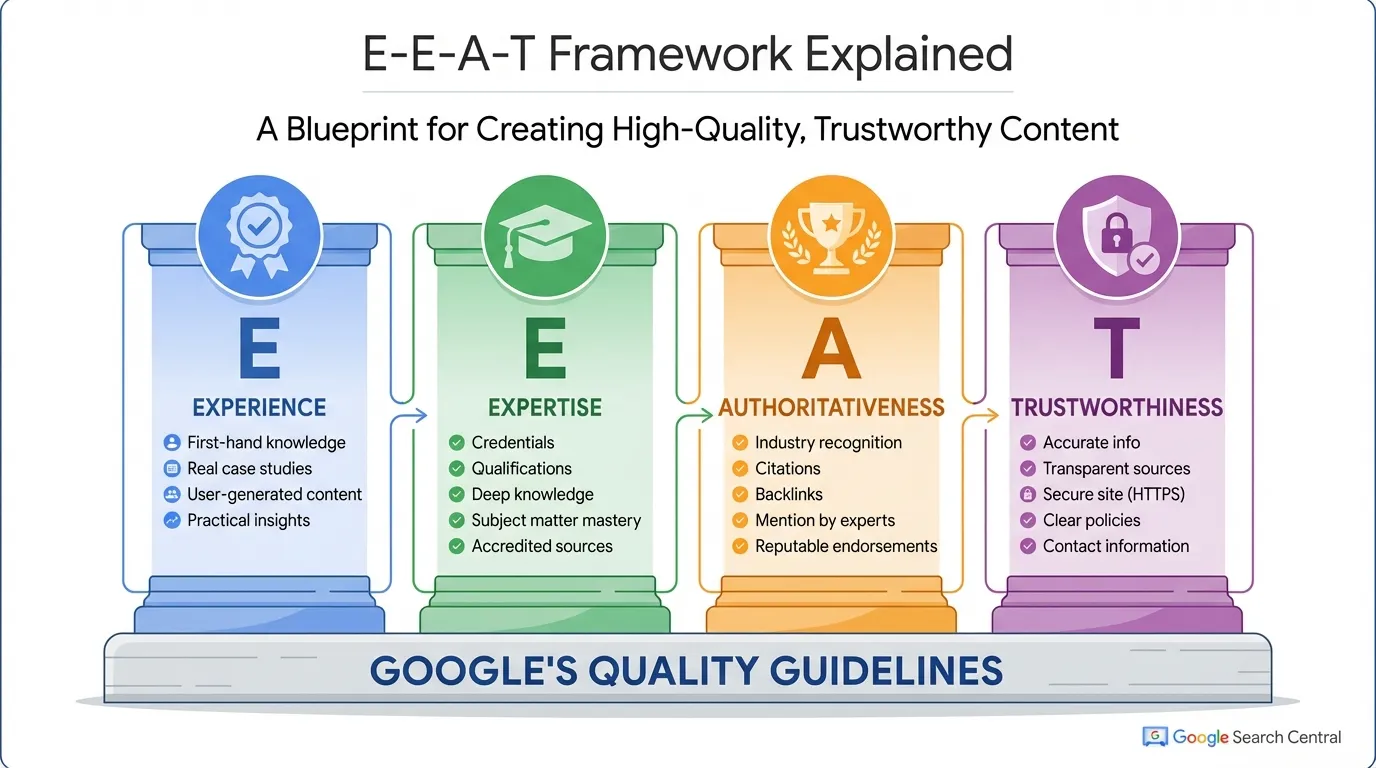
Google wants to see that you know your stuff. “Experience” means first-hand knowledge. Have you actually used the product or tried the strategy you’re writing about?
Show your experience by writing in first person, sharing real stories, and highlighting your credentials. Avoid generic author profiles. Make sure your posts have clear bylines that link to detailed bios.
Actionable Steps:
- Create detailed author bio pages highlighting qualifications and experience.
- Use phrases like “In my experience” or “Our team tested this.
- Link to your social media profiles (LinkedIn/Twitter) to verify identity.
Strategy 11: Build Authoritative Backlinks

Backlinks, links from other sites to yours, are still one of the most significant ranking factors. They’re like votes of confidence. But quality beats quantity every time. One link from a top news site or industry leader is worth more than a hundred low-quality links.
Invaluable content, packed with data, or even a bit controversial, tends to attract links on its own. This is called “link bait.” For more information, read our blog post with tips on getting backlinks.
Actionable Steps:
- Create “Skyscraper” content (content that is significantly better than existing resources).
- Conduct digital PR campaigns to get mentioned in industry news.
- Reach out to partners or suppliers for mention opportunities.
Strategy 12: Include Original Research and Data

Nothing builds authority quite like proprietary data. When you publish original research, you become the primary source. Other writers in your industry will cite your data, naturally earning you high-quality backlinks.
You don’t need a big budget for this. Even a simple survey of your email list or a look at your own customer data can give you insights no one else has.
Actionable Steps:
- Run a survey using Google Forms or SurveyMonkey.
- Analyse industry trends and publish a “State of the Industry” report.
- Create charts and graphs to visualise your findings.
Technical and User Experience for Content Optimisation
Your content is only as strong as your website. If your site’s technical foundation is weak, your content won’t perform well. Technical SEO makes sure search engines can find and understand your pages.
Strategy 13: Optimise for Mobile-First Indexing

Google now prioritises your mobile site when ranking pages. If your site isn’t mobile-friendly, you’re missing out. Most searches happen on mobile, so your site needs to work perfectly on every device.
Make sure your text is easy to read without zooming, buttons aren’t too close together, and nothing is hidden on mobile screens.
Actionable Steps:
- Use Google’s Mobile-Friendly Test tool.
- Ensure you are using a responsive design.
- Avoid intrusive pop-ups that cover the main content on mobile screens.
Strategy 14: Improve Core Web Vitals and Page Speed

Core Web Vitals are a set of specific factors that Google considers essential in a webpage’s overall user experience. They measure loading performance (LCP), interactivity (FID/INP), and visual stability (CLS).
A slow site turns visitors away. Studies show that every extra second of load time costs you conversions. Fast sites have the edge.
Actionable Steps:
- Check your scores in Google Search Console or PageSpeed Insights.
- Optimise images and leverage browser caching.
- Minimise JavaScript execution time.
Strategy 15: Create Strategic Internal Linking Architecture

Internal links tie your content together and help Google understand your site’s structure. They let you highlight your most important pages and pass more value to them.
By creating “content clusters, a pillar page linked to several related cluster pages, you signal topical authority to search engines.
For example, you might link from a general SEO page to our specific service pages, such as our SEO agency in Singapore page, to pass authority.
Actionable Steps:
- Audit your existing content for missed internal linking opportunities.
- Use descriptive anchor text (e.g., “read our SEO guide” rather than “click here”).
- Link high-authority older posts to your newer content to give it a boost.
AI and Future-Proofing Your Content

The digital world is changing fast. With AI search engines and generative answers on the rise, your content optimisation strategies need to keep up.
Strategy 16: Optimise for AI Overviews and Generative Engine Optimisation (GEO)
Generative Engine Optimisation (GEO) is the next big thing. It’s about making your content show up in AI-generated answers from Google AI Overviews, ChatGPT, and more. These engines want content that’s clear, factual, and trustworthy.
AI models look for clear, direct answers. They also prefer well-structured sources. To stand out, aim to be the go-to answer for your topic.
Actionable Steps:
- Structure content in a Q&A format (Question as H2, Answer immediately below).
- Use “is” statements (e.g., “Content optimisation is…”).
- Ensure your facts and statistics are cited and up to date.
Strategy 17: Keep Content Fresh with Regular Updates
Content doesn’t stay fresh forever. Over time, it can lose relevance and drop in the rankings. Google rewards content that’s kept up to date and reflects the latest trends.
Don’t just change the date. Update the actual information. If you wrote a guide in 2024, chances are it needs a real update to meet 2026 standards.
Actionable Steps:
- Conduct a content audit every 6 months.
- Identify pages with declining traffic.
- Update statistics, check broken links, and add new sections on emerging trends.
- You can find more details on keeping content relevant in our content optimisation guide.
Content Optimisation vs Content Refresh: What’s the Difference?
These terms are related but distinct:
What Is Content Optimisation?
Content optimisation is the process of creating content from the ground up using SEO and user experience best practices. This ensures your content is fully optimised before it’s published, increasing the likelihood of ranking well and engaging readers. Examples include keyword research, meta tag creation, internal linking, and optimised headings.
Pros:
- Strong foundation for SEO
- Better user experience from the start
- Easier to maintain rankings
Cons:
- Requires upfront time and effort
- Needs careful planning to avoid missing opportunities
What Is Content Refresh?
Content refresh (or content reoptimisation) involves updating and improving content that is already published. This can help recover lost rankings, align content with current search intent, or incorporate new data, trends, or insights. Examples include adding new statistics, rewriting outdated sections, or improving readability and structure.
Pros:
- Boosts the performance of existing content
- Keeps content relevant and accurate
- Can reclaim lost search rankings
Cons:
- May require significant edits depending on content age
- Needs regular monitoring to identify pages in need of refresh
Key Differences Between Optimisation and Refresh
Here’s a quick table for easier comparison:
| Aspect | Content Optimisation | Content Refresh |
| Timing | During content creation | After the content is published |
| Purpose | Build content correctly from the start | Improve or update existing content |
| Examples | Keyword research, meta tags, internal linking | Update stats, rewrite outdated info, add visuals |
| Pros | Strong SEO foundation, better UX upfront | Maintain rankings, improve relevancy, and recover traffic |
| Cons | Time-intensive upfront, requires careful planning | Can be time-consuming for large sites, needs ongoing monitoring |
In practice, both use similar techniques and principles. The difference is timing: optimisation happens during creation; refreshing happens afterwards to maintain or improve performance.
Turn Your Content Into a High-Performing Asset
Content optimisation isn’t a one-and-done job. It’s an ongoing commitment to quality and staying relevant.
As we head into 2026, the gap between average content and truly optimised content will only get bigger. By using these 17 strategies, you’re not just pleasing search engines, you’re creating a better experience for your users.
Remember, your goal is to be the best answer online for your topic. Focus on value, structure, and technical details, and the rankings will follow. It takes time and consistency, but the payoff is worth it.
Ready to take your digital presence to the next level? If you need a partner to navigate these changes, visit MediaOne to see how we can help. As a premier digital partner, we specialise in helping businesses like yours dominate the SERPs.
Start by auditing your content today. Pick one strategy from this list and put it into action. Then tackle another. Step by step, you’ll build a content engine that delivers real results. Get in touch if you want help!
Frequently Asked Questions
How long does it take to see results from content optimisation?
Most websites begin seeing initial improvements within 2-4 weeks, with more substantial results appearing after 2-3 months.
The timeline varies depending on your site’s existing authority, the level of competition, and how comprehensively you’ve optimised the content. High-authority sites with firm backlink profiles typically see faster results than newer websites.
Can I optimise content for multiple keywords at once?
Yes, you can and should optimise for one primary keyword plus several related secondary keywords that support the main topic. However, avoid targeting completely unrelated keywords in a single piece of content, as this confuses search engines and dilutes your focus.
The best approach is to create topic clusters in which one pillar page targets a broad keyword and supporting pages target specific long-tail variations.
Is content optimisation a one-time task or an ongoing process?
Content optimisation is an ongoing process, not a one-and-done activity.
Search algorithms evolve, competitors update their content, user intent shifts, and new information emerges, all of which require periodic re-optimisation to maintain rankings. Plan to review and refresh your top-performing content every 6-12 months to keep it competitive.
Will optimising old content negatively affect its existing rankings?
When done correctly, optimising existing content should improve or maintain rankings, not harm them. However, dramatic changes to well-performing content can temporarily cause ranking fluctuations as Google re-evaluates the page. The key is making strategic improvements based on data rather than wholesale rewrites of content that’s already ranking well.
Do I need expensive tools to optimise content effectively?
No, you can achieve solid content optimisation results using free tools like Google Search Console, Google Analytics, Google Keyword Planner, and basic readability checkers.
Paid tools like Ahrefs, SEMrush, or Surfer SEO certainly speed up the process and provide deeper insights, but they’re not essential for beginners or those with limited budgets. Focus first on mastering the fundamentals using free resources before investing in premium tools.