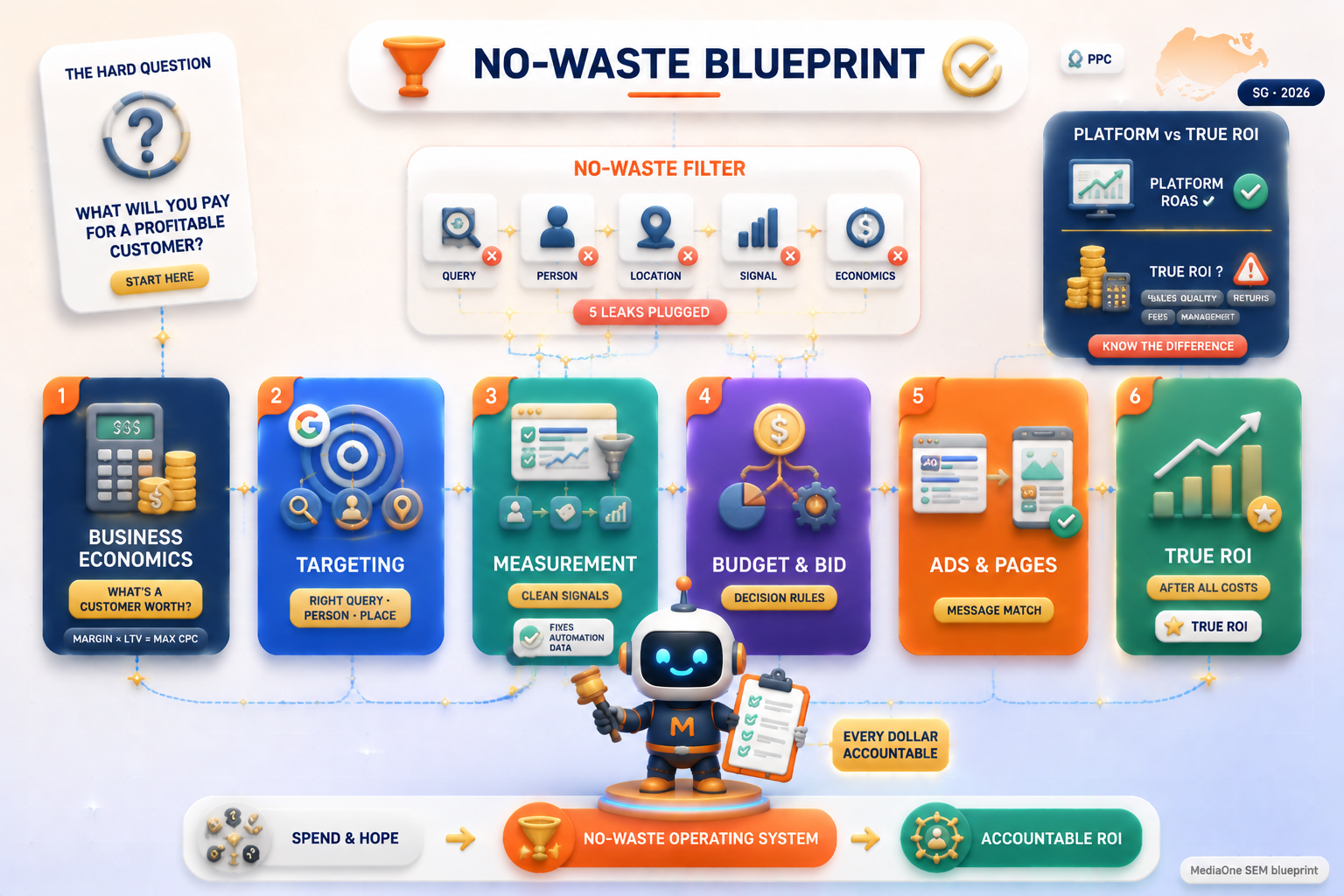
A strong SEM campaign strategy does not begin with keywords or bidding. It begins with a harder question: what is your business willing to pay for a profitable customer?

A no-waste Google Ads campaign strategy prevents budget from flowing to the wrong query, person, location, conversion signal, or customer economics. It cannot eliminate every non-converting click. It can make every dollar accountable to a decision rule. That distinction matters. A PPC campaign strategy can generate leads and purchases and deliver a healthy platform ROAS, yet still lose money after accounting for margins, sales quality, returns, fees, and management costs.

An SEM campaign strategy is the operating plan that connects business goals, paid-search targeting, conversion measurement, budget, bidding, ads, and landing pages. This blueprint starts with business economics, fixes the data used by automation, and closes the leaks between search demand and revenue.
Key Takeaways
- Define break-even CPA or ROAS before choosing a budget or bid target.
- Make genuine sales, purchases, or qualified lead stages the primary optimisation signals.
- Separate campaigns when intent, margin, geography, or customer value requires different controls.
- Use actual search terms, not keyword assumptions, to remove irrelevant demand.
- Judge automation by profitable business outcomes, not cheap clicks or inflated conversion counts.
What Counts as Wasted Spend in an SEM Campaign?

Wasted ad spend is not limited to clicks that fail to convert. Some conversions are also waste. A form fill from the wrong customer, a repeat buyer credited as new demand, or a low-margin sale can all make the account look stronger than the business actually is.
Audit waste in five layers:
- Measurement waste: Google Ads optimizes toward page views, duplicate actions, or low-quality leads.
- Demand waste: Ads appear for research, employment, support, or searches for the wrong service.
- Targeting waste: The wrong locations, hours, devices, audiences, or customer groups consume budget.
- Conversion waste: The query, ad, offer, and landing page do not match, or the page introduces friction.
- Economic waste: Conversions occur, but margin, close rate, returns, or lifetime value make them unprofitable.
Step 1: Set Profit Guardrails Before You Set a Budget
A budget is not a strategy. It is the amount you are willing to expose to a tested economic model. Start with four numbers: average order value or customer revenue, gross or contribution margin, conversion or close rate, and the cost ceiling your business can sustain.
Core formulas: ROAS = attributed revenue/ad spend. ROI = (incremental profit – total marketing investment) / total marketing investment. Break-even ROAS = 1 / gross-margin rate. Break-even lead CPA = gross profit per customer x lead-to-customer close rate.
Ecommerce example
A product sells for SGD 200 with a 40% gross margin. Gross profit before other marketing and operating costs is SGD 80. The simple break-even ROAS is 1/0.40, or 2.5x. If returns, fulfilment, payment fees, and agency costs reduce the contribution margin to 30%, the break-even point rises to about 3.33x. A 3x platform ROAS would look healthy, but still result in a loss.
Lead-generation example
A new customer produces SGD 2,000 in gross profit, and 10% of advertising leads become customers. The theoretical break-even lead CPA is SGD 200. Your operating target should usually sit below that ceiling because sales labour, no-shows, and overhead still matter.
There is no universal good ROAS. The right threshold depends on your economics and whether the measured revenue is incremental. Brand search and returning customers can inflate attribution without creating equivalent new demand.
Step 2: Fix the Conversion Signal Before Optimising the Campaign
Automation follows the outcome you define. If a thank-you-page view fires twice, or a low-intent download counts like a sale, bidding will seek more of the wrong behaviour.
Google distinguishes primary and secondary conversion actions. Primary actions can be used for bidding when the campaign uses that goal. Secondary actions are generally for observation in the All conversions column. Keep purchases, completed bookings, or qualified lead stages primary where practical. Track micro-conversions such as scroll depth or brochure views as secondary diagnostics.
For lead generation, connect the CRM outcome to the click. Import stages such as marketing-qualified lead, sales-qualified lead, booked meeting, and closed-won revenue. Google describes enhanced conversions for leads as an upgraded offline conversion approach, with setup options that include Google Ads Data Manager. This gives Smart Bidding a better signal than raw form volume.
Allow for conversion lag before labeling a query unproductive. A high-consideration service may close weeks after the first click. Document the reporting window, deduplicate actions, test calls and forms, and compare Google Ads with CRM records.
Step 3: Structure Campaigns Around Intent and Economics
Separate campaigns when groups need different budgets, targets, locations, or conversion values. Useful separations include brand versus non-brand, high-margin versus low-margin offers, product or service lines, new versus existing customers, and Search versus Performance Max. Keep competitor activity separate from core non-brand demand if you choose to run it.
Within each campaign, group searches by closely related intent. Avoid rigid single-keyword ad groups. Instead, build themes focused enough that one ad promise and landing-page path can effectively address the searches. Applying proven SEM strategies at this stage can strengthen campaign planning while keeping the focus on identifying and reducing wasted spend.
Step 4: Mine Search Terms and Build Negative-Keyword Guardrails
Keywords are your targeting instructions, while search terms are the actual queries people use. Google’s Search Terms Report shows how your keywords matched those searches. Export the report with cost, conversions, and conversion value, then classify each query as core buyer, adjacent, research, employment, education, support, wrong geography, competitor, or ambiguous.
Add precise exclusions at the account, campaign, or ad group level, and promote proven queries into controlled themes, supported by relevant ads and landing pages. Apply a structured negative keyword strategy to identify waste without blocking valuable demand. Because negative keywords do not match close variants or other expansions, review singulars, plurals, synonyms, and related phrasing separately.
Step 5: Close Targeting and Automation Leaks
Check location presence, explicit exclusions, language settings, operating hours, call-center availability, device performance, and customer lists. Search Partners are not automatically wasteful. Treat them as a segment that must prove its economics. For local campaigns, use Google geo-targeting to tighten service areas.
Performance Max now offers more controls than older advice suggests. Google documents search themes, negative keywords, brand exclusions, and Final URL controls within Performance Max search targeting. Use brand exclusions when you need cleaner non-brand measurement. Audit Final URL expansion to prevent traffic from landing on support, careers, or low-conversion pages. Applying effective Performance Max strategies can help strengthen these safeguards while preserving the benefits of automation.
If you test AI Max for Search, use a controlled experiment and a written success threshold. Do not enable an account-wide automation change without valid conversion data and enough time to observe conversion lag.
Step 6: Align the Query, Ad, Offer, and Landing Page
A click is not the finish line. It is a handoff. The query expresses intent, the responsive search ad makes a promise, the offer defines value, and the landing page must fulfill that promise without friction.
Use specific headlines, accurate descriptions, and relevant ad assets such as sitelinks, callouts, and structured snippets. Keep the primary action obvious. Make the page fast, mobile-friendly, credible, and concise. Separate landing pages when different intents need different proof, pricing, or forms.
Use Quality Score correctly. Google says Quality Score is a diagnostic, not an auction input or KPI. Its expected CTR, ad relevance, and landing-page experience components can identify weak alignment. They should not replace CPA, profit, or lead quality.
Step 7: Bid for Business Value, Not Cheap Clicks
Smart Bidding can allocate spend efficiently only when the conversion and value signals are trustworthy. It does not know your margin, lead quality, or capacity unless you provide meaningful data.
Google’s value-based bidding guidance stresses the importance of meaningful conversion values. Do not assign arbitrary values simply to make Target ROAS available. Base values on revenue, margin, or validated lead quality.
Use Auction Insights Without Copying Competitors
Google’s Auction Insights reports impression share, overlap rate, outranking share, position-above rate, top-of-page rate, and absolute top-of-page rate for Search campaigns. It does not reveal another advertiser’s exact keywords, bids, conversions, or profit.
Use the report to detect changing pressure, then compare it with your own CPA and profit. Do not chase absolute top visibility simply because a competitor appears above you. Visibility that exceeds your economic ceiling is still waste.
How the Blueprint Changes by Business Model
When customer lists, CRM uploads, or enhanced conversions involve personal data, document the appropriate basis for collection and use. Singapore’s PDPC explains the consent, purpose-limitation, and notification obligations. Apply the PDPA and relevant platform policies to your implementation.
The No-Waste Optimisation Cadence
There is no universal optimisation schedule. Review frequency should reflect spend, query volume, operational risk, and conversion lag.
| Cadence | Review |
| Launch and anomaly checks | Tracking, approvals, URLs, locations, budget pacing, and obvious irrelevant searches |
| Weekly or after meaningful volume | Search terms, negatives, lead quality, budget shifts, and landing-page problems |
| Monthly | Profitability by campaign, intent, geography, device, and customer type; Auction Insights; change log |
| Quarterly or strategic | Architecture, conversion values, margins, seasonality, and the role of Search versus Performance Max |
Record material changes, the reason for each change, the expected effect, and the date you will evaluate it. Avoid reacting to one bad day. Use Google Ads Experiments or controlled landing page tests when a change could affect significant spend.
A 15-Minute No-Waste SEM Audit Checklist
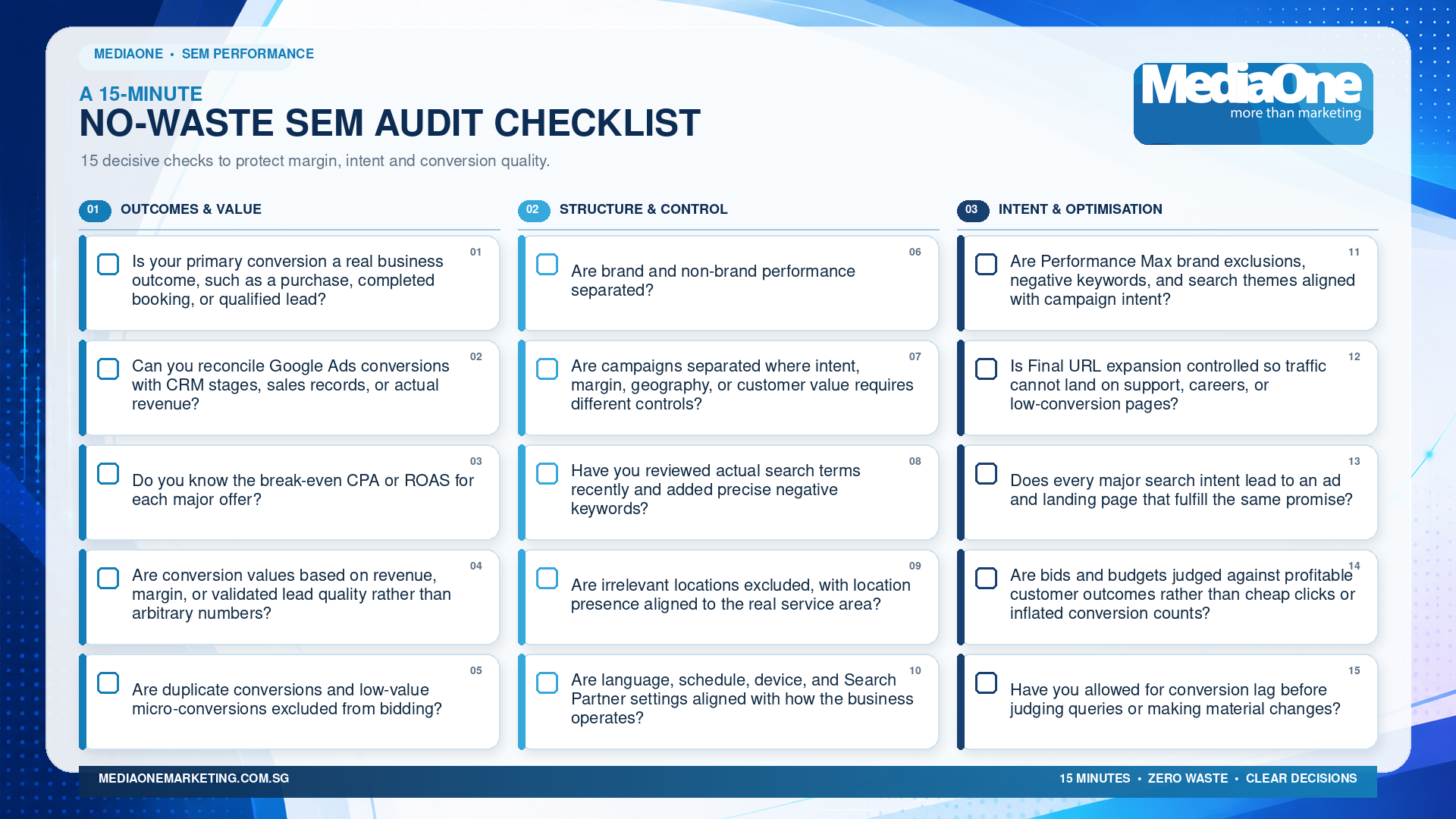
Answer yes or no. Any ‘no’ identifies the next place to investigate.

If you need practical models before restructuring an account, review these SEM campaign examples for small businesses. Use them as patterns, then adapt the economics and controls to your own market.
Stop Funding the Leak and Start Funding Growth
Your SEM campaign strategy should make profitable demand easier to identify and unprofitable demand easier to stop. Set the economic ceiling first. Fix the conversion signal. Separate different intent and margins. Mine actual queries. Control automation. Align the ad with the page. Then bid toward real business value.
Do not respond to weak performance by increasing the budget before you know where the leak is. If you want an independent account review, request a free paid media consultation.

Frequently Asked Questions
What is an SEM campaign strategy?
It is the operating plan that connects paid-search goals, conversion measurement, campaign structure, targeting, bidding, ads, landing pages, budget allocation, and review cadence. In Singapore agency usage, SEM often refers primarily to paid search and Google Ads.
How do I know whether Google Ads is wasting money?
Compare actual search terms, customer quality, contribution margin, and total campaign cost with your break-even CPA or ROAS. Clicks without conversions are one symptom. Unprofitable conversions, poor sales quality, brand cannibalization, and out-of-area traffic also indicate waste.
What is the difference between ROI and ROAS?

ROAS divides attributed revenue by ad spend. ROI compares incremental profit with the full marketing investment. A campaign can show a positive ROAS and a negative ROI after product costs, fees, agency costs, returns, and sales expenses.
What is a good ROAS for Google Ads?
There is no universal benchmark. A business with a 20% contribution margin needs a much higher ROAS than one with a 70% margin. Calculate your break-even point first, then set a target that leaves room for overhead and risk.
How often should I review the Search Terms Report?
Review it after meaningful traffic accumulates and after material targeting changes. High-spend or newly launched campaigns may need frequent checks. Low-volume or long-lag campaigns need longer windows. The goal is sufficient evidence, not a ritual calendar.
Should I use broad, phrase, or exact match?
Use the match type that balances reach with control for your data quality and economics. Broad match can work with strong conversion signals and Smart Bidding. Phrase and exact match can provide more control, but they still match close variants. Review actual search terms regardless of match type.
Can Performance Max spend money on branded searches?
Yes, overlap can occur. Google recommends brand exclusions or campaign negative keywords when you need to prevent it. Validate the brand and new-customer contribution before treating reported Performance Max revenue as incremental growth.
How much should a Singapore business budget for Google Ads?
Start with the economics and the amount of data required to evaluate a campaign, not a universal monthly figure. Estimate available search demand, expected CPC, conversion rate, break-even CPA, and sales capacity. Validate Singapore search and cost estimates in Keyword Planner before committing the budget.