Most link-building guides see automation as a quick fix. They aren’t wrong about efficiency: AI-powered outreach platforms can identify prospects, write personalised emails, and track results at a scale no human team can match. But they rarely tell you what these tools actually miss.

This guide cuts through that gap. We’ll walk through how AISEO (AI-powered SEO link building) platforms work, where they excel, and the moments when your judgement still outperforms the algorithm. Whether you’re a mid-market SaaS founder tired of manual prospecting or an in-house SEO lead evaluating your next tool stack, you’ll find concrete thresholds and decision criteria here, not just theory.
The goal isn’t to replace your team. It’s to give them back time for the judgement calls that move rankings.
Key Takeaways
- AISEO link building automates prospecting and outreach at scale but still requires human judgment to avoid spam signals and irrelevant targets.
- AI-powered platforms identify link opportunities by crawling authority sites, matching topic relevance, and scoring domain metrics in real time.
- The workflow includes automated contact discovery, personalised email generation, and follow-up sequencing, but acceptance rates depend on relevance and prior brand recognition.
- Google treats links identified and pitched by AI tools identically if they meet quality criteria, but platforms cannot detect all the nuance a skilled researcher would catch.
- ROI appears in 60 to 120 days for competitive verticals; niche and regional markets often see faster results.
- The most significant pitfall is chasing volume: fewer high-relevance links from AISEO campaigns outperform bulk outreach every time.
What AISEO Link Building Is and Why It Matters in 2026
The Core Concept: Automating Link Prospecting and Outreach
AISEO link building uses artificial intelligence to automate two stages of traditional link acquisition: finding qualified prospects and personalising outreach at scale.
In practice, this means an AISEO platform crawls the web to identify websites that match your relevance criteria (industry, audience overlap, content type), scores them by domain authority and contextual fit, extracts decision-maker contact details, and generates personalised outreach emails. Some systems also track responses and suggest follow-up timing.
The starting assumption is honest: prospecting for links manually takes weeks of research per target. Teams sift through search results, check domain metrics, cross-reference competitors’ backlinks, and hunt for contact details across LinkedIn, Twitter, and WHOIS records. AISEO compresses the entire workflow into hours.
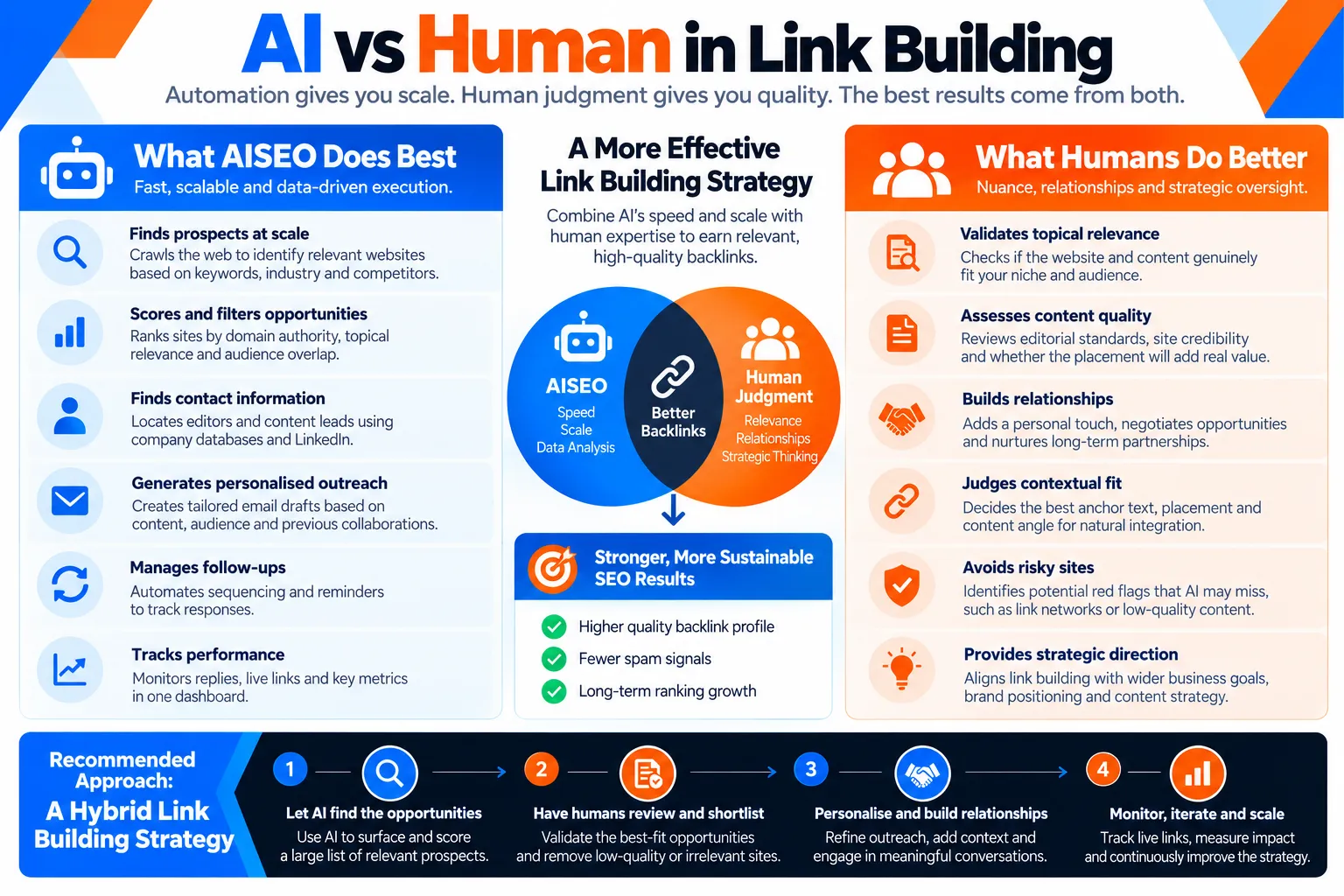
However, “automating” does not mean “set and forget”. The platform identifies candidates. A human still decides whether each prospect is worth contacting. The email templates are suggestions, not mandates. The follow-up sequence also needs oversight to avoid spam complaints or tone mismatches. Think of it as acceleration, not replacement.
How AISEO Link Building Differs From Manual Outreach
The clearest difference lies in speed and scale without proportional effort. A single SEO manager using manual outreach might qualify and contact 10-15 prospects per week. An AISEO workflow can surface 100-200 qualified candidates in the same time, but outreach volume remains limited by humans.
A second distinction: consistency in filtering. Manual prospecting is vulnerable to fatigue (you might accept a lower-authority site by day fifty). AISEO applies the same relevance and authority thresholds to every prospect, reducing the risk of pursuing weak targets.
A third critical difference: contact discovery speed. Finding the right person (editor, marketing manager, content lead) at a prospect website traditionally required time-consuming detective work. AISEO tools tap into company databases and LinkedIn APIs to surface decision-makers, though the accuracy varies by region and company size.
On the downside, AISEO lacks human nuance. A human outreach specialist reads recent articles from a prospect site, spots a publication angle or conversation thread, and crafts a hook that feels native. AISEO can match keywords and relevance signals but may miss the subtle editorial voice or current campaign that would make an email feel genuinely valuable rather than templated.
The most effective teams treat AISEO and manual outreach as complementary: AISEO handles volume and qualification; humans handle relationship building and custom pitches for tier-one targets.
Why SEO Teams in Asia-Pacific Are Adopting This Approach
Several regional factors have accelerated AISEO adoption in Asia-Pacific since 2025.
First, talent scarcity and cost. Experienced link-building specialists command high salaries in Singapore, Sydney and Hong Kong. AISEO tools reduce the headcount needed to run an equivalent outreach programme, freeing up budget for strategy or content creation.
Second, multilingual complexity. Building links across Mandarin, Thai, Korean and Vietnamese markets requires contact lists, relevance scoring and outreach templates in multiple languages. Doing this work manually across each market is prohibitively labour-intensive. AISEO platforms with multilingual NLP can handle it (though quality remains uneven outside English).
Third, publisher fragmentation. In Asia-Pacific’s digital landscape, publisher networks are distributed, unlike in North America and Western Europe, where a smaller number of high-authority publishers concentrate link authority. Regional publishers, with this work manually, and hyper-local news sites carry weight in their markets. Manual prospecting would require years to map these networks; AISEO crawl-and-rank systems can surface them in weeks.
Fourth, competitive intensity. Markets like India, South Korea and Singapore have seen explosive growth in SEO-aware companies. Manual link-building cycles are too slow to compete. Agencies and in-house teams using AI SEO tools can respond to ranking shifts and launch new verticals faster than teams relying on manual outreach.
A 2025 survey of SEO professionals across ASEAN countries (conducted by regional agencies) found that 64% of mid-market teams (20-100 employees) now use at least one AISEO platform for prospecting, up from 38% in 2023. However, adoption remains lowest in smaller teams and agencies that still view link building as a premium, hands-on service.
The trade-off is clear: speed and scale come with reduced relationship depth and higher spam-complaint risk if execution is careless.
How AISEO Platforms Identify and Qualify Link Opportunities
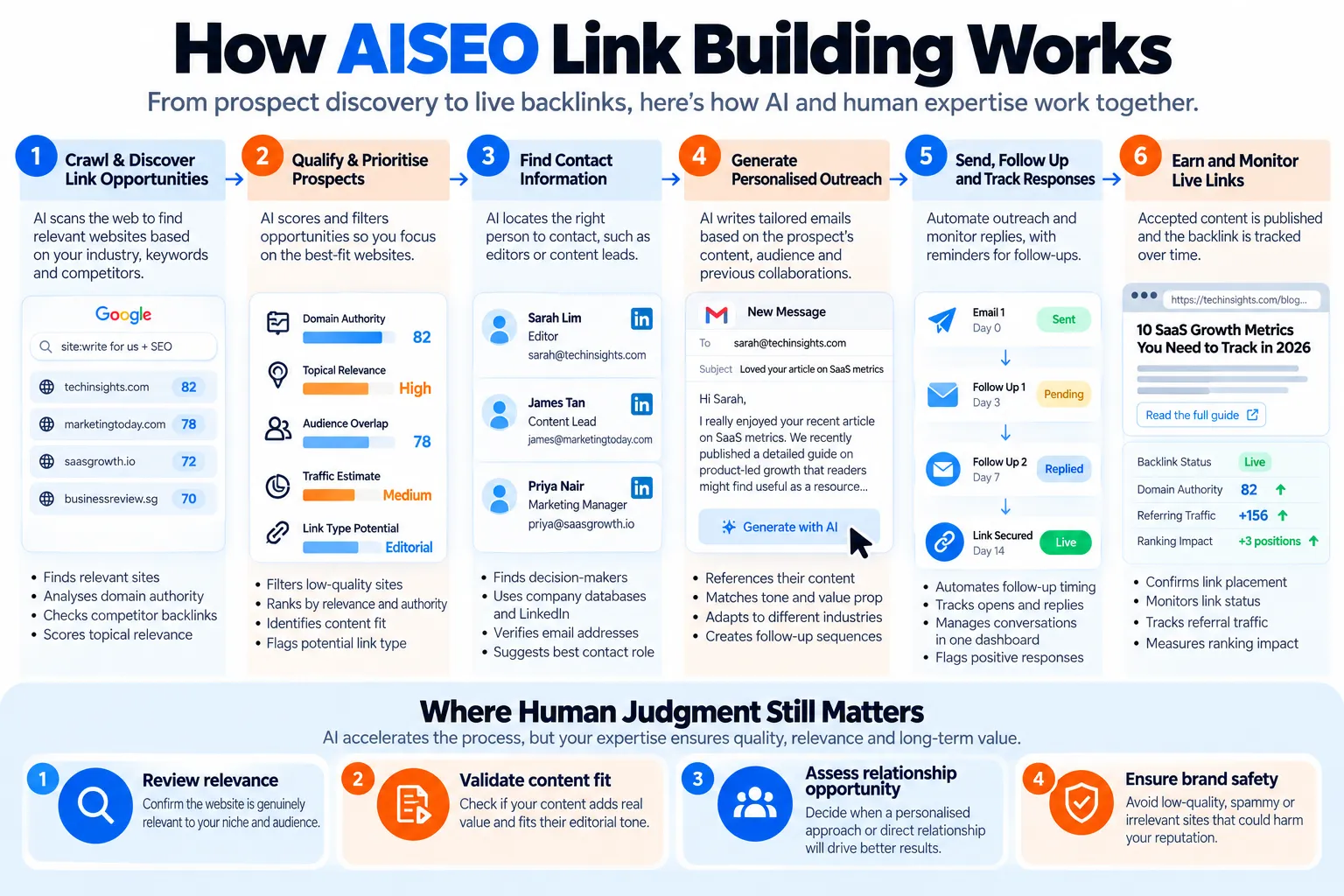
The difference between a wasted outreach campaign and one that yields consistent placements is often the quality of prospects at the start. AISEO platforms don’t just find websites; they apply layers of filtering to surface targets that are both authoritative and semantically aligned with your content. This section explains how that discovery and qualification work.
Intelligent Site Crawling and Authority Scoring
AISEO platforms begin by crawling the web at scale, building a live index of millions of potential link targets. Rather than treating every website equally, they apply authority signals to rank candidates by credibility.
These signals typically include domain authority (the aggregate strength of a site’s own backlink profile), citation flow (the volume of incoming links), topical authority (whether the domain has earned trust in your specific subject area), and structural health (page speed, mobile optimisation, and Core Web Vitals). Platforms like Digimetrics.ai, Ahrefs, Semrush and Majestic maintain these indices and expose them via API or direct platform integration.
The key advantage over manual prospecting is speed. A human researcher might manually check 50 websites in a day. An AISEO crawler will evaluate thousands in minutes, applying consistent scoring rules.
However, authority scores are not gospel. A newer site with fewer backlinks may still be a valuable target if it ranks well for your keywords or reaches your audience directly. AISEO tools score authority; they don’t decide it for you. The best platforms let you set minimum thresholds but also override them when a lower-authority site makes strategic sense.
Matching Relevance: Topic Clusters and Semantic Fit
Raw authority means little if the linking site serves a different audience or has no topical overlap with your content.
AISEO platforms use semantic analysis to measure topic alignment. They map the themes and entities across a prospect’s existing content and compare them against your own. If you publish articles about machine learning in healthcare, the platform will recognise that a digital health publication is a stronger match than a general technology site, even if both have similar domain authority.
This is often done via natural language processing (NLP) models that extract topic clusters from site content. Platforms like Moz’s Link Explorer and SEMrush’s Backlink Analytics now integrate topic-relevance scoring into their prospect lists, filtering candidates by conceptual fit rather than keyword string-matching alone.
In practice, a B2B SaaS company selling project management software might set filters for sites that frequently cover “team collaboration”, “workflow automation” and “productivity tools”, not just sites that mention those terms once. The platform clusters semantically related prospects, reducing false positives.
This matters especially in the Asia-Pacific region, where language and cultural nuance affect what “relevant” means. A platform operating across English, Simplified Chinese, and Japanese markets needs to handle semantic relevance across languages. A site that writes about “agile project management” in English should match against prospects discussing the same concept in Chinese, not be treated as unrelated.
Filtering by Domain Metrics and Audience Overlap
Beyond authority and topic match, successful AISEO platforms add audience-alignment filters.
They analyse traffic patterns, audience demographics and referral sources to identify sites whose readers resemble your target customer. For example, a B2C fitness brand might filter for sites with predominantly female audiences aged 25-45 who visit on mobile devices. An AISEO tool examines on-page content, audience insights (where available from platforms like Similarweb), and comment engagement to estimate demographic fit.
Domain metrics also include engagement signals: bounce rate, average session duration, and scroll depth. A site with high authority but poor engagement on pages related to your topic is a lower-priority target than one with moderate authority and strong reader retention.
Some platforms now surface “audience overlap” scores, comparing your website visitors to a prospect’s audience and flagging sites with the highest intersection. This is especially useful for publisher networks and affiliate platforms, where shared readership is a stronger indicator of placement success than topic tags alone.
Real-Time Opportunity Alerts and Competitor Backlink Analysis
The final layer of AISEO qualification is real-time monitoring and competitive intelligence.
Platforms that track when your competitors’ links go live can alert you to opportunities they’ve already secured. If a technology journalist links to your competitor’s guide on “API security best practices”, an AISEO system flags that same journalist as a prospect for your related content. This is competitor gap analysis in near real time.
Tools like SEMrush’s “Backlink Gap” feature and Ahrefs’ “Site Explorer” let you upload your competitor list and receive notifications when new sites link to them. These alerts typically arrive within 24 to 48 hours of the link going live, giving you a chance to pitch before the opportunity fades.
Real-time alerts also catch emerging opportunities: when a new article or roundup appears that covers your topic, AISEO platforms can flag it before the author has finished outreach to other sources. This is where speed genuinely beats human research.
However, alert fatigue is real. A platform that sends 200 daily notifications is less useful than one that surfaces 5 high-confidence prospects per day. Quality AISEO systems use machine learning to filter alerts by historical conversion rate: if prospects matching a certain profile have a 30% acceptance rate, they’ll rank higher than profiles with 5% acceptance rates.
AISEO platforms reduce prospect discovery time from weeks to days by automating crawling, scoring, and filtering at scale. But they’re tools for narrowing the field, not replacing judgement. A domain authority score of 45 may be irrelevant if the site’s audience doesn’t read your content. Human verification of the top-ranked prospects remains best practice before outreach begins.
The Link Outreach Workflow: From Prospect to Live Link
Once AISEO platforms identify and score your link targets, the real work begins: converting a list of domains into actual placements. This workflow is where automation saves the most time, yet where human judgement prevents the most damage. The process typically unfolds across four distinct phases, each with specific failure modes that tools alone cannot catch.
Personalised Email Template Generation
AISEO platforms generate outreach emails by pulling data from your prospect list and inserting dynamic fields: the publisher’s name, site topic, recent article headlines, and mutual content connections. The goal is to make each email feel written specifically for that editor or site owner, not templated at scale.
The best platforms use natural language models trained on successful link-building campaigns. They analyse which subject lines and opening hooks lead to higher open rates. They adjust tone and formality based on the target publication’s established voice.

However, this is where most automation fails in plain sight. A platform cannot know that the prospect was recently quoted in a competitor article, or that their publication has banned guest posts for six months, or that the contact email belongs to an overworked editorial assistant who reads only subject lines. Personalisation at scale often means pseudo-personalisation: “Hi [SITE_NAME], I noticed you wrote about [TOPIC]” repeated across 500 emails with enough individual variables to feel targeted but not enough understanding to feel genuine.
The most effective teams treat AISEO-generated templates as drafts, not final copy. They read through a sample of 10-15 generated emails before a campaign launches. They edit for tone, add a genuine detail about why that publication matters to their audience, or remove a claim the tool made that they cannot support.
Anchor text strategy also emerges here. The email should indicate what you are offering and ideally hint at the anchor text you hope to use. A vague “we have great content that might interest your readers” is likely to be ignored. “We have published original research on B2B SaaS pricing that aligns with your recent series on cost benchmarking” signals exactly what the link would be and why it serves the publisher’s audience.
Contact Discovery and Routing to Decision-Makers
Identifying the right person to contact is half the battle. AISEO tools scrape masthead pages, analyse article bylines, cross-reference LinkedIn profiles and use pattern matching to distinguish editors from writers from account managers.
Tools like Ahrefs, SEMrush and specialist platforms such as Pitchbox now route contacts through decision-maker scoring. They flag whether a byline belongs to a full-time editor (high likelihood of decision-making authority) or a contributed author (lower authority). Some now integrate with email-finding APIs to verify that a discovered email address actually exists and receives mail.
The catch: verification is only as reliable as the data sources. A publication may have deleted or archived its contact page. LinkedIn profiles lag reality by weeks. Email deliverability bounces can occur without the tool flagging the address as invalid until after you send.
In practice, AISEO platforms save 4-6 hours of research per 100 prospects by automating the “who to contact” question. Manual research at that scale is unsustainable. But a 5-10% error rate in contact routing (wrong person, defunct email, or gatekeeper instead of the decision-maker) means you waste 5-10 emails per campaign and damage your reputation with that publication when your pitch lands in the wrong inbox.
The safest approach: let AISEO tools discover contacts at speed, but manually verify your top-tier targets (the 20-30 publications where you are most willing to spend effort). For the long tail, accept that a few emails will misfire and factor in a slightly higher volume to account for bounce-back and wrong-contact responses.
Follow-Up Sequences and Timing Optimisation
A single email has a 1-3% response rate for link building. Multiple touches are essential. AISEO platforms automate follow-up sequences, sending 2-4 reminder emails if the prospect doesn’t reply after 5-7 days, 12 days, and sometimes 21 days.
The tools also use temporal optimisation. They analyse when recipients typically open emails (usually Tuesday to Thursday, 9am-11am local time) and schedule sends accordingly. Some analyse your own outreach history and model which days and times have worked best for your domain in that region.
Timing does matter. A study by HubSpot found that mid-week emails had a 2-3% higher open rate than Monday or Friday sends. But the gain is marginal, and personalisation and relevance matter far more.
Follow-up automation can create real friction: it can feel aggressive if not calibrated carefully. Three follow-ups in 30 days is normal in Western marketing. In parts of Asia-Pacific, people read repeated contact without initial interest as disrespectful. A single follow-up after 10 days is often the cultural norm in Singapore, Japan and South Korea. AISEO platforms default to Western email norms unless you manually adjust sequences.
Also, most tools lack true conversation awareness. If a prospect replies “not interested, but thanks for reaching out”, the automation often still sends a second or third follow-up to that same thread. This erases credibility instantly. The best platforms now track reply content and pause sequences if a soft rejection is detected, but the process still requires review of keywords like “not currently”, “no budget” or “wrong time”.
Create a follow-up sequence that mirrors your regional norms. For Asia-Pacific campaigns, consider a maximum of 2 touches, spaced 12-14 days apart. For North American and European markets, 3-4 touches over 4 weeks is defensible. Always scan the first reply before the automation sends a follow-up; manual intervention here takes 30 seconds and prevents 100 wasted emails.
Tracking Acceptance Rates and Link Placement Status
AISEO platforms track which prospects replied positively and flag them for manual handoff to a maximum of 2 touches or the partnership team. Integrated platforms like Pitchbox or Respona log responses in real time and update a campaign dashboard showing acceptance rate, placement rate and time-to-link.
Acceptance rate is the percentage of prospects who agree to consider your content. This typically runs 5-15% across the industry, depending on your targeting quality. Placement rate is narrower: the percentage of prospects who actually publish your link. This is usually 30-60% of acceptances, because some links fall through before publication (editorial changes, site redesigns, or procrastination).

The disconnect between acceptance and placement is material. A 10% acceptance rate on 500 prospects gives you 50 opportunities. If 40% of those convert to live links, you get 20 placements. But if you celebrate the acceptance rate without tracking placement, you think you are ahead when you are actually behind schedule.
Most AISEO tools now auto-populate a field to track placement status: “pending asset approval”, “asset approved, awaiting publication”, “live”, and “rejected”. Manual updates are often required here, which is where many campaigns break down. Content teams accept an opportunity, forget to log it as a link placement when it goes live, and the metrics become unreliable.
Set up a weekly checkpoint: pull your platform’s acceptance and placement reports every Monday and manually reconcile against your actual live links. Use a simple framework: if your target is 50 placements, you need roughly 125-150 acceptances (assuming 40-50% conversion), which requires outreach to 1,200-1,500 initial prospects (assuming 8-10% acceptance). Once you know your conversion ratios from your data, you can forecast campaign volume accurately.
The key insight most teams miss: a platform that sends 500 emails can only surface link opportunities. Your job is converting opportunities into placements. Track both metrics rigorously, and you can optimise the middle stages (acceptance-to-placement), where the real efficiency gains are.
Building Authority Through Content-Aligned Link Clusters
The most effective AISEO link-building campaigns don’t chase links in isolation. Instead, they map out clusters of related content across your site, identify the gaps that external sites need to fill, and orchestrate links that reinforce topical authority together. This approach transforms link building from a volume game into a precision instrument for domain strength.
Using AI to Map Content Gaps and Link Targets
AISEO platforms excel at surface-level link identification, but their real power emerges when they work backwards from your content architecture. A capable platform crawls your existing content, identifies the topics and entities you own, and flags which related subtopics remain unexplored or underdeveloped on your site.
From there, the tool maps where competitor domains and topically adjacent publishers have already established authority. It answers, “Which domains cover the gaps we haven’t closed yet? Which of those domains are cited or linked to by tier-one sites? And how does our audience overlap with theirs?”
This is where AISEO moves beyond “find any site that accepts guest posts” into “identify which specific sites could send us a link on Topic X, where we want to build depth.” Tools like Semrush’s Link Building Workspace and Ahrefs’ Link Prospector use content clustering to surface these opportunities, though they require manual curation to remain effective.
The AI advantage is speed and scale. Rather than manually auditing fifty competitors, you can run an analysis in hours and receive a prioritised list of knowledge gaps and corresponding link targets. However, the platform’s content-mapping accuracy depends entirely on how well your site’s structure reflects your actual topical strategy. Poorly tagged or siloed content will produce poor cluster analysis.
Co-Creating Assets Designed for Linkability
Once you’ve identified which content clusters matter most, the next step is ensuring those clusters contain assets worth linking to. AISEO platforms can guide asset creation, but they cannot write original insights for you.
A practical workflow combines human expertise with machine input:
- Run an AISEO analysis to find which subtopics within your cluster are mentioned in other authoritative content but not yet covered in depth on your site.
- Create an original piece on that subtopic, informed by what competitor research and audience queries show is missing.
- Optimise that asset for linkability: include original data, frameworks, case studies or tools that other writers would want to cite.
For example, a SaaS company building authority in “API security” might discover that competitors are linking to threat frameworks but that nobody has yet published a comparison of enterprise API gateways tested against specific compliance standards. That gap becomes your asset. The AISEO tool identifies the gap; you fill it with something genuinely new.
Linkability is not something automation adds. It comes from insight, originality and utility. AISEO accelerates the discovery phase, but the asset itself must come from real expertise.
Anchor Text Strategy Within an Automated Framework
Anchor text remains one of the strongest backlink signals. An automated outreach tool can suggest anchor variants, but a practitioner must decide whether those variants align with your cluster strategy and Google’s link guidelines.
Within a content-cluster approach, anchor text becomes more deliberate. Rather than accepting whatever anchor text a publisher offers, you can map which anchors reinforce your topical authority.
Example anchor strategy across a cluster:
| Anchor type | Share of cluster backlinks | Purpose | Risk to manage |
|---|---|---|---|
| Exact-match (“API security best practices”) | 10-15% | High-value topical signal | Over-optimisation |
| Semantic variants (“securing API endpoints”, “API threat detection”) | 40-50% | Reinforces relevance without keyword concentration | Drift from core topic |
| Branded or generic (“learn more”, “according to [Company]”) | Remainder | Natural profile, brand reinforcement | Weak topical signal |
AISEO platforms can automate anchor suggestion in your outreach templates, flagging anchors that match your target keyword density. However, they cannot gauge whether an anchor truly fits the publisher’s editorial context or evaluate the reputational risk of anchor text that looks manipulative.
This is where human review catches what automation misses. A publisher might offer an exact-match anchor that’s off-brand or contextually awkward. Your reviewer flags it and negotiates a variant that feels natural within their piece.
Scaling Niche Authority Without Sacrificing Relevance
Scaling link acquisition always introduces tension: the more links you pursue, the lower the average relevance of each prospect. AISEO tools amplify this dilemma by making large-scale outreach feasible where it was previously labour-intensive.
The solution is to keep your scaling constrained by relevance thresholds, not by effort.
Define explicit relevance criteria for your cluster:
- Audience overlap: Does the linking site serve a similar buyer persona, geography or industry vertical?
- Topic distance: Is the link coming from a site within three hops of your core topic cluster, or is it tangential?
- Authority floor: Set a minimum Domain Rating or topical authority score. Accept that you will skip a high-volume opportunity if it falls below that floor.
AISEO platforms can filter on metrics. What they cannot do is judge whether the semantic connection is real or merely keyword-adjacent. A B2B fintech company building authority in “payment reconciliation” might have prospects across “accounting software”, “ERP platforms”, and “treasury management”. An AISEO tool might.
Frequently Asked Questions
What is AISEO link building?
AISEO link building uses artificial intelligence to automate parts of backlink acquisition, especially prospect discovery, relevance scoring, contact research, outreach personalisation and follow-up. It can greatly reduce manual research time, but human review is still important for deciding whether a prospect is genuinely relevant and worth pursuing.
Can AI automate link building completely?
Not reliably. AI can automate repetitive tasks such as prospecting, contact discovery, email drafting and campaign tracking, but it cannot fully judge editorial fit, relationship quality or whether a placement will look natural. The strongest approach combines automation for scale with human judgement for high-value opportunities.
Does Google treat AI-generated backlinks differently?
Google does not assess a backlink based on whether AI helped identify or pitch the opportunity. What matters is the link’s nature and quality. Relevant, editorially justified links can provide value, while manipulative, paid or large-scale spammy links can create risk regardless of whether AI was involved.
How does AISEO find good backlink opportunities?
AISEO tools typically analyse domain authority, topical relevance, competitor backlinks, audience overlap and content similarity. They can then rank potential websites based on how closely they align with your content and target audience. Still use human verification before contacting the highest-priority prospects.
How many link-building prospects should an AISEO campaign target?
There is no ideal universal number. AI tools may surface hundreds of prospects quickly, but outreach quality matters more than volume. A smaller list of relevant websites with strong audiences and topical alignment will usually outperform a large database of loosely related domains.
How long does AISEO link building take to improve rankings?
Link-building results usually take time because search engines must first earn, publish, discover, and evaluate links. Depending on competition and website authority, meaningful movement may take around 60 to 120 days or longer. Competitive industries and newer websites may take longer.
What are the biggest risks of automated link outreach?
The main risks are irrelevant prospecting, generic outreach, excessive follow-ups, poor-quality websites and over-optimised anchor text. Large-scale automation can also damage sender reputation if campaigns generate spam complaints or high bounce rates. Human quality control is essential before launching outreach.

Is AISEO link building better than manual link building?
Neither approach is universally better. AISEO is stronger for speed, research, filtering and scale, while manual link building is stronger for relationship building, editorial judgement and highly customised pitches. In most cases, the best strategy is a hybrid model in which AI handles repetitive work and experienced marketers manage opportunities that require judgement.