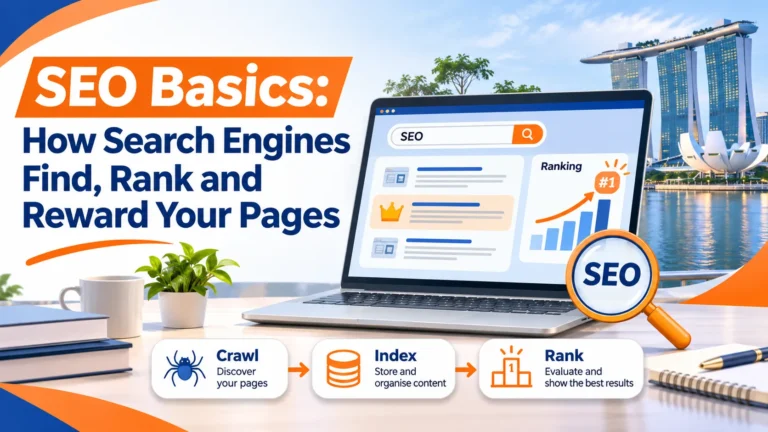
Enterprise SEO is the discipline of improving organic search visibility and revenue across large, complex websites. It is not a bigger version of the SEO most Singapore firms already run. It is a different way of working, built on templated pages, cross-team workflows and clear governance. This guide explains what enterprise SEO is, whether your business needs it, and how to build the capability step by step. It sets out a practical scorecard you can use to score your own organisation.
Key Takeaways
- Enterprise SEO is a separate discipline. Approaches that work for a small site often fail on sites with hundreds or thousands of pages, so treat it as a capability to build.
- Skills are usually the bottleneck. 57% of enterprises say limited in-house SEO skills are their biggest obstacle, according to Sureoak.
- Score your maturity before expanding. Rate your organisation from 1 to 5 across five dimensions. A total below 15 means building the foundation first.
- Expect a long timeline. Results can take months or even years, so set budget and internal expectations accordingly.
- Tie traffic to revenue. Extra organic visits matter only when those pages carry commercial intent.
- Use AI with human review. 78% of enterprise SEO teams use AI for keyword research, according to Objects, but output quality still depends on editorial oversight.
Introduction: What Enterprise SEO Means for Singapore Businesses
Enterprise SEO is the practice of managing organic search across large websites. The usual advice is to treat SEO as a set of page-level tasks. That approach fails once a site runs to thousands of URLs. At that size, the work shifts from single pages to the templates, workflows and rules that create them, and a sound enterprise SEO strategy has to be built around those systems.
My view is that the main bottleneck in enterprise SEO is internal skill, not tooling. Firms can buy platforms and SEO tools with ease, but they struggle to build teams who can read a crawl report, brief a developer and check a template fix. The sections below argue that case and show what to build first.
A tactic that works on a 40-page brochure site can quietly fail on a 40,000-page property or retail platform. Traditional advice rarely says this plainly. As Objects notes, approaches that work for small-scale SEO do not always work for websites with hundreds of pages.
Why large websites need a different approach
On a large site, most pages come from templates. A problem in one template repeats across every page it builds. A missing canonical tag, a slow product module or a thin category layout affects every URL that uses it. The fix sits in engineering and governance rather than in editing content, so teams have to improve those systems to lift performance across the whole site.
The cost of treating enterprise SEO as small-scale SEO
The cost is slow, expensive failure. Results can take months or even years, so teams expecting a quick lift often give up or overspend on tools. Sureoak reports that 57% of enterprises name limited in-house SEO skills as their biggest obstacle. The gap is usually capability, not budget. Weak skills also show up in how teams judge search results, which can lead them to chase the wrong numbers.
What Is Enterprise SEO and How Does It Differ from Traditional SEO?
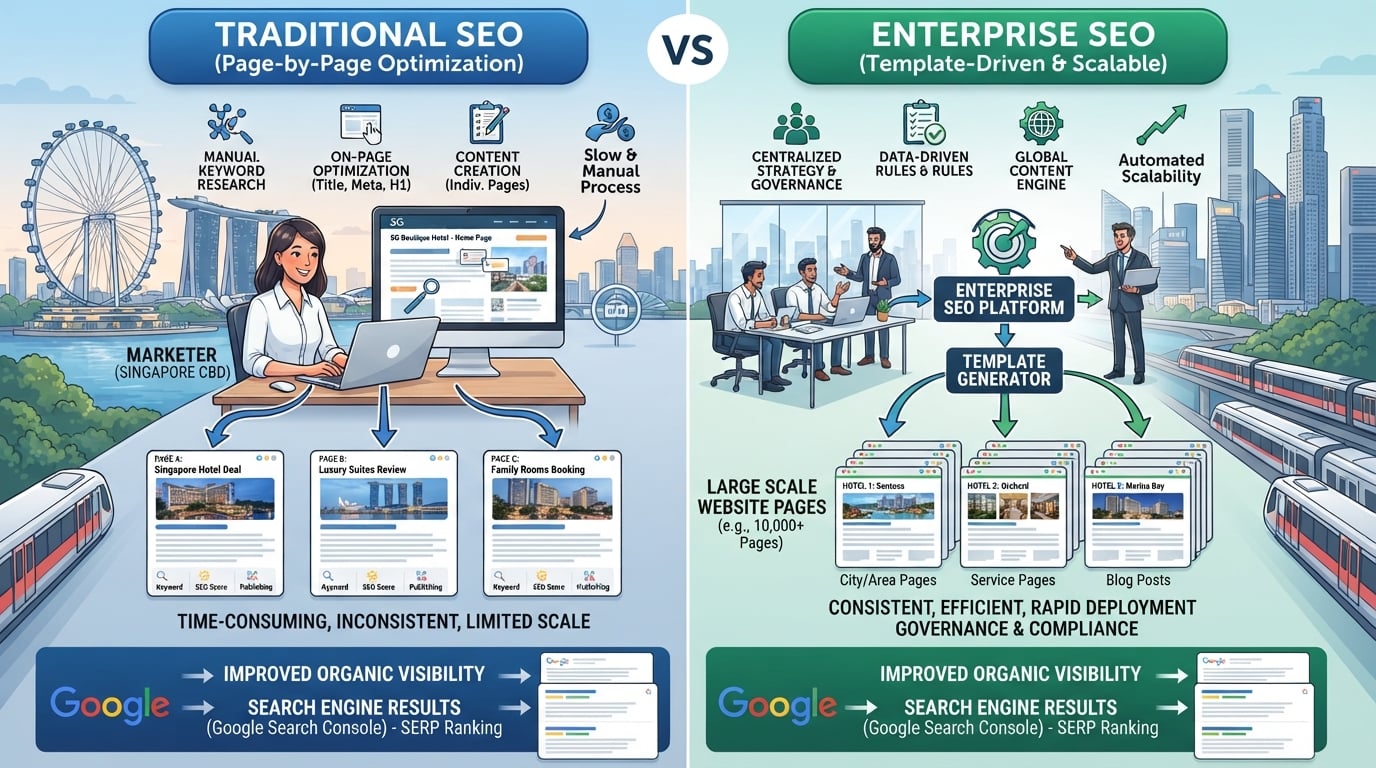
What is enterprise SEO
Enterprise SEO is the practice of improving organic search rankings and revenue for large organisations. These are typically Fortune 1000 or Global 2000 companies, according to Sureoak’s enterprise SEO guide. It applies to large websites with very large page counts, where one change can affect thousands of URLs at once.
How enterprise SEO differs from traditional SEO
The core difference is scale. Small sites optimise pages one at a time. Enterprise teams build templates and rules that produce pages in bulk. The job moves from editing content to managing the system that creates it, including the SEO strategies that govern every template.
Where the difference shows up in practice
On large sites, the first warning sign is rarely a ranking drop. Duplicate or thin pages multiply faster than anyone reviews them. Enterprise SEO therefore sits as much in development and content operations as in marketing. It depends on cross-team governance more than on any single tactic, and a search engine will reward consistency across the whole site.
Does Your Business Need Enterprise SEO?
Enterprise SEO earns its cost when page count drives the opportunity. One company in the Objects case study grew from 10,000 to more than 425,000 pages in three months. No single-page checklist can manage that, and a clear SEO strategy becomes essential at that scale.
Examples of websites that need enterprise SEO
Look for sites where templates generate most of the traffic. Typical candidates include property portals with thousands of listings, retailers with large, frequently changing catalogues, and financial or healthcare sites with many topic pages. Multi-market sites serving Singapore and neighbouring countries in English also qualify, especially when they need SEO solutions that scale across every market and keep their search results consistent.
Warning signs you have outgrown standard SEO
- Hundreds or thousands of templated pages that nobody reviews individually
- Rankings shifting on pages you never touched, because template changes affect everything
- SEO work stalled while waiting on development or content teams
- Reports that track rankings but cannot show organic revenue or performance against marketing goals
- Weak link building that leaves high-value templates without authority signals
Enterprise SEO services versus in-house capability
Rate your organisation from 1 to 5 on five dimensions: content coverage at scale, technical health of templated pages, in-house skills, workflow integration and revenue measurement. The scorecard in the next section explains each band. A total below 15 means you need a foundation before expanding.
Skills are usually the bottleneck. In a Sureoak survey, 57% of respondents named limited in-house SEO skills as their biggest obstacle. Tools and agencies rarely close that gap alone, so build internal capability first, with marketing teams trained alongside the SEO specialists who explain to search engines and users what each page is for.
Enterprise SEO Strategy and Optimisation Framework
Many enterprise SEO programmes fail because they measure the wrong thing. Rankings are easy to report, but they rarely show a finance director whether the work pays off. A useful framework starts with the commercial outcome and works back to the pages and keywords that deliver it.
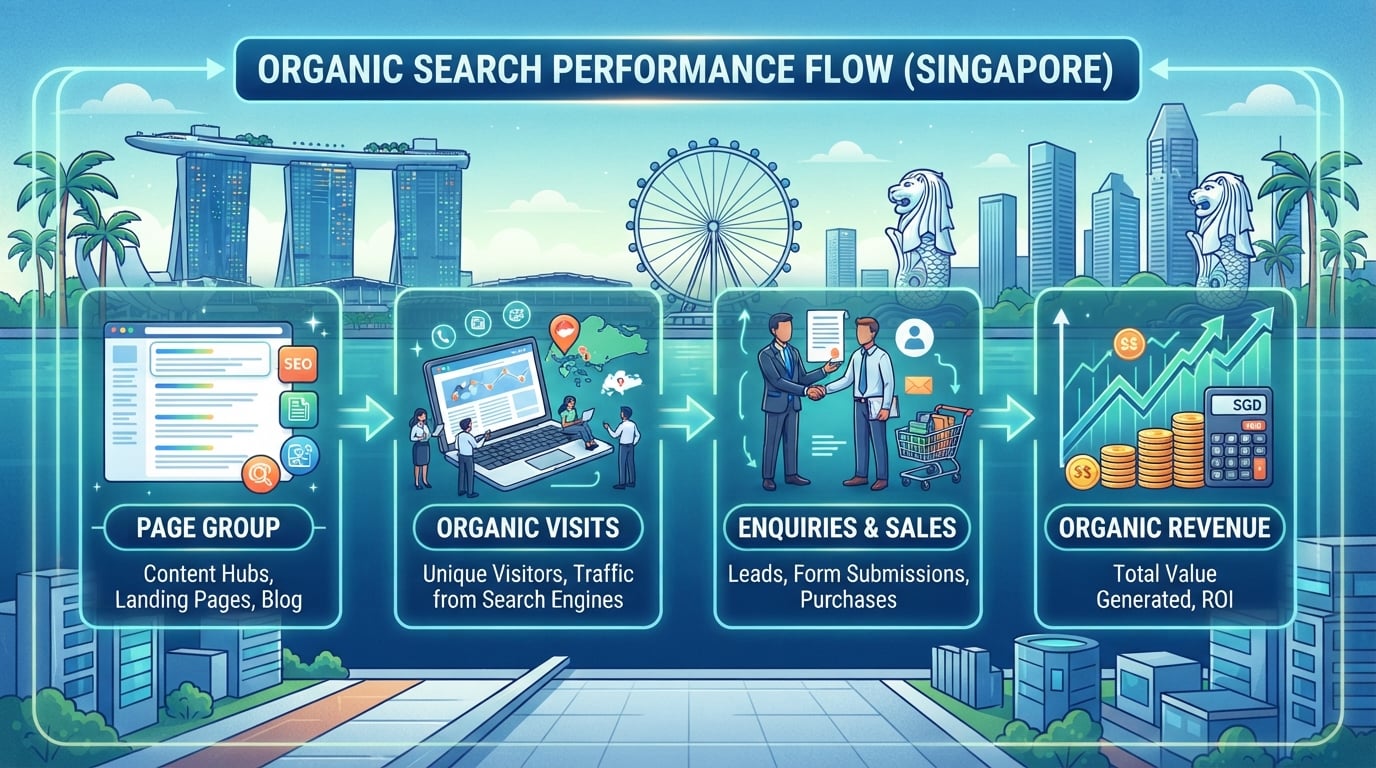
Setting goals and measuring organic revenue
Tie organic search to revenue. Track enquiries and sales by page group, not just sessions. The top three organic results on Google get 54.4% of all clicks, according to Backlinko’s analysis, so ranking position on high-intent pages matters a great deal. Set one primary goal for each business line. Use rankings only as an early signal.
Prioritising pages and keywords at scale
Score each page group on three factors: commercial intent, current visibility and effort required. Work the high-intent groups that sit close to page one first. This stops a team from spreading its effort across thousands of low-value URLs.
Scaling Content Production Without Losing Quality
Scaling content production is where most enterprise SEO work breaks down. A website that adds hundreds of pages a month needs templates, rules and review steps, not just better writers, and an SEO platform can help track that output.
Content briefs and templates for large page counts
At volume, each page cannot start from a blank document. A standard brief covers search intent, target entities, required sections, internal links and the commercial action the page should support. This keeps output consistent. In the survey cited by Sureoak, 54% of enterprises said high-quality content was their most effective SEO strategy. Templates are how that quality holds up over many pages, and a clear link-building plan keeps internal linking consistent across them.
Using AI for keyword research and briefs, with human review
AI now handles much of the groundwork. According to Objects, 78% of enterprise SEO teams use AI for keyword research. A further 71% use it to generate content briefs. The sensible sequence is to let AI cluster keywords and draft briefs. A subject specialist then checks accuracy and search intent before a writer starts so that the marketing team’s pages still help readers and rank in a search engine.
Maintaining quality as volume grows
Quality slips when nobody owns it. Set a sampling rate, for example reviewing one page in ten each month. Track thin content, duplicates and pages with no organic traffic. Scale only what performs.
Technical SEO for Enterprise Websites
Technical SEO is where enterprise programmes most often stall, because the problems are systemic. Fixing one title tag does nothing when a template produces ten thousand of them. The work is about designing the rules that govern how pages are built, linked and indexed, which is the core of any sound seo strategy. Sustained seo efforts depend on getting these rules right before any individual page is touched.
Crawl budget, site architecture and internal linking
Search engines allocate a limited amount of crawling to each site. This is the crawl budget. On a site with hundreds of thousands of URLs, it decides which pages are found and refreshed. Keep category and hub pages shallow, usually within three to four clicks of the homepage. Link to priority pages from templates, so they are not orphaned, meaning left without any internal links. Robots rules and parameter handling should stop crawlers spending budget on filtered or session URLs. Teams often rely on seo tools to map these paths and spot where budget is being wasted.
Managing duplicate, thin and expired pages
Scale multiplies small mistakes. A company that grew from 10,000 to over 425,000 pages in three months, according to Objects, needed governance rules more than any single page fix. Set a clear policy. Decide which templates may be indexed, set minimum content thresholds, and set canonical rules for near-duplicates.
Add a retirement process for expired pages. Use a 301 redirect to point users to an appropriate alternative when a page has permanently moved, and a 410 status code when a resource is permanently gone. Larger programmes often run these checks inside seo platforms that flag duplicates across the whole estate. Governance rules also shape the content creation workflow, so new pages launch with the right indexing settings from the start.
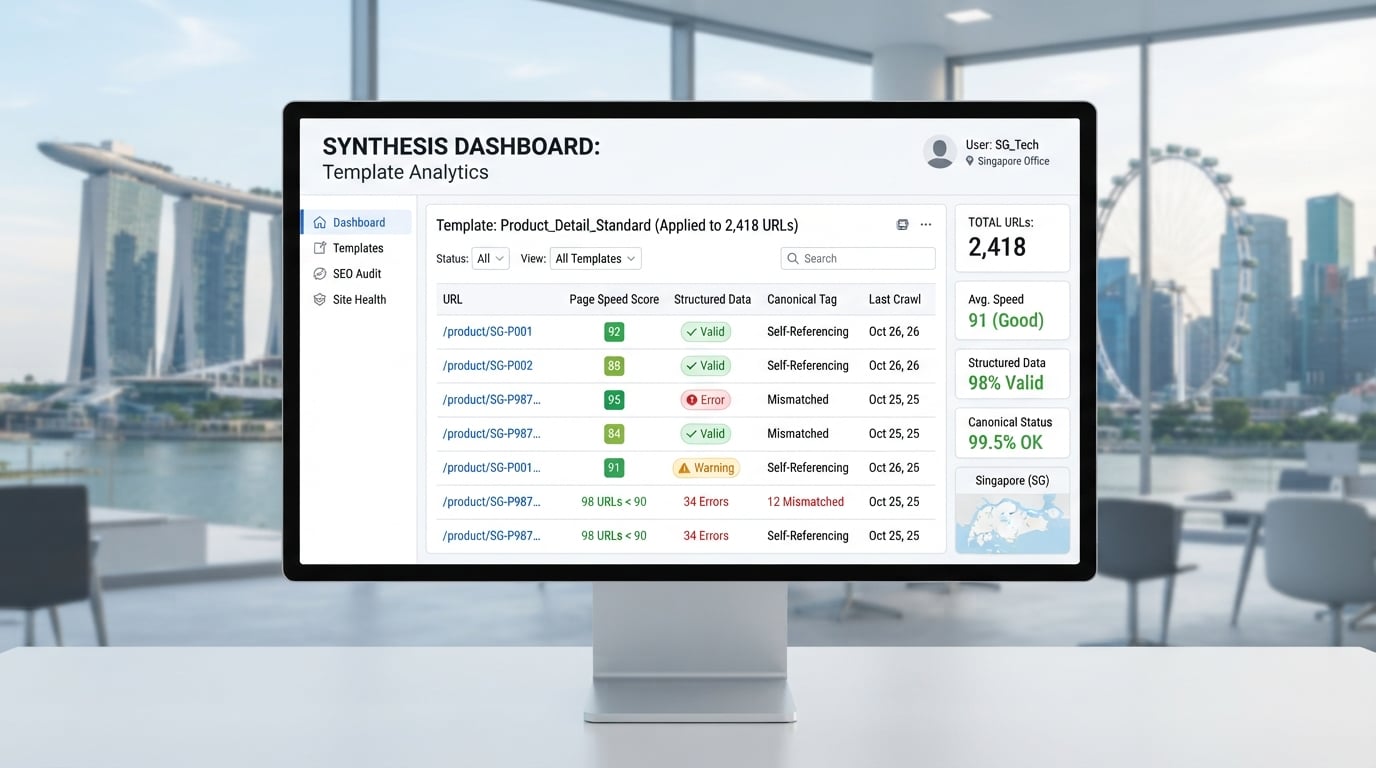
Templates, structured data and page speed at scale
Because one template governs thousands of URLs, a template fix is worth more than any manual edit. Audit each template once for structured data validity, heading use and load weight. Then monitor it continuously. Sample real pages on a schedule, since templates drift as developers ship changes. A single seo platform view of template health helps teams improve consistency across markets. Clean templates also protect traffic from being lost to avoidable errors. Specialist seo services can support this monitoring where internal teams lack capacity.
Conclusion: Building Enterprise SEO That Lasts
Patience, measurement and the long timeline
Enterprise SEO is a capability you build, not a campaign you buy. Start by scoring your organisation on an illustrative internal maturity framework. The framework is the writer’s own, not an industry standard. Rate each dimension from 1 to 5, and be honest about the lowest scores.
Set expectations early. Substantial results can take months or even years. Agree on a realistic timeline and budget with leadership before work starts. Measure against organic revenue, not rankings alone. A modest gain in organic visits only matters when those pages serve commercial intent. Include your content and website performance in that measurement, since a search engine rewards pages that meet real user needs.
Frequently Asked Questions
What is enterprise SEO?
Enterprise SEO is the practice of improving organic search rankings and revenue for large, complex websites. Such sites are typically run by Fortune 1000 or Global 2000 companies. According to Sureoak, the work centres on growing unpaid search visibility at scale. Because these sites can run to hundreds of thousands of pages, the work depends on templates, workflows and governance rather than optimising pages one at a time.
How is enterprise SEO different from regular SEO?
The difference is mainly one of scale. Objects notes that approaches which work on small sites do not always transfer to websites with hundreds of pages. Regular SEO asks whether each page is well optimised. Enterprise SEO asks whether the system producing thousands of pages consistently produces good ones.
How long does enterprise SEO take to show results?
Expect months, and sometimes years. Objects reports that substantial results can take that long. Track leading indicators such as indexation rates and template performance while you wait.
Do small businesses in Singapore need enterprise SEO?
Usually not. Enterprise SEO suits sites with very large page counts. A typical Singapore SME with dozens or a few hundred pages will get more from strong standard SEO. Consider enterprise methods only when your site outgrows manual page management.
What skills does an in-house enterprise SEO team need?
Look for technical SEO knowledge, comfort with templates and structured data, analytical skill in linking organic traffic to revenue, and the ability to work with developers and content teams. Sureoak found that 57% of enterprises cite limited in-house SEO skills as their biggest obstacle, so this is often the first gap to close.
Should we hire an enterprise SEO agency or build in-house?
Build the core capability first, then add outside help for specific gaps. Agencies and tools pay off only once your workflows and internal skills can use them. Use an agency for specialist work such as a technical audit or a launch, and keep ownership of governance and measurement in-house.