| AI Summary
SEO topic clusters organise related pages around a central pillar page. Each supporting page answers a narrower question, while internal links connect the group. Businesses can use this structure to cover customer needs, help search engines discover content and connect educational articles with relevant services. Results depend on page quality, search demand, competition and technical performance. |
SEO topic clusters bring related content together so readers can move from a broad question to a detailed answer. A pillar page introduces the subject, supporting pages explain its subtopics, and internal links show how everything connects.
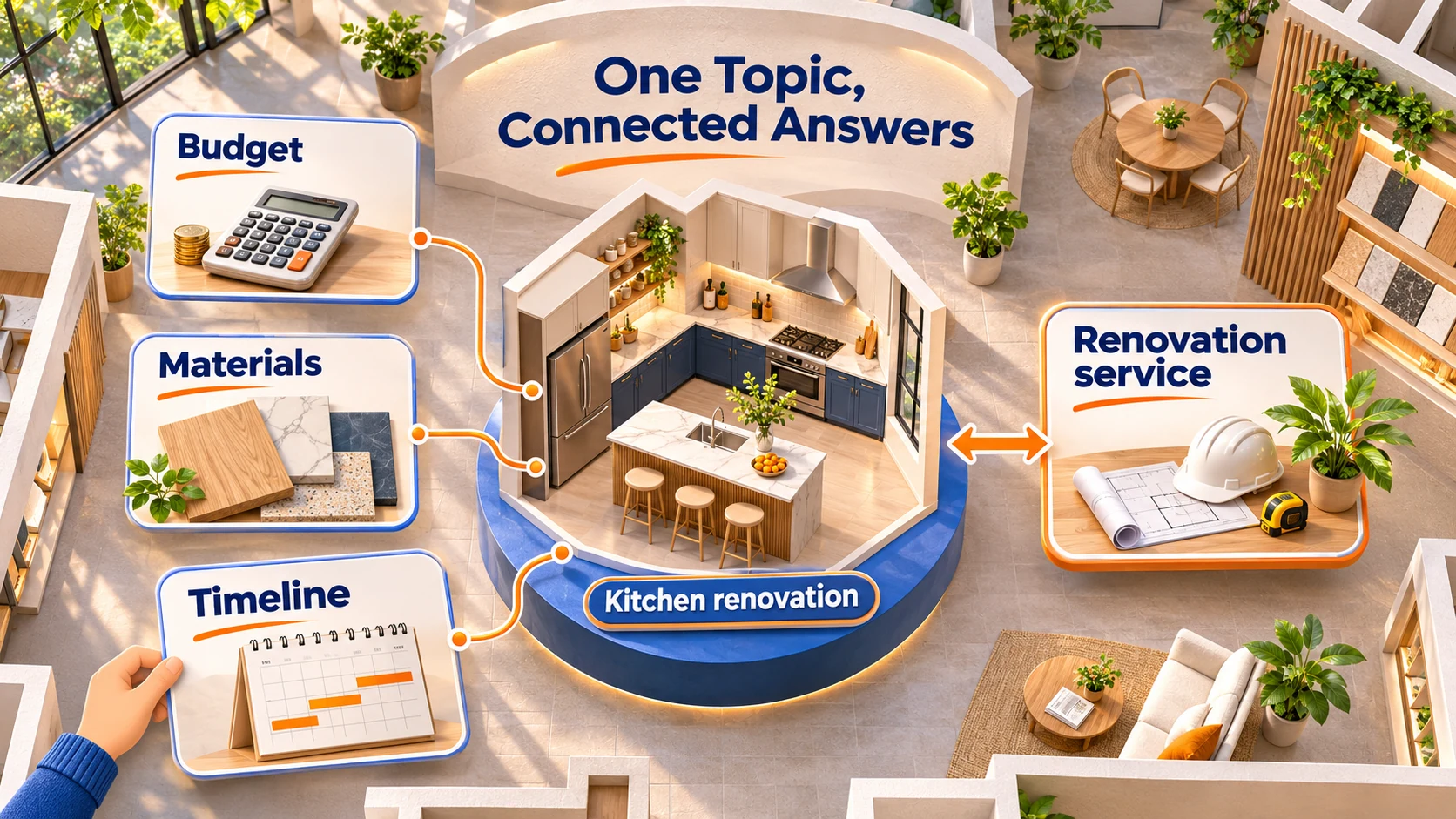
For a renovation company, that could mean a kitchen renovation guide connected to pages about budgets, materials and project timelines. Someone researching costs can explore those details without searching the website from scratch.
The planning starts with customer questions and the services behind them. Our approach to SEO strategy connects those questions with page planning, content development and measurement. The sections below explain how to put those pieces together.
Key Takeaways
- Choose a focused commercial subject. The pillar should address customer needs connected to a product or service the business provides.
- Give each page a distinct purpose. Related keywords can share one page when they lead readers towards the same answer.
- Plan internal links before publishing. Pillars, supporting articles and relevant service pages should connect where readers need more detail.
- Support coverage with evidence. Examples, first-hand experience and reliable sources give readers reasons to trust the content.
- Measure the whole cluster. Search visibility, relevant visits and qualified enquiries reveal more than page counts alone.
What Are SEO Topic Clusters?
A topic cluster is a group of connected pages about one main subject. Its structure helps readers understand the subject in stages, from an overview to specific questions.
Three parts form the cluster:
| Component | Main purpose | Kitchen renovation example |
| Pillar page | Introduces the subject and its main decisions | Kitchen renovation planning guide |
| Supporting pages | Explain individual questions in depth | Budgeting, cabinet materials and renovation timelines |
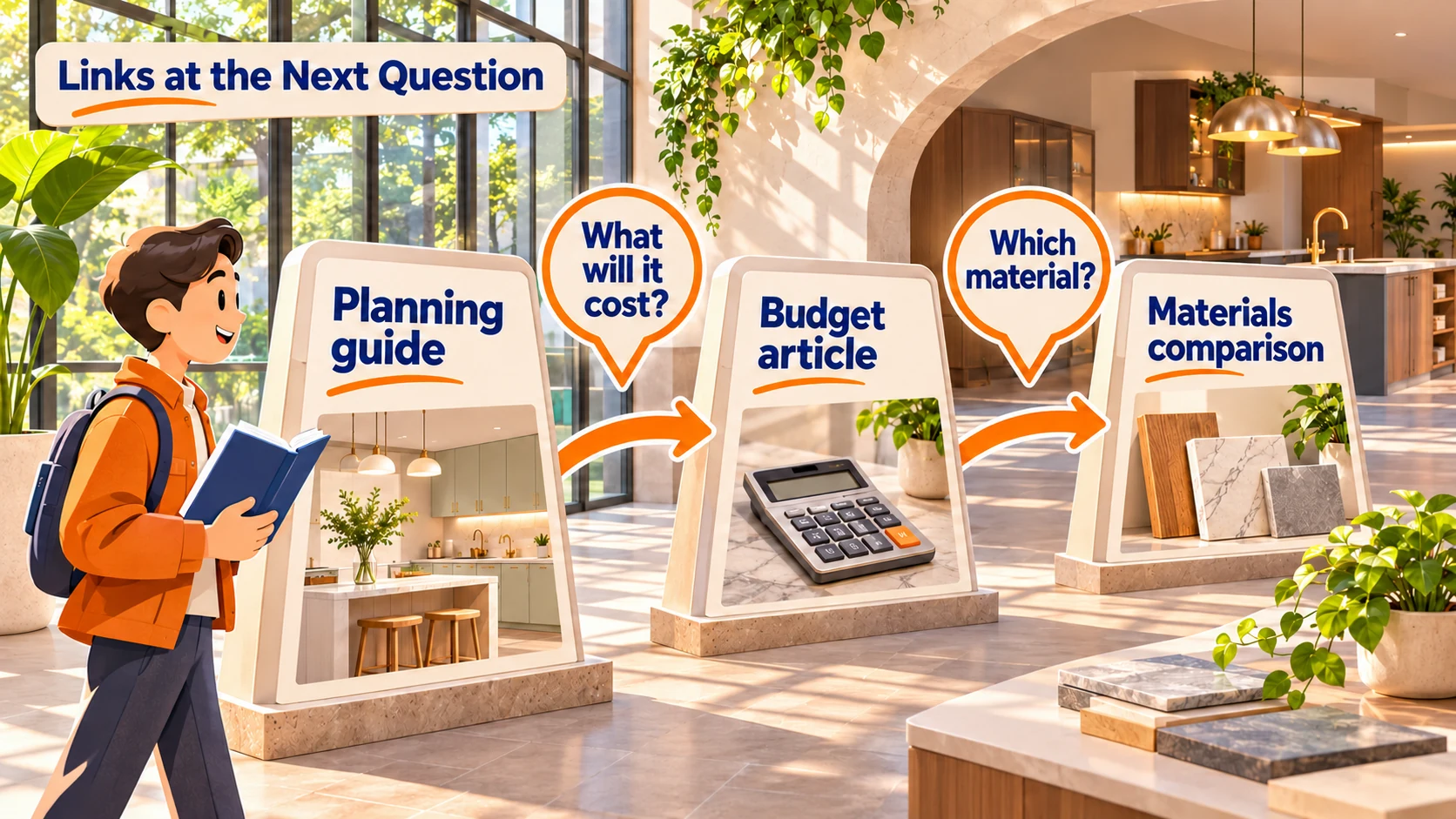
| Internal links | Connect relevant explanations | Links between the planning guide, cost article and materials comparison |
How topic clusters differ from keyword clusters
Keyword clusters group search phrases with similar meaning or intent. Topic clusters organise the pages that answer those searches.
For example, “kitchen renovation budget” and “how much does a kitchen renovation cost” may belong on one page. Cabinet materials deserve a separate page because readers need a different explanation.
That distinction prevents a website from creating a new article for every phrase. A planned set of SEO content types can include guides, comparisons and service pages, depending on the answer each search requires.
Why the structure helps readers and search engines
Readers benefit when related answers sit within reach. Someone comparing cabinet materials may also need to understand how each option affects the budget.
Search engines use links to discover pages and understand relationships between them. Google’s ranking systems include link analysis systems that help determine what pages cover and which may answer a query. A cluster provides an organised way to create those connections.
The structure supports discovery and understanding. Rankings still depend on the content and the wider search environment.
How Topic Clusters Support Topical Authority
Topical authority describes a website’s depth of knowledge about a subject. In everyday terms, readers should find accurate answers to the questions they would expect an experienced business to explain.
A collection of connected articles can demonstrate that depth when each page adds something valuable. Repeated summaries and lightly rewritten posts give readers little extra help.
What demonstrates subject knowledge
Coverage becomes more convincing when the business explains decisions through experience. A renovation company could show how limited kitchen space affects storage choices, supported by an annotated project example.
Evidence can take several forms:
- Original photographs showing the work discussed.
- Examples explaining why one approach suited a particular situation.
- Comparisons with reasons behind each advantage and limitation.
- Named authors or reviewers with relevant experience.
- Sources supporting technical claims and figures.
Google’s approach to people-first content asks whether pages provide original information, demonstrate experience and leave visitors with enough knowledge to achieve their goal. Those qualities should shape each article brief.
A website with twenty shallow articles may answer fewer customer questions than a website with five detailed pages. The number alone says little about accuracy, relevance or reader satisfaction.
A “topical authority ratio” based on subject pages divided by total website pages is therefore a poor target. It changes whenever unrelated pages are added, even when the subject content stays the same.
A more practical coverage review records important customer questions, identifies the page answering each one and checks whether the explanation is complete. That gives the team specific gaps to address.
Planning a Topic Cluster Around Customer Needs
Cluster planning begins with a subject the business understands and customers actively research. The subject also needs a sensible connection to the company’s products or services.
A broad theme such as “home improvement” can spread a small team across too many areas. “Kitchen renovation planning” gives that team a more manageable set of questions.
Choosing the pillar subject
A proposed pillar deserves attention when the business can explain it well and support the content over time. Customer conversations often reveal where that opportunity exists.
The planning discussion should cover:
| Planning question | What the answer establishes |
| Which customer problem does the subject address? | A reason for the cluster to exist |
| Which service or product relates to it? | A relevant commercial connection |
| What experience can the business contribute? | Evidence beyond a general summary |
| Which questions need separate explanations? | Potential supporting pages |
| Who will review the content? | Responsibility for accuracy and maintenance |
A completed table gives writers a shared direction. Unanswered questions reveal research or staffing needs before production begins.
Researching search intent
Search intent is the reason behind a search. Someone asking what a renovation involves needs an explanation, while someone comparing contractors may be preparing to contact a business.
The distinction affects the page format. A review of keyword intent helps separate introductory guides from comparisons, calculators and service pages.
Search results provide clues about what readers expect. The research should record:
- Common page formats appearing for the query.
- Questions repeated across relevant results.
- Whether answers depend on location, product or customer type.
- Missing explanations the business can support with evidence.
Results vary by location and time, so the research date belongs in the planning sheet. That context helps explain later changes to the brief.
Reviewing existing pages
An existing article may already answer part of the planned cluster. A content review can identify pages to retain, improve or combine before new writing starts.
The website audit report should separate content gaps from technical problems. A strong article that cannot be indexed needs a different response from an indexed article that leaves its main question unanswered.
Mapping Pillar Pages and Supporting Articles
A topic map assigns a purpose to each page before writers develop overlapping drafts. Every proposed article should explain what the reader needs and how its answer differs from the pillar.
For the kitchen renovation example, the map could look like this:
| Page | Reader’s main question | Recommended format | Relevant next step |
| Kitchen renovation planning | What does the project involve? | Pillar guide | Explore the main decisions |
| Kitchen renovation budget | What affects the total cost? | Cost breakdown | Prepare a project budget |
| Cabinet materials | Which materials suit different needs? | Comparison | Discuss material choices |
| Renovation timeline | What happens during the project? | Process guide | Prepare the household |
| Kitchen renovation service | Who can carry out the work? | Service page | Request a consultation |
The structure gives each page a job. Supporting articles can mention related subjects briefly, then link to the page that explains them fully.
The illustration below shows how those separate questions connect around one subject.
Deciding how many supporting pages to create
The number should follow the questions customers need answered. Three supporting articles can make a manageable first project, but the count is an editorial choice.
Some subjects need fewer pages because the questions belong together. Others need more because each decision requires its own evidence, examples or explanation.
A page earns its place when it can deliver a distinct answer. Topics with little separate value can remain sections within the pillar.
A brief helps writers preserve those boundaries. It also gives reviewers a basis for checking whether the draft fulfils its purpose.
Each brief should include the audience, main question, supporting questions, evidence, planned links and next step. The pillar brief should also state how much detail belongs in each overview section.
Our SEO content planning approach connects research with those production decisions. A shared brief reduces the chance that several writers explain the same background at length.
Writing Pillar Pages and Supporting Content
Writing works best when each page delivers its main answer early. Readers can then decide whether they need the full explanation or a particular section.
The pillar introduces the subject and connects its main decisions. Supporting articles provide the detail needed to act on individual questions.
Writing the pillar overview
A pillar should help readers understand the subject without opening every linked page. Its sections need enough explanation to stand on their own.
For kitchen renovation planning, the overview might cover project goals, budgeting, materials, scheduling and contractor selection. Each section would explain the main decision before linking to a deeper answer.
Readable information website design supports that structure through descriptive headings, short sections and a table of contents. Readers should be able to identify the section they need on a phone.
Developing supporting articles
A supporting article should resolve its main question through explanation and examples. A budgeting page, for instance, could separate materials, labour and changes to plumbing, then explain what affects each category.
The article should also identify limits. Costs depend on project details, so an example budget must state its assumptions and currency.
Effective SEO content writing connects those details with reader decisions. Each section should explain what the information means for the person planning the work.
Connecting information with a relevant action
The next step should follow the reader’s progress. Someone exploring materials may need a comparison checklist before they are ready for a consultation. Relevant actions could include:
- Downloading a planning checklist.
- Comparing available service options.
- Viewing a documented project example.
- Requesting an assessment after reviewing the project requirements.
The business should explain what happens after an enquiry. That gives readers enough context to decide whether to continue.
Linking Pillars and Cluster Pages Together
Internal links turn the topic map into a working structure. They connect the overview with detailed answers and help readers reach related services.
A planned internal linking strategy identifies those connections before publishing. Each link should have a reason based on the surrounding discussion.
Connecting the pillar and its supporting pages
The pillar should link to supporting articles where it introduces their subjects. Each supporting article should link back to the pillar when readers may need the wider context.
Related supporting pages can connect directly when the next question follows naturally. A materials article could link to the budget explanation while discussing how material choices affect spending.
A link plan might include:
| Source page | Destination | Reason for the connection |
| Planning guide | Budget article | Explains the cost factors introduced in the overview |
| Budget article | Materials comparison | Helps readers assess a major budget decision |
| Materials comparison | Planning guide | Gives readers the wider project context |
| Timeline article | Renovation service | Connects scheduling questions with project support |
Links between every possible pair of pages would add clutter. The relationships should follow the reader’s needs.
Writing descriptive anchor text
Anchor text is the clickable wording of a link. A phrase such as “cabinet material costs” tells readers what the destination explains.
Google’s link best practices support descriptive wording and crawlable links. Google also states that there is no ideal number of links for every page. Relevance should determine the count.
The sentence should introduce the destination naturally. “Cabinet material costs can change the overall budget” provides context without interrupting the explanation.
The illustration below follows one reader’s decision through those connected pages.
Checking links after publication
Live-page checks should confirm that links open the intended destination and use its final URL. Redirect chains and broken destinations create avoidable friction.
The review should also confirm that important articles receive links from other pages. A page with no incoming internal links can remain difficult for readers and crawlers to discover.
Preventing Overlap and Keyword Cannibalisation
Related articles will naturally share some terms. Problems arise when several pages serve the same need without a meaningful difference.
For example, “kitchen renovation cost” and “kitchen renovation pricing” may describe one question. Separate articles could divide the explanation and leave both pages incomplete.
Identifying overlap that needs action
A keyword cannibalisation review should examine the pages and their performance together. Two URLs appearing for a query do not automatically indicate a problem.
The review should establish:
- Whether each page serves a different audience or decision.
- Whether the content repeats the same answer.
- Whether the intended page attracts relevant visits.
- Whether combining the pages would improve the explanation.
Different purposes can justify keeping both pages. A budgeting guide and a service page may share terms while helping readers at different stages.
Combining pages without losing the strongest information
A combined page should retain the best explanations, examples and evidence from both sources. Internal links can then point directly to the retained URL.
Google’s documentation on permanent URL moves explains how redirects help communicate a move. The destination should represent the old page’s content closely enough to serve its visitors.
For duplicate or very similar URLs that remain accessible, canonicalisation helps indicate a preferred version. The appropriate method depends on whether the old page must remain available.
Tools for Research, Mapping and Maintenance
A small cluster can begin with a spreadsheet, Search Console and a website crawler. Additional tools become valuable when they answer a specific research or reporting need.
The tool set should support decisions across the project:
| Tool | Main job | Decision it supports |
| Keyword research tool | Finds related searches and demand estimates | Which questions deserve investigation |
| Search results review | Shows common formats and competing answers | What the page needs to explain |
| Google Search Console | Reports search visibility and indexing information | Which pages need closer review |
| Website crawler | Finds links, errors and page relationships | Where technical or linking repairs belong |
| Analytics platform | Records visits and configured actions | Whether content supports business goals |
| Spreadsheet | Records page roles, owners and review dates | What happens next and who handles it |
Search volume estimates provide context, but customer questions can reveal valuable subjects with limited reported volume. Research should combine both sources.
Maintaining the topic map
The spreadsheet should record each page’s main question, URL, status, author, reviewer and planned links. Publication and review dates help the team manage changes.
A monthly planning discussion can cover unfinished articles, new customer questions and pages needing attention. The review frequency can change with the subject and available resources.
Measuring Topic Cluster Performance
Measurement starts before launch with a record of current results. That baseline helps the team assess what changed after publication or revision.
A data-driven SEO process connects the cluster’s goals with search data and business outcomes. The report should distinguish discovery, visits and qualified actions.
Tracking search visibility
Google Search Console reports impressions, clicks, click-through rate and average position. Google’s explanation of search performance metrics also describes why position represents an average across impressions.
The analysis should group the cluster’s URLs and inspect individual pages when the totals change. Relevant non-brand queries can show whether the content is reaching people who have not already searched for the business.
Connecting visits with business outcomes
Analytics can show whether visitors reach service pages, submit forms or complete purchases when those actions are configured correctly. Sales records then help assess enquiry quality.
The reporting conversation should connect each stage:
| Stage | Example measure | What to investigate |
| Discovery | Relevant impressions | Whether pages appear for intended questions |
| Visits | Organic clicks and landing-page visits | Whether searchers choose the content |
| Further interest | Visits to relevant service pages | Whether readers continue towards an offer |
| Enquiries | Completed forms or bookings | Whether the next step works |
| Quality | Qualified enquiries or sales | Whether the cluster attracts suitable customers |
A rise in traffic with weak enquiries may point to the audience, offer or page experience. The next action should follow that diagnosis.
The illustration below shows how the team reads those stages together.

Reviewing progress without a fixed deadline
Cluster performance depends on competition, website history, search demand and the quality of the pages. A universal three-month or six-month promise would hide those differences.
Early reviews should check publishing, indexing and links. Later reviews can examine query coverage, visits and enquiry quality across comparable periods, with seasonal changes recorded alongside the results.
How Topic Clusters Support AI Search
Connected content can help readers explore the related questions behind a complex search. Direct explanations, evidence and descriptive headings also make each page easier to understand on its own.
Google’s documentation on AI features and websites says established SEO practices remain relevant for AI Overviews and AI Mode. It identifies internal discoverability and accessible text among those practices, while confirming that inclusion is not guaranteed.
Preparing answers for different search experiences
A supporting page should state its answer near the relevant heading, explain the conditions and show evidence where needed. Tables can clarify comparisons, while examples can explain choices.
The page should also retain enough context for someone arriving directly from search. Readers should understand the subject without opening the pillar first.
Build SEO Topic Clusters Around Real Customer Questions
SEO topic clusters organise a subject into connected answers. A focused pillar, distinct supporting pages and relevant internal links help readers understand their options. Measurement then shows where the content earns attention and where the business needs to improve the experience.
At MediaOne, we connect topic research, content planning and technical optimisation through our SEO services. We can help your team assess its existing content and develop a cluster plan around customer questions and commercial goals.
Frequently Asked Questions
Can a service page act as the pillar?
Yes. A service page can serve as the central page when it introduces the subject sufficiently and connects readers with supporting explanations. A separate guide may be appropriate when the educational overview would make the service page difficult to use.
Do all cluster pages need the same URL folder?
A shared folder can make organisation and reporting easier, but a cluster can connect pages across different folders. Existing URLs can remain in place when their subjects, links and navigation establish the relationships.
Should a topic cluster include video?
Video can explain tasks or comparisons that benefit from a demonstration. The accompanying page should provide enough written context for visitors who cannot watch, including the main answer and relevant details.
Can an ecommerce category page belong to a cluster?
Yes. A category page can connect buying guides, product comparisons and care instructions with relevant products. Those resources should help customers make decisions related to the category.
Who should own a topic cluster?
One person should coordinate the page map, briefs, links and review schedule. Writers, subject specialists and SEO staff can contribute, while the coordinator keeps the work aligned and follows up on unfinished tasks.
Should translated pages belong to the same cluster?
Each language version should provide a connected experience for its intended readers. Translated supporting pages should normally link to the corresponding pillar and relevant pages in that language.