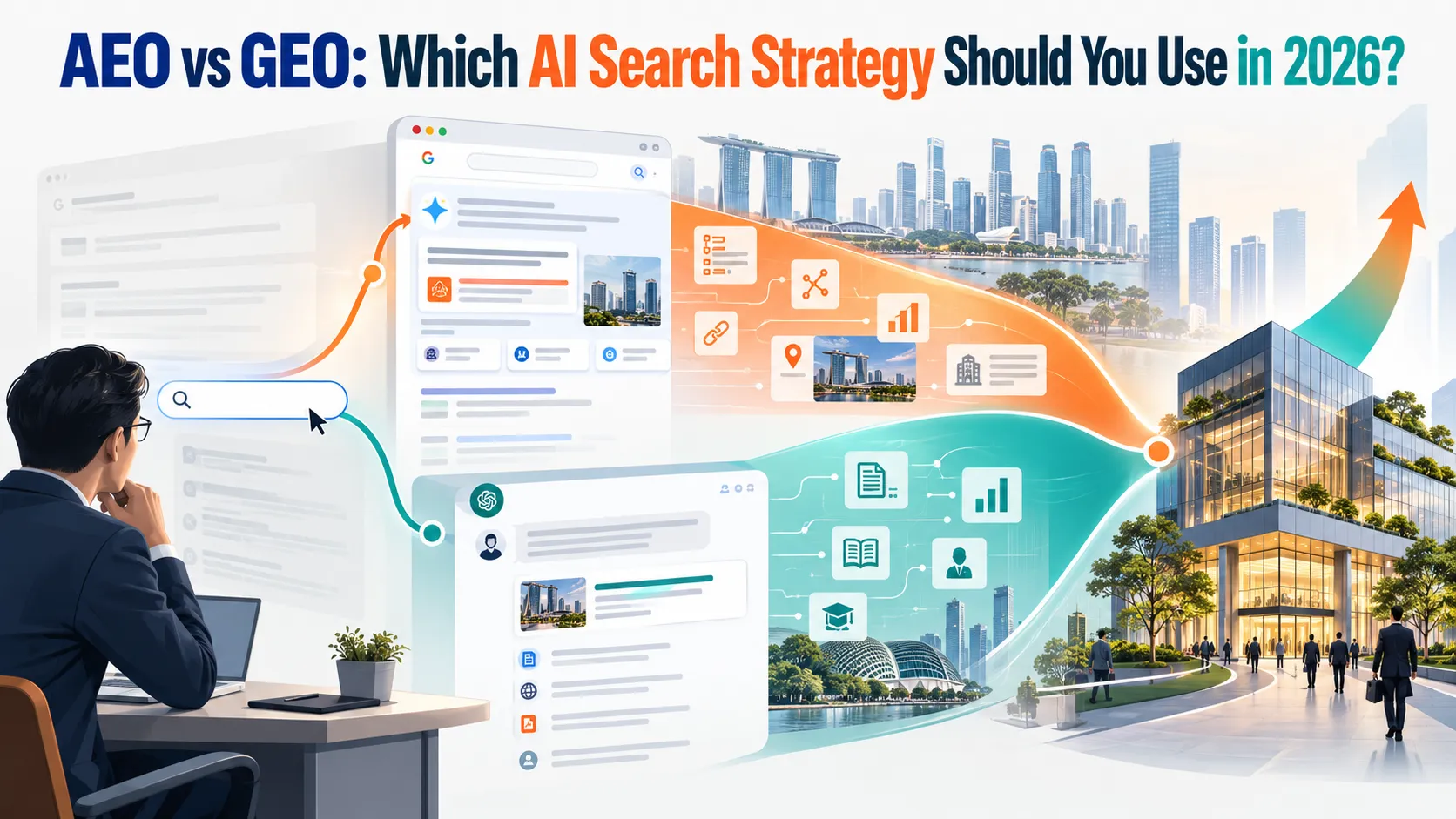
The search landscape shifted significantly between 2024 and 2025. Google’s AI Overviews now appear on roughly 21% of all searches, and up to 57% of long-tail informational queries. The impact on click-through rates has been substantial. Organic click-through rates on queries featuring AI Overviews fell from 1.76% to 0.61% between June 2024 and September 2025. Zero-click searches, meanwhile, grew from 56% in 2024 to 69% in 2025, representing a structural shift rather than gradual margin erosion.

For Singapore-based businesses, this change is material. Google processes an estimated 14 billion searches daily, and with AI Overviews now rolling out to over 200 countries and 35 languages, Singaporean marketers can no longer rely on traditional organic search alone to drive website traffic.
The traditional approach to search marketing no longer works. Visibility is fragmenting into two channels: AI-powered search answers within Google’s interface, and AI chatbot responses on standalone platforms. Businesses must now choose between playing in answer engines (AEO), generative engines (GEO), or both. Understanding the difference is critical for any Singapore-based business planning its 2026 marketing budget.
The Collapse of Traditional Click-Through and the Rise of Zero-Click Search
Between June 2024 and September 2025, organic click-through rates collapsed dramatically on queries with AI Overviews. The rate fell from 1.76% to 0.61%, a decline of 65%. This deterioration accelerated in 2025, with year-on-year drops of 61%.
When 69% of queries end without any click to any website, the assumption that ranking equals traffic no longer holds true. Zero-click searches are not new. Their scale and speed of growth are. The shift from 56% to 69% happened in months, not years. Google’s AI Overviews accelerated the trend by concentrating answers inside the search interface itself, removing the need for users to visit external websites.
For businesses that built traffic models on “rank for the keyword, wait for the click,” this represents a fundamental challenge. However, it also creates a new opportunity: being cited in the AI answer itself, even if the user never clicks through to your website.
That distinction separates Answer Engine Optimisation (AEO) from traditional SEO. Both are distinct from Generative Engine Optimisation (GEO), which targets AI platforms outside Google’s search interface entirely.
What Is Answer Engine Optimisation (AEO)?
Answer Engine Optimisation is the practice of structuring content, metadata and internal linking so that AI-generated answer summaries within search engines mention your brand or solution by name.
AEO assumes the user will remain within a search interface, such as Google Search with AI Overviews enabled. The business goal is not necessarily to receive a click. It is to be named in the answer itself.
Three factors separate AEO from traditional SEO:
Direct answers over ranking position. AEO does not prioritise page-one ranking. It prioritises being cited in the AI answer, regardless of where your page ranks. A page can rank fifth and appear in the Overview, or rank first and not appear at all.
Specificity over broad topical authority. AI systems favour exact data, case studies with measurable results, and entity-specific claims. Documenting specific results, such as “our integration approach reduced client onboarding time by 40%,” carries more weight than vague claims about improvement.
Internal linking as a ranking signal. Well-structured internal linking strengthens AEO performance. Static, disconnected internal link structures weaken visibility in AI answers.
Why AEO matters in 2026: Google’s AI Overviews now mention three to four brands per response. Being cited matters more than ever, but only if your content is discoverable and indexed by Google’s systems.
For Singapore businesses, this means optimising for local entity recognition. Include your Singapore Registration Number, SGD pricing, and Singapore-specific case studies. AI systems increasingly weight geographic signals more heavily.
Practical AEO signals include:
- Specific, measurable outcomes (e.g., “our approach reduced processing time by 40%”)
- Structured data using Schema markup for Organisation, Product, or LocalBusiness
- Short, standalone answer blocks of 100–150 words per topic
- High-quality internal linking from authority pages to answer content
- Clear entity references, including your brand name, Singapore location, and service type
What Is Generative Engine Optimisation (GEO)?
Generative Engine Optimisation is the practice of structuring content to appear in AI chatbot responses and standalone generative AI platforms such as ChatGPT, Claude and other large language model-based interfaces, rather than in search-engine-integrated AI answers.
GEO assumes the user is interacting directly with a generative AI chatbot outside Google Search. The user asks a question to ChatGPT or another large language model, and your content appears in that response, or you are cited as a recommended source.
Key differences from AEO:
Different distribution channel: AEO optimises for Google Search’s infrastructure. GEO optimises for standalone platforms where Google has no direct control.
Citation volume is lower: ChatGPT surfaces three to four brand mentions per response. Being cited matters, but reach is narrower than search results.
Traffic quality is higher: Traffic from AI sources converts at notably higher rates than traditional organic search. Whilst AI referral sources represent a small portion of total website visits, the conversion quality justifies optimisation for specific use cases.
According to eMarketer, generative AI engines accounted for 3.3% of online discovery time in the US as of August 2025. This proportion is modest until you consider the concentration of traffic in specific platforms. A small channel concentrated in a single high-intent platform can deliver strong ROI for certain businesses.
Practical GEO signals include:
- Authoritative, source-cited content (GEO systems reward citations and references)
- Content published to public-facing platforms that large language models can index (blogs, guides, whitepapers)
- Clear author credentials and publication metadata
- Content depth and originality (LLMs downweight thin, derivative content)
- Direct engagement with GEO platforms via API access where available
For Singapore businesses, GEO is less established than AEO in the Google ecosystem. However, as ChatGPT’s enterprise adoption grows in the region, GEO will become increasingly relevant for B2B and professional services firms looking to reach decision-makers who use AI tools for research.
AEO vs GEO: Key Differences and When to Use Each
| Factor | AEO (Answer Engine Optimisation) | GEO (Generative Engine Optimisation) |
|---|---|---|
| Primary Channel | Google Search (AI Overviews) | ChatGPT, Claude, standalone LLMs |
| User Behaviour | Remains in search interface | Exits search; uses dedicated AI platform |
| Content Lifespan | Real-time indexing; updates weekly | Trained on data; lag time of months to years |
| Volume Potential | High (21% of searches, up to 57% for long-tail queries) | Low (3.3% of discovery time; small portion of website traffic) |
| Conversion Quality | Lower click-through rate (0.61% as of September 2025) | Higher conversion rate than traditional organic search |
| Brand Mentions Per Response | Three to four | Three to four |
| Best For | High-volume informational queries; local search; e-commerce | High-intent research; B2B; professional advice; premium conversion |
| Optimisation Focus | Direct answers; entity signals; internal linking | Author credibility; source quality; original research |
| Geographic Relevance | Strong (Overviews localise to region and language) | Weak (LLM training data is global; local context added by user prompt) |
| Competitive Density | Growing rapidly | Still emerging |
When to prioritise AEO:
You operate in Singapore and rely on local search volume (restaurants, services, retail). Your industry has high search volume (finance, healthcare, e-commerce). You can provide direct, measurable answers through case studies with specific outcomes. You have resources to update and maintain internal linking at scale.
When to prioritise GEO:
Your content is highly cited within your industry (academic, research, policy). Your customers are power users of ChatGPT or Claude (typically tech, finance, creative professionals). Conversion value per visitor is very high, justifying the smaller volume. You are building long-form, original research your industry references.
The hybrid approach (recommended for most Singapore businesses):
Optimise for AEO first. Google Overviews appear in 21% of searches; GEO represents a smaller proportion of discovery time. The volume is on Google’s side. Layer GEO tactics on top for high-value, research-backed content. Both require the same foundation: clear structure, specific facts, strong source attribution, and entity signals.
Practical Implementation: AEO Strategy for Singapore Businesses
Step 1: Audit Your Current Visibility in AI Overviews
Search your top 20 keywords in Google Search (logged in to receive personalised, AI Overview-enabled results). Check whether your domain appears in the AI Overview answer. Record the answer text and whether your brand is mentioned. Do this for 30–50 keywords and track in a spreadsheet.
Step 2: Identify High-AEO-Potential Content Gaps
Prioritise queries where:
- An AI Overview exists (confirming Google has summary-ready data)
- Your brand is not mentioned (indicating an opportunity)
- Search volume exceeds 100 monthly searches
- Your product or service is a credible answer to that query
For Singapore context: focus on localised queries (for example, ‘best accounting software in Singapore’, ‘PDPA compliance requirements’). These are more likely to feature local brands in AI Overviews.
Step 3: Create Direct-Answer Content Blocks
Write a 100–150 word section on each target page that:
- Directly answers the query in a single sentence
- Provides a specific, measurable outcome (for example, ‘reduced processing time by 40% for 15 businesses’)
- Includes your Singapore entity name and location (Singapore region or postcode where relevant)
- Uses Schema markup (Organisation, LocalBusiness, or Product depending on context)
Example structure:
[Your Service] Results for Singapore Businesses: We helped [X] companies in Singapore reduce [metric] by [percentage] using [your approach]. For example, [specific client name or industry] achieved [outcome] within [timeframe].
Step 4: Strengthen Internal Linking
Audit your internal links. Map connections from high-authority pages (homepage, main category pages) to your target answer-content pages. Ensure every answer block receives at least three inbound links from pages with higher domain authority. Use descriptive anchor text (for example, ‘how our solution improves team productivity’ rather than ‘read more’).
Step 5: Implement Technical AEO Foundations
- Enable Google Search Console indexation monitoring
- Validate all Schema markup via Google’s Rich Results Test
- Fix crawl errors and broken internal links monthly
- Maintain Core Web Vitals above the 75th percentile (PageSpeed Insights score 75 or higher)
Step 6: Monitor and Iterate
Check AI Overview mentions monthly. If you are not appearing, revise the answer block by making it more specific or adding measurable proof. If you are appearing but receiving no clicks, test different answer angles by emphasising return on investment, time savings, or compliance.
Timeline: Expect 4–8 weeks before appearing in an AI Overview; 12 or more weeks for consistent citations.
Practical Implementation: GEO Strategy for Singapore Businesses
Step 1: Audit Your Content in LLM Training Data
Use tools such as OpenAI’s ChatGPT (free tier) or Perplexity to search for your brand name and key topics. If your content already appears in ChatGPT responses, you have a baseline. If not, you are invisible to GEO, or only visible through third-party citations.
Step 2: Prioritise Original Research and Authority
Generative engine optimisation systems favour content that:
- Makes a novel claim or original finding
- Cites sources and provides attribution clearly
- Comes from an author with publicly verifiable credentials
- Is published on a domain with existing topical authority
For Singapore businesses: publish detailed case studies or whitepapers unique to your market. An article titled ‘How Singapore SaaS Teams Improve Onboarding: A 12-Month Study’ will rank higher in generative results than generic guides because AI language models reward local, original data. For professional services and B2B firms, GEO matters increasingly as adoption of ChatGPT grows within these sectors.
Step 3: Structure Content for LLM Extraction
Write in a way that large language models can quote without losing meaning:
- Lead with the key claim in the first sentence
- Break sections into standalone answer blocks (100–200 words each)
- Use clear headings that summarise the section’s finding
- Include data in both prose and table or list format
Example:
Finding: Businesses that use structured internal linking see increased AI citations. This passage is quotable, attributable and self-contained, ideal for LLM extraction.
Step 4: Build Author Credibility Signals
- Create a detailed Author/About page with credentials and LinkedIn link
- Publish consistently under your name (byline consistency matters for large language models)
- Cite peer-reviewed sources and industry reports from firms such as Ahrefs, Quattr, Conductor and eMarketer
- Link to external authority sites, not just internal pages
Step 5: Increase Content Distribution and Indexability
- Publish to your blog (with sitemap and robots.txt allowing LLM crawlers)
- Syndicate to industry platforms (LinkedIn, Medium, industry publications)
- Ensure content is behind no paywall or login gate (large language models cannot access gated content)
- Use RSS feeds to signal new content to indexing services
Step 6: Monitor and Measure GEO Impact
Track these metrics:
- Referral traffic from ChatGPT (via UTM parameters such as utm_source=chatgpt)
- Brand mentions in ChatGPT responses (manual checks using ChatGPT free tier)
- Conversion rate of ChatGPT referrals versus organic search
Current baseline: ChatGPT referrals typically account for a small portion of overall website traffic but convert at a notably higher rate than organic search. Ensure your tracking infrastructure isolates this channel.
Timeline: 2–3 months for new content to appear in ChatGPT; 6 or more months for consistent citations if starting from low authority.
Summary: AEO and GEO in Singapore’s 2026 Search Landscape
The choice between AEO and GEO is not either/or. It is a resource-allocation question.
Invest in AEO if:
- You have high search volume in Google (most Singapore businesses)
- Your content can be structured as direct answers
- You can maintain internal linking and Schema markup over time
- Your target user is still in the search interface, not ChatGPT
Invest in GEO if:
- Your audience uses ChatGPT or Claude regularly (B2B, professional services, tech, finance)
- You produce original research or high-authority content your industry cites
- A single high-value customer is worth many lower-value search clicks
- You are building long-form, original research your industry references
The reality for most Singapore businesses:
Focus on AEO first. Google’s AI Overviews reach a significant proportion of queries. ChatGPT discovery represents a smaller share of total traffic. Volume is on Google’s side. Layer GEO efforts into your highest-authority, most-cited content. Both optimisations share the same foundation: clear structure, measurable claims, proper attribution, and entity signals.
Google has rolled out AI Mode to over 200 countries and 35 or more languages, including Singapore. Your market is moving now. Waiting for perfect clarity means falling behind competitors already testing these tactics.
Start with one high-value page. Optimise it for AEO (direct answer, internal linking, Schema). Monitor for AI Overview mentions for 4–8 weeks. Once you see results, scale. Layer GEO tactics on your top 10 research pieces. Measure referral traffic and conversion rate from ChatGPT. Adjust based on performance, not prediction.
The landscape has shifted. The playbook is clear. Execution is the differentiator.
Troubleshooting: Common AEO and GEO Issues
| Common Issue | Why It Happens | Recommended Action |
|---|---|---|
| Brand does not appear in AI Overview despite having content about the query | Content is not specific enough, or internal linking to the answer page is weak. AI Overviews prioritise content with clear structure and strong domain authority signals. | Rewrite the answer block to directly address the query in the first sentence. Add at least three inbound links from high-authority pages. Add Schema markup. Retest after 2 weeks. |
| AI Overview mentions your brand but sends no clicks | Users find the answer complete within the AI Overview itself. This is normal for commodity or procedural queries. | Accept zero-click visibility as brand awareness. Monitor whether the mention increases branded search volume. If not, test repositioning your answer to emphasise unique value rather than commoditised information. |
| ChatGPT does not cite your content despite publishing original research | Content is gated (behind login or paywall), not yet indexed by OpenAI’s training data, or lacks clear author credentials. LLMs cannot access paywalled content. | Remove paywalls or publish an excerpt publicly. Create a detailed author bio with credentials and LinkedIn link. Add RSS feed. Check robots.txt allows LLM crawlers. New content typically appears in ChatGPT responses after 2–3 months. |
| ChatGPT referrals drive traffic but with very low conversion rate | ChatGPT users may be researchers, students, or exploratory browsers, not high-intent customers. Relevance mismatch can also occur if content is too general. | Analyse the ChatGPT referral segment separately. Test landing page messaging targeted to research intent. Consider offering downloadable resources (guides, templates) that appeal to this audience. Monitor segments over 3 months before concluding channel is low-value. |
| Internal links are not indexed or are showing as crawl errors | Broken links, incorrect URL structure, or noindex tags on internal pages prevent crawler access. | Run an audit in Google Search Console. Fix 404 errors. Ensure no unnecessary noindex tags exist. Verify internal links use absolute URLs. Resubmit sitemap. Check monthly. |
| Schema markup validation fails in Google Rich Results Test | Incorrect JSON-LD format, missing required fields, or schema type does not match content. | Use Google’s Rich Results Test to identify specific errors. Refer to schema.org documentation for required fields. For LocalBusiness, ensure full address, phone number and opening hours are complete. Test again after corrections. |
Frequently Asked Questions
What is the difference between AEO and GEO?
Answer Engine Optimisation (AEO) targets Google’s AI Overviews and aims for visibility within Google Search results. Generative Engine Optimisation (GEO) targets standalone AI platforms like ChatGPT and aims for citations and referrals from those tools. AEO requires Google indexation and relies on AI Overview generation; GEO requires training data inclusion and relies on large language model citation patterns.
Why should a Singapore business care about AEO if Google searches are declining?
Google remains the dominant discovery channel in Singapore. Industry data indicates that AI Overviews appear in a meaningful percentage of searches. Even if click-through rates on queries with AI Overviews have declined, being named in an Overview provides brand visibility and referral potential. Most Singapore businesses should prioritise AEO before GEO due to volume.
Is ChatGPT traffic worth pursuing if it represents only a small percentage of total website traffic?
Yes, but conditionally. ChatGPT referrals convert at a significantly higher rate than organic search despite lower volume. For B2B and professional services, this makes the channel attractive despite small visitor numbers. High-value, low-volume channels often deliver better return on investment than high-volume, low-conversion channels. Measure your own ChatGPT conversion rate before deciding.
How do I know if my content will be included in ChatGPT’s training data?
Content published on publicly accessible websites without paywall restrictions and indexed by major search engines is likely included in training data snapshots. Ensure your robots.txt file allows LLM crawlers (GPTBot, Perplexity Bot). Check your content appears in ChatGPT responses by searching for your brand name and key topics. If it does not appear after 3 months, review author credentials, external citations, and content originality.
What is Schema markup and why does it matter for AEO?
Schema markup is code you add to your website that helps search engines and AI systems understand structured information about your business, products, or content. For AEO, Schema signals help Google’s AI system accurately extract and cite your information in AI Overviews. Use Organisation, LocalBusiness, or Product schema depending on your content type. Validate using Google’s Rich Results Test.
Should I choose between AEO and GEO or pursue both?
Pursue both, but with different resource allocation. Start with AEO because Google still drives the majority of search traffic. Once you have established AEO content and internal linking, layer GEO tactics into your highest-authority pieces (case studies, original research, thought leadership). The foundation (clear structure, measurable claims, citations) benefits both channels.
How long does it take to see results from AEO optimisation?
Expect 4–8 weeks before your brand appears in an AI Overview for optimised keywords. Consistent citations across multiple queries typically take 12 or more weeks. This depends on domain authority, content quality, and competition. Monitor monthly using logged-in Google Search or third-party tracking tools.
How long does it take to see results from GEO optimisation?
New content typically appears in ChatGPT responses within 2–3 months of publication. Consistent citations from cold-start authority (new domain with little existing topical credibility) take 6 or more months. Established domains with high topical authority see faster inclusion. Track manual mentions using ChatGPT free tier searches monthly.
What Singapore-specific signals should I include in AEO and GEO content?
Include your Singapore company registration number, business address (with Singapore postcode), SGD pricing, and Singapore-specific case studies or data. Reference Singapore regulatory bodies (ACRA for company registration, PDPA for data privacy, IMDA for tech/digital, MAS for financial services). Localization improves AI system accuracy when users search with Singapore context.
Is it a mistake to wait for AEO and GEO to mature before investing?
Yes. Early movers in new search channels gain disproportionate advantage because less competition exists for visibility. Competitors already testing AEO and GEO tactics are accumulating data and refining strategies. Waiting for perfect clarity means entering a more crowded, harder-to-rank landscape later. Start testing on one high-value page now.
What happens if my industry is not suited to direct answers or original research?
Many B2C and service-based industries can create direct answers (for example, ‘How to apply for a business loan in Singapore’). If your content is primarily comparison-based or opinion-led, focus on AEO first through listicles and FAQ-style pages. For GEO, build authority through case studies and client results rather than original research.
How do I measure the true business impact of AEO and GEO?
Set up UTM parameters to track referral sources (utm_source=ai_overview, utm_source=chatgpt). Track conversion rate separately for each channel. Monitor branded search volume changes (indicate if AI mentions drive brand awareness). Compare customer acquisition cost for each channel. After 3–6 months of data, calculate which channel delivers best return on investment for your business.