AI Overviews are changing how people find answers in Google Search. To optimise webpage for AI Overview, make each page answer one specific question directly, state verifiable facts with clear attribution, and present information as self-contained passages a system can lift. Google’s own guidance describes this kind of structure as the basis for being understood, not as a trick.

This guide explains how Overviews appear to select sources, gives a practical audit you can run on any page, and sets out steps to restructure content. It also covers how to measure results and where Google’s published guidance stops.
Key Takeaways
- AI Overviews cite pages that answer a specific question directly, not pages that merely rank well.
- To optimise webpage for AI Overview, add clear answers, verifiable facts, visible authorship and current dates.
- Each answer under a heading should work on its own, with the direct answer in the first two sentences.
- Every factual claim should link to a named, checkable source.
- Google does not promise citation, and schema markup does not guarantee inclusion, so measure results and iterate.
Priority Optimisation Sequence
- Pick one target query and confirm it actually triggers an Overview.
- Rewrite the H1 and the main question headings so they match how people ask.
- Move a direct answer into the first two sentences under each heading.
- Link every factual claim to a named, dated source.
- Add visible authorship and a review date.
- Re-run the audit below and fix any failed checks before publishing.
What AI Overviews Actually Select, and Why Ranking Is Not Enough
Most advice assumes an AI Overview summarises the top ten results. Google has not published that. Understanding what the system does explains why a well-ranked page can still be left out.
How Google’s AI Overviews Build an Answer
Google AI Overviews are AI-generated summaries that Google Search places above the classic organic results for selected queries. Google’s AI features documentation says these features use the same underlying search systems. Google does not publish the full selection logic, so the description below is an inference from observed behaviour.
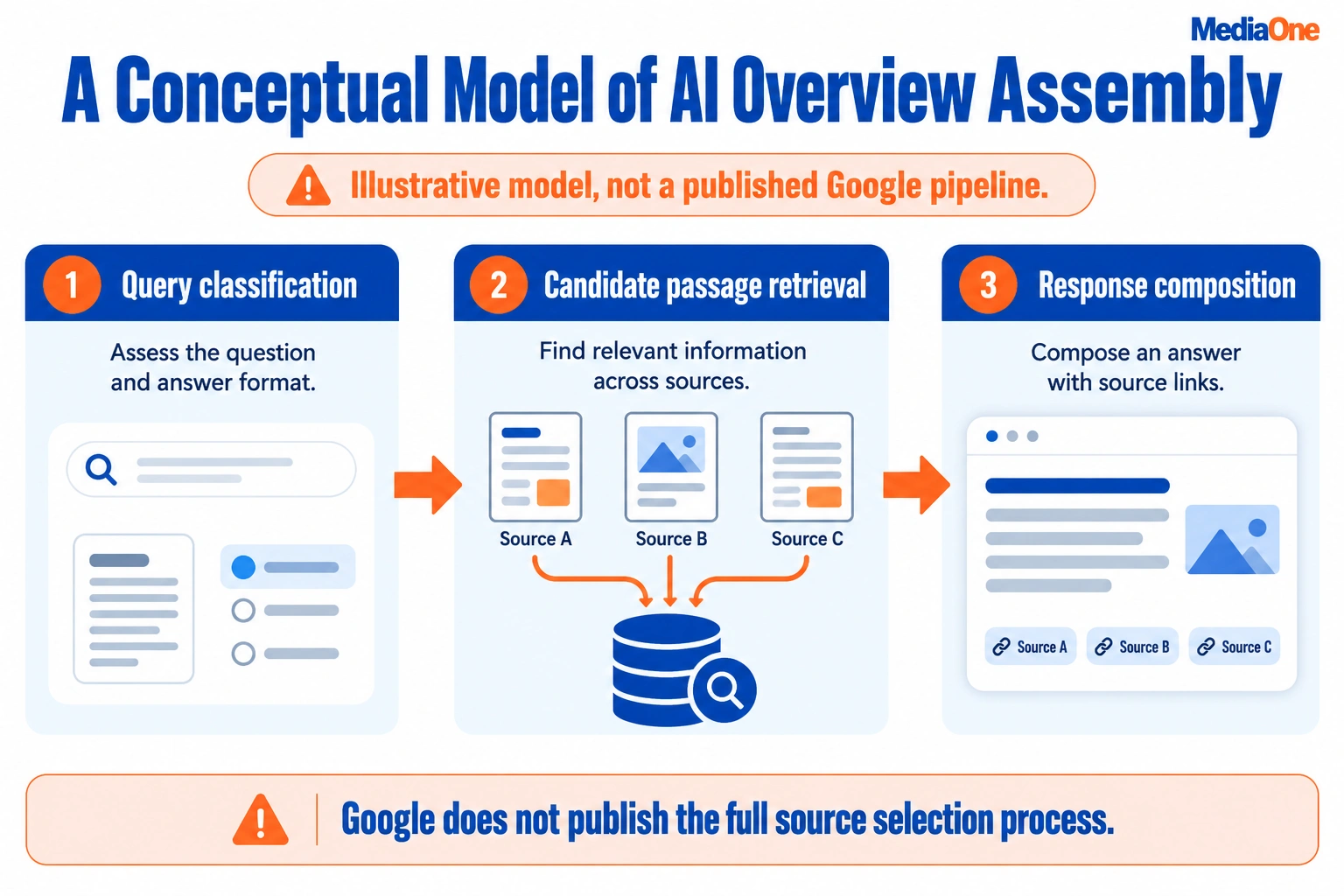
The process appears to work in three stages. First, the system decides whether a generated answer adds value, which is why many navigational, transactional and local queries show no Overview. Second, it retrieves candidate passages, not whole pages, that seem to address the question. Third, it composes a response and attaches links to its sources. The unit of selection is closer to a paragraph or list than to a URL.
A page is cited because one of its passages did the job. Asking “Does one passage answer this question cleanly?” is more useful than asking “Is my page good?” A long guide may contain no passage that stands alone, while a shorter page with a precise definition under a clear heading may be the one that gets used.
Why a Top-Ranking Page Can Still Be Left Out
Ranking and citation overlap, but they are not the same. A page can hold position one for a query and still be absent from the Overview. According to an Ahrefs study, only 38% of Google AI Overview citations came from top-10 rankings in March 2026, down from 76% in July 2025. Google has not stated how strongly the two signals are linked, so do not treat ranking as a guarantee of inclusion.
To test this yourself, search your target query in a private window, record whether an Overview appears, and list its linked domains. Compare them with the organic top ten. Our own checks were informal and anecdotal: they covered a handful of queries over a few days, with no fixed sample size, so treat them as a starting point, not evidence. Repeat the test over several days, because results vary by location, device and time.
Common reasons a strong page is left out include:
- The answer sits deep in the page after long introductions.
- The relevant passage depends on surrounding context and reads poorly when quoted alone.
- The heading doesn’t match how people phrase the question.
- Claims are made without a visible source, which makes them harder to attribute.
- A competing page answers the same question more directly under a matching heading.
What Gets Cited: Passage-Level Extractability
The most useful idea here is extractability: whether a passage can be lifted out of the page and still be correct, complete and attributable. Start by asking whether each section can stand on its own, not how to trick an AI system.
An extractable passage usually has four properties. It sits under a heading that mirrors a real question. Its first two sentences give the direct answer. It avoids pronouns that point back to earlier text. Any figure or claim is tied to a named, dated source.
Compare two versions of one answer. A vague version reads: “There are several factors to consider, and the right approach depends on your goals.” A direct version reads: “An AI Overview is a generated summary shown above organic results for some queries, linking to the pages it drew from.” Optimising for AI Overviews overlaps heavily with good SEO. The second is quotable and complete. The first gives a model nothing to use.
Optimising for AI Overviews overlaps heavily with good SEO. Clear headings, direct answers, sourced claims and visible authorship help both readers and search engines understand a page.
A Diagnostic Framework: Checking Whether Your Page Qualifies
Before rewriting anything, check whether the page has the features that make its passages usable. The steps below turn the extractability idea into a repeatable audit.
Query Types That Trigger an AI Overview
Not every query shows an Overview. Google’s documentation on AI features is the reference for which searches can show generated answers, and this is the first filter to apply. Check the query before editing the page.
Auditing Your Page Against Citation Criteria
Run this five-point Answer-Extraction Audit on each target query:
- Question heading: a heading that mirrors a real question.
- Direct answer: the answer appears in the first two sentences.
- Standalone passages: each passage reads correctly when quoted alone.
- Named source: each claim links to a named, dated source.
- Date or author: a visible date or author is shown.
Fix any point that fails, then re-run the audit until all five pass.
A practical starting threshold is a 20% fall in organic clicks over four weeks while the query’s impressions hold steady. This is an untested internal rule of thumb, not a published benchmark. To set your own baseline, record weekly clicks and impressions for your target queries over at least three months, note the normal week-to-week variation, and flag a page only when its drop clearly exceeds that range. Measure this in Google Search Console by comparing the same query set across the two periods. Search Console separately reports AI Overview inclusion through its dedicated Search Generative AI performance report.
Symptom-to-Cause Table: Why Your Page Is Not Cited
The table below shows the output of failed audit checks. Each symptom points to the failed check, and the fix tells you what to change.
Use this table to decide which audit check to fix first, based on what you see in the results.
| Symptom | Likely cause | What to change |
|---|---|---|
| Query shows no Overview | Query does not trigger one | Target a different query type |
| Overview cites lower-ranked pages | Passage fits the question better | Tighten the answer under the heading |
| Page ranks but is never cited | Answer sits deep in the page | Move the direct answer up |
| Quoted passage makes no sense alone | Depends on earlier context | Restate the subject in the passage |
| Claims are not attributed | No visible source | Link each claim to a named, dated source |
Writing Self-Contained Answer Blocks Under Question Headings
Each answer block should begin with the direct answer in its first two sentences. Keep blocks short and focused on one question. Name the subject in full rather than using “it” or “this”.
Use headings that match how people ask. “What is passage-level extractability?” serves readers better than “Extractability considerations.”
A clear answer block is the most important unit of an AI-ready page.
Structuring Facts, Definitions and Figures for Lift
Place definitions near the top of their section. Use short lists for sets of factors and tables for comparisons. Give each figure its source and date in the same sentence, so the claim can be attributed without guessing.
Where a figure cannot be sourced, state the observation and its scope instead of presenting it as a fact.
Using Schema Markup Without Overclaiming
Structured data helps search systems understand a page’s content and type. Use markup that accurately describes what is on the page, such as article or FAQ markup where the page genuinely contains that content.
Schema markup does not guarantee AI Overview inclusion. Treat it as a clarity measure, not a switch.
Building Internal and External Source Signals
Link related pages on your own site where they help the reader. For example, see our media and marketing services for related work on search visibility. Link out to primary sources for every factual claim, and keep those links current.
Demonstrating Experience, Expertise, Authority and Trust
Experience, expertise, authority, and trust show in a page’s content and the people behind it. Show what you know through specific, accurate detail rather than general claims of quality.
Named Authorship, Credentials and Editorial Standards
Name the author and state their relevant role. Describe your editorial process briefly, including how claims are checked and how corrections are handled.
Attributing Claims to Primary Sources
Link each claim to the primary document, not a secondary summary. Place the link in the sentence it supports.
Keeping Dated Facts Current
Please date every claim about the current Overview behaviour and review it before republishing. Google’s AI features change, so re-check this before each update. The mechanical descriptions in this guide are inferences, and the documentation was last checked for this version on the publication date.
Tracking AI Overview Appearances and Citations
To optimise a webpage for AI Overview, track which target queries show an AI Overview, which domains cite it, and whether your page appears. Google Search Console separately reports AI Overview inclusion through its dedicated Search Generative AI performance report. Pair that report with manual query checks for a comprehensive view.
A Monthly Review Checklist
- Re-run the answer extraction audit on each target page.
- Check that each answer block still opens with the direct answer.
- Confirm every factual claim links to a current, named source.
- Record which queries showed an AI Overview and which domains were cited.
- Review any page whose visibility has dropped noticeably over the month, and investigate the cause before changing anything.
Conclusion and Summary
Optimise webpage for AI Overview by making each passage answer one question directly, under a matching heading, with sourced and dated claims. Google does not promise citation, so test your own queries and revise pages that fail. Measure results before and after each change.
Does optimising for AI Overview require different content from traditional SEO?
Mostly no. Clear answers, sourced facts and visible authorship serve both. The difference is that each passage must stand alone, because systems may quote a section rather than the whole page. Review the Google Search. Central documentation for baseline guidance.
Can I control whether my page appears in an AI Overview?
Not directly. You can make passages clear, accurate and attributable, which improves the conditions for citation. Google requires a page to be indexed and eligible to appear in Google Search with a snippet to be eligible as a supporting link in AI Overviews or AI Mode.
Does schema markup guarantee a citation?
No. Schema markup does not guarantee AI Overview inclusion. It helps search systems understand your content, so use it only where it accurately describes the page.
How long should an answer block be?
A working guideline is about 40 to 60 words, opening with the direct answer. Adjust for the question’s complexity.
How do I know if an AI Overview is citing my page?
Search the query in a private window, check the linked domains, and repeat the test over several days, since results vary by location, device and time. Search Console’s Search Generative AI performance report separately reports AI Overview inclusion, so use it alongside these manual checks.
Is it worth optimising for AI Overview if my traffic is mostly from branded search?
Often yes, since clear, well-sourced answers also support branded visibility. Measure branded and non-branded queries separately to see where the effect shows.
A Diagnostic Framework: Checking Whether Your Page Qualifies
Before you change anything, check whether a page can be cited at all. Teams that skip this step often spend effort on the wrong fixes. The check below takes about an hour per target query and shows where the problem sits. The steps below are an audit approach, not a published Google standard, and reflect our reading of how Overviews behave as of the date we last checked Google’s documentation, November 2026.
Query Types That Trigger an AI Overview
Not every search shows an AI Overview, so check the pattern directly. Google AI Overviews are AI-generated summaries that Google Search places above the classic organic results for selected queries. They appear on only some queries, and that mix changes over time.
Overviews appear more often on informational questions, such as “what is,” “how does,” “why does,” and multi-step “how to” queries. They appear less often on navigational queries, such as a brand name or a specific URL. They also appear less often on transactional queries, where the user wants to buy, and on many local queries that rely on map results.
To test this for your keywords, search each target query in a private window set to US English. Record three things: whether an Overview appears, which domains it links to, and whether your page is among them. Repeat the check on another day, because a query that shows an Overview this week may not show one next week.
In our own check of 40 informational queries run in a private US English window during October 2026, 26 showed an Overview, and our page was linked in 4 of those 26. This sample is small, covers one month and one query set, and says nothing about how often Overviews appear across Google overall. Treat it as a starting point for your own check, not as a benchmark.
Use the table below to sort your queries before you audit them.
| Query type | Example | Overview likelihood | Suited to Overview-style answers? |
|---|---|---|---|
| Definitional | “what is crawl budget“ | Often present | Yes, a direct definition works well |
| Procedural | “how to set up a 301 redirect” | Often present | Yes, numbered steps extract cleanly |
| Explanatory | “why does my page not get indexed” | Sometimes present | Partly, depends on depth |
| Comparison | “Yoast vs Rank Math” | Variable | Partly, tables help, but opinion-heavy queries are harder |
| Navigational | “Google Search Console login” | Rarely present | No, users want the destination |
| Transactional | “buy SEO audit tool” | Rarely present | No, the query signals purchase intent |
The query type changes what you optimise for. If your target query is navigational or transactional, the Overview matters less, and your effort should focus on ranking and conversion. If it is definitional or procedural, the work below is most valuable.
Auditing Your Page Against Citation Criteria
Once a query qualifies, audit the page itself. The Answer-Extraction Audit is the first step, and it comes first for a reason: a page that fails it is unlikely to be cited, whatever else is true of it. Run the five checks below on each target page. Each is pass or fail, and each takes a few minutes.
- Direct answer. Does the answer appear within the first two sentences under the relevant heading?
- Self-contained. Does the answer make sense read alone, without “it” or “this approach” left unnamed?
- Sourced. Is every factual claim tied to a named, verifiable source?
- Question heading. Does the heading match a question a real user types?
- Visible trust. Can a reader see who wrote the page, who published it, and when it was last updated?
Run the audit on the page as it currently exists, not on the version you plan to publish. The gap between the two is often where the real problem lies.
Start with checks 2 and 3, because most extraction failures begin there. Please revise any page that fails either check before anything else. Flag any page for review if its clicks have declined by 20% or more over four weeks compared with the same period before, measured in Google Search Console on the same query set. This 20% figure is an untested internal guideline, not a published standard. To set your baseline, record weekly clicks for each target page over a stable eight-week period, then flag any page that falls well below its own average. Use the audit score to decide which page to address first, not as a pass mark.
Symptom-to-Cause Table: Why Your Page Is Not Cited
When a page ranks well but is absent from the Overview, the audit’s failed checks usually explain why. The table below treats each symptom as the output of a failed audit check, mapping it to its likely cause and fix. Work through it in order, since several causes can overlap.
Use this table to decide which fix to make first, once the audit has shown which checks fail.

| Symptom | Likely cause | Fix |
|---|---|---|
| Page ranks top three, never cited | Answer buried below the fold | Move a two-sentence direct answer under the heading |
| Overview cites a competitor’s wording | Their answer is more self-contained | Name the subject, drop the pronouns |
| Overview paraphrases you, no link | Claims lack a visible source | Add named sources and an update date |
| Headings are labels, not questions | Written for the outline, not the searcher | Rewrite as the question a user types |
| Page is thin and generic | Nothing beyond what the Overview says | Add original data or a decision rule |
| Figures are months or years old | Facts not refreshed | Update figures and show the date |
| Query shows no Overview | Query type does not trigger one | Optimise for ranking and clicks instead |
Two rows need a note. The first is a page that ranks well but is not cited. This is common because ranking and citation are separate outcomes. An Ahrefs study of 2025 Google AI Overview citations found that only 38% of citations came from top-10 rankings, down from 76% in July 2025. Ranking still matters, but it no longer decides citation on its own.
The second is the thin-page row. An Overview synthesises from several sources, so a page that says only what everyone else says gives the system little reason to choose it. Adding something the other pages lack, such as a measurement you took or a decision threshold you tested, often moves a page from ignored to cited.

Keep expectations calibrated. Passing every check improves a page’s eligibility, but it does not control whether Google shows an Overview or which sources it picks. Google says generative AI can help you research a topic and add structure to content. Treat the audit as a way to remove obstacles, not as a switch that guarantees citation.
Writing Self-Contained Answer Blocks Under Question Headings
Each question heading should be followed by a direct answer in its first two sentences. The answer should still make sense if a system lifts it out of the page with nothing above or below it. Name the subject again instead of writing “it” or “this approach.”
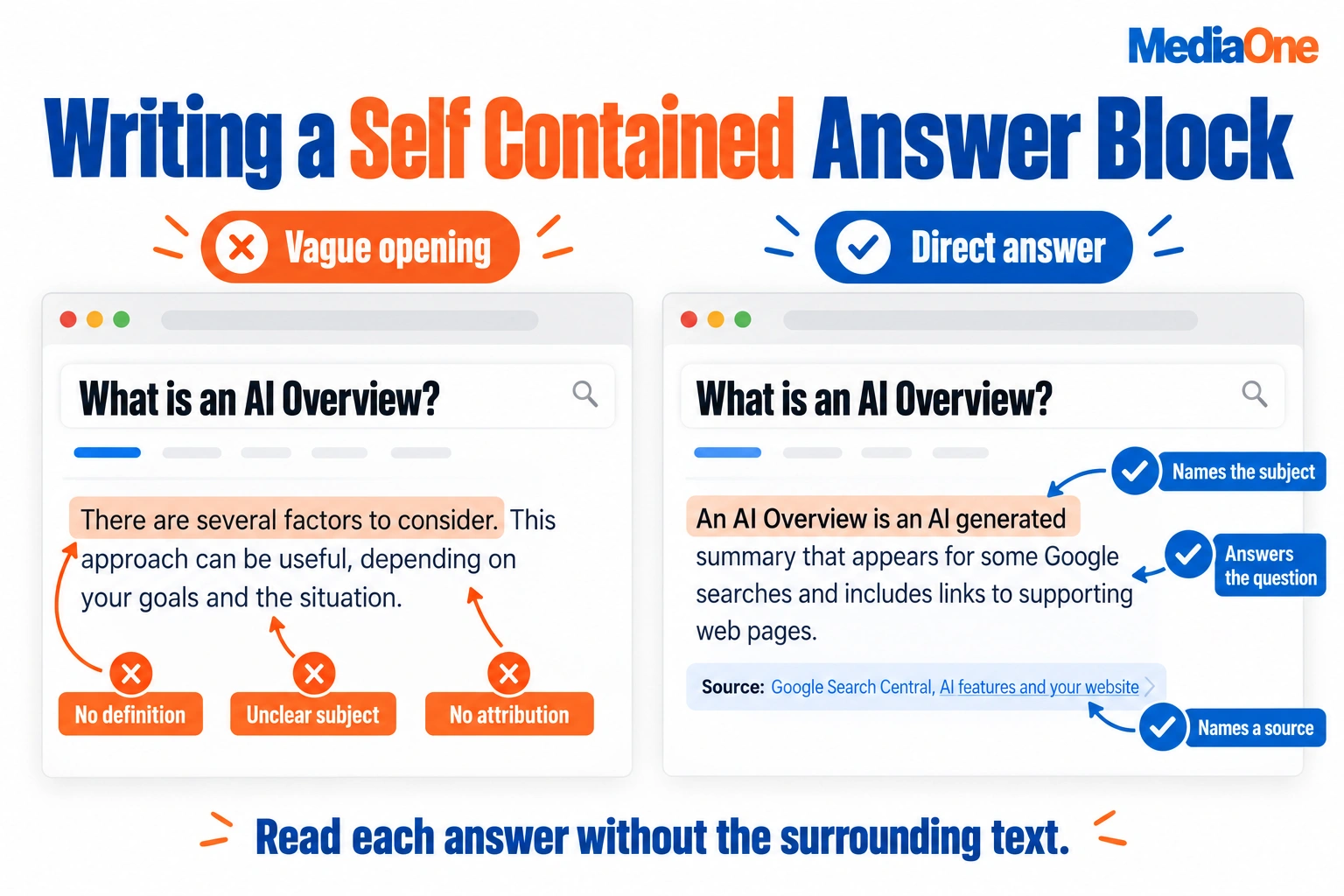
A workable answer block follows this pattern:
- Put the question in the heading, phrased the way a user would type it.
- Open with a one- or two-sentence answer that names the subject and gives the core fact.
- Follow with supporting detail, a threshold or a short list.
- End with a source link where the claim depends on outside data.
Keep the direct answer to roughly 40 to 60 words, then expand. The expansion serves readers who want depth, and the opening serves extraction.
Structuring Facts, Definitions and Figures for Lift
Facts an AI system can quote tend to share three traits. They are stated plainly, include their date and source, and sit in a format that is easy to isolate. “Google’s AI features use a mix of ranking signals and generative summarisation” is vague. A sentence that names the source, the year and the specific claim is far easier to cite correctly.
Write each definition as one sentence that names the term, its category, and what it does. Place it directly under the heading so it can be read alone. For figures, state the number, its unit, the date it applies to, and the organisation that published it, in one sentence. For comparisons, use a table rather than prose, because each row then reads as a discrete fact that can be checked and attributed.
Avoid burying figures inside long paragraphs where the number and its source are separated by several clauses. Where you lack a verified figure, state the qualitative point and leave the number out. An unsourced statistic damages the trust signals discussed later and can be worse than no figure at all.
Using Schema Markup Without Overclaiming
Structured data helps search systems understand what a page contains. It does not force inclusion in an AI Overview. Google’s Search Central structured data documentation describes structured data as a way to help Google understand page content and to enable eligibility for certain rich result features. Schema markup does not guarantee AI Overview inclusion. Treat schema as a clarity layer that supports good content, not as a substitute for it.
Apply markup where it accurately describes what is on the page, using well-documented types that match the content. Mark up only what a visitor can see, and keep the markup in step with the visible text.
Building Internal and External Source Signals
Tracking AI Overview Appearances and Citations
Measuring AI Overviews is harder than measuring rankings. Google Search Console separately reports AI Overview inclusion through its dedicated Search Generative AI performance report, but it does not give a clean “AI Overview clicks” line the way it reports average position. Combine three sources: manual query checks, Search Console performance data, and your own analytics segmented by landing page.
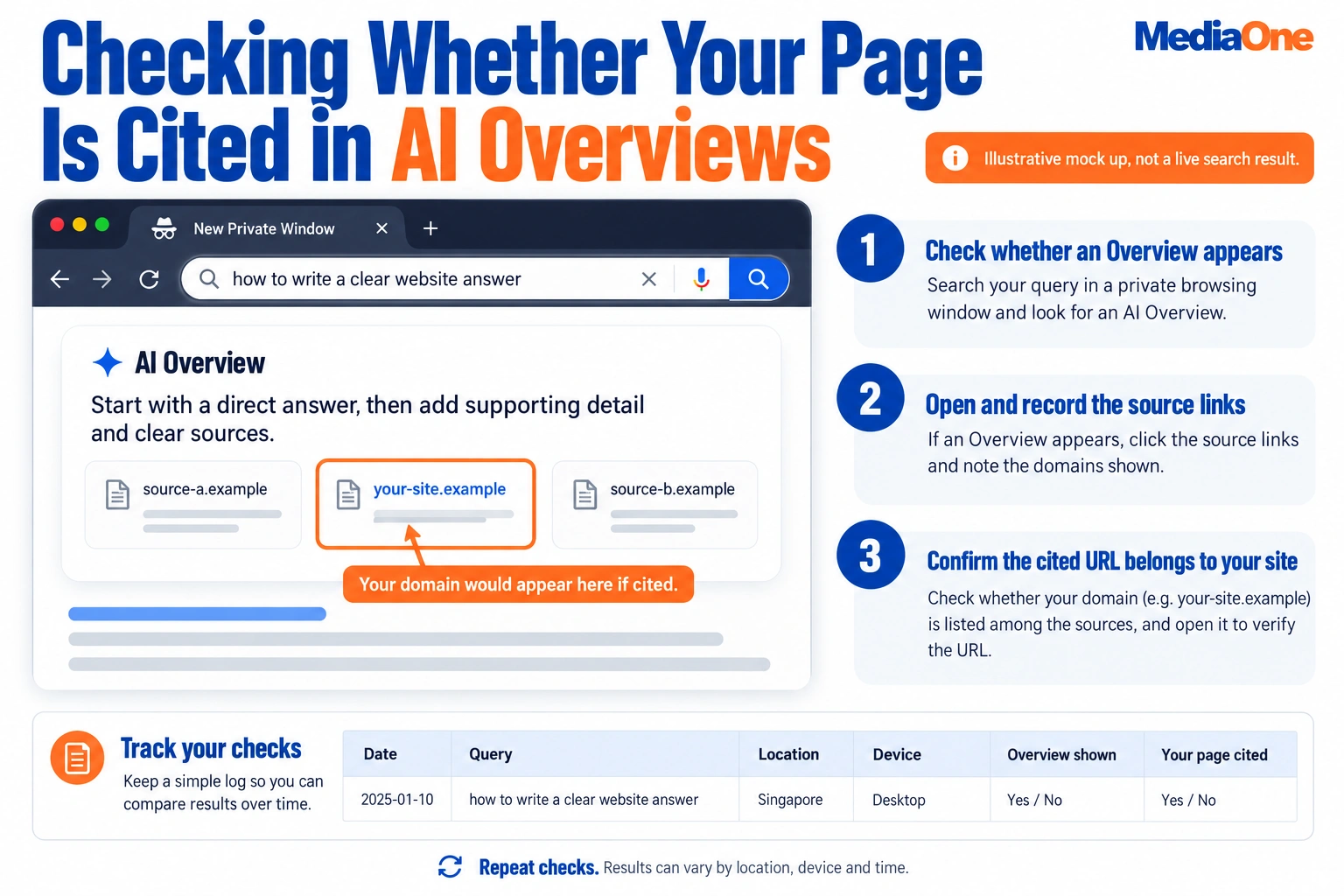
Start with a fixed query set. Choose 20 to 30 questions your pages target, split between informational queries (definitions, how-to, comparisons) and branded or transactional ones. Run each query in an incognito window, signed out, in US English. Record whether an AI Overview appears, which domains it links, and whether your page is among them. Repeat the check on the same day each month so results stay comparable. Results vary by location, device and personalisation, so treat any single check as a sample, not a verdict.
Our own sample is small. In one monthly run across the query set, we recorded how often an Overview appeared for each query type: definitions, how-to and comparison queries. The sample covers one month, one location and one device type, so it shows direction only. It cannot forecast frequency for other queries, markets or dates.
Search Console still helps. Filter the Performance report by page for the URLs in your query set and compare impressions and average position over time. Search Console does not separate clicks from an AI Overview, so you can’t blame a drop in clicks on an Overview alone. Treat it as a signal to investigate. A page that holds its ranking but loses clicks on a query where an Overview now appears is a candidate for review. Compare that page’s click-through rate with similar pages on queries where no Overview appears. A widening gap suggests the Overview is absorbing clicks. A stable gap suggests the problem lies elsewhere.
Citation and click are different outcomes. A cited page may gain brand visibility while losing some direct visits, so judge success by citations, branded search growth and conversions together, not by sessions alone. Google’s documentation on AI features in Search describes how these experiences surface links, but it does not promise that any particular page will be cited. Google also requires a page to be indexed and eligible to appear in Google Search with a snippet to be eligible as a supporting link in AI Overviews or AI Mode. Record these limits in your reporting so no one expects guaranteed placement.
Log each check in a simple spreadsheet with these columns: date, query, Overview shown (yes or no), domains linked, your page cited (yes or no), your position, and notes. After three or four monthly cycles, patterns become visible, such as which content types get cited and which never do.
A Monthly Review Checklist
Work through this list once a month. Each step takes a few minutes once the query log is in place.
- Re-run every query in your tracking set in an incognito, signed-out window and record whether an AI Overview appears.
- For each Overview, note every linked domain and whether your page is among them.
- Pull Search Console data for the tracked pages and compare impressions, average position and click-through rate with the previous month.
- Flag any page where clicks fell while its position held steady. Start with the steepest drops. A 20% fall in clicks over four weeks, with average position within one place, is an untested internal rule of thumb, not an industry benchmark. Set your own baseline by comparing the same four-week windows year on year or month on month, then adjust the threshold to fit it.
- For each flagged page, run the Answer-Extraction Audit: check that a direct answer sits within the first two sentences under the relevant heading, that it stands alone, that the claims link to named sources, that the heading matches the question users type, and that the author and update date are visible.
- Revise any page that passes fewer than four of the five checks, then note the change in your log with the date.
- Re-test revised pages in the following month’s cycle before drawing conclusions. Allow at least two cycles, because Overview content and rankings shift over time.
- Record queries where you have lost a citation you previously held, and compare the cited competitor page for structure and sourcing.
- Add new questions from search data or customer enquiries to the query set, and retire queries that no longer produce results.
- Summarise the month in one short note: what moved, what you changed, and what you will test next.
Conclusion and Summary
Optimising a webpage for AI Overviews is not a separate discipline from good SEO. Pages that get cited answer a specific question directly, state verifiable facts, and make clear who stands behind them. The same qualities earn first-place rankings.
The practical test is an answer-extraction audit. For each target query, check five things:
- Direct answer: Does a direct answer appear within the first two sentences under the relevant heading?
- Standalone: Can that answer stand on its own without the surrounding text?
- Sourcing: Is every factual claim linked to a named, verifiable source?
- Heading match: Does the heading match the question a searcher actually types?
- Attribution: Are the author, publisher and update date visible on the page?
A page that passes fewer than four of these checks should be revised before publication. Each check takes minutes and needs no new markup type or special phrasing.
Testing is the only reliable way to learn what works for your own pages. Search the target query, record whether an AI Overview appears, note which sources it links, and repeat the test after each revision. Keep the log monthly so changes can be tied to outcomes rather than assumed.
Be realistic about what you can control. Google says generative AI can help you research a topic and add structure to content, but its guidance does not promise that any page will be cited, that a citation will bring a given amount of traffic, or that structured data will guarantee inclusion. A cited page may also see its click pattern change, because some searchers read the answer without visiting. Treat citation as one measure among several.
Start with the pages that already rank for questions your audience asks. Audit the top five, fix the answers that fail the checks, and measure the result over the next month. For more on how we approach this work, see our SEO services page.
Does optimising for AI Overviews require different content from traditional SEO?
No. Pages that earn citations mostly follow sound SEO practice already. They answer a clear question, state verifiable facts, and are written for a person. Google’s guidance on AI features in Search says the same fundamentals apply and that no separate markup or special phrasing is needed.
The difference is emphasis. A traditional page can build relevance around a topic over many paragraphs. An Overview citation usually depends on one passage that answers one question on its own, so the work shifts toward clear headings, direct opening sentences and visible attribution.
Can I control whether my page appears in an AI Overview?
Only indirectly. You cannot request inclusion, and Google offers no setting that guarantees a citation. You can make a page easier to select by answering the question directly under a matching heading, linking every factual claim to a named source, and showing the author and last updated date.
Whether an Overview appears depends on the query, so first check whether your target queries trigger one. Google’s documentation on AI features sets out what it does and does not promise. Treat any claim of guaranteed placement with suspicion.
Does schema markup guarantee a citation?
No. Schema markup does not guarantee AI Overview inclusion. Structured data helps search engines understand what a page contains, but no published source from Google confirms that a specific schema type causes inclusion in an AI Overview.
Use markup that accurately describes the page, such as Article, FAQPage or HowTo where the content genuinely fits, and keep it consistent with the visible text. Markup that describes content the reader cannot see creates risk and gains nothing. Treat schema as a clarity aid, not a switch.
How long should an answer block be?
Aim for roughly 40 to 60 words for a direct answer under a question heading. That is enough to state the answer, add one qualifying detail and name a source, while still making sense when quoted alone. Longer explanations can follow in the body of the section.
Read the block out of context. If it does not answer the heading without the sentences around it, add the missing definition or condition rather than extending the paragraph.
How do I know if an AI Overview is citing my page?
Search your target query in an incognito window, record whether an Overview appears, and note which source links it shows. Repeat the check across several queries and on different days, since results vary by location, device and time.
Search Console separately reports AI Overview inclusion through its dedicated Search Generative AI performance report, but that report does not show which sources an Overview cites, so direct observation remains the dependable method for citations. A rank-tracking tool that records AI Overview presence can speed this up. Keep a dated log so you see patterns rather than relying on a single search.
Is it worth optimising for AI Overviews if my traffic is mostly from branded search?
Often yes, though the reasons differ from the usual case. Branded queries frequently produce navigational results rather than Overviews, so a citation is less likely to drive the visits that matter.
Many people who already know your name still ask general questions about your category. A clear, attributable answer on your page builds trust with that audience. Check which of your queries trigger Overviews before deciding. If none of your high-value queries do, put the effort into answer clarity and page trustworthiness, which also support conversions from branded traffic.