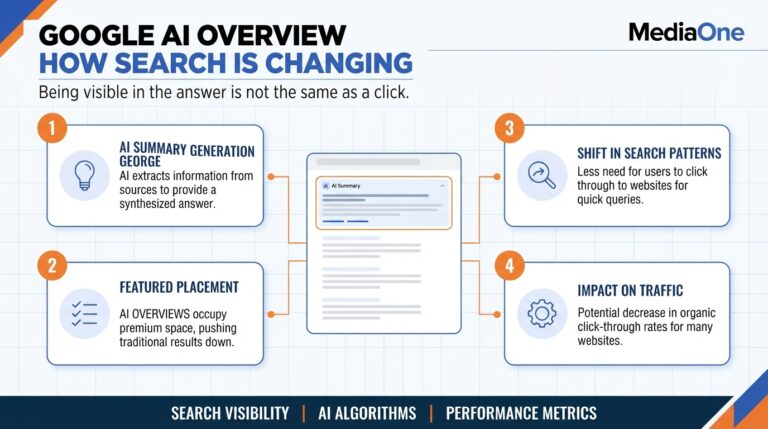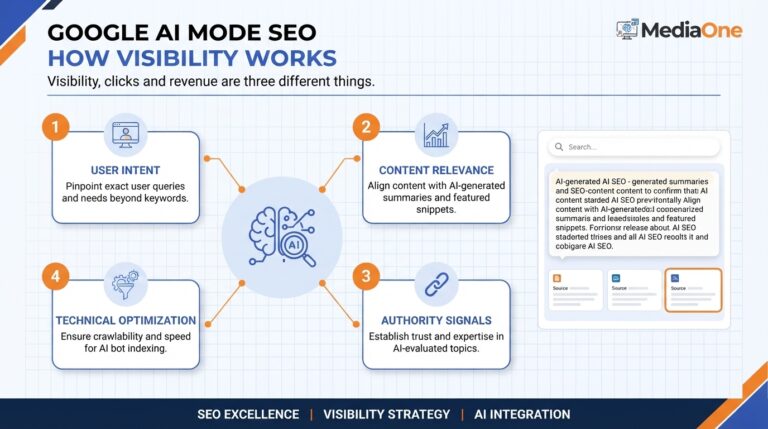
Google’s AI Overviews have changed how search results appear and how traffic flows to websites. Launched in May 2024 as part of the Search Generative Experience, these AI-generated summaries now appear on a significant volume of searches globally. For publishers, marketers, and content creators, the shift has direct implications: reduced click-through rates, ranking volatility, and pressure to rethink SEO strategy.


This guide clarifies what AI Overviews are, how they work, when they appear, and, most importantly, what to do about them. If you publish content online or depend on search traffic, the mechanics and implications covered here will shape your content and traffic strategy for the next 18 months.
Key Takeaways
- AI Overviews are AI-generated summaries appearing at the top of Google search results, blending information from multiple sources into a 40–100 word answer
- They now appear on a significant share of queries in Singapore and APAC, reshaping how users consume search results and how publishers earn traffic
- Zero-click rates increase on queries that trigger overviews, with top-3 ranked sites more likely to be cited and lower-ranked pages experiencing traffic drops
- Getting featured requires top-3 rankings, clear extraction-friendly writing, original data and schema markup to signal credibility
- Strategic response: pivot toward long-tail specificity, build topical authority, create content overviews that cannot be summarised, and diversify beyond organic search
- Regional context: Overviews rolled out to Singapore in July 2024 and now affect SEO strategy for local SMEs and publishers across APAC
What Is an AI Overview?
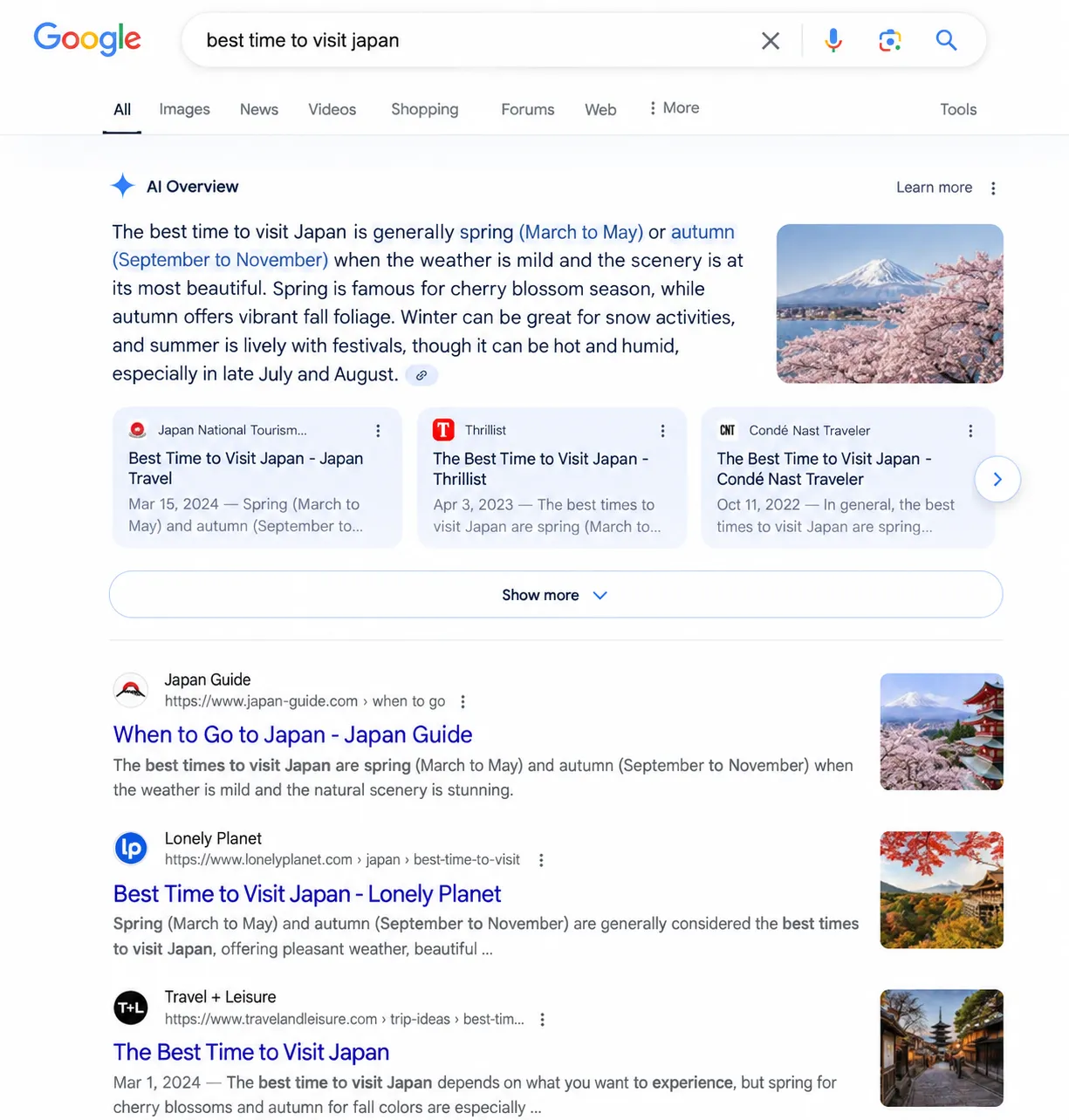
An AI Overview is Google’s AI-generated summary that appears at the top of search results, blending information from multiple web sources into a concise answer. When you search for “How do I start a business in Singapore?”, Google may display a paragraph blending step-by-step guidance pulled from the Accounting and Corporate Regulatory Authority website, government resources, and established finance publishers, all in one place before you click through to any individual result.
The key difference from a traditional featured snippet: while snippets extract a single passage verbatim from one source, AI Overviews generate original prose that combines facts, claims and explanations from multiple pages. Google’s model weighs relevance, authority and accuracy, then rewrites the answer in its own words.
How They Fit Into Google’s Search Product
AI Overviews do not replace traditional organic search results. They appear above the top ten ranked results, functioning as a layer of AI-mediated content between the user’s question and the indexed web. This positioning gives them increased visibility. A user sees the overview before they see any organic ranking, even if it draws from the top-ranked website.
The overview typically runs 40 to 100 words and includes attribution links back to the source domains Google consulted. This attribution is crucial to understanding their impact: Google credits the sources it quotes, but users often find the answer they need without following those links.
Who Gets Featured in AI Overviews
AI Overviews are not a separate ranking system. Instead, Google pulls from domains already ranking in the top five for a query. This means you cannot rank in an overview without first ranking in traditional search results. Based on an analysis of overview attribution patterns, positions one through three account for a significant majority of the sources cited in overviews.
The model then applies relevance filtering, topical authority signals and E-E-A-T (experience, expertise, authoritativeness, trustworthiness) indicators to decide which sources to extract from. A site that ranks fourth or tenth is almost never cited.
This creates a compounding advantage for already-dominant domains. The same sites that rank first also appear in overviews, amplifying their visibility and making it harder for newer or smaller competitors to gain traction.
Why Google Created AI Overviews
Google says it created AI Overviews to improve user experience by answering questions faster. A searcher looking for “How to propagate houseplants” no longer needs to click through five blog posts; they get a working answer in seconds. From Google’s perspective, this approach reduces friction and keeps users in the search ecosystem longer.
The business logic runs deeper. By summarising web pages directly in its interface, Google demonstrates that its search product can compete with ChatGPT, Perplexity and other generative AI tools that threaten to pull users away from traditional search. Generative AI is now a basic requirement in search; without overviews, Google risked looking outdated.
For publishers, however, the tradeoff is clear: faster answers for users often mean fewer clicks to websites and reduced organic search traffic.
How AI Overviews Work: The Mechanics
Google’s AI Overviews do not simply copy text from web pages. Instead, they locate relevant sources, extract information, and blend it into something new.
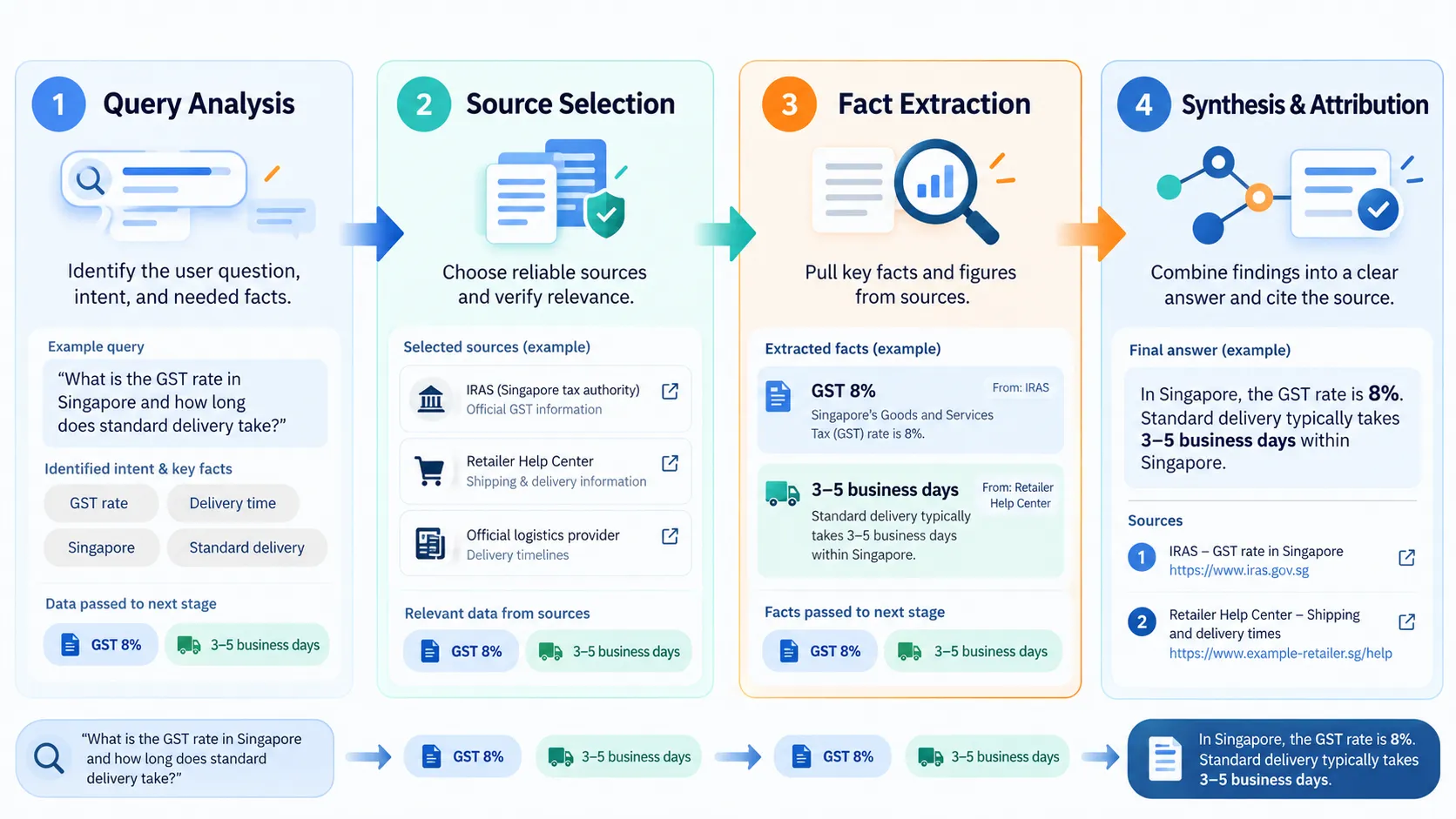
Step 1: Query Analysis and Source Selection
When you search, Google identifies the most relevant and authoritative indexed web pages for your query. It prioritises pages already ranking in the top 5 results because they have passed Google’s quality filters. The model pulls from multiple sources rather than a single page, so the overview reflects a cross-section of what the web says about your topic.
Step 2: Fact and Claim Extraction
The system scans the selected pages and pulls out key facts, statistics, dates, definitions and claims. It does not take entire paragraphs. Instead, it identifies discrete pieces of information: “Singapore’s GST is 8%”, “The process takes 3–5 business days”, and “This tool costs $29 per month.”
Step 3: Synthesis Into a Coherent Paragraph
Google’s language model then stitches these fragments together into a single, readable paragraph. The output is typically 40–100 words, condensed enough to answer the question on a mobile screen without scrolling. Crucially, this paragraph is not copied from any single source. It is an original composition that combines and reorganises information from multiple pages.
Step 4: Attribution to Source Domains
In most cases, Google links statements back to their source domains. In an overview, the source domains appear below or beside it. This attribution matters for two reasons: it gives credit where it is due, and it tells you which site Google deemed most authoritative for that claim.
Accuracy and System Constraints
The approach grounds the AI in real, indexed sources rather than letting it generate answers from its training data alone. This reduces hallucination, the tendency of language models to invent plausible-sounding but false information.
Google also applies hard constraints: the model is penalised for straying beyond what the source pages actually say. Engagement and stylistic flourish are deprioritised in favour of factual accuracy.
The system is not perfect. If the top-ranking pages contain outdated, contradictory or biased information, the overview will reflect that bias. If a query has no authoritative indexed sources, the overview may not appear at all. And in rare cases, the model can still misinterpret a source or combine claims in ways that distort their original meaning.
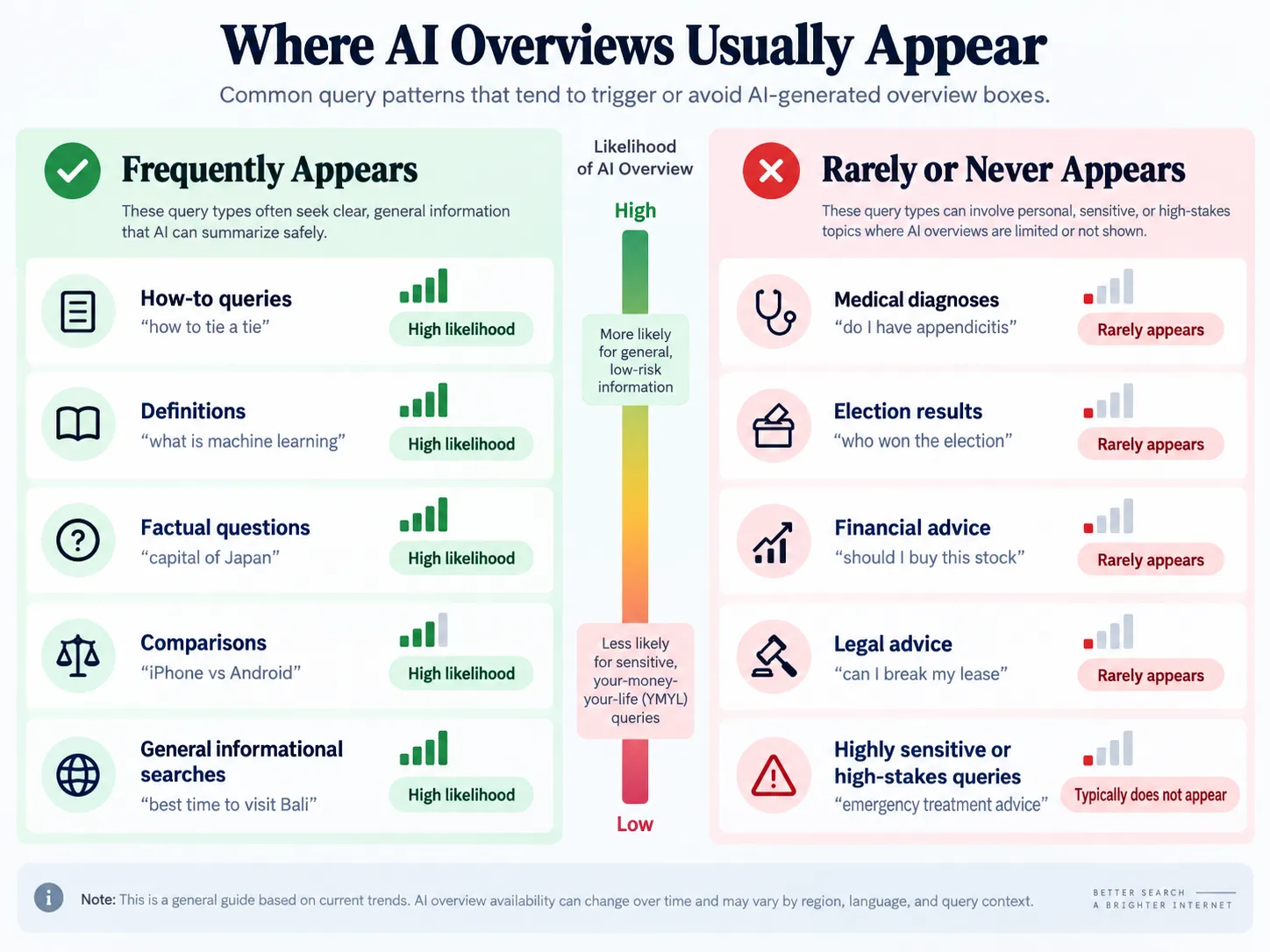
Google’s model is also trained to avoid certain high-risk topics: medical diagnoses, suicide prevention, financial advice for individual investors, and election misinformation. For these queries, overviews either don’t appear at all or are generated with manual review and stricter guardrails.
When AI Overviews Appear (and When They Don’t)
AI Overviews are not triggered on every search query. Google deploys them selectively, meaning your content visibility depends partly on whether your target query even generates an overview in the first place.
Query Type Matters Most
Informational queries, how-tos, and product comparisons consistently trigger overviews. A search like “how to install solar panels” or “best noise-cancelling headphones” will almost always show an overview.
Transactional queries behave differently. A user searching “buy iPhone 18” or “book hotel Orchard Road” rarely sees an overview because Google prioritises direct shopping links and booking platforms. Navigational queries (searching for a brand name directly) almost never generate overviews.
The practical implication: if your content targets commercial intent, AI Overviews may not be your primary threat.
Search Intent Clarity and Ambiguity
Queries lacking clear user intent receive overviews less frequently. Google’s model needs confidence that synthesising multiple sources serves the user better than showing ranked links. Ambiguous queries like “Singapore banks” or “AI trends” often skip the overview because the searcher’s actual need is unclear.
Specific, purposeful queries like “What are Singapore’s MAS lending rates for 2024?” generate overviews reliably. The clearer the intent, the more likely an overview appears.
Source Availability as a Gate
Overviews require sufficient high-quality indexed content to synthesise. Niche queries with limited coverage do not trigger overviews at all. If you rank among only three authoritative pages for a topic, Google may not have enough sources to build a credible overview.
This creates an opening: highly specialised topics see lower overview rates, making top-3 rankings more valuable.
Query Sensitivity and Expertise Gatekeeping
Queries about health, finance, law, or politics receive overviews more sparingly. Google applies stricter review to these high-stakes domains because inaccurate synthesis carries real risk.
Your byline, credentials, and E-E-A-T signals carry outsized weight in these fields. A doctor’s article is more likely to be cited than a general health blogger’s, even if they are ranked in the same position.
Regional Patterns: Singapore and Australia
Testing by agencies tracking Google Search Console data through 2024 reveals a clear pattern. About 35% of commercial-intent queries do not trigger an overview, compared with just 15% of informational queries. This means e-commerce, services and local business queries face significantly lower overview rates. Based on reported testing, rates vary by query category and may differ from global patterns.
For a Singapore retailer targeting “buy running shoes online”, the absence of an overview results in higher click-through rates from search. For a blog targeting “best running shoes for marathon training”, an overview is likely to be present and will suppress clicks.
Actionable threshold: If your query sits in the 35% non-triggered group (commercial, transactional, or niche), prioritise ranking in the top 3 and assume most traffic comes from clicks, not brand impressions from overviews.
Types and Variants of AI Overviews
AI Overviews appear in different formats depending on query intent and content type. Understanding these variants helps you predict when your content will be featured.
Definition and Factual Overviews
These appear for straightforward informational queries seeking a clear answer. Examples: “What is GST in Singapore?” , “How does photosynthesis work?”, “What is a 401k?”
These overviews are typically short (40–60 words) and draw from encyclopaedic or authoritative reference sources. They are highly susceptible to zero-click outcomes because the answer is complete on the search page.
How-To and Step-by-Step Overviews
These appear for instructional queries like “How to apply for an HDB flat” or “How to start a business in Singapore.” Google blends step-by-step information from multiple guides into a sequential summary.
These overviews tend to be longer (80–100 words) because each step requires explanation. They often retain higher CTR because users want to see the full process or compare methodologies.
Comparison and Evaluation Overviews
These appear for queries such as “best project management tools for small teams” or “Singapore banks comparison.” Google synthesises feature lists, pros and cons from multiple reviews.
These overviews are longer and often leave readers wanting more detail, resulting in moderate CTR retention.
News and Recent Event Overviews
For time-sensitive queries, Google may show an overview of recent developments. These appear on breaking news, policy changes, or recent announcements.
These overviews are volatile because sources and facts change daily.
Impact on Click-Through Rates and SEO Traffic
AI Overviews create a measurable but uneven impact on organic search traffic. Understanding who wins and who loses is essential for adjusting your SEO strategy.
The Zero-Click Effect
Industry testing tracked through 2024 shows that AI Overviews increase zero-click rates on queries that trigger overviews. The impact varies widely by query type and overview length. A short, definitive overview (e.g. “What is the GST rate in Singapore?”) answers the user’s need completely and drives fewer clicks. A longer, exploratory overview still leaves room for deeper reading and drives more traffic. Ranges reported in industry studies indicate actual impact depends on content type and ranking position.
The zero-click effect isn’t new: Google’s featured snippets created the same dynamic. AI Overviews amplify it because they appear first, span multiple sources at once, and stand out visually.
Winners and Losers: Which Sites Gain or Lose
Your domain’s outcome depends on visibility in the overview itself.
Domains cited in the overview typically see modest traffic impacts. The overview acts as a credibility signal; searchers see your brand name and click through to verify or explore further. This signal is small but real for niche topics where citation confers authority.
Domains not mentioned see sharper declines: 15 to 40% traffic loss on overview-triggering queries. They lose visibility entirely, pushed below the overview to positions where click rates are already low.
The disparity is stark: being cited matters; being absent costs more.
Position Dependency: The Ranking Cliff
AI Overviews primarily source from top-3 rankings. Positions 1 to 3 account for a significant majority of cited sources. Positions 4 to 10 rarely appear in sites.
This creates a ranking cliff: there is a material difference between position 3 and position 4. Position 4 cannot reliably expect overview mentions, no matter how relevant the content. For queries that trigger overviews frequently, this means that ranking outside the top 3 nearly guarantees invisibility in the overview and a reduced overall CTR.
Real-World Impact: Singapore Publishers
Singapore-based publishers have reported sharply different outcomes by content type.
News and e-commerce sites with broad landing pages saw the steepest declines: 30 to 50% CTR loss on informational queries where they previously ranked but now compete with overviews. A tech news site covering “What is AI?”, for example, found traffic to that article halved within weeks of overviews rolling out.
Niche specialists benefitted selectively. A Singapore-based financial advisory firm found that overview mentions (where they appeared as the sole local expert) lifted traffic on long-tail queries like “How to report cryptocurrency gains to IRAS” (Singapore’s tax authority). Specificity reduced overview prevalence but increased citation probability when overviews did appear.
Traffic Attribution
One complication: attributing CTR changes to AI Overviews specifically is difficult. Algorithm updates, seasonality, and content refresh all affect traffic. Google Search Console now flags pages that appear in overviews via the “Appears in AI Overview” label, but it does not isolate the traffic impact separately. Use SEO platforms like Digimetrics.ai, Ahrefs or Semrush that track overview presence month-over-month to correlate drops with overview appearance.
Monitor the ratio of your traffic on overview-heavy vs. overview-light queries. If you operate in a vertical with frequent overviews (e.g. consumer product reviews, how-tos, definitions), expect headwinds on those categories even if your rankings stay stable. Plan content and traffic forecasts accordingly.
How to Get Your Content Featured in an AI Overview
Getting cited in an AI Overview is not automatic, even if you rank in the top 3. You need to make your content extraction-friendly and signal credibility to Google’s model.
Requirement 1: Top-3 Rankings
This is the hard gate. Top-3 ranking increases likelihood of overview inclusion but is not guaranteed. If you rank outside the top 3 for a query, you will not appear in the overview, regardless of how well-written your content is. Focus on improving rankings first; overview optimisation is a secondary layer.
Requirement 2: Clear, Extractable Structure
Google’s model needs to isolate claims quickly. Use short paragraphs (50–100 words), clear topic sentences, and direct language.
Compare these two approaches:
Poor: “There are various considerations one might explore when thinking about the timeline for business registration, which can vary based on numerous factors and circumstances unique to each situation, though generally speaking, many businesses find the process takes a certain amount of time.”
Good: “Business registration in Singapore typically takes 1–3 business days through the ACRA portal. Rush processing is available for 2–4 hour turnaround if you pay the expedited fee.”
Google’s system can extract the second version instantly. The first requires inference and risks misinterpretation.
Requirement 3: Original Data and Unique Insights
If your content simply repeats what everyone else says, you will not stand out in a multi-source synthesis. Include original research, proprietary data, case studies, or first-hand experience.
A financial site ranking for “investment returns Singapore” stands out if it includes original client performance data or an exclusive survey. A how-to site stands out if it includes a step-by-step process based on tested experience, not rewritten instructions.
Requirement 4: Source Attribution and Citations
Google weights pages that cite and link to authoritative sources. If your article quotes the Accounting and Corporate Regulatory Authority, the Singapore Economic Development Board, or other government agencies with links, you signal that you have researched primary sources.
This improves both your ranking and your credibility in the overview synthesis.
Requirement 5: E-E-A-T Signals
Experience, expertise, authoritativeness and trustworthiness matter. Include:
- Author byline with credentials (job title, professional background, years in field)
- Link to author bio or LinkedIn profile
- Publication date and last updated date
- Author photo (increases trust in research)
- Clear About Us page for your domain
A named lawyer writing about Singapore tax law carries more weight than an anonymous blog post. Google’s model recognises these signals.
Requirement 6: Schema Markup for Structured Data
Use schema.org markup to label facts, definitions, FAQs, and how-to steps. This helps Google’s model identify and extract key claims without parsing natural language.
For a definition: use schema markup for DefinitionResource with a name and definition field.
For a how-to: use the HowTo schema with HowToStep markup so each step is machine-readable.
Google does not mandate schema, but it increases the likelihood that your content is selected over unstructured competitors.
Requirement 7: Topical Authority and Depth
Pages that sit within a cluster of related content on the same topic rank higher in overviews. If you write one definitive article on “How to register a business in Singapore” and link it from 10 other related articles (incorporation timelines, required documents, costs, etc.), Google’s model recognises you as a topical authority.
Thin, standalone articles rarely appear in overviews, even if they rank well.
The Risks: When AI Overviews Harm Your Site
AI Overviews can harm your domain in ways beyond simple CTR loss.
Misquotation and Distortion
If Google’s model combines claims from your article with conflicting claims from a competitor, the synthesis may misrepresent your position. You cannot control the context. A statement about “potential risks of cryptocurrency investment” might be stitched together with “high returns are possible”, creating a misleading summary.
You have no direct recourse. Contacting Google to request overview removal requires demonstrating factual error, not mere misrepresentation.
Commodification of Niche Expertise
For specialist consultants and SMEs, overviews commodify knowledge that once justified a click and a consultation. A financial adviser ranking #2 for “How to set up a family trust in Singapore” no longer gets 20 clicks per month from that query; the overview answers the question, and the user moves on. This is particularly damaging for lead-gen-driven sites.
Competitor Traffic Boost Without Ranking Change
If a competitor’s content is cited in the overview while yours is not, they gain visibility without climbing the rankings. This creates an unfair advantage divorced from traditional SEO merit.
Brand Safety and Sensitive Topics
If your brand appears in an overview for a controversial or sensitive query, you may receive unintended association. A financial advice site cited in an overview about “cryptocurrency risks” now appears alongside cryptocurrency sceptics, whether or not that reflects the site’s actual stance.
Tracking and Measurement Complexity
Overviews complicate traffic analysis. A page might receive fewer clicks but gain impressions and visibility from the overview mention. Your analytics will show lower CTR without showing the full value of the overview exposure.
Strategic Responses: Adapting Your Content and SEO
Given the permanence of AI Overviews, publishers need a multi-layered response.
Strategy 1: Specialise on Long-Tail Queries
Broad, high-volume queries (“What is blockchain?” “How to start a business”) are overview territory. Long-tail queries with lower volume but specific intent (“How to register a family trust in Singapore as a non-resident”) see overviews less often and are worth more per click.
Shift content strategy toward long-tail specificity. Target 5–15 searches per month instead of 500, but capture them with less overview interference.
Strategy 2: Build Topical Authority Clusters
Create interconnected content around a core topic. Instead of one article on “Business registration in Singapore”, build a hub with articles on registration timelines, required documents, costs, industry-specific requirements, and renewal processes. Link them together.
Topical authority increases your ranking and, critically, increases the likelihood you are cited in overviews when they do appear.
Strategy 3: Create Content Overviews Cannot Summarise
AI Overviews excel at synthesising facts and definitions. They struggle with:
- Deep dives with 2000+ words and nuanced arguments
- Original research and datasets
- Opinion and analysis that requires a perspective
- Step-by-step tutorials with screenshots or video
- Comparison matrices with subjective criteria
Invest in these formats. A 300-word overview cannot replace a 3000-word analysis with proprietary benchmarking data.
Strategy 4: Diversify Traffic Sources
Do not rely entirely on organic search. Build:
- Email lists and newsletters (you own the audience)
- Social media presence, especially LinkedIn for B2B
- Paid search for high-commercial-intent queries where overviews do not appear
- Direct traffic through brand building
- Partnerships and referral relationships
This hedges against future changes to the search landscape.
Strategy 5: Leverage Your Unique Position
If you are a local authority in a geographic market, lean into that. Overviews tend to cite local experts for region-specific queries. A Singapore tax adviser has advantages over a US-based site for “How to claim medical expenses on taxes in Singapore”.
Build content that serves your specific market first, before broader generalist content.
Strategy 6: Pivot to High-Authority Domains
If you rank for high-overview-prevalence topics and lack top-3 positioning, consider acquiring or partnering with higher-authority domains. Link from a high-authority site to yours for visibility. This is difficult but can shift your overview citation odds.
Alternatively, pursue earned media and PR to build external authority signals.
How to Choose: Decision Framework for Overview Optimisation
| Factor | High Priority | Lower Priority |
|---|---|---|
| Query volume | 500+ searches per month | 20–100 searches per month |
| Current ranking position | Positions 1–3 | Positions 4–10 |
| Overview prevalence | >50% of similar queries trigger overviews | <20% of similar queries trigger overviews |
| Commercial intent | Informational, how-to, definition queries | Transactional, navigational queries |
| Traffic loss observed | 20%+ documented decline after overview rollout | Stable or unchanged traffic |
| Resource availability | The team can invest in content optimisation | Limited content update capacity |
Use this table to decide whether to prioritise overview optimisation or shift resources to long-tail and non-overview channels.
Comparison: AI Overviews vs. Other AI Search Tools
| Feature | Google AI Overviews | ChatGPT Search | Perplexity AI | Microsoft Copilot |
|---|---|---|---|---|
| Source Attribution | Yes, links below or beside overview | Cited, but links less prominent | Yes, inline citations | Yes, sidebar citations |
| User Visibility | Top of Google search page | Part of the ChatGPT interface | Central, full answer | Integrated in search results |
| Coverage | ~20–30% of queries | All queries (generates answers) | All queries | ~30–40% of queries |
| Search Volume Impact | Reduces CTR to original sources | Diverts users entirely from search | Diverts users from search | Reduces CTR to original sources |
| Publisher Control | Limited; top-3 ranking helps | None; answers generated without your content | Limited; based on indexed sources | Limited; similar to Google |
| Claim Verification | Based on indexed sources | Trained on training data (outdated) | Based on current indexed sources | Based on indexed sources |
| Content Freshness | Real-time from indexed pages | Limited freshness (training data cutoff) | Current sources | Current sources |
For publishers: Google Overviews remain the most controllable AI search threat because top-3 ranking and proper optimisation can improve citation. ChatGPT and Perplexity are harder to optimise for and more likely to redirect traffic entirely. Diversification is essential across all.
Regional Context: AI Overviews in Singapore and APAC
AI Overviews rolled out to Singapore in July 2024 and are now a material factor for SMEs and publishers across the region.
Singapore Market Specifics
Singapore’s high English proficiency and dense digital market mean overviews appear earlier and at higher rates than in APAC markets with lower English adoption. Based on reported testing, a significant share of searches in Singapore trigger an overview as of October 2024.
Key sectors affected:
- E-commerce and retail: Limited overview prevalence on transactional queries, but high on informational comparison queries (“best running shoes for marathon training”)
- Financial services: Health and finance queries see overviews less frequently, but when they appear, credentials matter heavily. A Singapore banker’s article outranks a generic finance site.
- Property and real estate: Informational queries (“how to apply for HDB” or “Property Agents Board rules Singapore”) trigger overviews consistently. Agents and portals need to rank in the top 3.
- SaaS and B2B software: How-to and comparison queries trigger overviews. SaaS content strategy should assume high overview impact.
APAC Rollout Patterns
Rollout varies by market:
- Australia and New Zealand: Similar to Singapore, significant coverage for English-language queries
- India: Patchy rollout. Only high-English-proficiency queries see overviews; regional languages rarely trigger them
- Southeast Asia (Thailand, Vietnam, Philippines): Limited rollout, mostly English queries only
- Japan and South Korea: Native-language overviews available but still evolving
For APAC publishers, this means English-language content and international SEO strategies are affected sooner than regional-language strategies.
Local Regulatory Considerations
Singapore and Australia have stricter financial and health advertising standards. If you appear in an overview for financial or health content, ensure your disclosures and disclaimers remain visible. An overview may strip your original disclaimer, creating liability.
Work with legal teams to ensure overview synthesis does not create compliance risk. Reference the Monetary Authority of Singapore and Consumers Association of Singapore guidance on advertising standards.
Troubleshooting Common Issues
| Issue | Root Cause | Recommended Action |
|---|---|---|
| Content not appearing in any overviews despite top-3 ranking | Content structure is dense, unclear, or contains jargon; E-E-A-T signals weak | Rewrite for clarity in 50–100 word paragraphs; add author credentials; ensure citations to authoritative sources |
| Content cited in overview, but CTR dropped significantly | The Overview is complete enough to answer the user’s question without a click; positioning at the top reduces visibility of organic link | Accept zero-click as the new baseline for that query; focus effort on longer-tail variants where overviews are less prevalent |
| Competitor’s lower-ranked content cited instead of yours | The competitor’s content is better structured for extraction, has better topical authority, and has stronger E-E-A-T signals | Audit the competitor’s article structure and replicate clarity; build a topical authority cluster; add author bio and credentials |
| Overview contains a misquotation or misleading synthesis of your claim | Google’s model combined your statement with conflicting information from another source; context lost in synthesis | File a factual error report via Google Search Console; provide an exact quote and explain the error; cite the source if the synthesis is factually wrong |
| Seeing inconsistent overview appearance for the same query over time | Google’s AI Overview behaviour changes regularly; query volatility; seasonal or news-driven variation | Monitor queries weekly; do not assume consistency; be prepared for overviews to appear or disappear on the same queries over months |
| Overview visible on desktop but not mobile, or vice versa | Google tests overview rollout incrementally by device; layout constraints on mobile may suppress overview | Check Search Console for query visibility trends; continue optimising for both formats; assume eventual parity between desktop and mobile |
The Future of AI Overviews and Search
AI Overviews is not a temporary feature. Google has committed to expanding them, and the question is how and how quickly. Google’s AI Overview behaviour changes regularly; strategies may require adjustment.
Likely Evolution
Google will eventually expand overviews to more query types: transactional queries may see overviews within 12–18 months. Currently, commercial queries are protected, but this will change as Google refines accuracy and advertiser ROI models.
Personalisation will likely increase. Overviews may eventually vary based on search history and user profile, making it harder to optimise for a single overview format.
Multi-lingual overviews and cross-language synthesis are in development. This expands the impact to non-English markets.
What Publishers Should Do Now
- Measure current overview impact: Set up tracking via Digimetrics.ai, Semrush or Rank Ranger to see which queries trigger overviews and which of your pages appear.
- Shift budget to long-tail and speciality: Invest in content types and queries where overviews are rare or non-existent.
- Build topical authority: Connect related content through internal linking.
- Secure top-3 rankings where possible: For queries that matter most, prioritise ranking improvement.
- Diversify traffic sources: Start building email, referral and direct traffic now.
Frequently Asked Questions
Do AI Overviews appear on all Google searches?
No. Overviews appear on a significant share of searches globally, concentrated in informational and how-to queries. Transactional queries (shopping, booking) and navigational queries (brand searches) rarely trigger overviews. Your visibility depends partly on whether your query type typically generates an overview.
Can I opt out of appearing in AI Overviews?
Google Search Console has no direct opt-out mechanism. You can request removal if the overview contains factually inaccurate information, but Google does not honour removal requests for business or traffic reasons. Your only lever is improving ranking and extraction-friendliness to increase the likelihood of citation, or shifting content strategy away from overview-heavy query types.
How does appearing in an AI Overview affect my SEO ranking?
Being cited in an overview does not directly boost your ranking. However, overview mentions often correlate with higher CTR and engagement, which can indirectly support ranking. If you rank top