| AI Summary
SEO content connects customer questions with pages that answer them and support a business goal. Singapore businesses can plan topics through search intent, local context and evidence from their own work. A four-part scoring method helps set priorities. Search Console, GA4 and sales records then show whether those pages earn visibility, visits and qualified enquiries. |
SEO content is website content created to answer search queries and attract relevant organic traffic. An effective process covers topic research, intent mapping, writing, fact-checking, internal linking and measurement. Singapore businesses should include local details where relevant, support claims with evidence and assess enquiries alongside search visibility.
Key Takeaways
- A topic score helps compare opportunities, but it cannot predict rankings.
- Search intent determines whether a query needs a guide, comparison, product page or service page.
- First-hand examples give readers information they cannot get from a general summary.
- Content reports need separate measures for visibility, website activity and business results.
- A 90-day review provides a planning checkpoint, not a deadline for SEO success.
SEO content gives a business a way to answer customer questions before a sales conversation begins. A reader might need a price explanation, a product comparison or help understanding a service.
For Singapore businesses, local detail can make that answer easier to apply. S$ examples, service coverage and relevant buying conditions help when they affect the decision. The work starts with choosing the question and continues after publication, when performance data shows what needs attention.
What SEO Content Is and Why It Needs a Purpose
SEO content includes articles, service pages, product descriptions, comparisons and other pages that answer searches. Each format serves a different need.
A long article cannot replace a product page when someone wants to buy. A service page may leave a learner without enough explanation. Content planning therefore starts with the reader’s task.
Customer questions give keywords meaning
A keyword identifies a subject. A customer question explains what the page needs to resolve.
For example, “office cleaning Singapore” might lead to questions about service frequency, contract terms or requesting a quotation. Those needs can support different pages.
A page brief should identify:
- The intended reader.
- The question behind the search.
- The answer the business can support.
- The next action available to the reader.
Google’s people-first content principles emphasise original information, sufficient detail and a satisfying reader experience. Repeating phrases adds little when the answer remains incomplete.
AI search still depends on sound SEO
AI Overviews and AI Mode create further ways for people to discover linked sources. Their presence also changes how a search results page looks.
Google’s generative AI search documentation keeps established SEO practices at the centre. Indexed, accessible pages and original information remain relevant; a particular writing formula cannot secure inclusion.
Direct answers help readers understand a section. Definitions, examples and supporting sources should remain together so that a short passage does not lose its meaning.
A budget should cover the full publishing cycle
Content costs include research, writing, review, publishing and maintenance. A low writing quote may exclude several of these tasks.
| Cost component | Work included | Question for the supplier |
| Research | Search intent, topics and source checks | What research comes with each brief? |
| Production | Interviews, writing and editing | How many review rounds are included? |
| Publishing | Formatting, images and links | Who prepares the page in the CMS? |
| Measurement | Reporting and lead tracking | Which outcomes will the report cover? |
| Maintenance | Fact checks and revisions | How are later updates priced? |
A team’s internal review time belongs in the budget too. Technical topics often need input from the people who deliver the service.
How to Map Search Intent Before Writing
Search intent describes what someone wants to achieve through a search. The page format should support that task.
A review of keyword intent helps connect search terms with the type of answer a reader expects.
Different searches need different pages
Four intent groups provide a starting point:
| Intent | Reader’s goal | Example query | Suitable page |
| Informational | Understand a subject | “what is SEO content” | Explainer or guide |
| Commercial | Compare options | “SEO agency or in-house team” | Comparison |
| Transactional | Take action | “request SEO quotation Singapore” | Service or enquiry page |
| Navigational | Find a known destination | “MediaOne contact” | Contact or named page |
Some searches contain mixed intent. Results may include guides, services and videos together. A page should still have one main purpose, with supporting information that helps the same reader.
Search results reveal the expected answer
The search engine results page, or SERP, shows the formats currently appearing for a query. A Singapore location setting helps make the review relevant. Private browsing alone does not establish location or remove every influence on results.
A research note should record:
- Common page formats.
- Questions appearing in results.
- The audience each page addresses.
- Missing explanations or examples.
- Dates and sources behind changing claims.
A result containing an AI Overview is a research prompt, not a source of verified facts. Claims still need checking against their original publishers.
Local detail should affect the decision
Singapore references work best when they explain something practical. A service area, local delivery condition or S$ cost example can change how someone evaluates an offer.
A payroll software comparison, for instance, needs to explain relevant capabilities and limitations. A generic introduction about Singapore’s business environment adds less than a worked example showing what the buyer must check.
Keyword analysis combines demand with business relevance. Search volume alone does not show whether a topic will attract customers.

How to Choose Topics With a Scoring Method
A scoring method helps teams compare topics using the same questions. It supports editorial decisions without claiming to measure Google’s ranking systems.
The following four-part score is a planning tool for this guide. Its threshold is adjustable.
Four criteria keep topic selection practical
Each criterion receives a score from one to five.
| Criterion | Score 1 | Score 3 | Score 5 |
| Buyer relevance | Weak connection to customers | Supports a common customer question | Directly supports an important buying decision |
| Content opportunity | Little additional value available | Some missing explanation | A substantial unanswered need |
| Available evidence | No reliable material ready | Sources and limited business input | Strong sources and first-hand evidence |
| Local relevance | Little connection to the target market | Some relevant local context | Local conditions strongly affect the answer |
Scores of two and four represent positions between these descriptions. A short note beside each score makes later reviews easier.
A total of 12 out of 20 can serve as an initial shortlist threshold. A high total does not cancel a serious evidence gap.
A worked example shows the limits
Consider a hypothetical office cleaning company assessing “office cleaning checklist Singapore”.
| Criterion | Illustrative score | Reason |
| Buyer relevance | 4 | Office managers may need the information |
| Content opportunity | 3 | Existing checklists leave some tasks unexplained |
| Available evidence | 5 | The company has documented procedures |
| Local relevance | 3 | Some building and service conditions apply |
| Total | 15/20 | Suitable for further planning |
The figures illustrate a decision process. They are not client results or a forecast.
A topic with weak evidence needs further research even if its total passes. Revenue relevance, production effort and existing pages also influence the final choice.
Related pages need distinct jobs
A topic cluster groups related pages around a broad central guide. Supporting pages explain narrower questions.
An office cleaning cluster could include:
- A central service guide.
- A cleaning checklist.
- An explanation of contract terms.
- A guide to service frequency.
An internal linking strategy connects these pages where the relationship helps readers. Several pages appearing for similar queries is a reason to investigate overlap, not automatic proof that pages need merging.
How to Structure SEO Content for Readers
A page structure should help readers find an answer and understand the evidence behind it. Headings, tables and examples give longer articles manageable sections.
On-page SEO connects those elements with titles, descriptions and other page details.
Answers belong near their questions
A section about content costs should begin with what affects costs. A section about measurement should identify the relevant measures.
A practical section order is:
- The direct answer.
- The explanation.
- An example or supporting evidence.
- Any limitation that changes the answer.
A price example needs its scope beside it. A reader should not reach the bottom of a page before discovering that the quoted amount excludes essential work.
Headings should describe the section
One H1 identifies the article. H2s organise main subjects, while H3s divide those subjects into smaller points.
Specific headings help readers scan. “How to Score Content Topics” communicates more than “A Closer Look”.
Paragraphs should contain one main idea. Lists suit parallel items, and numbered steps suit procedures. Tables help when the same criteria apply to several options.
A mobile preview often exposes problems hidden on a desktop screen:
- Paragraphs that occupy most of the display.
- Wide tables with dense cells.
- Small text inside images.
- Buttons separated from the explanation they support.
Examples should resolve confusion
A definition explains a term. An example shows how someone can apply it.
“Business evidence” may sound abstract. A documented process, authorised project photograph or customer question from a sales call gives the term a concrete meaning.
Hypothetical examples need labels. Readers should be able to distinguish an invented scenario from a completed client project.
How to Demonstrate Experience and Check Facts
Trust comes from identifiable expertise, accurate claims and evidence readers can inspect. E-E-A-T refers to experience, expertise, authoritativeness and trustworthiness; it is not a score a business can calculate for a page.
The strongest evidence depends on the subject. A technical explanation may need an expert review, while a product tutorial may need hands-on testing.
First-hand detail should be specific
A business can contribute knowledge that general research cannot supply.
Examples include:
- A recurring question customers ask.
- A process the team follows.
- A problem discovered during delivery.
- An authorised result with its measurement period.
- A limitation that affects the service.
An author biography should describe a real role and relevant experience. Unsupported awards, client names and performance claims do not belong in the copy.
Sources should match the claim
The original publisher usually provides the best place to check a statement.
| Claim | Appropriate evidence |
| Search platform behaviour | Platform documentation |
| Product capability | Current product documentation |
| Local requirement | Responsible Singapore authority |
| Customer result | Approved records and measurement method |
| Price example | Dated quote or labelled calculation |
A link should support the sentence attached to it. A source about search indexing cannot establish that a specific writing tactic increases sales.
Dates need equal care. A 2024 survey remains a 2024 survey when cited in an article reviewed in 2026.
AI assistance still needs editorial review
AI tools can help organise notes or draft an outline. Their output still needs checks for accuracy, originality and relevance.
Google’s generative AI content policy explanation warns against producing many pages without adding value. The production method does not replace editorial responsibility.
A reviewer should compare names, figures, quotations and links against the original evidence. Confidential business information also needs approval before publication.
A Six-Stage Workflow for Publishing SEO Content
A repeatable workflow gives each task an owner and an output. Small teams can combine roles, but the checks still need completing.
Research and briefing establish the scope
The first two stages decide what the page will do.
| Stage | Main task | Finished output |
| 1. Research | Assess demand, intent, existing pages and evidence | Topic decision |
| 2. Brief and outline | Define the reader, answer, sections and next step | Approved brief |
| 3. Draft | Explain the subject with examples and sources | Complete copy |
| 4. Edit | Check substance, facts, structure and language | Reviewed article |
| 5. Prepare links and page | Add references, images and metadata | CMS preview |
| 6. Publish and measure | Check the live page and record a baseline | Measurement record |
A brief should identify the main question, supporting questions, source material and conversion goal. Existing pages need checking so the new article has a distinct purpose.
Drafting and editing need separate passes
A draft develops the answer. Editing tests whether that answer holds together.
Three review passes keep the work manageable:
- Substance: The page answers the question and supports its claims.
- Structure: Sections follow a logical order and avoid repetition.
- Language: Sentences use familiar words and explain technical terms.
Readability tools can flag dense passages. Their scores do not establish factual accuracy or predict rankings.
A colleague unfamiliar with the topic can identify missing explanations. A specialist can check whether simpler wording has changed the meaning.
Publishing includes links, metadata and access
Internal links should explain their destination through natural anchor text. Google’s link best practices also support crawlable links that help people and search engines understand connected pages.
A publishing check should cover:
- Accurate page title and H1.
- Descriptive URL and meta description.
- Working links to final destinations.
- Relevant image alt text.
- Mobile layout and functioning forms.
- Indexing settings and canonical URL.
- A recorded publication or review date.
Google may generate a title link from several page signals. Search snippets may also come from page text, so the displayed result can differ from the supplied metadata.
The URL Inspection tool helps check indexing information. An indexing request does not guarantee inclusion or rankings.

How to Measure SEO Content in 2026
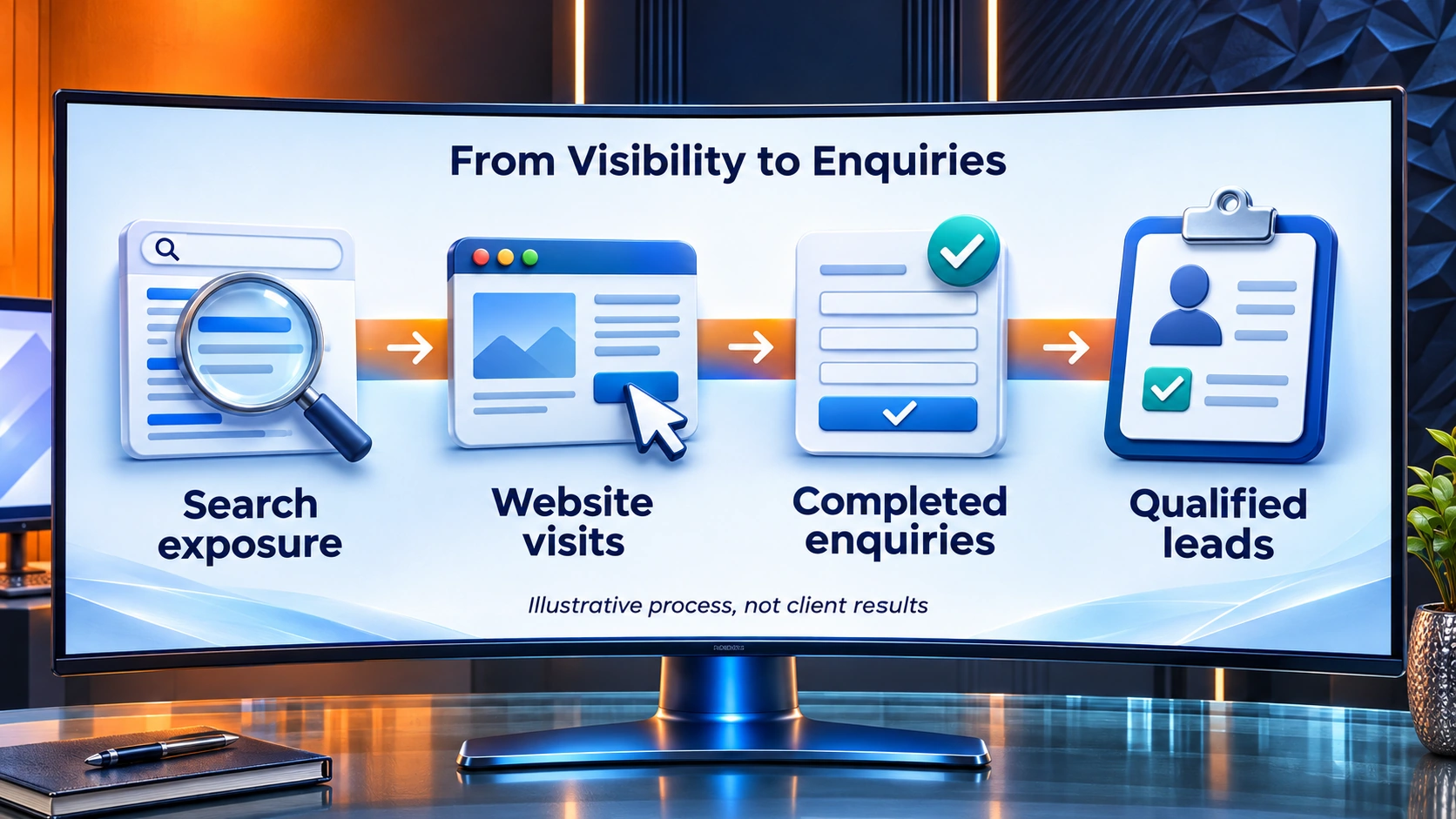
Content measurement should separate search exposure, website activity and business outcomes. A page can perform well at one stage and need attention at another.
A data-driven SEO framework connects reporting with decisions about what to improve.
Different reports answer different questions
| Measure | What it helps assess | Source |
| Impressions | Search exposure | Search Console |
| Clicks and CTR | Visits earned from that exposure | Search Console |
| Average position | Changes in reported search placement | Search Console |
| Engagement | Activity after arrival | GA4 |
| Key events | Selected business actions | GA4 |
| Qualified enquiries and sales | Commercial outcomes | CRM or sales records |
Google’s definitions of impressions, clicks and position explain why report totals need context. Average position is not a permanent rank shared by every searcher.
GA4 key events can measure selected actions, such as a completed enquiry form. A button click and a confirmed submission should remain separate events.
AI visibility has a dedicated reporting view
As of this review, Search Console’s Generative AI performance report reports impressions from AI Overviews and AI Mode. Its dimensions include pages, countries, devices and dates.
The report provides an AI visibility view within overall Search performance. Its impressions should not be added to the overall total as separate exposure. A missing report may reflect insufficient impressions.
AI exposure and commercial success remain different measures. A cited page may gain visibility without producing a visit or enquiry.
A 90-day review should diagnose problems
Ninety days provides a manageable first review point. It does not establish how long Google needs to assess every page.
| Symptom | Checks before editing | Possible response |
| No impressions | Indexing, access, demand and internal links | Resolve access issues or reassess the topic |
| Impressions without clicks | Queries, position, device and results layout | Improve relevance and title wording |
| Clicks without enquiries | Intent, offer, forms and tracking | Adjust the next step or repair measurement |
| Falling traffic | Seasonality, demand and recent changes | Investigate before rewriting |
| Several URLs sharing queries | Page purpose and sustained performance | Differentiate or consolidate where justified |
A single symptom can have several causes. Rising impressions with flat clicks, for example, may reflect new lower-position queries.
Review dates should follow the topic
A six-month review can suit stable content. Prices, product features and changing requirements may need earlier checks.
A review record should show what changed, why it changed and which measures will be watched. Redirects belong where a removed page has a relevant replacement. An unrelated redirect can leave visitors without the answer they expected.
Give SEO Content a Measurable Purpose
SEO content works towards a defined reader need and a business goal. Topic selection, evidence, structure and measurement help teams decide what deserves publication and what needs further work.
At MediaOne, our content marketing services and SEO services support businesses planning their search presence. A conversation with our team can help connect customer questions, content priorities and reporting with your commercial goals.
FAQs About SEO Content
Does SEO content have a minimum word count?
Google does not prescribe a preferred word count. A page needs enough detail to answer its question without repetition. Short definitions and detailed buying guides serve different purposes, so they need different lengths.
Can English and Chinese versions target the same subject?
Language versions can address the same subject for different audiences. Each version needs language-appropriate research and editorial review. Direct translation may miss the terms customers use. Separate URLs and suitable language annotations help organise multilingual pages.
Should important SEO content be available only as a PDF?
An HTML page usually gives readers easier access to links, forms and mobile layouts. A PDF can provide a downloadable checklist or report alongside it. The main explanation should remain accessible to people who do not want to download a file.
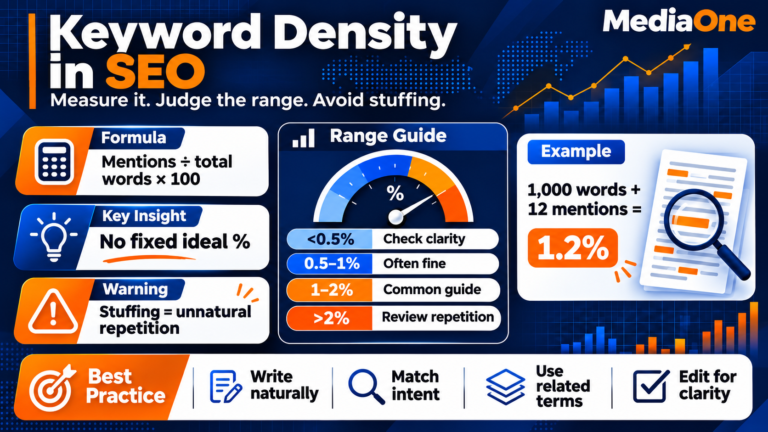
Is there an ideal keyword density?
No fixed percentage establishes content quality. The primary phrase belongs where it describes the page naturally. Related terms help explain the subject, while repeated wording can distract readers. A review should assess meaning and readability across the whole page.
A business can publish company-authored content. Readers still need enough information to understand who takes responsibility for it. A company profile, editorial contact and relevant reviewer details can help explain the origin of the information.