
| AI Summary
Keyword analysis helps businesses decide which search terms deserve attention and which pages should target them. The process combines search intent, business relevance, demand, competition and timing. This guide explains how to interpret keyword data, compare opportunities, score a shortlist and turn the results into page decisions. Examples show how businesses can avoid chasing traffic that brings few suitable enquiries. |
Keyword analysis is the process of evaluating search terms to decide which ones a website should target. It considers search intent, search volume, competition, trends and business value. The result is a prioritised keyword list that connects each topic with a relevant page and a measurable business goal.

Key Takeaways
- Search volume measures demand, but it does not predict visits, enquiries or sales.
- Google Keyword Planner’s competition column describes advertiser competition, not organic ranking difficulty.
- Difficulty scores need a manual check of the pages already ranking.
- Keywords that answer the same search need can often share one page.
- A scoring system helps teams compare opportunities, provided each score has a written reason.
Your keyword list is only helpful if it tells you which pages to build. A spreadsheet containing hundreds of terms can look impressive while leaving the main decision unanswered: which topic deserves your next investment?
Most teams can collect more keywords than they can act on. The harder task is separating relevant demand from searches that have little connection with the business.
Keyword analysis turns that list into decisions. The aim is to identify searches your business can answer well, assess the work required and connect each opportunity with an appropriate page.
What Is Keyword Analysis, and How Does It Differ from Research?
Keyword research gathers possible search terms. Keyword analysis evaluates those terms and decides what to do with them.
A payroll provider might collect “payroll”, “payroll software Singapore” and “how to calculate overtime”. Analysis examines who makes each search, what answer they expect and whether the provider can serve that need.
The output should include:
- A primary search topic.
- Related terms that belong on the same page.
- The searcher’s likely need.
- An existing or proposed page.
- A priority and a reason for that decision.
MediaOne’s keyword research services connect search demand with business goals. The analysis stage adds the judgement needed to turn those findings into content priorities.
Broad keywords describe a large subject, such as “accounting”. Their results may serve several audiences, making the searcher’s exact need difficult to identify.
Long-tail keywords sit in the lower-demand part of search activity. They often describe specific needs, such as “accounting software for a tuition centre”. Length alone does not define them, and lower volume does not guarantee easier rankings.
Related phrases add context. An overtime article may need to explain working hours, hourly pay and employment terms. Google’s language-matching systems can connect pages with relevant queries without every wording appearing verbatim. A separate “LSI keyword” list is unnecessary.
Start with Customer Language and Your Own Search Data
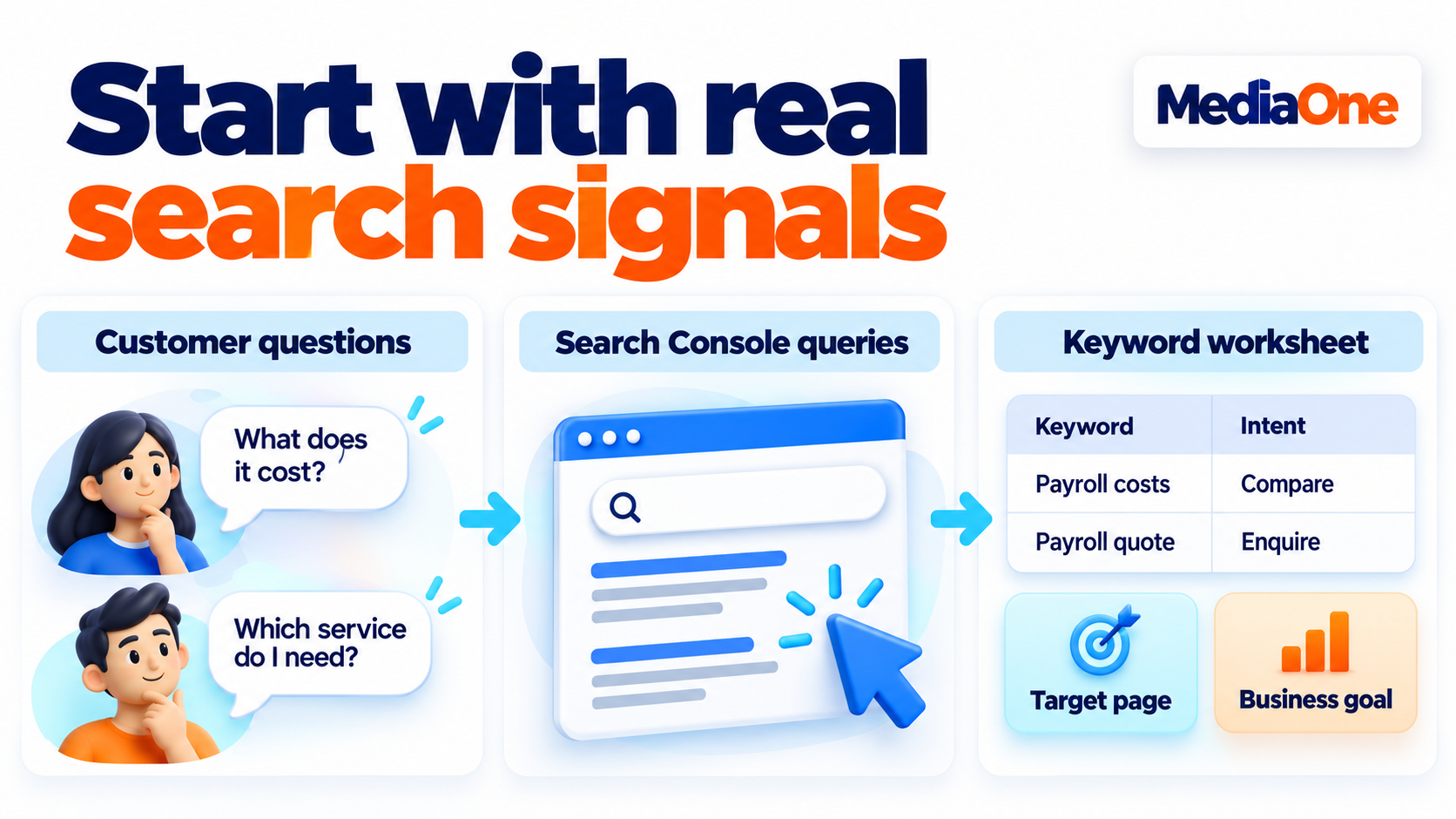
Your customers often describe problems differently from your marketing team. A bookkeeping firm may promote “outsourced financial reporting”, while customers ask why their accounts never balance.

Customer emails, sales calls and support requests provide starting phrases. A short list based on actual conversations gives the research a business connection before tools expand it.
Collect terms from existing activity
A starting list can draw from:
- Questions prospects ask before requesting a quote.
- Problems customers mention during onboarding.
- Products and services that generate enquiries.
- Queries already bringing visitors to the website.
Google Search Console’s Performance report shows queries, pages, clicks, impressions, click-through rate and average position. Country and device filters help narrow the review to the audience you serve.
Record enough context to compare terms
A keyword spreadsheet needs more than a volume column. Each row should explain what the term means for the business.
| Field | What to record |
| Keyword | The phrase being assessed |
| Audience and location | The people and market being targeted |
| Search intent | The task behind the search |
| Demand | The estimate, source and date |
| Current page | The relevant URL, if one exists |
| Business goal | An enquiry, purchase, sign-up or learning outcome |
This record supports data-driven SEO because later decisions can be traced to evidence.
How Do You Check Search Intent Before Choosing a Keyword?
Search intent describes what someone wants to accomplish. Keyword analysis needs this check because the same subject can support several different tasks.
A search for “payroll software” may favour product comparisons. “How does payroll software work?” calls for an explanation. A service page answering the second query may leave readers without the information they need.
Recognise the four common intent types
| Intent | What the searcher wants | Example | Likely page |
| Informational | An explanation or solution | “How does payroll work?” | Guide or tutorial |
| Navigational | A particular website | “CPF employer login” | The intended destination |
| Commercial | Help comparing options | “Payroll software for small businesses” | Comparison or product page |
| Transactional | A purchase, booking or enquiry | “Payroll services Singapore quote” | Service or enquiry page |
These labels are starting points. A search can contain mixed intent, and buying decisions often involve several searches.
Examine the results in the target market
The search engine results page, or SERP, provides evidence of the formats Google currently shows. A review should note:
- Page types: guides, service pages, categories or tools.
- Content formats: comparisons, instructions, videos or calculators.
- Recurring needs: price, eligibility, delivery or setup.
- Search features: shopping results, local listings, questions or AI answers.
Search results vary by location, device, time and personal context. Private browsing does not make a search location-neutral. Singapore businesses should assess the market they serve.
The relationship between keyword intent and page purpose should guide the format. An opportunity also needs an identifiable contribution: a worked example, local detail, original evidence or an answer competing pages overlook.
Read Search Volume, Competition and Click Potential Correctly
Keyword metrics describe different parts of an opportunity. Confusing them can produce a shortlist that looks attractive but asks the wrong pages to compete.
Search volume is an estimate of searches
Google Keyword Planner defines average monthly searches using the selected period, location and Search Network settings. Its figures include close variants and are rounded. They are not exact counts of individual people.
A global estimate can overstate demand for a business serving Singapore alone. Comparisons need matching locations, periods and sources.
The following example is hypothetical:
| Candidate | Monthly searches | Likely audience | Business connection |
| “Payroll meaning” | 8,000 | Learners seeking a definition | Indirect |
| “Payroll outsourcing Singapore” | 250 | Businesses assessing providers | Direct |
The second term may deserve earlier attention for a payroll agency. The first could still support an educational goal. Neither figure establishes likely revenue.
Paid competition is different from SEO difficulty
Keyword Planner’s competition column reflects advertiser activity. A “low” rating does not establish that organic rankings are easy.
Bid estimates can suggest advertiser interest, but they do not prove that a keyword will convert profitably for your business. Costs, margins and customer quality still need separate assessment.
Search demand does not equal website traffic
A results page may answer a short question without requiring a visit. Ads, maps, videos and other features also affect which links people choose.
Google’s AI search documentation says established SEO practices remain relevant to AI Overviews and AI Mode. No special schema or additional optimisation guarantees inclusion.
A keyword review should therefore record why someone would need the page: detailed instructions, evidence, a comparison or access to a service.

Assess Keyword Difficulty and Competitor Gaps
Keyword difficulty is a tool’s estimate of organic ranking competition. Different platforms use different methods, so scores should be compared within the same system.
A difficulty score can help organise a large list. It cannot account for every feature of your website, the proposed page or the current results.
Review the ranking pages themselves
A manual review should examine:
- Whether the pages answer the intended question.
- The evidence, examples and resources they provide.
- Their relevance to the target location.
- The websites and links supporting them.
- The work needed to offer a stronger answer.
A short page is not automatically weak. Some searches need only a brief explanation or a working tool.
A newer website may find opportunities among specific queries, but specificity alone does not make them easy. The comparison must consider what the current results deliver.
Look for gaps your business can serve
Competitor keyword analysis identifies searches where other websites appear and yours has little presence. Search competitors can include publishers, directories and marketplaces alongside businesses selling the same service.
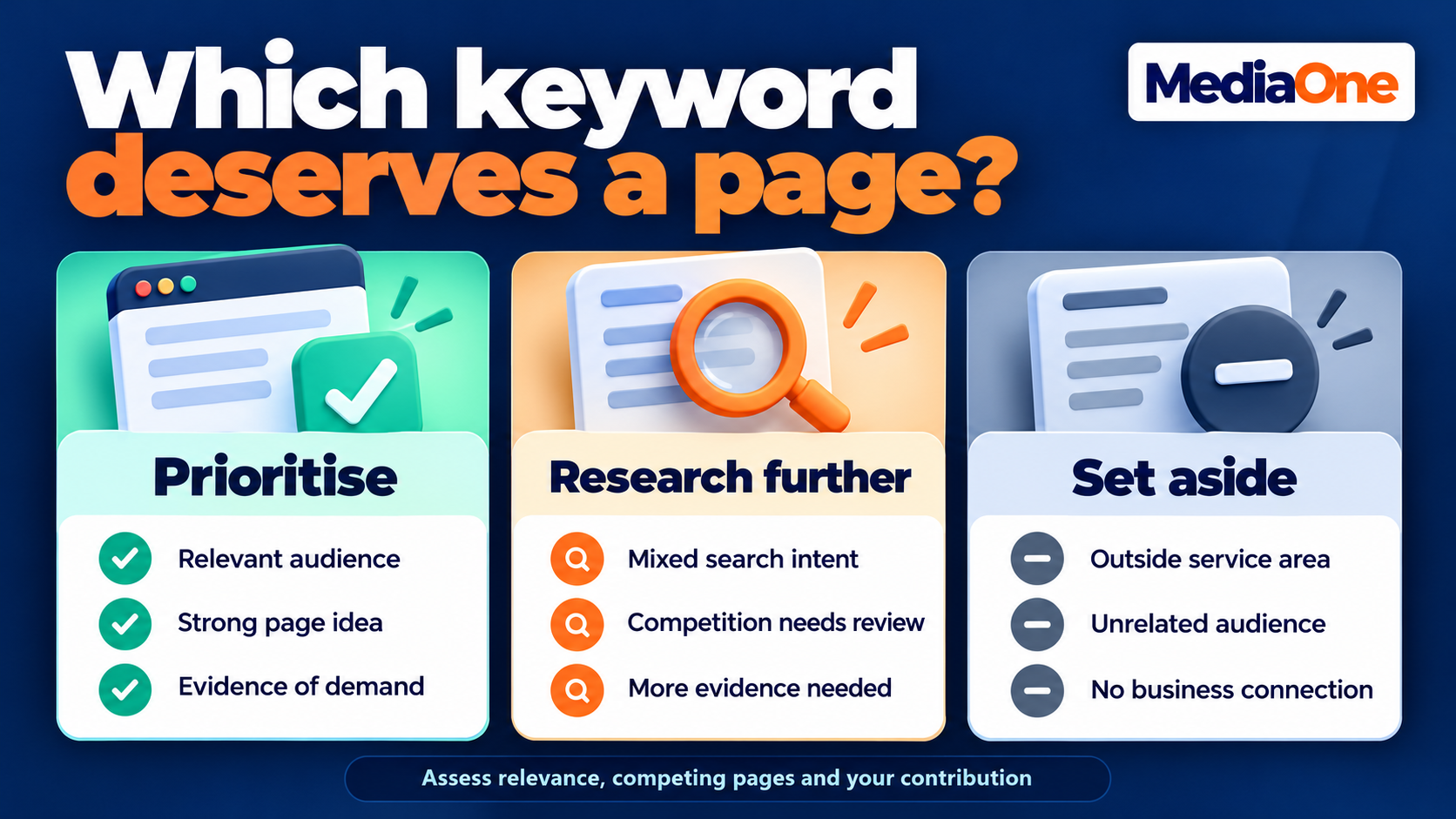
A gap deserves attention when it meets three conditions:
- The search connects with your offer.
- Your business can provide the expected page or resource.
- Your content can contribute something readers need.
Google Keyword Planner can generate ideas from a website address. It does not provide the multi-domain organic keyword-gap comparison described in some tool reviews. Its website-based keyword suggestions are idea generation, not proof of a competitor’s rankings.
Check Keyword Trends and Seasonal Demand
An annual average can hide the timing that determines whether a topic deserves attention. A business selling festive hampers needs to understand the build-up to demand.
Distinguish recurring patterns from isolated spikes
Google Trends shows relative search interest on a normalised scale from 0 to 100. A score of 100 marks peak relative interest within the selected comparison; it does not mean 100 searches. Low-volume terms may show zero.
Several years of data can help separate:
| Pattern | What it suggests | Planning implication |
| Recurring peaks | Seasonal or calendar demand | Prepare before interest rises |
| Fairly steady interest | Ongoing demand | Maintain a permanent resource |
| A single spike | An event or short news cycle | Assess whether interest will last |
| Sustained decline | Falling interest in that wording or topic | Check alternatives and customer demand |
A predictable seasonal keyword can be valuable even when demand falls between peaks. Year-round stability should not automatically receive a higher priority.
Plan timing without promising rankings
Historical patterns support planning, but they do not guarantee the next peak. Moving holidays, product launches and changing language can alter demand.
A publishing schedule needs time for production, review, discovery and possible indexing. No fixed number of weeks guarantees rankings before a peak. The schedule should reflect the website and the work required.
Score Keywords with a Repeatable Priority System
A scorecard helps teams explain why one term comes before another. The scores represent judgement supported by evidence; they are not a formula Google uses.
The following framework rates four factors from one to five.
| Factor | A score of 1 means | A score of 5 means |
| Intent match | The planned page cannot meet the search need | The page directly serves the task |
| Business relevance | Little connection with the offer | A strong connection with a business goal |
| Competitive opportunity | The required work exceeds current resources | The business can support a competitive page |
| Demand confidence | Demand is uncertain or poorly understood | Several signals support the opportunity |
Intermediate scores describe positions between these endpoints. Each score needs a note explaining the evidence.
Apply the scorecard to a small shortlist
The example below uses invented scores for a payroll provider.
| Keyword | Intent | Relevance | Opportunity | Demand confidence | Total |
| “Payroll outsourcing Singapore” | 5 | 5 | 3 | 4 | 17 |
| “Payroll software vs outsourcing” | 5 | 4 | 4 | 3 | 16 |
| “Payroll meaning” | 4 | 2 | 2 | 4 | 12 |
The comparison topic could deserve attention despite a slightly lower total. It may require less production work or support a sales question the team hears repeatedly.
Keep judgement in the decision
A team might shortlist terms scoring 14 or more, then review the evidence manually. That threshold is an internal planning rule, not an industry benchmark.
A high total should not override a fundamental problem. A keyword unrelated to the service area remains unsuitable even if other scores look strong.
The final decision also needs an effort estimate. A calculator, research report and short explanation can serve different opportunities, with very different production costs.
Which Keyword Analysis Tools Support Each Task?
A tool should answer a defined question. More subscriptions do not remove the need to assess relevance or examine the results.
Google Search Console and Keyword Planner
Search Console supports analysis of an existing website’s search performance. Keyword Planner helps discover ideas and assess estimated demand, advertiser competition and bid ranges.
Keyword Planner requires a Google Ads account and completion of the required setup. Its forecasts concern advertising performance; they should not be presented as predictions of organic visits.
Google Trends and paid SEO platforms
Google Trends helps assess timing and relative interest. Paid platforms such as Moz, Ahrefs and Semrush add keyword estimates and organic search analysis, with features varying by product and plan.
A comparison should use a small sample from your actual market. Database-size claims and headline prices provide little assurance that a platform covers your niche well.
| Tool | Main role in analysis | Important limit |
| Search Console | Existing queries and page performance | Covers your verified website |
| Keyword Planner | Keyword ideas and demand estimates | Advertising metrics need careful interpretation |
| Google Trends | Relative interest and seasonality | Does not provide monthly search counts |
| Paid SEO platform | Keyword and competitor estimates | Coverage and methods vary |
A starting set of SEO tools for beginners can support the core workflow. A paid platform earns its place when it answers a recurring question the free tools cannot address efficiently.
Turn Keyword Analysis into a Page Plan and Measure Results
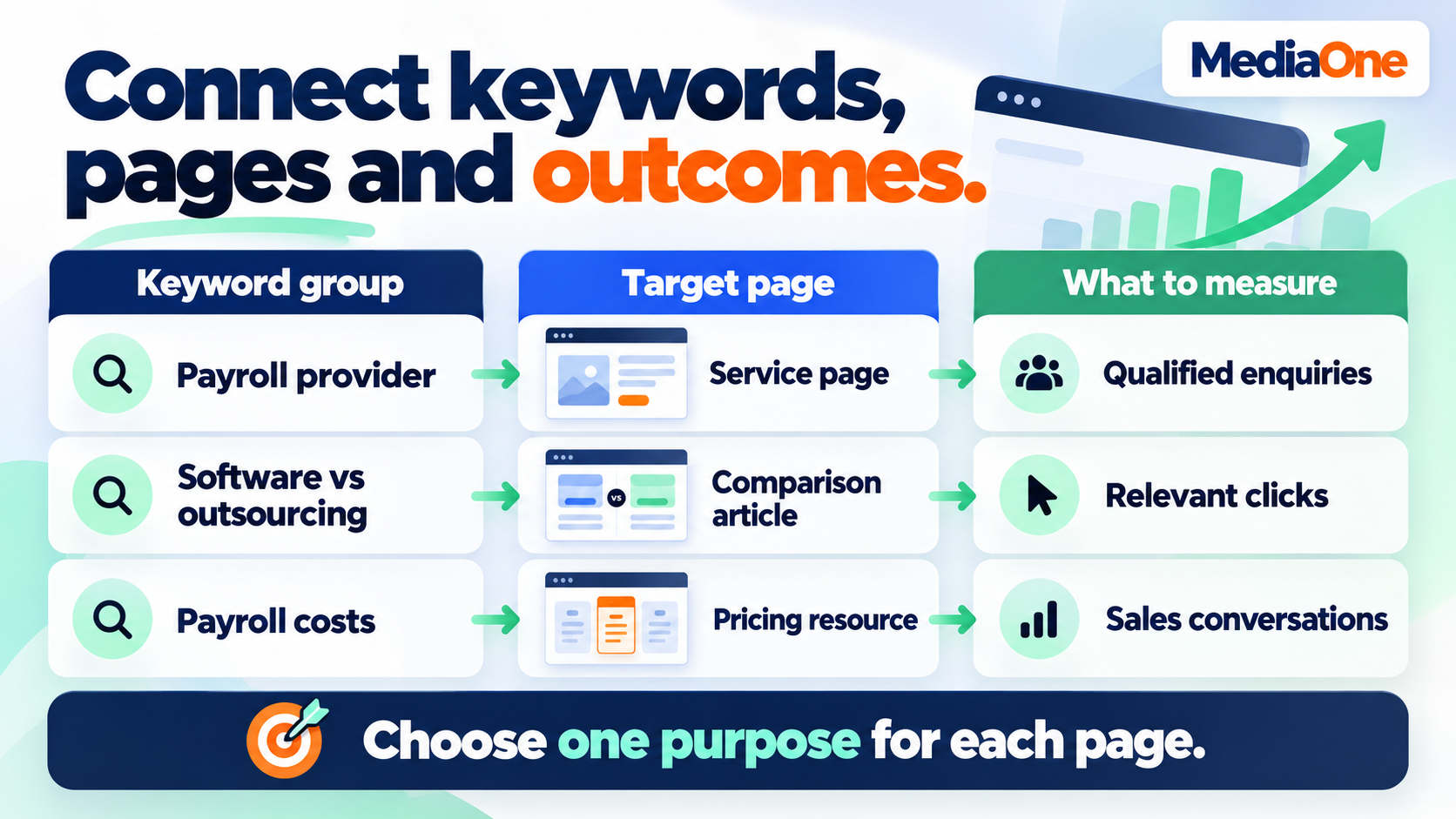
Keyword analysis is complete when the shortlist becomes a practical publishing plan. Every chosen topic needs an intended page, a purpose and an outcome to review.
Several phrases may belong on one page. “Payroll outsourcing cost”, “payroll service pricing” and “monthly payroll fees” could share a pricing explanation if they ask for the same information.
Separate pages need a meaningful difference in purpose. A guide explaining payroll outsourcing and a service page offering it can serve different tasks.
A keyword map should record:
- The primary topic and related searches.
- The existing or proposed URL.
- The intended page type.
- The evidence or examples required.
- The expected visitor action.
- The person responsible for delivery.
The choice between SEO content formats should follow the task. Online shops also need ecommerce SEO decisions that distinguish category, product and supporting content.
Build the page around the reader’s decision
The page needs to answer its main question early, then cover the details readers need to act. Headings should describe those needs in everyday language.
A well-structured SEO content writing process also gives the writer room for examples, limits and evidence. Repeating exact phrases adds little when the explanation remains incomplete.
Google’s keyword-stuffing policy addresses unnatural repetition intended to manipulate rankings. Related terms belong where they help explain the subject.
Relevant internal links connect supporting pages through descriptive anchor text. A pricing paragraph might link “payroll service costs” directly within its explanation.
Review performance against the page’s purpose
A baseline should capture existing search performance and the intended business outcome before publication.
| Result | What to investigate |
| Impressions rise but clicks remain low | Position, title, competing features and intent |
| Relevant visits produce few enquiries | Service details, offer and contact process |
| Unrelated queries dominate | Topic focus and page wording |
| Suitable enquiries increase | Lead quality and the page’s contribution |
Search Console reports queries, while analytics and sales records help assess page outcomes. Those sources do not automatically reveal which individual search term produced a particular sale.

Regular reviews connect content marketing investment with outcomes. Small datasets need time before they support major conclusions.
Conclusion: Turn Keyword Analysis into Better Page Decisions
Keyword analysis gives the next content decision a reason. A smaller shortlist with documented evidence is easier to act on than a large export without priorities.
The next page should have a defined audience, a search task and an outcome the business can assess. MediaOne’s SEO services support that connection between research, content and performance.
Our team can help assess keyword opportunities and connect them with a practical publishing plan. A conversation with MediaOne can start with the services and customers your website needs to reach.
FAQs about Keyword Analysis
Should keyword analysis include British and American spellings?
Spelling variants deserve checking when customers use both. “Optimisation” and “optimization” may appear in research, but a page can retain its audience’s preferred spelling. Separate pages usually need a stronger distinction than spelling alone.
Can website search logs help identify keywords?
Internal search logs can reveal what visitors struggle to find after arriving. Repeated searches may expose missing product details or confusing menus. These records describe existing visitors’ needs; they do not establish wider search demand.
Does keyword analysis work for multilingual websites?
Each language needs its own research. A direct translation can miss local wording, cultural context or buying habits. Native-language review helps assess whether a translated phrase expresses the intended need.
Are negative keywords part of organic keyword analysis?
Negative keywords control advertising eligibility. Organic search does not provide an equivalent list for blocking individual queries. An SEO worksheet can still record excluded topics so the team avoids spending content resources on them.
Can AI produce a reliable keyword shortlist?
AI can organise phrases and suggest angles, but generated terms may lack verified demand. Search data, customer language and result-page checks are still needed before those suggestions become publishing priorities.

Does a featured snippet draft guarantee a Google snippet?
Google selects snippets automatically. A concise answer can help readers and give Google relevant text, but publishers cannot guarantee selection. Google’s snippet documentation explains that search snippets can vary with the query.