| AI Summary
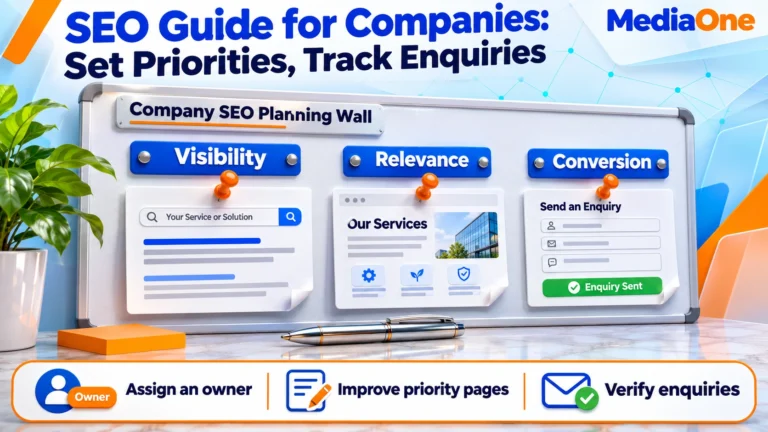
Company SEO connects search visibility with business results. Singapore businesses need a named owner, pages that answer buyer questions and reliable enquiry tracking. A three-lever audit checks visibility, relevance and conversion before more budget goes into content. Technical checks, accurate local listings and evidence of experience support that work. Monthly reporting should connect search visits with qualified enquiries and sales. |
An SEO guide for companies explains how a business can attract customers through unpaid search results. The main steps cover assigning ownership, checking website access, choosing buyer-stage keywords, improving service pages and measuring enquiries. Singapore companies should also maintain accurate local business details and review progress against a recorded baseline.
Key Takeaways
- Each SEO task needs an owner, a deadline and evidence that the work is complete.
- A three-lever audit helps separate visibility problems from weak content and enquiry barriers.
- Buyer questions should determine page topics; search volume adds context.
- Successful form submissions and qualified enquiries provide stronger evidence than contact-button clicks alone.
- A 90-day review should produce a short decision list tied to business priorities.
An SEO guide for companies should help a team decide what to do on Monday morning. Most Singapore businesses need a manageable starting point: which pages need attention, who will improve them and how the company will judge progress.
SEO means helping search engines find and understand a website while giving visitors reasons to choose the business. A small company can start with its main services, customer questions and enquiry process. A larger company needs the same foundations, with more coordination across teams.
The work becomes easier when each task connects to a business need. A broken quotation form deserves attention before another article joins the publishing queue.
Company SEO Starts With Ownership and Business Goals
SEO involves several people, even on a small website. A marketer may plan content, a developer may fix technical faults and a sales team may assess enquiries. One internal owner needs to keep those tasks connected.
A named owner keeps decisions moving
The owner does not need to perform every task. Their role covers priorities, approvals and monthly results.
A working record should include:
| Responsibility | What the company records |
| Business goal | The service, product or customer group being prioritised |
| SEO owner | The person accountable for progress |
| Delivery support | The writer, developer, freelancer or agency doing the work |
| Baseline | Current search visits, enquiries and known problems |
| Review date | The next meeting to assess results |
A focused SEO strategy connects these decisions with the pages receiving investment. “More traffic” needs a business explanation, such as reaching companies seeking outsourced payroll support.
A sustainable budget covers delivery and measurement
A first-year budget should account for website fixes, content work and reporting. The balance depends on the site’s condition and the team’s capacity.
A quotation should state what the provider will inspect, change and deliver. Separate allowances may cover development, photography or translation when those services fall outside the main agreement.
The cheapest proposal can become expensive when nobody implements its recommendations. A budget discussion therefore needs a second question: who has time to complete the work?
The Three-Lever Audit Shows What Needs Attention
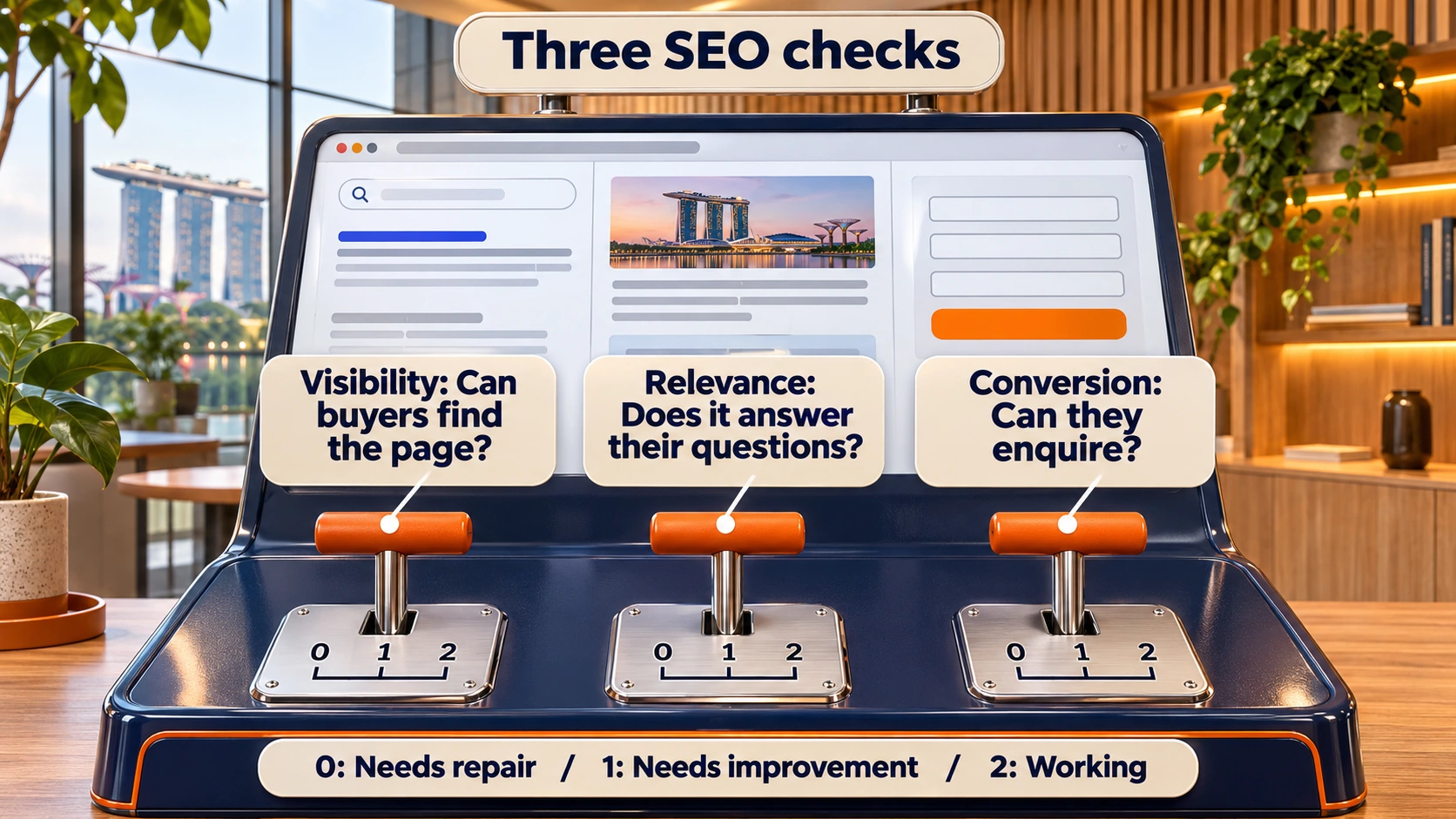
The three-lever audit is a planning worksheet for this guide. Its scores are internal judgements, not Google metrics or predictions of ranking success.
The three levers cover different parts of the customer journey:
| Lever | Score 0 | Score 1 | Score 2 |
| Visibility | Important pages have access or indexing problems | Pages are accessible, but relevant search exposure is limited | Target pages receive relevant impressions and clicks |
| Relevance | Pages miss the buyer’s main questions | Pages answer some questions but leave important gaps | Pages explain the service, evidence and buying details |
| Conversion | Enquiry routes fail or are difficult to find | Enquiry routes work but contain avoidable barriers | Enquiry routes work, receive testing and support measurement |
A score needs a written reason. “Visibility: 0 because the payroll service page has an accidental noindex tag” gives the team a task it can complete.
The lowest score helps set priorities
A low score points to a problem worth investigating. Business impact still determines the order, especially when several problems exist.
For example:
- A broken form requires repair before a new campaign sends visitors to it.
- An excluded service page needs an indexing investigation.
- A page attracting unrelated searches needs a content and keyword review.
- A working page receiving few relevant visits may need stronger coverage and links.
A single total can hide these differences. A website scoring four out of six could have strong content and visibility but no working enquiry form.
Evidence keeps the audit practical
The worksheet should name the affected URL, supporting evidence, proposed fix and owner. Screenshots, test submissions and Search Console records help explain the decision.
A data-driven SEO process becomes more practical when the evidence leads to a short task list. A small team may complete three important fixes faster than it can manage a report containing dozens of low-priority observations.
Technical Checks Protect Important Pages
Technical SEO helps search engines access the website and helps visitors use it. The first review should cover the homepage, main service pages and contact routes.
Crawling and indexing need separate checks
Crawling means a search engine can fetch a page. Indexing means the search engine has included it in its searchable collection.
The URL Inspection tool reports information about Google’s indexed version of a page and offers a live test. A successful live test does not guarantee indexing.
The review should cover:
- Accidental noindex tags on public service pages.
- Broken links leading to important information.
- Pages returning errors.
- Redirects sending visitors to unrelated destinations.
- Missing links from menus or relevant pages.
A sitemap lists URLs for search engines, but it does not guarantee that every listed page will enter the index. Each reported exclusion needs context; some excluded URLs, such as duplicate versions, may require no repair.
Mobile testing should include the enquiry process
A page can load successfully and still frustrate a customer. Small buttons, intrusive overlays and forms that reject valid details can prevent an enquiry.
A mobile review should test the complete task: finding a service, checking its details and sending a message. A successful submission should reach the correct inbox or customer system.
Google’s Core Web Vitals cover loading performance, responsiveness and visual stability. Good scores support page experience but do not guarantee high rankings.
Heavy images and scripts deserve attention when they delay important content. A developer’s fix list should explain which pages suffer and what visitors experience.
Buyer-Stage Keywords Turn Search Data Into a Content Plan
Keyword research starts with the language customers use. Sales calls, quotation requests and support messages can reveal needs that a broad keyword list misses.
A payroll company, for example, may hear questions about employee numbers, monthly fees and whether a package includes particular tasks. Those questions help shape the research.
Each buying stage needs an appropriate page
The same service can attract people at different stages:
| Buyer stage | Illustrative search | Appropriate page |
| Researching | “What does payroll outsourcing include?” | Explanation of tasks and responsibilities |
| Comparing | “Payroll outsourcing costs Singapore” | Pricing factors and package comparison |
| Ready to enquire | “Payroll services Singapore quote” | Service page with an enquiry route |
These examples illustrate intent; they do not represent verified search volumes.
Keyword analysis adds demand estimates, current rankings and an assessment of the results already appearing. A phrase with fewer searches can still deserve attention when it describes a service the company sells.
Specific wording does not automatically mean easy rankings. The team still needs to examine competing pages and assess whether it can provide a stronger answer.
Singapore context should reflect actual customers
Local terms can help when they describe the service accurately. A renovation company may encounter HDB-related questions, while an accounting firm may receive questions involving ACRA.
Location names also need a reason. A company serving all of Singapore does not need to insert every neighbourhood into every page.
Language decisions should follow evidence from customers and search data. Chinese, Malay or Tamil pages need their own research and language review; direct translation alone may miss how buyers describe the service.
One topic group should have a planned destination
A content worksheet can prevent several pages from answering the same question.
Each row should record:
- The buyer question and related phrases.
- The intended audience and buying stage.
- The destination URL.
- Missing information or evidence.
- The business outcome and content owner.
The publishing order should reflect gaps in the buying journey. A company without a complete service page has a different need from one whose service pages already attract qualified enquiries.
Service Pages Need Answers, Evidence and Relevant Links
A service page should help a buyer understand the offer and decide whether to contact the company. Search visibility brings the visitor; the page must support the decision.
Buying details belong near the service explanation
A practical service page answers:
- What does the service include?
- Which customers does the company serve?
- Which tasks fall outside the service?
- How does pricing work?
- What happens after an enquiry?
A provider that cannot publish a fixed price can explain the factors affecting a quotation. A cleaning company might price work according to premises size, frequency and access requirements.
Specific details reduce uncertainty. A vague promise about quality gives a buyer less information than an explanation of the work, timing and responsibilities.
Titles and headings should describe the page accurately
A title tag should identify the page’s main subject. A location belongs there when it describes the intended market.
A concise meta description can explain the page’s value, although Google may generate a different search snippet. Headings should divide the content into sections readers can scan.
Google’s SEO Starter Guide supports descriptive titles, organised content and meaningful link text. A fixed character count or repeated keyword formula cannot guarantee how a result appears.
The SEO basics remain relevant here: each page needs a recognisable purpose, accessible content and links that help people reach it.
Internal links should support the next question
A relevant article can introduce a service when the connection helps the reader. An explanation of payroll errors could link naturally to a payroll service page.
The anchor text should describe the destination. “Monthly payroll support” gives more context than “click here”.
A review should check whether important commercial pages receive links from related content. The aim is a connected website, without adding links to unrelated sentences or forcing every article through the homepage.

Local SEO Requires Accurate Business Information
Local SEO supports companies serving customers in particular places. A Google Business Profile can appear in Maps and local search results when the business meets Google’s eligibility requirements.
Profile details must represent the real business
Google’s business representation rules require accurate details. Businesses generally need in-person customer contact; online-only businesses are not eligible for a profile.
The profile review should cover the real-world business name, categories, contact details, hours and address arrangements. A service-area business that does not receive customers at its address should follow Google’s address-display requirements.
The company should retain ownership of the account. Staff and providers can receive appropriate access without becoming the only people able to manage it.
Reviews and location pages need genuine substance
Google describes local ranking mainly through relevance, distance and prominence. Accurate information helps Google understand the business, while reviews can contribute to prominence.
Review requests should invite honest feedback from customers without incentives or screening out dissatisfied people. Replies should address the customer’s experience without exposing private information.
A location page needs details that justify its existence, such as a staffed branch, local project or area-specific service information. Replacing one district name with another adds little value.
A local SEO programme should connect the profile with accurate website information and relevant service pages. Directory listings deserve maintenance when customers actually encounter them.
Business Evidence Supports Trust and AI Search Readiness
Buyers need reasons to believe a company’s claims. Project examples, accurate credentials and named specialists provide evidence they can assess.
Experience should appear through specific details
A project example can explain the customer’s problem, the company’s work and the documented result. Customer permission is necessary before publishing identifying details.
Trust checks should include:
- Current qualifications and memberships.
- Accurate team roles.
- Sources for factual claims.
- Genuine photographs or labelled illustrations.
- Dates where information can become outdated.
Relevant links from associations, publications or partners can help people discover the business. Paid ranking links and unrelated directory submissions create risk without establishing credible experience.
Structured data and AI visibility have limits
Structured data describes information in a format search engines can process. The chosen type should suit the page, and its claims must match visible content. Eligibility for a rich result does not guarantee its display.
A business can test supported markup with Google’s Rich Results Test. An online-only company and a customer-facing branch may need different approaches.
Google’s AI search documentation says established SEO practices remain relevant to AI Overviews and AI Mode. Special schema does not guarantee inclusion.
Direct answers, readable tables and sourced explanations help readers understand content. Those formats should serve the subject; they do not promise an AI citation.
SEO Reporting Should Follow Enquiries Through to Sales
A search report should explain what happened after people reached the website. Rankings and clicks provide context, while qualified enquiries show whether the business is reaching potential customers.
Tracking should distinguish interest from completed contact
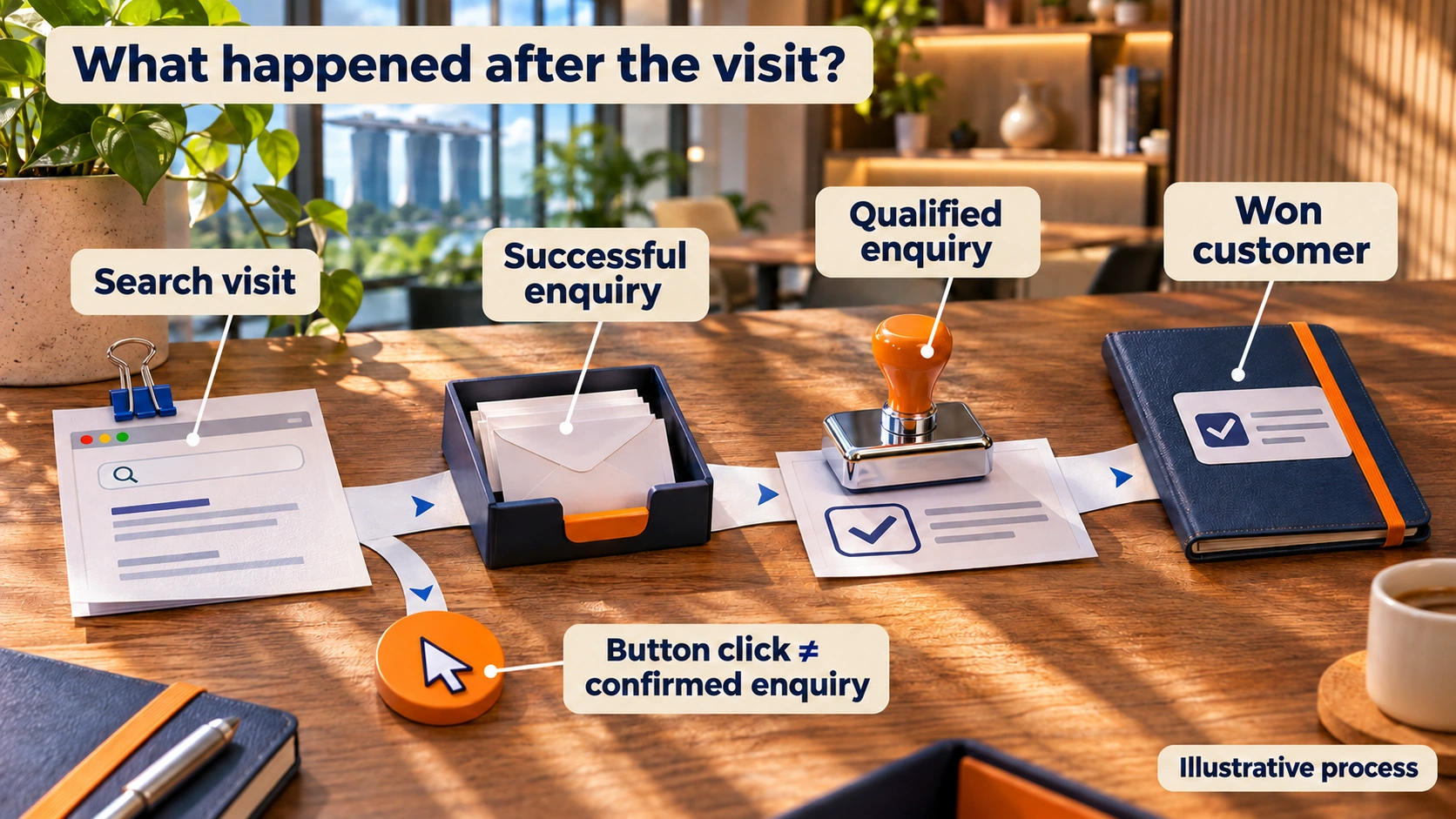
A phone-button click shows an attempted action, not a completed conversation. A WhatsApp click does not prove that a message reached the business.
Google Analytics lists generate_lead among its recommended events. The implementation needs to match the actual lead action, such as a successful enquiry submission. Important actions can then be marked as key events.
The sales record should distinguish:
| Measure | What it explains |
| Organic landing sessions | Visits beginning through unpaid search |
| Successful enquiries | Completed contacts recorded by the business |
| Qualified enquiries | Contacts meeting agreed customer criteria |
| Won work | Enquiries becoming customers |
| Attributed revenue | Sales linked under the chosen reporting method |
Consistent definitions make comparisons more reliable
A qualified enquiry needs an agreed definition. A commercial cleaning company might require premises within its service area and a request for a service it provides.
Duplicate contacts should not become separate new leads. Existing-customer support requests also need separate treatment.
An SEO ROI calculation requires cost and outcome data. Revenue alone does not show profit, and attribution cannot capture every influence on a sale.
A buyer may discover the company through search, return through a direct visit and enquire later. Reports should explain their attribution method and acknowledge missing data.
Monthly reviews need context
A rise in impressions without more enquiries does not identify one automatic cause. The review should examine query relevance, landing pages, tracking, demand and sales follow-up.
Seasonality and other campaigns can also affect results. A monthly report should record major website changes so the team can compare outcomes against actual work.
A 90-Day Plan Turns Findings Into Assigned Work
A 90-day plan gives the company a review cycle. It does not promise rankings or a fixed number of enquiries within that period.
Each month needs a defined outcome
| Period | Main work | Evidence of completion |
| Days 1–30 | Baseline, access checks, tracking tests and urgent repairs | Recorded problems, test results and assigned owners |
| Days 31–60 | Priority service-page improvements and buyer-stage content | Published changes and working internal links |
| Days 61–90 | Search and enquiry review | Findings, unresolved issues and next priorities |
The review should compare similar periods where possible. A short period containing holidays may not represent normal demand.
Small datasets require patience. Two enquiries becoming four is an increase, but it does not establish a dependable trend.
Outside support should fill a defined capacity gap
An internal marketer may manage a small website with occasional technical help. A freelancer may suit a limited research or content assignment. An agency may coordinate several disciplines across a larger programme.
The decision to hire an SEO expert should reflect the work required and the company’s ability to implement it. A review of proposed SEO services should identify deliverables, responsibilities, reporting and exclusions. The internal owner remains accountable for commercial priorities whichever delivery model the company chooses.
Company SEO Needs an Accountable Next Step
Company SEO connects ownership, website access, buyer questions and enquiry measurement. The three-lever audit helps teams identify the next repair, while a 90-day plan gives each task an owner and review date. Progress becomes easier to assess when reporting follows qualified enquiries through to won work.
At MediaOne, we can discuss how our SEO services support your company’s search priorities. A conversation with our team can start with your main services, current enquiry tracking and the website problems your business needs to resolve.
Frequently Asked Questions
Can a company pause SEO during its busy season?
A company can reduce publishing while maintaining essential checks. Website faults, inaccurate service details and failed enquiry forms still need attention. A pause plan should name the person responsible for monitoring those issues.
Does buying Google Ads improve organic rankings?
Google Ads and organic search operate separately. Advertising can generate paid visits, but purchasing ads does not buy higher organic positions. Advertising data may still reveal customer wording or landing-page problems worth investigating.
Can confidential businesses publish case studies?
A company can describe a project without naming the customer when confidentiality requires it. Permission and contractual terms still apply. An anonymised example should explain its limits and avoid details that identify the customer indirectly.
Who should own SEO accounts when an agency manages the work?
The company should retain control of its domain, website and measurement accounts. An agency can receive the access needed for its work. Company-controlled ownership helps preserve records and continuity when staff or providers change.
Does a website redesign require an SEO review?
A redesign can change URLs, page content, menus and indexing settings. An SEO review should check those changes before launch. Important old URLs need appropriate destinations, and enquiry tracking needs testing on the new website.
Can a company guarantee the featured snippet supplied with an article?
Google selects featured snippets automatically. A publisher can provide a concise answer, but that does not secure placement. The supplied snippet should remain accurate and helpful even when Google displays a different result.