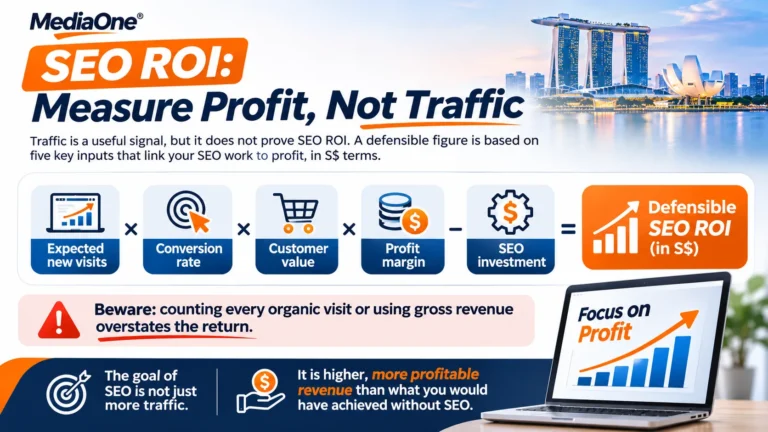
Many SEO ROI figures are overstated. They often count every organic visit as revenue and leave out conversion rate and profit margin. A defensible figure starts with expected new visits, your site’s conversion rate, customer value, and margin. Organic search delivers 53.3% of trackable website traffic according to BrightEdge’s channel research, but traffic alone does not prove a return. This guide shows Singapore business owners and marketing managers how to measure the return on their SEO efforts in S$ terms that a finance team can check. Judge each SEO campaign by the profit it generates, not the traffic it brings in.
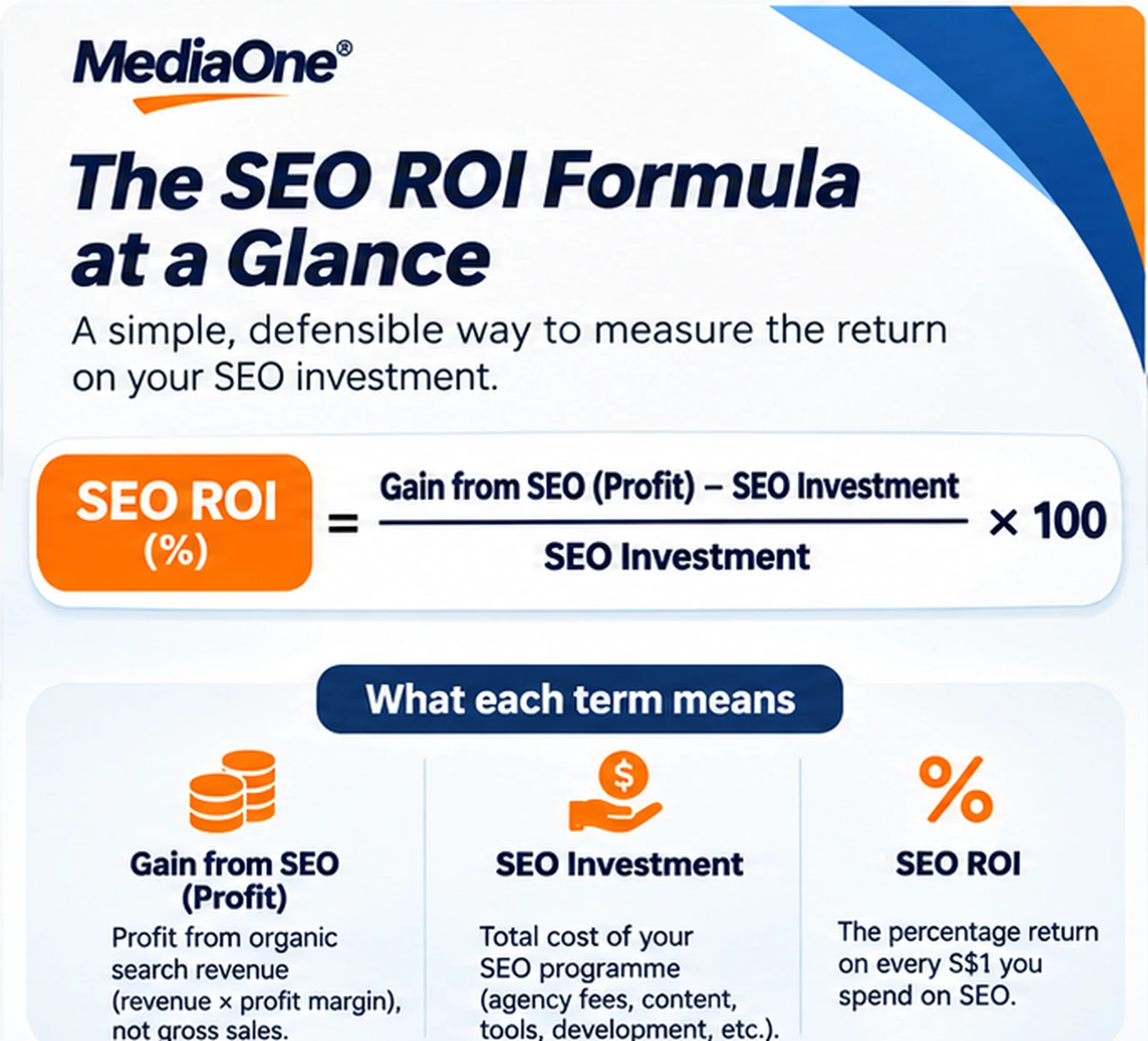
The core formula: SEO ROI = (Gain from SEO − SEO investment) ÷ SEO investment × 100, where gain is profit from the organic revenue, not gross sales. A worked example appears in its own section below.
Key Takeaways
- Count only the new organic visits your SEO work adds, not your total traffic. Existing visitors would have arrived anyway.
- Use a 2% conversion rate as an internal planning threshold, not an industry standard. Pages at or above it can justify more spending. Pages below it need work first.
- Calculate ROI using profit rather than revenue. S$10,000 at a 10% margin keeps only S$1,000.
- Treat the worked example as hypothetical and check every input against your own figures.
- Build the forecast from your traffic baseline and projected uplift.
- Track leads and assisted conversions, not just direct sales, so you don’t undercount SEO returns.
Why SEO ROI Matters for Singapore Businesses
Organic search is one of the largest sources of website traffic. That scale is why finance teams want to know what an SEO campaign returns. Marketing managers also need a return figure to justify their budgets and to decide where the next dollar should go in their marketing mix, alongside every other channel in the brand’s plan.
SEO ROI Definition
SEO ROI is the profit an organic search programme generates compared with what it costs. It answers one question: for every dollar spent on SEO, how much profit came back? The usual formula is (Gain from SEO − SEO investment) ÷ SEO investment × 100, as set out in the publisher’s SEO ROI calculator guide.
The word that matters most is “gain”. Many calculations stop at revenue, but revenue is not profit. Two businesses with identical SEO results can show very different returns, so a sound measure of SEO ROI must account for margin. Local SEO agency fees in Singapore vary widely by scope, so compare quotes on the same deliverables before comparing returns. Each keyword in the plan should be judged by the margin it brings in, not by its ranking alone.
Why measuring SEO ROI is necessary
Without a defensible figure, SEO budgets are argued from instinct. A common problem is rankings rising while enquiries stay flat. A traffic report alone cannot show whether that traffic is converting. Measuring ROI forces the question: are these visits turning into customers, and at what cost per customer? Tracking click-through rate by ranking position over time shows whether visibility gains translate into visits. Local intent shapes search results in Singapore, so please track the terms your buyers actually use.
A worked example with S$100,000 invested
The example below is hypothetical. It shows the arithmetic, not a typical Singapore SEO outcome. Suppose a business spends S$100,000 on an SEO strategy over a year and attributes S$275,000 in revenue to it. At a 10% margin, that revenue keeps S$27,500 as profit. The gain minus the investment is then −S$72,500, and dividing by the S$100,000 invested gives −0.725, or a −72.5% SEO ROI.
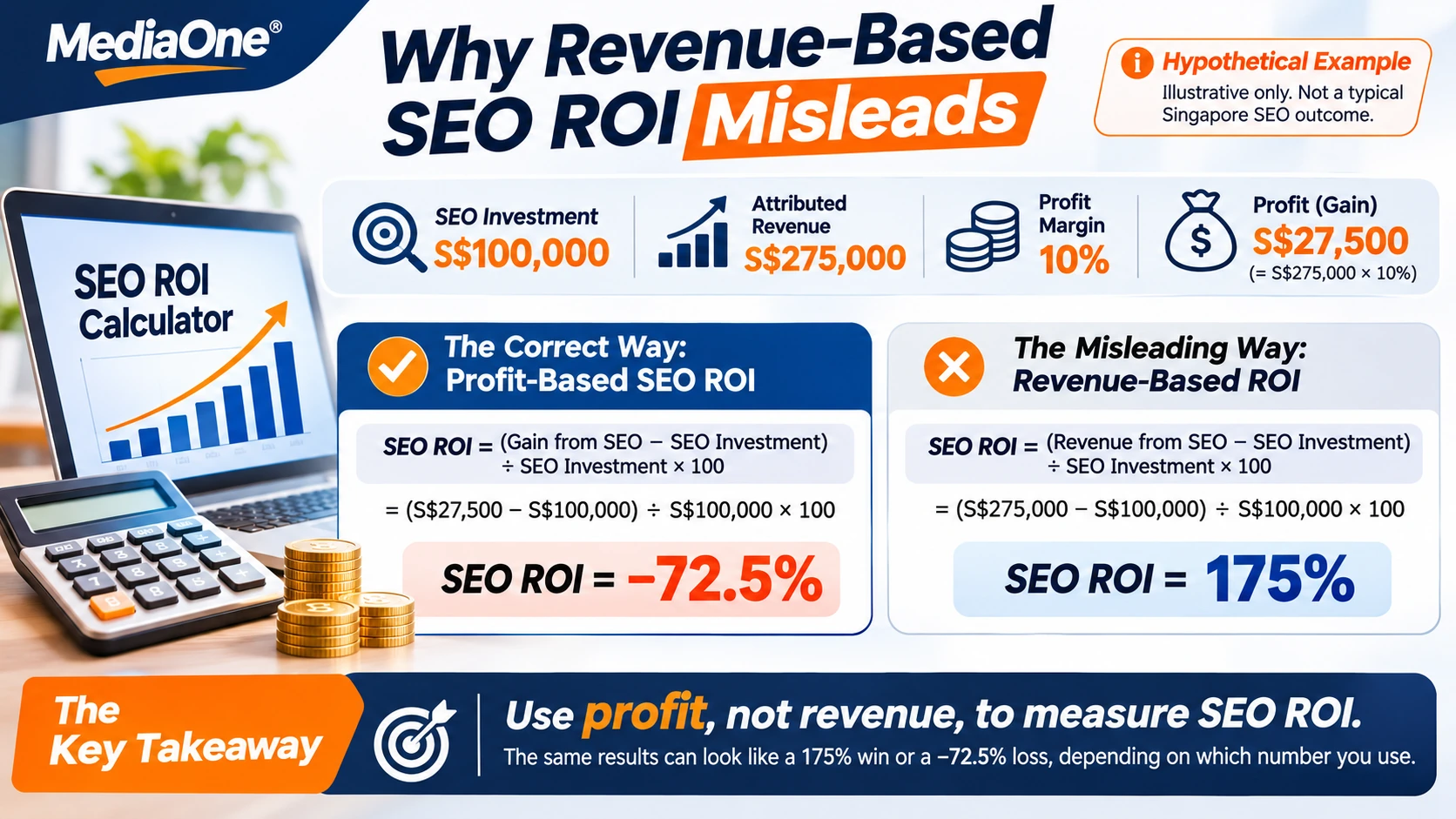
If the same revenue were treated as a gain, the result would be an illustrative 175% ROI. That figure overstates the return, which is why the inputs deserve more scrutiny than the output. Please run the same calculation with your figures before trusting any number, including this one.
Singapore SME scenario: a retailer spends a monthly SEO budget on search optimisation, reports organic revenue from search traffic, and keeps a healthy profit margin. Substitute your values in the template in Step 4.
Why profit margin matters
Revenue is not profit. A business earning S$10,000 at a 10% margin keeps S$1,000, while the same S$10,000 at a 40% margin keeps S$4,000. Use profit margin in the gain figure, not gross sales. That single change separates a defensible SEO ROI from an inflated one.
Step-by-step: calculating your SEO ROI
Work through these four steps in order. Each one feeds the next. The conversion rate check in Step 3 decides whether more traffic spend is justified at all.
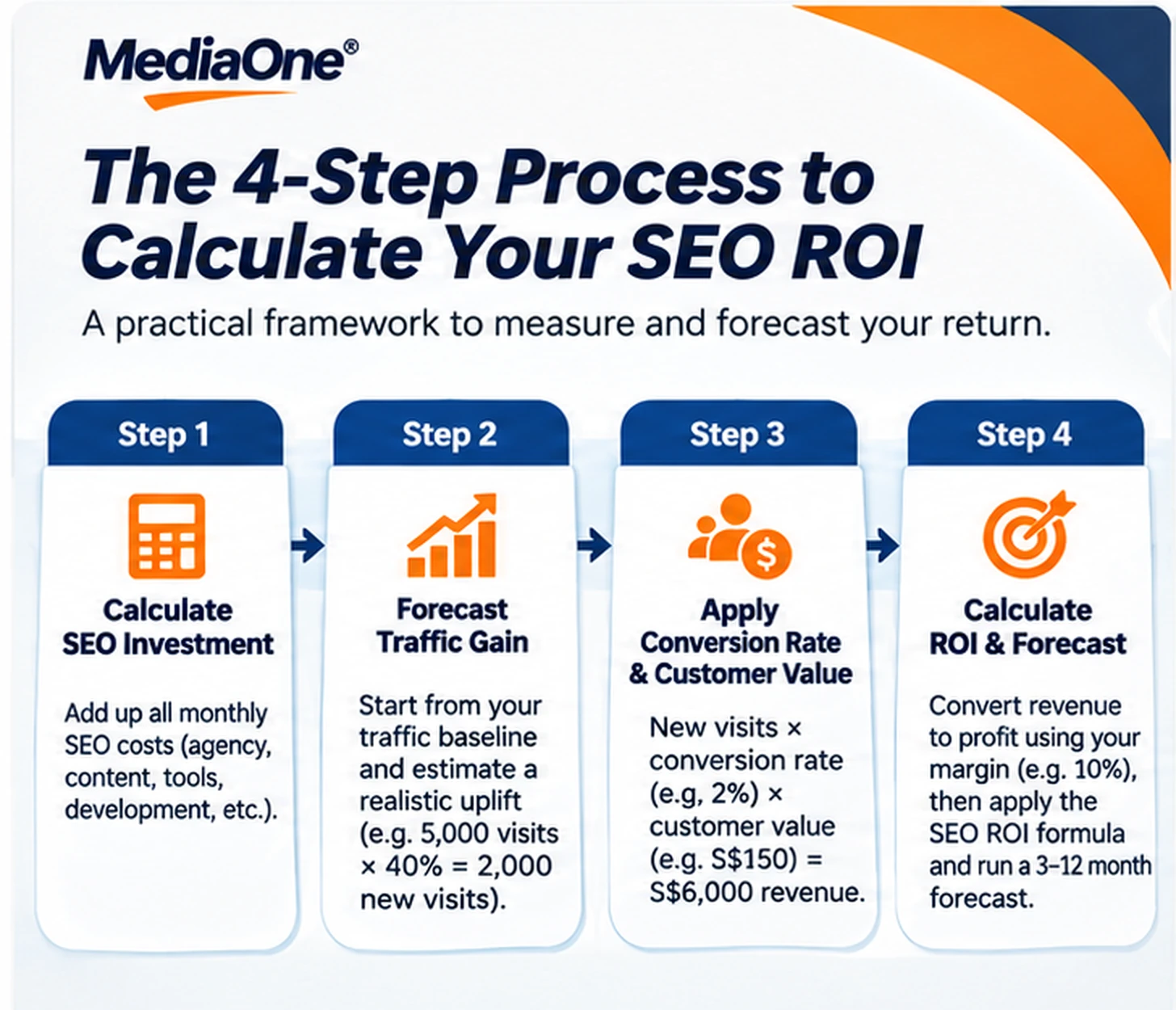
Step 1: Calculate your SEO investment costs
Add up everything you spend on search engine optimisation each month. This includes agency or freelance fees, content production, tools and any developer time for technical fixes. Keep the figure monthly, so it matches the monthly gain. A S$100,000 programme spread over a year is roughly S$8,333 a month, which you will divide by later. Include every cost in your seo campaign budget so the investment figure is complete.
Step 2: Forecast your organic traffic gain
Start from a traffic baseline, not a guess. If your website gets 5,000 organic visits a month and you project a 40% uplift, your expected new visits are 2,000. Use your analytics history to set the baseline, and be conservative with the uplift. Keyword research shows which search terms are worth targeting, so base your uplift on terms with proven demand.
Step 3: Apply your conversion rate and customer value
Multiply the new visits by your conversion rate, then by customer value. Conversion rate is the share of visitors who complete a sale or enquiry. Customer lifetime value is the total profit a customer brings over the relationship, not just the first order.
Before you scale spend, check your conversion rate against one planning threshold: a page at or above 2% can justify more spend, and a page below 2% needs fixing before you buy more visits. Submerge Digital’s SEO ROI calculator uses the same 2% threshold to flag pages for optimisation. Between 2% and your target, improve the page while keeping spending steady.
The 2% figure is a planning assumption you should test against your data, not a universal benchmark. A rule of thumb puts a good e-commerce conversion rate at 2% to 5%, though this varies by industry, device, and shopper intent.
Step 4: Apply the profit margin and run the calculation.
Convert revenue to profit before you calculate return on investment. Take revenue from the converted visits, then apply your profit margin. Judge the result against your SEO strategy goals, since the margin shows whether the strategy is paying back. Track SEO ROI over the same period as your investment so the two figures line up.
Use this fill-in template:
- Baseline organic visits per month: ____
- Expected uplift (%): ____
- New visits = baseline × uplift: ____
- Conversion rate (%): ____
- Average customer value (S$): ____
- Profit margin (%): ____
- Monthly SEO investment (S$): ____
- Gain = new visits × conversion rate × customer value × margin: ____
- ROI = (gain − investment) ÷ investment × 100: ____
Calculation checklist: confirm the baseline excludes branded traffic, confirm the margin is your real figure, confirm the investment includes every cost, and confirm the conversion rate is measured on the same pages the uplift covers.
Tracking SEO revenue: direct tracking, lead generation and goal value
Revenue from SEO only counts if you can trace it back to the search visit that produced it. Without that link, every return-on-investment figure is an estimate. A clear view of SEO ROI depends on that link, and the same tracking discipline applies to your brand, your content, and your wider marketing.
Direct tracking of e-commerce revenue
For online shops, the cleanest route is to tag each order with its traffic source. Google Analytics 4 records the source and medium of each transaction, so you can filter revenue to organic search and see what it earned in S$. GA4’s data-driven attribution spreads credit across several touchpoints using the paths that converted, whereas last-click gives all credit to the final visit. To test incremental SEO lift, compare a page group where you improved SEO with a similar group left unchanged, and measure the difference over the same period. Check the figure monthly against your payment records, because analytics tags are often lost when a customer returns on another device.
Lead generation and assigning value to enquiries
Most service businesses do not sell online, so they must put a value on each enquiry. Count the form fills, calls and chats that started from organic search visits. Then multiply by your average close rate and average deal size. For example, if 40 organic enquiries close at 20% with a S$2,000 average deal, the channel produced S$16,000 in revenue. Use your own sales history for these numbers, not a generic benchmark.
Goal value and attributing assisted conversions
Some buyers find you through search, then convert days later through a direct visit or an email. Last-click reporting gives that sale to the wrong channel. Assisted conversions show how often organic search appeared earlier in the journey, and they help you judge the engine optimisation work that started the relationship. For example, if a buyer’s first visit came from organic search and their purchase came from an email, credit only the share you can justify, such as one-third of the sale, and say so in your report.
Comparison of tracking methods
| Method | Best for | Strength | Limitation |
|---|---|---|---|
| Last-click attribution | Simple reporting | Easy to set up | Ignores earlier organic visits |
| Data-driven attribution (GA4) | Multi-touch journeys | Spreads credit across touchpoints | Needs enough conversion data |
| Lead value estimate | Service businesses | Links enquiries to sales | Depends on close-rate accuracy |
| Incrementality test | Proving real lift | Isolates SEO’s effect | Takes planning and time |
Forecasting SEO results and knowing when to expect returns
Forecasting organic traffic growth
Forecasting starts from your current baseline. Export twelve months of organic sessions from your analytics tool, then apply a projected uplift. If your website records 5,000 monthly organic visits and you expect a 40% rise, the forecast is 2,000 new visits a month. That gain, not total traffic, is the input the SEO ROI formula needs, because only new visits can be credited to your SEO efforts. Model each campaign’s cost against that gain so the return reflects what you actually spend.
Work through the forecast as a short table, using the same baseline and margin in each row:
| Item | Value |
|---|---|
| Baseline organic visits per month | 5,000 |
| Projected uplift | 40% |
| Forecast new visits per month | 2,000 |
Use three scenarios to test how sensitive the return is to the uplift:
| Scenario | Uplift | New visits per month | What it assumes |
|---|---|---|---|
| Conservative | 10% | 500 | Only a few target keywords reach the top positions |
| Base | Confirmed on enquiry | 1,250 | Steady gains across the main target keywords |
| Optimistic | 40% | 2,000 | Most target keywords move into the top results |
Be cautious with the uplift itself. Ranking gains depend on how many keywords move into the top positions, and the click-through rate falls steeply down the results page. Backlinko’s study of search results reports that the first organic position gets around 27.6% of clicks, against 6.3% for fifth place. That study uses a US dataset, and click share varies by query and by search features on the page. A forecast that assumes every target keyword reaches page one will overstate the visit gain.
Time to See SEO ROI
SEO payback is slow, and a realistic timeline helps you judge progress. Use the following as a rough guide, not a guarantee:
- Months 1 to 2: Technical fixes, keyword research and content planning- the groundwork of any search engine optimisation effort. Leading indicators include resolved crawl errors and mapped target keywords.
- Months 3 to 4: New and updated pages go live. Watch for rising impressions in Search Console.
- Months 5 to 6: Many clients see significant increases in organic traffic within this window. Watch for more non-branded clicks and early enquiries.
- Months 7 to 12: Traffic and conversions become measurable. Judge the full ROI from SEO on this window, not earlier.
Measuring ROI in month one will almost always show a loss. Judge progress against the leading indicators for the first two to three quarters, and reserve the full verdict for a longer window.
Branded Versus Non-Branded Traffic
Separate branded traffic (queries that use your company name) from non-branded traffic (generic terms your customers search). Branded traffic would often arrive anyway through word of mouth or paid ads, so counting it as SEO gain inflates the return. Calculate the ROI of SEO on non-branded organic visits wherever possible, and report branded traffic as a separate line. Tracking this split in your search engine data keeps the figures honest.
Common Challenges in Measuring SEO ROI
Most SEO ROI problems come from three places. Credit goes to the wrong channel, traffic never had a real chance to buy, or the conversion rate has never been checked. Each one makes a return look better or worse than it really is. Measuring roi from seo accurately means fixing all three.
Attribution Gaps and Assisted Conversions
Search rarely closes a sale on its own. A buyer may find a page through organic search, leave, return through a paid ad and convert on a third visit. Last-click reporting gives the credit to the ad, so the return from your SEO work disappears. Marketing teams that rely on last-click data will consistently undervalue organic search.
Assisted conversions show the early touches that organic search earned. In Google Analytics 4, these appear in the attribution reports. Credit only the share of the sale you can justify. Google Analytics 4 uses data-driven attribution by default, which spreads credit across touchpoints based on patterns in your data, whereas last-click gives the whole sale to the final visit. To test the real lift from SEO, compare a period of optimised pages against a comparable period, or against a control group of pages left untouched, and look for a change in organic conversions that paid campaigns cannot explain. Judge an SEO campaign on this kind of evidence, not traffic volume alone.
Valuing Organic Traffic Conversions
Do not treat every organic visit as revenue. Use five inputs: expected new visits, conversion rate, customer value, profit margin and monthly SEO spend. Convert gross revenue into profit before comparing it with cost, because the ROI of SEO depends on what you keep, not what you bill. The margin point is covered in full in the worked example and the section on why profit margin matters.
Diagnosing a Low Conversion Rate
Check the conversion rate before you buy more traffic. Pages converting below the planning threshold usually have a page problem, not a reach problem. Review each page against the threshold in Step 3 before scaling any keyword effort. A business that fixes its website’s weakest pages first will get more return per pound spent.
Use this rule of thumb to decide what to do next:
- Pages converting at or above 2.9% can justify more spend.
- Pages converting below 2.9% should be fixed first.
- Between 2% and 2.9%, improve the offer and call to action, then retest before scaling.
Check the offer, the call to action, page speed and whether the content matches the search intent. Benchmarks vary by sector, device and shopper intent, so compare each page with similar pages on your own site first, and use the average of those pages as your starting baseline.
Conclusion and Next Steps
A defensible SEO ROI figure starts with new visits, then applies conversion rate, customer value and profit margin, in that order. Skipping a step is how SEO and content marketing returns get overstated, so every term in your reporting should follow the same sequence. Treat the ROI of SEO as a result of this sequence, not a shortcut to it.
Your next steps are:
- Pull your current monthly organic visits from your analytics platform and set a realistic uplift figure, drawing on your keyword research to size the opportunity.
- Measure the conversion rate on your top landing pages and flag any below your sector benchmark.
- Use profit margin, not revenue, in the calculation.
- Compare the result against your monthly SEO cost to decide whether to continue, expand or fix before you invest further, and review the figures over time so you can see how returns change across your brand, marketing and social media channels.
Frequently Asked Questions
How long does it take to see a return from SEO?
Many clients see significant increases in organic traffic within three to six months, though a fully paid-back investment usually takes longer. Timing depends on how competitive your keywords are, how strong your site already is, and how quickly your pages earn rankings. Judge progress against your forecast, not a single month’s revenue.
What is a good SEO conversion rate?
A rule of thumb puts a good ecommerce conversion rate at 2% to 5%, though this varies by industry, device and shopper intent. This article uses 2% as an internal planning threshold, not an industry standard. Set your own benchmark from your current data.
Should I include branded traffic in my SEO ROI?
Report branded and non-branded traffic separately. Branded visits come from people who already know your company, so counting them as SEO gains overstates what the work achieved. Non-branded visits show whether SEO brings in new customers, which should drive your ROI calculation.
How do I measure SEO ROI for lead generation?
Assign a value to each enquiry based on your historical close rate and average deal size. For example, if one in five enquiries becomes a sale worth S$2,000 at a 40% margin, each enquiry is worth S$160 in profit. Multiply that by the number of organic enquiries and compare the result with your monthly SEO investment.
Why is my SEO ROI low even though traffic is growing?
Traffic growth means little if visitors do not convert. Check the conversion rate on your landing pages first. If it sits below your benchmark, the page is the problem, not the traffic. Fix the offer, layout or call to action before buying more visits, because extra traffic to a weak page only raises your spend.