| AI Summary
Digital marketing trends for 2026 centre on AI-assisted work, changing search experiences, customer data, short-form video and better measurement. Businesses can assess each opportunity against customer behaviour, business value, team capacity and measurable results. A small, controlled test helps establish whether a trend deserves further investment. |
Digital marketing trends describe changes in how businesses reach people and how customers discover, compare and buy products. In 2026, those changes include AI-generated search answers, automated advertising and video-led discovery, alongside greater attention to privacy and customer relationships.
Your business doesn’t need to adopt every new format or tool. The practical task is to identify which changes affect your customers, then decide what deserves time and budget. The sections below explain the main developments and provide a framework for testing them.
Key Takeaways
- Customer evidence comes first. Search queries, sales conversations and buying behaviour help identify trends worth testing.
- AI needs defined responsibilities. Drafting, bidding and customer support require different checks and success measures.
- Customer data needs a purpose. Relevant sign-up offers and preference choices support more helpful communication.
- Content needs a next step. Search pages, videos and creator campaigns should help people move from interest towards a decision.
- Testing needs business measures. Qualified enquiries, sales and profit provide stronger investment signals than views alone.
Which Digital Marketing Trends Deserve Attention in 2026?
The main trends affect different parts of the buying journey. AI search changes how people find answers, while short-form video creates opportunities to show products and explain ideas. Once someone expresses interest, customer data and email help a business continue the conversation.
That connection gives each trend a job. A campaign becomes easier to manage when the team knows which customer action it supports.
| Trend | Decision it affects | A practical starting point |
| Privacy and first-party data | What information to collect | Review one sign-up form |
| Generative AI | Which tasks to assist | Test one recurring drafting task |
| AI-assisted search | How customers find answers | Improve one buyer-question page |
| Automated advertising | Which outcomes guide bidding | Review conversion goals |
| Short-form video | How to explain and demonstrate | Film one customer question |
| Creators and social commerce | Who introduces the product | Test one relevant partnership |
| Email and personalisation | What happens after interest | Improve one follow-up sequence |
| Mobile experience | How easily visitors act | Complete a mobile enquiry yourself |
These are investment options, rather than a required checklist. A business with weak enquiry tracking may gain more from repairing measurement than from launching another channel.
Privacy and First-Party Data: Better Relationships Start With Relevant Information
First-party data is information collected through your direct relationship with customers. Purchases, enquiries and stated preferences can help your team understand what someone needs and respond appropriately.
That information becomes more valuable when tracking across other websites is limited. However, claims that Chrome has universally removed third-party cookies are inaccurate: Google’s April 2025 Chrome announcement retained its existing approach to user choice.
A relevant offer gives people a reason to subscribe
A subscription works best when customers understand what they’ll receive. A gardening retailer might offer seasonal planting reminders, while a software company could offer a practical evaluation checklist.
The offer also determines which details the form needs:
- Newsletter: Email address and optional topic preferences.
- Product enquiry: Contact details and information needed to answer.
- Loyalty programme: Details needed to manage membership and rewards.
- Service booking: Information needed to arrange the appointment.
The UK Information Commissioner’s Office describes data minimisation as collecting information that is adequate, relevant and limited to the purpose. Although legal requirements vary between markets, this principle offers a practical starting point for form design.
Customer preferences should shape the follow-up
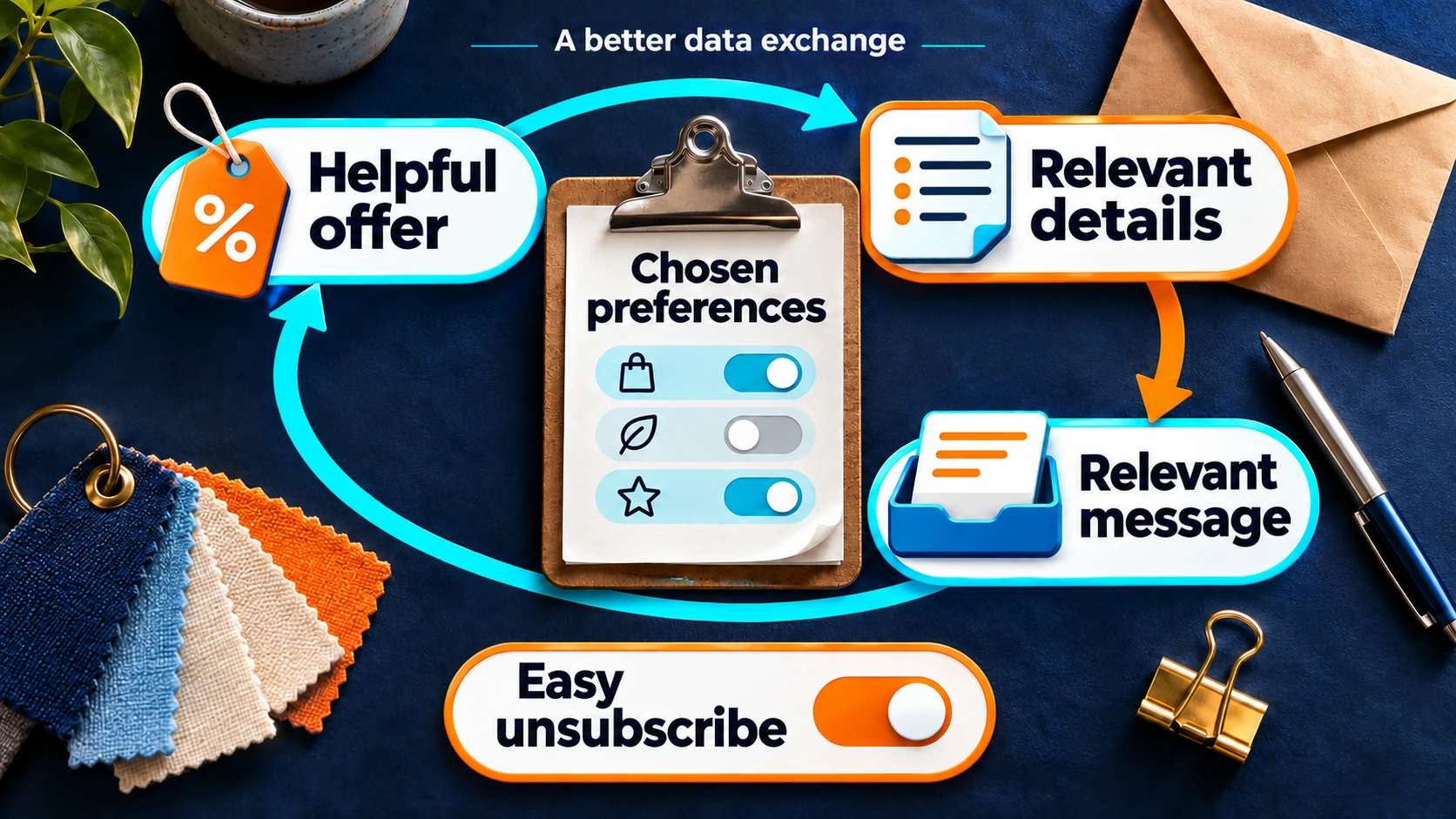
A person who asks about installation needs different information from someone browsing product colours. Their stated interest can guide the first response, with later messages reflecting what they choose to receive.
A preference centre can support that relationship by offering topic and frequency choices. Your team should also explain how information will be used, control access and establish a retention period appropriate to its purpose.
The exchange below shows how a customer preference can become a relevant message without adding unnecessary form fields.
Generative AI: Defined Tasks Produce More Useful Results
Generative artificial intelligence, or generative AI, creates material such as text, images and audio from instructions. Marketing teams can use it to organise notes, suggest draft variations and turn approved material into different formats.
The value depends on the task and the review process. A draft based on an approved product sheet is easier to check than an article built from unsupported claims, so the first experiment should have a reliable source and a named reviewer.
A small workflow makes quality easier to assess
A team could test AI-assisted email drafting using the same brief it normally gives a writer. The editor would then assess accuracy, tone and revision time before deciding whether the process saves effort.
| Task | AI contribution | Human responsibility |
| Interview notes | Group recurring themes | Check meaning and context |
| Ad copy | Suggest wording variations | Verify claims and approve copy |
| Product description | Draft from supplied specifications | Confirm every detail |
| Campaign report | Summarise supplied results | Check calculations and explanations |
Time savings should include editing and correction. A draft produced quickly may still cost more overall if the reviewer must rebuild it.
Original evidence gives assisted content substance
Customer interviews, demonstrations and documented processes provide material that a generic prompt cannot supply on its own. AI can help organise that evidence, while the author explains what it means for the reader.
Our content marketing work brings research, writing and distribution together. Within that process, AI assistance should support the people responsible for the final content.
AI Search: Buyer Questions Need Complete, Accessible Answers
AI-assisted search can present an answer alongside links to supporting pages. That changes the way a customer may encounter your business: someone can discover a product explanation or comparison before visiting the homepage.
Google’s documentation on AI features and websites says established search engine optimisation practices remain relevant. Its guidance does not require a special optimisation method for AI Overviews or AI Mode.
Customer questions provide the starting point
Sales and support teams hear the uncertainties that hold purchases back. Those questions can shape content that helps readers compare options and understand the next step.
For example, an equipment supplier could explain:
- Which workloads each model supports.
- What installation requires.
- Which maintenance tasks the buyer handles.
- What affects delivery time.
- Which costs sit outside the purchase price.
Each answer should include enough context to prevent misunderstanding. A maintenance schedule, for instance, may depend on usage, so the explanation needs to state that condition.
Search visibility still needs technical foundations
A well-written answer also needs an accessible page. Search engines must be able to discover the content, and visitors need readable text, working links and relevant supporting images.
Our SEO services address those foundations, while keyword research helps connect customer language with page topics. Our AI search visibility work extends that assessment to agreed questions and brand appearances.
A review should record the question, platform and date. AI answers can vary, so a single appearance provides limited evidence of ongoing visibility.
Automated Advertising: Conversion Quality Guides the System
Advertising automation can adjust bids using signals that would be difficult to assess manually. Google describes Smart Bidding as automated strategies that optimise for conversions or conversion value.
That makes the chosen conversion goal an important business decision. If an account treats every form submission as equally valuable, its reports can hide the difference between genuine enquiries and unsuitable contacts.
Sales feedback improves the picture
A service business can connect advertising results with later sales stages. The team first defines a qualified enquiry, then records whether each contact reaches that stage. A practical review includes:
- Tracking accuracy: Does each completed action register once?
- Lead quality: Does the enquiry match the service and audience?
- Sales progress: Does the contact become a credible opportunity?
- Commercial value: Does the resulting work justify acquisition costs?
Our Google Ads management connects campaigns with landing pages and conversion tracking. The purpose is to give campaign decisions a stronger link to customer and sales outcomes.
Campaign reviews need time for outcomes to develop
An enquiry may arrive today and become a customer weeks later. Reports should allow for that delay before comparing recent campaigns with older ones.
Budget, targeting and creative changes also need context. A performance decline after several simultaneous changes is difficult to explain, so a controlled test should isolate one major change wherever practical.
Short-Form Video: Demonstrations Give Attention a Purpose
Short-form video gives businesses a compact way to show products, explain processes and answer questions. A demonstration can help someone assess an offer before they commit time to a longer page or sales conversation.
The format also allows room for explanation. YouTube’s Shorts announcement extended eligible Shorts to three minutes, showing why “short-form” should not be treated as one fixed duration.
Each video needs one customer question
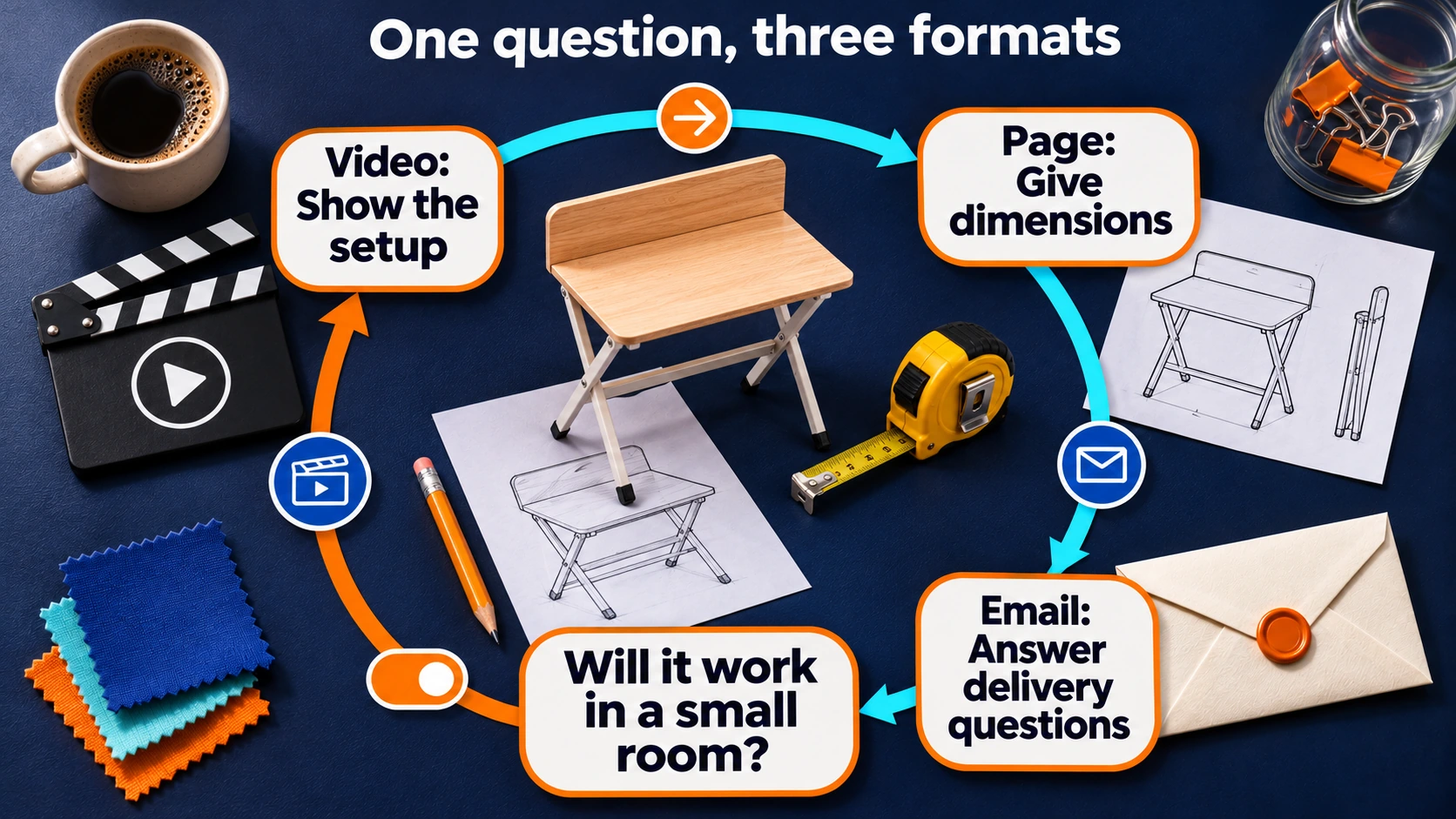
A furniture retailer could show how a folding desk opens in a small room. That demonstration answers a practical concern, which gives the viewer a reason to continue to dimensions, delivery details or the product page.
A repeatable production plan can draw from four sources:
- Discovery: A problem customers recognise.
- Explanation: A process or product feature.
- Evidence: A genuine demonstration or documented result.
- Decision support: An answer to a purchase concern.
The same subject can produce several videos, provided each adds a distinct answer. Our social media marketing approach connects those subjects with platform formats, campaign goals and measurement.
Viewing figures need a business context
Watch time helps assess attention, while saves and shares suggest reasons people may return or pass content along. Their value becomes easier to judge when the team also tracks product visits, relevant enquiries or purchases.
The video, caption and destination should continue the same conversation. A demonstration of a particular desk should lead to that desk’s details, so viewers can act on what they have just learned.
A single product question can therefore support several connected assets, as the example below illustrates.
Creators and Social Commerce: Relevant Audiences Need Credible Recommendations
Creator partnerships can introduce a product through someone whose audience already follows a related subject. Social shopping features may then shorten the distance between that introduction and a product listing, depending on the platform and market.
The opportunity depends on audience relevance and the quality of the explanation. A specialist creator who demonstrates a product honestly can help buyers assess it, even when the audience is relatively small.
A partnership brief should cover delivery and rights
Before production begins, both parties need to understand what they are agreeing to. The brief should connect the creative work with a defined audience and business objective.
Key terms include:
- The audience and customer problem.
- The content format and publication date.
- Payment, commission or product arrangements.
- Advertising disclosure responsibilities.
- Approval, editing and reuse rights.
- Reporting and campaign identifiers.
Our influencer marketing work includes campaign planning and creator partnerships. A focused brief gives that work a practical basis for assessing delivery and results.
Disclosures help people assess the recommendation
The US Federal Trade Commission’s influencer disclosure guidance explains that payments, free products and other brand relationships can require disclosure. Campaigns serving other markets need to account for their applicable advertising rules.
The commercial review should then include creator fees, commissions, discounts and production costs. Sales alone can overstate the return if those costs are excluded.
Email and Personalisation: Follow-Up Should Reflect Customer Intent
Email provides a direct way to continue a conversation after a subscription, enquiry or purchase. Its value comes from the relationship behind the message and the relevance of the next response.
A customer who downloads a comparison checklist may need help evaluating options. A recent buyer may need setup instructions instead, which makes the email marketing lifecycle a practical basis for planning different messages.
Small segments can support more relevant messages
A team can begin with a few meaningful groups, such as subscribers, active enquirers and recent customers. Each group should receive content linked to the action that placed them there.
A simple follow-up sequence might contain:
- Delivery: The requested resource or confirmation.
- Support: An answer to a related question.
- Next step: A relevant product, booking or conversation.
- Preference choice: A way to change topics or frequency.
Personalisation should use information customers expect the business to use. An enquiry topic is a reasonable starting point; an unsupported assumption about someone’s personal situation is harder to justify.
Delivery requirements belong in the plan
Gmail’s sender requirements include email authentication, with additional requirements for bulk senders. Marketing and subscribed messages from senders exceeding its stated bulk threshold must support one-click unsubscribe.
Your technical setup supports delivery, while relevant messages support the relationship. Clicks, replies, purchases, complaints and unsubscribes together give a more informative view than open rates alone.
Mobile Experience: Interest Needs an Easy Next Step
A customer can arrive from a video or advert and still leave before acting. A slow page, awkward form or moving button can interrupt the task that brought them there.
Google’s Core Web Vitals assess loading, responsiveness and visual stability. These measures help identify experience problems, although good scores alone do not guarantee high search rankings.
A real customer task reveals practical problems
A mobile review should follow the action your campaign asks visitors to complete. A team member can open the destination on a phone, find the relevant details and complete a test enquiry or purchase.
The review should cover:
- Whether the promised product or service appears immediately.
- Whether text and controls are readable.
- Whether the form requests necessary information.
- Whether errors explain how to correct them.
- Whether confirmation states what happens next.
Our website design work connects page structure, content and performance. That connection helps campaigns deliver an experience consistent with the message that attracted the visitor.
How to Choose Which Trends to Test
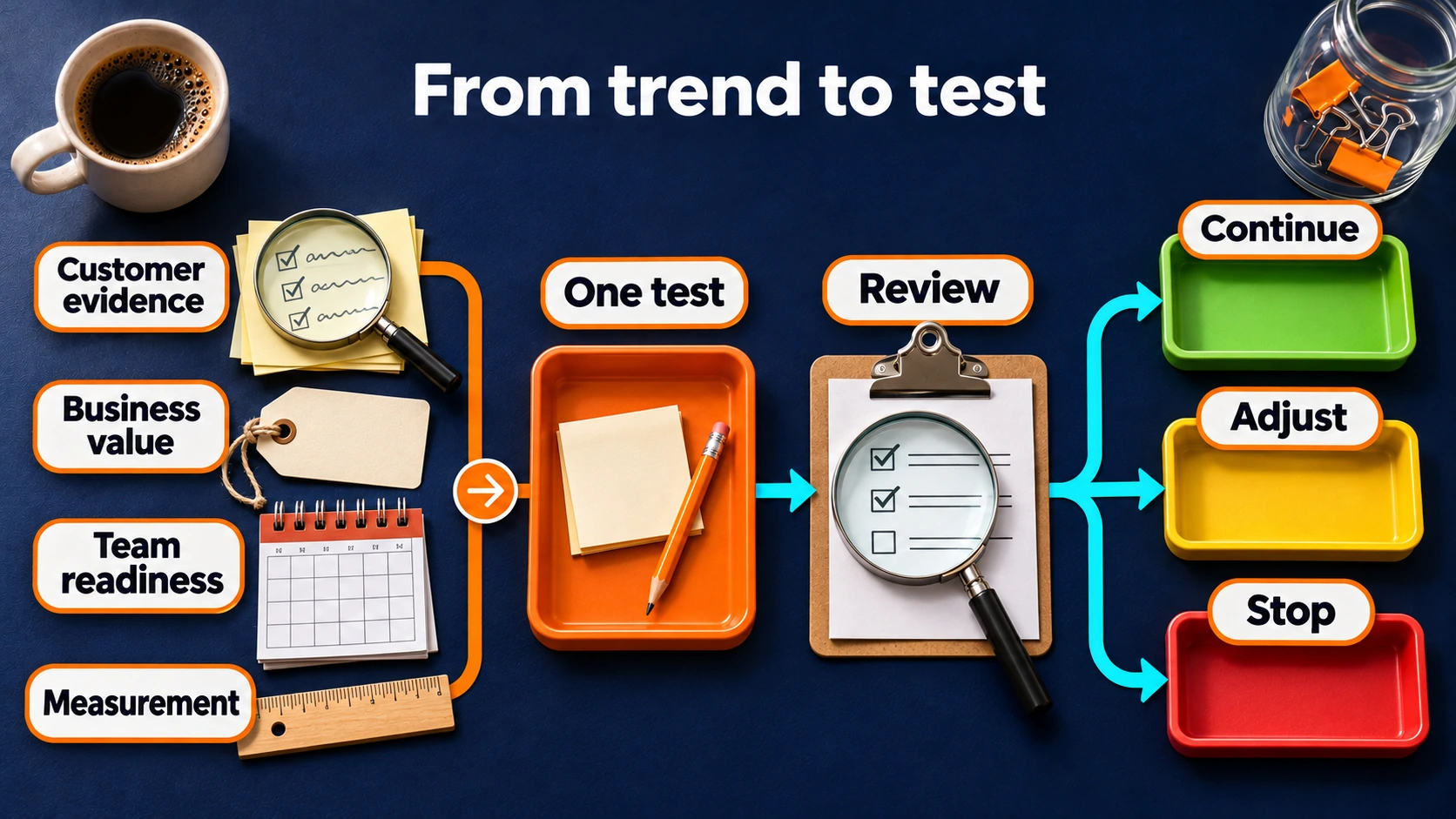
A trend deserves a test when there is evidence of customer relevance and a realistic way to assess the outcome. The following scorecard turns those considerations into a discussion your team can document.
Each criterion receives a score from one to five. Higher scores indicate stronger reasons to investigate; the total helps compare options but does not predict success.
| Criterion | Score 1 | Score 3 | Score 5 |
| Customer relevance | Little supporting evidence | Some relevant activity | Repeated customer evidence |
| Business value | Weak link to a goal | Plausible contribution | Direct link to an important goal |
| Delivery readiness | Major resources missing | Some preparation needed | People and tools available |
| Measurement readiness | Outcome difficult to track | Partial measurement | Baseline and tracking available |
A high total should still prompt discussion. A measurement problem may need repairing before the team spends money, even when customer relevance scores well.
A short example makes the trade-off visible
Consider a hypothetical equipment supplier whose sales team repeatedly receives installation questions. The team already has demonstration footage and can track quotation requests, making a video test practical.
A creator campaign might also reach buyers, but suitable partners and production rights would need further work. The supplier can record that opportunity for later while testing the prepared demonstration first.
The workbench below shows how the scorecard leads to a controlled decision.
A Practical Test Plan for the Next Quarter
A test needs a written question, a comparison and a decision rule. Those details prevent a team from treating any positive movement as proof that the idea worked.
Our lead generation approach connects acquisition with qualification and follow-up. A test should preserve that connection by measuring the customer outcome the campaign is intended to support.
A test brief keeps the team aligned
The brief can stay short while covering the decisions needed before launch:
- Hypothesis: The expected effect of one change.
- Audience: The people included in the test.
- Baseline: Comparable recent performance.
- Primary measure: The business outcome being assessed.
- Budget: Spending and staff time available.
- Review date: Enough time for relevant outcomes to develop.
- Decision rule: Conditions for continuing, adjusting or stopping.
For example, a supplier might test whether an installation video increases qualified quotation requests from a product page. The success threshold should reflect its current volume, costs and commercial needs.
The review period should match the buying cycle
Thirty days can provide early learning for some campaigns, but it is not a universal deadline. Low traffic, seasonal demand and long sales cycles may require a longer period.
A review should explain what happened and what remains uncertain. If the sample is too small, the team can extend the test or revise the design without presenting the result as established proof.
Turn Digital Marketing Trends Into Measured Decisions
Digital marketing trends for 2026 create opportunities across discovery, advertising and customer relationships. Progress comes from connecting a relevant change with a customer need, preparing the supporting experience and testing against a business outcome.
At MediaOne, we connect search, paid media, social content and lead generation around your goals. Our team can review your current activity and help identify a practical first test through a digital marketing consultation.
Frequently Asked Questions
Who should approve a new marketing tool?
The person responsible for the workflow should assess its practical value, with technical and data owners involved where relevant. A named budget owner should approve spending. That arrangement gives the tool an accountable user and helps the business assess security, access and ongoing costs before adoption.
Can seasonal businesses test trends outside their busiest period?
A quieter period can help a team test production, tracking and customer responses. However, off-season results may not represent peak demand. A seasonal business should record those conditions and, where possible, compare results with a similar period before making a larger spending decision.
What should a business check before paying for an annual subscription?
An annual subscription needs evidence that the team will use the product consistently. A trial should cover the intended task, export options, user limits and cancellation terms. The total cost should include setup, training and any paid features required to complete the workflow.
How can a business spot unreliable trend statistics?
A credible statistic should identify its original source, date, audience and method. A percentage without those details provides little basis for a spending decision. Survey responses also need careful interpretation because a respondent’s opinion about performance differs from independently measured campaign results.
Markets can share business goals while using different channels, messages and offers. Customer habits, language, platform access and advertising requirements can vary. A business expanding into another market should validate those conditions before applying results from its existing audience to the new campaign.