| AI Summary
SEO case studies describe how search performance changed after work on a website. Singapore businesses can assess them through five checks: starting figures, measurement dates, metric definitions, other activity and how credit was assigned to SEO. Strong reports connect the work to relevant enquiries or sales and explain their limits. Published results can inform a buying decision, but they cannot predict another business’s performance. |
SEO case studies are reports of website changes and their search results. A credible report states the baseline, timeframe, metrics, other campaigns and measurement method. Traffic growth alone does not prove sales growth or show that SEO caused the increase.
Key Takeaways
- Absolute numbers give percentages context: growth from 20 visits to 220 means 200 additional visits.
- Comparable dates, countries and tracking settings make before-and-after figures easier to assess.
- Rankings, clicks, sessions, leads and revenue answer different business questions.
- Reported revenue reflects a measurement method; it does not establish that SEO caused every sale.
- Similar customers, budgets and website problems make a case study more relevant to a Singapore business.
- Missing evidence should reduce reliance on a claim, even when the headline sounds impressive.
SEO case studies often lead with a large percentage or a revenue figure. A business owner still needs to know what changed, how long it took and whether those gains reached paying customers.
A report can describe genuine progress and leave important questions unanswered. Traffic may have risen during a sale, after a website launch or alongside an advertising campaign.
The following checks help Singapore businesses assess the evidence before using a published result to choose an agency, approve a budget or plan their own SEO work.
What Makes an SEO Case Study Worth Reading?
An SEO case study should explain a business problem, the work completed and the results measured. SEO means search engine optimisation: changes that help search engines understand pages and help people find relevant information.
Google’s SEO Starter Guide describes practices that support search visibility. The same guidance makes no promise of first-place rankings. A case study deserves similar care when presenting its results.
The business problem comes first
A report becomes easier to assess when it names the original problem:
- Product pages were missing from search results.
- Service pages attracted visitors from countries the business could not serve.
- Search traffic reached articles but rarely reached enquiry pages.
- Customers searched for services that the website barely explained.
- Important pages competed with duplicate versions of themselves.
Each problem calls for different work. A site with indexing problems needs a different approach from a site attracting the wrong audience.
The work needs enough detail
“Improved SEO” tells a buyer very little. A stronger account identifies the pages changed, the problems corrected and when the changes went live.
An effective SEO strategy connects those tasks to a business goal. A plumbing company, for example, might improve emergency service pages because urgent enquiries support its business. Publishing unrelated lifestyle articles would serve a different purpose.
The report should also distinguish completed work from planned work. A recommendation in an audit cannot explain a result if nobody implemented it.
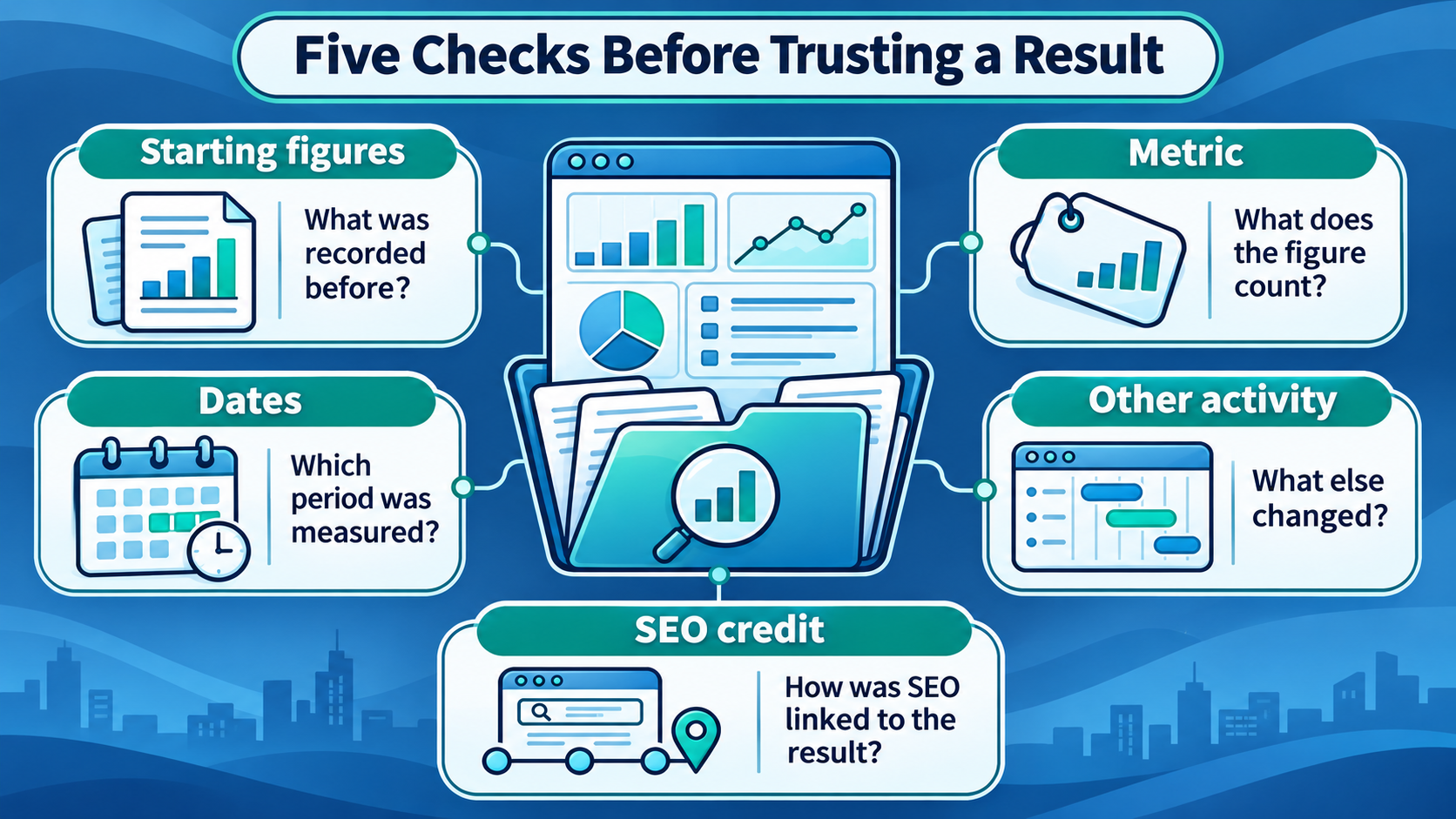
Five Checks for Assessing SEO Case Studies
A five-check scorecard helps readers organise the evidence. Each check earns one point only when the report provides enough information to assess it.
The score is an editorial checklist, not a scientific rating or proof of cause and effect.
| Check | Evidence to look for | Warning sign |
| Baseline | Starting traffic, leads or other relevant figures | A percentage without starting numbers |
| Timeframe | Measurement dates and implementation dates | “Within months” without dates |
| Metric definition | Named metric, source and filters | Traffic, users and clicks treated as interchangeable |
| Other activity | Advertising, promotions, redesigns and tracking changes | Every improvement credited to SEO |
| Attribution | An explanation of how SEO received credit | Revenue claims without a measurement method |
A report answering all five checks provides more context for review. Every missing check leaves uncertainty that the buyer should record.
A missing baseline, for example, limits the meaning of a growth percentage. A missing attribution method limits any claim about SEO-generated revenue. Several unanswered checks make a report suitable for exploring ideas, but weak support for a spending decision.
Baselines and Dates Give Results Context
A baseline records performance before the work begins. Without it, a percentage says how much a number changed but hides the size of the original business opportunity.
An illustrative rise from 20 monthly visits to 220 represents 1,000% growth. The gain is 200 visits. Growth from 20,000 visits to 40,000 represents 100%, yet adds 20,000 visits. Neither example says how many customers those visits produced.
Starting figures should match the claim
A traffic claim needs traffic figures. A lead claim needs lead figures. A sales claim needs sales records and an explanation of how the business connected those sales to search.
A baseline can include:
- Organic sessions and the pages receiving them.
- Search clicks from the target country.
- Enquiries that met the business’s sales criteria.
- Completed orders, refunds and recorded revenue.
- Brand searches and searches for products or services.
- The tracking setup and any known missing data.
The baseline should use the same definitions as the later report. Comparing all website visitors before a campaign with organic visitors afterwards creates an invalid comparison.
Measurement periods should be comparable
A six-month project may contain only two months of completed SEO work. The report should distinguish the contract start, implementation dates and result period.
Seasonal demand also changes the meaning of growth. A tuition centre may receive more enquiries near enrolment periods. A retailer may see stronger sales around festive promotions.
Comparable periods help readers judge those effects. A year-on-year comparison can provide context, although changes in stock, prices or market conditions can still affect the result.
A full trend also helps. One strong week at the end of a campaign may hide several weaker months.
Metrics Need Names, Sources and Definitions
SEO reports often place rankings, visits and revenue beside one another. Those measures describe different stages of a customer’s journey.
Google’s Search Console performance report defines impressions, clicks, click-through rate and average position. These measures describe search performance; they do not directly count completed sales.
| Metric | What it describes | What it cannot establish alone |
| Impressions | Appearances in search results | Website visits or customer interest |
| Clicks | Clicks from search results | Completed enquiries |
| Average position | The average position of the site’s top result | A fixed ranking for every searcher |
| Organic sessions | Visits classified as organic search | Unique customers or profitable sales |
| Leads | Recorded enquiries under a stated definition | Lead quality or completed purchases |
| Revenue | Sales value recorded under stated rules | Profit or additional sales caused by SEO |
Search clicks and website sessions differ
Google explains that Search Console and Google Analytics cover different parts of the journey. Their figures can differ because of measurement methods and other reporting factors. An exact match is not the standard for a credible report.
A case study should identify which tool supplied each figure. An unexplained switch between tools can create the appearance of growth.
Conversion rates need a stated calculation
An illustrative increase from a 2% enquiry rate to 3% equals one percentage point, or a 50% relative increase. Those descriptions express the same change differently.
The denominator also needs a name. A rate based on sessions differs from one based on users.
The enquiry definition deserves equal attention. A quotation request, newsletter sign-up and button click should not all appear as equivalent sales leads.
Other Campaigns Can Influence Organic Results
Concurrent activity means other work happening during the same period. Its presence does not invalidate an SEO result, but its absence from the report leaves an incomplete account.
Common examples include:
- Paid search or social advertising.
- Public relations and media coverage.
- Discounts, events or product launches.
- Changes to prices, delivery or stock.
- A redesigned website or shorter enquiry form.
- New analytics tags or consent settings.
A new form may help existing visitors submit enquiries. Advertising may increase awareness, followed by searches for the brand. Both can accompany genuine SEO progress.
Brand searches need separate context
A person searching for a company name may already know the business. A person searching for “office cleaning Singapore” may be comparing providers.
Both searches can produce customers. Separating them helps explain whether growth came from existing awareness, broader service visibility or a combination.
Keyword totals need similar care. A report counting thousands of new rankings should identify the country, tracked terms and ranking range. A larger keyword count does not automatically mean more relevant demand.
Attribution assigns credit
Google’s explanation of attribution models shows that reporting methods distribute credit across customer interactions. The chosen model affects how a business interprets channel performance.
An illustrative customer might discover a supplier through an advertisement, return through an organic search and later place an order. A report assigning credit to organic search describes its measurement rules. It does not establish that the sale depended entirely on SEO.
Google Analytics also uses channel definitions to classify traffic. The report should identify the channel and reporting scope behind its claim.
A Published Example: What Saramin’s Results Show
Google’s Saramin case study, published in April 2020, describes SEO work by a Korean recruitment platform. The team began addressing crawl problems in 2015 and later worked on duplicate content, canonical URLs and relevant structured data.
The report states that Google organic traffic increased 102% year on year during the September 2019 hiring season. It also reports a 93% increase in new member sign-ups and a 9% year-on-year increase in the conversion rate from Google organic traffic.
The evidence supports a limited conclusion
The example identifies a business, several changes, a comparison period and separate traffic and conversion measures. That detail makes the account more informative than an isolated growth percentage.
The published account does not provide every underlying starting figure, a full record of other campaigns or a controlled test. The reported results therefore support learning about the approach, without proving the exact effect of each task.
Singapore businesses can transfer the reasoning
A local retailer might share the problem of duplicate pages. A recruitment firm might share the need to help search engines understand job listings.
The practical lesson is to investigate an equivalent problem. Saramin’s percentage cannot become another company’s target without evidence about that company’s starting position.
A technical change also needs a reason. Structured data should describe eligible page content accurately; its presence alone does not promise traffic or revenue.
Singapore Relevance Goes Beyond a Local Address
A case study from another country can still explain a relevant website problem. A Singapore example can still be a poor comparison when its audience, resources or sales process differ.
The strongest comparison shares several business conditions:
| Condition | Comparison to make |
| Customers | Consumers, procurement teams or other buyers |
| Coverage | Singapore, selected neighbourhoods or several countries |
| Website | Service site, online shop, directory or publisher |
| Purchase | Immediate order, appointment or lengthy sales process |
| Resources | Content, development and campaign budget |
| Starting position | Established visibility, weak visibility or a new site |
Search location changes the opportunity
Global traffic can conceal limited reach among Singapore customers. A local service provider needs reporting that reflects the places it serves.
Local SEO also involves needs that may differ from a global publishing business. A clinic appointment, shop visit and online product order require different evidence of success.
Country filters help, but country alone is insufficient. A Singapore visitor researching a school assignment may have no buying intent.
Search intent connects visibility to customers
Search intent means the purpose behind a query. Someone searching for a definition needs different information from someone comparing service prices.
Relevant keyword research considers those needs alongside demand. A case study should explain why its target searches supported the business.
A larger overseas site may also have writers, developers and a recognised brand. The same volume of publishing may be impractical for a small local team.
A Baseline Example Makes Growth Easier to Assess
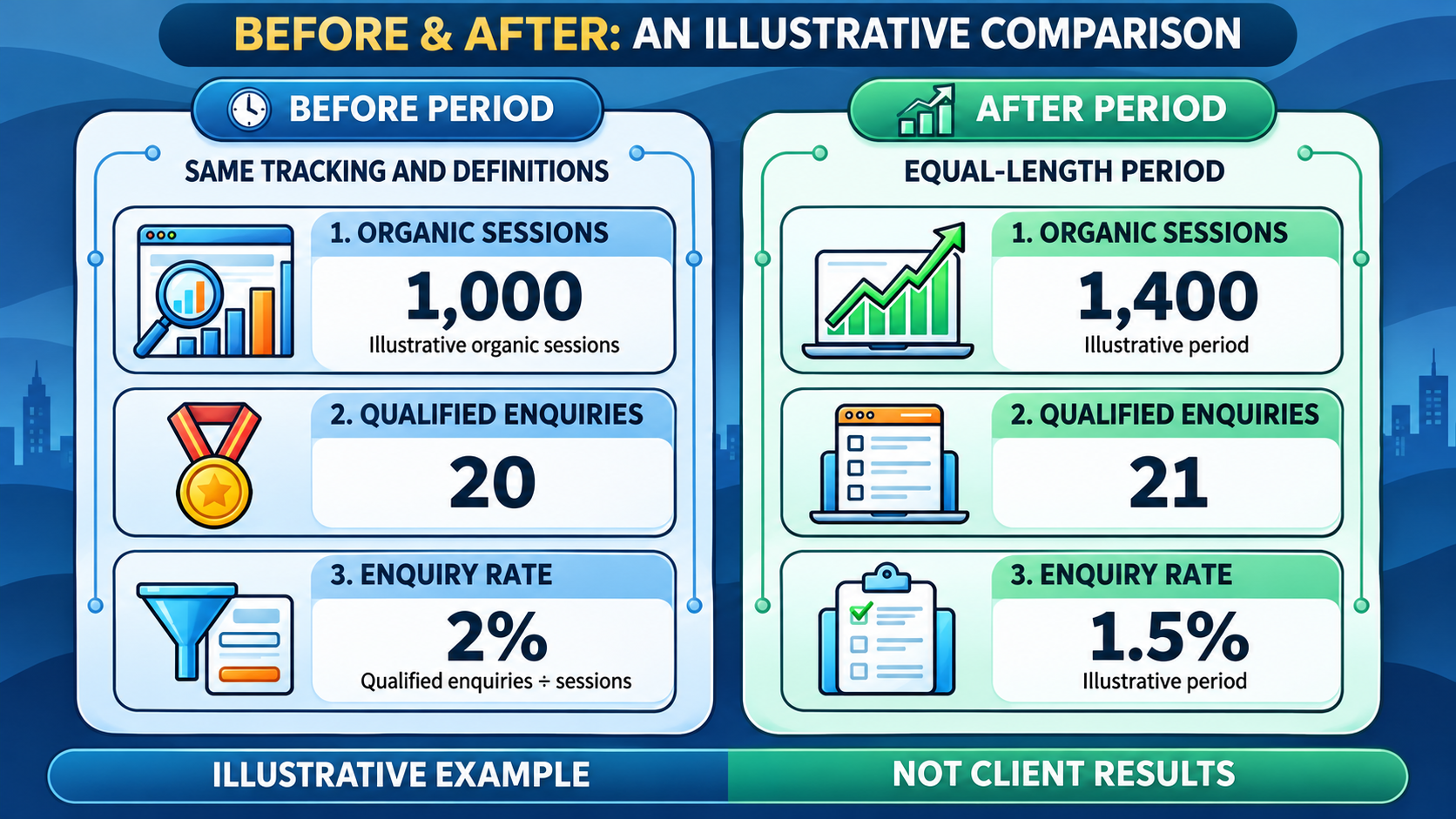
The following figures illustrate a review method. They do not represent an actual client or a promised result.
An imagined Singapore service business compares two equal-length periods using unchanged tracking and the same organic-search definition.
| Measure | Before | After |
| Organic sessions | 1,000 | 1,400 |
| Qualified enquiries | 20 | 21 |
| Qualified enquiries per session | 2% | 1.5% |
Organic sessions increased 40%, while qualified enquiries increased 5%. The enquiry rate fell by 0.5 percentage points.
The headline and business outcome differ
A “40% traffic increase” headline describes the visits accurately. It leaves out the smaller change in qualified enquiries.
Several explanations deserve investigation:
- New visits reached information pages with limited buying intent.
- The audience included people outside the service area.
- The business could not answer enquiries quickly.
- Prices or availability changed.
- A form or telephone tracking problem affected records.
The numbers alone cannot identify the cause. Page-level reports and sales records help the business decide what to investigate next.
Better page content has a specific role
A service page may need clearer pricing information, eligibility details or an explanation of the next step. Relevant content marketing can address those customer needs.
A change should respond to evidence. Rewriting every page because the enquiry rate fell would make it harder to understand which issue affected performance.
A Practical Review Process for Singapore Businesses
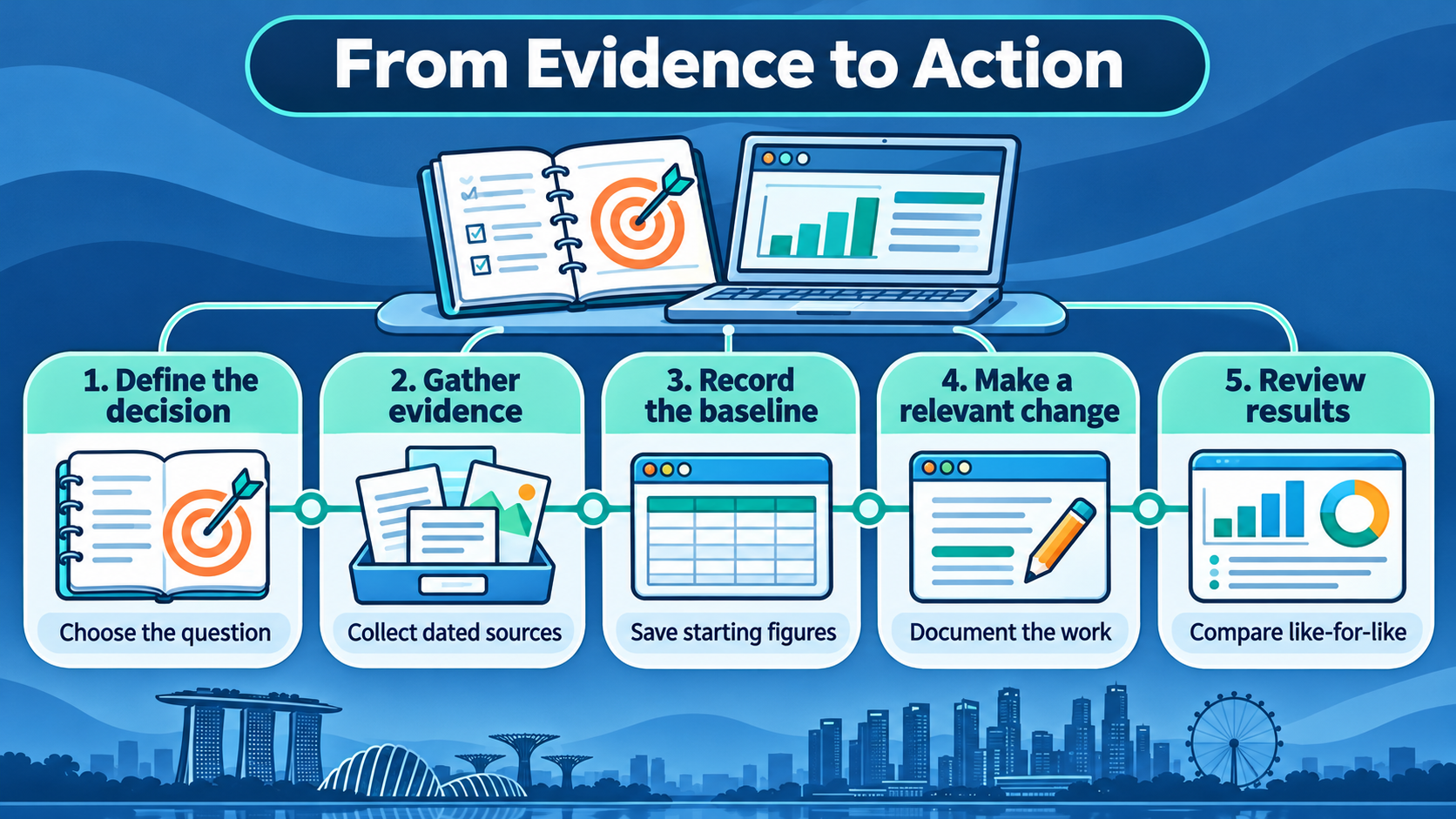
A review process turns case studies into questions a business can investigate. The starting point is the business’s own problem and records.
1. Define the decision
The review should support a specific decision, such as choosing an agency or improving service-page performance. A shortlist based on similar problems gives the team a reason to compare examples. A collection of unrelated headline percentages provides little help.
2. Gather the evidence
The review file can contain the published report, dated screenshots, metric definitions and answers to missing questions. An accessible source is preferable to a cropped image copied into a sales presentation. Screenshots should show enough context to identify the period and filters.
3. Establish the current baseline
The business should record its own search visibility, organic visits and qualified enquiries before implementation. Click-through rate can help assess whether search appearances lead to visits. Sales records then help assess whether those visits produce relevant opportunities.
4. Choose work linked to an observed problem
The proposed task should explain what it addresses. An indexing repair, service-page rewrite and enquiry-form improvement solve different problems. A change log should record the page, action, publication date and intended outcome. Other campaigns belong in the same timeline.
5. Review outcomes and limits
The review should compare equivalent periods and preserve the original metric definitions. Results need enough context to explain both improvement and remaining uncertainty.
A small business can use a spreadsheet for this record. The discipline comes from consistent entries and honest interpretation.
SEO Case Studies Support Better Buying Decisions
SEO case studies help businesses assess a provider’s methods when the reports explain starting figures, dates, metrics and other activity. Relevant customer outcomes and stated measurement limits give those results more meaning than headline growth alone.
At MediaOne, we can discuss how our SEO services relate to your website’s needs. Our consultation gives us a starting point to discuss your goals, existing evidence and questions about proposed SEO work.
FAQs About SEO Case Studies
Can an anonymous case study still be credible?
An anonymous report can protect a client’s identity while providing dated, redacted evidence. Its credibility depends on the information available for review. A provider may also offer a private discussion within its confidentiality agreements. Anonymity alone neither proves nor disproves a result.
Does a screenshot prove that a result is genuine?
A screenshot can support a claim, but its context remains important. A cropped chart may omit filters, channel names or comparison dates. A dated export and an explanation of the report provide stronger support than an image without labels.
Can an agency promise the same result as its case study?
A previous result cannot establish another website’s future performance. Different customers, competition and starting conditions affect outcomes. A proposal should explain its assumptions and planned work without treating a past percentage as a guaranteed forecast.
Do case studies have an expiry date?
Case studies have no fixed expiry date. Older examples can still explain a relevant problem, while tool names and implementation details may become outdated. The publication date helps readers separate the lasting lesson from practices that need current verification.
Can ordinary SEO reports prove AI Overview visibility?
Google states that traffic from its AI search features appears within overall Web search reporting in Search Console. An ordinary growth chart therefore cannot isolate that visibility by itself. Google’s AI features documentation explains the reporting context; any separate visibility claim needs its own measurement method.