| AI Summary
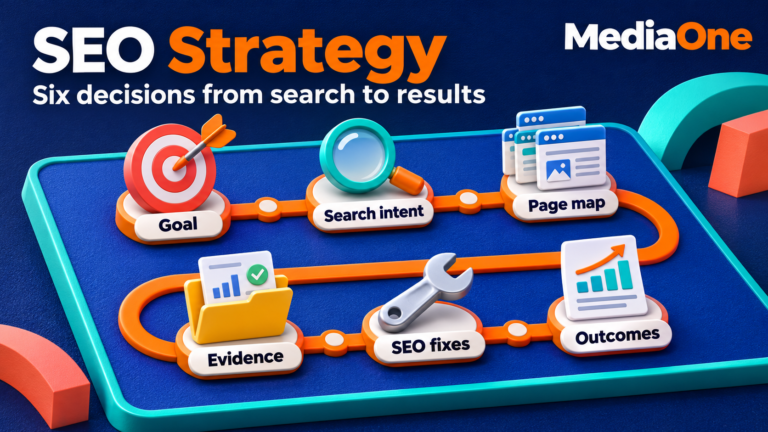
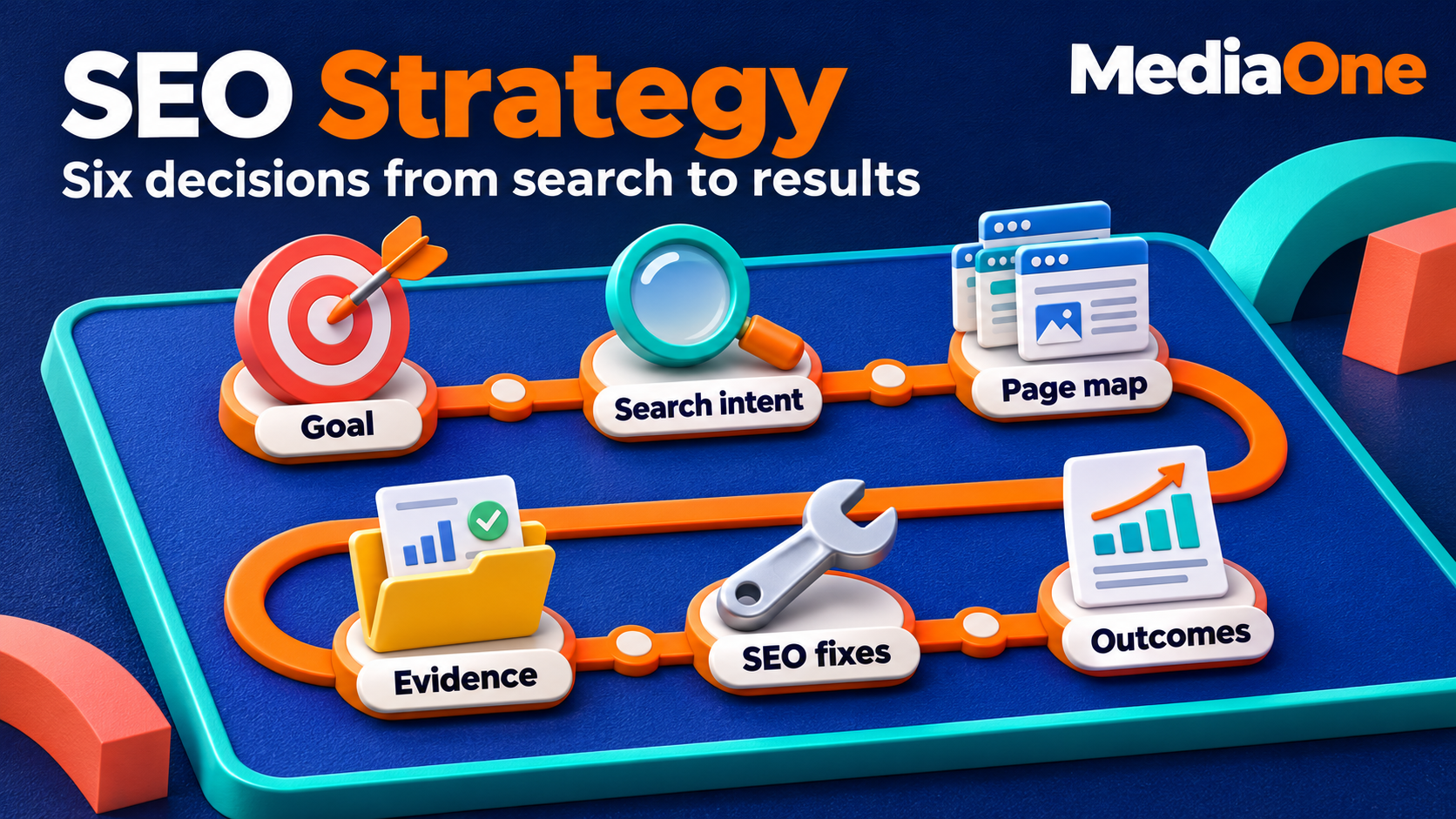
An SEO strategy connects the searches a business wants to appear for with an outcome it can measure, such as qualified enquiries or online sales. Singapore businesses can build one in six decisions. Set a goal, research what buyers search for, choose which pages to build or improve, decide what evidence each page needs, fix the problems that limit visibility, and measure results. A quarterly review helps the team decide which pages need more work and which are already doing their job. |
An SEO strategy is a plan for reaching the right people through organic search and turning that visibility into business results. The six steps are to set a measurable goal, research keywords and search intent, map topics to pages, create content backed by evidence, fix SEO foundations, and track outcomes.
A Singapore office cleaning company may get thousands of visits to a guide on removing carpet stains and still struggle to book site visits. A service page that answers how office cleaning is priced and shows what a quote includes may generate more of the enquiries the team needs.
That choice is the start of an SEO strategy. It gives each action a reason, whether the team rewrites a service page, adds a link or fixes a crawl issue. The six decisions below follow the same cleaning company so you can see how the work connects from the first goal to the quarterly review.
Key Takeaways
- A baseline makes a target useful. Record how many qualified enquiries or sales organic search already brings in before setting a growth goal.
- The search results help you choose the page type. A pricing search and a how-to search about the same service often call for different pages.
- Existing pages can give you a head start. A page already getting impressions for a relevant query may need a better answer or a simpler enquiry form.
- Search data and sales data answer different questions. Google Search Console shows how people found the site. Your sales records show which enquiries turned into opportunities.
1. Set a Business Goal You Can Measure
An SEO strategy starts with one result the business can count. A service company might choose qualified enquiries. An online shop might choose completed orders or revenue from organic search. A sales team with long buying cycles might track qualified opportunities while it waits for deals to close. The right metric depends on what the business sells and how customers buy it.
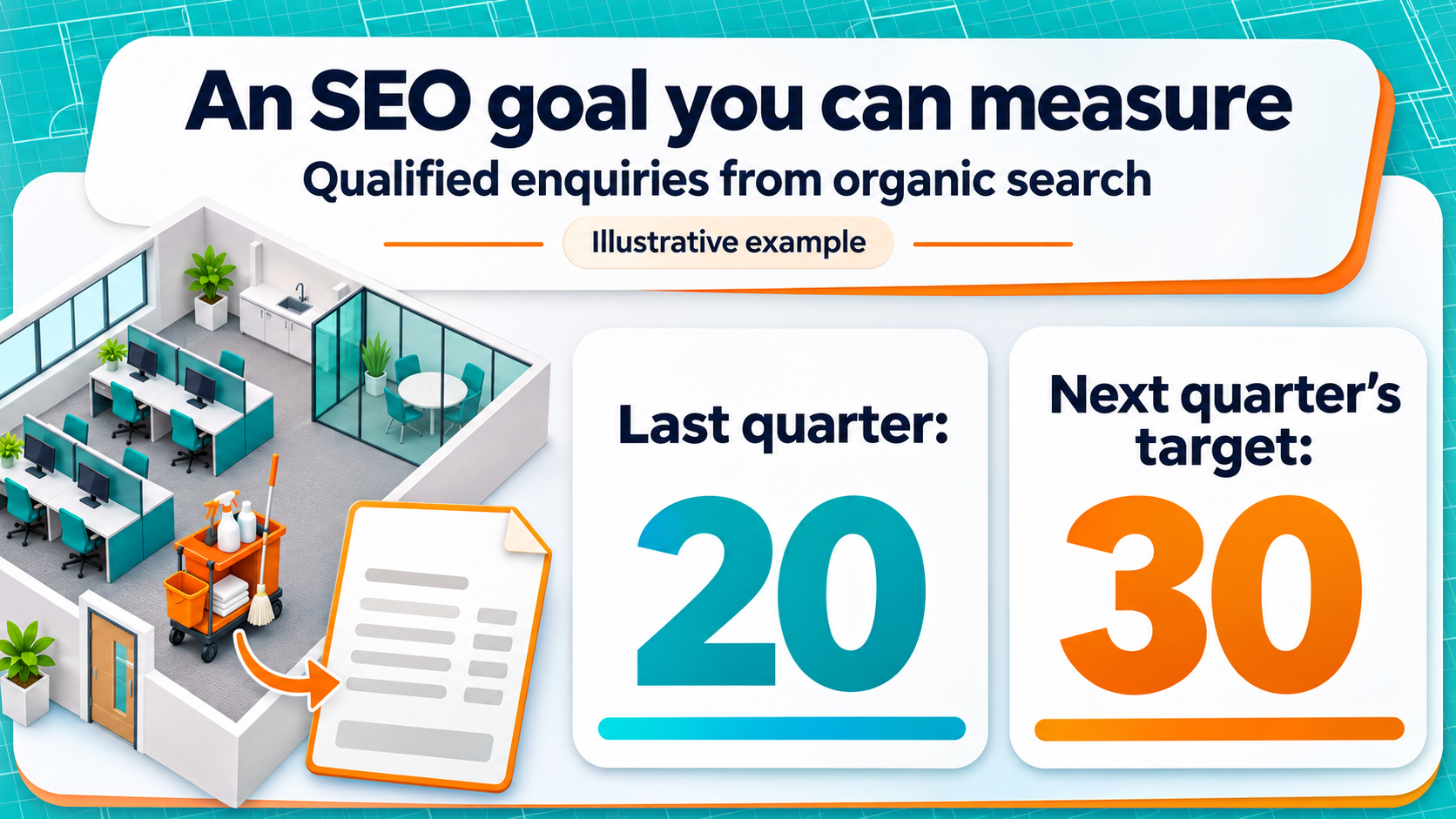
A baseline gives that goal context. The cleaning company in this example recorded 20 qualified enquiries from organic search last quarter. It wants 30 next quarter. Its sales team counts an enquiry as qualified if the prospect manages a commercial site in Singapore and needs a service the team provides. The figures are illustrative. Your baseline and sales capacity should determine your target.
Give each number a job
| Measure | What it tells the team | Office cleaning example |
| Business outcome | Whether SEO contributes to a sales goal | Qualified enquiries from organic search |
| Search indicator | Whether target pages are reaching more people | Clicks to the office cleaning service page |
| Work completed | Whether the team delivered the planned changes | Pricing information added and quote form tested |
The three measures guide different decisions. If clicks rise but qualified enquiries stay flat, the team can review the page, form and lead quality before paying for more content. If qualified enquiries increase on steady traffic, the team can check whether a better page or a change in demand contributed. Sales records give the team a way to test those explanations.
For a small team, one line in a shared sheet can hold the goal, the baseline, the deadline and the person who owns it. A named owner can check that marketing and sales are using the same definition of an enquiry before the first report goes out.
Decision check: Can your team name the outcome, baseline, target, deadline and person who will report on it?
2. Choose Keywords That Match What Buyers Need
Keyword research helps you find the words buyers use. Search intent tells you what they want to do next. “How often should an office be cleaned?” calls for an explanation. “Office cleaning quote Singapore” points to someone looking for a supplier. Both searches can support the same goal when the pages answer the right questions.
Search the phrases your customers use and look at the results they would see in Singapore. Note the page types that appear, such as service pages, guides, directories or videos. Map listings can point to a local need. A mix of guides and service pages may signal that people use the same phrase for different reasons. In that case, a more specific query can give the page a stronger focus.
Match each search to a page
| What the buyer wants | Example search | Page that can help |
| Learn about a need | How often should an office be cleaned? | Guide with a sample cleaning schedule |
| Compare options | Daily vs weekly office cleaning | Comparison by office use, size and needs |
| Request a service | Office cleaning quote Singapore | Service page with a quote form |
| Find a known business | A company name followed by “contact” | Contact page with the right details |
Weigh demand against business value
A keyword tool can estimate search volume and difficulty. Those figures help compare terms within the same tool. They cannot tell you whether a visitor will qualify as a customer. Your Search Console data can show phrases that already bring people to your site. Sales calls, quote requests and customer emails can uncover wording that tools miss, especially when buyers use terms specific to a job or industry.
- Business value. Does the search relate to a service you want to sell?
- Page match. Can you give the searcher the type of answer they expect?
- Evidence of demand. Does the query show up in your reports, tools or conversations?
- Work required. Can you improve a page you already have, or does the topic need new research and a new page?
A buyer who asks for “office cleaning after business hours” may be a good prospect even if a tool reports low volume. The company can check how often that request comes up and whether it can offer the service. If the question keeps coming up in calls, a sentence on the main service page may help more than a separate article. Video and community discussions can surface similar questions. They are worth checking when your customers use those channels to research a purchase.
Decision check: Does each priority search have a purpose, a page and a reason to serve your business goal?
3. Find Content Gaps and Map Topics to Pages
A content gap is a buyer question your site could answer well but currently leaves open. Search for your priority terms and compare the pages that appear. A directory may list several vendors. A supplier may show how its quotes work. A trade group may answer safety or quality questions. These pages compete for attention in search even if their owners sell different things.
Look for something a buyer needs that the results handle poorly. A cleaning company might find plenty of general service descriptions and few examples of what a quote covers. It can explain how floor area, cleaning frequency and access hours affect scope. The team can verify those details with its operations staff, and buyers can use them to prepare for a site visit.
A topic cluster is a group of pages about the same subject. The main page gives readers a place to start. Supporting pages answer narrower questions that deserve more detail. A sound internal linking strategy connects those pages at the point where a reader would need the next answer. Descriptive link text also helps Google understand the relationships between pages.
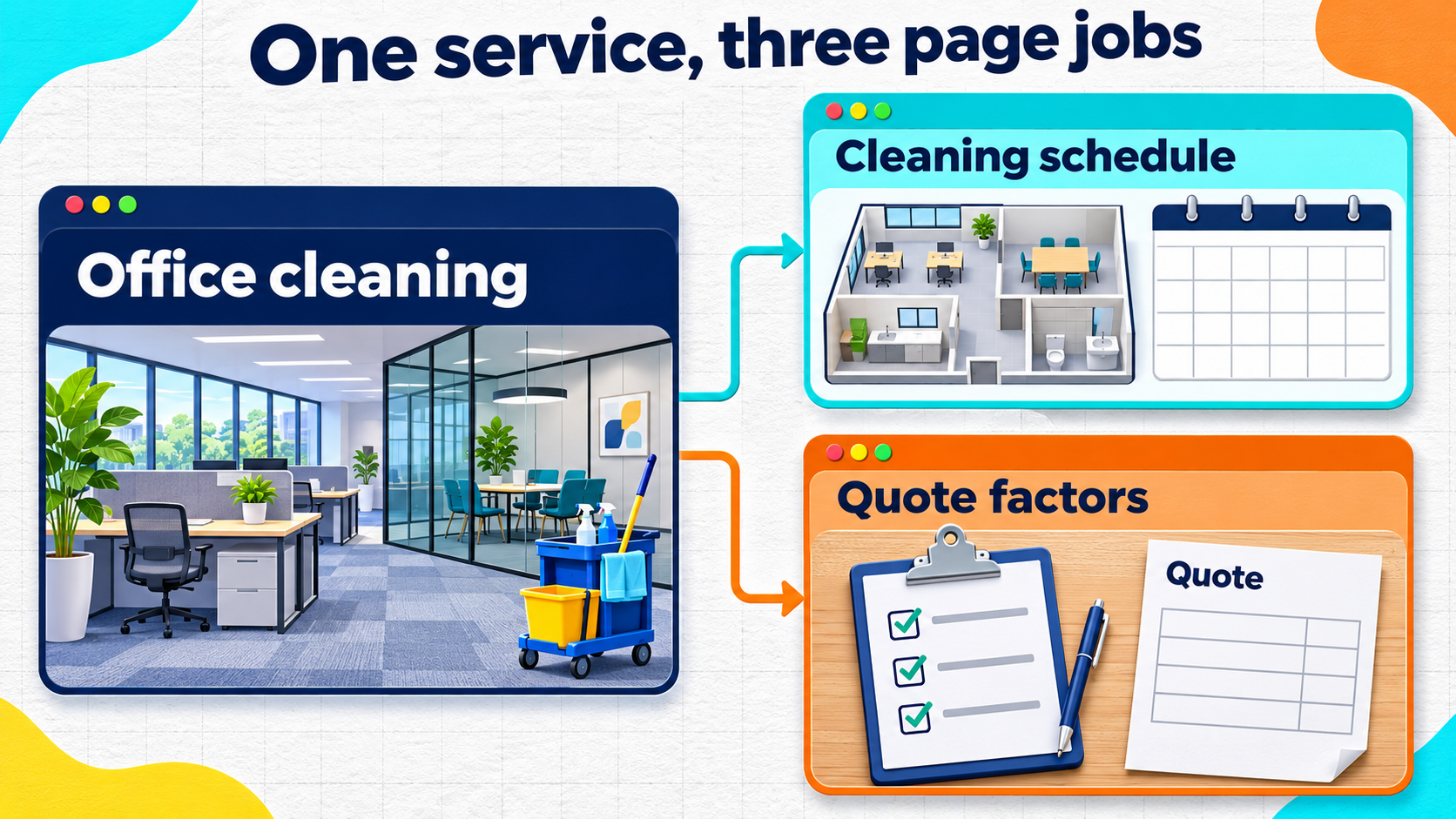
- Main service page. Office cleaning in Singapore, covering scope, scheduling, service area and the quote process.
- Planning guide. A sample cleaning schedule by room and frequency, with advice for offices that share a pantry or receive visitors.
- Cost explainer. The details that can change a quote and the information needed before a supplier can provide one.
Existing pages deserve a place on the map. A service page that already appears for pricing searches may benefit from a pricing section. A separate explainer earns its place when it answers questions that would slow down a buyer who arrived ready to request a quote. If two existing pages serve the same need, check their traffic, enquiries and links before choosing which one to improve or combine.
The map can be as simple as four columns in a spreadsheet. Give each row a topic, a target page, a job and a next action. A small team can start with one service and the two or three questions that most often delay a buying decision.
Decision check: Does each page answer a distinct buyer question, and can readers reach the next relevant page?
4. Create Content That Shows Your Work
A page earns trust when readers can see how the business knows what it claims. Google’s people-first content documentation asks site owners to consider whether their pages show first-hand experience, explain who created the content and give readers enough information to act. For a service business, that can be as simple as having the person who prepares quotes explain what happens before a quote is issued.
Put evidence next to the answer
A generic page might say that cleaning prices depend on several factors. A stronger page names those factors and explains how they change the work. An office with a shared pantry used by several teams may need a different cleaning schedule from a small office with few visitors. A sample scope can show what the quote includes and which items the business prices separately, if that reflects how it actually works.
- Service claims can draw on a checklist, service terms or a named team member’s explanation.
- Cost claims can show what the price covers, when the figure was checked and which conditions affect it.
- Case examples can explain the starting problem, the work done and the verified result, with permission where needed.
- Third-party facts can link to the organisation that published the information.
Make direct answers easy to find
A heading should tell the reader what the section will answer. A short opening answer can then lead into the details, example or table. On a quote page, a heading such as “What affects the cost of office cleaning?” sets up a direct answer about floor area, cleaning frequency and access hours. The next paragraph can explain how the team uses those details in a quote.
The same approach supports Google’s AI search features. Google’s documentation on generative AI in Search points site owners to SEO fundamentals and original, reliable content. A page that provides a direct answer, adds evidence and explains conditions can serve readers who skim as well as readers who need detail.
An AI tool can help organise an outline or suggest clearer wording. An editor and a person who knows the service should still verify the facts that a customer might act on. A claim about weekend availability, for example, needs to come from the booking team or the service terms.
Decision check: Does each priority page answer the buyer’s question and show how the business knows the answer?
5. Fix the SEO Foundations That Help Pages Get Found
SEO foundations help visitors and search engines reach, read and understand a page. SEO basics start with the pages that support your goal. An office cleaning company can begin with its service, pricing and contact pages before reviewing less important archives. An indexing problem on the main service page deserves prompt attention because it can limit visibility for searches tied to enquiries.
Check access, page content and mobile use
| Area | What to check on a priority page |
| Access and indexing | The page loads, Google can access it, and a setting does not block it from the index. |
| Title and content | The title names the service or topic, and the opening answers the search the page is meant to serve. |
| Internal links | At least one relevant page links to it using text that describes what readers will find. |
| Mobile experience | Important details are readable, buttons work and the form can be completed on a phone. |
Google’s technical requirements for Search specify that Googlebot must be able to access the page, the page must return a successful HTTP status, and it must contain indexable content. Meeting those requirements makes the page eligible for indexing. Google still decides whether to include it. If a priority page is missing, start with URL Inspection in Search Console and check whether Google sees the page version you intend it to index.
On-page work connects those checks to what visitors see. A service title that names office cleaning in Singapore helps customers recognise the page in search. The page itself should give them what the title promises. A quote button near the scope and pricing information lets a ready buyer act without having to hunt through the site.
Check local visibility and relevant links
For an eligible local business, an accurate Google Business Profile helps customers confirm what the company does and how to reach it. Google says local results depend mainly on relevance, distance and prominence. Keep categories, hours and contact details accurate. If the business visits customers at their premises, the profile and service page should reflect how it operates.
A relevant mention can also give potential customers another way to find the business. A facilities association could link to a maintenance checklist its members can use. A trade publication might cite original research if the findings help its readers. Google’s spam policies list links bought to influence rankings as link spam. The editorial reason for a link is a better starting point than the number of links a vendor promises.
Decision check: Can a buyer discover your priority pages, find the details they came for and take the next step on a phone?
6. Measure Results and Decide What to Change
An SEO strategy needs a review that leads to a decision. A monthly check can catch broken forms, changes in visibility or a fall in enquiries. A quarterly review gives the team time to compare outcomes with the target and decide what to fund next. Where demand varies by season, it helps to compare with the same period last year as well as the previous quarter.
Follow the numbers from search to sales
| Source | What it tells you | What to review |
| Google Search Console | How pages performed in Google Search | Impressions, clicks and queries for priority pages |
| Google Analytics 4 | What measured visitors did on the site | Completed quote forms from organic search |
| Sales records | Whether enquiries became qualified leads or customers | Qualified enquiries, quotes issued and jobs won |
The Search Console performance report shows which pages and queries are earning clicks from Google. In Google Analytics 4, a successful form submission can be marked as a key event. MediaOne’s data-driven SEO framework explains how Search Console and analytics cover different parts of the visit. Sales records add the step that neither system can settle on its own: whether the enquiry met your definition of a qualified lead.
Give the team a next action
- More impressions, few clicks. Review the page title and the results around it. Check whether the page shows up for the searches you meant to target.
- More clicks, few enquiries. Test the form on a phone and check whether the page answers common questions about scope, pricing and availability.
- More enquiries, few qualified leads. Ask sales which requirements prospects fall short of. The page may need to state who the service is for or what areas the team covers.
- A fall on one priority page. Check indexing and recent site changes first. Then compare the page’s search queries and results before deciding whether to rewrite it.
A team that began with 20 qualified enquiries and reached 27 has a specific result to investigate. In this example, it fell three short of its target of 30. If the service page drew more clicks and the number of form submissions rose, the team could ask sales what happened to lead quality. If submissions stayed flat, it could test the quote form or review the information the page gives buyers before they enquire.
Decision check: Can your team explain what moved, what still needs investigation and what it will do next?

Turn Your SEO Strategy Into a Quarterly Plan
A quarterly SEO plan can begin with one business goal and a small group of pages. Buyer research shows which questions those pages should answer. Evidence and technical checks help the pages do their job, while search data and sales records show where to focus the next round of work.
At MediaOne, we use SEO audits to identify site issues and help businesses decide which fixes to prioritise. If your site draws visits but generates few qualified enquiries, our SEO services can help you review the pages, searches and conversion steps that support your next sales goal.
Frequently Asked Questions
How long does an SEO strategy take to show results?
Some changes take a few weeks to show up in search, while others take several months. The time depends on how soon Google revisits the page, what changed and how competitive the searches are. A newly corrected page and a new service competing for broad searches will often move at different speeds. Google’s SEO Starter Guide suggests waiting at least a few weeks before assessing the effect of many changes.
Can a business build an SEO strategy before its new website launches?
Yes. The team can use customer interviews, sales notes and current search results to choose which pages the site needs at launch. If a new site is replacing an old one, the team can also list the old URLs and identify where each one should point. That record helps developers carry search and referral traffic to the right pages after launch.
Can Google Ads data help an SEO strategy?
Yes. Paid search data can show which search terms led to enquiries and which landing pages helped turn visits into leads. A sales team can check whether those leads were qualified before the SEO team uses the findings. Paid outcomes help identify topics worth testing in organic search, where page types, visibility and visitor behaviour may differ.
What if two teams want to target the same keyword?
The teams can choose one owner and one main page for the search if both are serving the same buyer need. If the teams serve different buyers, each page can target a more specific query. For example, a retail shop cleaning page can address shop opening hours, while an office cleaning page can explain access to an occupied workplace.
Does a Singapore business need a .sg domain for SEO?
A .sg domain can signal that a site serves Singapore. A .com domain can also appear for Singapore searches. A business that already has a working domain can show who it serves through relevant page content, service areas, contact information and local business details. A domain change is a larger project that requires redirects and checks on the old and new URLs.