The best platform depends on the job you do most often, not on which database is larger. Both Ahrefs and Semrush cover the keywords and links most Singapore marketers need, but the real question is which tool handles your weekly tasks better.


Key takeaways
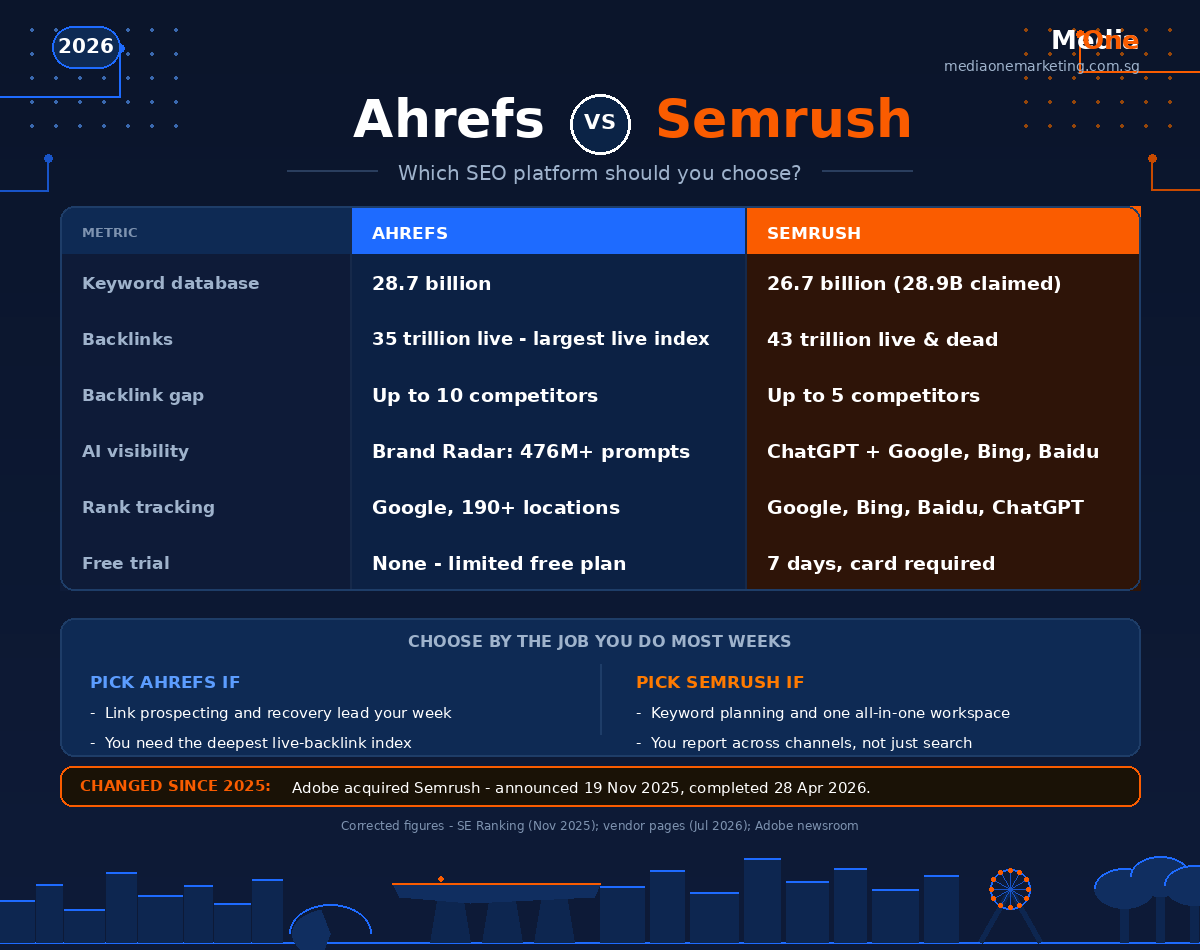
- Decide by job, not database size. Ahrefs reports 28.7 billion keywords and Semrush 26.7 billion as of November 2025 — both large enough that the gap rarely settles the choice.
- Score both on your top five tasks. Rate each task 0 to 2 and pick the higher total out of 10. Seven or more is a clear signal.
- Ahrefs leads on live-backlink depth. It maintains 35 trillion live backlinks — the largest such index — suiting link audits and prospecting. Semrush reports 43 trillion live and dead backlinks.
- Semrush is the broader marketing suite. Its Keyword Gap covers up to five competitors.
- Semrush is now an Adobe company. Adobe completed its acquisition on 28 April 2026 — a material change for procurement and roadmap planning.
- Check local coverage and S$ pricing. Confirm each covers your target markets, then compare plan prices on each vendor’s site.
- Run a parallel trial. Test both on your own keywords and URLs, which reveals more than any feature table.
Who this comparison is for
Most teams shortlisting Ahrefs and Semrush are not comparing feature lists. They want to know which platform fits their weekly work, so start with the job, not the feature count. Many SEO tools overlap heavily, so the deciding factor is often how well each platform’s features match your daily routine.
This comparison is written for three groups in Singapore:
- marketers running their own brand’s search programme
- agency leads managing several client accounts
- in-house SEO specialists who report into a wider marketing team.
Teams weighing a social media budget alongside search spend will find the same logic applies.
The central claim is that a platform winning on total feature count can still be the wrong purchase if its strengths sit outside your daily tasks. Both tools face the same criteria, task list and scoring rules. Database sizes describe scale, not accuracy. Confirm plan prices and database figures on each vendor’s website before you buy, and check that the content you rely on for reporting is covered by the plan you choose.
How Ahrefs and Semrush started, and where they stand now
Both platforms began with one strength, and that origin still shapes how each feels to use. Semrush started as a keyword research tool in 2008. Its workflow still centres on keyword discovery, with the Keyword Magic Tool at its core. Later additions, including advertising data, local SEO metrics and a wider marketing suite, were built around that core. Its features now span much of the social media and reporting side of marketing.
Ahrefs took a different route. It was founded in 2010 and is headquartered in Singapore, growing out of a backlink index. Its link data remains its most distinctive asset, which is why many practitioners reach for it first when they need to see how a competitor built its authority. For a Singapore-based marketer, it is also a locally headquartered vendor, which can simplify procurement and support conversations. Its rank tracker is a common reason teams keep it in their SEO tools stack, and its link data supports content marketing research, since teams can see which pages attract the most references. A site audit can also flag technical issues on any website a team is reviewing.
The current figures are worth reading with their sources in mind. Ahrefs’ own comparison page states that its index tracks 35 trillion live backlinks — the largest index of live backlinks — and that its Brand Radar product covers 476 million-plus monthly AI prompts across seven AI indexes, with data supplied as of July 2026. SE Ranking’s review reports Semrush’s keyword database at 26.7 billion as of November 2025, and gives Ahrefs 28.7 billion for the same date. Separately, Semrush’s own data page claims 43 trillion backlinks, 808 million domains and 142 geographic databases. These numbers come from different dates and methods — and, in the case of backlinks, count different things (Ahrefs counts live links; Semrush counts live and dead) — so treat them as snapshots, not a live race.
Index size alone does not decide the choice. A larger database shows how many queries a tool has seen, not how fresh its metrics are or whether they reflect your market. Check whether the tool’s country database covers Singapore, Malaysia or the wider region you target. Then ask which platform’s core strength matches the work you do most often. Search results for a Google query should also be checked in your own market, since rankings vary by location, and a well-chosen tool can help you spot those differences quickly.
What Adobe’s acquisition of Semrush means for buyers
The headline change since the original draft
Adobe acquired Semrush. The deal was announced on 19 November 2025 as an all-cash transaction at $12.00 per share — an equity value of roughly $1.9 billion — and completed on 28 April 2026. Semrush now describes itself as “Semrush, an Adobe company”.
This is not a footnote. The whole decision frame here is “which vendor suits your weekly work” — and one of the two vendors is no longer independent. Three practical consequences:
- Procurement. A tool inside Adobe’s portfolio may be bought through existing Adobe agreements or enterprise licensing, and reviewed by whoever signs off on Adobe spend. That changes the buying conversation for agencies and in-house teams, and it is worth checking before you shortlist.
- Roadmap direction. Adobe has publicly tied Semrush to Adobe Experience Manager, Adobe Commerce, Adobe Experience Platform and Adobe LLM Optimizer, and states that “Semrush customers of all sizes can expect continued investment and an expanded product roadmap”. Treat that as a stated commitment, not a guarantee — the same integration could pull the product toward enterprise buyers.
- The independence argument. Ahrefs’ comparison page already leans on this, presenting “Semrush got acquired by Adobe” against “Ahrefs is independent”. Buyers comparing this exact pair should weigh that dynamic consciously rather than let a vendor’s marketing page set the terms.
For existing Semrush customers, the vendor’s own customer FAQ covers the transition. Independent coverage of the deal terms is available from Reuters, CNBC and Search Engine Journal.
Core feature comparison: keyword research, site auditing and rank tracking
Both platforms find keywords, audit sites and track rankings, so the useful question is how each handles the tasks you run every week. The Job-First Fit Score measures exactly that, and a short trial helps you score each tool fairly.
| Function | Semrush | Ahrefs |
|---|---|---|
| Keyword discovery | Keyword Magic Tool, bulk analysis of up to 100 keywords | Keywords Explorer, strong on difficulty and SERP overview |
| Competitor keyword gap | Keyword Gap across up to five competitors | Competitor research through Site Explorer |
| Site auditing | Issues prioritised by severity | Crawl depth reporting and issue grouping |
| Rank tracking engines | Google, Bing, Baidu and ChatGPT | Google-focused, with AI visibility via Brand Radar |
Worked example: scoring the keyword research task
Score each tool 0 to 2 on a single task, where 0 means it does not handle the task, 1 means partly, and 2 means directly. Take “build a keyword list for one service page” as the task, run the same seed term in both tools, and record the evidence behind the score.
| Evidence observed | Semrush | Ahrefs |
|---|---|---|
| Usable ideas returned for the seed term | Yes | Yes |
| Difficulty shown beside each idea | Sometimes | Yes |
| Who ranks for the term, shown in the same view | No | Yes |
| Task score (0–2) | 1 — partly handles it | 2 — handles it directly |
In this sample, Ahrefs scores 2 because it shows the ranking pages behind each term, which shortens the path from keyword to decision. Semrush scores 1 because it returns plenty of ideas but separates the competitive picture into other reports. The scores are illustrative — run the same test on your own seed terms.
Repeat the exercise for your top five tasks. The maximum is 10. If one tool scores four or more points higher, buy it. A gap of one point or less is a tie that your budget should settle. A gap of two or three points is inconclusive on paper — that is the case for the parallel trial, not for a coin toss.
Keyword research tools
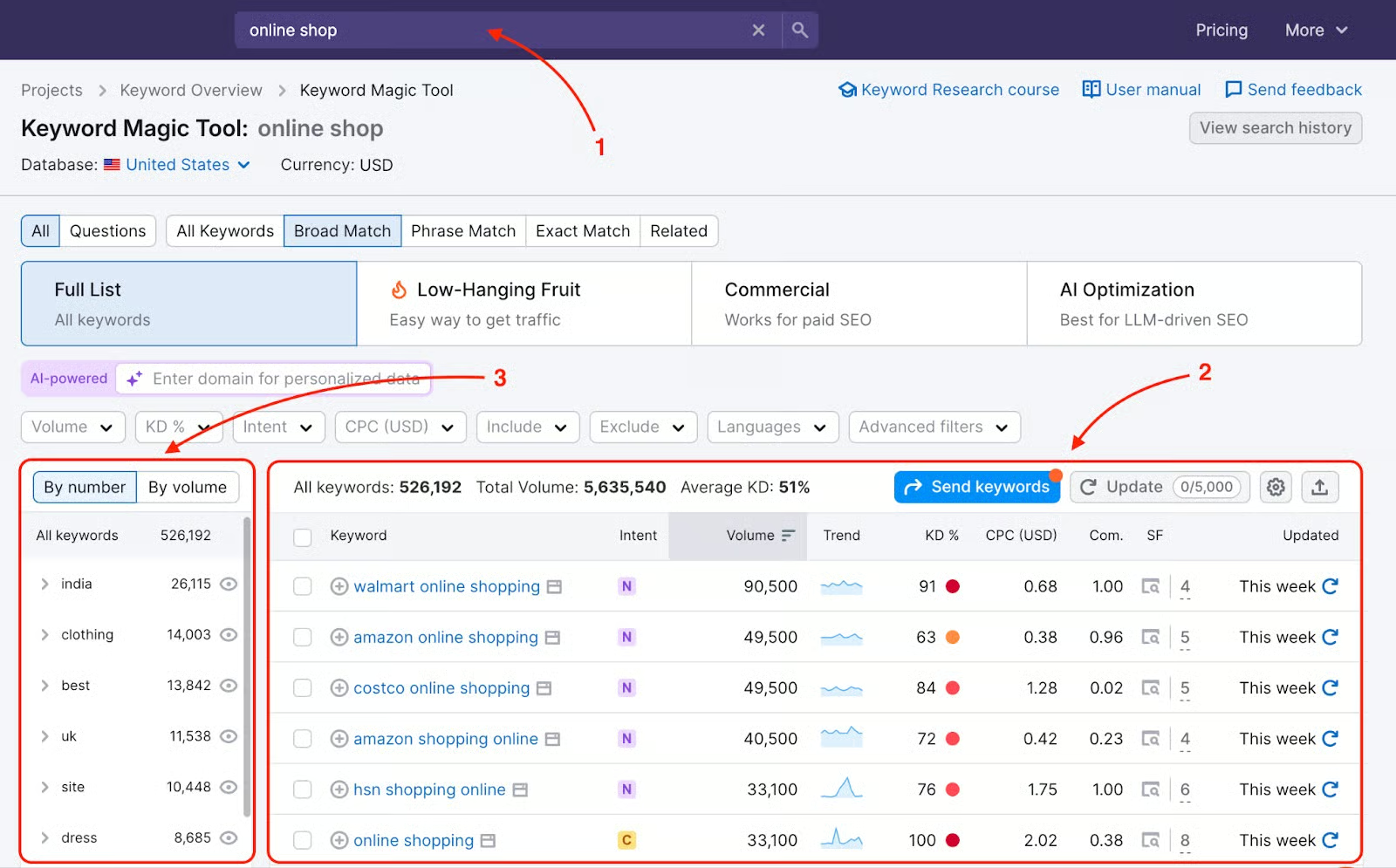
The Semrush Keyword Magic Tool suits discovery work. Enter a seed term, then filter clustered ideas by intent and volume. Ahrefs Keywords Explorer is built around judgment: it shows keyword difficulty beside the SERP results behind each term, so you can see who ranks before you commit to a target. For a structured method of turning those lists into a plan, see the MediaOne guide to the four pillars of data-driven SEO.
Keyword gap and competitor analysis
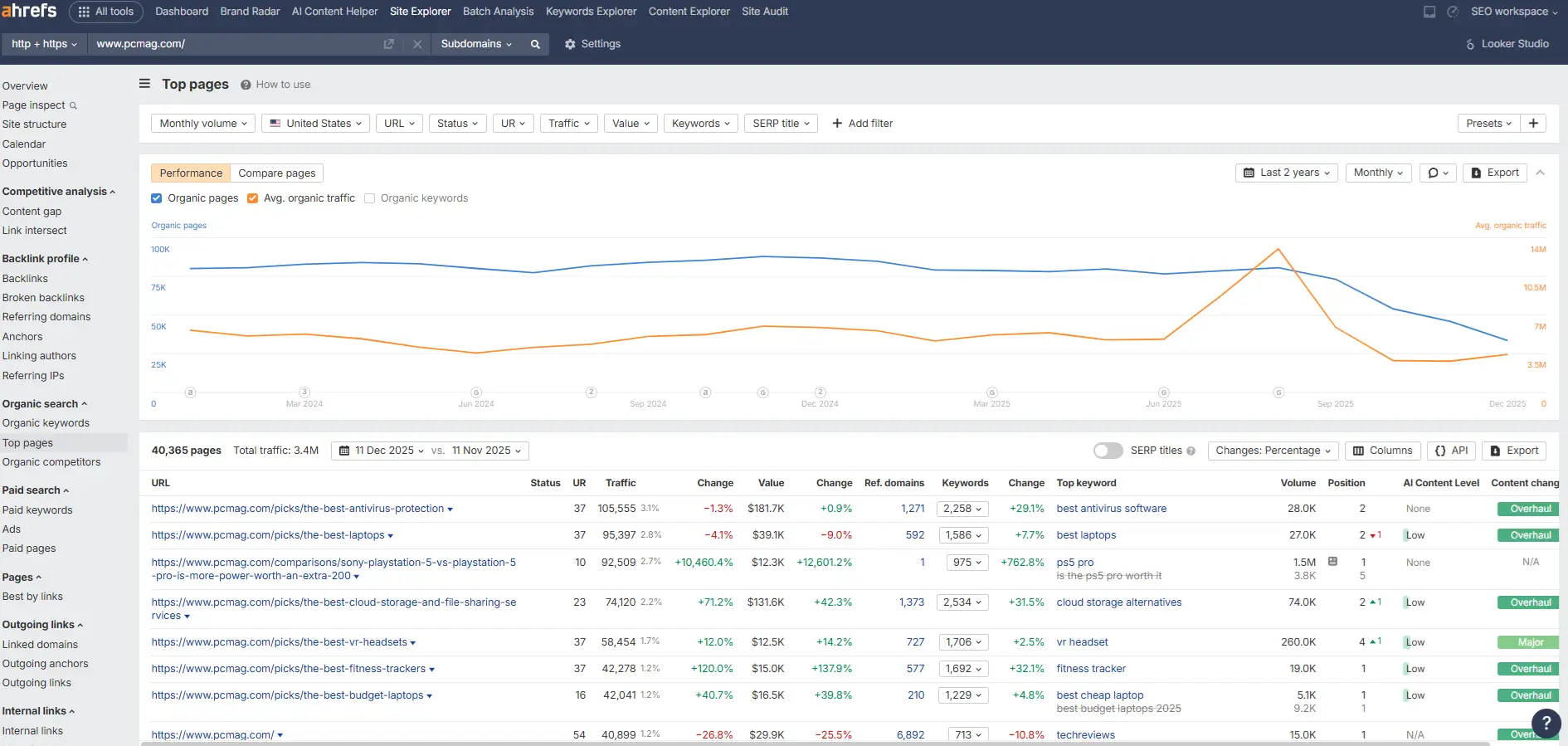
Semrush Keyword Gap compares your profile with up to five competitors in one report. Ahrefs handles competitor work through Site Explorer. It is less of a one-click gap table, but it lets you inspect the pages behind each gap.
Site auditing
Both tools crawl a site but organise the output differently. Semrush groups issues by severity. Ahrefs emphasises crawl depth and where issues sit in the site structure. Prioritise fixes in this order:
- Issues that block indexing (noindex tags, broken canonicals, server errors)
- Issues on pages that already earn organic traffic
- Duplicate or thin content on templates that generate many URLs
- Cosmetic warnings, such as minor title length issues
Fixing item 1 on a page with traffic beats fixing 100 warnings on pages nobody visits. For a worked example of this discipline in practice, see MediaOne on the AI traps that cost you rankings.

Rank tracking
Semrush tracks Google, Bing, Baidu and ChatGPT, which matters if your audience searches beyond Google or you need visibility in AI answers. Ahrefs Rank Tracker covers Google across 190-plus locations with 19 SERP features including AI Overviews, and handles AI visibility separately through Brand Radar. If SERP features are what you report on, MediaOne’s round-up of the best Google SERP tools covers the wider category.
Keyword databases and geographic coverage
Database sizes are often quoted as if they measured quality. As of November 2025, SE Ranking’s comparison lists Ahrefs at 28.7 billion keywords (2.3 billion in the US) and Semrush at 26.7 billion (3.6 billion in the US). The totals are close enough that the choice should not turn on them.
Note that both vendors publish higher figures for themselves today. Semrush’s statistics page says its Keyword Magic Tool now covers more than 28.9 billion keywords, and its data page cites 28.8 billion across 142 geographic databases. The two sets of numbers are not in conflict so much as measured differently and at different dates — but if you quote a figure, date it and name its source.
For Singapore work, check whether each tool’s regional database holds your actual terms, with volumes that reflect local behaviour. Run ten Singapore-targeted queries in both tools and compare the volumes against your Search Console data.
Site auditing and rank tracking in practice
An audit matters only if it changes what you do next. Look for pages that cannot be indexed, pages that load slowly on mobile, and internal links pointing to dead or redirected URLs. Fix indexing first, since it caps the value of every other fix.
Set up rank tracking around intent rather than volume:
- Keywords: 10 to 30 terms mapped to commercial pages, plus a few informational terms that feed them
- Locations: the exact country and city where local intent matters
- Devices: desktop and mobile separately, since SERP features often differ
Avoid tracking hundreds of terms on day one. A smaller, deliberate set turns the monthly review into a decision meeting rather than a data dump.
Backlink analysis and link building workflows
Both tools index links at a scale that covers most websites you will need to study. The difference lies in how each packages that data for prospecting, and both are worth evaluating against your technical SEO and search intent goals.
Ahrefs maintains the industry’s largest index of live backlinks, at 35 trillion, per its own comparison page. Semrush reports 43 trillion live and dead backlinks on its data page — dead links are links that have since disappeared, which helps when you want to recover lost links. Note that these count different things, so they are not directly comparable. Semrush exposes its backlink data through 22 backlink-related API endpoints (against Ahrefs’ 77), suiting teams that feed link data into their own dashboards.
Semrush’s Backlink Gap compares your profile with up to five competitors. Ahrefs’ Link Intersect works across up to 10, giving more coverage in one pass.
A link prospecting workflow you can run in both tools
- List three to five competitors that already rank for your target terms in Singapore.
- Run the gap report in each tool, filtering for referring domains that link to two or more competitors but not to you.
- Remove directories, scraper sites and domains with no real traffic.
- Sort the remaining domains by relevance, then by traffic.
- Check each prospect’s recent links to confirm it still publishes in your niche.
- Send outreach in batches of 20 to 30, tracking response rates by tactic.
Run steps one to four in both trials on the same competitor set. Score each platform 0 to 2 on relevant prospects returned, where 2 means most prospects are on-niche. Choose the higher scorer, regardless of database size. For the ethical and practical frame around this work, see MediaOne on white hat link building, and on automating backlink strategy without losing judgment.
Pros and cons for link work
| Factor | Ahrefs | Semrush |
|---|---|---|
| Competitor gap depth | Up to 10 competitors | Up to five competitors |
| Historical link tracking | Live links (35 trillion) | Live and dead links (43 trillion reported) |
| Custom reporting | Dashboard-led | API endpoints |
| Best suited to | Prospecting and link recovery | Teams feeding data into their own systems |
Ahrefs is the stronger choice if prospecting and link recovery drive your week. Semrush is stronger if backlink data must flow into an existing reporting setup. A solo professional may never use the API, so its extra endpoints add little value.
Content marketing tools, AI visibility and brand monitoring
Both platforms now cover more than keyword and backlink work. Score content and AI visibility against your own tasks before choosing. Confirm the search intent behind each target query first, since intent determines whether a tool’s topic suggestions are worth using. For local businesses, check whether each platform can track local SEO signals, such as map pack rankings, as well as national rankings.
On content marketing, Semrush has the broader toolkit. Its topic research and content gap features find subjects competitors cover and you do not, and its writing assistance sits in the same workspace as your keyword data. Ahrefs approaches content through Site Explorer and Content Explorer, which surface top-performing pages by traffic and links. Teams that start from search demand usually prefer Semrush. Teams that want to see which existing articles earned links before commissioning new ones get clearer evidence from Ahrefs.
AI visibility is the newer reporting layer, and it is where the two products diverge most. Ahrefs’ Brand Radar covers an index of 476 million-plus monthly AI prompts across seven AI indexes, per Ahrefs’ own comparison page. Semrush tracks keyword rankings on ChatGPT alongside Google, Bing and Baidu, as noted in SE Ranking’s comparison. Both figures come from vendor sources and are unaudited, so test them against your own brand queries.
For an agency-side view of what proprietary AI tooling looks like in this space, MediaOne publishes a review of Digimetrics AI.
To check whether your brand appears in AI answers, run 10 to 20 prompts a buyer would type, and record whether your brand is named, cited or absent. Repeat monthly, alongside rank tracking rather than instead of it.
| Content task | Semrush | Ahrefs |
|---|---|---|
| Topic and gap research | Stronger, integrated with keyword data | Solid, via Content Explorer |
| Writing aids | Built in | Limited |
| AI visibility | Keyword tracking on ChatGPT | Brand Radar index |
Pros for content teams. Semrush suits teams wanting one workspace from ideation to writing. Ahrefs suits teams that judge content by links and traffic already earned. Cons. Semrush’s breadth can dilute depth in any single area; Ahrefs offers fewer writing aids. Technical audits are a separate job to check against each platform’s own documentation.
Pricing, plan limits and support
Treat the price tag as the start of the calculation, not the end, and note that both vendors have restructured their plans recently — so any figure quoted in a secondary source is likely to be a snapshot.
SE Ranking’s pricing overview, which checked figures in November 2025, lists Semrush at $139.95 per month (Pro), $249.95 (Guru) and $449.95 (Business), and Ahrefs at $29 (Starter), $129 (Lite), $249 (Standard) and $449 (Advanced). Those legacy Semrush tiers have since moved: current third-party listings put the Business plan at $499.95 per month, and Semrush’s pricing page now sells a different ladder entirely — SEO, Starter, Pro+, Advanced and Enterprise — with limits expressed as websites monitored, keywords tracked daily, and AI prompts tracked daily. All of these are US dollar figures, so convert them to S$ and confirm current prices on each vendor’s own pricing page before budgeting. For a sense of how tooling sits inside a broader budget, see MediaOne on how much SEO costs.
Ahrefs sets its tiers the same way, with each step adding project capacity, crawl allowances and seats. Current Ahrefs tiers run Lite, Standard, Advanced and Enterprise, stepping up from 5 projects, 750 tracked keywords and 100,000 crawl credits at the entry tier to 50 projects and 5,000 tracked keywords at Advanced; Enterprise is listed at $1,499 per month on an annual commitment. According to Ahrefs’ own comparison page, you can group up to 1,000 URLs from 10 domains as a single project, which suits small portfolios. Watch tracked keywords, projects and user seats, as these run out first — and check keyword difficulty and rank tracker allowances against your keyword volume, since both count towards plan limits.
To judge value, match the plan to three numbers from your own workload:
- Team size: how many people need logins at the same time.
- Project count: how many websites or clients you monitor, including local SEO locations.
- Reporting needs: whether you export white-label reports, including social media reporting.
A solo marketer with one brand site rarely needs the top tier. An agency with ten clients usually does, and the cost per client falls as the plan rises.
Customer support differs less than the marketing suggests. Both vendors offer email, help-centre access and onboarding guides. Judge them on how quickly a real question about technical SEO gets answered during your trial, not on the feature list. Use the trial to find out whether the content guides answer your own questions clearly.
Choosing the right platform for your SEO goals
For most Singapore teams, the right choice depends on the work you repeat each week, not on which tool has the bigger feature list. Ahrefs reports 28.7 billion keywords and Semrush 26.7 billion, as of November 2025, according to SE Ranking’s comparison. These figures measure size, not freshness, so test each tool on your weekly jobs before deciding. If you are still building a shortlist beyond these two, MediaOne’s round-ups of the best SEO tools for 2026 and premium SEO tools that deliver results in Singapore cover the wider field.
Quick verdict by user type
- Solo marketer: Start with Semrush if keyword planning and an all-in-one dashboard matter most. Choose Ahrefs if your work is mainly link research.
- Agency: Pick the tool whose project and seat limits fit your client load, and check which reports you can export.
- In-house team: Choose the tool that fits your existing reporting. If AI visibility is a priority, check which tool covers the AI engines your audience uses.
Decide with three questions
- What do I do most each week? Link research usually favours Ahrefs. Keyword planning and an all-in-one dashboard usually favour Semrush.
- How many projects and seats do I run? Check each plan’s project, user and data limits.
- Do I need AI visibility tracking? If so, confirm which tool’s AI features match how you report results.
If the answers still leave you torn, run a parallel trial. Use the same ten to twenty keywords and website, then run keyword research, a backlink check and a site audit in both tools on the same day. Score each of your top five tasks from 0 to 2. Pick the tool with the higher total out of 10, and treat a gap of one point or less as a tie that your budget should settle. For a Singapore agency’s view of what this looks like in practice, see MediaOne’s digital marketing practice and its SEO services.
Frequently asked questions
Is Ahrefs better than Semrush?
Neither is better in general. Ahrefs is generally stronger for backlink research, since it maintains the largest index of live backlinks — 35 trillion, per its own comparison page. Semrush is generally stronger as an all-in-one suite, with ad data, local SEO metrics and bulk keyword analysis.
Which is cheaper, Ahrefs or Semrush?
Entry pricing is close, and both vendors have restructured their plans, so check current S$ prices on each site before buying. SE Ranking’s November 2025 snapshot lists Semrush at $139.95 (Pro) to $449.95 (Business) and Ahrefs at $29 (Starter) to $449 (Advanced), in USD; current listings put Semrush’s legacy Business tier at $499.95, and Semrush now sells a different plan ladder. Compare plans by the limits you need — projects, users and monthly quotas — not by headline price.
Which tool is better for keyword research?
Semrush is usually the stronger choice for broad keyword discovery. Its Keyword Magic Tool covers over 28.9 billion keywords across 142 geographic databases, per Semrush’s statistics page, and its Keyword Gap compares your profile with up to five competitors. Note that a November 2025 third-party snapshot put the same database at 26.7 billion — figures move, and methods differ, so test both tools on your own Singapore and regional terms. Database size measures coverage, not accuracy.
Which tool is better for backlink analysis?
Ahrefs is generally the stronger choice. Its Site Explorer covers 35 trillion live backlinks, and its Link Intersect compares up to 10 competitors. Semrush’s Backlink Gap covers up to five competitors and exposes data through 22 API endpoints, which suits teams building their own reporting.
Can Ahrefs or Semrush track brand visibility in AI search?
Both now offer AI-related tracking, but the feature sets differ. Ahrefs Brand Radar shows AI visibility based on an index of 476 million-plus prompts across seven AI indexes. Semrush supports rank tracking on Google, Bing, Baidu and ChatGPT. Check whether each tool covers the AI engines your audience uses.
Is there a free trial for either platform?
They are not equivalent. Ahrefs does not offer a free trial — it offers Ahrefs Free, a limited free-forever plan. Semrush offers a seven-day free trial that requires a card. Terms change, so check each vendor’s pricing page for the current offer, and run the same ten keywords and your own URLs through both before committing to a paid plan.
Who owns Semrush now?
Adobe. The acquisition was announced on 19 November 2025 and completed on 28 April 2026, in an all-cash deal at $12.00 per share worth roughly $1.9 billion. Semrush operates as “Semrush, an Adobe company”.