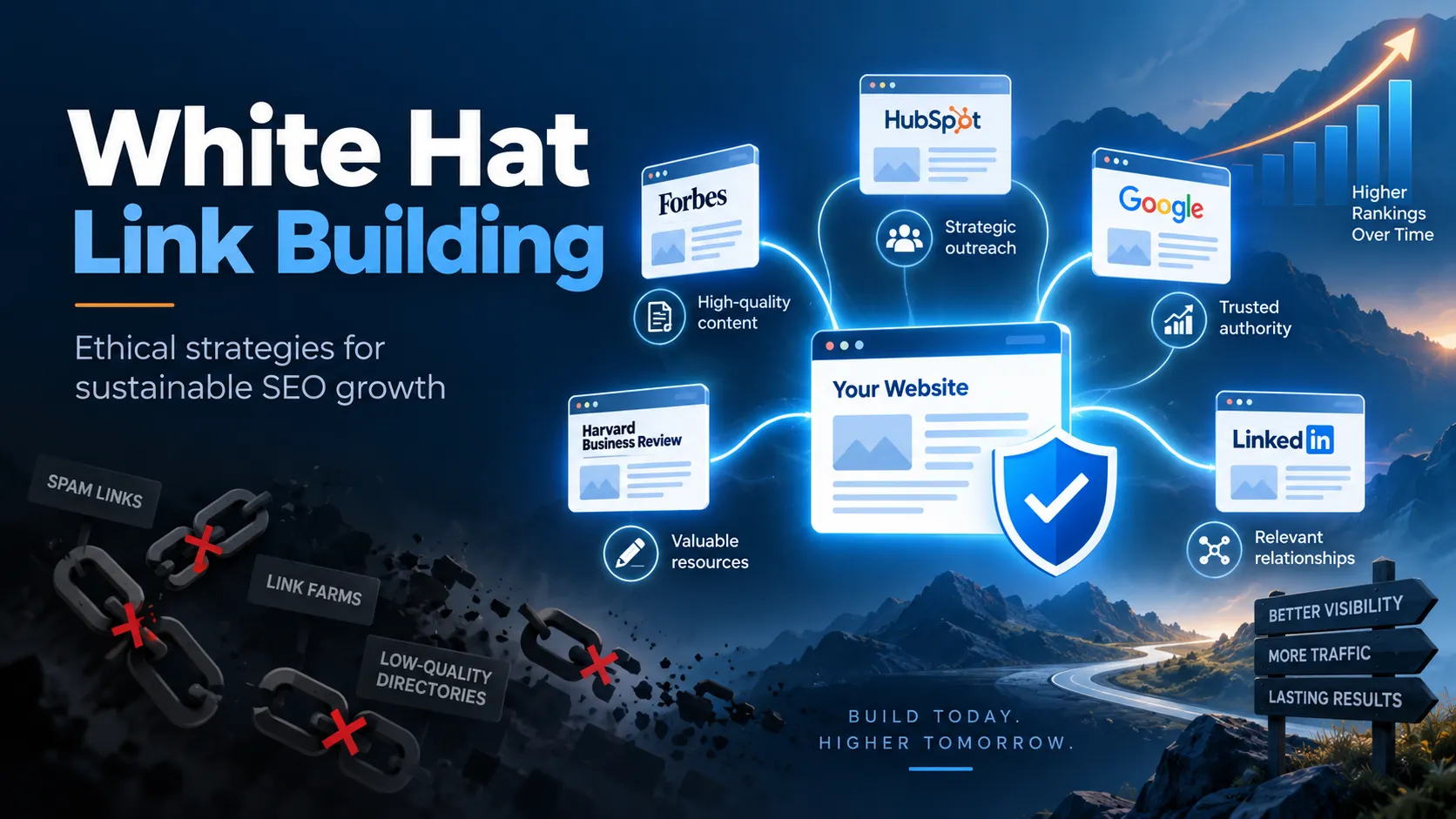
Link building remains a significant ranking factor according to Google Search Central documentation. However, it has also become one of the most misunderstood and misused SEO practices. Many websites lose rankings or face manual penalties because they pursue quick links instead of earned ones. White hat link building is the alternative: a slower, systematic approach that builds authority the way Google intended and survives every algorithm update.


This guide moves beyond the assumption that a white hat means taking a passive approach. Instead, you will discover a repeatable system that has generated measurable ranking gains for small businesses and hundreds of links for larger ones. You will also learn why consistency, not individual tactics, separates winners from those who conduct link building intermittently for a few weeks and abandon it. The framework here applies whether you run a local service business in Singapore, manage a B2B SaaS platform, or publish content at scale.
Key principles of sustainable white hat link building:
- White hat link building is the only path to rankings that survive Google algorithm updates. Black hat tactics produce short-term gains followed by penalties.
- Quality and relevance matter far more than quantity. Your first 10 strategic links move the needle; 1,000 mediocre ones create risk without reward.
- A repeatable outreach rhythm, typically 10 to 15 personalised pitches per week, compounds into 40 to 60 quality links annually.
- High-authority links without topical relevance signal risk to Google’s systems. A finance blog link to a plumbing site raises flags, not rankings.
- Consistent link velocity, or steady acquisition, outranks link spikes. A business acquiring 10 quality links per month outranks a competitor who acquired 100 links and then nothing.
- White hat campaigns take 6 to 12 weeks to show ranking movement. Plan for long-term compounding, not quick wins.
Understanding White Hat Link Building
Links remain a significant ranking factor according to Google Search Central documentation. The term matters for two reasons. First, links remain central to Google’s algorithm, despite years of commentary suggesting their importance had declined. Second, white hat protects your brand: a penalty from black hat tactics can reduce your visibility for months, but white hat links compound safely over time and do not drop as tactics evolve.
White hat SEO rests on three core principles:
- Relevance. The linking site covers a topic related to your content. A financial advisor linking to your accounting software is relevant; a casino linking to your fitness guide is not.
- Authority. The linking domain has genuine topical credibility and traffic. Links from established news outlets, industry associations, or research institutions signal trust to Google’s algorithm.
- Natural acquisition. The link is given freely because your content deserves it, not because you paid, incentivised, or otherwise manipulated the publisher into placing it.
Not all link building sits on one side of the line. The table below shows where tactics fall:
| Approach | Method | Example | Google Risk |
|---|---|---|---|
| White Hat | Earn links through quality content, expert positioning, partnerships | A journalist cites you as an expert source; an industry body links to your guide | No penalty risk; gains compound |
| Gray Hat | Borderline tactics that exploit loopholes without explicit rule violation | Guest posting on moderate-authority sites purely for the link; sponsoring research and then requesting the link | Possible algorithm churn; safe from manual action but can dilute effectiveness |
| Black Hat | Techniques that violate Google’s link scheme guidelines | Private Blog Networks (PBNs), paid link networks, comment spam, link exchanges for no editorial reason | Manual penalty, ranking drop, or deindexing |
Real Consequences of Black Hat Tactics
Black hat links often produce fast, visible rank gains, then crash. In 2023, Google’s helpful content updates swept away many sites built on low-quality paid links. A manual penalty from the Search Console team can take several months to recover from, even after removing bad links.
White hat builds slower. Your first 10 quality links might improve rankings by 2 to 4 positions. By month 12, you might have 40 to 60 new referring domains and top-3 rankings on competitive terms, depending on keyword difficulty and industry competition. The curve is gentler, but it stays steady.
Why Singapore-Based Businesses Should Prioritise White Hat
Singapore’s regulatory environment and brand-conscious market demand transparency. Singapore’s advertising standards emphasise transparency in sponsored content. A Singapore business using paid links risks reputational damage in a tight-knit business community and potential advertising restrictions.
Additionally, Singapore-registered companies competing for government contracts, partnerships with multinationals, or investment often face due diligence reviews. Black hat SEO tactics can disqualify you before you pitch.
Singapore’s digital media landscape is mature and global-facing. Top journalists at The Straits Times, CNA, and Business Times actively cover local companies. Genuine expertise and thought leadership generate earned links far faster than buying them.
How Google Evaluates Links
Links signal trust to search engines, but only when they come from relevant, authoritative sources and point to content worth linking to. A single high-quality link from a topical authority often moves rankings more than a hundred links from unrelated or low-authority domains.
Google’s systems evaluate whether a link represents a genuine endorsement from a trusted source, aligned with the E-E-A-T framework (Experience, Expertise, Authoritativeness, Trustworthiness).
A link from the New England Journal of Medicine to your health guide matters far more than fifty links from health forums or affiliate sites. The source’s expertise in the field, the topical match between source and target, and the editorial decision to link all combine to determine the link’s weight.
Three factors work together:
- Source Authority. Is the linking domain established, well-maintained, and credible in its niche? Does it have its own inbound links from other trusted sources?
- Topical Relevance. Does the linking page cover a subject related to yours? A link from a fintech blog to an accounting software guide carries more weight than the same link to a plumbing service.
- Anchor Text and Context. Does the link appear naturally in the body of the article, with anchor text that matches or complements your page’s topic? Links in navigation footers or surrounded by dozens of other links signal less intent.
When all three align, Google treats the link as a trust indicator. The search engine interprets it as “this authoritative site, in this topic area, found this content valuable enough to reference.” That signal lifts rankings far more efficiently than volume.
The Diminishing Returns of Link Volume
Quality links drive more ranking gain than link volume. A site with 50 relevant, high-authority links typically ranks higher for competitive terms than a site with 5,000 low-quality links.
Your first ten quality links usually produce the most visible ranking gain. Links 11 to 50 continue to help, but the improvement slows. By the time you reach five hundred mediocre links, each new link adds almost nothing to your rankings.
Why the first ten move the needle: If you have zero links, you are invisible to the algorithm in most competitive niches. Ten relevant links from established domains signal that your content exists and is credible. That threshold unlock is steep.
Why one thousand mediocre ones do not: Once you cross into the hundreds of links, the search engine has already classified your site as established in your topic. Additional links from low-authority, off-topic, or spammy domains add noise, not signal. Google begins to discount them or ignore them entirely.
Real thresholds to track:
For a business with a new website, aim for 15 to 25 referring domains in your first year. This typically produces measurable ranking movement on moderately competitive keywords. Highly competitive keywords may require 50 to 100 or more referring domains, but the gains per link still diminish as you scale.
Metrics that matter more than raw link count:
- Referring Domains: The count of unique websites pointing to yours. Two links from one domain count as one referring domain.
- Topical Relevance Score: What percentage of your links come from pages in your industry? Aim for 70% or higher.
- Traffic Flow: Does the linking page send you actual visitors? Google weights links from high-traffic pages more heavily because they reflect real editorial decisions.
- Link Velocity: Are you earning 3 to 5 new links per month consistently, or 50 links in one month followed by silence? Steady velocity ranks higher than spikes.
Domain authority alone is not enough. A link from a domain with a 60+ authority score will underperform if it comes from an unrelated niche or a low-traffic page. Prioritise relevance and traffic over authority scores alone.
When rankings plateau: Most sites see the largest rank gains from link one to link fifty. From fifty to two hundred, gains continue but become incremental, often one to three position shifts per twenty new links depending on competition. Beyond two hundred, you are typically fighting for page-one real estate against sites with similar link profiles, so content quality, on-page SEO, and user signals become the tiebreaker.
The practical takeaway: do not chase link volume. Focus on landing links from your target sources, the 15 to 20 websites where your audience already trusts and reads. Quality compounds faster than quantity ever will.
Proven Link-Building Tactics
The difference between a link-building campaign that stalls and one that compounds is execution on tactics with proven win rates. Each method below has a specific use case, realistic timeline, and measurable outcome.
Tactic 1: The Skyscraper Method
Find a competitor’s top-performing content, create something measurably better, then pitch it to everyone who linked to the original.
How it works:
Step 1: Use Ahrefs or SEMrush to export your competitor’s backlinks. Sort by domain authority. Find the page with 50 or more referring domains that ranks in your niche.
Step 2: Create an upgrade. Include more data, fresher research, additional formats such as a calculator or template added to a how-to guide, or a local angle. For Singapore businesses, adapt the content to address Singapore-specific regulations, case studies, or market conditions. A guide to “Supply Chain Optimisation” becomes “Supply Chain Optimisation for ASEAN Manufacturers: Singapore Case Study”.
Step 3: Export the 50+ domains linking to the original. Use Hunter.io or LinkedIn to find contact emails. Write a personalised email to each without templates: reference their article, explain why your upgrade is better, and link to yours.
Timeline: 4 to 8 weeks per campaign (1 week research, 2 weeks creation, 1 to 2 weeks outreach, 2 to 4 weeks waiting for responses).
Expected outcome: 8 to 20 new links if executed properly. Success depends on the strength of your upgrade and the relevance of the source domains.
Why it works: You are not asking for a favour. You are offering linkers a better resource to point their audience toward, which improves their page’s value.
Tactic 2: Resource Page Pitching
Identify hub pages in your sector that compile tools, guides, or references, then pitch your content as a gap-filler.
How it works:
Search Google for phrases like “[your industry] + resources”, “[your sector] + tools”, or “[niche] + best guides”. Look for pages that list 10 to 30 or more external links. These are resource pages.
Assess each candidate: Is the page maintained with recent updates in the footer or post date? Does it accept submissions with a “suggest a resource” link or contact form? Avoid dormant pages.
Pitch your asset as a gap-filler: “Your guide covers X and Y well, but I notice you do not have a resource on Z. I wrote a guide on Z that might fit your audience.”
Timeline: 2 to 4 weeks per placement.
Expected outcome: 1 link per 10 outreach emails. Resource pages usually carry high domain authority because they are curated hubs.
Why it works: Resource page owners want their pages to be comprehensive and current. You are solving a problem they already have.
Tactic 3: Journalist and Expert Outreach
Position yourself as a source for journalists covering your industry. When they need an expert quote, they link to you.
How it works:

Sign up for HARO (Help A Reporter Out) and set alerts for keywords in your niche. Journalists post requests such as, “Seeking expert comment on AI adoption in manufacturing.” Reply within 24 hours with a one-liner soundbite and your credentials.
If selected, the journalist includes your name, title, and a link to your site in the published piece. High-authority outlets such as TechCrunch, Forbes, or The Verge send referral traffic and pass authority. For Singapore businesses, monitor Singapore-specific media databases and pitch to local business journalists covering your sector.
Timeline: Ongoing. Realistically, 1 to 2 placements per month if you reply consistently.
Expected outcome: Links from news outlets with high domain authority, plus branded mentions and qualified traffic.
Why it works: Journalists need expert quotes. If you are easy to work with and reliable, you become their go-to source.
Tactic 4: Content Sponsorship and Original Research
Commission original research, surveys, or reports in your industry, then partner with universities, research firms, or industry bodies to distribute findings.
How it works:
Identify a gap in your industry’s knowledge: “No one has surveyed remote work preferences in Singapore’s tech sector.” Commission a survey or research project using Qualtrics, SurveyMonkey, or a university partnership.
Promote the findings via a whitepaper, infographic, or press release. When universities, industry associations, or media outlets cite the research, they link to your original report.
Example: You sponsor a study titled “Retail Trends in Southeast Asia 2024. NUS publishes a case study using your data. Trade publications cite it. Your results page collects 20 to 50 referring links naturally.
Timeline: 2 to 4 months, including research planning, execution, analysis, and distribution.
Expected outcome: 20 to 50 links from high-authority sources such as universities, research hubs, media, and industry groups.
Cost: Higher than other tactics (2,000 to 10,000 SGD depending on research scope), but the links are earned, not bought.
Why it works: Original data is rare and valuable. Organisations that cite it are linking to a unique asset no competitor has.
Tactic 5: Broken Link Recovery
Find broken links pointing to competitor content, create a replacement, and contact the linking site to fix it.
How it works:
Use Ahrefs, SEMrush, or the free tool Digimetrics.ai to identify 404 pages on competitor sites. Export the list of domains that link to those dead pages.
Create content on a similar topic. Email the linking site: “Hi. I noticed you link to [dead page]. It now returns a 404. I wrote a similar guide on [topic]. Your readers might find this helpful.”
Success rate improves when you mention the dead link in the subject line and keep the pitch to 2 to 3 sentences.
Timeline: 1 to 2 weeks per campaign.
Expected outcome: 30 to 40% of contacts will check your resource and link to it.
Why it works: You are solving a concrete problem such as a broken link that the site owner probably does not know about. You are also offering a genuine replacement, not a sales pitch.
Tactic 6: Awards and Directory Listings
Apply to relevant, curated award programmes and contribute to high-authority directories that are specific to your sector.
How it works:
Research award programmes in your industry. Focus on curated programmes such as Singapore’s SME Award, Singapore Business Review awards, or AsiaOne awards, rather than link-farm “awards” that accept everyone.
Apply. If you win or are nominated, the award programme’s website links to your profile or company page. These links carry high trust signals because award bodies are selective.
Similarly, contribute to curated directories: professional associations, industry bodies, or Singapore Standards listings. Verify that the directory carries a do-follow link and is actively maintained.
Timeline: 4 to 12 weeks, as award decision timelines vary.
Expected outcome: 1 to 3 links per award or directory, but from high-authority sources.
Why it works: Award sites and professional directories are trusted by both search engines and users. A link from them is a credibility endorsement.
Tactic 7: Co-Created Content and Partnerships
Collaborate with complementary, non-competing brands to produce joint research, guides, or interactive tools. Both sites link to and promote the shared asset.
How it works:
Identify businesses that serve adjacent audiences. If you sell project management software, partner with an agency that uses your tool. Create a co-authored guide: “Project Management Best Practices for Distributed Teams”.
Both companies publish the guide on their sites or on a shared hub. Both link to it from their blog and resource pages. Both promote it to their audiences.
Example: A Singapore HR consultancy partners with a payroll software provider to co-author “Employment Law Changes in Singapore 2024”. Both link, both promote.
Avoid low-authority guest posting in which you write a post on a weak site purely for a link. Instead, focus on true co-ownership where both partners have a stake in promotion.
Timeline: 6 to 12 weeks for a major co-project, including planning, collaborative writing, editing, and launch coordination.
Expected outcome: 2 to 4 links per partner plus shared audience exposure.
Why it works: Co-created content is stronger than solo work and naturally attracts links from both partners’ networks.
Comparison of Link-Building Tactics
| Tactic | Effort Level | Timeline | Expected Links | Best For |
|---|---|---|---|---|
| Skyscraper | High | 4 to 8 weeks | 8 to 20 | Established competitors, clear gaps |
| Resource Page | Medium | 2 to 4 weeks | 1 to 3 | Quick wins, lower authority requirements |
| Journalist Outreach | Medium | Ongoing | 1 to 2 per month | Visibility, branded mentions, long-term growth |
| Content Sponsorship | High | 2 to 4 months | 20 to 50 | Authority, sector-wide credibility |
| Broken Link Recovery | Low to Medium | 1 to 2 weeks | 1 to 3 | Quick start, low competition |
| Awards and Directories | Medium | 4 to 12 weeks | 1 to 3 | Trust signals, local authority |
| Co-Created Content | Medium to High | 6 to 12 weeks | 2 to 4 per partner | Audience expansion, partnership growth |
Allocation strategy: Start with Broken Link Recovery to build momentum quickly. Run Skyscraper and Journalist Outreach in parallel over 3 months. Add a Content Sponsorship project for quarter 2. Maintain Awards submissions as a quarterly habit.
How to Choose Your Link-Building Strategy
A repeatable framework beats a menu of tactics. You need a system that turns random link-building efforts into a predictable engine: audit what you have, identify who links to your competitors, fill content gaps, prioritise your work, systematise outreach, and create something worth linking to.
Use the following steps to choose which tactics fit your situation:
1. What is your baseline link profile? Start with what you already own. Export your backlink data into a spreadsheet so you can see patterns, not just numbers. Use Ahrefs, SEMrush, or Moz to pull your full backlink list. Sort by referring domain authority and topical relevance. Keep links from high-authority sources in your industry. Flag spammy or irrelevant links such as low-quality directories, unrelated content farms, or exact-match keyword anchors. Disavow or ignore those later. Look for patterns in your best links. Which sectors sent you your strongest sources? Did links come mostly from blog posts, news coverage, resource pages, or directory listings? Which outreach method worked best: cold email, relationships, award programmes, or organic mentions? Document your baseline. Total backlinks matter less than referring domains, or unique sources. Count both. Note your top 10 link sources by traffic and authority. This becomes your comparison point after six months. A typical small business has 20 to 50 referring domains. Mid-market businesses have 50 to 200. If you have fewer than 10, this audit will be quick. If you have 500 or more, filter to domain authority greater than 20 to keep the analysis manageable.
2. Who links to your competitors? Your competitors already know where the good links are. Reverse-engineer their strategy. List 15 to 20 direct competitors and adjacent players in your space. For each, export their top 20 to 30 referring domains using Ahrefs or SEMrush. Open a spreadsheet and paste all the domains together. Find the overlaps. If 15 of your 20 competitors link from the same 30 domains, those are your target sources. Journalists, industry publications, and research hubs link to everyone in your sector for a reason: they are authoritative, relevant, and actively seeking sources. Prioritise sources by traffic and authority. A domain that links to five competitors is worth more than one that links to only one. A source sending 100 or more monthly visitors beats one with zero traffic. Ignore outliers. If only one competitor links from a domain, it may be a personal blog or irrelevant site. Focus on the 20 to 30 sources that appear across at least three competitors. This step typically takes 2 to 3 hours and reveals your entire competitive landscape for link acquisition.
3. What content types rank in your space? Links flow to specific content types and formats. Identify what works in your industry, then check if you have it. Search your top target keywords in Google. Which content types rank in positions 1 to 10: blog posts, tools, calculators, guides, original data, interactive content, and white papers? Visit the top-ranking pages and note their format, length, and focus. Ask yourself: Do I have content in that format? If competitors rank with 5,000-word guides and you have 1,500-word blog posts, that is your gap. If they rank with original surveys and you have curated lists, that is another gap. For Singapore-based businesses, add local specificity. Are there regulations, case studies, pricing models, or compliance requirements unique to Singapore that no competitor has covered? A guide titled “SEO for Singapore Fintech Startups: Regulatory Compliance + Rankings” will attract links that a generic “SEO guide” never will. Plan to close one or two gaps per quarter. Do not try to rebuild your entire content library at once.
4. How should you allocate your time? Not all link-building tactics deserve equal time. Allocate your limited hours strategically.
Tier 1 tactics (60% of your budget): High effort, high return. Original research, competitive content upgrades, comprehensive guides, interactive tools, and data sets. These take 6 to 12 weeks and 40 to 80 hours each, but they attract 15 to 50 links per asset.

Tier 2 tactics (30% of your budget): Medium effort, medium return. Resource page pitches, expert commentary via HARO, broken link recovery, and guest articles on authority sites. These take 2 to 4 weeks and 10 to 20 hours each, yielding 2 to 8 links per campaign.
Tier 3 tactics (10% of your budget): Low effort, low return. Directory submissions, award applications, and review site listings. These take 1 to 2 weeks and 3 to 5 hours each, return 1 to 3 links, and require minimal investment.
A one-person team should spend 60% of their time on Tier 1, creating one flagship asset per quarter. Spend 30% on ongoing Tier 2 outreach with consistent weekly effort. Spend 10% on bulk Tier 3 activities through batch submissions.
Building Your Link-Building System
Consistency beats brilliance in link building. A system ensures you send 10 to 15 personalised pitches every week, which compounds into 40 to 60 links per year.
Establish Your Outreach Workflow
Create an outreach template library with five to six variations. One for journalists, one for bloggers, one for resource page curators, one for co-content partnerships, and one for award programmes. Each should open with a personalised reference such as their recent article or focus area and close with a specific ask.
Set up a CRM or spreadsheet to track every outreach effort. Use columns such as Target URL, Contact Name, Email, Industry/Type, Pitch Date, Response Date, Response (Yes/No/Maybe), Outcome (Link live/Pending/Rejected), and Notes. This takes 2 minutes per contact but transforms your campaign from guesswork into data.
Establish a weekly rhythm. Block 5 to 10 hours each week for outreach. Send 10 to 15 personalised emails, not 100 templated ones. Track response rates. A healthy cold outreach campaign typically gets a reply rate of 15-25%. Of those replies, 30 to 50% convert to actual links.
If your reply rate is below 10%, your pitches aren’t personalised enough, or your ask isn’t clear. If replies are high but conversion is low, your content is not compelling enough.
Create Content Worth Linking To
Do not build links to mediocre content. Your outreach will fail, or your links will not move rankings.
Commit to one flagship asset per quarter. Choose one format: original research such as a survey, data analysis, or benchmark report; a comprehensive guide with 4,000 or more words and original examples; an interactive tool such as a calculator, quiz, or template; or a proprietary methodology.
Make it measurably better than what exists. If guides on your topic average 2,500 words, write 5,000 and add original research. If competitors use generic examples, add local case studies. If they use five-year-old data, source 2024 data.
Promote internally first. Link to it from your homepage, email list, and existing content. Let it sit for 4 to 8 weeks so it gains internal authority and early referral traffic. When you pitch it to external sources, you can say, “This guide attracted X thousand views from our audience. Your readers would likely value it too.”
Plan 3 to 6 months ahead. Research, create, refine, and promote before you launch an outreach campaign. Rushing a half-baked asset wastes your entire outreach effort.
Each flagship asset typically attracts 20 to 50 links if it genuinely fills a gap. That is worth four to five months of your time.
Common Link-Building Mistakes and Solutions
Most link-building campaigns fail not because the tactics are weak, but because they are executed poorly. These seven mistakes will trap you in a cycle of wasted outreach, low-quality links, and stalled rankings.
| Common Mistake | Why It Happens | Solution |
|---|---|---|
| Pursuing high-authority links from irrelevant niches | You see the domain authority score and assume all high-authority links are equal | Score links on relevance first, authority second. Before you pitch, ask: Does this source’s audience care about my topic? If the site has never written about your industry, move on. |
| Sending mass template emails | You want to scale outreach and send hundreds of pitches quickly | One personalised email to the right person beats 100 template emails. Hand-research each contact. Read their recent posts. Reference something specific from their work. Limit yourself to 10 to 15 personal pitches per week for 15 to 25% reply rates. |
| Routing all links to your homepage | You want to centralise link equity | Route every link to the specific content it discusses. A link about your new guide should point to the guide, not your homepage. Let homepage links happen naturally from brand mentions. This distributes authority across your site and strengthens individual ranking targets. |
| Accepting links from zero-traffic sources | You think any link passes authority | Prefer sources that send real visitors. Check GA4 under Traffic > Source. Use Ahrefs or SEMrush to estimate the linking site’s monthly traffic. Aim for sources that combine authority and audience. A moderately authoritative blog with 10,000 monthly visitors beats a high-authority site with 500 monthly visitors. |
| Using exact-match keyword anchor text exclusively | You think exact-match keyword text triggers rankings | Aim for a natural distribution: 10% exact match, 40% partial match (e.g. “white hat tactics” or “link building strategies”) and 50% branded and naked URLs. Let anchor text emerge naturally from how writers would reference your content. Do not pitch with exact-match demands. |
| Pitching links to unfinished or weak content | You want to secure links quickly before your content is ready | Finish and test your content first. Build internal links to it. Get data showing it performs well. Then pitch for external links. This discipline ensures that when a link goes live, it lands on a polished asset that converts visitors into results. |
| Running only occasional campaigns | You conduct link building sporadically, then stop | Link building is an ongoing engine, not a campaign. Allocate 5 to 10 hours per week to outreach, always. Build one flagship asset per quarter. Send 10 to 15 pitches every week. This rhythm generates 40 to 60 links per year on a steady curve. Competitors who link build sporadically will always lag behind you. |
The pattern in all seven mistakes is the same: rushing execution over strategy. A poorly researched outreach email to a high-authority site performs worse than a thoughtful pitch to a mid-authority relevant source. A link from the wrong site is worse than no link. And a one-time effort is worse than a sustainable system that runs every week.
The best white hat link builders are not creative wizards. They are disciplined and consistent. They score links by relevance, they write personal emails, and they treat link building as a weekly habit, not a project.
Tools and Platforms for Link Building
White hat link building doesn’t require expensive tools, but the right ones speed up your research, outreach, and tracking. Note that most backlink analysis tools and email finders charge subscription fees. Free alternatives exist but offer limited features. This list includes both paid options and notes on costs.
Backlink Analysis:
- Ahrefs. The standard for competitive backlink analysis. Export competitor backlinks, filter by domain authority and topical relevance, and identify gaps in your link profile. Cost: from 99 USD per month. Use case: Skyscraper method, competitive analysis, target source identification.
- SEMrush. Similar to Ahrefs with a user-friendly interface. Includes topic authority filtering and link gap analysis. Cost: from 99 USD per month. Use case: Content gap audits, resource page research.
- Moz Link Explorer. Lighter and lower-cost alternative. Offers decent backlink data and authority metrics. Cost: from 99 USD per month. Use case: Smaller teams or budgets, entry-level competitive analysis.
Contact and Email Discovery:
- Hunter.io. Find email addresses for domain-based contacts. Search by domain and find verified email patterns. Note that email discovery tools have variable accuracy; verify contacts manually where possible. Cost: free tier plus 99 USD per month for premium. Use case: Journalist outreach, resource page curator pitching.
- LinkedIn. Identify contacts by job title and company. Export lists for outreach. Combine with Hunter to find verified emails. Cost: 40 to 80 USD per month for Sales Navigator.
- Apollo. Email finder plus CRM integration. Build contact lists, verify emails, and track responses. Cost: from 49 USD per month. Use case: Large-scale outreach, list-building campaigns.
Organisation and Workflow:
- Google Sheets or Excel. Simple but effective. Create columns for target URL, contact, email, pitch date, response, and outcome. Update weekly. Cost: free.
- Pipedrive. Lightweight CRM designed for outreach. Track every pitch and follow-up. Cost: from 15 USD per month.
- HubSpot. Full-featured CRM with a free tier. Email tracking, automation, and reporting. Cost: free (limited) to 45 USD per month and higher.
Research and Content Creation:
- Typeform or Qualtrics. Build surveys for original research. Typeform is simpler and cheaper; Qualtrics is more powerful for large-scale studies. Cost: 14 to 35 USD per month (Typeform) or custom pricing (Qualtrics).
- Canva or Adobe Express. Design infographics and report covers without hiring a designer. Cost: 120 USD per year (Canva Pro) or free (Adobe Express).
- Figma. Collaborate on interactive tools and dashboards. Cost: free (personal) to 12 USD per month and higher (professional).
Monitoring and Compliance:
- Google Search Console. Monitor your backlinks and disavow bad ones. Free. Use case: Link profile health, penalty alerts.
- Mention. Track brand mentions and links across the web in real time. Cost: from 25 USD per month. Use case: Early warning for unlinked brand mentions, link surveillance.
Frequently Asked Questions
How long does it take to see ranking improvements from white hat link building?
White hat campaigns typically take 6 to 12 weeks to show measurable ranking movement. Your first 10 quality links may shift rankings by 1 to 3 positions. Steady gains compound over 6 to 12 months as your link profile grows. Results depend on niche, execution quality, and existing domain authority. Highly competitive keywords require longer timelines.
What if I already have some low-quality or spammy links? Should I disavow them?
Yes, audit your backlink profile and disavow links from low-authority directories, unrelated content farms, exact-match keyword anchor text patterns, or sites that appear spammy. Use Google Search Console to upload a disavow file. Focus on disavowing links that look manipulated or off-topic. Natural low-quality links rarely cause penalties. If you received a manual penalty notice, disavow the flagged links immediately and request reconsideration in Search Console.
Is guest posting dead, or can it still generate quality links?
Guest posting on high-authority sites in your niche can still generate valuable links when the primary purpose is to contribute genuinely useful content to the publisher’s audience. The problem isn’t guest posting itself, but mass-producing low-quality articles solely to get backlinks. The problem is mass-producing low-quality articles solely to obtain backlinks.
Choose publications with real readership, topical relevance, editorial standards, and established authority. Write content that adds something the publication does not already have. Avoid keyword-stuffed anchor text, duplicated articles, paid placement schemes disguised as editorial contributions, and large-scale guest-post networks.
A good guest article should still be worth publishing even if the backlink were removed. That is a useful test of whether you are practising genuine white-hat link building.
Should I pay for backlinks?
Paying specifically for links intended to manipulate search rankings creates unnecessary SEO risk. Google distinguishes between genuine advertising or sponsorship and links purchased primarily to pass ranking signals.
There is nothing inherently wrong with paying for advertising, sponsorships, advertorials, partnerships, or promotional placements. However, paid links should be appropriately qualified where required rather than presented as independent editorial endorsements.
A stronger long-term strategy is to invest the same budget in assets that naturally earn coverage: original research, proprietary data, useful tools, expert commentary, industry reports, interactive resources, and genuinely newsworthy campaigns.
The difference is important. Buying a backlink purchases a temporary placement. Creating something people want to reference can generate links repeatedly for years.
How many backlinks do I need to rank on Google?
There is no universal number.
The number of links required depends on your keyword competition, existing website authority, content quality, search intent, topical relevance, internal linking, and the backlink profiles of the pages currently ranking above you.
Instead of asking, “How many backlinks do I need?” analyse the pages already ranking for your target keyword.
Compare:
- Number of referring domains
- Quality and relevance of those domains
- Authority of the individual ranking pages
- Content depth and usefulness
- Search intent alignment
- Internal links pointing to the pages
- Brand authority
- Topical coverage across the wider website
If the top-ranking pages have 30 strong referring domains and yours has three, links may be a major competitive gap. If everyone has similar backlink profiles, improving content or technical SEO may deliver a greater return.
The objective is not to accumulate the largest backlink count. It is to build enough legitimate authority to compete successfully within your particular search results.
Are nofollow links useless for SEO?
No.
A nofollow link may not function in exactly the same way as a traditional followed editorial link, but it can still provide substantial value.
A link from a major publication can generate referral traffic, brand searches, journalist discovery, social sharing, secondary citations, and future links from people who discover your business through the original article.
This is why judging a link purely by whether it is “dofollow” or “nofollow” is too narrow.
Ask instead:
Does the link place your brand in front of the right audience?
Does it come from a credible source?
Could it generate traffic, recognition, citations, or additional coverage?
A relevant mention from a respected publication can be worth pursuing even when the link itself is qualified.
What makes a backlink high quality?
A high-quality backlink normally combines several signals rather than relying on one metric.
The strongest links tend to come from websites that are:
- Topically relevant to your business
- Trusted within their industry
- Publishing genuine editorial content
- Receiving real organic or referral traffic
- Selective about what they link to
- Linking naturally within relevant content
Context also matters.
An editorial reference within a detailed article is generally more meaningful than a link buried in a footer, directory page, author biography, or page containing hundreds of unrelated outbound links.
Third-party authority metrics can help with prospecting, but they should never replace manual evaluation.
A simple question often works better: Would you still want this website mentioning your brand if Google did not exist?
If the answer is yes because the publication has credibility and reaches your target audience, it is probably worth pursuing.
How do I know if my link-building campaign is working?
Do not evaluate link building solely by counting backlinks.
Monitor a combination of acquisition, visibility, traffic, and business outcomes.
At minimum, track:
- New referring domains
- Quality and topical relevance of new links
- Rankings of priority keywords
- Organic clicks and impressions
- Referral traffic
- Branded search growth
- Rankings of pages receiving links
- Organic conversions or enquiries
- Number of successful placements per outreach campaign
Measure progress over months rather than days.
A link obtained this week may not produce an immediate ranking jump. Its impact may combine with improved content, internal links, additional referring domains, and increasing topical authority over time.
The goal is not simply to report that you have “built 20 links.” The goal is to demonstrate that stronger authority contributed to greater search visibility and ultimately more valuable organic traffic.
A Practical 90-Day White Hat Link-Building Plan
If you are starting from scratch, avoid launching seven tactics simultaneously. Build the system gradually.
Days 1–30: Research and preparation
Audit your backlink profile and identify your strongest existing links. Analyse the referring domains of your closest competitors. Create a shortlist of approximately 30 to 50 realistic link prospects.
At the same time, choose one page or asset worth promoting. Improve it until it gives another website a legitimate reason to reference it.
This might mean adding original data, Singapore-specific examples, expert commentary, downloadable resources, clearer visuals, or information competitors have missed.
Your objective during the first month is not maximum outreach. It is making sure you have something worth outreaching about.
Days 31–60: Begin consistent outreach
Start approaching carefully selected prospects.
Prioritise relevance rather than sheer domain authority. Personalise each message and keep the request simple.
Run two or three complementary tactics at once, such as:
- Resource page outreach
- Broken link opportunities
- Journalist or expert-source outreach
- Unlinked brand mention reclamation
- Carefully selected partnership opportunities
Track every contact, response, follow-up, and placement.
After several weeks, patterns will emerge. Certain subjects, assets, audiences, or outreach approaches will consistently outperform others.
Double down on what works.
Days 61–90: Scale the winners
By month three, you should have enough information to identify the tactics producing the highest-quality links.
Stop spending time on approaches that generate poor replies or irrelevant placements.
Improve successful outreach templates without turning them into generic mass emails. Expand your prospect list using the characteristics of sites that already responded positively.
At the same time, start planning your next linkable asset so the campaign doesn’t stop when the first one is exhausted.
By day 90, the most important achievement should not simply be a particular number of backlinks. You should have created a repeatable process for earning them.
Measuring Link Quality Before You Pursue It
Before spending time contacting a website, perform a quick qualification check.
Ask five questions:
- Is the website relevant to my industry or audience?
- Does it appear to receive genuine traffic?
- Does it publish original, useful content?
- Would I be comfortable showing this placement to a customer?
- Would I still value the mention even without its SEO benefit?
If several answers are no, the opportunity is probably not worth pursuing.
This simple filter prevents one of the biggest wastes in link building: spending hours acquiring backlinks that look impressive in a spreadsheet but contribute little to rankings, referral traffic, or brand credibility.
White Hat Link Building in the Age of AI Search
Link building is also becoming broader than traditional Google rankings.
Search engines, AI-generated answers, recommendation systems, and large language models increasingly encounter brands through third-party sources across the web.
That means the objective should not simply be to place a hyperlink.
Your brand should appear in credible industry publications, authoritative guides, expert commentary, research reports, comparison articles, associations, news coverage, and other sources that establish what your company is known for.
This makes digital PR, thought leadership, original research, expert commentary, and authoritative citations increasingly complementary to traditional link building.
A strong link-building campaign therefore creates more than ranking signals. It expands your brand’s footprint across the information ecosystem.
The businesses most likely to benefit are those consistently associated with their subject area across multiple independent, trustworthy sources.
Final Takeaway: Build Authority, Not Backlinks
White hat link building becomes much easier to understand when you stop thinking about links as commodities.
You are not trying to accumulate URLs in a spreadsheet.
You are trying to accumulate credible third-party endorsements.
The best backlink is created when another website has a legitimate reason to reference your expertise, research, resource, tool, data, product, or organisation.
That changes the question from:
“How can I get this website to link to me?”
to:
“Why would this website genuinely want to reference us?”
Build something worth citing. Identify the publishers your audience already trusts. Approach them intelligently. Earn relevant placements. Measure the impact. Then repeat the process consistently.
There is no shortcut that reliably replaces that system.
Ten highly relevant links earned through strong content and genuine relationships can contribute more to sustainable search visibility than hundreds of links acquired simply because they were easy to obtain.
That is the fundamental principle behind white-hat link building: create genuine value, earn genuine authority, and let rankings compound over time.