
| AI Summary
Generative AI marketing helps Singapore teams speed up drafting, visual production, analysis and workflow automation, but useful results depend on clean source material, clear approval gates and suitable tools. Start with low-risk, high-volume tasks, measure accepted output and hours saved, then expand only after the workflow proves useful. When personal data is involved, apply the PDPA and vendor data-handling terms before uploading customer information. |
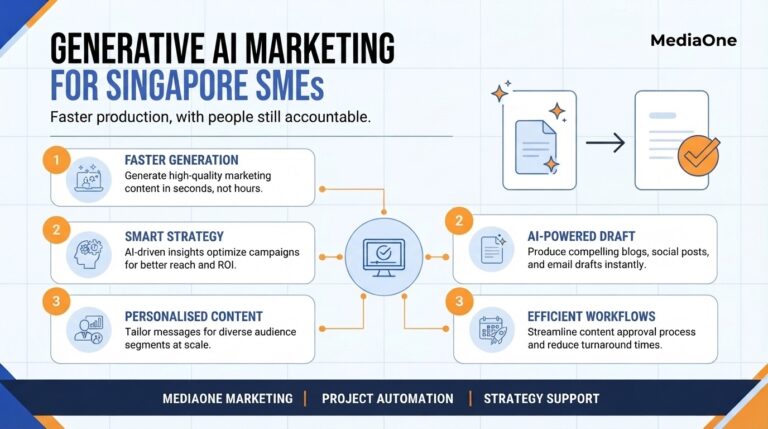
Generative AI marketing is most useful when it removes repetitive production work without removing human accountability. For Singapore SMEs, that can mean faster drafts, more creative variations and less manual work between marketing systems.


The practical question is which task to assist first, what source material the model can use, who checks the output and what the team will measure. This guide focuses on text, images, workflow automation and data analysis for Singapore marketing teams.
Key Takeaways
- Treat generative AI as workflow support, not an automatic publishing system. Start with repetitive drafting and analysis tasks, then keep a person responsible for factual accuracy, brand tone and local context.
- Measure early value through hours saved, accepted output and campaign production speed. Revenue impact may take longer to isolate.
- Use AI-generated multilingual or localised copy as a first draft. Mandarin, Malay, Tamil and Singlish output should be reviewed by people who know the language, audience and brand.
- Clean brand guidelines, product information and approved examples improve the quality of generated work. Tool choice comes after data and process readiness.
- Select tools for a defined job and data-handling requirement. A team does not need every text, image and automation subscription at the start.
- Small pilots can begin with one general AI assistant and existing design or automation software. Add specialist tools only when repeated work justifies them.
What Generative AI Marketing Is and Is Not
Generative AI marketing means using generative models to draft, refine or assist marketing work such as copywriting, visual concepts, research summaries, data analysis and campaign coordination. In Singapore, teams may also use these systems for multilingual first drafts, local e-commerce content and region-specific campaign variations.
It is not a replacement for strategy, brand judgement or cultural review. It also should not be deployed around customer data without a clear data-handling policy. Different use cases need different controls, which is why a governed content marketing workflow is more useful than buying a large tool stack without a process.
This guide focuses on AI adoption for Singapore SMEs and marketing teams in larger organisations. It covers text generation, image creation, workflow automation and data analysis. It does not cover pricing algorithms, advanced predictive modelling or production-scale video systems.
How Generative AI Marketing Works
Generative AI usually fits into a four-step marketing cycle:
- Prompt and input. Provide an instruction plus approved reference material such as brand guidelines, campaign examples or a product catalogue.
- Generation. The model produces a draft email, social post, product description, image concept or analysis.
- Human review. A team member checks factual accuracy, tone, cultural fit, legal risk and brand safety. Weak outputs are rejected or revised.
- Publication or automation. Approved work is published, sent or passed into a connected marketing system.
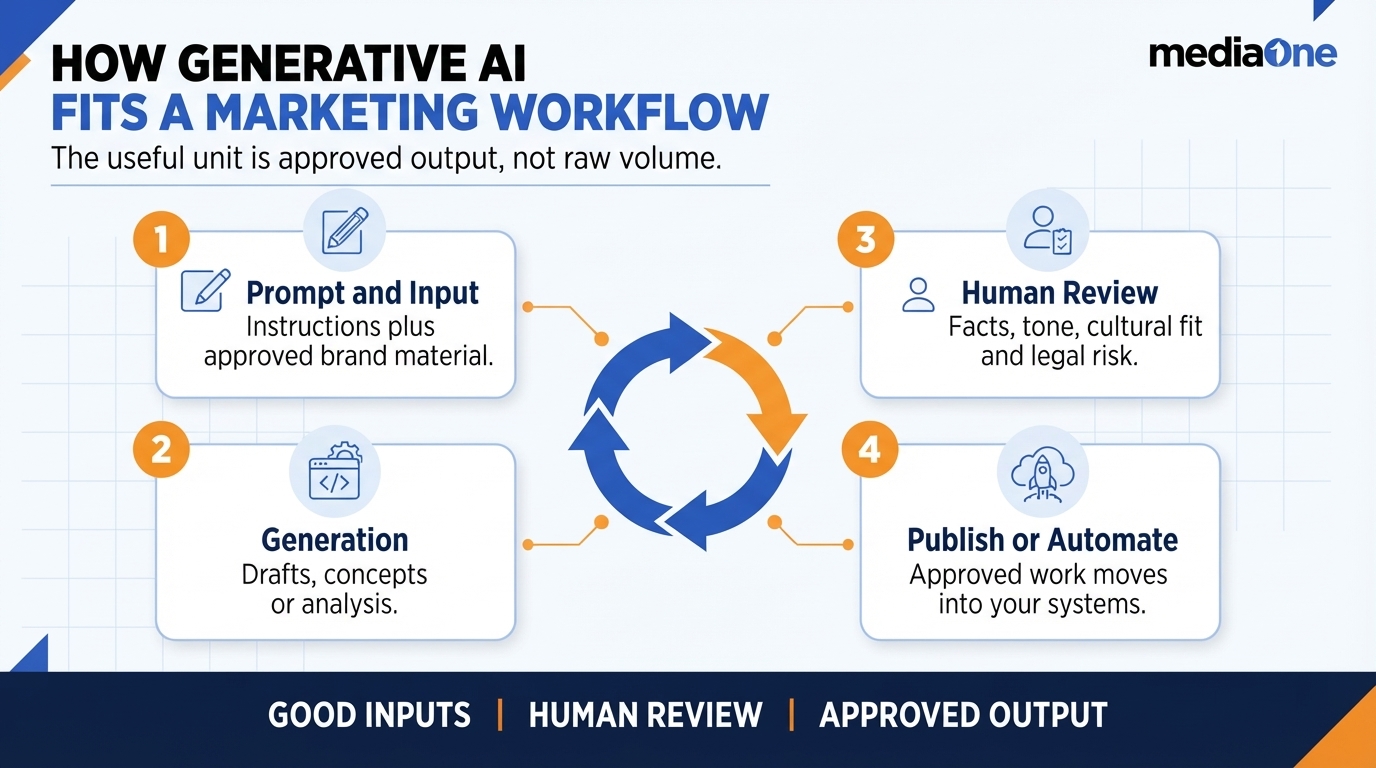
The useful unit is approved output, not raw generation volume. A workflow that produces ten drafts and requires ten rewrites has not saved much time. MediaOne’s AI content creation workflow uses the same principle by separating AI-led, AI-assisted and human-owned work according to risk and review needs.
Teams can embed AI into tools they already use, including e-commerce platforms, email systems, content management systems and customer databases. Integration can reduce copy-and-paste work, but it also increases the need for access controls and clear data rules.
Types of Generative AI Tools for Marketing
AI marketing tools differ by their main job:
- Text and analysis: ChatGPT Business, Claude Team or Pro, and Gemini can assist with emails, social copy, product descriptions, research summaries and document analysis.
- Image generation and design: Midjourney, OpenAI image generation and Canva AI can produce concepts, social assets and design variations.
- Video and multimedia: Tools such as Synthesia, Runway and Descript support video generation, editing, voice and repurposing workflows.
- Workflow automation: Make and Zapier connect applications and can trigger AI steps inside larger processes. Integromat is the former name of Make, not a separate current platform.
- Data analysis: General AI assistants can summarise campaign exports, classify comments and help analysts explore patterns, provided the underlying data is suitable for the tool being used.
For a wider comparison, MediaOne’s guide to generative AI tools for marketers reviews assistants, design, video, research and automation products by job rather than by hype.
Comparing Generative AI Tools for Singapore SMEs
| Tool | Primary use | Current pricing approach | Best fit | Governance note |
| ChatGPT Business | Text, analysis and team workflows | US20annuallybilledorUS25 monthly per Standard seat; two-seat minimum | Managed team workspace | Business data is excluded from training by default |
| Claude Team | Text and long documents | Varies by billing period; multiple-member plan | Collaborative document work | Use a commercial plan for managed team use |
| Midjourney | Image and short video generation | Varies by tier | Visual concepts and variations | Check commercial-use and privacy terms |
| Canva | Design and AI-assisted production | Free and paid plans | Existing Canva teams | Brand controls differ by plan |
| Make | Workflow automation | Credit-based plans | Multi-step workflows | Review connected-app permissions |
| Zapier | Workflow automation | Task-based plans | Common app connections | Review AI-step usage rules |
OpenAI’s current ChatGPT Business pricing confirms the Standard seat rates above and notes that Business workspaces require at least two paid seats. Vendor prices and plan features can change, so confirm them before procurement rather than converting a global list into fixed SGD figures.
Choose the smallest tool set that covers a repeated business need. More subscriptions do not create a better process if the reference data, review rules and ownership are unclear.
How to Choose the Right AI Tools and Approach
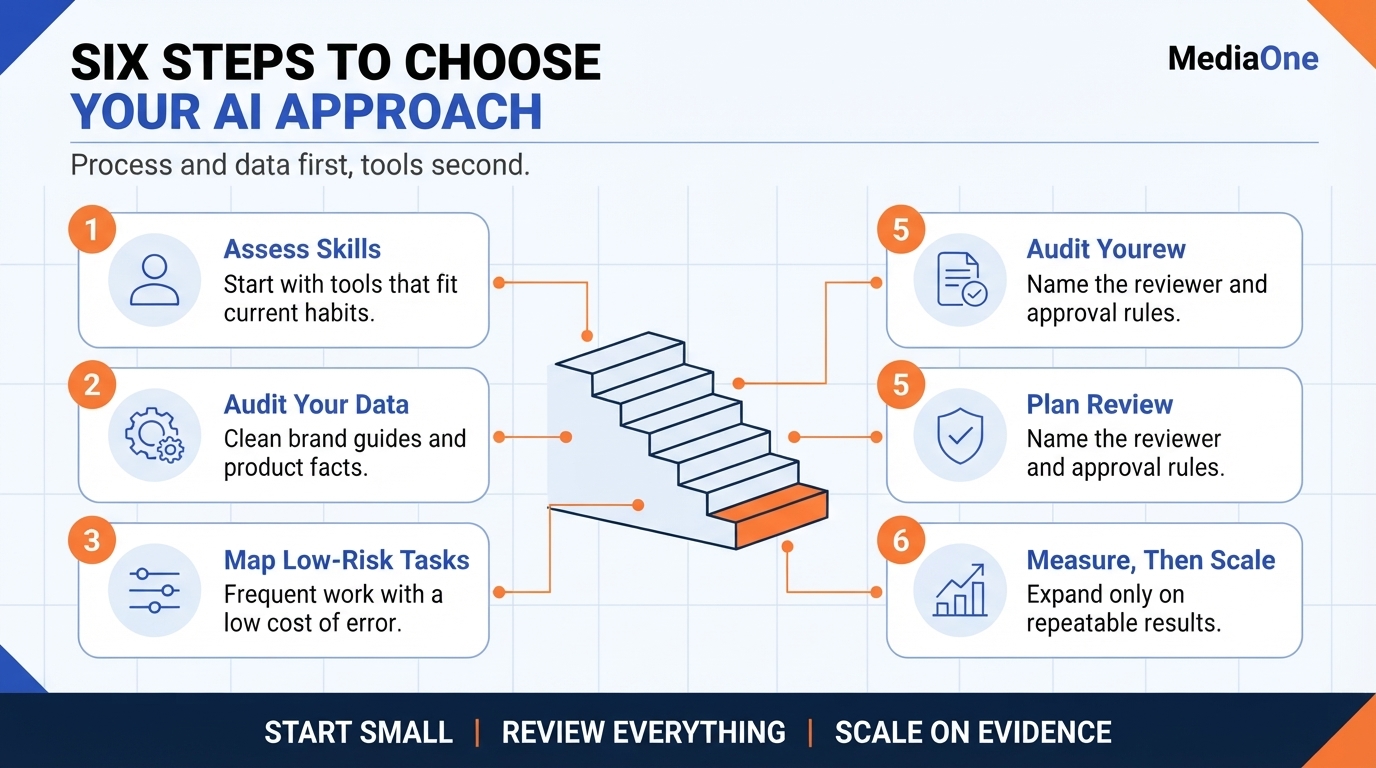
Step 1: Assess Your Team’s Current Skills
Start with tools that fit existing working habits. A design-heavy team may adopt Canva AI faster, while a document-heavy team may get more use from a general assistant.
Step 2: Audit Your Data Readiness
Gather current brand guidelines, approved campaign examples and product information. Remove outdated prices, conflicting claims and old tone guidance before using them as reference data.
Clean source material reduces avoidable editing later. If the team cannot agree on the current product facts or brand voice, an AI system will not resolve that inconsistency for them.
Step 3: Map High-Volume, Low-Risk Use Cases
Start with frequent work that has a low cost of error, such as product-description variants, email subject lines, social drafts or internal summaries. Leave regulated claims and sensitive customer communications for later.
Step 4: Evaluate Tool Fit, Not Just Cost
Check integrations, admin controls, privacy terms and access controls alongside subscription cost.
For a broader decision model, MediaOne’s AI marketing strategy guide covers data readiness, pilot selection, ownership and performance measurement.
Step 5: Plan Human Review
Name the reviewer and set approval criteria for tone, facts, policy, cultural fit and approved source use.
Step 6: Measure Before Scaling
Compare a limited pilot with the old process. Track time, accepted drafts, errors and completed assets, then scale only when the improvement is repeatable.
Practical Implementation: Getting Started
Week 1: Set Up One Tool and One Workflow
Choose one approved text assistant. Build a brand brief covering audience, tone, banned claims, terminology and examples, then compare outputs from the same task.

Weeks 2-3: Integrate One System
Connect one workflow only after the manual version works, such as product-description drafts or email subject-line variants.
Week 4: Add Review and Measurement
Document the approval path and record the time required before and after the pilot. Treat any time-saving number as your own operational result, not a universal benchmark.
Do not upload personal data simply because a tool accepts file or CRM inputs. Check the purpose for which the data was collected, the vendor’s terms, your organisation’s policy and the PDPA position before using customer records in an AI workflow.
Common Implementation Issues and Solutions
| Common concern | Why it happens | What to do |
| Output is generic or off-brand | The model lacks approved examples or specific constraints | Add brand guidance, product facts and examples of accepted work |
| The AI invents facts | The prompt asks for information that is missing or uncertain | Supply verified source material and require claim checking before publication |
| Local language or Singlish feels unnatural | Generated language may not match the audience or house voice | Treat it as a first draft and use a fluent human reviewer |
| The team rewrites every output | The task, prompt or source material is poorly defined | Narrow the job and compare accepted-output rate before expanding |
| Management is hesitant to invest | Quality, privacy and cost are not yet demonstrated | Run a limited pilot with agreed measures and a named owner |
| Integration takes longer than expected | App permissions, data fields or triggers do not match the planned workflow | Map the manual process first, then automate one hand-off at a time |
Most early AI problems are process problems disguised as tool problems. Fix the input, approval rule or workflow before adding another subscription.
Budgeting for Generative AI Marketing
Avoid starting with a fixed percentage of marketing spend or a generic monthly stack. The budget should follow the use case and the number of people, generations, automation runs and review hours involved.
| Budget line | Main cost driver | Question to answer before buying |
| AI assistant | Seats, plan type and usage | Does one shared business workflow justify paid seats? |
| Design or image tool | Generation allowance, privacy and team features | Is AI visual production frequent enough to need a separate plan? |
| Automation | Tasks, credits and run frequency | How many real workflow runs will happen each month? |
| Training | Skill level and role coverage | Which staff need prompt, review, data or governance training? |
| Review and compliance | Risk of the use case | Who is responsible for factual, legal and brand approval? |
Singapore’s SkillsFuture programmes include AI and generative AI training options, with funding and eligibility depending on the programme and learner. Check the current course listing and subsidy rules rather than assuming a fixed training allowance.
Calculate payback from your own baseline. Track monthly tool cost, staff time spent on the workflow and the amount of approved work produced before and after the pilot. Do not assume a first-month saving or a two-quarter recovery period without internal data.
Governance and Compliance
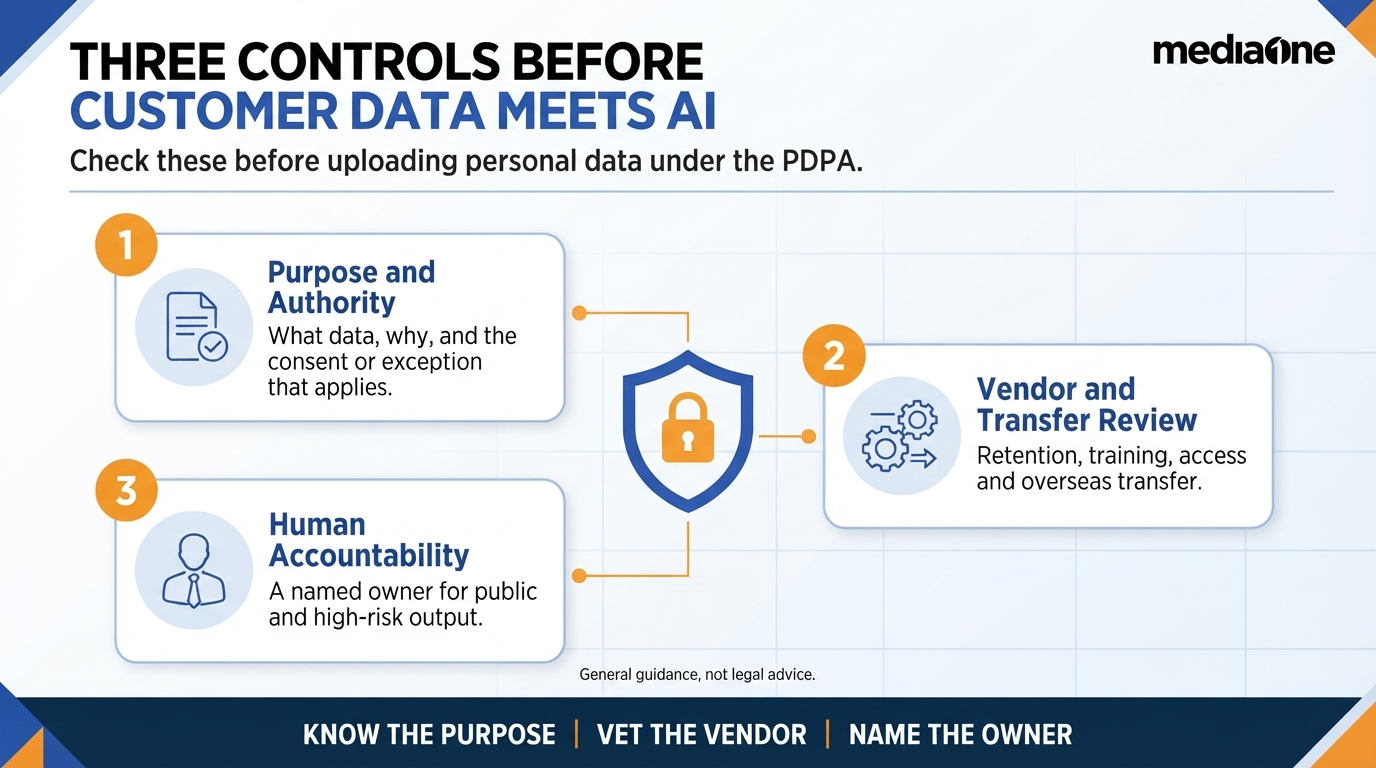
Singapore’s PDPA applies when marketing teams collect, use or disclose personal data. The PDPC’s advisory guidelines on personal data in AI systems explain how existing PDPA obligations apply to AI development and deployment.
The draft rule ‘customer consent is always required for that specific AI use’ is too broad. Organisations generally need consent and must notify purposes, but deemed consent and statutory exceptions can apply. Teams should identify the permitted purpose and legal basis rather than applying one rule to every upload.
- Purpose and authority: Record what personal data is being used, why it is needed and whether the use is covered by consent, deemed consent or an applicable exception.
- Vendor and transfer review: Check retention, training, access controls, sub-processors and any overseas transfer implications before connecting customer data.
- Human accountability: Keep a named person responsible for reviewing public-facing output and high-risk uses. This is a governance control, not a substitute for meeting the PDPA.
AI speed does not reduce the organisation’s responsibility for the data and claims it publishes. Marketing, legal, data protection and operations should agree on the workflow before sensitive data or regulated claims enter the system.
Frequently Asked Questions
What is the fastest way to start seeing results?
Choose one frequent, low-risk task, record its current time and quality, then run a limited AI-assisted pilot. Expand only if accepted output improves or time falls without increasing errors.
Is my data safe if I upload it to ChatGPT or Claude?
It depends on the product and plan. OpenAI says ChatGPT Business data is not used for training by default, while Anthropic says its commercial-product inputs and outputs are not used for model training by default; review retention, organisation policy and PDPA duties before uploading sensitive data.
Do I need to retrain my team before we start?

Start with practical training on instructions, source material, claim checking and error logging. Add deeper training when the team moves into automation, analytics or customer-data use.
How do I know if AI output is factually correct?
Check claims against approved product specifications, current pricing and internal policy. Reference data helps, but human verification is still required.
Is generative AI going to replace my marketers?
It can automate parts of drafting, summarising and production, but role impact varies by organisation. Keep people responsible for strategy, judgement, evidence and approval.
Use it as a draft only. Have a fluent local reviewer decide whether the language sounds natural and fits the brand.
What if my competitor is publishing far more campaigns?
Do not copy output volume as a target. Use AI where your own process has a measured production bottleneck.
Does SkillsFuture training help?
It can when the course matches the work your team needs. Compare current AI or digital-workplace syllabuses with your planned use cases before enrolling.
What happens if an AI tool changes its pricing or shuts down?
Keep prompts, brand briefs, approval rules and source data in systems your organisation controls. Avoid making the whole process dependent on one vendor-specific feature.
My industry is heavily regulated. Can I still use AI?
Potentially, but apply the same professional and compliance checks required for manually drafted material, with extra review for higher-risk claims and personal data.
How do I pitch this to my CFO?
Show a measured pilot: monthly tool cost, hours before and after, accepted output, error rate and campaign throughput. Value the change using your organisation’s real labour and production costs.