| AI Summary
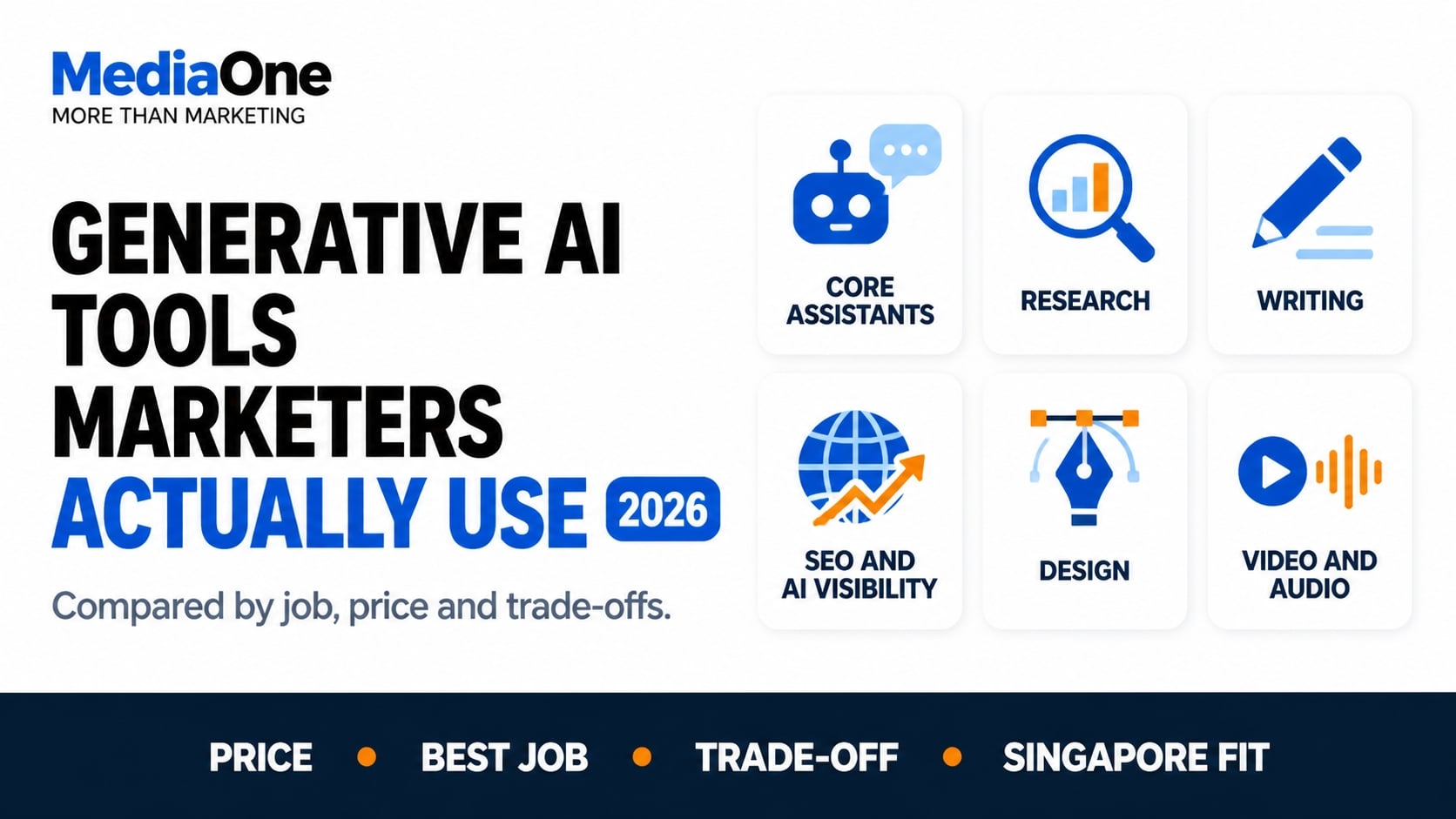
This guide sorts the generative AI tools marketers actually use by job: core assistants (ChatGPT, Claude, Gemini), research, content, SEO and AI visibility, design, video and audio, and automation. For each one, it gives the best use, main limitation and approximate price. It recommends starting with one assistant and adding specialists only where a repeated task needs them, and measuring accepted output rather than drafts. It features MediaOne’s own Digimetrics as an SEO and GEO audit option, with its limits stated, and covers Singapore data rules and common mistakes. |
Most lists of generative AI tools read like a shopping catalogue: dozens of products, each described as “powerful”. Marketers need something different: which tools earn a place in a real workflow, what each one is good for, and where it lets you down.

This guide draws on the tools our team has used in day-to-day SEO, content and paid media work at MediaOne. Working across many of them is also what led us to build Digimetrics, our own AI marketing workspace. Prices and features come from vendor documentation, checked in September 2026, so trial any tool on your own work before you commit.
A note on transparency: MediaOne built Digimetrics, which appears in this list. We’ve marked it clearly and described its limits the same way we describe every other tool.
Key Takeaways
- Start with one general assistant. ChatGPT, Claude or Gemini covers most early marketing needs. Add a specialist only when a repeated task exposes a gap.
- Buy for the job, not the demo. A striking sample says little about dependable weekly work.
- Measure accepted output, not generated output. Ten drafts that all need rebuilding save no time.
- Keep a human at every public-facing point. Fluent text is not the same as accurate text.
- Treat company data as a procurement issue. Free and business plans often follow different data rules.
- Expect prices and features to change. Check the vendor before you buy.
What Are Generative AI Tools for Marketing?
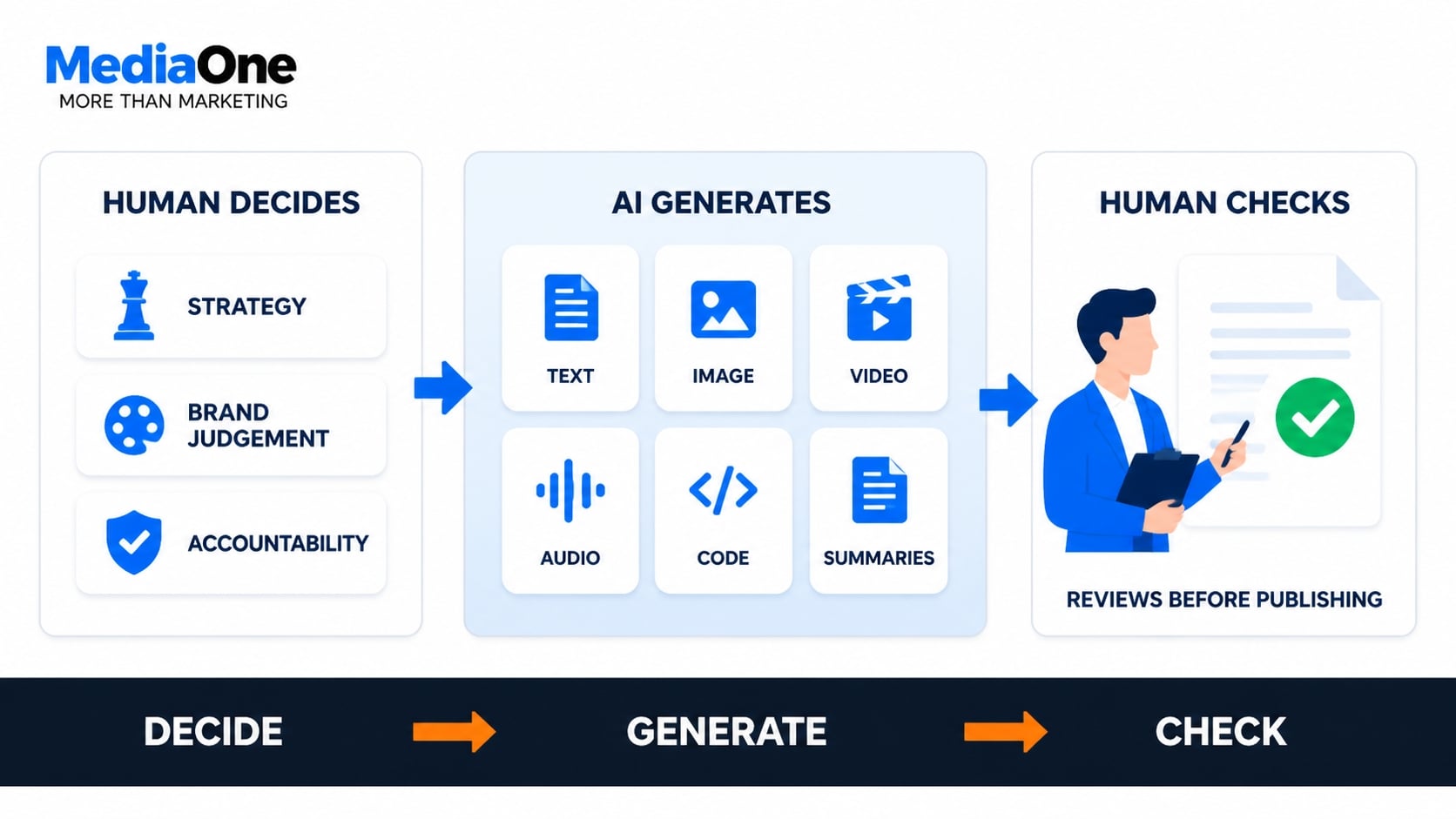
Generative AI tools create new content, such as text, images, video, audio, code and summaries, rather than only retrieving or organising what already exists.

In marketing, they draft copy, generate visuals, condense research, turn a script into video, and automate repetitive steps. According to a 2025 survey by the Thomson Reuters Institute, 22% of professional services organisations are actively using generative AI across their business, nearly double the rate from 2024.
Undeniably, these tools speed up production, but they don’t supply strategy, brand judgement or accountability. As we always tell our team, the tools below work best when a person decides what to make and checks what comes out.
How We Chose These Tools

We started with the tools our team has used on real projects, then checked each against vendor documentation for features, pricing and data terms.
Categorically, we looked at five things:
- Fit to the job. Does it solve a specific, repeated marketing task?
- Quality after editing. How much human work is needed before the output is usable?
- Data and rights. How does the vendor handle stored data, training and commercial use?
- Cost against value. Is the price justified by time saved?
- Singapore fit. Does it suit local teams, budgets and data obligations?
Prices below use approximate Singapore dollar equivalents, checked in September 2026 at roughly US$1 to S$1.30. GST and billing terms can change the total.
Quick Comparison
| Tool | Best marketing job | Starting price | Main trade-off |
|---|---|---|---|
| ChatGPT | Mixed drafting and ideas | Free; Plus about S$26/month | Needs firm review rules |
| Claude | Long documents, on-brand editing | Free; Pro about S$26/month | Smaller app ecosystem |
| Google Gemini | Teams inside Google Workspace | Free; AI Pro S$28.99/month | Best value stays inside Google |
| Perplexity | Cited market research | Free; Pro about S$26/month | Citations still need checking |
| Gemini Notebook | Research from your own sources | Free; higher limits via Google AI plans | Weak without good source files |
| Jasper | Governed campaign content | Pro about S$77/month | Expensive for solo writers |
| Grammarly | Consistent business writing | Free; Pro about S$39/month | Limited research depth |
| Digimetrics (ours) | SEO, GEO and content audits | Free trial; paid from $39/month | Recommends fixes; doesn’t apply them |
| Semrush | Keyword and competitor research | Paid plans; check current pricing | Broad suite with a learning curve |
| Canva Magic Studio | Everyday campaign assets | Free tools; Pro about S$20/month | Less fine control than design software |
| Adobe Firefly | Commercial-safe imagery | Free credits; Standard about S$13/month | Credit limits shape cost |
| Genspark | One-prompt research, decks and assets including images | Free; Plus from about US$19/month | Output needs fact-checking before use |
| monday.com | Campaign workflow and approval | Free; Basic from about US$9/seat/month | Workflow tool, not a writer |
Generative AI Tools by Marketing Job
Core Assistants
1. ChatGPT
ChatGPT is the flexible generalist. A marketer can outline an article in the morning, rewrite sales copy at lunch and summarise campaign notes before a meeting, all in one place. It also handles files, images and basic data analysis.
- Best for: mixed drafting, brainstorming, ad variations, summaries.
- Not ideal if: you need legal-grade accuracy or on-brand copy without careful instructions and review.
- Price: free tier; Plus about S$26 a month.
- Website: chatgpt.com
2. Claude
Claude is a strong choice when the work involves long inputs, such as briefs, reports, transcripts or brand guidelines. Its writing tends to be measured, which can reduce the editing needed on cautious or regulated content.
- Best for: long-document analysis, careful rewriting, tone control.
- Not ideal if: you want a broad ecosystem of integrations or the most expressive creative output.
- Price: free tier; Pro about S$26 a month.
- Website: claude.ai
3. Google Gemini
Gemini works inside Gmail, Docs, Sheets and Drive, which lowers the barrier for teams that already live in Google Workspace. It handles text, files and images, and suits research and first drafts.
- Best for: Workspace-based teams that want AI inside the tools they use daily.
- Not ideal if: your stack is mostly outside Google, where the integration advantage fades.
- Price: free tier; Google AI Pro S$28.99 a month.
- Website: gemini.google.com/app
Research
4. Perplexity
Perplexity answers with cited sources, making it quick for market scans, competitor checks, and briefing notes. Open the sources that matter, because a citation may support only part of a claim.
- Best for: fast,source-led research.
- Not ideal if: you need tight control over tone or long-form structure.
- Price: free tier; Pro about S$26 a month.
- Website: perplexity.ai
5. Gemini Notebook
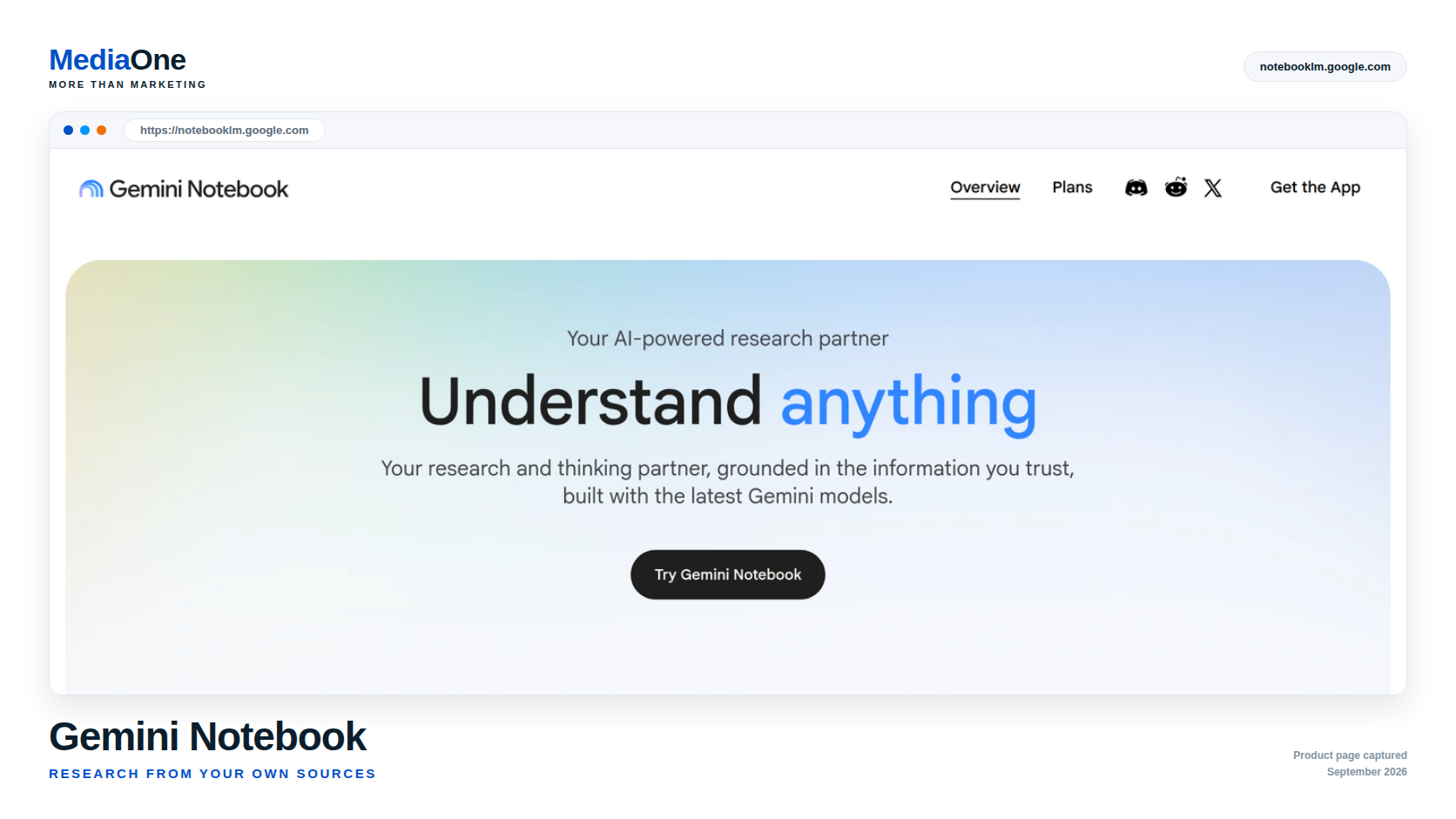
This tool answers only from sources you supply, such as approved research packs, policies or call transcripts. That boundary makes it safer for fixed material than a general chatbot.
- Best for: summarising and querying a defined set of documents.
- Not ideal if: you need open-web discovery, or your source files are weak.
- Price: free; higher limits through Google AI plans.
- Website: notebook.google.com/notebook
Writing and Content
6. Jasper
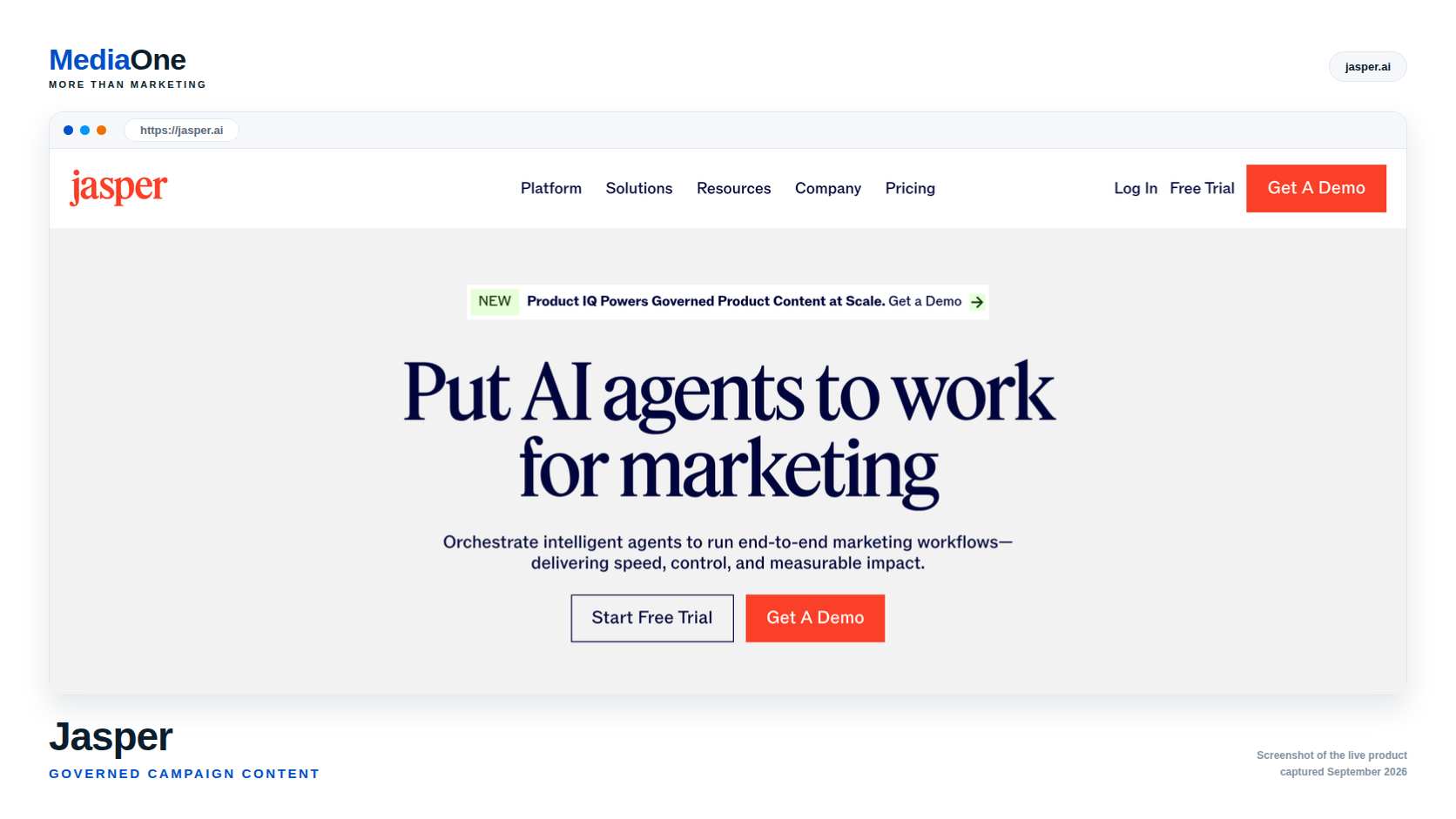
Jasper is built for marketing teams that produce repeated campaign content under shared brand rules. You are paying for workflow and voice control, not automatic SEO results.
- Best for: teams with volume, multiple contributors and brand consistency needs.
- Not ideal if: you are a solo writer, where ChatGPT or Claude often gives better value.
- Price: Pro is about S$77 a month.
- Website: jasper.ai
7. Grammarly
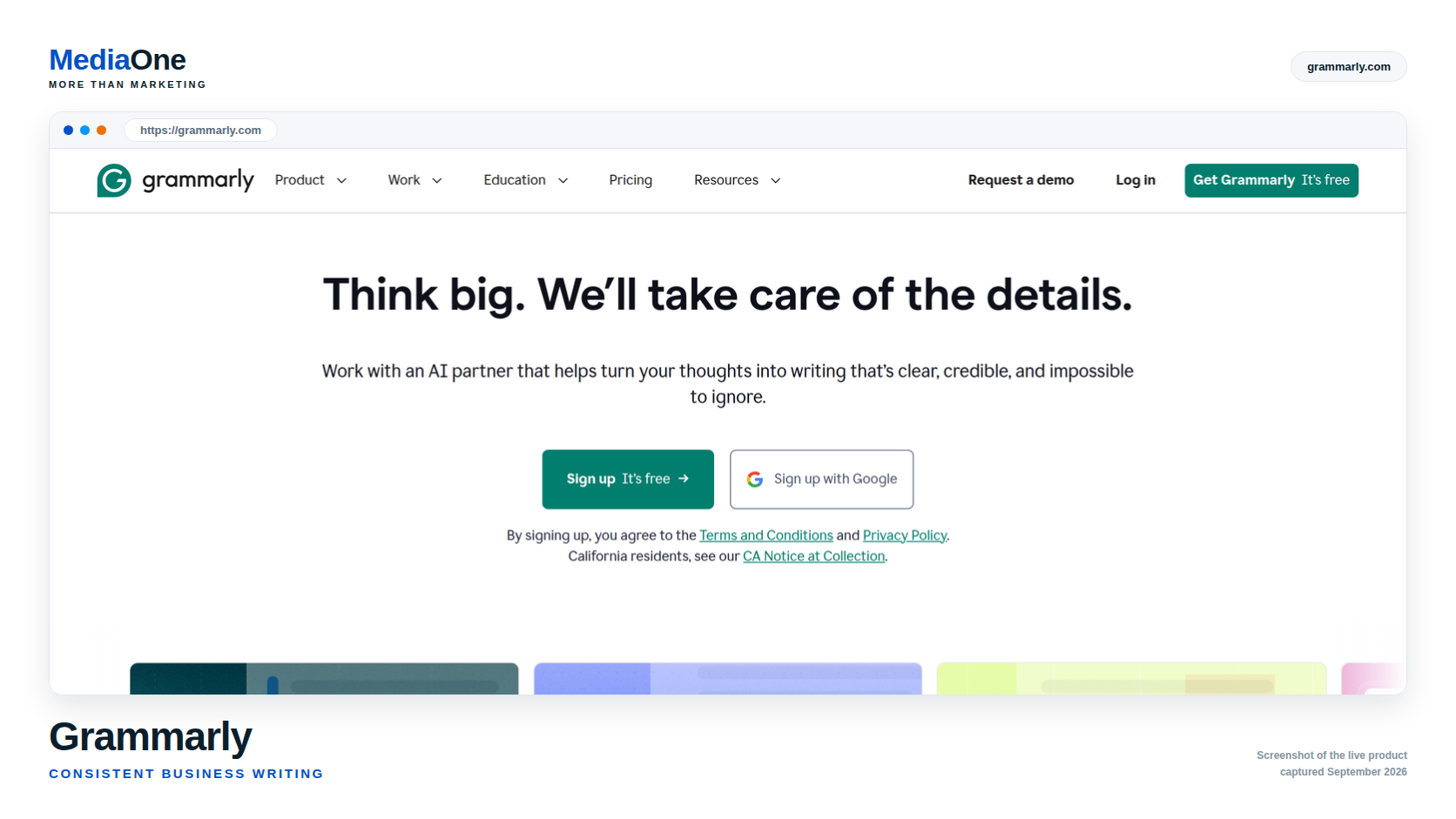
Grammarly polishes tone, clarity and consistency across email, documents and browsers. It works best when your team supplies the substance and needs consistent delivery. Keep legal and technical meaning under human review.
- Best for: consistent business writing at scale.
- Not ideal if: you want research or long-form drafting.
- Price: free tier; Pro about S$39 a month.
- Website: app.grammarly.com
SEO, GEO and AI Visibility
Ranking on Google no longer guarantees you appear in ChatGPT, Gemini or Google’s AI answers. Tools in this category help you audit both.
8. Digimetrics (our own tool)
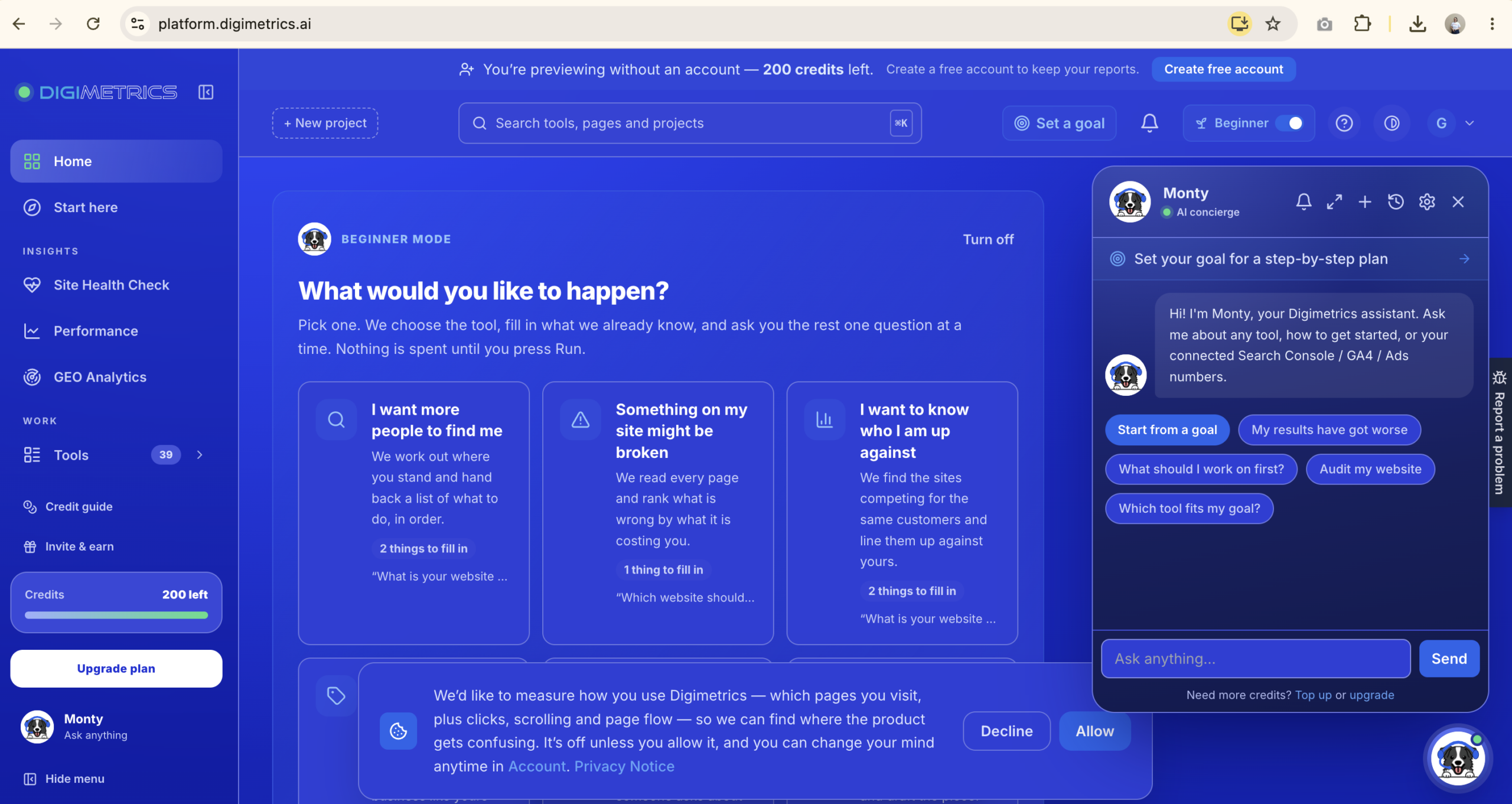
Digimetrics is an AI-powered marketing workspace that audits SEO, AI visibility and content, then explains what to fix next in plain English. It is more of an analysis and strategy platform than a pure generator, though it includes generative features such as an SEM ad copy generator, a caption generator and a persona generator. It has more than 30 tools, including an AI Mentions Tracker, an AI Discovery Audit and a llms.txt generator. We cover it in more detail below.
- Best for: SMEs, independent marketers and agencies who want SEO, GEO and content checks in one place.
- Not ideal if: you need Meta ads reporting today (listed as “coming soon”) or expect it to implement changes for you.
- Price: 7-day free trial with 200 credits, no card required; paid plans from $39 a month.
- Website: digimetrics.ai
9. Semrush
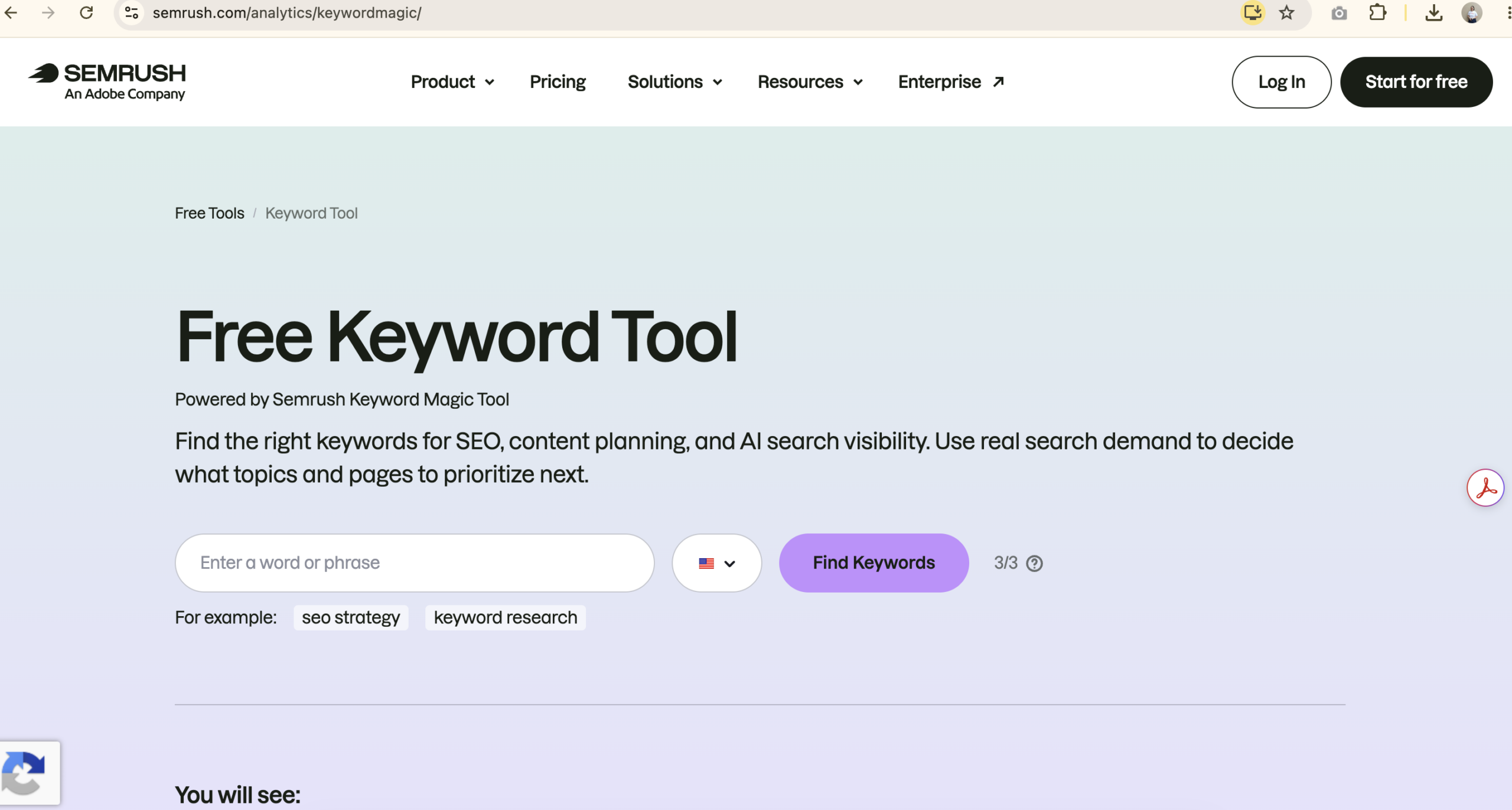
Semrush is the familiar all-round SEO suite for keyword research, competitor analysis and site audits, and it has been adding AI features. We include it as a benchmark so you can compare an established platform with newer options. [Verify its current AI features and pricing before publishing.]
- Best for: keyword and competitor research across a large keyword set.
- Not ideal if: you want a simple, plain-English action list rather than a wide toolset.
- Price: paid plans; check current pricing.
- Website: semrush.com
Design and Images
10. Canva Magic Studio

Canva puts writing, image, video and resizing tools inside an editor most marketers already know. It suits social posts and simple ad variants for non-designers.

- Best for: fast, everyday campaign assets.
- Not ideal if: you need the fine control of professional design software.
- Price: free tools; Pro about S$20 a month.
- Website: canva.com/magic-design
11. Adobe Firefly
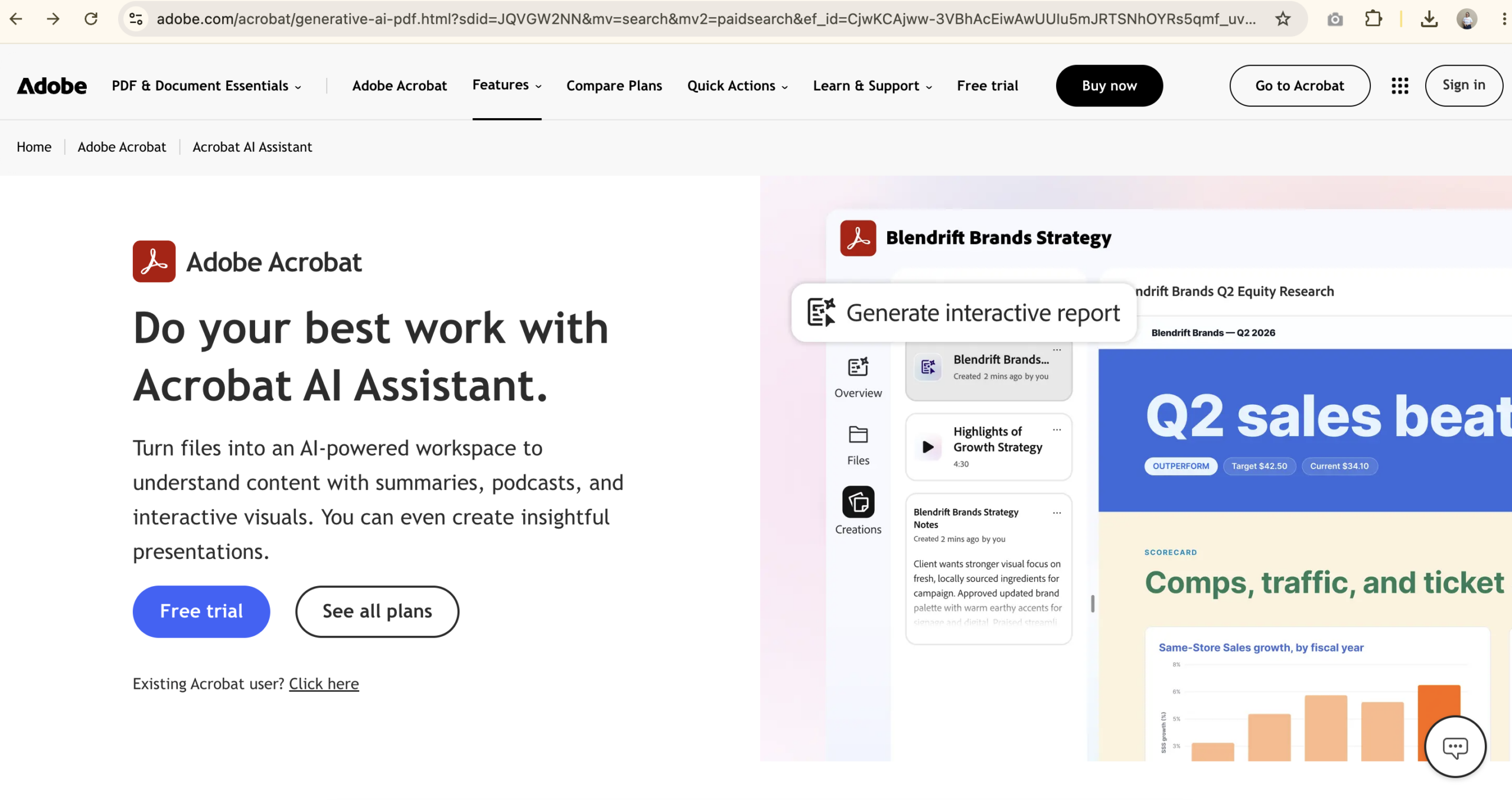
Firefly generates images, video and audio inside Adobe apps, with a focus on commercially safer training data. Procurement teams should still read the rights and credit terms for each plan.
- Best for: Creative Cloud teams that need editing control and clearer commercial terms.
- Not ideal if: you don’t already use Adobe tools.
- Price: free credits; Standard about S$13 a month.
- Website: firefly.adobe.com
12. Genspark
Genspark is an agentic assistant: you give it one instruction, and it plans the steps, browses, and returns a finished artefact, such as a research brief, a slide deck, a spreadsheet or a set of visuals. It suits the messy middle of marketing work, where a task means gathering material from several places before anything can be written.
The trade-off is trust. Because it assembles and summarises on your behalf, sources and figures need checking before the output goes anywhere near a client. Treat it as a fast first pass that gets you to a structured draft, not a finished deliverable.
- Best for: one-prompt research briefs, image and presentation deck generation, and one-off assets.
- Not ideal if: you need audited accuracy, or the work depends on confidential client material.
- Price: free tier with daily limits; Plus from about US$19 a month.
- Website: genspark.ai
Workflow and Project Management
13. monday.com
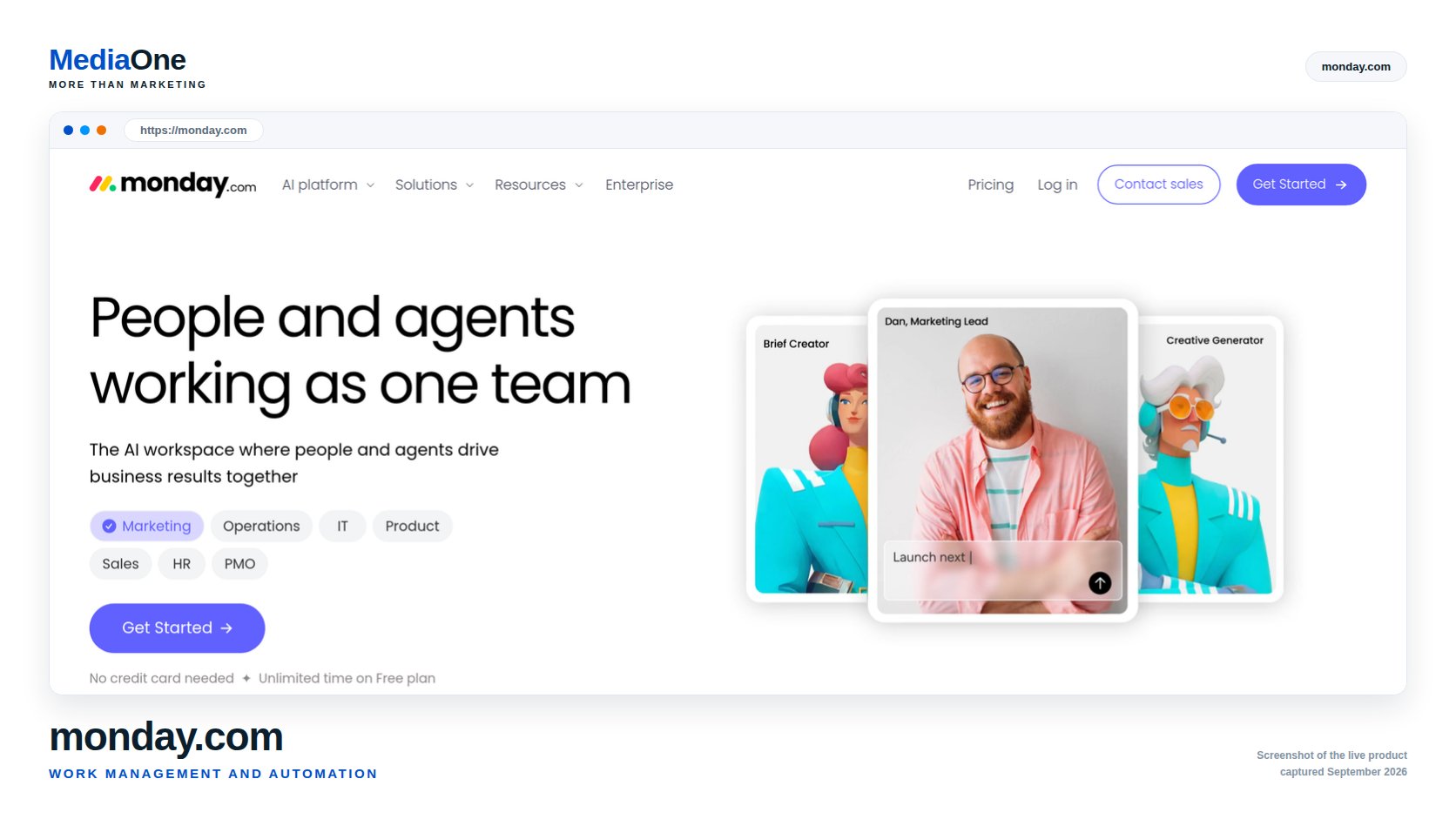
monday.com is where the work lives once the AI has produced it. Campaigns, content calendars, asset approvals and reporting all sit on boards that show status, owner and due date, so a draft cannot quietly stall in someone’s chat history. Its AI features summarise updates, draft replies and help build automations, but the value is the structure underneath.
For a marketing team, this is the tool that turns a pile of generated drafts into a tracked pipeline: brief in, review assigned, approval logged, publish scheduled. It is not a writer and does not replace a core assistant.
- Best for: campaign boards, content calendars, approval workflows and cross-team visibility.
- Not ideal if: you want a drafting tool, or your team is small enough that a shared document already does the job.
- Price: free tier for up to two seats; Basic starts at about US$9 per seat per month on annual billing.
- Website: monday.com
Where Digimetrics Fits in Your Stack
Digimetrics grew out of our own experience. Juggling separate tools for SEO, content, ads and reporting is what led us to build one workspace that connects them.
Most generative AI tools help you make content. Digimetrics helps you decide what to make and whether it worked.
It follows a simple loop: it diagnoses your site’s SEO, AI visibility and content signals, prioritises the fixes, explains each one through its AI guide, Monty, and then tracks what changed. Connecting Google Search Console, GA4 and Google Ads adds your own performance data, and none of that is required for tools that analyse public information.
A few facts worth knowing before you try it:
- It recommends changes but doesn’t alter your website or ad accounts. You stay in control of what gets implemented.
- The free trial gives 200 credits for 7 days with no card. Paid plans start at $39 a month for 500 credits, with higher tiers for more projects and tracked keywords [confirm currency].
- Like any platform, it cannot guarantee rankings, traffic or leads.
It pairs naturally with a core assistant: use DeepSeek or Claude to draft, and Digimetrics to check the page against search intent, AI visibility and content quality before it goes live. You can start a free analysis on Digimetrics with your own site.
Build a Lean AI Stack
Most teams need fewer tools than they think. A sensible starting point is one core assistant plus one or two specialists tied to a repeated job.
- Solo marketer: one assistant (ChatGPT or Claude), Canva for assets, and one audit tool such as Digimetrics or Semrush.
- In-house team: Gemini or a Microsoft-based assistant, Jasper if content volume is high, and Zapier for reporting and lead routing.
- Agency: an assistant, Perplexity for research, an SEO and GEO platform for audits, and video or voice tools as client work requires.
Run a four-week pilot on five recurring tasks. Track completion time, review time, accepted outputs, errors and cost. If a S$39 tool creates 40 drafts and you approve ten, divide the cost and review time by ten, not forty. That is your real price per usable output.
Using Generative AI Tools in Singapore
Marketing teams handle customer data, so the tool you choose is also a data decision.
- Decide what staff may enter. Separate public content from personal data, client files and confidential plans, and match each class to an approved plan and setting.
- Check the plan, not just the brand. Consumer and business plans can follow different data rules on storage, training and deletion.
- Mind overseas transfers. Singapore’s PDPA Transfer Limitation Obligation applies when personal data moves abroad, and a well-known vendor doesn’t remove your organisation’s duties. The PDPC has published guidance for organisations that develop, deploy or procure generative AI systems.
- Name a reviewer. Someone accountable should approve marketing claims, customer messages and generated media before publication.
For high-risk uses, take qualified legal advice.
Common Mistakes With Generative AI Tools
- Publishing raw output. Fact-check claims, statistics and quotes every time.
- Tool sprawl. Twelve overlapping subscriptions create confusion, not leverage.
- Tracking usage instead of results. Logins and prompts aren’t business value. Measure time saved after review, accepted output and error rates.
- Ignoring rights. Check commercial-use and licensing terms for images, voice and music before client work.
Choose the Tools That Fit the Work
The best generative AI tools are the ones that disappear into your workflow and hold up under real deadlines. Start with one assistant, add specialists only where a job demands it, keep a person accountable for what goes public, and measure results rather than usage.
If you want a second opinion on your stack, MediaOne’s SEO and GEO agency services connect AI-assisted production with search intent, evidence and measurable outcomes.
Frequently Asked Questions
What are the best generative AI tools for marketers?
It depends on the job. ChatGPT, Claude and Gemini cover most early needs. Add Perplexity for research, Canva or Firefly for design, and an audit platform such as Digimetrics or Semrush for SEO and AI visibility.
How many generative AI tools does a marketing team need?
Most teams do well with one general assistant and one or two specialists. Add another only after a repeated workflow shows a clear gap.

Can I put customer data into generative AI tools?
Only after confirming the purpose, the vendor’s terms, retention and deletion, and any overseas transfer controls. Use paid business plans with clear data settings for anything sensitive, and seek advice for high-risk cases.
Are free plans good enough for marketing work?
They suit low-risk testing with public or synthetic information. Paid plans usually add stronger admin and data controls, but always verify the exact contract and settings.
How do I measure whether generative AI is worth it?
Track time saved after review, accepted output, error rates and avoided production cost. Ignore drafts generated and prompts written.