| AI Summary
Free SEO courses can help Singapore professionals learn keyword research, website improvements and search reporting without paying for training. Ahrefs, Yoast and Semrush offer different learning options, while Google provides reference material and analytics training. Some free courses include certificates. A stronger learning plan combines lessons, a credential that others can check, and documented work on a real website. |
Free SEO courses worth comparing include Ahrefs’ beginner course, Yoast’s beginner training and Semrush Academy’s SEO courses. Google’s SEO Starter Guide supports further study. Course choice depends on the syllabus, access requirements and assessment. A certificate records learning, while website projects show how that learning works in practice.
Key Takeaways
- Course selection: One structured beginner course helps prevent scattered learning across unrelated videos.
- Certificate checks: Free training can include a certificate, but completion badges and assessed credentials show different things.
- Practical work: Keyword lists, page edits and dated reports turn course lessons into evidence of skills.
- Singapore relevance: Local projects need examples based on the business’s customers, services and locations.
- Progress tracking: A short record of decisions and results supports a portfolio without promising rankings or employment.
Free SEO courses appeal to Singapore business owners and marketers who want to understand organic search without adding another training bill. The challenge is choosing lessons that lead to practical work.
A short video can explain a term. A structured course can connect the terms. A website project gives those lessons a purpose, whether the goal is improving a business page or preparing for a marketing role.
The options below cover beginner training, certificates and supporting resources. The comparison also explains where free learning ends and when paid feedback may deserve a place in the budget.
What Free SEO Courses Should Teach
Search engine optimisation, or SEO, helps search engines understand website content and helps people find relevant pages. A beginner course should explain the connection between a customer’s search, the page that answers it and the business action that follows.
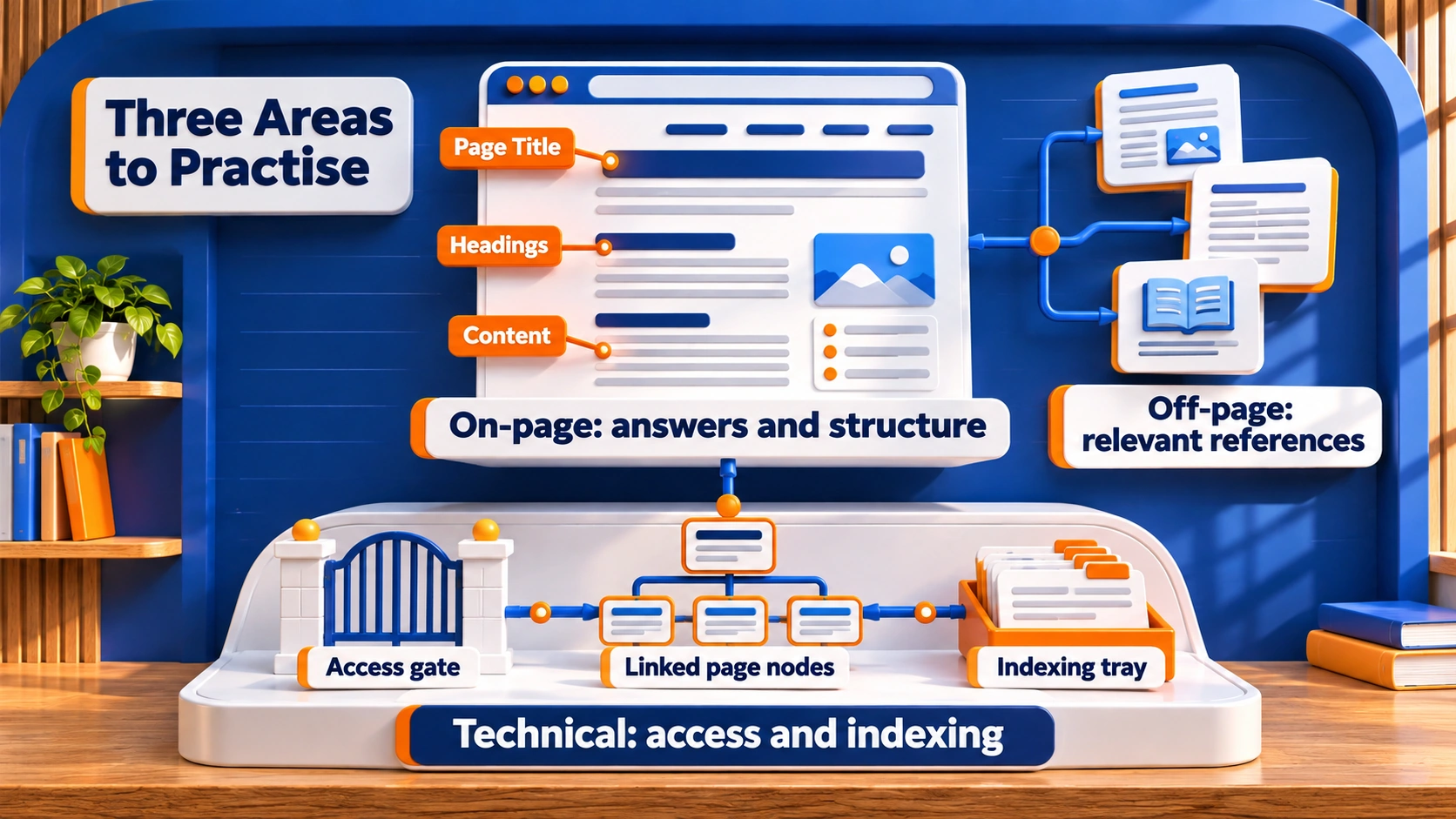
Three areas provide a starting point:
| SEO area | Plain-language explanation | Beginner practice task |
| Technical SEO | Whether search engines can access and process pages | Check an important page for indexing problems |
| On-page and content SEO | Whether a page answers the search and explains its subject | Improve a service page’s title, headings and answers |
| Off-page SEO | Relevant references and links from other websites | Identify an accurate business listing or editorial opportunity |
A course should connect these areas. An accessible page still needs relevant content. A detailed article still needs a website structure that helps people find it.
Google’s Search Essentials covers technical requirements, spam policies and recommended practices. Eligibility does not guarantee that Google will index or display a page.
What a beginner should be able to do
A first course should leave the learner able to explain a task and attempt it on a small site. The following checks provide a practical starting point:
- A keyword list groups related searches by customer need.
- A page title describes the page accurately.
- A heading structure helps readers find answers.
- An internal link connects related pages with descriptive wording.
- A basic report distinguishes search visibility from website visits.
A certificate cannot confirm all these skills on its own. A small project can show where the learner understands the work and where further help is needed.
Free SEO Courses and Resources Compared
The strongest starting option depends on how someone learns and what they need to do next. Video lessons, reading material and software demonstrations serve different purposes.
The table separates current course options from supporting study resources.
| Provider or resource | Main focus | Learning format | Certificate position | Main consideration |
| Ahrefs beginner course | SEO foundations and practical methods | Video lessons | Beginner course page does not advertise an included certificate | Tool demonstrations may require separate access |
| Yoast beginner course | Search fundamentals and website basics | Videos, quizzes and reading | Completion certificate and badge included | Some examples use Yoast software |
| Semrush Academy | SEO subjects and software workflows | Self-paced courses | Certificates available after course requirements | Course access and software access differ |
| Google SEO Starter Guide | Google Search fundamentals | Written reference | No course certificate | Learners must organise their own practice |
| Google Analytics Academy | Website measurement | Online training | Analytics certification available | Supports SEO reporting; it is not an SEO qualification |
| eMarketing Institute | Beginner SEO reading | Ebook-based material | New exams currently paused | Platform migration affects enrolment |
Course details can change. The provider’s current course page takes priority over an older comparison article.
Ahrefs: a structured video introduction
The Ahrefs SEO Course for Beginners contains 14 lessons across five modules, with around two hours of video. The lessons cover keyword research, on-page improvements, link building and technical basics. No registration is required to watch.
The course suits someone who wants to see how SEO tasks connect. A learner can follow the sequence and apply one lesson at a time to a business page.
The main limitation is the difference between watching a demonstration and repeating it. Some tool-based exercises may need access beyond the videos. A learner without that access can still record the method, practise page analysis and use available website data. A sensible first assignment is a one-page research sheet: the customer’s search, its purpose, the proposed page and the reason for choosing it.
Yoast: beginner lessons with a completion certificate
Yoast’s free beginner SEO course includes around two hours of video, quizzes, supporting PDFs, a certificate and a badge. A free MyYoast account is required, while payment details are unnecessary.
The course explains how search engines find and understand pages. Its fundamentals apply beyond WordPress, although some demonstrations show the Yoast plugin.
The certificate records course completion. A practical follow-up gives that record more context: one edited page, a list of changes and a short explanation of each decision.
The learner should also separate software prompts from business decisions. A plugin score can flag possible issues, but it cannot decide whether the page answers a customer’s question.
Semrush Academy: subject-specific courses and assessment
Semrush Academy’s SEO courses cover subjects such as keyword research, on-page work, local search and software use. The academy states that its learning resources are free and that certificates follow successful completion of the relevant requirements, including quizzes or exams.
The range suits learners who already know which task they need to improve. A small retailer may focus on local search, while a content editor may choose keyword research.
A free course does not establish that every demonstrated software feature is free. The learner should check tool access before planning an assignment around a particular report. One focused course followed by a completed task usually provides a better learning record than several unfinished modules.
Google’s SEO Starter Guide: a reference alongside a course
Google’s SEO Starter Guide explains search fundamentals, website organisation, content, links and images. It is written reference material, with no associated course certificate.
The guide belongs beside a course because it helps learners check advice against Google’s own explanation. A video may show a technique; the reference helps establish the principle behind it.
The absence of a lesson schedule means the learner must supply structure. A manageable approach is one topic, one page inspection and one written observation per study session.
The guide also helps distinguish a recommendation from a guarantee. Following sound practices improves the basis for SEO work, but no checklist secures a particular search position.
Google Analytics Academy: supporting measurement skills
Google Analytics Academy provides free training and an Analytics certification through Skillshop. Its subjects include collecting data, reporting and understanding marketing performance.
Analytics training complements SEO study because search visits are only part of a business’s results. A visitor might browse, enquire, book or leave without taking another action.
The qualification should appear under its correct name on a CV. Google Analytics certification demonstrates learning about Analytics; it should not be presented as Google SEO certification.
A suitable follow-up assignment is a short report explaining which pages receive organic visits and which recorded actions deserve further investigation.
eMarketing Institute: reading material with an access restriction
The eMarketing Institute SEO course page advertises a free beginner course and ebook. However, its current migration notice states that new registrations and exam attempts are unavailable while accounts and certificates move to another platform.
The draft’s claim that its certificate requires payment was incorrect. The current restriction concerns access to registration and exams.
The material may support reading, but this option should not anchor a certificate deadline. A learner who needs an available assessment should choose another current programme and check its requirements directly.
Older material also needs care when it describes software interfaces or search features. The underlying concept may remain relevant even when the pictured process has changed.
How to Choose a Course Without Wasting Study Time
A course needs to support the learner’s next task. A business owner improving a service page has different needs from a marketer learning reporting.
Five checks can narrow the choice:
| Check | Evidence to look for |
| Syllabus | Named topics and an understandable lesson order |
| Teaching format | A sample lesson that suits the learner |
| Practical access | Exercises that work with available tools and permissions |
| Assessment | Published completion or exam requirements |
| Currency | References that agree with current official documentation |
An updated date helps, but it does not prove every lesson is current. A sample lesson reveals more about teaching quality than a large promise on a sales page.
A course should match one immediate goal
A learner’s first goal can be small: improve one page, understand one report or produce one keyword plan.
For example, a Singapore cleaning company could study keyword research before deciding whether separate pages are needed for office cleaning and end-of-tenancy cleaning. The decision depends on what customers need and what the company actually provides.
A marketer learning reporting could begin with Analytics training and an existing account. A career switcher could pair a beginner course with a small website project.
Warning signs deserve attention
Course claims need closer inspection when they promise outcomes beyond the provider’s control.
- Guaranteed first-place rankings offer no dependable basis for choosing training.
- Fixed keyword-density rules can encourage awkward writing.
- Bulk link packages can teach habits that conflict with search policies.
- Screenshots without dates or context reveal little about performance.
- A certificate fee hidden until completion changes the course’s real cost.
A worthwhile course explains decisions, limits and examples. The learner should understand why a method applies before repeating it.
Free Courses, Certificates and Paid Training
Free and paid learning cannot be divided neatly into basic and advanced options. A free course may include assessment, while an expensive programme may provide little individual feedback.
The stronger comparison concerns what the learner receives.
| Feature | Free learning can provide | Paid training may add |
| Structure | Ordered lessons and exercises | Scheduled sessions and deadlines |
| Assessment | Quizzes, exams or completion records | Marked projects and detailed feedback |
| Support | Documentation or community discussion | Direct tutor access |
| Practice | Independent website tasks | Supervised assignments |
| Evidence | Certificates and self-managed projects | Reviewed work, depending on the programme |
This should explain the evidence behind learning without suggesting that payment proves competence.

A checkable certificate needs an accurate description
A certificate is easier to assess when the issuer, course name and completion date are visible. A public credential page or identification number can help another person check the record, when the provider offers one.
The assessment also needs an accurate label:
- A completion certificate records that the course requirements were finished.
- An exam-based certificate records performance against the provider’s test.
- A project assessment includes review of submitted work.
A learner should describe the credential exactly as issued. A multiple-choice test does not establish experience managing a website.
Paid training earns its place through added support
Payment may be reasonable when a learner needs feedback on a technical problem, accountability or a reviewed project. The benefit should be specific enough to compare with the fee.
A course description should explain who reviews assignments, how feedback arrives and what access ends after training. Testimonials alone do not answer those questions.
A business owner with a small site may progress through free study and occasional specialist help. Someone handling a complex website may need supervised learning before making changes that affect many pages.
How Singapore Learners Can Practise SEO
International courses explain principles. Local practice connects those principles to a Singapore business and its customers.
A neighbourhood retailer, training provider or home-service company can provide a manageable project when the owner grants permission. The project should start with a limited set of pages and a written record of planned changes.
The work below keeps each learning task connected to a deliverable.
Keyword research starts with customer needs
A Singapore air-conditioning company could investigate searches about servicing, chemical cleaning and maintenance contracts. Those searches may involve different needs, even when they share a broad subject.
A long-tail keyword represents a more specific search phrase. Specificity can help a learner explain what a page needs to answer.
A small research sheet can record:
| Search phrase | Customer’s likely need | Proposed page |
| Aircon servicing Singapore | Compare service options | Main service page |
| What happens during aircon servicing | Understand the work | Explanatory article |
| Office aircon maintenance contract | Assess ongoing commercial support | Contract service page |
These examples illustrate planning. They do not represent measured search demand or a recommendation to create every page.
Page improvements should answer real questions
A first on-page SEO assignment can focus on one service page. The learner checks its title, opening explanation, headings and next step.
A vague page called “Our Solutions” may leave visitors unsure what the company offers. A service-specific title and accurate opening paragraph can make the page easier to understand.
The change log should explain the reason for each edit. “Added service coverage because customers need to know whether bookings are available in their area” demonstrates more understanding than “added more keywords”.
Local and off-page work needs relevance
A business serving nearby customers may need local SEO practice, including consistent business details and accurate service information. A learner exploring off-page SEO can identify relevant directories, associations or publications. The assignment should explain the relationship between the business and the proposed source.
The concept of link equity helps explain why links deserve context. A long spreadsheet of unrelated websites provides little evidence of sound judgement.
Content practice should include source checks
A first writing project can answer a question that customers ask before buying. The brief should define the reader, the question, supporting evidence and the appropriate next step.
AI tools can help organise ideas, but the writer remains responsible for accuracy. Google’s information on generative AI content warns against producing pages at scale without adding value. A content marketing project becomes stronger when the article contains specific explanations, checked sources and business details that the writer can support.
A Four-Week SEO Practice Plan
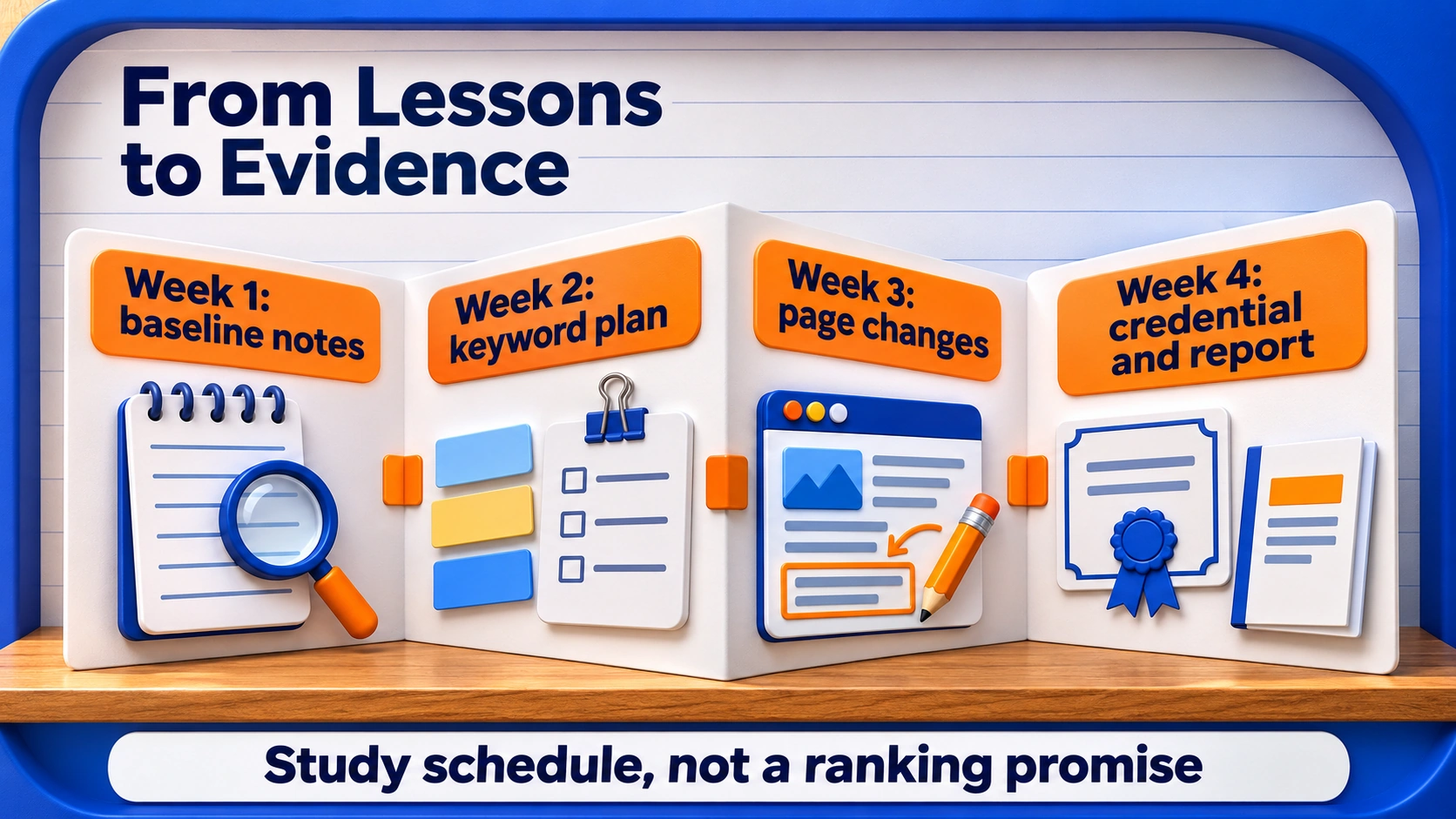
A short schedule can turn study into finished work. The plan below is a suggested learning timetable, not a prediction of search results.
| Week | Study focus | Practical task | Evidence to keep |
| 1 | Search fundamentals | Inspect a small set of pages | Baseline notes |
| 2 | Keywords and page purpose | Research one service topic | Keyword-to-page sheet |
| 3 | Content and website checks | Improve one approved page | Dated change log |
| 4 | Assessment and reporting | Complete requirements and review data | Credential and project report |
The sequence connects a lesson to a task, then connects the task to evidence.
Baseline notes make later reports easier to interpret
The baseline should record the page, the date and the problem being investigated. Existing search data adds context when access is available.
Google Search Console’s Performance report shows clicks, impressions, click-through rate and average position. These metrics describe different parts of search performance.
A new site may have little data. The learner can still document whether a page is accessible, whether its content matches its purpose and which changes were completed.
Results need context and honest limits
A page edit does not prove that every later change in traffic came from that edit. Demand, competing pages and other website changes can affect the same period.
A project report should separate observations from explanations:
- The change log records what happened.
- The report shows the selected dates and pages.
- The analysis explains possible causes.
- The next step addresses an unresolved question.
A small project with limited results can still demonstrate sound reasoning. Honest analysis gives the reader more to assess than a percentage presented without context.
What an SEO Portfolio Should Include
A beginner portfolio can contain one complete project. Its purpose is to show how the learner approached a problem and what the evidence supports.
Six items provide enough structure:
- Project context: The website, audience and permission to work.
- Starting problem: A specific page or search need.
- Research: Keywords, page observations and checked sources.
- Completed work: Approved edits with dates.
- Measurement: Relevant reports and known limitations.
- Reflection: What worked, what remains uncertain and the next test.
Private business information needs permission before publication. Redacted screenshots and short explanations can demonstrate the work without exposing customer details.
A portfolio also helps the learner choose further training. Repeated difficulty interpreting reports suggests a measurement gap; repeated uncertainty about indexing suggests a technical gap.
Turn Free SEO Courses Into Practical Work
Free SEO courses provide several ways to learn, assess knowledge and begin a website project. The strongest choice supports a specific task, works with available tools and produces evidence that the learner can explain. Certificates support that record when their issuer and requirements are described accurately.
At MediaOne, we help businesses connect learning with website priorities through our SEO services. Our team can support Singapore businesses that need help turning keyword research, content improvements and reporting into a managed SEO programme.
Frequently Asked Questions
Can someone learn SEO without knowing how to code?
A beginner can study keyword research, page titles, content structure and reporting without coding. Technical tasks may require further knowledge or developer support. Early practice should stay within the learner’s access and skill level, especially on a business website.
Does an SEO certificate need renewal?
Renewal rules depend on the issuer and credential. A certificate may show an expiry date or remain available as a completion record. The provider’s account page and credential terms should establish the current requirements.
Can a free SEO course be listed on LinkedIn?
A completed course can appear under the relevant training or certification section. The entry should include the correct issuer, course name and completion date. A credential link or identification number can be included when the provider supplies one.
What can someone practise without access to a business website?
Public pages support keyword research, content briefs and page reviews without making changes. A learner can label these exercises as independent analyses. A personal website allows implementation, although it may involve hosting or platform costs.
Can a team study the same free course together?
A team can agree on shared lessons and discuss examples from its work. Individual accounts may be needed for progress records and certificates. A short group review of one page can reveal how different roles interpret the same SEO task.
How should course learning appear on a CV?
A training entry should state the provider and course accurately. A separate project entry can describe completed work, tools used and documented outcomes. Claims about managing campaigns or producing results need evidence beyond course attendance.