| AI Summary
Full service SEO brings technical work, page improvements, content, link outreach and reporting under one managed plan. Singapore businesses should compare written deliverables, implementation support and total costs before choosing a retainer. Published starting prices show how much scope can vary. The provider scorecard below helps buyers assess evidence, responsibilities, reporting and account ownership. |
Full service SEO is an ongoing service covering website audits, technical improvements, keyword research, content, on-page optimisation, link outreach and reporting. One provider coordinates the work, although development and content production may cost extra. Singapore retainer fees vary by website size, competition, target markets and the work included.
Key Takeaways
- A technical audit and the work to fix its findings are separate deliverables.
- Published starting prices need a written scope before they become comparable quotes.
- Provider scores should reflect evidence, delivery, reporting, link practices and ownership.
- Qualified enquiries and sales help explain whether search traffic supports the business.
- A named internal contact helps prevent delays in approvals, access and website changes.
Full service SEO gives a business one team to coordinate its search work. That can save management time, especially when technical problems, weak service pages and missing tracking need attention together.
The buying decision still needs care. Two providers can offer the same monthly price while taking responsibility for very different tasks. A business needs to know what gets delivered, who publishes it and how progress will be assessed.
What Full Service SEO Covers
A full-service retainer connects the work needed to help customers find and use a website through search. The agency manages priorities across the programme, with responsibilities agreed before work begins.
Google’s SEO Starter Guide covers the foundations behind this work, including accessible pages, descriptive content and links that help people find related information. A retainer turns those foundations into ongoing tasks for a particular business.
The five core service areas
| Service area | What it covers | Evidence of delivery |
| Technical SEO | Crawling, indexing, redirects, mobile performance and site structure | Implemented fixes and checks |
| On-page SEO | Page titles, headings, internal links and search intent | Updated pages with documented changes |
| Content | Research, writing, editing and content updates | Approved pages published on the website |
| Off-page SEO | Relevant outreach, earned links and business mentions | Placement records and explanations |
| Measurement | Search visibility, visits, enquiries and sales tracking | Reports connected to business goals |
A technical SEO audit identifies problems that can affect access to the site. The proposal must also explain whether the agency fixes those problems or sends recommendations to a developer.
Content scope deserves the same detail. “Content support” might mean editing existing pages, supplying briefs or writing complete articles. Each involves different time and costs.
Full service versus separate SEO tasks
Separate projects can work when a business already has someone coordinating them. A developer might handle technical repairs while an editor manages service pages and a consultant reviews performance.
A full-service arrangement gives one provider responsibility for connecting those jobs. For example, an air-conditioning company may need a repair page improved, linked from related guides and measured through enquiry tracking.
The package name alone does not establish that responsibility. A fixed package can provide broad support, while a custom retainer can remain narrow. The written deliverables show what the business is buying.

How the Monthly Work Runs
A retainer needs a delivery cycle, but every service area does not need equal attention each month. Early work may focus on access and tracking. Later months may involve stronger service pages, new content or outreach.
The agency should explain why each task comes next and what must happen before it can proceed.
Baseline and business priorities
The starting review records current search performance, important pages and available enquiry data. Missing tracking becomes a setup task, with the limits of earlier data recorded.
The business also identifies its commercial priorities:
- Services or products it wants to sell.
- Areas it can genuinely serve.
- Customer types it can support.
- Capacity limits and seasonal demand.
- Questions sales staff hear before a purchase.
That context shapes keyword research. A company seeking maintenance contracts needs different pages from one seeking emergency repair calls, even when both work in the same industry.
Delivery and approval responsibilities
| Stage | Agency responsibility | Business responsibility |
| Planning | Research and prioritised task list | Service priorities and customer insight |
| Technical work | Diagnosis, agreed fixes and testing | Developer access or implementation budget |
| Content | Briefs, drafts and page improvements | Factual review and approval |
| Outreach | Relevant prospects and placement records | Accurate company information |
| Reporting | Results, explanations and next actions | Lead quality and sales feedback |
A named contact on each side reduces delays. An agreed approval window, such as ten working days, also gives the team a schedule it can manage.
The monthly record should distinguish completed work from drafts, recommendations and blocked tasks. An audit delivered in a PDF is progress, but it is not the same as a repaired website.
What Full Service SEO Costs in Singapore
Singapore SEO prices vary because retainers buy different amounts of work. Website size, technical problems, competition, languages and publishing requirements all affect the quote.
A published starting fee is a reference point, not a market average or a final project price. The closest comparison comes from providers quoting against the same brief.
Published prices and what they include
MediaOne’s main SEO service page lists these starting prices at the research date:
| Published plan | Starting monthly price | Selected advertised inclusions |
| Starter | S$850 | On-page work, monthly reporting and Google Business Profile support |
| Growth | S$1,245 | Technical audit, content and on-page work, link campaigns and account management |
| Enterprise | S$3,550 | Custom keyword strategy, advanced technical work, content implementation and strategic reviews |
These are examples from one provider’s published offer. They do not establish typical fees across Singapore, and the final quotation must define volumes, implementation and exclusions.
Lower-priced subscriptions also exist. MediaOne’s separate SEO subscription plans list a S$380 monthly Basic plan with no blogs included. That illustrates why a low starting fee cannot establish the cost of a complete managed programme.
What increases the quote
The workload usually expands when a business needs:
- Repairs across several website templates.
- Research and content for multiple services.
- Product or category improvements across a large catalogue.
- Pages in more than one language.
- Support across several locations or countries.
- Regular original research, interviews or design work.
Keyword totals alone are a weak price comparison. Twenty related phrases may belong on one page, while five services may each need their own research, writing and technical support.
A proposal should connect the fee to work the buyer can recognise. “Four service-page updates and one technical release” explains more than “ongoing optimisation”.
The full budget beyond the retainer
The total budget may include development, photography, design, translation, tracking setup and applicable tax. A business should also allow staff time for reviews and customer information.
An illustrative monthly budget might contain:
| Budget item | Example amount |
| Managed SEO retainer | S$2,000 |
| Additional development | S$600 |
| Additional content or design | S$400 |
| Total before applicable tax | S$3,000 |
These figures demonstrate budget planning only. They are not an agency quotation or a claim about standard rates.
The distinction prevents double counting. Content already included in the retainer should not appear again as an extra charge. A quote should state which additional work requires approval and how the provider prices it.
Agency, Freelancer or In-House Team?
The delivery model affects coordination as much as cost. An agency can provide several skills through one relationship. A freelancer can provide direct specialist support. An internal team brings daily access to the business.
| Model | Main advantage | Responsibility to plan for |
| Agency | Several disciplines under one managed account | Service scope and access to specialists |
| Freelancer | Direct contact with the person doing the work | Cover for skills outside their specialism |
| In-house team | Close knowledge of products and customers | Recruitment, tools and specialist support |
| Hybrid | Internal ownership with external expertise | Coordination between contributors |
A business with an active content team may need technical support and strategic review. Another business may need research, writing, implementation and reporting managed together.
The decision should follow the missing skills and available management time. A lower fee can still require considerable internal coordination.
How to Choose a Provider With a Scoring Checklist
A provider comparison works best when every candidate answers the same questions. Google’s advice on hiring an SEO includes checking previous work, relevant experience, expected results and measurement methods.
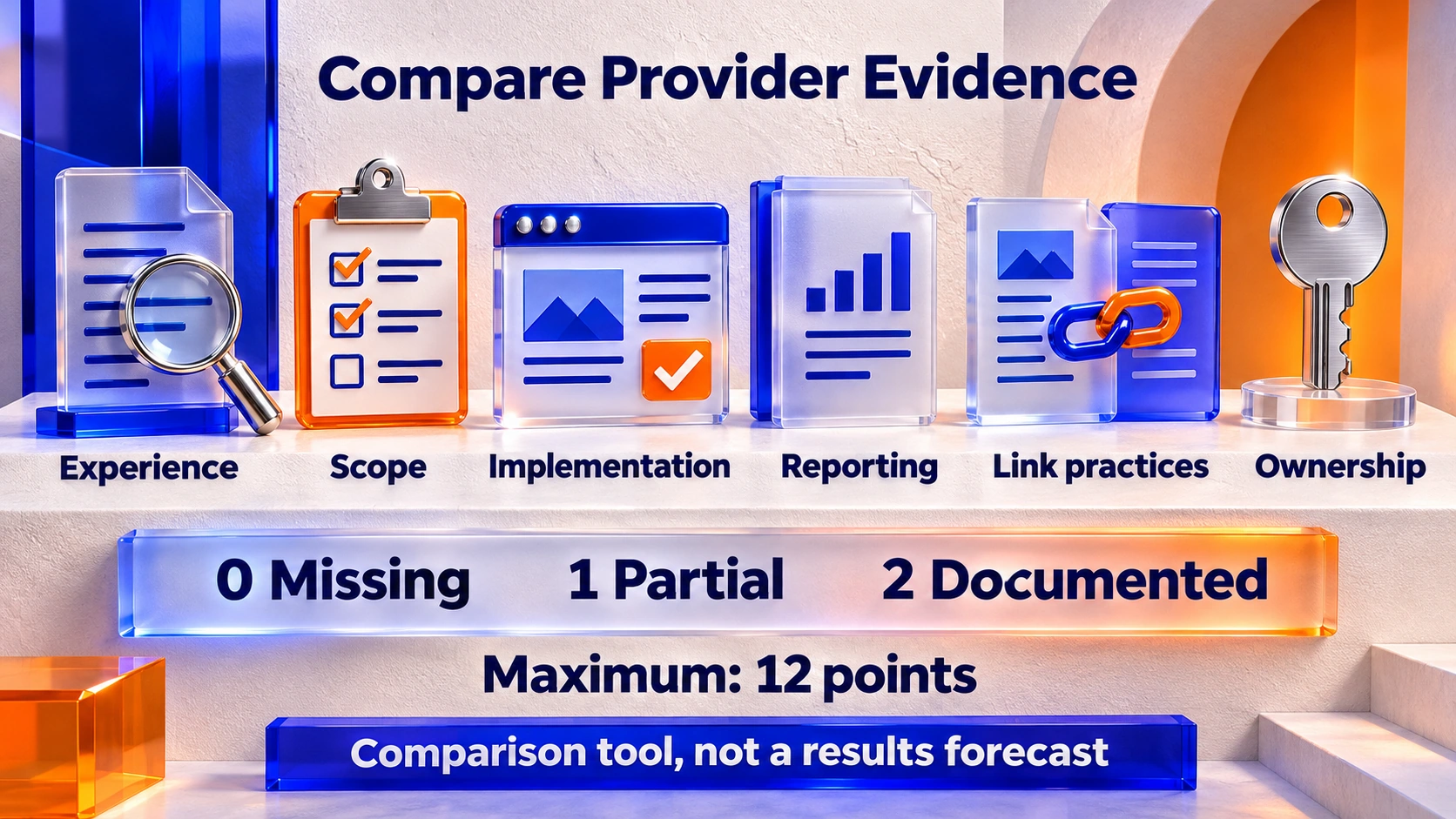
The scorecard below is an editorial comparison tool. Its scores organise evidence; they do not predict rankings or revenue.
Score six areas from zero to two
Each area receives zero for missing or unsupported information, one for partial evidence and two for documented evidence.
| Area | Evidence needed for two points |
| Relevant experience | Comparable projects with dates, starting figures and explained results |
| Scope | Written deliverables, exclusions and priorities |
| Implementation | Named owners for publishing, technical changes and testing |
| Reporting | Search data linked to qualified enquiries or sales where tracking permits |
| Link practices | Explained outreach methods and records of placements |
| Ownership and handover | Business-controlled accounts and written exit arrangements |
The maximum score is 12. A buyer can investigate the lowest-scoring areas before choosing between otherwise similar proposals.
A high total should never cancel a serious ownership problem or an unexplained link scheme. Some weaknesses require resolution before any contract begins.
Examine the evidence behind case studies
Percentage growth needs context. An increase from two enquiries to four differs from an increase from 200 to 400, although both represent the same percentage.
A case study should identify:
- The period measured.
- The starting figures.
- The pages or markets involved.
- The work completed.
- Other activity that may have influenced results.
Confidential projects can still provide anonymised evidence. The explanation should help the buyer understand the provider’s contribution without exposing another client’s private data.
Recognise warning signs
Ranking guarantees deserve scrutiny because the provider does not control Google’s results. Other concerns include inaccessible accounts, unexplained charges and reports without dates or source data.
Link practices need particular attention. Google’s spam policies identify links created mainly to manipulate rankings as link spam. Paid advertising links require appropriate qualification; payment does not turn a placement into an editorial endorsement.
A large link count or a third-party authority score cannot establish relevance or compliance. The provider should explain the purpose and source of its outreach.
Singapore Requirements That Can Change the Scope
Singapore businesses may need local search support, multilingual content or both. The agency should establish that need through customer information and search research.
A national business does not automatically need a page for every neighbourhood. Each location page needs a reason to exist for its readers.
Google Business Profile and local searches
An eligible business may need its Google Business Profile included in the retainer. Google’s business representation rules cover eligibility and accurate business details, including requirements for customer-facing locations and service-area businesses.
The work can include categories, opening hours, service information, photos and review responses. A local SEO audit connects those checks with website information and local search performance.
Google describes local ranking mainly through relevance, distance and prominence. Profile work cannot remove the effect of a searcher’s location, and the retainer should avoid promising that outcome.
Language and service-area decisions
Additional languages need research, writing and review by someone who understands the audience. Translation alone may miss how customers describe a service.
Google’s documentation on multilingual websites explains separate language URLs and ways to identify language versions. The technical setup belongs in the scope when several versions are planned.
Service-area pages also need genuine differences. A business may explain local availability, delivery terms or examples of completed work. Replacing one district name with another adds little for readers.
How to Measure Progress and Review the Retainer
A monthly report should connect work completed with changes in visibility, visits and customer action. No single number explains the whole programme. The business and provider should agree on the starting position, reporting dates and measurement limits before judging results.
Separate delivery from outcomes
| Measurement layer | Examples | What it explains |
| Delivery | Fixes released, pages published | Whether agreed work happened |
| Visibility | Search impressions and relevant queries | Whether pages appear for intended searches |
| Visits | Organic clicks and landing-page sessions | Whether searchers reach the website |
| Enquiries | Calls, forms and bookings | Whether visitors take action |
| Business value | Qualified leads and completed sales | Whether enquiries support commercial goals |
A tracked phone-button click is not proof of a completed call. A form submission may also be spam or an unsuitable enquiry.
Sales feedback helps close that gap. The agency needs to know whether enquiries concern the right services and whether the business can serve them.
Understand timing and attribution
Google notes that SEO benefits can typically take four months to a year after changes begin. That is a broad expectation, not a deadline for a particular website. Starting conditions and implementation affect the pace.
A report should compare similar periods and explain changes such as seasonal demand, tracking updates or a website launch. Rankings, visits and revenue do not always rise in that order.
Attribution also has limits. Consent settings, different devices and offline conversations can interrupt the record of a customer’s journey. Reported organic revenue represents what the measurement setup can identify.
Decide what needs to change
A review should investigate the cause of weak results before replacing the provider. The evidence may point to:
- Unpublished work or unresolved technical problems.
- Pages reaching the wrong audience.
- Enquiries arriving but receiving slow replies.
- Content that fails to answer buying questions.
- A budget spread across too many priorities.
Different SEO content types serve different customer needs. A business attracting guide readers may need stronger service pages and enquiry options.
Google’s people-first content criteria also support reviewing whether pages offer original information and satisfy their readers. More articles alone do not resolve weak content.

What the Contract Should Put in Writing
A contract should make the work reviewable before the first invoice. The proposal and agreement need consistent descriptions of scope, responsibilities and costs.
The following details reduce avoidable disputes:
- Deliverables and how priorities can change.
- Technical implementation and testing responsibilities.
- Content volumes, revisions and publishing arrangements.
- Reporting frequency and access to source data.
- Extra-work approval and charges.
- Cancellation terms and notice periods.
- Content rights, account access and handover duties.
Business-controlled accounts allow continuity when staff or providers change. Agency access can be assigned according to the work required.
A handover should also explain current redirects, tracking changes, outstanding tasks and where files are stored. Those records help the next person maintain the website.
Choose Full Service SEO Around Delivery and Evidence
Full service SEO works as a coordinated programme when its scope covers the website’s needs and both teams can complete their responsibilities. A sound buying decision connects price with deliverables, checks provider evidence and measures progress through customer outcomes.
At MediaOne, we provide SEO services across technical optimisation, content and reporting. A conversation with our team can establish the priorities for your website and the work to include in a written proposal.
FAQs About Full Service SEO
Does full service SEO include paid search advertising?
Full service SEO does not automatically include paid advertising. Google Ads campaigns need their own scope, budget and reporting. Google states that advertising with it does not influence organic rankings, so a combined proposal should separate the two services.
Does an SEO retainer include a website redesign?
A redesign needs an explicit agreement. An SEO team may identify problems with templates or site structure, but rebuilding the website involves additional design and development work. A redesign proposal should explain how existing URLs, content and tracking will be handled.
Can a provider guarantee inclusion in AI Overviews?
A provider cannot guarantee inclusion. Google’s AI search documentation states that established SEO practices remain relevant and no special additional optimisation is required. A proposal should describe the work being performed without promising selection by an AI feature.
What happens to search visibility when the retainer ends?
Ending a retainer does not automatically remove rankings. Existing pages and implemented changes can remain, but competitors, website changes and search systems continue to affect performance. The business still needs someone to maintain content, monitor problems and preserve working tracking.
An agency usually needs patterns and business context rather than complete customer records. Anonymised enquiry categories and aggregated sales information may be enough. Any personal-data access needs an agreed purpose, appropriate permissions and controls that reflect the organisation’s privacy requirements.