
AI Summary

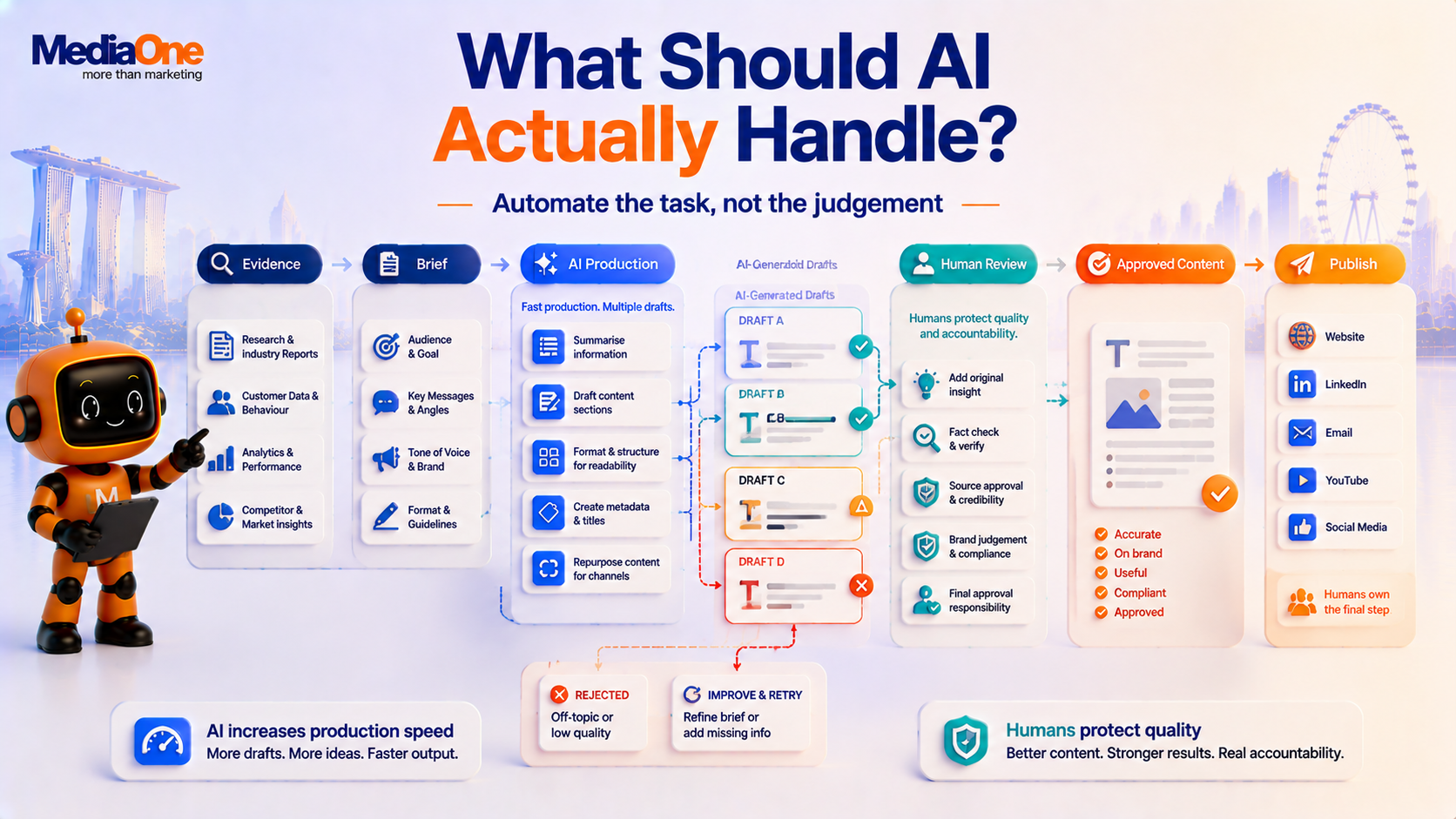
Most AI content workflows fail not because AI can’t write drafts, but because teams don’t account for the editing, fact-checking and approvals that shift downstream instead of disappearing. This article proposes splitting content work into AI-Led, AI-Assisted and Human-Owned tasks based on repeatability, evidence needs, reversibility and brand risk, and introduces a “Publishable Yield” metric to measure how much AI-assisted output actually gets published without major rework. It also covers building an evidence packet before generation, using quality gates to reject weak drafts early, and matching review depth to the cost of an error.
AI can produce a 2,000-word draft before a writer has finished reviewing the brief. That sounds efficient until an editor spends the next two hours checking sources, replacing generic sections, correcting the brand voice and removing claims that should never have appeared.
This is where many AI content creation workflows fail. They optimise the part AI makes fastest while the work shifts into research verification, editing, approvals and corrections.
For Singapore businesses, the broader adoption trend is already clear. IMDA reported that SME AI adoption rose from 4.2% in 2023 to 14.5% in 2024. It also found that 84% of AI-using firms relied on off-the-shelf generative AI tools.
The next challenge is not getting access to AI. It is deciding where AI actually reduces work without lowering the standard of what gets published.
A good AI content creation workflow should improve the amount of useful content your team can confidently publish. It should not simply maximise drafts generated.
That changes the main question from
Can AI do this task?
to
What happens if AI does this task badly?
We would split content work into three levels of responsibility.
AI-Led → AI-Assisted → Human-Owned
Then assess each task against its repeatability, evidence requirements, reversibility, brand risk and need for real human experience.
Key Takeaways
- AI is a stronger fit for predictable tasks with clear inputs and inexpensive mistakes. Tasks involving original viewpoints, important factual claims, customer promises or expert judgement need greater human involvement.
- Measure the whole production process. Drafting time can fall while fact checking, editing and approvals increase. The better measure is how much publishable content reaches the finish line with less total work.
- Research should also happen before generation. Give AI approved evidence, company facts, customer language and original inputs before asking for a draft instead of asking editors to discover unsupported claims afterwards.
- Finally, weak AI output should sometimes be rejected, not repaired. A bad angle or unsupported draft can cost more to edit than to replace.
What an AI Content Creation Workflow Should Improve
AI does not remove the core jobs involved in content production. Teams still need to choose a useful topic, gather evidence, develop a point of view, produce the content, review it, publish it and learn from the result.
AI changes who or what handles each part.
That means generated output is a poor productivity measure on its own.
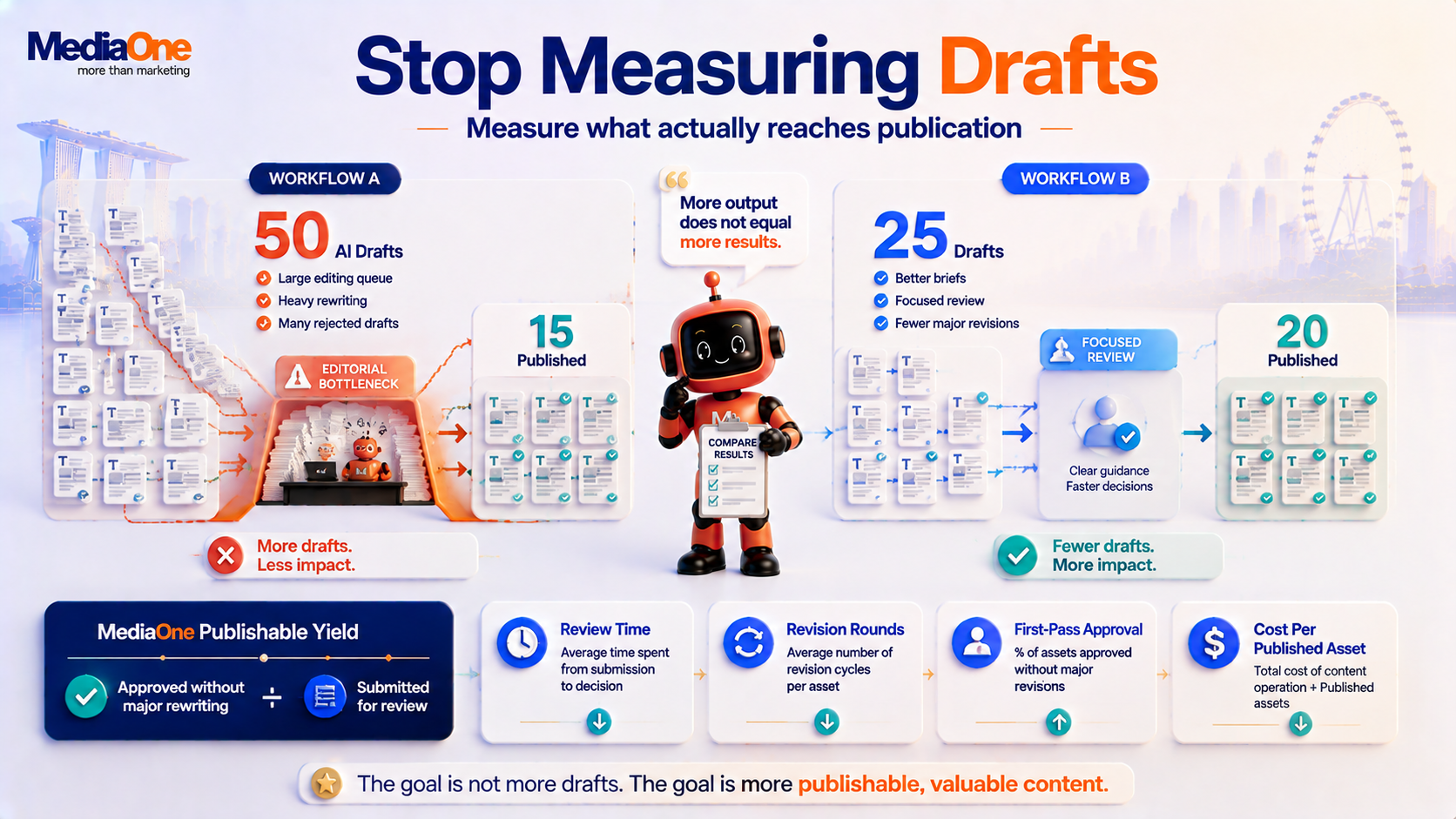
Consider two teams.
Team A generates 50 AI drafts but publishes 15 after substantial rewriting.
Team B creates 25 drafts and publishes 20 with relatively light revision.
If management measures draft volume, Team A appears more productive. If the goal is useful finished content, Team B has the stronger workflow.
That is why we would track the production process differently.
| Metric | What It Shows |
| Time from brief to publication | Actual production speed |
| Review time per asset | Human workload created after generation |
| Revision rounds | How often content returns for correction |
| First-pass approval rate | Reliability of the first submitted version |
| Cost per published asset | Actual production economics |
| Post-publication corrections | Errors that escaped review |
| Publishable yield | Share of submitted work accepted without a major rewrite |
We call the final measure MediaOne Publishable Yield.
Publishable Yield = Assets approved without major rewriting ÷ Assets submitted for review × 100
This is a practical MediaOne workflow metric, not an established industry standard.
Its purpose is simple. If AI doubles draft volume but cuts publishable yield in half, the team may have shifted its bottleneck from writing to editing.
The MediaOne AI Content Delegation Test
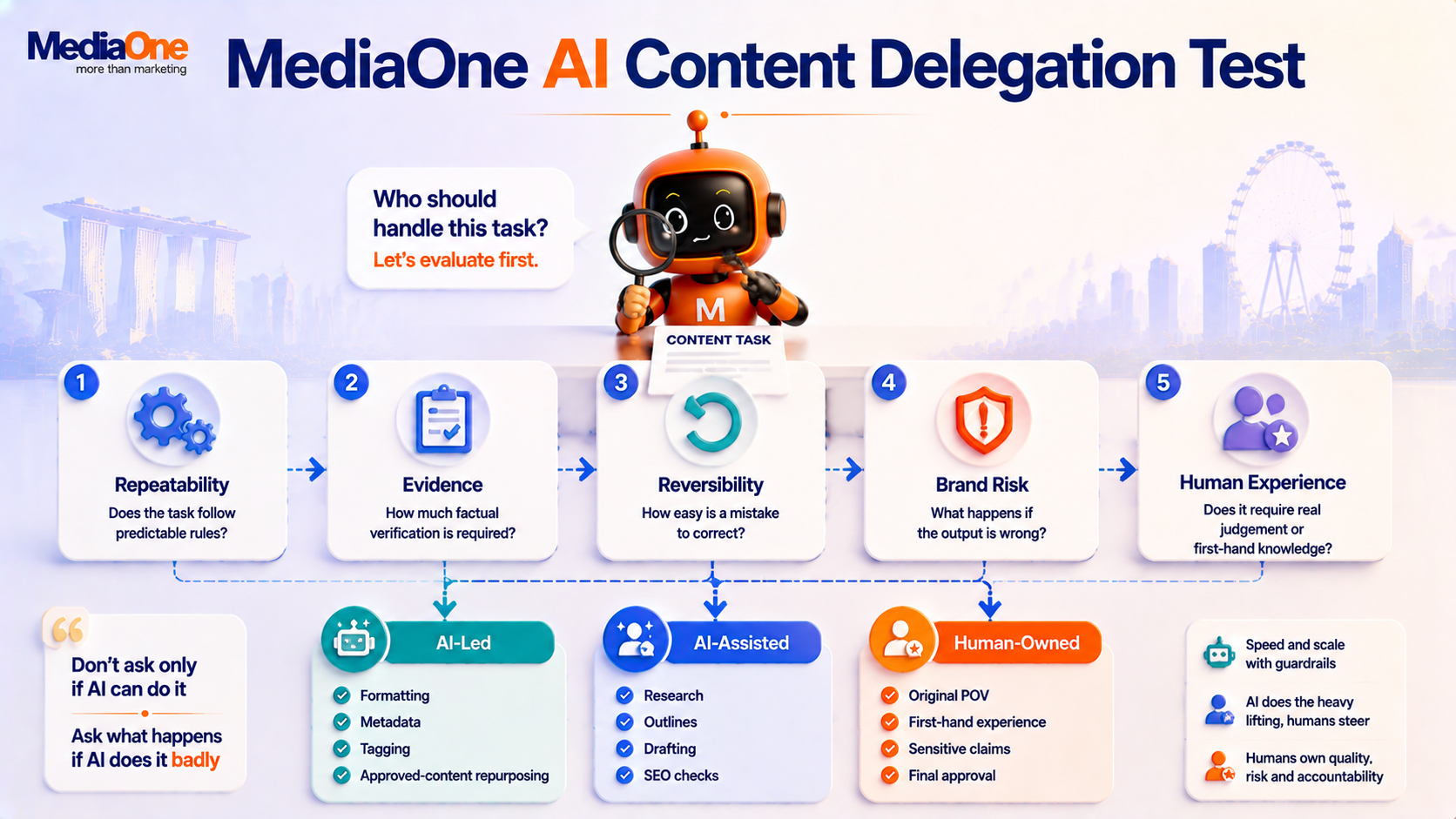
Before moving a task towards automation, assess it across five areas.
Repeatability
The more predictable the inputs and acceptable outputs are, the easier a task is to delegate.

Generating metadata from an approved article is highly repeatable. Converting an approved webinar transcript into several proposed social posts is also relatively structured.
Creating a new position on an industry issue is different. The business first needs to decide what it actually thinks.
Evidence
Ask how much factual support the output needs.

AI can be useful for discovering sources, organising information and summarising approved research. It deserves more supervision when the content includes current statistics, regulations, product claims, financial statements or other information where an incorrect answer carries a larger cost.
Google’s guidance says generative AI can be useful for topic research and adding structure to original content. It also tells publishers using generated material to focus on accuracy, quality and relevance.
Reversibility
Ask how easy an error is to correct.
An internal headline suggestion can be deleted instantly. A customer email already sent to thousands of people cannot.
The same idea applies to AI-generated visuals. An experimental concept image has a very different risk profile from a product advertisement where AI accidentally changes the packaging or product details.
Brand Risk
Consider what a weak output could do to the company.
A rough internal summary carries little public risk. An article published under a CEO’s name, a major landing page or a campaign making a product promise requires much stronger review.
Human Experience
Ask if the content requires information AI cannot genuinely possess.
That can include first-hand product testing, customer conversations, original research, internal observations, professional experience and a person’s own opinion.
AI can organise those inputs. It should not manufacture them.
AI-Led vs AI-Assisted vs Human-Owned Work
The delegation test helps place each task into a practical role.
| Workflow Role | Good Candidates | Human Role |
| AI-Led | Formatting, metadata drafts, tagging, transcript summaries, repurposing approved content | Quick check and approval |
| AI-Assisted | Research discovery, outlines, first drafts, headline ideas, comparisons, SEO checks | Direction, evidence and editing |
| Human-Owned | Original thesis, first-hand experience, expert judgement, sensitive claims, final approval | Creates or approves the substance |
This does not mean AI-led tasks become completely unattended. It means the task is predictable enough for AI to perform most of the production work.
A good example is repurposing. Once a long-form article has been checked and approved, AI can produce proposed LinkedIn posts, email summaries and short video scripts from that source with relatively limited risk.
The original article often needs more human ownership because the business still needs to decide what useful contribution it has that readers cannot get from existing search results.
Google’s current guidance for content appearing in AI search experiences also stresses useful, distinctive content instead of simply reproducing material that is already easy to find elsewhere.
A Simple Tool Map for the Workflow
Tools should support the process. They should not define it.
| Workflow Need | Examples | What the Human Still Owns |
| Topic and source discovery | Google Search, ChatGPT Search, Perplexity | Selecting useful questions and credible sources |
| Search and competitor research | Ahrefs, Semrush, Search Console | Deciding the angle and search intent |
| Drafting and restructuring | ChatGPT, Gemini, Jasper | Argument, source packet and final reasoning |
| Editorial support | Grammarly, internal QA checklists | Accuracy and brand judgement |
| Visual production | Canva, image generation tools | Brand accuracy and final visual approval |
| Publishing | WordPress, HubSpot, Buffer | Final sign-off and channel fit |
| Measurement | GA4, Search Console, CRM data | Deciding what success means |
For example, ChatGPT Search can retrieve current web information with links to source material, which makes it useful for source discovery. OpenAI itself recommends checking important information and reviewing original sources when accuracy is important.
The tool is therefore part of research discovery. It does not remove source verification from the workflow.
Build the Evidence Before You Generate
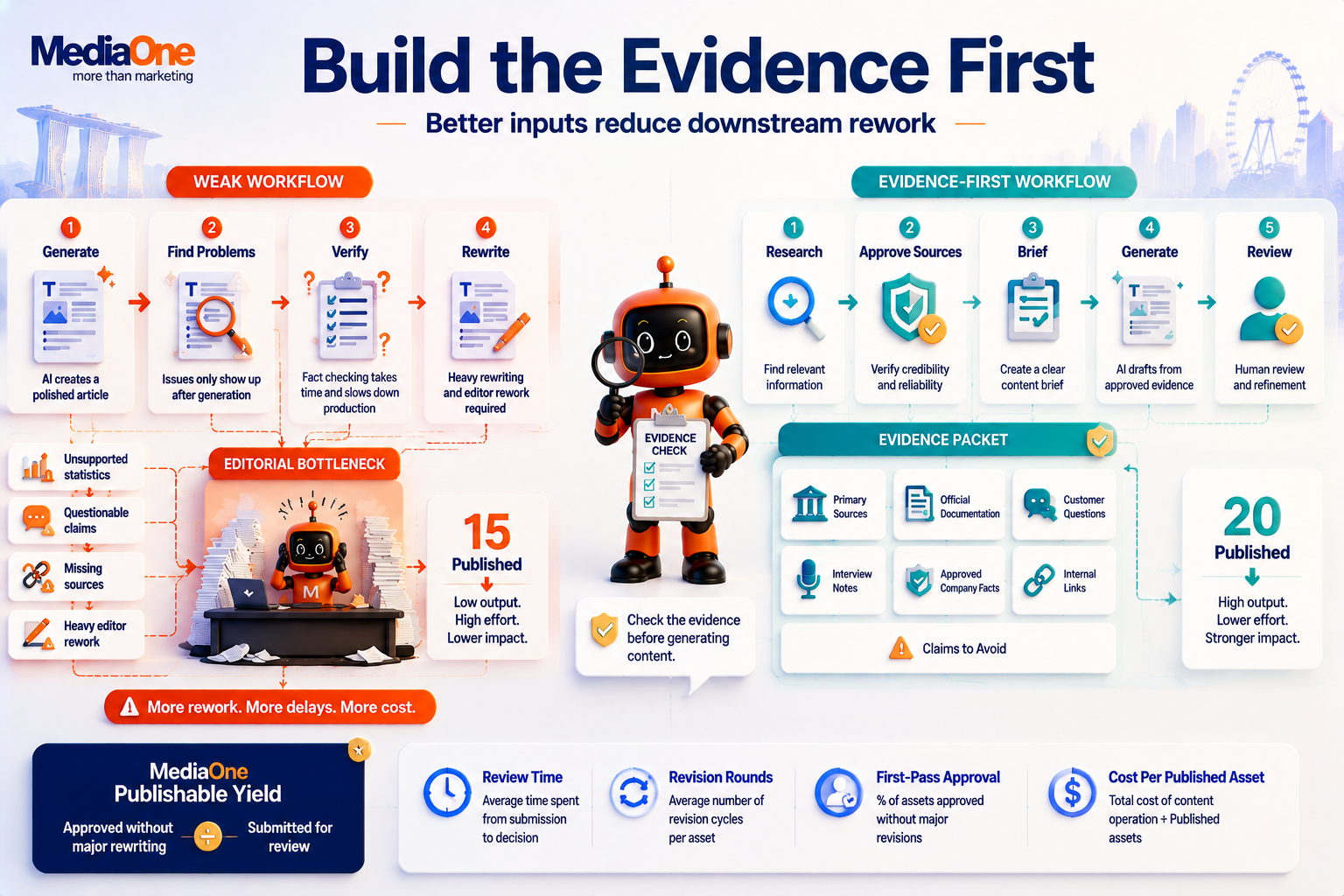
A common AI workflow starts with a broad prompt, generates a complete article and then asks an editor to check everything afterwards.
We would reverse that process.
Before the main draft begins, create a small evidence packet.
For a typical SEO article, this could include primary reports, official product documentation, verified statistics, customer questions, interview notes, approved company information, relevant internal articles and any real MediaOne observations that can be published.
The packet should also identify claims that should not be made without additional evidence.
The workflow then becomes
Research → Approved Evidence → Brief → Generation
instead of
Generation → Find Problems → Verify
AI research tools can speed up discovery. ChatGPT Search, for example, can retrieve timely web information and provide links to relevant sources. The human researcher should still open important sources and confirm what they actually support before placing the claim into the evidence packet.
This upstream work also supports stronger search content. Google’s people-first guidance asks publishers to consider if their pages provide original information, research or analysis, add substantial value beyond their sources and show first-hand expertise when readers would expect it.
A structured content calendar can also record each article’s owner, source requirements, intended angle and review level before production begins.
Do Not Edit Every AI Draft
Another hidden cost appears when teams assume every generated draft deserves to be saved.
Sometimes the cheapest editorial decision is to reject it.
We would use five gates before spending significant time on line editing.
Angle Gate
Does the content answer the reader’s problem in a useful way that existing articles do not?
If the draft repeats the same generic advice already appearing across the search results, return to the brief.
Evidence Gate
Can important factual claims be traced back to sources that support them?
If the article depends on invented examples, unsupported statistics or outdated product information, fix the evidence first.
Experience Gate
Does the topic require actual experience, analysis or a clear professional point of view?
If it does and the draft contains none, rewriting the tone will not solve the deeper problem.
Brand Gate
Would the company comfortably publish the content under its own name?
Review how confidently it speaks, what it promises and how closely it reflects the company’s actual position.
Publication Gate
Once the substance has passed, check links, metadata, visuals, attribution, formatting and the CTA.

This sequence prevents an editor from spending an hour polishing prose before discovering that the article’s basic argument is weak.
Match Human Review to the Cost of an Error
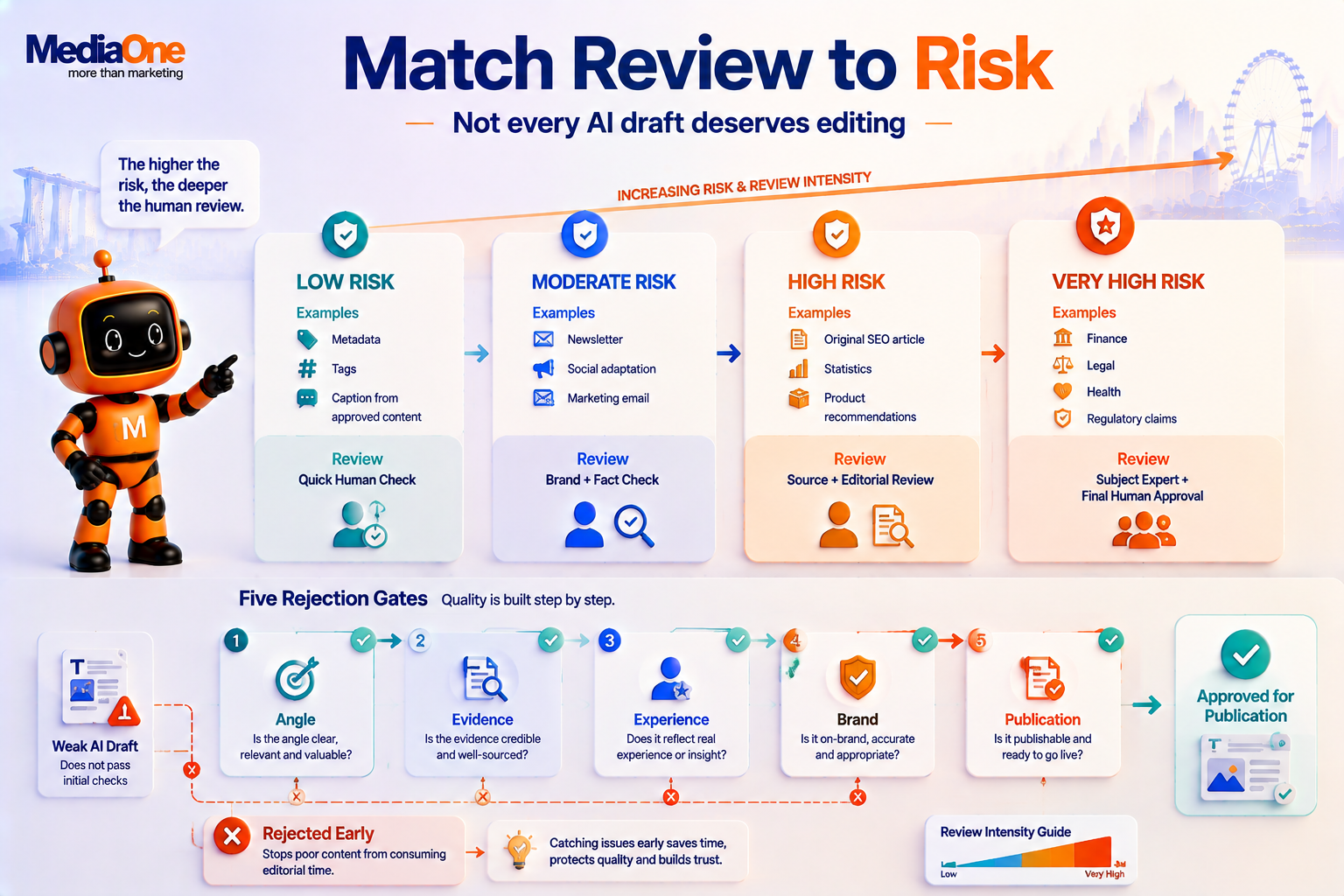
Not every AI-assisted asset needs the same level of review.
| Content Risk | Example | Suitable Review |
| Low | Metadata based on approved content | Quick human check |
| Moderate | Social adaptation or newsletter | Brand and factual review |
| High | Original article containing statistics or recommendations | Source and editorial review |
| Very High | Financial, legal, medical or regulatory claims | Subject expert and final human approval |
Google’s people-first content guidance places additional emphasis on trust for topics that can affect people’s health, financial stability, safety or welfare.
This is a better system than attaching the same generic instruction to every AI task saying a human should review it.
Sometimes AI Should Not Write the First Draft
An AI content creation workflow does not require AI to begin every article.
For executive thought leadership, interview the person first. Capture the actual position, examples, disagreements and experience. AI can then structure the transcript, identify missing support and help improve the presentation.
For product reviews, begin with actual testing notes, screenshots and observations. AI can help shape those materials into readable content but should not invent personal experience.
For original research, AI can organise datasets, summarise responses or identify themes. The interpretation should remain grounded in the research and the people who conducted it.
The same approach works for technical or sensitive expert content. Have the expert establish the substance first. Use AI later for organisation, clarity and production support.
A Practical AI Content Creation Workflow
Once roles are clear, the workflow itself can stay simple.
Evidence → Brief → Generate → Gate → Human Edit → Approve → Publish → Learn
Evidence
Collect approved sources, company information, customer language and original inputs.
Brief
Define the audience, problem, search intent, article angle, required information, claims to avoid and intended next action.
Generate
Use AI according to the responsibility level assigned to the task. Some articles may use AI only for an outline. Others may allow a complete first draft because the evidence packet is strong and the content risk is low.
Gate
Check the angle, sources, originality and brand fit before detailed editing begins.
Human Edit
Improve reasoning, remove generic material, verify claims and add genuine expertise.
Approve
Assign a named person who owns final factual and brand sign-off.
Publish
Complete the links, metadata, visuals, CMS formatting and channel distribution.
Learn
Measure both content performance and workflow performance.
Look at traffic quality, leads or conversions where they apply, but also track production time, review time, revisions, post-publication corrections and publishable yield.
The findings should shape the next brief. If articles with original customer questions repeatedly outperform generic topic ideas, feed more customer language into planning. If a particular AI drafting process consistently creates heavy revision work, change the process instead of producing more drafts.
Worked Example for a Singapore B2B Article
Consider a hypothetical Singapore B2B company creating an article about a recurring problem its sales team hears from prospects.
The company begins by collecting actual sales questions and selecting one that also shows meaningful search demand.
Its evidence packet contains official government information, current product documentation, anonymised sales objections, relevant internal expertise and approved internal links.
AI helps organise that material into an outline. A human content strategist checks the angle before drafting begins.
AI then creates a first draft from the approved packet. The draft passes the evidence gate but fails the experience gate because it explains the topic correctly without saying anything the company’s specialists have learned from handling the problem.
Instead of asking AI to make the article “more expert,” the editor interviews the relevant specialist and adds those observations.
The finished article receives factual and brand approval before publication.
Afterwards, AI converts the approved article into proposed LinkedIn posts, an email summary and a short video script. Because the underlying source has already been approved, repurposing can carry a higher level of automation.
The team then measures the article’s performance along with production time and revision work.
That is an AI workflow.
It is not simply asking a chatbot for an article and cleaning up the response.
Repurposing Is a Stronger Automation Opportunity
Once an asset has passed editorial approval, AI can often take on more work.
A verified article can become the controlled source for social posts, email copy, video scripts, FAQ answers, presentation material and sales content.
The AI no longer needs to invent the main argument or independently gather evidence. Its job is transformation.
Human review can then focus on the destination.
A LinkedIn post may need a sharper opening. An email may need a different CTA. A video script needs to work when spoken aloud.
For businesses producing content across several channels, MediaOne’s content marketing services cover planning, production and distribution as part of the wider content process.
What Google Says About AI Content
Google does not say that content loses search visibility simply because AI contributed to creating it.
Its official guidance says generative AI can help with research and structure. The problem arises when automation is used to generate large quantities of pages without added user value, which can fall under Google’s scaled content abuse policy.
Google’s people-first guidance also asks publishers to consider original information, first-hand expertise, clear sourcing and the value a page adds beyond material already available elsewhere.
Its 2026 guidance for generative AI features goes further by recommending useful, non-commodity content with a distinctive point of view and warning against generating separate pages for every possible query variation simply to influence Search or AI responses.
That is why a fixed keyword-density target should not sit at the centre of an AI content workflow.
A better SEO review asks if the content solves the searcher’s problem, contributes original value, supports its claims, uses clear structure and connects naturally to relevant pages.
Common AI Content Workflow Failures
The first failure is generating more drafts than the team can review. Writing capacity expands while editorial capacity stays fixed, so the queue grows and quality drops.
Another is feeding AI generic material and expecting distinctive output. A detailed prompt cannot fully compensate for weak evidence, no original experience and no clear editorial position.
Teams also make human decisions too late. If the first strategic review happens after a complete 2,000-word draft already exists, the writer may spend more time repairing the direction than establishing it earlier.
Another problem is automation too close to publication. Automatically generated statistics, product details, images or customer-facing promises should not move straight into live channels when an error could damage trust.
Finally, content operations can become obsessed with efficiency without checking commercial value. Workflow metrics tell you how efficiently content was produced. Traffic, leads and conversions tell you if the finished content contributed to the business.
The two should be evaluated together. Our guide to AI marketing ROI explains how additional value can be compared with the full cost of AI tools and human supervision.
Build for Publishable Content
AI can make content generation dramatically faster. That does not automatically make a content team more productive.
The strongest workflow gives AI more responsibility when work is predictable, reversible and easy to check. It keeps people close to evidence, original experience, brand positioning and decisions where a mistake carries a larger cost.
Build the evidence first. Decide what AI owns. Reject weak output early. Match review depth to risk. Publish only after someone accepts responsibility for the finished work. Then use performance and workflow data to improve the next production cycle.
A good AI content creation workflow does not generate the most content.
It creates the highest amount of publishable content with the least unnecessary rework.
Businesses looking to improve the strategy and production system behind their content can explore MediaOne’s content marketing services or contact MediaOne to discuss the current setup.
Frequently Asked Questions
What Is an AI Content Creation Workflow?
An AI content creation workflow is a defined production process that assigns research, drafting, review, repurposing, approval and publishing work between AI systems and people.
A good workflow also defines what happens when AI output fails a quality check.

Which Content Tasks Are Best for AI?
Predictable tasks with clear inputs and low error cost are usually the best candidates. Metadata drafts, formatting, tagging, transcript summaries and repurposing approved source content are good examples.
Original arguments, first-hand experience, sensitive factual claims and final approval normally require stronger human involvement.
Should AI Write the Entire First Draft?
It can for some lower-risk topics when the evidence packet and brief are strong.
For executive thought leadership, first-hand reviews, original research and sensitive expert topics, human source material should usually come first.
How Do You Stop AI Content From Sounding Generic?
Improve the source material before adjusting the prompt.
Give AI customer questions, interviews, first-hand observations, original research, company opinions and a specific argument. Distinctive inputs produce a much better starting point than another instruction to “sound human.”
Can AI-Generated Content Rank on Google?
AI involvement does not automatically prevent content from appearing in Search. Google says publishers should focus on accuracy, quality, relevance, usefulness and its existing Search policies. Large-scale automated content created without added value can violate its spam policies.
How Should an AI Content Workflow Be Measured?
Track the full process from brief to publication. Useful measures include review time, revision rounds, first-pass approval, cost per published asset, post-publication corrections and publishable yield.
Then connect the finished content to the business result it was designed to support.