
| AI Summary
Google AI Mode SEO in 2026 still rests on core SEO: crawlable pages, useful original content, clear site structure and reliable sourcing. AI Mode uses Google Search systems, retrieval and query fan-out to build answers with links to the web, while Search Console now reports generative AI visibility separately. The practical shift is measurement: compare generative AI impressions, organic clicks, branded demand and conversions without assuming that a citation will produce a visit. |
Google’s move into generative search has changed how search visibility is displayed and measured. In 2026, AI Mode can answer a query directly, support follow-up questions and show links to relevant websites. For SEO practitioners in Singapore and across APAC, the change does not create a separate replacement for SEO. It adds another search surface in which pages can be discovered, referenced and visited.


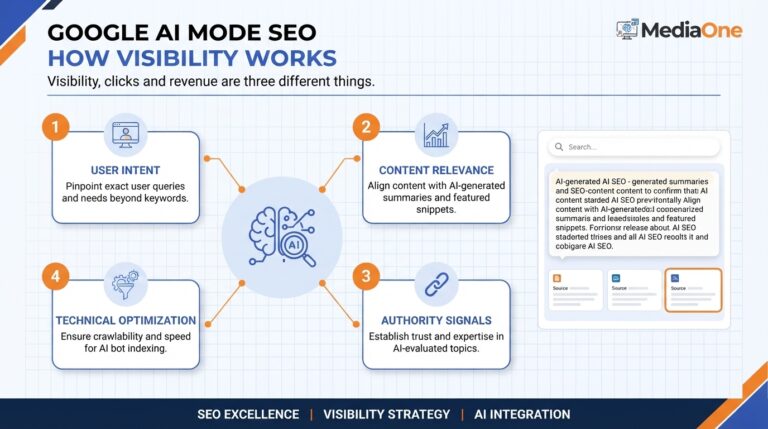
The central commercial challenge remains the one identified in the original draft: content can receive visibility inside an AI-generated answer without receiving a proportional click. A user may read enough on the search page to continue the task without visiting the source. That makes it necessary to distinguish visibility from traffic and traffic from revenue.
AI Mode availability, presentation and features still vary by country, language, account type and query. This article therefore separates what Google has documented from what marketers may observe in individual Search Console properties or live searches.
Key Takeaways
- Google treats optimisation for generative AI search as part of SEO, not a separate ranking system. Core practices such as crawlability, useful original content, internal linking and accurate structured data still apply.
- Generative AI visibility and clicks should be measured separately. Search Console’s Generative AI reporting helps track impressions across pages, countries, devices and dates.
- AI-generated search experiences can reduce clicks, but there is no universal traffic-loss percentage. The effect varies by query, market, device and user intent.
- Clear structure, reliable sourcing and accurate authorship support strong content, but Google does not require special AI formatting, tiny content chunks or dedicated AI schema.
- Businesses should measure outcomes beyond impressions. Track organic clicks, branded demand, conversions and owned channels such as email rather than assuming AI visibility automatically produces traffic or revenue.
What Google AI Mode Means for SEO in 2026
Google AI Mode is an AI-powered Search experience that lets users ask complex questions, continue with follow-up questions and explore supporting web links. It is not simply a longer featured snippet. Google’s own documentation says AI Mode can divide a question into subtopics, run related searches and use retrieved web information to construct a response.
The practical SEO implication is that a page still has to be discoverable and useful within Google Search before marketers should worry about AI-specific presentation.
The Core Mechanics of Google AI Mode
Google describes generative AI Search as being rooted in its core Search ranking and quality systems. Its official guide to generative AI search describes two relevant techniques: retrieval-augmented generation, which retrieves current web pages from Google’s index, and query fan-out, which generates related searches to gather information for a broader answer.
That changes the shape of a search process. A user may begin with one question, while the system retrieves material that addresses several related subtopics. The resulting response can contain prominent links to pages that support different parts of the answer.
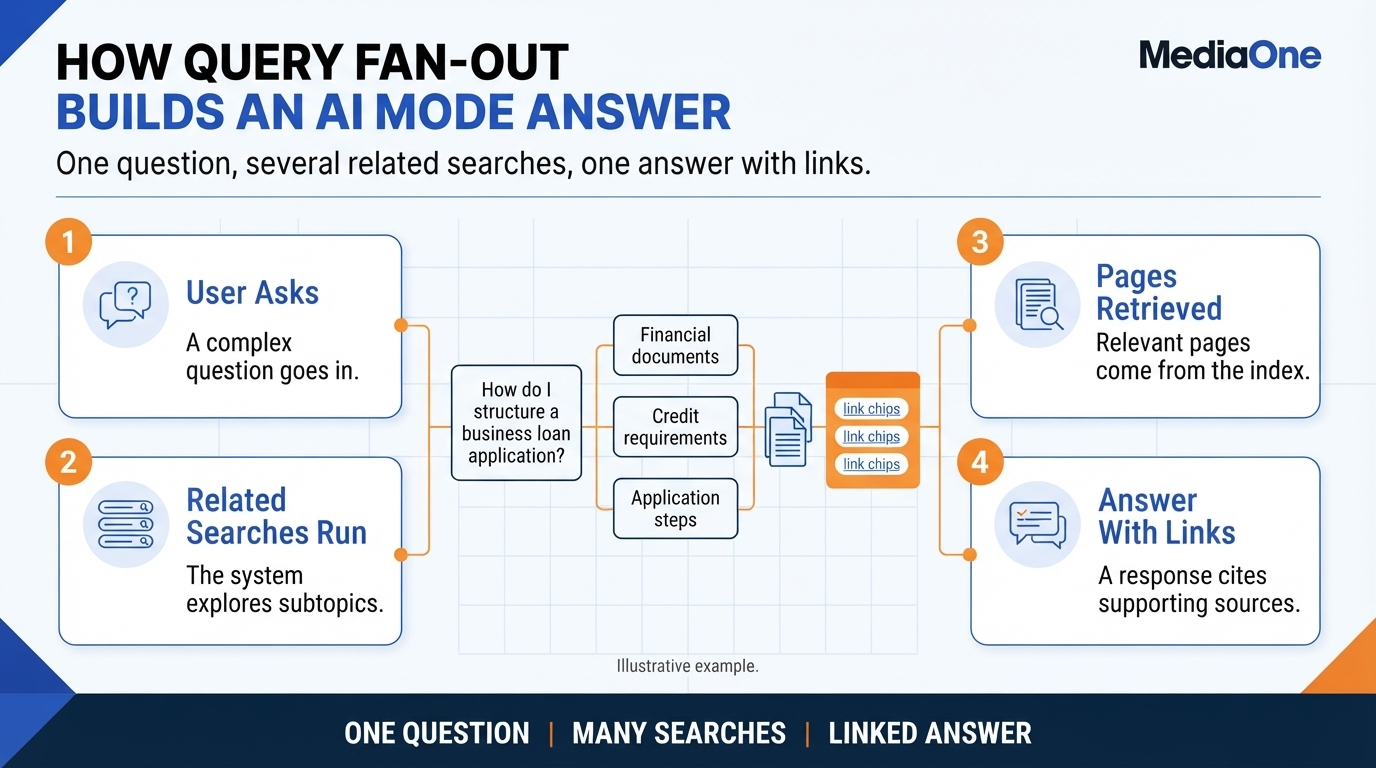

Consider an illustration. A user asks how to structure a business loan application. AI Mode may explore related subtopics such as financial documents, credit requirements and application steps, then draw on different indexed sources. A useful page can therefore appear because it answers one part of a wider question, not only because it matches the exact wording of the original query.
The earlier draft described this process as Google extracting clauses from ranking pages and citing domains or authors in a fixed pattern. Google does not publish a rule that AI Mode must cite an author or that it selects sources according to a single visible ranking order. The safer description is that Google retrieves relevant web content through Search systems and shows supporting links within the generated experience.
This also differs from a standard list of organic results. Traditional results present individual pages as separate choices. AI Mode can first present a generated response, then give users multiple ways to inspect sources or continue the task. For publishers, that means a search impression can represent visibility without necessarily producing the same click behaviour as a blue-link result.
Why Traditional Click-Based SEO Metrics No Longer Tell the Full Story
Traffic can fall on some search-result pages even when the site remains visible. That is why impressions, clicks and conversions should no longer be read as interchangeable indicators.
A practical example helps. Suppose an article on ‘SEO metrics for startups’ receives 8,400 generative AI impressions in a month but a lower clickthrough rate than the same page’s conventional organic appearances. Those figures are illustrative, not benchmark data. The important point is to inspect the two search experiences separately before diagnosing the page as a ranking failure.
Brand exposure may still have value, but it should not be treated as guaranteed revenue. A user may recognise a source, click later, search for the brand later or never return. Analytics can show whether direct sessions, branded queries, assisted conversions or subscriber growth move alongside generative AI visibility, but correlation alone does not prove the AI exposure caused the later action.
For reporting, separate at least four questions:
- Is the page visible in generative AI features?
- Is that visibility producing clicks?
- Are those clicks producing useful on-site actions?
- Is branded or direct demand changing over the same period?
This framework keeps an awareness hypothesis separate from measured commercial performance.
What Google Says About Optimising for AI Search
Google’s 2026 guidance is more conservative than much of the third-party discussion around AEO and GEO. It says that optimisation for generative AI Search is still SEO. There is no requirement for an llms.txt file, a special AI schema, a fixed content length or a special writing style for AI Mode.
Google does recommend unique, valuable and people-first content. It also recommends clear organisation, useful images or video where appropriate, crawlable internal links and technical access for Googlebot. These are familiar SEO practices rather than a replacement playbook.
The guidance also pushes back on one common tactic from the original draft: aggressive ‘chunking’. Short paragraphs and clear sections can be good for readers, but Google says there is no requirement to split content into tiny units for AI systems. Pages should be organised around the needs of the audience.
For Singapore businesses, this distinction is useful. Google AI Mode SEO should start with the same diagnostic questions used for strong organic search: Can Google crawl the page? Is it indexed? Is the main information available in text? Does the page add original value? Do internal links make important pages discoverable? Are claims accurate and clearly sourced?
How AI Mode Changes Visibility and Traffic Patterns
The gap between visibility and traffic is now easier to observe because Search Console can report generative AI impressions separately. That creates a new reporting layer without changing the underlying need to earn useful search visibility.
Do not assume that every generative AI impression has the same traffic value as a traditional organic impression. Measure the behaviour of each surface.
The Shift from Click Optimisation to Search Visibility
The original draft framed the change as a move from ranking optimisation to citation optimisation. Google’s current guidance does not support that as a strict either-or shift. Search ranking systems remain part of the retrieval process, and Google says established SEO best practices continue to apply to AI Mode and AI Overviews.
A better distinction is between search visibility and site traffic. A page can contribute to a generated answer and receive an impression without receiving a click. It can also receive a click from a supporting link. The task for SEO teams is therefore to improve eligible visibility while designing the page and offer so that people who do visit have a reason to continue.
That still rewards useful content. Pages that clearly answer a real question, contain original evidence or experience, and provide details beyond a generic summary give users more reason to follow the source. Pages that merely restate common knowledge are easier for any search interface to summarise without requiring a visit.
Keyword targeting also remains relevant. Google Search Essentials still recommends using words people would use to find the content in titles, headings, alt text and link text. The change is that exact-match repetition is not a substitute for usefulness, and it never was.
Traffic Implications of AI Summaries
The clearest independent evidence in the draft’s direction comes from a 2025 Pew Research Center analysis of 68,879 Google searches by 900 US adults. In that study, users clicked a traditional search result in 8% of visits where an AI summary appeared, compared with 15% of visits where no AI summary appeared. Users clicked a source inside the AI summary in 1% of visits. The study concerned US users and Google AI summaries, so it should not be treated as a Singapore-specific AI Mode benchmark. See the Pew Research Center analysis.
Those figures replace the draft’s unsupported claim that clickthrough routinely falls by 20 to 40 per cent in affected verticals. The direction of travel may be similar in many cases, but the impact varies by query, device, market, result design and user intent.
Illustrative traffic scenarios should therefore be labelled as illustrations. A page might receive 10,000 generative AI impressions and 200 clicks, or it might receive far more or fewer. Search Console data from the actual property is the appropriate benchmark.
The business effect depends on the revenue model. Publishers paid largely by page views face a direct risk when fewer searchers reach the site. Lead-generation and ecommerce businesses may care more about whether the smaller number of visits is qualified. Subscription businesses may value email capture or return visits. None of these outcomes should be inferred from impressions alone.
The table below is a reporting framework, not a universal performance forecast.
| Metric | Generative AI search | Traditional organic search |
| Impressions | Track separately where Search Console reports them | Track in the standard Performance report |
| Clickthrough rate | Measure for your property and pages | Use as the conventional organic benchmark |
| Supporting-link visibility | Can occur within AI experiences | Not applicable in the same form |
| On-site conversion | Measure after the visit | Measure after the visit |
| Revenue effect | Depends on traffic and business model | Depends on traffic and business model |
The Role of E-E-A-T and Authorship
The original draft used ‘E-A-T’ and described credentials as a primary AI Mode ranking factor. Google’s current terminology is E-E-A-T: experience, expertise, authoritativeness and trustworthiness. Google also states that E-E-A-T itself is not a single ranking factor. Its systems use a mix of signals that can align with those qualities, with stronger emphasis on trust for topics that could affect health, financial stability or safety.
Accurate authorship is still useful. Google encourages bylines where readers would reasonably expect to know who created the content, and it recommends providing information about the author’s background when that helps readers assess the work.
That does not justify a claim that a named expert will automatically outrank an anonymous page in AI Mode. The defensible practice is simpler:
- Use a real byline where appropriate.
- Describe relevant experience accurately.
- Link to an author page or professional background where useful to readers.
- Cite reliable primary sources for factual claims.
- Add first-hand evidence, examples, testing or original analysis when the topic allows it.
- Apply more care to YMYL topics, where inaccurate information can cause harm.
A cardiologist writing about a medical topic is an intuitive example of relevant expertise, but the article should not claim that Google will select that page solely because of the credential. Search systems consider many signals and the relevance of the content itself.
Content Structure and Formatting for AI Search
Clear structure remains good practice, but the reason should be framed correctly. Headings, lists and tables help readers scan content and help search systems understand the page. Google does not publish a rule that these formats are extracted or cited at a fixed higher rate.
Structure content for people first, then make sure the same structure is technically clear enough for Search to crawl and understand.
Heading Hierarchies and Semantic Clarity
Use one clear H1 for the page topic, H2s for major sections and H3s for genuine subdivisions. This creates a readable hierarchy and reduces ambiguity for people using assistive technologies, search systems and content-management tools.
What works:
- Start with one H1 that accurately names the topic.
- Use H2s for distinct major sections.
- Use H3s only to subdivide the H2 above them.
- Keep heading wording descriptive rather than decorative.
- Put the answer close to the question when a section is designed to answer a specific query.
This does not mean every paragraph must be short or every answer must fit inside a fixed word count. Google’s generative AI guidance says there is no ideal page length and no requirement to break a page into tiny pieces. A section can be long when the subject needs depth.
For example, an H2 such as ‘How to Optimise Images for Web’ can contain H3s on file formats, compression and lazy loading. The headings should reflect real subtopics that help the reader move through the explanation.
The same principle applies to AI search content on WordPress. MediaOne’s guide on optimising WordPress for AI search focuses on access, indexability, understandable content and trust rather than a separate AI-only writing formula.
Fact-Checking and Source Attribution in Body Copy
Every statistic and material factual claim should have a source that a reader can inspect. That is an editorial requirement for this article and a sound trust practice regardless of how Google chooses to rank or display the page.
Prefer primary or authoritative sources. For a statement about AI Mode features, use Google Search Help or Search Central. For Singapore regulations, use the relevant government agency. For research findings, link the original paper or recognised research organisation where possible.
Do not invent a study name to make a sentence look sourced. The earlier draft used an example called the ‘2026 Google Search Quality Report’ with a precise AI Mode statistic. No such source was established in the draft, so that example has been removed.
Direct quotes are not inherently better for AI visibility than careful paraphrases. Use a quote only when the exact wording is useful. Otherwise, paraphrase accurately and link the source. The editorial goal is traceability, not a particular citation syntax.
For practical publishing:
- Place the source link on natural descriptive text.
- Keep the source close to the claim it supports.
- Distinguish sourced data from an illustration.
- Record the source date for time-sensitive platform features.
- Recheck platform documentation before publication because AI Search features change quickly.
This article also links related MediaOne coverage of AI Overview visibility so readers can compare AI Overview concepts with the AI Mode discussion here.
Lists, Tables and Structured Data
Lists are useful for steps. Tables are useful for comparisons. Neither format should be added merely to imitate an assumed AI extraction preference.
Use numbered lists when sequence is important. Use bullets when the items are parallel. Keep prose when the idea needs explanation and relationships between sentences.
Structured data should describe the visible page accurately and follow Google’s supported Search feature guidance. The earlier draft recommended special treatment such as HowToStep, ‘Table schema’ and FAQPage specifically to tell AI systems that content is ready for extraction. That overstates what structured data does.
Google’s 2026 generative AI guidance says structured data is not required for generative AI search and there is no special schema.org markup to add for AI Mode. Existing structured data can still be valuable when it makes a page eligible for supported rich results or helps Search understand known content types, provided the markup matches what users can see.
That means the correct workflow is:
- Identify whether Google supports a relevant structured-data feature for the page.
- Follow the feature-specific documentation.
- Make sure the marked-up content is visible on the page.
- Validate the markup.
- Do not add unsupported types or properties simply because an AI-search checklist recommends them.
The same caution applies to claims about list density. The draft stated that pages with three or more tables or numbered lists were cited at nearly double the rate of prose-only pages. No acceptable source for that figure was supplied or found during this review, so the claim has been removed.
Measuring AI Mode Impact on Your SEO Performance
Measurement is one of the areas where the 2026 draft needed the largest factual update. Google introduced dedicated Search Generative AI performance reports in Search Console in June 2026 and stated that the insights had rolled out to all websites worldwide by 31 August 2026.
Use Search Console’s generative AI reporting for visibility, then connect that data to analytics and commercial outcomes rather than estimating AI exposure from a traffic drop.
Generative AI Impressions and Clicks
Google’s Search Generative AI performance report announcement says the dedicated reports cover impressions in generative AI features such as AI Overviews and AI Mode. The report includes views for pages, countries, devices and dates, while the data also contributes to overall Search performance reporting.
That corrects two problems in the original draft. First, marketers no longer need to rely only on manual searches or third-party trackers to know whether their pages receive generative AI visibility. Second, the report should not be described as a dedicated ‘AI Mode filter’ unless the interface explicitly provides that exact segmentation for the property and date being analysed.
Track at least:
- Generative AI impressions: how often URLs from the site appeared within Google’s generative AI features.
- Pages: which URLs receive that visibility.
- Countries: where the impressions occur, which is particularly useful for Singapore and regional APAC sites.
- Devices: whether visibility differs between desktop and mobile where the report exposes device data.
- Dates: whether changes align with content updates, product rollouts or seasonality.
- Clicks and conversions: use the applicable Search Console and analytics data to understand what happens after a user reaches the site.
The draft proposed a ‘citation rate’ that measured how often a page was cited by name versus paraphrased. Google does not document that as a standard Search Console KPI. A business may build its own monitoring metric, but it should be labelled as an internal or third-party measurement rather than a Google metric.
Identifying Query and Page Risk
Do not assign fixed AI Mode exposure percentages to entire query categories without supporting data. The original draft said informational queries had the heaviest deployment, process queries ranked second, commercial queries had specific click-loss ranges and branded traffic was largely protected. Those statements were too broad.
A better method is property-level analysis:
- Export generative AI visibility by page and date.
- Group pages by business purpose, such as informational guide, product, service, local page or branded resource.
- Compare clicks and conversions before and after visibility changes.
- Separate country and device when the sample is large enough.
- Review live results for priority queries to understand the presentation users actually see.
- Repeat the analysis because AI result designs and availability can change.
External research can provide context. Pew’s 2025 study found that longer and question-form searches were more likely to produce AI summaries in its US sample. That is useful directional evidence, but it still does not prove that a given Singapore query category behaves the same way in 2026.
For local and commercial pages, watch revenue rather than only search-interface labels. A service page can lose non-converting informational visits and still improve lead quality. Conversely, a publisher can hold impressions while losing page-view revenue. The useful metric depends on the business.
Setting Revenue Targets When Traffic Falls
If a business depends on display advertising, fewer visits usually mean fewer opportunities to show ads. If it depends on affiliate clicks or lead forms, fewer visits can reduce conversion opportunities unless the remaining visitors are more qualified. These are business-model effects, not proof that AI Mode itself caused every revenue movement.
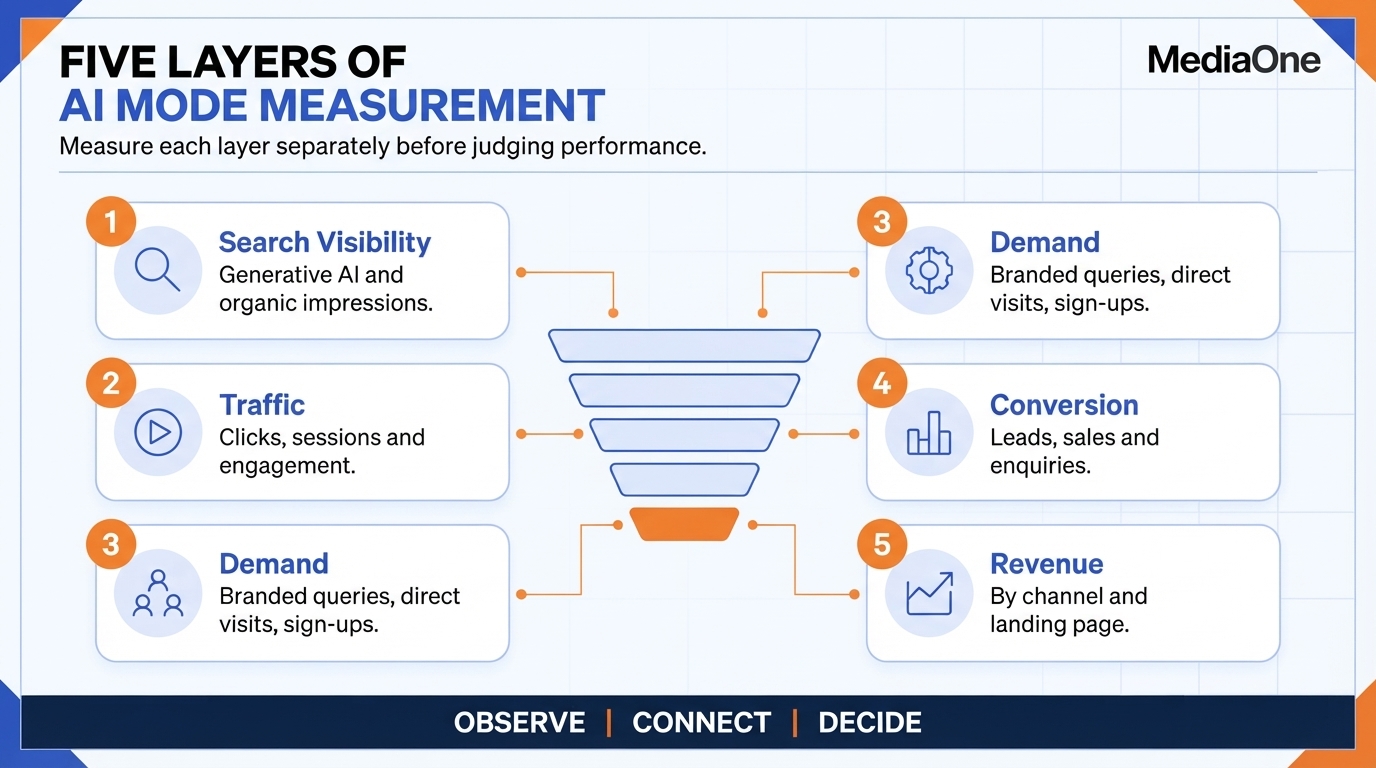
Use a layered measurement framework:

- Search visibility: generative AI impressions, standard organic impressions and important ranking coverage.
- Traffic: clicks, sessions and landing-page engagement.
- Demand: branded queries, direct visits, newsletter sign-ups and returning users.
- Conversion: leads, sales, qualified enquiries and assisted conversions.
- Revenue: revenue by channel and, where possible, by landing page or content group.
Multi-touch attribution can be useful when customers interact with several channels before converting, but it should not be used to manufacture credit for an AI impression that cannot be connected to the customer path. Treat brand lift as a hypothesis to test.
For publishers, a sensible response to reduced click opportunity is to strengthen reasons to visit the site: original data, tools, calculators, expert commentary, downloadable resources, communities and products that a search summary cannot fully substitute.
For lead-generation businesses, focus on pages that answer enough to establish competence while giving the visitor a clear next action. For ecommerce, product data, availability, images, reviews and Merchant Center hygiene remain important parts of Search visibility.
Repositioning Your Content Strategy for AI Mode
The strategy change is less dramatic than the original draft suggested. Google has not declared keyword targeting obsolete, and it has not replaced traditional ranking with an AI citation score. The stronger change is that useful information can now be consumed within more Search interfaces.
Build content that deserves to be retrieved, gives the user something beyond a generic summary and supports a measurable business objective.
From Keyword Targeting to Information Utility
Do not stop keyword research. Use it to understand demand, wording and intent. Then test whether the proposed page solves a real problem better than the material already available.
Ask:
- What is the user trying to accomplish?
- Which part of the answer can we provide from first-hand experience?
- What evidence, data, examples or tools can we add?
- What would make a user want the full page rather than a short summary?
- Which related pages should be linked so both users and Google can find the broader topic cluster?
A page about compound interest should use the language searchers use, but it can add more value with a working formula, a calculator, assumptions, examples and explanations of edge cases. A Singapore business guide can cite the relevant government agency and add practical implementation details from local experience.
Pages written solely to tease an answer can disappoint readers. Pages that give away every useful element in a generic paragraph may also create little reason to visit. The balance is to answer the question clearly while offering depth, evidence or utility that rewards the click.
For teams comparing terminology around AEO and GEO, MediaOne’s AEO vs GEO guide provides additional context. For Google Search specifically, remember that Google’s own position is that optimisation for generative AI remains part of SEO.
Credentials, Attribution and Links
Accurate credentials improve editorial transparency. They should be added because they help users understand who created the content, not because a checklist promises an AI citation.
A useful authorship pattern is:
- Name the real author.
- State a relevant role or area of experience.
- Link to an author page with verifiable background.
- Disclose material testing methods or review processes where useful.
- Cite external evidence for factual claims that do not come from the author’s own experience.
Backlinks still have a place in Search. Google documents link analysis and PageRank as part of its ranking systems, and internal links help Google discover pages and understand relationships. What cannot be supported is the draft’s claim that an internal link from a CEO carries a special AI Mode weight or that ‘authority stacking’ is a published citation factor.
Build links because they help discovery, context, reputation and users. Avoid artificial link schemes or manufactured mentions. Google explicitly warns against chasing inauthentic mentions as an AI-search tactic.
For internal linking, use descriptive anchor text and connect pages when the relationship is genuinely useful. A coherent topic cluster can improve navigation and make important pages easier to find without pretending that each internal link has a known AI citation score.
The Case for Owned Audiences and Direct Traffic
Owned audiences remain a sensible hedge against dependence on any single discovery platform. Email, newsletters, communities, direct product usage and customer relationships can continue even when search-result layouts change.
Do not state that an AI citation will cause a user to return directly later unless you can measure that behaviour. Instead, test whether generative AI visibility correlates with changes in branded search, direct sessions, sign-ups and repeat visits.
Practical options include:
- Email capture on useful resources: Offer a genuinely helpful checklist, template, calculator result or update rather than a generic download.
- Newsletter publishing: Give subscribers information they cannot get from a one-off search result, such as original analysis, local updates or practical case studies.
- Branded demand measurement: Monitor branded queries and direct sessions, but treat increases as signals that require further analysis.
- Community or customer programmes: Create reasons for people to return without beginning every interaction on Google.
- Remarketing and paid search where appropriate: Use paid channels based on measurable economics, not because an AI citation is assumed to create demand.
SEO teams should report both discovery and outcome metrics. If generative AI impressions rise while clicks fall, that is an observation. Whether the change is positive depends on conversions, revenue and the strategic role of the content.
Summary and Roadmap for 2026–2027
AI Mode changes the way some searches are presented, but it does not invalidate the foundations of SEO. Google’s 2026 documentation repeatedly points publishers back to unique content, technical accessibility, internal links, page experience and people-first value.
The strongest 2026 plan is to improve core SEO, measure generative AI visibility separately and avoid unsupported AI-search shortcuts.
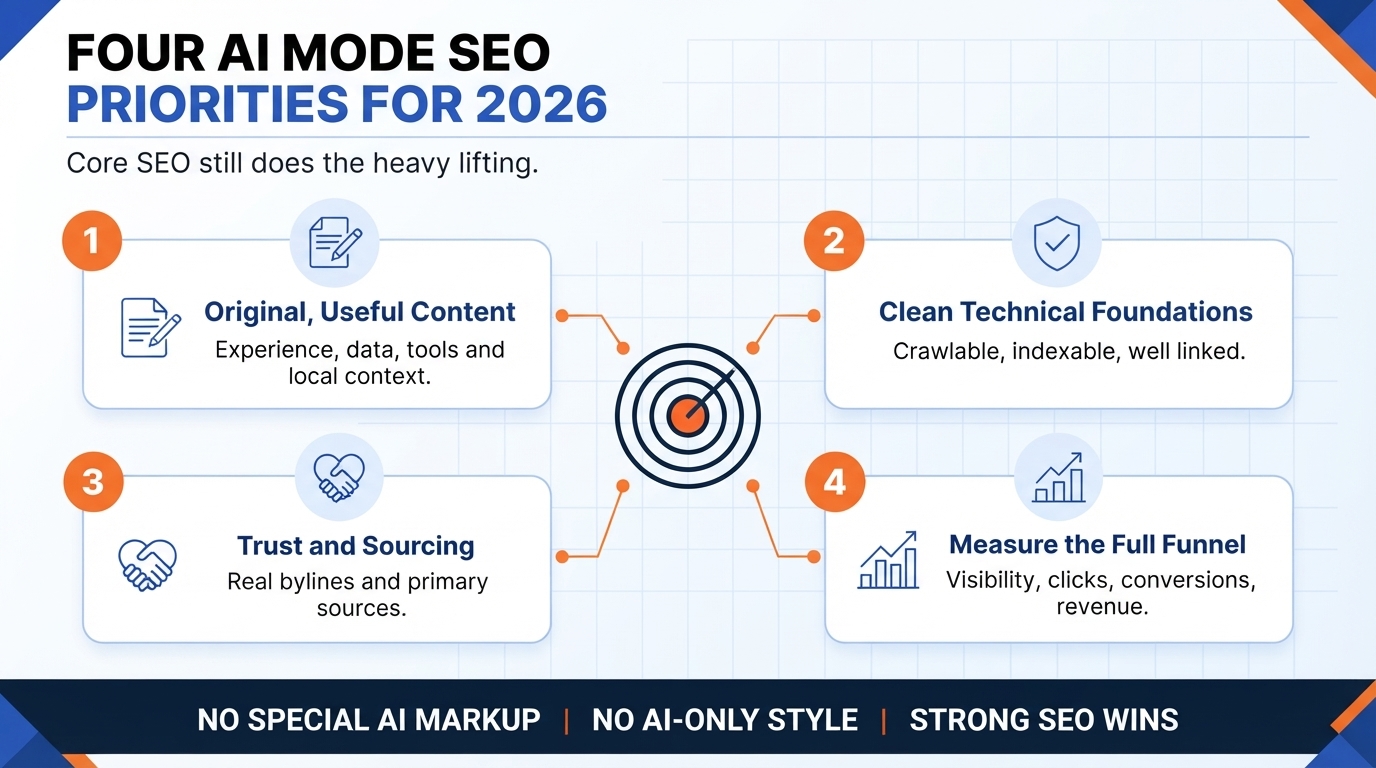
Four Priorities for 2026
- Create original, useful content
Add first-hand experience, original examples, local context, tools, data or expert analysis where the topic allows it. Do not produce commodity pages solely to cover keyword variations or imagined fan-out queries.
- Keep the technical foundations clean
Make important pages crawlable and indexable. Use internal links that are easy for Google to crawl. Keep important information in textual form. Use high-quality images and video when they add value. Apply structured data only where it accurately matches the visible content and a supported use case.
- Strengthen trust and sourcing
Use accurate bylines, explain relevant expertise and cite authoritative sources. Give extra care to YMYL topics. Do not invent studies or credentials. Review time-sensitive platform claims before publication.
- Measure the expanded search funnel
Use Search Console’s generative AI reports alongside standard organic data. Track clicks, conversions and revenue separately from impressions. If brand or direct traffic changes, test the relationship rather than automatically crediting AI exposure.
These priorities are consistent with the broader MediaOne coverage of AI search visibility while keeping the Google-specific claims aligned with current Search documentation.
Sites That Adapt vs. Sites That Do Not
Sites that add original value and measure new search surfaces will be better placed to diagnose changes. They can see whether a decline comes from rankings, generative AI presentation, demand, seasonality, conversion issues or a combination of factors.
Sites that rely on high-volume commodity articles face a harder problem because generated search experiences can often answer generic questions without requiring a visit. The response should be to improve the usefulness of the page, not to add arbitrary lists, invented credentials or unsupported schema.
The commercial opportunity differs by business model. A publisher may need more distinctive subscriber value. A local service business may need stronger evidence, local proof and lead capture. An ecommerce site may need richer product information and better merchandising. A B2B company may need original research, tools and expert material that supports a longer buying cycle.
Planning for 2027 Without Guessing
The original draft forecast that AI Mode would appear on 70 per cent or more of search volume across most verticals and that specific query types would be dominated by AI-generated answers by late 2027. No authoritative source was found for those predictions, so they have been removed.
A better roadmap is scenario-based.
For the next 12 months:
- Monitor Google’s Search Central documentation and Search Console releases.
- Record baseline generative AI impressions by content group.
- Identify pages where visibility is rising but commercial performance is falling.
- Invest in original information and functionality that cannot be replaced by a short generic summary.
- Keep testing titles, internal links, page experience and conversion paths using normal SEO and CRO methods.
- Recheck regional availability and features before making Singapore-specific claims.
Do not plan around a precise forecast that Google has not published. Plan for continued change in search presentation while maintaining a site that is useful even when the discovery channel changes.
Frequently Asked Questions
Will Google AI Mode replace traditional organic search results entirely?
Google has not announced that AI Mode will eliminate conventional Search results. AI Mode is an AI-powered Search experience with supporting links, and Google continues to operate standard Search alongside generative AI features. Treat claims about a complete replacement date as speculation unless Google publishes one.
How do I know if my page appears in Google generative AI features?
Use Search Console’s Generative AI performance report. Google says the report shows impressions plus page, country, device and date information for generative AI features such as AI Overviews and AI Mode. For high-value queries, combine that reporting with live checks so you can understand how the result appears to users.
Does Google AI Mode penalise affiliate or commercial websites?
Google has not published a blanket AI Mode penalty for affiliate or commercial sites. Commercial content still needs to follow Search policies and provide useful, reliable information. Thin or scaled content created mainly to manipulate rankings can perform poorly or violate spam policies regardless of whether it is affiliate-funded.
Can I still rank in traditional Google results if I optimise for AI Mode?
Yes, because Google’s position is that generative AI optimisation is still SEO. Focus on crawlability, people-first content, clear internal linking, relevant wording, page experience and accurate structured data. Avoid changing a useful page solely to satisfy an assumed AI-only format.
How should I measure ROI from AI Mode visibility if clicks fall?
Start with generative AI impressions in Search Console, then connect traffic to analytics, leads, sales or other business outcomes. Also monitor branded search, direct sessions and subscriber activity, but do not automatically attribute those changes to AI exposure. Use experiments, time-series comparisons and assisted-conversion data where available.
Is AI Mode available in Singapore?
Yes. Google’s current AI Mode availability documentation lists Singapore among supported Asia-Pacific countries and territories. Specific capabilities can still vary by language, account, subscription and feature rollout, so check the Help Center before publishing a claim about a particular AI Mode function.
What is the difference between AI Mode visibility and traditional rankings?
Traditional rankings present pages as individual search results. AI Mode can generate a response from retrieved web information and show supporting links within that experience. A site can therefore gain visibility in generative AI features without that impression behaving like a conventional organic listing.
How does AI Mode affect local search and ‘near me’ queries?
There is no safe universal rule that local queries are unaffected. AI Mode now includes features that can work with local information, and Search presentation varies by query and location. Keep Google Business Profile information accurate, maintain strong local landing pages and measure the actual queries that generate local leads.
Should I stop building backlinks in an AI Mode world?
No. Google still documents link analysis and PageRank as part of Search ranking systems. Focus on earning relevant links and avoiding manipulative schemes. Do not assume that a backlink carries a separately published AI Mode citation weight, because Google has not documented such a metric.
What happens to revenue if traffic falls but impressions stay high?
It depends on the business model. A display-ad publisher may lose revenue when page views fall, while a service business may be less affected if lead quality improves. Compare generative AI visibility, site visits, conversion rate and revenue before deciding whether the change is positive or negative.
Can AI-generated content still appear in Google AI Mode?
Yes. Google says it focuses on content quality rather than whether a human or AI produced the first draft. AI-generated content should still be accurate, original, useful and compliant with Search policies, and large-scale automation used mainly to manipulate rankings can violate spam rules. Where readers would reasonably want to know how content was created, a clear disclosure can provide useful context.