
| AI Summary
Digital marketing courses in Singapore range from free, self-paced platform training to structured professional certificates and multi-year diplomas. The best option depends on your starting skill level, available study time, need for recognised credentials and whether the programme gives you practical work you can show an employer. Compare curriculum recency, instructor experience, project depth, funding eligibility and assessment methods before you enrol. |
Choosing a digital marketing course in Singapore is less about finding one ‘best’ provider and more about matching the programme to your goal. You can choose from formal diplomas, professional certificates, intensive cohorts, vendor certifications and self-paced courses, and each route trades off time, cost, depth, structure and credential value differently.


If you are changing careers, you may need broad foundations plus portfolio projects. If you already work in marketing, you may get more value from a specialist course in paid search, analytics, SEO, email automation or another skill tied to your next role. Before spending money, compare the actual syllabus, teaching hours, assessment and project work rather than relying on the course title alone.
This guide gives you a decision framework for comparing digital marketing courses, with Singapore-specific checks for funding, course recognition and current platform skills. It also shows how to judge whether a programme will leave you with work you can demonstrate, not just a certificate.
Key Takeaways
- Course formats vary widely. A learner can start with a free platform certification, choose a short professional course, join an intensive cohort or commit to a longer formal qualification.
- Practical work should influence your choice. Look for campaigns, audits, analytics exercises or content projects you are allowed to discuss in interviews.
- Current platform training is important. Check that analytics content uses GA4 and that advertising modules reflect the current Google Ads and social-platform interfaces.
- Funding depends on the exact course and learner profile. Verify the approved course and your own eligibility before treating a headline subsidy as your final fee.
- A certificate is only one hiring signal. Pair training with a portfolio, clear measurement skills and an understanding of how your chosen channel supports business outcomes.
What Digital Marketing Courses Cover and Why It Affects Your Choice
Core Disciplines Across Most Programmes
Many digital marketing courses cover a common core: SEO, paid search, social media, content marketing, email marketing and analytics. The order and depth vary, but these areas give learners a useful map of professional digital marketing work.
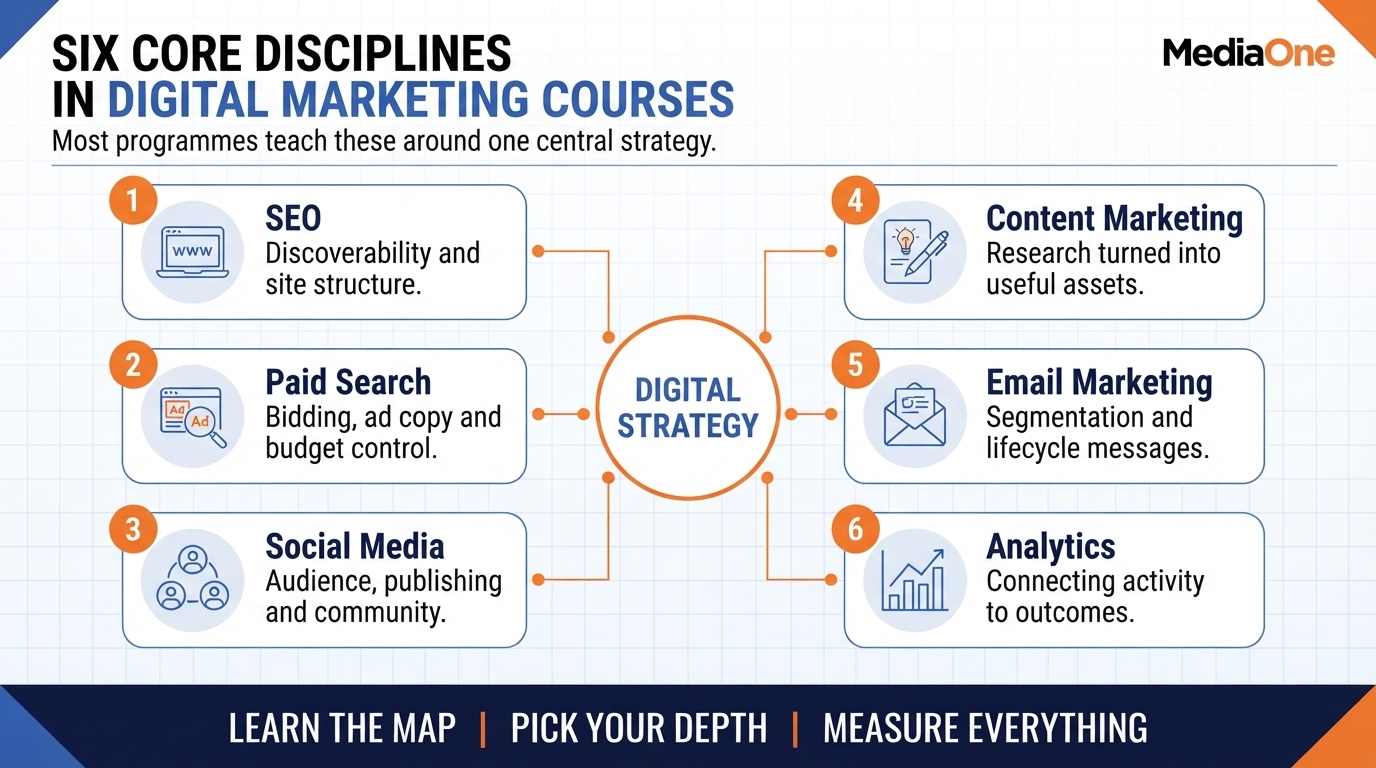
Not all courses weight these disciplines equally. Some go deep on search and measurement, while others spend more time on content or social media. That difference is important because a broad introduction does not prepare you automatically for a specialist role.
If you want a generalist role in a small team, breadth can be useful. If you are aiming for a paid-search, SEO or analytics role, choose a programme with enough practical depth to let you diagnose problems rather than simply recognise terminology.
The Gap Between Generalist and Specialist Tracks
A generalist course introduces several channels and helps you understand how they fit together. A specialist track goes deeper into one discipline, such as technical SEO, performance marketing, analytics or marketing automation.
Generalist programmes can include polytechnic or university marketing qualifications, professional certificates and broad cohort-based courses. Specialist tracks are often offered through platform academies, short professional courses or focused workshops.
If you are entering the field with little experience, a generalist foundation can help you identify where your strengths are. If you already work in marketing and need a specific capability for a promotion or role change, a specialist course can be more efficient.
Hands-On Projects vs. Theory-Only Learning
Practical work is one of the clearest ways to test whether a course will help you build job-ready evidence. An employer can ask what you did, what you measured, what changed and what you would do differently; a certificate alone cannot answer those questions.
Courses that use a real or realistic business case can expose you to the decisions behind campaign work. A supervised search campaign, SEO audit, analytics implementation or content project forces you to work through constraints that slides often skip.
Before enrolling, ask the provider: ‘What will I own at the end, and what am I allowed to show a hiring manager?’ If the answer is limited to a completion certificate and group discussion, you may need to create your own portfolio project alongside the course. If you will finish with individual work, feedback and a documented outcome, the course gives you more evidence to use after graduation.
Types of Digital Marketing Courses Available in Singapore
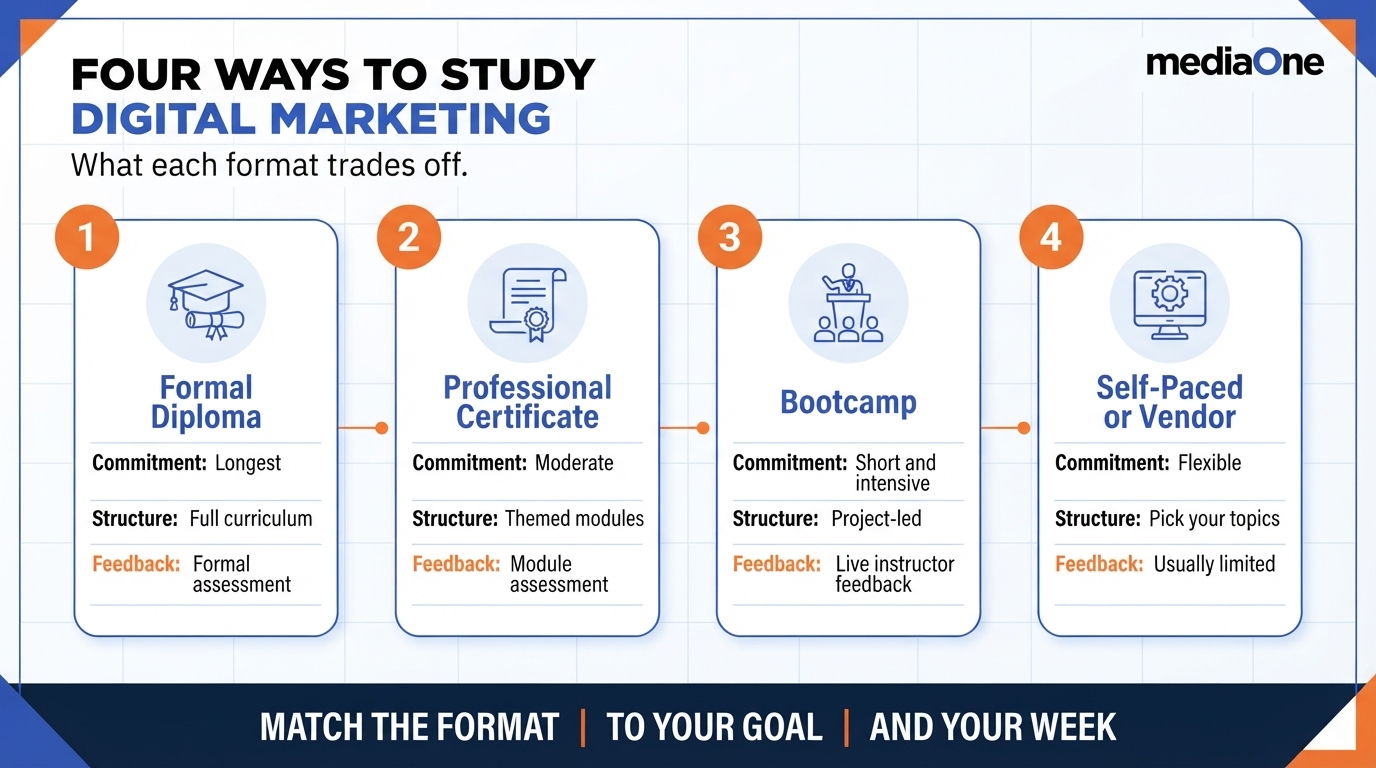
Course format changes what you are paying for. A formal diploma buys structure, assessment and a recognised qualification. A professional certificate narrows the scope and can fit around work. A bootcamp compresses teaching and project work into a shorter period. A self-paced course gives you flexibility but usually less individual feedback.
How the four formats differ at a glance
- Formal diplomas and post-diplomas suit learners who want a structured curriculum, broader business context and a qualification with defined entry and assessment requirements. They usually include more than platform training, so you may study consumer behaviour, branding, strategy and communication alongside digital channels. The trade-off is a longer commitment and less freedom to skip subjects that are not central to your target role.
- Professional certificates suit working adults who want guided learning without committing to a full diploma. They often group several modules around a practical theme. Compare whether the modules are individually assessed, whether they can be stacked toward a larger award and whether the teaching includes projects rather than lecture-only delivery.
- Bootcamps and intensive cohorts suit learners who prefer deadlines, peer accountability and concentrated project work. Their value depends heavily on the instructor, the amount of live feedback and whether the programme gives you enough time to practise between sessions. A short schedule is useful only if you can sustain the workload.
- Self-paced and vendor training suits people who need a specific skill, want a low-cost starting point or learn well independently. The main risk is fragmentation: completing unrelated courses can leave you with many certificates but no clear portfolio or understanding of how the channels fit together.
Compare the same five decision factors across every format: credential value, teaching support, practical work, pace and cost.
University-Accredited Degrees and Diplomas
Diploma and post-diploma routes
Polytechnic and post-diploma routes offer a structured way to build marketing fundamentals alongside digital skills. Check the exact award, entry requirements, curriculum and funding status for the intake you are considering rather than assuming every marketing diploma has the same digital depth.
Advantages
- May qualify for government course-fee subsidies or SkillsFuture Credit when the specific course is approved; check the current course listing before applying.
- Full-time or part-time study options, so you can work while studying.
- Broad curriculum covering marketing fundamentals, digital channels and business strategy.
- A structured credential with a clearly defined awarding institution and assessment path.
Limitations
- Longer commitment than a short course or certification.
- Formal curricula can update more slowly than vendor training when platforms change quickly.
- Generalist approach with less depth in any single channel unless you opt for electives.
Professional and postgraduate certificates
Universities and continuing-education units also offer shorter professional certificates for working adults. Current formats vary by intake, from individual modules to stackable certificates, so compare the published schedule rather than relying on a generic duration.
Advantages
- Usually shorter than a full diploma or degree route.
- Can be more focused on current business applications than a broad diploma.
- Cohort-based formats can create useful peer and professional connections.
Limitations
- Fees can be substantial, especially before subsidies or employer support.
- Less hands-on project time than bootcamps.
- Part-time cohorts may have less intensity.
When to choose this pathway: Select a formal programme if you value a structured credential, broader business context and a defined assessment path. Choose a shorter specialist option if your priority is one platform skill or a faster refresh.
Industry Certification Programmes (Short-Cycle)
Provider-led certifications teach a specific platform or discipline. For example, Google Skillshop currently provides self-paced Google Ads training and certification paths in areas including Search, Display, Measurement, Video and Shopping. Other platform academies offer training in inbound marketing, SEO tools, social advertising and related skills.
- Google Ads training and certification through Google Skillshop, with self-paced learning paths for Search, Display, Measurement, Video and Shopping.
- Free vendor-led courses in inbound, content, email and related disciplines from established platform academies.
- Platform-specific social advertising training where the provider publishes a current learning path and assessment process.
- SEO tool training that teaches practical auditing, keyword research and reporting workflows.
Some training providers package multiple vendor certifications into a broader programme. Check whether the fee is paying for teaching, mentoring and project feedback rather than access to certification material that may already be free from the platform owner.
Advantages
- Often lower-cost than a full diploma or bootcamp, with several major platform academies offering free learning paths.
- Platform owners can update learning paths when their products change.
- Flexible pacing, especially for self-directed learners.
- A clear platform-specific credential that can support a broader portfolio.
Limitations
- Narrow focus on one tool rather than the full marketing picture.
- Self-paced formats require more self-discipline because there is less external accountability.
- Exams test knowledge, not application; passing doesn’t guarantee you can run a real campaign.
When to choose this pathway: Use certifications to fill a specific skill gap or show structured learning in one tool. If you complete more than one, choose certifications that support the same target role rather than collecting unrelated badges. Pair them with a project or portfolio piece that demonstrates applied capability.
Bootcamps and Intensive Workshops
Bootcamps compress a broad curriculum into a shorter, intensive format, often with evening, weekend or full-time study. Provider availability, fees and delivery mode change frequently, so verify the current cohort before using an old course listing as a benchmark.
Intensive workshops focus on a narrower skill or campaign problem over a short period. They can be useful for working marketers who need an update rather than a full career-change programme.
Advantages
- Faster skills exposure than a diploma, especially when the curriculum is project-led.
- Project-heavy curriculum that builds your portfolio.
- Peer cohort and instructor support throughout.
- Instructors often bring recent agency experience.
Limitations
- Breadth sacrificed for speed; six weeks per discipline is shallow coverage.
- The workload can be difficult to sustain alongside a demanding full-time job.
- Quality varies, so verify the instructor, assessment method and provider terms before enrolling.
- Cost can be high relative to the number of teaching weeks, so compare contact hours and feedback time.
When to choose this pathway: Select a bootcamp if you can sustain an intensive schedule and want guided project work. Avoid choosing on duration alone; ask how much individual feedback, live campaign practice and career support are actually included.
Self-Paced Online Platforms
Self-paced platforms offer a wide range of digital marketing courses at different price points. Quality varies by instructor and update cycle, so check the publication date, syllabus, assessment method and whether the course teaches the current version of the tools you need.
Advantages
- Affordable pricing.
- Flexible study on your own schedule.
- Wide choice to cherry-pick topics that match your needs.
Limitations
- No cohort support; quitting is easy without external accountability.
- Minimal feedback; you can complete assignments without instructor review.
- A completion certificate by itself gives a hiring manager limited evidence of how you perform on a real campaign.
- May not include structured portfolio output or individual feedback.
When to choose this pathway: Use self-paced platforms to supplement a bootcamp or diploma, or to learn a single skill in depth such as ‘Advanced Google Analytics 4’. Do not rely on them alone unless you pair the course with a capstone project you build independently and can demonstrate to employers.
Key Skills You’ll Actually Learn
The exact mix varies by course, but the most useful programmes connect channel skills to measurement and business decisions. Learning a platform interface is only one part of the job. You also need to understand the audience, choose a goal, measure the result and explain what you would change next.
How the core disciplines connect
- SEO and search marketing teach you how people express intent through search. Organic SEO focuses on discoverability, site structure and content; paid search adds bidding, ad copy, landing pages and budget control. Together they teach you to distinguish between visibility and profitable demand.
- Social media and community management teach audience research, content planning, publishing, moderation and paid distribution. A good module also explains how platform objectives differ. The creative that earns comments is not always the creative that generates qualified leads.
- Content marketing and copywriting teach you to turn research into useful pages, articles, emails and campaign assets. This is where strategy becomes language. Feedback is especially important because writing quality cannot be assessed reliably through multiple-choice quizzes alone.
- Analytics and measurement teach you to define events, read performance data and connect activity with outcomes. This skill cuts across every other channel. Without measurement, you cannot tell whether a ranking, click, view or lead moved the business in the right direction.
- Paid advertising teaches campaign structure, targeting, bidding, testing and budget discipline. Platform knowledge changes quickly, so the deeper skill is learning how to form a hypothesis, run a controlled change and interpret the result.
- Email and marketing automation teach segmentation, lifecycle communication and triggered workflows. These modules are useful for understanding how marketing continues after the first click or lead, especially in businesses with longer sales cycles or repeat purchases.
For a first course, breadth helps you see how these pieces interact. For a second course, depth is usually more valuable: choose the discipline that appears repeatedly in your target job descriptions or solves a real problem in your current role.
Search Engine Optimisation (SEO) and Search Marketing
Many courses teach SEO across three layers. If you want to compare course content with agency practice, review the work typically included in SEO services in Singapore:
- Technical SEO: helping search engines crawl and index your site (sitemaps, robots.txt, page experience metrics, schema markup).
- On-page SEO: keyword research, title and meta-description optimisation, internal linking, content structure.
- Off-page SEO: earning relevant links, digital PR and other authority signals.
The strongest courses add a fourth: SEO auditing and tooling. You learn to use Google Search Console, Semrush or Ahrefs to diagnose a real site’s problems and prioritise fixes.
What employers can evaluate: not just theory, but whether you can audit a live site, identify priorities and explain your recommendations. A portfolio case study with a clear baseline, actions and measured outcome gives an interviewer more evidence than a completion certificate alone.
Social Media Strategy and Community Management
This module covers:
- Platform best practices (Instagram, TikTok, LinkedIn, Facebook): post format, posting frequency, hashtag strategy.
- Community management: responding to comments, handling complaints publicly, building a brand voice.
- Platform-specific tools: Meta Business Suite, TikTok For Business, Hootsuite.
Courses vary in depth. Some focus on strategy and audience planning; others focus on execution such as publishing, moderation and reporting. Stronger programmes connect the two through supervised practice on a real or test account.
Red flag: if a social media course offers no supervised practice, ask how you will apply the material. A useful module should make you plan, publish or simulate responses, then review the result rather than only discuss theory.
Content Marketing and Copywriting
Content marketing teaches:
- Content strategy to identify topics your audience cares about.
- Blog writing and SEO copywriting that targets search intent, not just readers.
- Long-form content such as guides, whitepapers and case studies.
- Repurposing strategies to turn one blog post into a social clip, an email and a podcast outline.
Copywriting is often a subset: persuasive writing that moves readers toward a goal such as signing up, buying or requesting a demo.
A useful content module should require you to produce your own work and receive feedback. Analysing examples can help, but it does not replace drafting, editing and measuring content yourself.
Portfolio expectation: graduate with several finished pieces that you are allowed to show. Where you have real metrics, include the baseline and outcome; where you do not, explain the brief, audience, editorial choices and optimisation process.
Analytics, Data Interpretation and ROI Measurement
Analytics training should go beyond reading a Google Analytics 4 dashboard. Stronger programmes also cover measurement planning, event setup, key-event tracking and how to connect campaign activity with business outcomes.
Core topics include:
- Setting up GA4, event tracking and conversion goals.
- Understanding attribution approaches and their limitations.
- Calculating return on ad spend (ROAS), cost per acquisition (CPA) and customer lifetime value (CLV).
- Dashboarding and reporting for non-technical stakeholders.
What employers can evaluate: whether you can explain why a campaign succeeded or failed using data. Use a clear chain from spend to traffic, conversions, revenue and profit where the data is available.
Seek courses that walk you through setting up tracking on a real test site (or your own) and have you interpret data under instructor supervision.
Paid Advertising (Google Ads, Meta, TikTok)
Paid advertising covers:
- Google Search Ads: keyword bidding, ad copy, landing page testing.
- Google Shopping and Display Ads: for e-commerce and brand awareness.
- Meta Ads (Facebook and Instagram): audience targeting, creative testing, pixel setup.
- TikTok Ads: audience targeting, campaign setup and creator-style content where relevant to the target audience.
Coverage varies by programme. Specialist certifications usually go deeper into one platform, while generalist courses may give you a broader introduction across several advertising channels.
The practical gap: setting up a campaign is easier than diagnosing why it is underperforming. A useful course should make you interpret results, form a hypothesis, change one variable and explain what happened rather than treating campaign creation as the finish line.
Aim for a course that gives you supervised campaign practice. If live media spend is involved, confirm who funds it, who owns the account and what you are allowed to show in your portfolio.
Email Marketing and Marketing Automation
Email and automation cover:
- Email platforms (Mailchimp, Klaviyo, HubSpot): list segmentation, automation workflows, A/B testing.
- Lifecycle marketing: welcome series, re-engagement, win-back campaigns.
- Integration connecting email to your CRM, e-commerce platform or website.
Email and automation may receive less teaching time than search or social media, but the module is still useful because it connects segmentation, lifecycle messaging and measurement.
Good practice: build a test automation workflow, document the trigger and segmentation logic, and test every step from sign-up to reporting. That exercise reveals operational details that slides alone do not.
Choosing the Right Course: A Decision Framework
This framework helps narrow your options. Answer each question below, then cross-reference your answers against the provider comparison table.
Your Starting Point (Beginner, Intermediate, or Advanced)
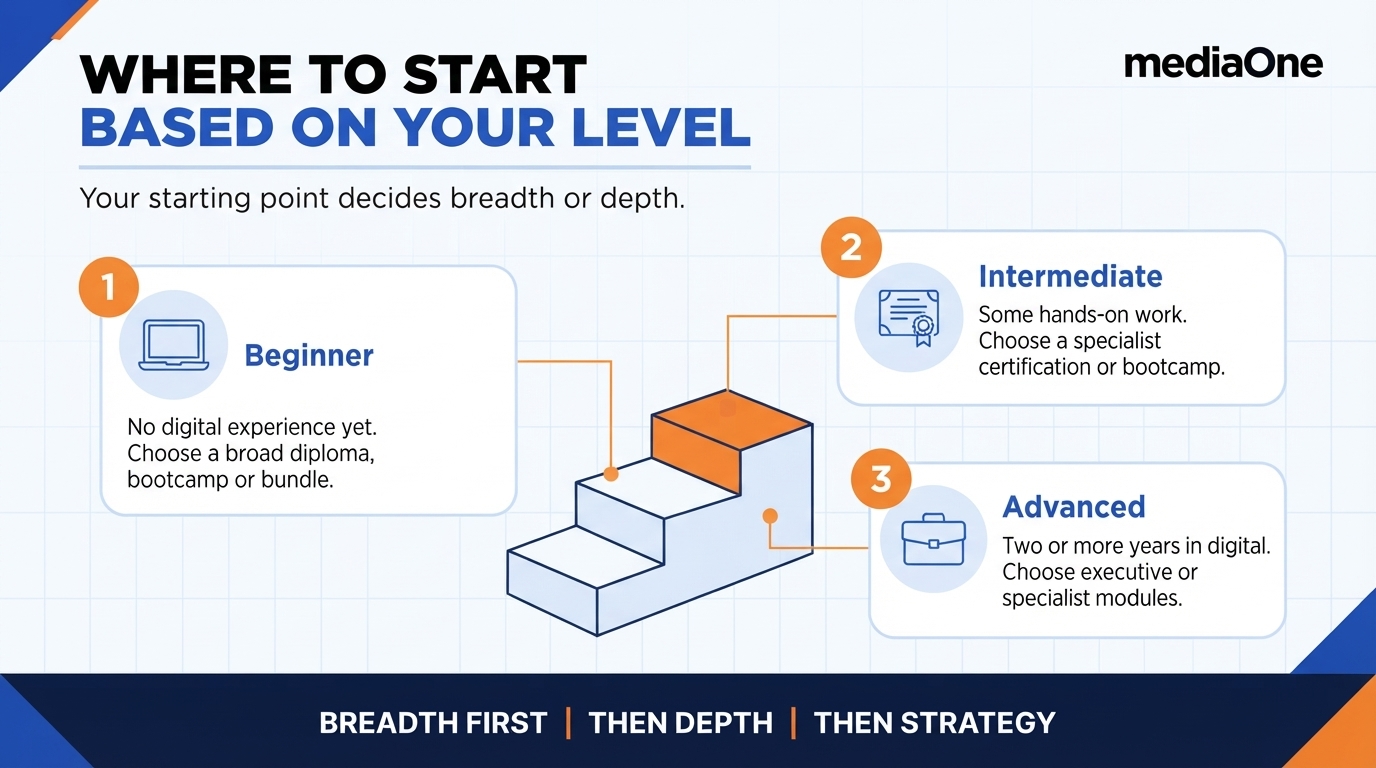
Beginner: you have no digital marketing experience, or you’ve worked in traditional marketing (print, TV, events).
- What to choose: a generalist diploma, bootcamp or broad online bundle.
- Why: you need breadth first.
- Duration: depends on the programme; use the published contact hours and assessment schedule rather than the marketing label alone.
Intermediate: you’ve worked as a junior marketer, or you’ve run social media or SEO for your own small business.
- What to choose: a specialist certification or bootcamp, or a postgraduate diploma.
- Why: you know the basics; you need depth or new platform skills.
- Duration: usually shorter than a generalist qualification, but varies by platform and assessment depth.
Advanced: you’ve worked in digital marketing for two or more years and want a new specialisation or a move into management.
- What to choose: an executive postgraduate certificate or specialist consulting modules.
- Why: you don’t need fundamentals; you need credentialed expertise or business strategy knowledge.
- Duration: varies from short executive modules to multi-module certificates.
Course details, fees and entry requirements change between intakes. Verify the current information on the provider’s own page before applying.
Time Investment and Study Mode
| Your situation | Study mode to consider | What to check before enrolling |
| Full-time job with limited weekly study time | Part-time or self-paced | Weekly contact hours, assignment load and catch-up policy |
| Full-time job with regular evening or weekend capacity | Structured part-time | Live-class schedule, project deadlines and attendance rules |
| Able to study intensively | Full-time or intensive cohort | Daily workload, project support and whether career services continue after class |
| Need one specific platform skill | Short specialist course | Current platform version, assessment and hands-on practice |
| Need a formal credential | Diploma, post-diploma or university certificate | Award level, entry requirements, funding and assessment method |
If you work full-time and can study only a few hours each week, an intensive full-time format is unlikely to fit. Choose a schedule whose weekly workload you can sustain consistently.
Budget and Financing Options in Singapore
Illustrative budget comparison. These are planning bands, not market averages. Replace them with current quotes from your shortlisted providers.
| Course type | What drives cost | What to compare |
| Formal diploma or post-diploma | Qualification length, institution and subsidy status | Net payable fee, contact hours, assessment and internship or project components |
| Professional certificate | Number of modules, faculty time and assessment | Full fee, maximum funding assumptions and your actual net fee |
| Bootcamp | Live teaching, mentoring and project support | Contact hours, instructor access, portfolio work and career support |
| Self-paced course | Platform subscription or one-off access | Update date, assessment quality and whether feedback is included |
| Vendor certification | Usually platform-specific | Whether training and assessment are free, current and relevant to your target role |
SkillsFuture Credit: Singapore citizens aged 25 and above receive a base SkillsFuture Credit, while additional mid-career support applies to eligible Singaporeans aged 40 and above for selected courses. Check your available balance and the specific course’s eligibility through the official SkillsFuture Credit information before enrolling.
Remove funding assumptions from your shortlist until you have checked the specific course. Government support is tied to eligibility and approved programmes, so compare the published net fee for your own profile rather than a provider’s headline maximum subsidy.
Employer sponsorship: some organisations fund role-relevant professional development. Ask your manager or HR team whether a learning budget, study leave or reimbursement policy applies before self-funding.
Industry Recognition and Employer Demand
Test this before enrolling:
- Find 10 job postings for the role you want on LinkedIn or JobStreet Singapore.
- Note what qualifications they mention. Do they ask for a diploma, a certification, a bootcamp, or none?
- Do they name a specific provider?
Example exercise:
- Role: ‘Junior Google Ads Specialist’
- Job posting language: ‘Required: 1 to 2 years experience with Google Ads and Meta. Nice-to-have: Google Ads certification.’
- Implication: a certification can support the application, but a portfolio gives the employer more evidence of how the candidate applies the skill.
Run this exercise for your target role. MediaOne’s guide to digital marketing jobs in Singapore can also help you map common role families before you compare course syllabuses. If most postings name a credential such as HubSpot certification, that credential signals strongly. If they never mention courses and only ask for years of experience, a certificate won’t move the needle much. Focus on building a portfolio instead.
Role requirements differ by employer and channel. When you compare course content, focus on the tasks in the jobs you want rather than assuming one broad curriculum fits every role. MediaOne’s guide to hiring digital marketers shows how skill requirements change by hiring model and business need.
Career Outcomes You Can Verify
Before enrolling, ask the provider for data. Treat any figure as provider-reported unless an independent auditor is named.
- Placement rate: what share of graduates land a digital marketing job within three months? Ask how it’s measured.
- Starting-role data: what roles do graduates actually move into, and is the figure based on all graduates or only respondents? Compare any salary claim with current job listings and independent salary data.
- Graduate references: can they share three or four with permission? Look for job titles and company sizes, not just glowing quotes.
- Employer partnerships: do they have formal recruiting relationships with employers?
Red flags:
- ‘100% placement’ with no definition of placement.
- No data provided. Ask again or walk away.
- Testimonials only from experienced hires, not true beginners.
How to Evaluate Course Quality Before Enrolling
Questions to Ask Before You Pay
A provider should be able to answer practical questions without falling back on marketing slogans. Use the same checklist for a university certificate, bootcamp or short course so you compare like with like.
- When was the syllabus last updated? Ask for a date and the current module list, not a general claim that the course is ‘industry relevant’.
- Which tools will I use myself? Watching an instructor demonstrate a platform is different from working inside it and submitting your own output.
- How many hours are live teaching, guided practice and independent study? A short calendar can still hide a large workload.
- What is assessed individually? Group work can teach collaboration, but you also need evidence of what you can do without teammates.
- What feedback will I receive? Ask whether instructors comment on your campaign setup, analysis, writing or strategic reasoning, and how quickly that feedback arrives.
- Who teaches the current intake? Check whether the named instructor is actually scheduled for your cohort and whether their recent work matches the channel you want to learn.
- What will I be allowed to show publicly? Client confidentiality can make a strong project unusable in a portfolio unless the provider offers a redacted or simulated alternative.
- What happens if a platform changes during the course? Good training should explain principles while updating screenshots, workflows and assignments when tools change materially.
- What is the full net cost for me? Include assessment fees, required software, optional exams, media spend and any deposit that is not refundable.
- What evidence supports career claims? If a provider quotes placement, salary or promotion figures, ask for the cohort, time period, response rate and definition used.
These questions do not guarantee a good course, but they make weak claims easier to identify before you commit time and money.
Curriculum Recency and Industry Alignment
Request the full curriculum from the provider. Check:
- Are the paid-social platforms relevant to your target role covered? If TikTok Ads is important for the jobs or clients you want and the course omits it, the syllabus may not fit your goal.
- Is GA4 taught, or is Universal Analytics still the focus? GA4 replaced Universal Analytics as the standard, so older content is a warning sign.
- Does the course explain where AI-assisted tools fit into the workflow? If those tools are important to your target role, ask how they are used, reviewed and measured rather than looking for an AI label alone.
- Does the course go beyond setup into measurement and decision-making? Topics such as attribution, incrementality and first-party data can indicate greater depth when they are taught with practical examples.
Ask the programme’s curriculum owner or head of programme. If they can’t answer in detail, they may not own the content.
Instructor Credentials and Real-World Experience
Instructor experience is especially important for bootcamps and instructor-led online courses. If you want context on how channel specialists work together, compare the syllabus against the roles in a typical digital marketing team.
Question to ask: ‘Who are the instructors? Can you share their LinkedIn profiles and recent client work?’
What to look for:
- Current or recent (last two to three years) in-market experience in an agency, in-house or consulting role.
- A public portfolio: case studies, articles or talks.
- Sector experience that matches your target, such as e-commerce, B2B software or fintech.
Illustrative profile: a trainer who has recently managed paid-search campaigns, can show published case studies and can explain current platform decisions gives you more relevant evidence than a biography that lists teaching experience without recent campaign work.
Student Reviews and Placement Rates
Look for reviews on independent platforms and on the provider’s own site. Expect bias on the latter, but look for specifics.
Red flags in reviews:
- ‘Great course, but I still didn’t get a job.’ Suggests weak portfolio support.
- ‘Instructor didn’t have experience with X platform.’ This is relevant if X is central to the course.
- ‘Cohort was large and I received no individual feedback.’ Ask how feedback works and how much instructor access each learner receives.
Ask the provider for independently verified placement data. Some share it; many don’t.
Trial Lessons, Money-Back Guarantees and Refund Policies
Some providers offer trial lessons, cooling-off periods or refund policies. Treat these as contract terms, not a quality guarantee, and read the written conditions before paying.
What this tells you: whether you can sample the teaching style or exit under stated conditions. It does not prove the programme’s employment outcomes.
Check the policy: note deadlines, attendance conditions, deposits, administrative fees and whether completing assignments changes your eligibility for a refund.
Accreditation and Professional Recognition
Recognition in Singapore can come from different places, and the terms are not interchangeable:
- SkillsFuture course approval or funding eligibility relates to specific training support and does not automatically make every credential equivalent to a diploma or degree.
- Academic accreditation applies to institutions or programmes under separate quality frameworks.
- Platform certifications show knowledge of a particular product or discipline; they are not substitutes for formal academic awards.
What to check:
- For formal programmes, verify the awarding institution and qualification level.
- For short courses, verify who issues the certificate and what assessment you must pass.
- For platform training, confirm the certification still exists in its current form and whether renewal is required.
Ask: ‘What exactly is this course approved, accredited or recognised for?’ If the provider claims government funding eligibility, cross-check the course on the official SkillsFuture system before paying.
Top Digital Marketing Course Providers and Learning Options in Singapore
Course names and intakes change, so treat provider lists as a starting point rather than a permanent ranking. The most useful comparison is between the credential, curriculum, teaching format, practical work and net fee you would actually pay.
Polytechnic and Formal Programme Routes
Temasek Polytechnic’s Diploma in Marketing is a current example of a formal marketing qualification with digital marketing strategy and analytics, e-commerce, brand management, industry certifications and project work in the curriculum. Temasek Polytechnic also lists a Specialist Diploma in Digital Marketing & Communication Management for adult learners, illustrating how post-diploma routes can focus more tightly on digital and communications practice.
A formal route suits learners who want a recognised qualification, a broader business foundation and structured assessment. Before applying, confirm the specific award, entry requirements, current intake, internship or project components and whether the timetable fits your other commitments.
University and Professional Certificates
SMU Academy’s Professional Certificate in Digital Marketing is a current example of a modular professional programme aimed at marketers, business owners and communications professionals. Its published fee and funding information also shows why you should compare the full fee with the net amount that applies to your own funding profile.
Professional certificates can suit working adults who want structured teaching without committing to a full degree. Compare whether the course is assessed, whether modules can be taken separately, how current the platform content is and how much work you produce yourself.
Platform Certification and Self-Directed Learning
Platform training works best when you need a defined technical skill. Google Skillshop, for example, offers Google Ads learning paths and certifications that you can study at your own pace. Similar vendor academies can be useful for analytics, inbound marketing, SEO tools, email platforms and social advertising.
The main limitation is scope. A platform certification can show that you understand a product, but it does not automatically show that you can diagnose a business problem, work with messy data or build a cross-channel plan. Pair self-directed certification with a practical project whenever possible.
Bootcamps and Independent Training Providers
Bootcamp availability changes more quickly than university and platform programmes. Instead of relying on an old list of brand names, compare current providers using the same evidence: instructor track record, live teaching hours, individual feedback, project ownership, refund terms, published career support and recent graduate outcomes.
Ask for the exact syllabus and a sample assignment. A strong answer tells you what you will build, which tools you will use, how your work is assessed and whether the instructor will review your individual decisions. A weak answer relies mainly on the provider’s reputation or a long list of topics.
Cost Breakdown and Financing
Digital marketing training ranges from free vendor learning to formal qualifications that cost several thousand dollars. Because course prices and subsidies change by intake and learner profile, compare current net fees rather than using a generic market average.
Compare the Net Fee, Not the Headline Fee
Start with four numbers for every shortlisted course:
- Full course fee before subsidies.
- Subsidy or funding amount that applies to your profile.
- Amount you can use from SkillsFuture Credit, if eligible.
- Any additional costs for exams, software, media spend, books or subscriptions.
This prevents a common comparison error: placing a fully subsidised price from one provider next to an unsubsidised price from another.
SkillsFuture Credit and Course Funding
Singapore citizens aged 25 and above have a base SkillsFuture Credit that does not expire. Eligible Singaporeans aged 40 and above also have access to additional mid-career credit for selected programmes. Funding rules and eligible courses can change, so check your current balance, course eligibility and claim process before you pay a deposit.
Do not assume that a course is funded because the provider mentions SkillsFuture on its website. Confirm the exact course or module, the intake and the learner category that the advertised net fee assumes.
Employer Sponsorship
If the course is directly relevant to your current role, ask whether your employer has a learning budget, reimbursement scheme or study-leave policy. A specialist analytics, paid-media or marketing-automation course may be easier to justify internally when you can connect it to a current business need.
When employer sponsorship is available, agree in advance on what happens if you leave the company shortly after the course. Some organisations attach repayment conditions to funded training.
What ROI to Expect
Do not treat a course as an investment with a guaranteed salary uplift. The financial return depends on whether the new skill changes your role, improves your performance, helps you win freelance work or supports a promotion.
Use a simple break-even test instead. Illustration: if a course costs SGD 3,000 after funding and you later earn an additional SGD 300 per month because the skill directly changes your role, the simple payback period is ten months. That illustration is not a salary forecast; it is a way to compare options using your own assumptions.
Also account for non-cash returns. A project you can show, direct instructor feedback, access to a useful peer group and a clearer specialisation can be valuable even when the short-term salary effect is uncertain.
Common Mistakes When Choosing a Digital Marketing Course
Choosing by Brand Name Alone
A famous institution can still offer a course that is too broad for your goal. A small provider can also be a poor choice if the instructor lacks current platform experience. Start with the job or business problem you want to solve, then compare the syllabus against that target.
Also check the exact intake rather than assuming every cohort is identical. Providers change instructors, elective modules, delivery modes and assessment briefs between runs. Save a copy of the syllabus and fee page you are using to make the decision, and ask the admissions team to confirm any feature that influenced you to enrol. If a portfolio project, software licence, certification exam or mentoring session is important to you, make sure it appears in the written course information rather than only in a sales conversation.
Treating Topic Coverage as Skill Depth
A syllabus may list SEO, social media, analytics, email and paid advertising, but one hour on each topic is not the same as being able to perform the work. Ask how many teaching and practice hours are allocated to the skills you care about most.
Ignoring Assessment and Feedback
If you never have to make a decision, submit work and defend your reasoning, it is difficult to know whether you can apply the material. Look for individual feedback, not only group projects and automated quizzes.
Assuming Funding Means Value
A heavily subsidised course can still be the wrong course for you. Funding lowers the financial cost, but you are still spending time. Compare the course against your goal first, then apply funding as a secondary filter.
Collecting Certificates Without Building Evidence
Three platform certificates can show initiative, but they do not replace a portfolio. After each course, build or improve something: an audit, campaign plan, dashboard, landing page, content brief, email flow or measurement framework.
What to Do After Completing Your Course
Turn Course Work Into Portfolio Evidence
Select two or three projects that show different skills. For each one, document the brief, your role, the decisions you made, the tools you used, the result and what you would change next time. Remove confidential client information and make it clear when a project was simulated rather than live.
A concise case study is usually more useful than a folder full of screenshots because it shows how you think. Hiring managers can ask follow-up questions about your reasoning, not just whether you clicked the right buttons.
Add One Real-World Practice Loop
If the course used only simulations, find a low-risk way to practise. You might help a small organisation improve a landing page, analyse anonymised campaign data, build a personal content project or audit a site you control. Get permission before using any business data publicly.
Keep Platform Skills Current
Digital platforms change frequently, so course completion is a starting point rather than an endpoint. Keep a short monthly learning routine: review platform release notes, re-run one practical exercise and update your portfolio when the tool or workflow changes materially.
Apply for Roles by Skill Cluster
Do not apply to every job with ‘digital marketing’ in the title. Group roles by the work they actually require: SEO and content, paid media, lifecycle and email, analytics, social and community, or broader generalist work. Tailor your portfolio and course evidence to the cluster.
Conclusion
The right digital marketing course is the one that closes a specific skill gap at a cost and pace you can sustain. A formal qualification can give you structure and recognised credentials, a professional certificate can focus learning into a shorter period, and platform training can build a technical skill quickly.
Before enrolling, verify the current syllabus, instructor experience, project ownership, assessment, funding and net fee. Then ask one final question: ‘What will I be able to do, show and explain after this course that I cannot do today?’ If the provider cannot answer clearly, keep comparing. The strongest shortlist is the one where every course has a clear purpose, a realistic weekly workload and a practical output you can use after completion.
Frequently Asked Questions
How long do digital marketing courses in Singapore take?
There is no single standard duration. Options range from a few hours of self-paced platform training to multi-module professional certificates and multi-year formal qualifications, so compare contact hours and assessment rather than the course label alone.
Are digital marketing courses eligible for SkillsFuture Credit?
Some approved courses are eligible, but eligibility depends on the exact course and the learner’s profile. Check the current SkillsFuture listing and your available credit before paying, because a provider’s maximum-funding example may not be your own net fee.
Is a bootcamp better than a diploma for changing careers?
A bootcamp can be faster and more project-focused, while a diploma offers a broader formal qualification. The better choice depends on your timeline, prior education, need for a recognised credential and whether the programme gives you enough practical work to compete for the roles you want.
Which digital marketing skill should I learn first?
Beginners benefit from a broad overview before specialising. If you already know your target role, start with the skill that appears repeatedly in those job descriptions, such as SEO, paid search, analytics, content, social advertising or marketing automation.
Do certificates help you get a digital marketing job?
Certificates can support an application by showing structured learning or platform knowledge, but they are stronger when paired with practical evidence. A portfolio that explains your decisions, measurement and results gives an employer more information about how you work.