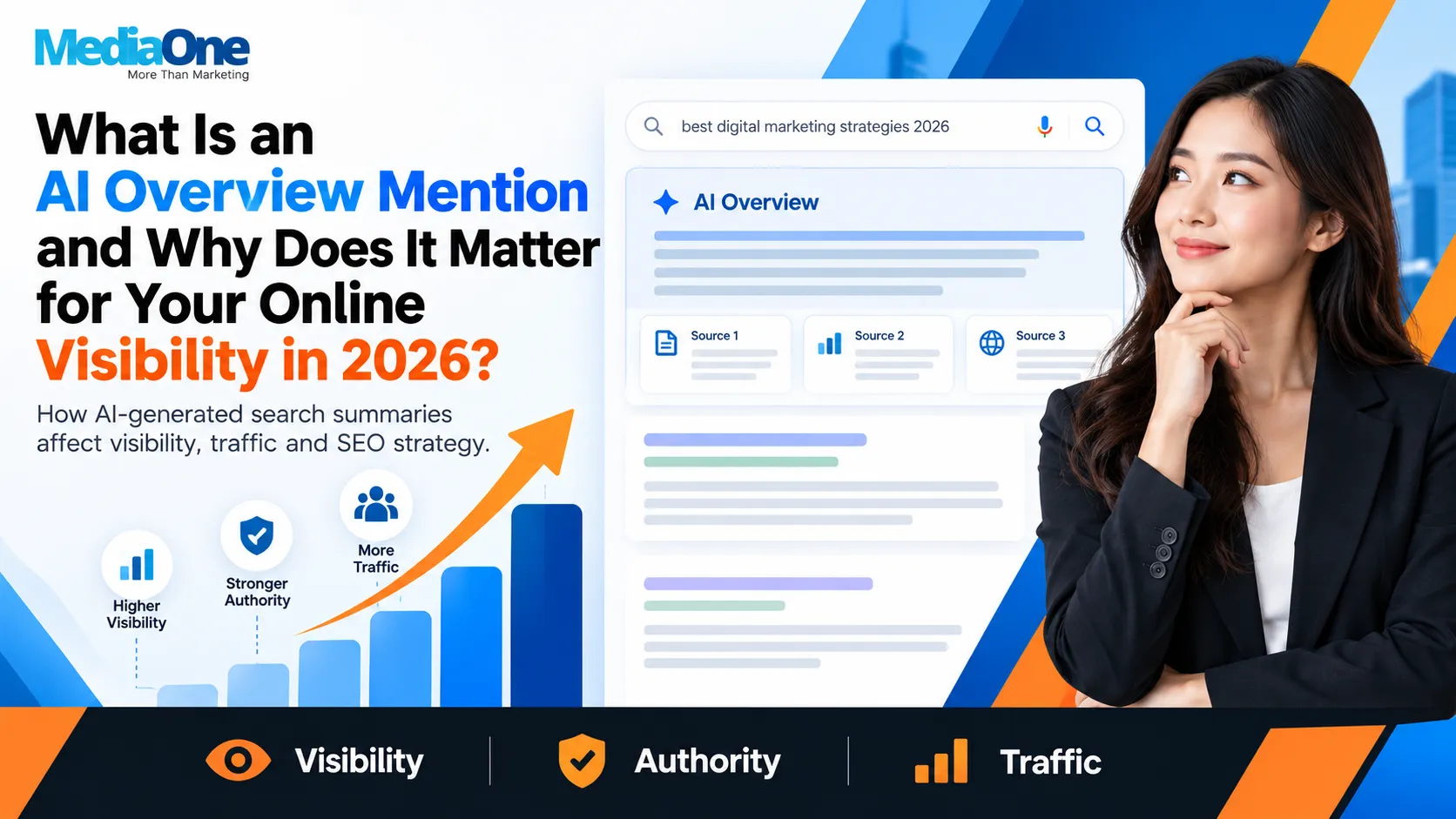
An AI Overview mention is a citation of your website inside an AI-generated summary that appears at the top of search results. When someone searches, Google’s AI system, Microsoft’s Copilot, or another search platform synthesises an answer from multiple web sources and displays it before the traditional organic links. If your content is selected as a source, your site is named and linked within that summary.
This matters because AI Overviews sit where user attention concentrates first. A person scanning a results page now reads a paragraph or two of synthesised information before scrolling to links. Whether a page appears in an overview fundamentally changes how visible that expertise is at the moment of search intent.
The shift happened gradually through 2024 and 2025, but by 2027 AI Overviews should be the default experience on most informational queries. They are no longer an experimental feature. This shift means search strategies built on traditional ranking alone are now incomplete.
This guide walks through how AI Overviews select content, how they change traffic patterns, and the concrete steps you can take now to secure mentions for your most important queries.
Note: AI Overview inclusion criteria, traffic patterns, and platform availability may change. This content reflects the state of the market as of October 2026.

Key Takeaways
- AI Overviews are machine-generated summaries that appear above traditional organic results in Google Search, Bing, and other platforms, synthesising information from multiple sources into a single answer box.
- Appearing in an AI Overview does not automatically harm traffic. The actual impact depends on positioning, content quality, attribution visibility, and whether readers click through for additional detail.
- AI systems select content based on relevance, topical depth, E-E-A-T signals (expertise, experience, authority, and trust), and structured data that clarifies your answer’s scope and credibility.
- Optimising for inclusion requires clear information architecture, comprehensive topic coverage, readable snippet-friendly formatting, and schema markup that helps search systems understand and attribute your content correctly.
- Monitoring your presence requires dedicated tools and metrics beyond click-through rate: impressions in overview context, referral traffic quality, and brand visibility within the summary itself all matter for long-term SEO health.
Why This Shift Reshapes SEO Strategy
For twenty years, being on page one meant being visible. Now visibility divides into two tiers: you either appear in the AI Overview (top tier) or you appear as a traditional blue link beneath it (second tier).
A page ranked fifth overall but featured in an overview can receive more attention than a page ranked second but excluded from the synthesis. Attribution also matters. When a search engine names your site in an overview, it includes a clickable link back to your page. That drives qualified traffic, because users who click from an overview already know your site provided the information they needed.
Consistent inclusion across multiple overview mentions builds a pattern of recognition that influences your organic rankings as well.
The visibility challenge is real. Following the broader AI Overview rollout in 2024 and 2025, some publishers reported traffic volatility, even though their organic rankings remained stable. Others saw the overview mentions compound their traffic. The difference lies in whether the content was optimised for inclusion or whether the change was overlooked.
Understanding AI Overviews now helps you align with where users are looking. Competitors who ignore this shift may lose visibility to those who don’t.
Understanding AI Overviews: Definition and Core Function
What an AI Overview Actually Is
An AI Overview is a machine-generated summary of web results that appears at the top of a search results page, synthesised directly from multiple sources to answer a query without requiring users to click through to individual websites.
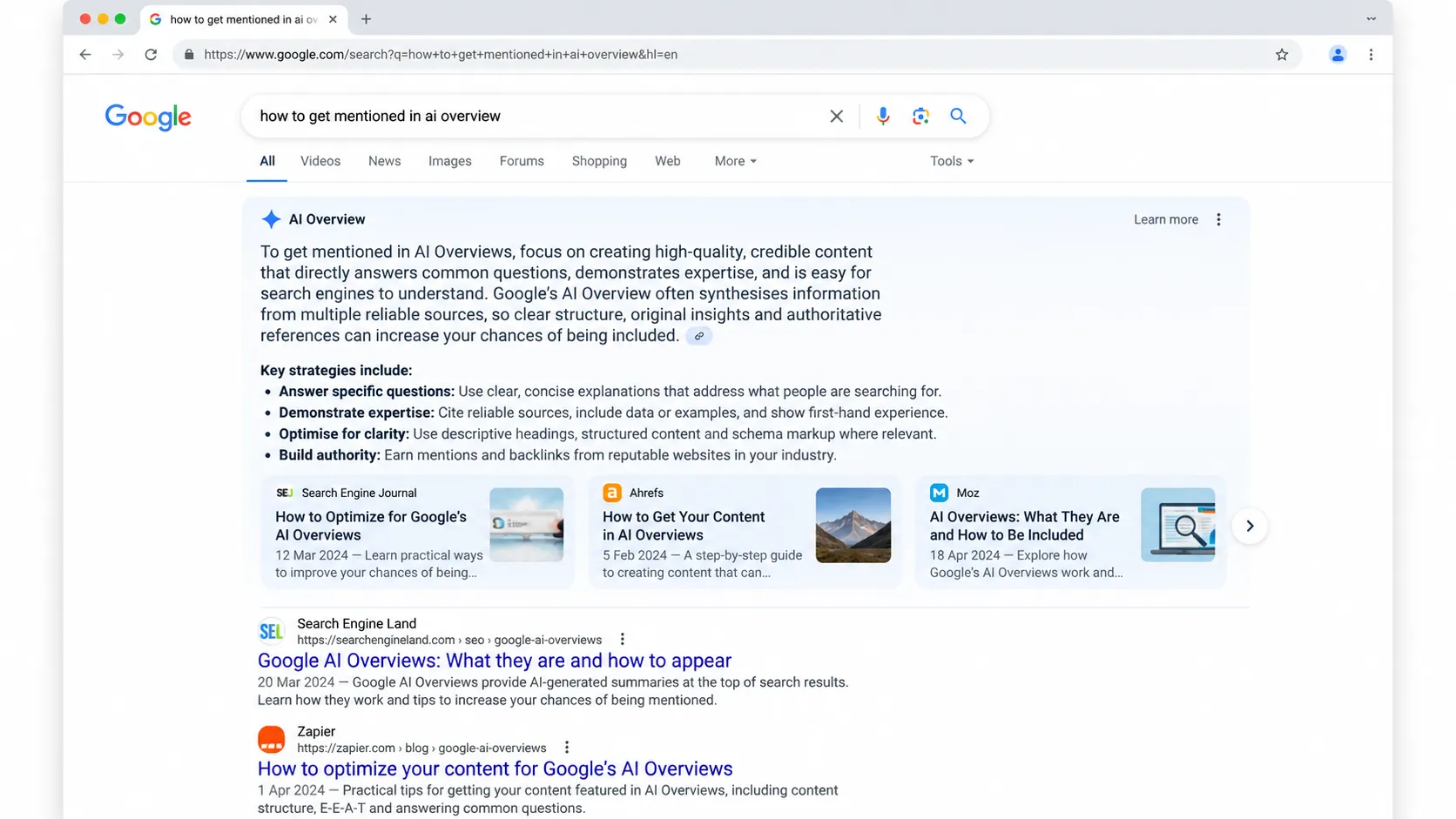
Google announced Search Generative Experience in 2023. Google rolled it out more widely to core search through 2024 and 2025. When someone searches for a question like “how to fix a leaky kitchen faucet” or “best practices for employee onboarding”, Google’s AI pulls relevant content from several high-quality pages, combines the information, and presents it as a single answer block at the very top of the page.
The overview typically includes:
- A direct answer to the query (usually 2-4 sentences)
- Supporting details or steps (where applicable)
- Attribution links showing which sources the AI drew from
- Related follow-up questions to explore next
This format is fundamentally different from a traditional search snippet (the 155-character preview beneath a blue link). An overview is longer, more comprehensive, and written by the search engine itself, not copied from the page title or meta description.
How AI Overviews Differ from Traditional Search Results
Traditional search results rank individual pages based on relevance, authority, and user-satisfaction signals. The first-ranked result gets the most visibility. The second-ranked result comes second. Users click on a page to read the full answer.
AI Overviews invert this model. Instead of ranking pages, the search engine synthesises information across multiple pages and presents a unified answer. The source pages still rank below the overview, but the visibility dynamic has shifted. Content now competes not just for the first-place ranking but for inclusion in the overview’s source set.
This distinction matters because:
- Attribution replaces ranking: A page does not need to rank first to get traffic. A page ranked fifth might be included in an overview and receive significant clicks, while the second-ranked result is omitted entirely.
- Query intent can be satisfied by the overview alone: Users learn the answer without clicking further. In competitive queries, this can reduce overall traffic to individual sites, even if they appear in the sources cited.
- Content structure becomes visible: Overviews favour clear, structured answers. A page with a well-formatted list, FAQ section, or step-by-step guide is more likely to be extracted than a traditionally written article, regardless of its ranking position.
- Multiple winners emerge: Unlike traditional search, where one page dominates the top spot, overviews often pull from 3 to 8 different sources, creating multiple opportunities for visibility and traffic.
Where AI Overviews Appear Across Search Platforms
Google Search remains the dominant platform for AI Overview presence. As of October 2026, overviews appear on most informational and how-to queries in English-speaking markets. Availability and prevalence vary by search platform, geography, and query intent. Google has prioritised the rollout in the United States, the United Kingdom, Canada, and other English-language regions, with selective availability in other languages.
Overviews appear most frequently on informational queries (how-to, definitions, comparisons). Overviews appear less frequently on highly commercial or local-intent queries, based on user-reported observations.
Bing, which introduced its own AI-powered summaries in 2024, displays them above traditional results on select queries. Bing’s approach closely mirrors Google’s in structure but sources content from a different set of pages.
DuckDuckGo has integrated similar features through partnerships, though adoption remains limited compared to Google and Bing.
Other platforms: Various search properties now employ similar synthesis approaches, though they operate within their own ecosystems rather than as open web search results.
For practical purposes, the primary concern is including content on Google and, to a lesser extent, Bing, if it exists on the public web and ranks in organic search. Google and Bing are the primary platforms for AI Overview visibility in English-language markets.
The specific triggers for inclusion vary slightly between platforms. Google favours topic authority, comprehensive coverage, and clear formatting. Bing weighs content freshness and the directness of its answers more heavily. Both penalise thin content, unsubstantiated claims, and poor E-E-A-T signals.
How AI Overviews and Competing Search Systems Work
Google’s Approach: Content Synthesis and Attribution
Google’s AI Overview system retrieves relevant web pages, synthesises information across multiple sources, and generates a natural-language summary in real time. The system does not pull a single answer from one page.
Instead, it reads dozens of sources, weighs their credibility and relevance, and composes an original paragraph or list. This synthesised answer reflects the consensus or the most useful angles across those sources.
When a user queries Google with a question in 2026, the AI Overview appears above traditional blue links. Google’s language model reads snippets, full-page content, and structural signals such as headings and schema markup from top-ranking pages. It then decides which facts to include, how to phrase them, and which source to cite. A well-structured answer with clear supporting data has a higher chance of being selected and attributed correctly.
Google attributes sources by name or URL beneath the summary. A user can click “Learn more” or follow the cited sources to read the original content. Attribution is not optional: Google’s system credits the publishers whose content fed the overview, though the exact weighting of sources remains proprietary.
The key difference from a traditional snippet is that AI Overviews are generative. They do not truncate or reuse exact wording. Google’s model reads your content, understands it, and rewrites it. Your original phrasing doesn’t appear verbatim, but your ideas, data, and findings still influence what users see.
Other Search Engines’ AI Overview Implementations
Bing has deployed Copilot features that generate summaries with citations since late 2023. Unlike Google’s approach, Bing’s AI summaries often show citations inline with the text itself. This makes source attribution more visible at first glance.
DuckDuckGo has kept AI summarisation more limited. It partners with third-party providers for AI chat features but doesn’t generate overviews directly on the search results page the way Google and Bing do.
Perplexity AI and other answer-engine platforms generate AI overviews as their primary product. They cite sources in a sidebar or footnote format, which can obscure which sources contributed most. These platforms are growing in use but do not yet approach Google’s traffic volume. They represent a meaningful shift in how some users find answers.
The key point is that every overview-generating system must decide which pages to read and how to credit them. None can exist without source material. This is why appearing in any of these systems depends on your content being findable, well-structured, and authoritative.
The Technical Stack Behind AI-Generated Summaries
AI Overviews rely on large language models paired with information retrieval systems. Google’s system retrieves the top-ranking pages for a query and passes their content to the model. The model then generates a summary. This process happens in milliseconds.
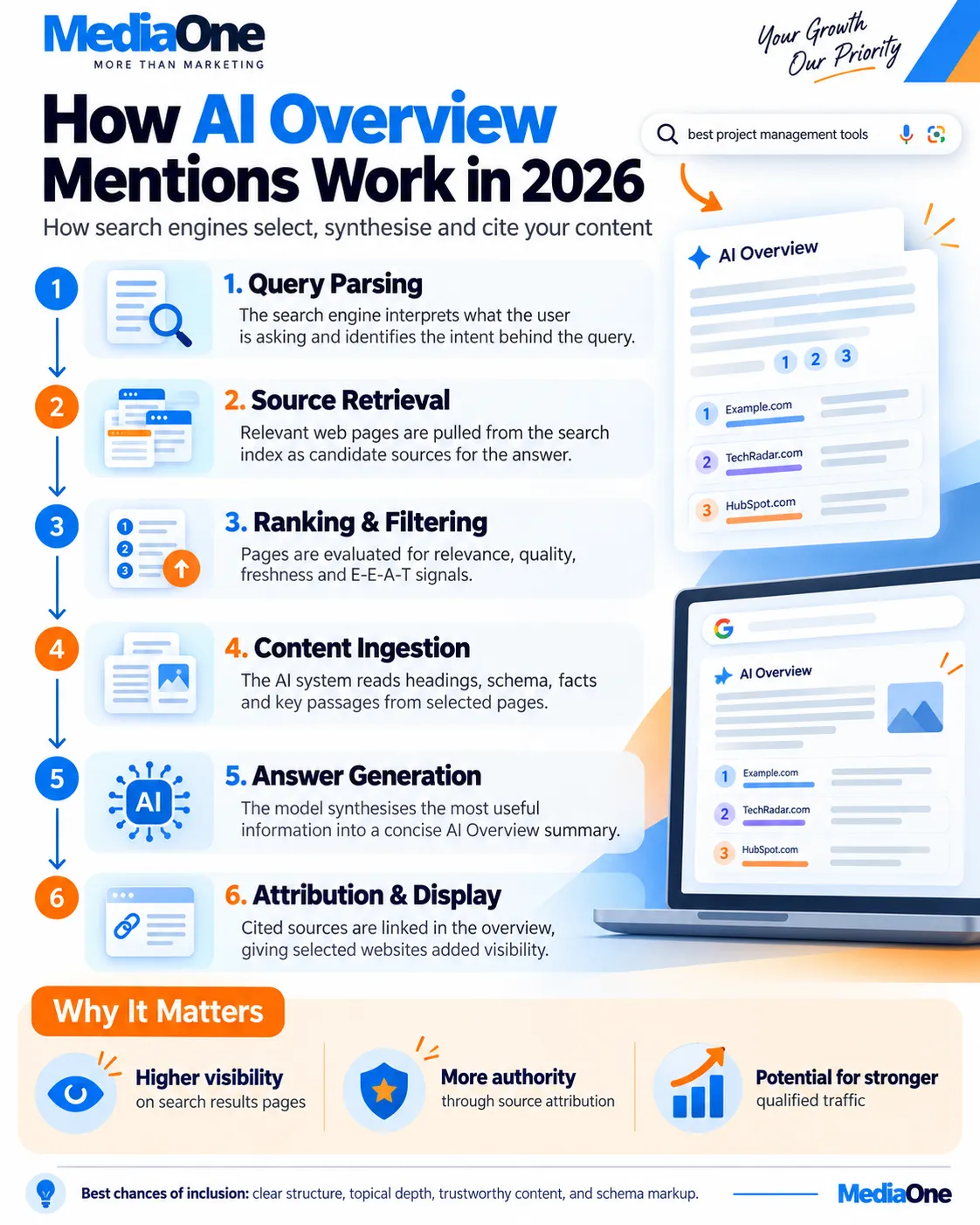
The process follows these steps:
- Query parsing: Google interprets what the user is asking.
- Retrieval: The search index returns candidate documents.
- Ranking and filtering: Google applies relevance and quality signals to select the best sources.
- Content ingestion: The language model reads or processes the selected pages.
- Generation: The model synthesises and writes the overview.
- Attribution mapping: Google identifies which pages contributed and adds citations.
- Rendering: The overview displays on the results page.
Schema markup, headings, and structured data feed into steps 3 and 4. If your content is marked with schema.org/Article, FAQPage, or NewsArticle, the retrieval system can more easily recognise its type and context. If your headings are clear in proper order (H1, H2, H3), the model can parse your argument structure more easily.
The language model does not have real-time internet access during generation. It reads the content Google has already retrieved. This means crawl speed and indexing priority affect whether your latest content is available for overview generation.

E-E-A-T signals (expertise, experience, authority, and trust) are used to weight sources during retrieval and generation. A page from a recognised medical authority will rank higher than a forum post for the same query. The model is trained to prefer high-E-E-A-T sources when it synthesises information.
If you publish on the open web, your content is fair material for AI Overview synthesis. Opting out, where available, is a strategic choice, not the default.
The Impact of AI Overviews on Website Traffic and Click-Through Rates
What the Data Shows About Traffic Changes
The relationship between AI Overview appearance and website traffic is more nuanced than early speculation suggested. Inclusion does not automatically reduce clicks. Instead, the effect depends on context: query intent, positioning within the overview, and content depth.
Authoritative sites like Wikipedia, the Mayo Clinic, and established news outlets report maintained or improved traffic even when featured in Google’s AI Overview. Their data shows that users who see a direct answer still click through to verify details, read around the topic, or access related information on the source domain.
Transactional and local queries show different patterns. E-commerce sites selling products and local service providers report significant traffic declines when AI Overviews answer “where to buy” or “who’s nearby” without requiring further clicks. Quick-answer queries (definitions, unit conversions, simple facts) show higher traffic loss across all content types.
The critical variable is whether the overview answers the user’s full intent or creates curiosity that drives further exploration. A summary of “What is machine learning?” may reduce clicks. But “how to optimise machine learning models for production” typically leads users to your site for implementation detail.
Which Content Types See the Biggest Impact
Original research, guides, and niche expertise content fare better in the AI Overview environment than commodity reference material.
Most affected: Listicles and “top 10” roundups suffer disproportionately. When an AI Overview synthesises multiple sources into a single ranked list, the originating pages lose their comparative advantage. Dictionary entries, definitions, and biographical summaries also experience traffic decline because overviews often contain the complete answer.
Least affected: In-depth tutorials, case studies, and methodologies remain protected traffic sources. An overview might state “A/B testing involves splitting traffic between two versions,” but users still need your step-by-step walkthrough to actually run one. Research papers, industry benchmarks, and technical deep-dives are rarely cannibalised, as overviews cite them but cannot replace them.
Opinion-driven content and curated experiences (for example, “best laptops for video editing in 2026” with personal testing) retain traffic because the overview cannot capture subjective judgement or author credibility the way your byline does.
| Content type | Typical traffic impact |
|---|---|
| Quick-answer reference (definitions, conversions, simple facts) | Highest loss |
| Listicles and “top 10” roundups | High loss |
| Transactional and local “where to buy” / “who’s nearby” queries | Significant decline |
| Long-form content (3,000+ words) with clear methodology | 10-15% average impact |
| Foundational reference pages | 25-50% impact |
| In-depth tutorials, case studies, methodologies | Lowest impact |
| Opinion-driven and personally tested content | Lowest impact |
Based on reported findings from industry monitoring through 2026, content exceeding 3,000 words and with clear methodology sections has lower average traffic impact than foundational reference pages, which see higher impact.
Why Your Positioning Within an Overview Matters
Position in an AI Overview functions differently than position on a traditional search results page. Google does not always lead with the highest-authority source. Placement instead reflects content relevance, answer completeness, and whether the system judges your content as the clearest explanation for that specific query angle.
Being cited first in an overview does not guarantee clicks. It often means your answer was deemed sufficient, reducing user motivation to visit. Appearing second or third can drive higher click-through because users want verification or an alternative perspective.
The most valuable position is being cited as the only source for a specific aspect of the answer. If Google attributes methodology to your site and approaches a competitor, searchers click you specifically for methodology detail. This creates segmented traffic based on intent subdivision.
Your author byline and E-E-A-T signals influence your positioning. Sites established as authoritative (medical sites for health, financial institutions for investing, and academic publishers for research) tend to appear earlier in overviews. Newer sites with highly specific, well-structured answers can outrank established competitors for particular query angles.
The practical implication is this: aiming for overview inclusion without understanding your positioning strategy leads to disappointment. A niche publisher that gains a third-position mention for a specific angle often sees more qualified traffic than a generic first-position mention that fully answers the query.
Note: AI Overview inclusion criteria, attribution methods, and traffic patterns are subject to change as search platforms refine their systems. AI Overview availability varies by search platform, geography, and query intent. The information above reflects the state of these systems as of October 2026 based on available reporting and user-reported observations.
How AI Overviews Select and Attribute Source Content
AI Overview systems do not randomly select content from the web. They apply measurable selection criteria, favour sources with strong authority signals, and use citation mechanisms that either amplify or obscure your attribution. Understanding these mechanics determines whether your content gets featured or remains invisible.
Selection Criteria: Why Some Pages Get Featured
Google’s AI Overview system, along with competitors like Perplexity, prioritises pages that answer the user’s question directly and completely. The selection process works in layers.
First comes relevance matching. The AI retrieves pages containing terms semantically related to the query. A question about “how to reduce inflammation” triggers pages with language around anti-inflammatory foods, medical evidence, or clinical studies. Relevance alone is insufficient: thousands of pages match most queries.
Next comes content structure. Pages with clear answers score higher. Lists, tables, numbered steps, and definition sections are easier for AI systems to parse and synthesise. A page with three bullet points explaining inflammation mechanisms ranks above a 2,000-word essay on the same topic buried in prose, even if the essay contains richer technical detail.
Third, demonstrated expertise and author authority matter. AI systems check for bylines, author profiles, publication dates, and whether the author has published similar content before. An article by a cardiologist on heart disease carries different weight than an uncredited blog post, even if both answer the query.
Source diversity also matters. AI Overviews aim to show multiple perspectives and cross-check facts. A query about “best productivity methods” pulls from management researchers, industry practitioners, and real-world case studies rather than relying on a single source.
Finally, freshness applies to time-sensitive queries. Medical guidance, software tools, and policy information updated within the last few months rank above outdated content.
The Role of E-E-A-T in Overview Inclusion
E-E-A-T (Expertise, Experience, Authoritativeness, Trustworthiness) is not hidden metadata. AI systems detect it through observable signals. Your presence in AI Overviews correlates directly with how strongly your pages signal these qualities.
Experience comes through author bios, case studies, and documented narratives. When your article states “we tested this approach with 150 clients over two years,” that is a stronger signal than “this approach works.” AI systems detect this through language patterns and verify it where possible.
Expertise appears in your specialisation depth. A page covering a narrow topic comprehensively (for example, “how to diagnose chronic migraine in high-altitude patients”) signals more expertise than a page skimming ten loosely related topics. AI Overview systems value topic authority: does this publication have multiple articles on this exact subject, and have they gone deeper than competitors?
Authoritativeness builds through third-party validation. Citations from other authoritative sources, backlinks from recognised publishers, and mentions in industry directories feed into authority scoring. A personal finance article from NerdWallet carries different weight than identical content from a generic blog. AI systems have learned which publishers are consistently reliable.

Trustworthiness is the hardest signal to authenticate. It comes from consistency, transparency about limitations, proper citation of your own sources, and absence of promotional bias. A product review that discloses an affiliate relationship ranks higher with AI systems than one that hides it. A health article that says “consult a doctor” when appropriate builds trust; one that overstates its scope erodes it.
Pages with weak E-E-A-T signals are routinely excluded from AI Overviews entirely, even if they technically answer the question. This is deliberate: AI systems prioritise accuracy and trustworthiness over comprehensiveness.
Attribution and Citation: Getting Credit for Your Research
Getting featured in an AI Overview is only half the battle. The other half is whether that attribution drives traffic and builds your authority further.
Google’s AI Overview system displays source URLs and publication names next to content it pulls. When your page contributes a definition, statistic, or methodology to an overview, your name appears as visible attribution: the user sees you credited.
Position and format matter significantly. Content that appears first in the overview, or content that answers the primary question, typically links directly to your page. A user reading an AI Overview will click the source link to learn more. Content positioned deeper or used for supporting context may be cited inline without a prominent click target.
Different AI platforms handle attribution differently. Perplexity displays source citations prominently and consistently throughout. Google’s approach emphasises source diversity, showing multiple sources per overview. This means more opportunities for your content to be featured, though potentially lower per-source click-through rates.
The actionable insight: your content is more likely to be featured if it answers a specific, verifiable question. A page titled “Proven Methods to Reduce Inflammation” with a section headed “Five Foods That Reduce Inflammation: Scientific Evidence” gets cited more often and more prominently than a page titled “Understanding Inflammation: A Complete Guide,” even if both contain the same information.
You cannot opt out of AI Overview inclusion without blocking AI crawlers entirely, which forfeits organic visibility. You can, however, optimise your content for prominent citation. Use clear statements of fact. Add data sources inline. Structure answers to stand alone. An AI system is more likely to cite a paragraph that begins with “According to a 2025 study by the American Heart Association, caffeine increases blood pressure by an average of 8 mmHg” than one that says “caffeine might affect blood pressure depending on various factors.”
Optimising Your Content for AI Overview Mentions in 2026
The practices that earn AI Overview citations overlap heavily with those that earn traditional search rankings. The differences lie in emphasis, not direction. AI systems reward content that is easy to parse, easy to verify, and clearly authored.
Structural Optimisation: Lists, Tables, and Clear Answers
Structure is the single highest-leverage change most websites can make. AI systems extract answers from content they can parse, and parsing favours explicit formatting.
Use this checklist for every page you want featured in an overview:
- Place the direct answer in the first 40–60 words beneath a question-style H2 or H3.
- Convert any comparison written in prose into a table.
- Break processes into numbered steps with one action per step.
- Use H3s to separate distinct sub-questions rather than creating long undifferentiated sections.
- Bold the key entity or number in each paragraph so the extractable fact is immediately obvious.
- Keep paragraphs under approximately 75 words and sentences under approximately 18 words.
The last point matters more than it sounds. A model selecting which passage to cite is effectively selecting which passage to quote. A self-contained 50-word paragraph survives extraction intact. A rambling 150-word paragraph gets paraphrased, and paraphrasing dilutes the attribution value of your original phrasing.
Topic Authority: Building Depth Across Related Queries
AI systems check whether a publication has covered a subject comprehensively before treating it as a reliable source. A single strong page on a topic is weaker than a cluster of pages answering adjacent questions.
Build that cluster deliberately. For each core topic, map the follow-up questions a real reader would ask, and answer each on its own URL with its own clear heading. Internal linking between those pages signals to the retrieval system that they belong together. This hub-and-spoke logic has worked for topical SEO for years; AI Overviews simply reward it more heavily because synthesis benefits from breadth.
Snippet Optimisation Without Sacrificing Article Quality
A common concern is that writing for extraction means reducing quality. In practice, the opposite holds. Extraction rewards specificity and evidence: the exact qualities that make human readers trust a page.
Write the extractable version first, then expand it. State the claim. Give the number or source. Use the rest of the section to explain nuance, exceptions, and application. The extractable sentence sits at the top where an AI system finds it, and the human reader gets the depth beneath it. You serve both audiences by sequencing them well.
Schema Markup and Rich Data Signals
Schema markup tells retrieval systems what kind of page they are reading before the model processes text. The types that matter most for overview inclusion are Article and NewsArticle for editorial content, FAQPage for question-and-answer blocks, HowTo for procedural guides, and Person for author entities linked to their credentials.
Two practical rules apply. First, markup must match what is visible on the page; mismatched schema signals the wrong kind of trust. Second, connect your author entity to your organisation and to external profiles so the E-E-A-T signals you build off-site are legible to the AI system reading your page.
Common Misconceptions About AI Overviews and SEO
Myth: AI Overviews Always Reduce Click-Through Traffic
Traffic outcomes vary by query type. Publishers answering quick factual questions have reported traffic shifts. Publishers answering questions that require judgement, methodology, or current detail have maintained traffic or grown it, because the overview cannot fully satisfy the reader’s need.
When evaluating your own situation, segment your traffic by query intent before drawing conclusions. A site-wide panic based on aggregate traffic data from one vertical is a common and expensive mistake.
Myth: You Must Avoid Being in an AI Overview
Avoidance is a losing strategy. First, you cannot easily opt out without blocking AI crawlers, which forfeits the organic visibility that still depends on being indexed. Second, being unfeatured leaves your traffic vulnerable to competitors who are. An AI Overview on a query does not eliminate traditional search results; it simply changes how users scan the page.
Note: AI Overview inclusion criteria, traffic patterns, and platform presence are subject to change. Availability and prevalence vary by search platform, geography, and query intent. This article reflects the state of AI Overviews as of October 2026 based on available public reporting.
Frequently Asked Questions
What is an AI Overview mention?
An AI Overview mention occurs when a search engine cites or links to your website within an AI-generated summary shown above or alongside traditional search results. It means your content has been selected as a source for part of the generated answer.
Why are AI Overview mentions important for SEO in 2026?
AI Overview mentions can increase brand visibility even when a website is not ranked first organically. They can place your brand directly inside the answer users see first, creating additional opportunities for recognition, authority and qualified traffic.
Do I need to rank number one on Google to appear in an AI Overview?
No. A page can be cited in an AI Overview without holding the number-one organic position. Search engines may select different sources for different parts of an answer based on relevance, clarity, authority and how well each page addresses a specific aspect of the query.
How can I increase my chances of being mentioned in an AI Overview?
Create clear, authoritative and well-structured content that directly answers searchers’ questions. Use descriptive headings, concise answer sections, lists, tables, original insights, credible sources and strong internal linking. Building topical authority across related content can also improve your chances of being selected.
Does appearing in an AI Overview always increase website traffic?
No. The impact depends on the query and how much information the AI Overview provides. Some users may get enough information without clicking, while others may visit cited sources for more detail, evidence, examples or implementation guidance.
What types of content are most likely to earn AI Overview citations?
Content that answers specific questions clearly tends to perform well. This can include detailed guides, step-by-step tutorials, comparisons, research, case studies, definitions, data-backed explanations and expert commentary that provides information the AI can easily understand and attribute.
How can I track whether my website is appearing in AI Overviews?
Traditional ranking reports are not always sufficient. Businesses should monitor important search queries for AI Overview appearances, record which URLs and competitors are cited, track changes over time, and compare AI visibility with organic impressions, clicks and referral traffic.
Are AI Overview optimisation and traditional SEO the same thing?
They overlap significantly, but they are not identical. Traditional SEO focuses heavily on rankings and organic clicks, while AI Overview optimisation also focuses on citation visibility, extractable answers, entity authority, topical depth and whether AI systems can confidently understand and reference your content.