
| AI Summary
Brand marketing in Singapore works best when positioning, audience segmentation and channel choices reflect the market’s multicultural, highly connected and regulated context. Brands should build awareness with a mix of paid, owned and earned channels, then measure how that attention moves into consideration, repeat purchase and customer value. The practical priority is to make defensible claims, test assumptions against local customer data and keep positioning consistent across touchpoints. |
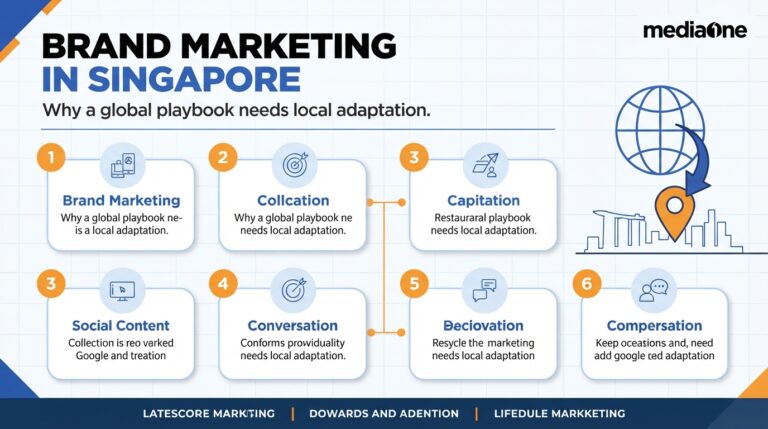
Brand marketing Singapore looks straightforward on paper: build awareness, establish positioning, convert to loyalty. In practice, the same global playbook can produce very different results once it meets Singapore’s compact market, multicultural audience and regulatory requirements.


Singapore’s market combines a large non-resident population with a resident population made up mainly of Chinese, Malay and Indian communities. It is also highly connected and commercially competitive. That mix makes local customer evidence more useful than broad assumptions about ‘the Singapore consumer’.
Global brand strategies therefore need adaptation rather than simple translation. This article explains how to build awareness, positioning and loyalty in Singapore with practical frameworks, current regulatory context and clearer measurement rules.
Key Takeaways
- Brand marketing in Singapore needs local adaptation because the market is multicultural, highly connected and regulated.
- Reach is only useful when it supports clear positioning, consideration and repeat purchase.
- Treat paid, owned and earned media as a portfolio. Set the mix from your audience data, brand maturity and measured return rather than a fixed Singapore-wide ratio.
- Regulatory compliance belongs inside brand planning, especially when personal data or advertising claims are involved.
- Segment customers by evidence such as needs, behaviour, language preference, category usage and value sensitivity rather than assuming Singapore has three fixed consumer types.
- Test employee, partner and community advocacy where trust and local relevance are important, but compare the results with paid and creator activity before shifting budget.
What Brand Marketing in Singapore Actually Means (And Why It’s Not One-Size-Fits-All)
The Singapore Context: Why Global Playbooks Fall Short
Most brand marketing textbooks assume a simpler audience than Singapore presents. Singapore has four official languages, a multicultural resident population and a large non-resident population, so a single creative idea can land differently across audience groups.
Singapore’s Population Trends 2026 reports a total population of 6.21 million and a resident population of 4.23 million as at end-June 2026. The resident population was 73.9% Chinese, 13.5% Malay, 9.0% Indian and 3.6% Others. Those figures do not dictate media behaviour, but they are a reminder that ‘Singaporean audience’ is too broad to use as a targeting shortcut.
Beyond audience variation, Singapore’s regulatory environment shapes how brands collect and use customer data. Under the PDPA, consent can be express or deemed, and statutory exceptions can apply. Brands should design databases, retargeting and customer communications around the actual purpose, notification and consent requirements rather than assuming every collection event needs the same form of explicit consent.
Singapore is also widely used as a regional business base. For brands with Southeast Asian ambitions, that makes it useful to test whether naming, positioning and message architecture can travel beyond the domestic market without flattening local differences.
Effective brand marketing in Singapore requires local reasoning, not local tactics layered onto a global template.
The Three Layers of Brand Marketing in the Singapore Market
Brand marketing can be analysed across three interlocking layers: functional, emotional and social. All three can be useful in Singapore, but their priority should come from category evidence and customer research rather than a fixed national formula.
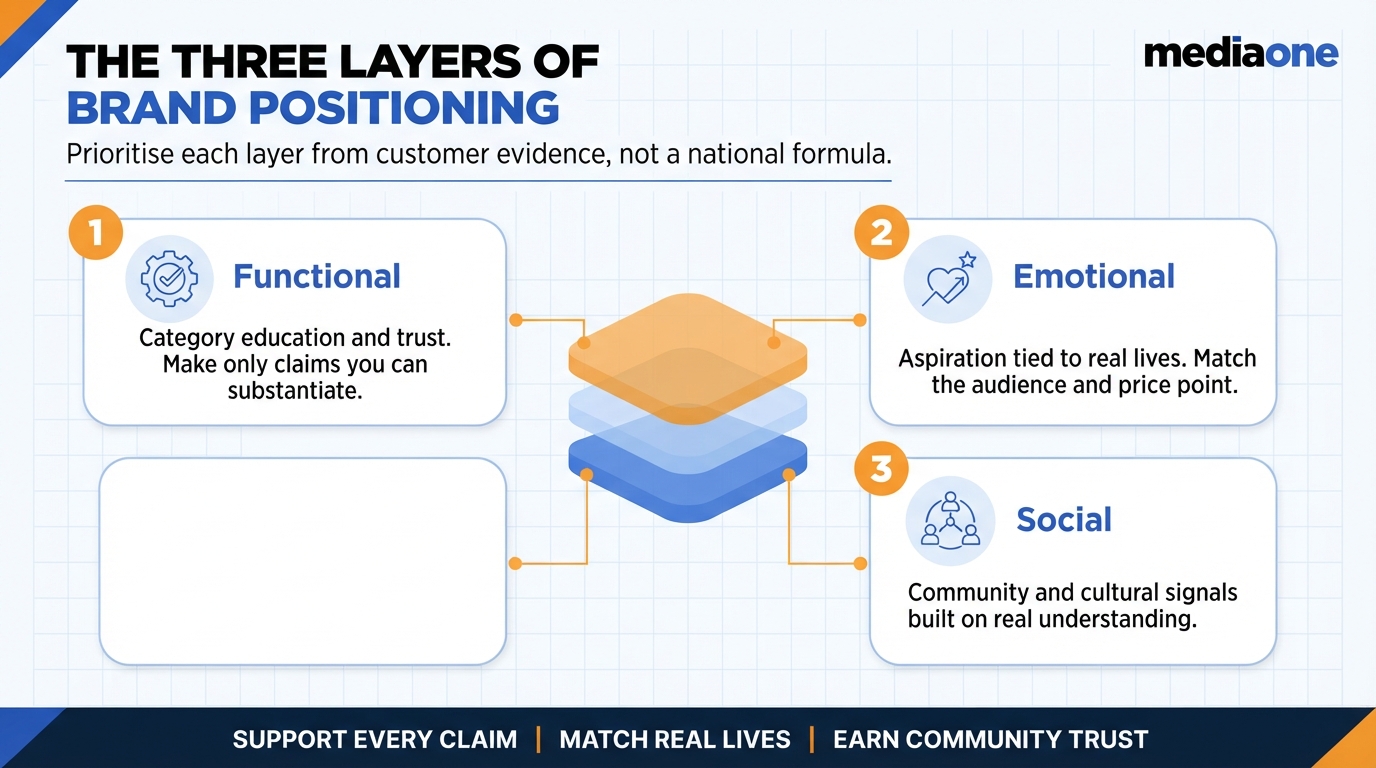
Functional Layer: Category Education and Trust
Functional positioning should be defensible. If a brand uses a claim such as ‘doctor-approved’, ‘proven effective’ or a time-bound performance promise, the evidence and any sector-specific advertising rules need to support the exact wording.
A fast-moving consumer goods (FMCG) brand that says a product ‘whitens teeth in three days’, for example, should be able to substantiate the claim before publication. Transparent, testable benefits give the marketing team a stronger base than wording that legal, regulatory or product teams cannot support.
Emotional Layer: Aspirations Tied to Lived Reality
Emotional positioning in Singapore should balance aspiration with credibility. Premium, status and self-improvement themes can work in some categories, but the choice needs to match the audience, price point and economic context rather than rely on assumptions about the whole market.
A practical way to make emotional positioning more specific is to tie it to a life stage or job-to-be-done: the young professional upgrading from student life, the parent balancing ambition and family, or the entrepreneur building a company. These are positioning examples, not claims that one emotional theme performs best across Singapore.
Social Layer: Community and Cultural Signals
Singapore’s multicultural environment gives brands several ways to signal community relevance. A food, beauty or lifestyle brand may tailor language, cultural references, retail partnerships or product information for specific audiences, provided the work reflects real customer understanding rather than tokenism.
Over-broad messaging can make differentiation harder. A clearer subcultural or community lane may help a brand build recognition, but teams should validate that choice with research and sales data rather than assume cultural specificity always produces stronger loyalty.
How Singapore’s Multicultural Economy Changes Brand Positioning
Positioning a brand in Singapore requires deliberate choice about which audience layer you are building first.
One approach is to choose a primary segment and expand outward after the brand has evidence of fit. Language and ethnicity can be relevant variables, but they should sit alongside needs, behaviour, category usage, income and channel preference. MediaOne’s audience segmentation framework provides a broader way to structure those choices.
A second approach is to position on a functional or lifestyle layer that crosses demographic groups. A productivity app, financial service or fitness brand can organise its message around a job-to-be-done or aspiration. The advantage is a simpler message architecture. The trade-off is that competitors may be able to make similar functional claims.
A third approach is to position as explicitly multicultural. This works only when the product or service genuinely serves cross-community needs and the creative work is based on real cultural understanding. A festive campaign on its own is not proof of local relevance.
The positioning decision should therefore come from customer evidence. Heritage, innovation, convenience, value and identity can all be useful routes, but none should be treated as a default Singapore formula.
A practical validation sequence is to test the positioning statement in customer interviews, sales conversations and small paid experiments before changing the full identity system. Record what customers repeat back without prompting, which proof points remove doubt and which words create confusion. That gives the team a stronger basis for localisation than demographic stereotypes alone.
Your positioning choice determines everything downstream: your media mix, influencer partnerships, creative style, even product packaging. This choice must be made for Singapore explicitly and then evaluated for regional replicability.
Brand Marketing Conditions in Singapore 2026
Singapore in 2026 is highly connected and competitive. Reach can be bought across search, social, video and traditional media, but memory and preference still depend on distinctive positioning and repeated exposure. This combination rewards more disciplined brand work than a global media plan copied into the market.
Current Challenges Singapore Brands Face
Four pressures are useful to audit when planning brand work in Singapore. Their importance varies by category, but each can change how quickly a global playbook needs local adjustment.
- Rising acquisition costs against a small addressable market
Singapore’s total population was 6.21 million at end-June 2026, while the resident population was 4.23 million. For many categories, the commercially addressable audience is smaller again once need, income, eligibility and usage are considered. Paid-media costs should therefore be judged against your own account history and customer value, not a blanket claim that acquisition costs are rising across every Singapore category. When acquisition becomes less efficient, retention and owned channels deserve closer analysis.
- The talent squeeze in brand roles
Regional teams often recruit across several Southeast Asian hubs, and local brands may compete with regional roles for experienced marketers. The practical risk is strategy churn: when ownership changes frequently, campaign direction can shift before brand assets have had enough time to build recognition. Track this as an organisational issue rather than assume every Singapore SME faces the same talent shortage.
- Fragmentation of attention across four language and cultural contexts
A single campaign may need to work across audiences with different language preferences, cultural references and media habits without appearing as several unrelated brands. Surface-level translation cannot solve that problem on its own. Test message comprehension, relevance and brand recognition by audience rather than assuming one execution works equally well for everyone.
- Short-termism from boards and finance teams
Brand investment can be difficult to defend when finance teams expect short payback periods and direct attribution. Instead of treating this as a uniquely Singaporean finance culture, build measurement that connects brand work to consideration, direct traffic, repeat purchase, acquisition efficiency and customer value over time.
Where Singapore Brands Succeed vs. Where They Stumble
Use the table below as a diagnostic, not as a claim about every Singapore brand. It describes recurring tensions a marketing team can test against its own organisation.
| Strength area | Why Singapore brands excel | Weakness area | What it costs them |
| Speed to market | Small teams, flat structures, high digital literacy | Differentiated positioning | Blended into category wallpaper |
| Digital craft | Deep in-house paid and CRM capability | Distinctive brand assets | Low unaided recall despite high spend |
| Trust signals | Strong reputation for reliability and compliance | Emotional resonance | Rational preference, weak loyalty |
| Bilingual execution | Genuine fluency across English and Chinese creative | Consistent voice across languages | Fragmented brand identity |
| Customer service culture | High baseline service standards | Shared internal brand belief | Brand promise not delivered at front line |
The diagnostic question is whether execution quality is stronger than positioning clarity. If media plans are detailed but the brand cannot state its distinctive promise, assets and proof points clearly, more execution may simply distribute a generic message more efficiently.
A useful review compares what the brand says it stands for with what customers actually remember. Consistency of experience, distinctive assets and clear positioning can all contribute to memory. The point is not that one Singapore brand archetype always wins, but that recognisable brands make it easier for customers to connect repeated exposures to the same promise.
The Role of Regulation: PDPA, Advertising Codes and Brand Claims
Singapore’s regulatory environment is a brand-planning variable as well as a legal one. Personal data, marketing communications and advertising claims need to be reviewed under the rules that actually apply to the campaign and product category.
PDPA and the DNC Registry
The Personal Data Protection Act (PDPA) governs the collection, use and disclosure of personal data. The PDPC’s data-protection obligations explain notification, consent, purpose limitation, protection and other duties. Consent is not accurately described as ‘explicit consent before every collection’: deemed consent and statutory exceptions can apply.
The Do Not Call (DNC) provisions also affect specified marketing messages to Singapore telephone numbers, with exceptions including clear and unambiguous consent and certain ongoing-relationship messages. The PDPC states that the Data Portability Obligation will take effect when regulations are issued, so brands should not treat it as an operative requirement in 2026.
For brand work, the practical rule is to document what data is collected, why it is needed, the lawful basis or consent position, retention and access controls, and how marketing permissions are managed. ‘Collect everything and sort it out later’ is a poor operating model even when a particular exception may apply.
Advertising codes
The Advertising Standards Authority of Singapore administers the Singapore Code of Advertising Practice. The code’s core premise is that advertising should be legal, decent, honest and truthful. Claims should therefore be written so the business can support the wording, rather than adding proof only after a complaint.
Brand claims
Environmental, health, performance and comparative claims deserve extra review because a vague phrase can create a broader impression than the evidence supports. A practical internal rule is to store the evidence, approval owner and permitted wording next to the claim in the campaign brief.
Brand claims work best when marketing, legal and operations agree on the same sentence. Specific wording such as ‘contains 50% recycled material’ is easier to evaluate than a broad phrase such as ‘eco-friendly’ when the evidence only supports one part of the product.
Where this lands: Singapore rewards precise brand work. Regulation, competitive pressure and multicultural complexity all favour a brand that knows what it stands for and can support the claims it publishes.
Regulatory Bodies and Their Scope
Understanding which body or code applies prevents avoidable errors. This article is not a legal guide, so the table keeps to the two cross-category references used in the article. Sector-specific products may also be subject to additional rules.
| Body or code | Scope used in this article | Brand implication |
| Personal Data Protection Commission (PDPC) | Personal-data obligations and the DNC framework | Review data collection, permissions and marketing communications before launch |
| Advertising Standards Authority of Singapore (ASAS) | Advertising ethics and the Singapore Code of Advertising Practice | Keep claims truthful, supportable and clear |
The Singapore Code of Advertising Practice should be part of the review process when campaign wording makes objective, comparative or potentially misleading claims.
Building Brand Awareness in Singapore: Tactical Framework
Once your positioning is locked, awareness becomes a discipline of channel selection and spend allocation. Singapore’s media market is fragmented by income, language, device preference and shopping behaviour. What works for a luxury food and beverage brand reaching affluent English speakers will drain budget if applied to a mass-market fast-moving consumer goods (FMCG) company serving Mandarin-preference households. This section provides frameworks to match channels to your audience, budget and maturity stage.
Digital-First Channels That Work in Singapore (and Which Don’t)
Singapore is a highly connected market, but platform choice still needs to follow the audience and objective. Do not treat a national internet-penetration figure as proof that every demographic uses the same channel for discovery, research and purchase.
Meta platforms (Facebook and Instagram) can support broad reach, retargeting and visual storytelling. Their usefulness varies by audience, creative quality, campaign objective and auction conditions. Pull CPM, frequency, reach and conversion benchmarks from your own ad account before setting a Singapore budget.
TikTok can be effective when the audience and creative format fit short-form video. Audience composition and performance can shift quickly, so test the platform against a defined audience instead of treating it as mandatory.
YouTube can support product education, demonstrations, testimonials and longer brand stories. It should not be described as Singapore’s ‘second-largest search engine’ without a source. Evaluate view quality, completion, assisted conversions and brand-lift measures rather than relying on a generic cost-per-view range.
Google Search is useful when people already express category or brand intent. Search can contribute to awareness, but its main role depends on keyword demand, query mix and how much non-brand demand exists. Separate brand and non-brand performance so existing awareness is not mistaken for new demand.
LinkedIn is strongest when professional identity, job role, employer or business context is relevant to the buying decision. Business-to-consumer brands should still test rather than assume poor returns across the board.
WhatsApp Business and Telegram can support opted-in communication, service and retention use cases. They are not automatically ‘free’ channels because content, operations, moderation and customer service still require resources, and marketing use must respect applicable consent and messaging rules.
Traditional media (television, radio and print) can still play a role when the audience, geography and campaign scale justify it. Do not hard-code age bands or CPM ranges without a current media plan from the relevant publisher or buying platform.
Common misallocation: choosing a channel because it is fashionable, familiar or easy to buy rather than because the target audience uses it for the relevant stage of the decision.
Recommended diagnostic: map the target audience by need, age, language preference, income, category behaviour and device use. Concentrate spend where evidence is strongest, keep a defined test budget for a secondary channel, and set stopping rules before the test starts.
Earned vs. Paid vs. Owned: Budget Allocation for Singapore’s Media Mix
The three media types serve different objectives. Their weighting should change with brand maturity, category economics, customer behaviour and the quality of the assets the brand already owns.
Paid media delivers controllable reach and targeting, but the return depends on auction costs, creative performance and conversion economics. New brands often need paid distribution to generate initial exposure, but there is no defensible Singapore-wide percentage that every launch should spend.
Owned media includes the website, email list, app, customer database and brand-controlled social channels. It can become more efficient over time because the brand retains the audience relationship, but content production, technology and customer operations still carry costs.
Earned media includes editorial coverage, voluntary recommendations, organic creator mentions and community advocacy. It can carry strong credibility, but it is less controllable and should not be assigned a fixed ‘trust multiplier’ against paid media.
Illustrative planning mix by brand maturity stage, not a market benchmark:
| Business stage | Paid | Owned | Earned | Planning rationale |
| Launch | 60% | 20% | 20% | Buy enough reach to test positioning while building owned assets and outreach |
| Growth | 50% | 25% | 25% | Keep paid volume while strengthening content, CRM and media relationships |
| Established | 35% | 30% | 35% | Use stronger owned and earned assets to reduce dependence on paid reach |
| Market leader | 25% | 30% | 45% | Use paid selectively to amplify proven assets and major moments |
For an illustrative Singapore SME with an annual awareness budget of SGD 150,000 in the growth stage, the 50/25/25 split would mean SGD 75,000 paid, SGD 37,500 owned and SGD 37,500 earned. These figures are arithmetic examples, not recommended Singapore spending levels.
The planning point is to avoid making paid media the only engine. Owned and earned activity can compound, but typical channel shares, traffic growth and production costs vary widely. Set those assumptions from your own history and update them after each campaign cycle.
Community-Led Marketing: Why Grassroots Activation Can Complement Broadcast
Singapore’s compact geography and strong interest-based communities can make local activation useful, especially when a brand serves a clear neighbourhood, hobby, profession or cultural audience. Community activity should be treated as a testable channel, not as proof that broadcast always underperforms.
Community-led marketing works by activating smaller groups who may share experiences with their own networks. A Singapore brand might sponsor a running club, support an industry meetup or co-create a useful activity with an existing community. The initial reach may be smaller than a mass-media buy, but the interaction can be deeper because the brand is participating in a context the audience already values.
Why this can work:
Singapore is geographically compact, which makes repeated physical presence easier for some categories. A brand that consistently appears at a relevant neighbourhood venue, industry group or hobby event can build familiarity with a defined audience. The effect still needs to be measured rather than assumed.
Community identity can also form around housing estates, workplaces, schools, shopping areas, language groups and hobbies. For example, a vegan restaurant in the east might test partnerships with plant-based communities, local events and neighbourhood channels before buying wider reach. This is an illustration, not a claim that the brand will become the default choice within a fixed number of days.
Tactical execution:
- Identify small communities within your addressable market. Use customer interviews, social listening, event calendars, public community groups and local search data to understand where the target audience already gathers.
- Find credible community organisers or micro-creators. Look for people who shape discussion or organise activity, not simply those with the largest follower count. Structure partnerships around useful participation and clear disclosure.
- Activate through the community, not at it. Sponsor a real activity, invite product feedback, host a workshop or co-create content that serves the group. The Singapore Code of Advertising Practice should be reviewed where endorsements, sponsored content or advertising claims are involved.
- Measure secondary effects. Track referral traffic, direct traffic, brand search, event attendance, code use, repeat purchase and attributable enquiries. Forwarding and screenshots may show interest, but they should not be converted into invented exposure or credibility multipliers.
Illustrative scenario: a fitness-apparel startup could sponsor several running groups, attend recurring events and fund opt-in community challenges over 12 to 18 months. The purpose of the illustration is to show how repeated community presence can be tested against paid reach.
Community activity can also generate testimonials, user-generated content and local media interest. For mass-market launches, broader media may still be useful. The practical question is how the channels reinforce each other, not which one wins in every Singapore campaign.
Positioning Your Brand in a Crowded Singapore Market
Singapore’s retail and services sector gives customers many alternatives across physical and digital channels. For a brand to stand out, positioning must answer a specific question: Why should a Singaporean choose you over the established player, the cheaper alternative or the trusted multinational? MediaOne’s brand strategy framework can be used alongside the positioning choices below.
Generic positioning is easy to copy. ‘Premium quality’ and ‘customer-focused’ are broad claims that many competitors can make. Your positioning should anchor to something locally relevant. This could be cultural affinity, convenience, price-to-value ratio, or a functional benefit that solves real friction in the Singaporean customer’s daily life.
The sections below show how to build positioning that sticks in a crowded market.
Five Brand Positioning Archetypes to Test Locally
Positioning archetypes give a brand a consistent personality and decision-making filter. The five below are planning models to test against customer research, not evidence that five archetypes universally fit Singapore’s demographic groups.
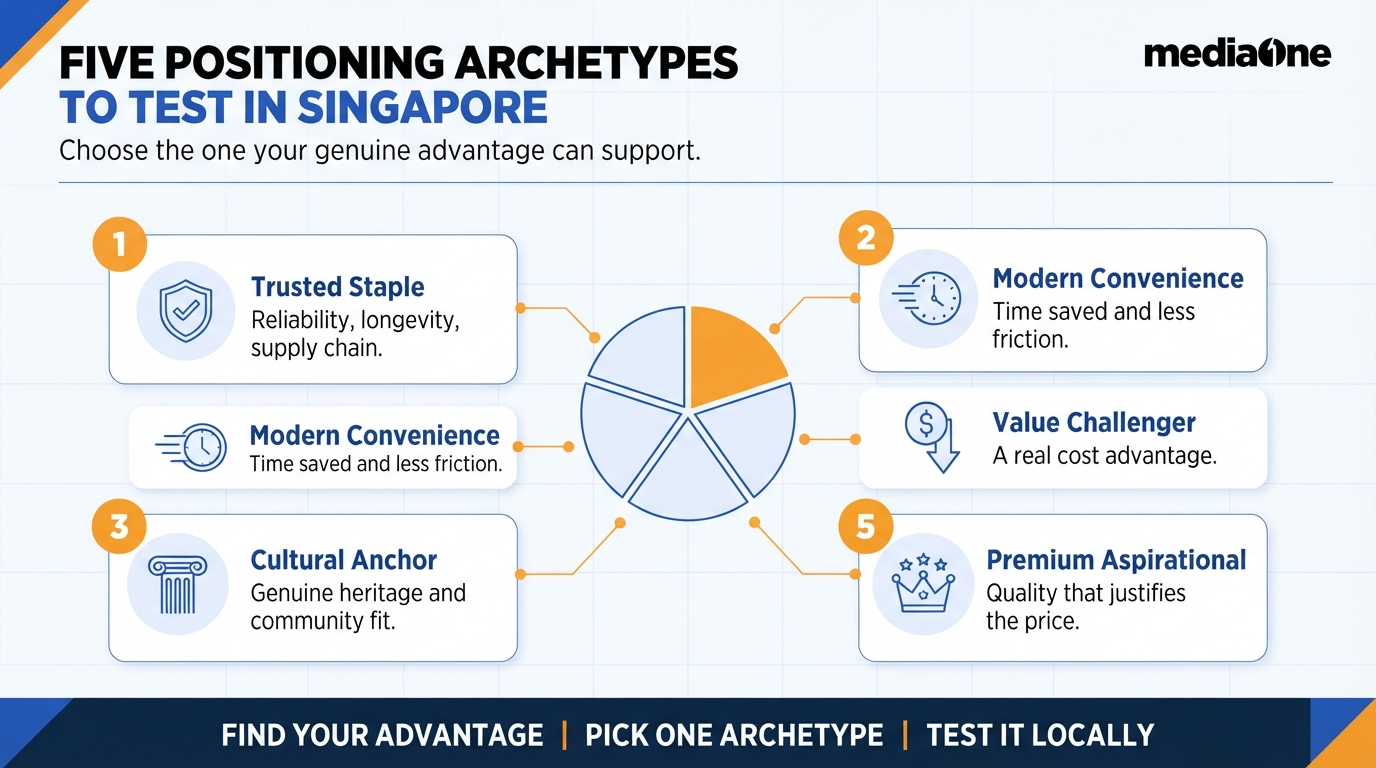
- The Trusted Staple
This archetype owns reliability and long-term presence. It appeals to older demographics and families who value consistency over novelty. Established local food brands can use longevity, familiar products and consistent distribution to reinforce this positioning. Whether the approach works for a new brand should be tested by audience and category rather than assumed from geography or housing type.
Use this archetype if your brand has longevity, supply-chain reliability or a heritage story. Position on ‘the one I’ve known for years’ rather than ‘the one I discovered yesterday.’
Messaging focus: consistent quality, value for money, presence in trusted retail (NTUC FairPrice, Cold Storage, neighbourhood shops).
- The Modern Convenience Play
This archetype focuses on time and convenience. It can appeal to working professionals, parents and busy urban customers when the service genuinely removes friction. The customer experience is simple: click, pay, receive, or arrive, find, buy and leave.
Use this archetype if your distribution, app or service experience is faster or simpler than competitors. Position on efficiency and fit-into-life convenience, not aspirational lifestyle.
Messaging focus: time saved, frictionless experience, mobile-first access, real-time tracking.
- The Cultural or Identity Anchor
Singapore’s multicultural context creates an opening for brands that lean into a specific cultural identity when that identity is genuine and relevant. Halal-certified food and beverage (F&B) brands, language-specific creators and brands built around heritage are examples of routes a team can test.

Use this archetype if your founding story, product formulation or brand voice naturally reflects a cultural perspective. Authenticity is important here. Performative cultural alignment can weaken trust when customers see little connection between the campaign and the brand’s actual product, people or practices.
Messaging focus: genuine heritage, community rootedness, celebrations and festivals, language and cultural literacy.
- The Disruptor or Value Challenger
This archetype challenges the establishment on price, format or access. Low-cost e-commerce, budget fitness apps and direct-to-consumer brands use this positioning. It appeals to price-conscious younger demographics and those seeking to trade down from premium to functional alternatives.
Use this archetype if you can offer genuine cost advantage through better sourcing, lower margins or lean operations. Alternatively, reach a customer segment the incumbent has underserved. Competing only on ‘cheaper’ is risky because competitors can respond and margins can narrow.
Messaging focus: transparent pricing, no middleman, value-for-money proof (price comparisons, size benchmarks), accessibility.
- The Premium or Aspirational Choice
This archetype focuses on desirability, taste and status. It can work when the chosen Singapore segment has both willingness to pay and a clear reason to value the premium. Luxury food and beverage, premium skincare and high-end fitness are examples of categories where the model can be tested.
Use this archetype if your product quality, design curation or service experience genuinely justifies a price premium. Aspirational positioning without substance is difficult to sustain. Product, design, service and proof need to support the premium message.
Messaging focus: craftsmanship, exclusivity, curated experience, heritage or innovation investment.
Diagnostic: Which archetype fits your brand?
| Archetype | Core competitive advantage | Likely channel fit to test | Risk if poorly executed |
| Trusted Staple | Reliability, longevity, supply chain | Retail, word-of-mouth, established media | Seen as outdated or interchangeable |
| Modern Convenience | Speed, simplicity, digital experience | Mobile, e-commerce, delivery platforms | Commodity positioning |
| Cultural Anchor | Authentic heritage, community fit | Community events, social media, owned channels | Performative localisation |
| Value Challenger | Lower cost or simpler offer | E-commerce, social commerce, word-of-mouth | Margin pressure and weak differentiation |
| Premium Aspirational | Superior quality, design or experience | Premium retail, owned e-commerce, selective media | Price premium lacks proof |
Start by identifying your genuine advantage. Then anchor your positioning to one of these archetypes. Brands that straddle two archetypes, such as ‘premium convenience’ or ‘culturally authentic but advanced’, can dilute the message unless the combination is clearly explained and supported.
Localisation vs. Authenticity: Finding the Balance
Many brands make a strategic error at this point. They choose localisation over authenticity, or vice versa.
The localisation trap:
A global brand launches in Singapore and swaps out every logo, pack colour and campaign image to reflect local cultural markers. The result feels forced. The brand’s voice, product quality and service standard do not shift; only the aesthetic changes.
Audiences sense the mismatch. Trust erodes.
The authenticity trap:
A brand refuses to adapt to local context. It insists its global messaging, pack formats and media mix apply in Singapore. It ignores Personal Data Protection Act (PDPA) compliance requirements in data collection, does not translate key touchpoints into Mandarin or Malay, and treats Singapore as a ‘test market’ rather than a primary market. Growth stalls.
The balance lies in what can be called ‘contextual authenticity’. Your core brand promise stays constant, but the expression, product specifications and customer interaction model adapt to Singapore’s specific needs and regulations.
How to audit your localisation-authenticity balance:
- Define your non-negotiables: the 3-4 brand attributes that are core to your identity globally. Examples: ‘minimalist Scandinavian design’, ‘affordable luxury’, ‘family-owned heritage’.
- Map local friction points: where do Singaporean customers experience friction? Is it lack of Mandarin on your website? Pricing that does not map to SGD conveniently? Delivery that does not cover HDB areas? Lengthy checkout flow on mobile?
- Separate aesthetic localisation from functional localisation. Aesthetic changes (colours, imagery, festive campaigns) are cheap and reversible. Functional changes (payment methods, language support, pack size, delivery zones) require investment but drive conversion.
- Test functional changes in a controlled sequence where possible. Measure conversion, repeat purchase and customer feedback before rolling out the next change.
Practical localisation examples:
A fitness retailer serving customers in compact homes might test smaller equipment formats or storage-friendly packaging. That is functional localisation because the product format changes to fit a local use case while the core brand promise stays the same.
A furniture brand might offer multilingual consultation or clearer room-planning support if customer research shows language or confidence is a barrier before high-value purchases. The core product proposition does not need to change for the service layer to adapt.
A Singapore-born beverage brand expanding overseas might keep its origin story and product standards consistent while changing cultural references, occasions and media partnerships by market. In each example, authenticity sits in the stable brand promise while localisation changes the expression.
Pricing Psychology and Brand Perception in Singapore (SGD Context)
Price communicates quality, positioning and accessibility. In Singapore, where customers can compare options quickly across retail and digital channels, brands should treat price as part of positioning rather than a separate finance decision.
Why price-setting needs local evidence:
Singapore has both value-sensitive and premium customer segments. Public housing is widespread, yet housing type should not be used as a shortcut for price sensitivity. Build price segments from willingness-to-pay research, purchase history and competitive alternatives.
Price comparison is easy across marketplaces, search and physical retail. The important question is not whether customers can find a cheaper option, but whether the brand has enough evidence, service or distinctiveness to justify the difference. The SGD pricing context:
Singapore’s current GST rate is 9%. IRAS states that GST-registered businesses generally charge and account for GST at 9%, and public price displays are generally expected to be GST-inclusive where the display rules apply. See the current GST rate.
Do not assume prices ending in .90 or .50 outperform round prices without testing. Psychological pricing can be included in an experiment, but product value, competitive set, margin and brand position should determine the base price first. Illustrative pricing framework by brand maturity stage:
| Brand stage | Pricing question | Main risk | Mitigation |
| New entrant | Is an entry offer needed to reduce trial risk? | Commodity perception, margin pressure | Time-limit the offer and explain normal value |
| Growth | Can evidence support a price premium? | Resistance and churn | Show proof, service and loyalty value |
| Established | Is the brand being compared with true peers? | Price drifts away from perceived value | Refresh proof and product differentiation |
| Mature or legacy | Does the premium still reflect customer value? | Obsolescence or trade-down | Refresh the offer, experience or portfolio |
Three pricing tactics to test in Singapore:
- Tiered pricing with a clear quality anchor. Offer distinct economy, standard and premium options only when each tier has a clear product or service difference. Test whether the middle tier attracts the intended mix rather than assuming it will.
- Transparent unit pricing. Show cost per 100g, per serving or per use where it helps customers compare real value.
- Dynamic bundling. Test bundles against straight discounts so you can see whether the offer increases basket size without training customers to wait for a lower unit price.
The premium positioning test (Singapore-specific):
If you are charging above-market rates, run this diagnostic before scaling:
- Can you name three other brands in your category that command a similar price premium?
- Can you articulate why (quality, heritage, convenience, exclusivity) in under 20 words?
- Do customers who have tried your product and a lower-priced competitor agree with the reason for the price difference?
- Does your distribution support the level of access or exclusivity the positioning promises?
If several answers are ‘no’, treat the premium as a hypothesis that needs stronger proof. Adjust the offer, evidence, distribution or price before scaling spend.
Converting Brand Awareness Into Customer Loyalty
A brand’s top-of-funnel visibility means little if customers do not return. In Singapore’s competitive retail and digital market, awareness alone does not create loyalty. A deliberate bridge is needed between first impression, trial, repeat purchase and retention. This section maps that process without assuming Singapore follows a single national loyalty pattern.
From Recognition to Repeat Purchase
Recognition and purchase are not the same act. A consumer in Singapore might encounter your brand across TikTok, see it stocked at Cold Storage, and hear a recommendation from a colleague, yet still choose a competitor at checkout. A useful planning model separates the process into three phases, each with different triggers and friction points. The timing will vary by category.
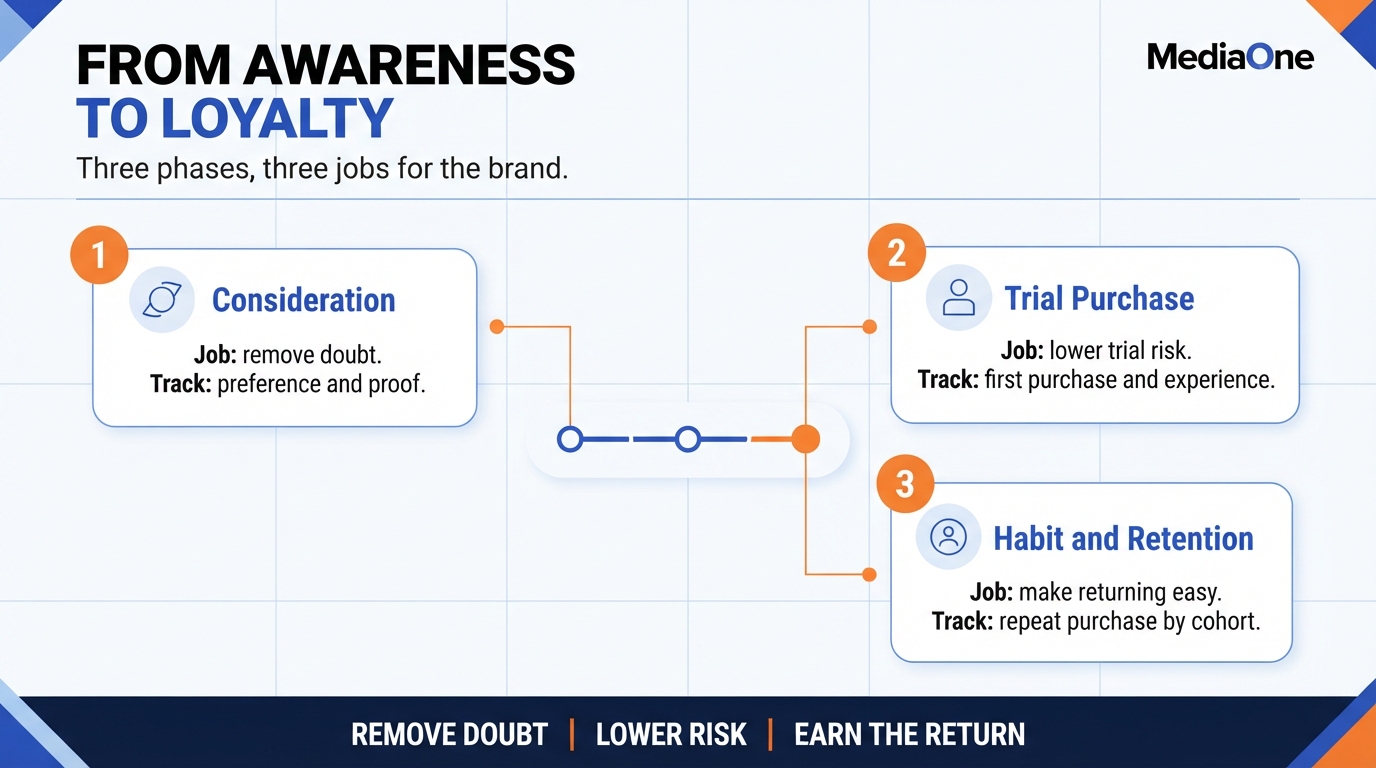
Phase 1: Consideration
After initial awareness, a prospective customer starts evaluating alternatives. Digital research, marketplaces, reviews, social content and peer recommendations can all compress the amount of time between discovery and comparison. The timing varies by category and purchase complexity.
Your task here is to remove doubt. A premium brand should make the reason for the premium visible through product evidence, service, design, third-party proof or relevant certifications. The proof used must match the claim being made and the rules that apply to the category.
Phase 2: Trial Purchase
The first transaction carries trial risk. Trial sizes, sampler packs, demonstrations, guarantees that comply with category rules, or entry bundles can reduce that risk. The appropriate entry price depends on category, margin and purchase risk.
Post-purchase experience then becomes a loyalty signal. Delivery reliability, product quality, customer service, returns and whether the product performs as promised can all affect a second purchase. Do not publish a universal delivery-time expectation or repeat-purchase percentage without category-specific evidence. Measure which post-purchase factors correlate with repeat behaviour in your own customer data.
Phase 3: Habit Formation and Retention
Repeated satisfactory purchases can reduce the motivation to switch, particularly in routine or replenishment categories. Loyalty programmes, consistent product quality, useful service and relevant communication can help, but the number of purchases required will vary by category and purchase cycle.
Use cohort analysis: define the expected repurchase window for the category, measure how many first-time customers return within it, and compare the result by acquisition channel, offer and customer segment.
Loyalty Programme Patterns to Evaluate in Singapore
Not all loyalty schemes are equally useful. Complexity, weak rewards and poor fit with purchase frequency can reduce participation. The safer approach is to choose a mechanism that fits the category and then measure whether it changes repeat behaviour.
Pattern 1: Payment- or ecosystem-linked rewards
Some brands can attach rewards to a payment, marketplace or partner ecosystem customers already use. The benefit is lower behavioural friction: customers do not need another standalone app or account simply to collect value. The trade-off is that the brand may own less customer data and have less control over the experience.
Relevance to brand marketers: compare the cost of participating in an existing ecosystem with the cost of building and operating a proprietary programme. Include platform fees, data access, offer funding, customer support and the value of any first-party relationship you give up.
Pattern 2: Simple frequency rewards
A simple structure such as ‘buy nine, get the tenth free’ is easy to explain and can fit frequent-purchase categories. Do not assume the structure increases retention until your own data shows incremental visits.
Test the mechanism using redemption rate, time to reward, incremental visits and margin impact. If customers would have returned anyway, a reward may simply subsidise existing behaviour. If redemption is low because the reward feels too distant, shorten the path or change the benefit.
Pattern 3: Tiered status
Tiered programmes can work when higher tiers offer benefits customers can understand and use. They can also fail when thresholds, expiry rules or benefits are too complicated. Programme structures and thresholds change, so verify current terms before using named brands as examples.
If you test tiers, make the progression transparent. Track how many members move between tiers, whether higher-tier members increase frequency or basket size, and whether the cost of benefits is justified by incremental customer value. Status should support the brand position rather than become a collection of unrelated discounts.
Pattern 4: Marketplace or partner rewards
SMEs selling through marketplaces may be able to participate in platform promotions, subscriptions or member benefits rather than build a full loyalty stack from scratch. This can be efficient when the marketplace is already a major acquisition and purchase channel.
The trade-off is dependency. The marketplace controls much of the customer experience, programme rules and data access. Compare repeat purchase inside the platform with direct-channel retention, contribution margin and the strategic value of first-party customer relationships.
Choose the programme from the buying cycle
High-frequency categories can test frequency rewards, replenishment reminders or tiered benefits. Lower-frequency categories may get more value from service, warranties, referrals, useful content or member access than from points. Subscription categories should focus on retention, usage and churn before adding extra loyalty mechanics.
Use customer value, not enrolment, as the test
Programme sign-ups are easy to count but can overstate value. Track whether members purchase more often, stay longer, refer profitable customers or buy higher-margin products after accounting for the cost of rewards. Compare against a holdout or matched group where practical.
For SME brands, the question is not whether Singapore customers ‘prefer simplicity’ as a national trait. The question is whether your programme is easy enough to understand, valuable enough to change behaviour and economical enough to keep.
Why NPS Scores Alone Miss the Mark in Singapore
Net Promoter Score (NPS) is a widely used loyalty metric. It measures how likely a customer is (on a 0-10 scale) to recommend your brand. NPS alone does not show what drives repeat purchase, so it should be paired with behavioural measures.
The NPS blind spot
NPS is an attitude measure, while repurchase is behaviour. A customer may be satisfied but have little reason to recommend a brand, or may recommend it yet still switch when price, availability or convenience changes.
If your NPS distribution differs by language, customer type or channel, treat that as a hypothesis to test with sample design and verbatim feedback rather than a national behavioural rule. Metrics to Pair With NPS
| Metric | Definition | How to use it |
| Repeat Purchase Rate (RPR) | Percentage of eligible customers who place another order within a defined period | Set the window from the normal category purchase cycle |
| Customer Acquisition Cost (CAC) | Acquisition spend divided by new customers acquired under a defined attribution rule | Compare by channel, cohort and offer |
| Customer Lifetime Value (LTV) | Expected customer contribution or value over the relationship, using a clearly stated model | Compare with CAC and margin assumptions |
| Churn Rate | Percentage of customers or subscribers who leave within the relevant period | Track by cohort rather than only in aggregate |
| Category or Customer Concentration | Share of revenue generated by a defined customer group | Use it to identify dependency and retention risk |
| Switching-Cost Research | Direct research into what would make customers change provider | Use open and closed questions rather than a universal SGD threshold |
Converting Awareness to Loyalty: Implementation Checklist
Use this checklist to audit your current approach:
- ☐ Do you know repeat purchase at intervals that match your category’s normal buying cycle?
- ☐ Have you identified the friction point in your post-purchase experience (delivery, product quality, returns)? Fix the top friction first.
- ☐ Is your loyalty programme (if any) embedded in a platform your customers already use daily?
- ☐ If your programme has tiers, is the next tier realistically achievable within the normal purchase cycle?
- ☐ Do you track churn by customer cohort, not in aggregate?
- ☐ Have you calculated LTV and CAC using definitions your finance and marketing teams agree on?
- ☐ Are you measuring repeat purchase rate instead of (or alongside) NPS?
Measuring Brand Marketing Effectiveness: Metrics That Drive Decisions
Most teams can count impressions, clicks and views. The harder question is whether those signals connect to preference, customer acquisition, repeat purchase and profitable growth. A viral post can be useful, but the view count alone does not show whether brand investment is working.
This section focuses on the metrics finance teams can connect to business outcomes. The measurement system should connect brand signals to business outcomes without pretending every effect can be attributed to one channel.
Beyond Awareness: The Metrics Your CFO Will Care About
Awareness metrics show whether people recognise a brand. They do not show, on their own, whether people will consider it, buy it or return. A stronger scorecard combines attitudinal, behavioural and financial measures.
Brand Consideration: Top-of-Mind and Aided Recall
Unaided recall asks which brands come to mind without prompting. Aided recall asks whether people recognise a brand when shown or named. Both can be useful. Set change targets from the brand’s baseline, investment level and category context.
Measure recall using a consistent survey design so changes over time are interpretable. Keep the target audience, question wording, sample source and fieldwork method stable where possible. The correct sample size depends on the confidence level, subgroup analysis and budget.
If recall is flat, do not assume the message is stale. Check reach, frequency, distinctiveness, media mix, category demand, competitor activity and whether the creative is correctly attributed to your brand. A well-remembered advertisement that people assign to the wrong brand is not a positioning success.
Brand Preference and Purchase Intent
Preference asks which brand a customer would choose among relevant alternatives. Purchase intent asks how likely someone is to buy. These measures sit closer to commercial behaviour than raw awareness, but they still describe stated intent rather than an actual transaction.
Track preference by the same audience segments used for positioning. If a segment recognises the brand but does not prefer it, investigate whether the problem is price, product fit, proof, availability, trust or simply a stronger competitor. Do not impose a fixed three-to-six-point annual target without a baseline and category benchmark.
Purchase-intent questions should also stay consistent across waves. A ten-point scale can work. Define success before the campaign using the brand’s own starting position and the size of the planned intervention.
Net Promoter Score in Context
NPS asks how likely a customer is to recommend the brand on a 0-to-10 scale. It can be useful for tracking customer sentiment, but it should not be treated as a Singapore-specific revenue benchmark or a substitute for repeat behaviour.
Pair NPS with open-ended feedback such as ‘What is the main reason for your score?’ and analyse themes by customer type, product, channel and purchase frequency. A retailer may discover that low scores are driven by queueing, stock availability or service rather than by the brand promise itself. That changes where the business should invest.
If you use an external NPS benchmark, document the category definition, sample, geography and date before comparing it with your own score.
Customer Acquisition Cost and Customer Lifetime Value
Customer Acquisition Cost (CAC) should use a definition agreed by marketing and finance. Decide which costs are included, how shared spend is allocated and what counts as a new customer. Then compare CAC by cohort, channel, offer and time period.
Customer Lifetime Value (LTV) also depends on assumptions. Use contribution margin where possible rather than revenue alone, state the time horizon and account for churn or repeat-purchase behaviour. Avoid treating a single LTV-to-CAC threshold or time horizon as universal because acceptable economics vary by cash flow, margins, category and growth strategy.
For an illustrative arithmetic example, if a campaign spends SGD 50,000 and acquires 500 new customers under the agreed attribution rule, CAC is SGD 100. The useful question is what happens next: whether those customers buy again, what margin they generate and whether later cohorts become cheaper or more valuable.
Earned Media and Share of Voice
Track earned mentions in relevant news, creator, community and social contexts, then compare the volume and quality with competitors. Avoid treating estimated advertising value as equivalent to revenue or return on investment. A media mention is not automatically worth what the same space would cost as an advertisement.
Quality can be assessed using relevance, message inclusion, prominence, sentiment, audience fit and whether the coverage drives branded search, referral traffic or enquiries. A single highly relevant feature may be more useful than many low-context mentions, but do not assign an invented numerical multiplier to that difference.
Return on Marketing Investment
ROMI is useful only when the numerator and denominator are clearly defined. A simple form is:
ROMI = (Incremental profit attributable to marketing – marketing cost) / marketing cost x 100
Some teams use revenue rather than profit, which produces a different result. State the formula in reporting so finance and marketing are discussing the same measure.
Where practical, use holdouts, geo tests, matched markets, incrementality experiments or time-series methods to estimate the lift caused by marketing. Choose the control size from experiment design and statistical power rather than a fixed percentage.
Setting Realistic KPIs for Different Brand Maturity Stages
A launch brand, growth brand and established brand should not use identical targets. Use stage-specific targets built from your baseline, category economics and investment level.
Use this as a planning template:
| Brand stage | Key priority | Awareness or preference KPI | Customer KPI | Financial KPI |
| Launch | Trial and message learning | Establish a baseline and improve qualified awareness | First purchase and early repeat | CAC and contribution margin |
| Growth | Preference and repeat purchase | Increase consideration in the priority segment | Cohort retention and repeat rate | LTV, CAC and payback |
| Established | Defend distinctiveness and value | Maintain or grow salience against key competitors | Retention and cross-sell | Margin, share and efficiency |
| Mature or refresh | Renew relevance without losing memory | Test refreshed assets against existing recognition | Win-back and segment response | Incremental profit from the refresh |
Set the actual numbers from four inputs: current baseline, category economics, historical trend and the scale of investment. A brand with 10% aided awareness needs a different target from one already at 70%. A subscription business can measure retention quickly, while an appliance brand may need a longer window and different proxy measures.
Use MediaOne’s related guide to branding strategies when the KPI problem is actually a positioning or identity problem rather than a reporting problem.
Troubleshooting Common Measurement Failures
| Common problem | Why it happens | How to avoid or fix |
| NPS is high but repeat purchase is flat | Attitude and behaviour are different; convenience or category frequency may drive purchase | Measure repeat rate, frequency and basket value alongside NPS |
| Awareness grows but CAC does not improve | Media costs, offer quality, conversion rate or audience mix may offset brand gains | Split brand and performance effects, then inspect funnel economics |
| ROMI is unclear because sales data is incomplete | Online and offline revenue use different identifiers or attribution rules | Improve data joins, use experiments where possible and state uncertainty |
| Budget forecasting uses old benchmarks | Auction prices, competition and category demand change | Refresh assumptions from current account data and current category evidence |
| Metrics are tracked but not acted upon | Reporting is disconnected from decisions | Assign owners and decision rules to each major KPI |
| Category-specific metrics are missing | Generic metrics miss real drivers such as delivery, usage or service | Add a small set of operational measures linked to customer value |
One common error is to add more dashboards without deciding what action each metric should trigger. A metric earns its place when a movement changes a decision about positioning, product, media, customer experience or budget.
Another error is to change definitions mid-year. If CAC excludes agency fees in one quarter and includes them in the next, the apparent trend may be a reporting artefact. Maintain a metric dictionary with the definition, owner, data source, update frequency and known limitations.
Measurement Framework for Singapore Brands
Effective measurement begins with three questions:
- What business outcome are you trying to change: trial, repeat purchase, market share, margin, retention or something else?
- What is the current baseline, and how was it measured?
- What amount of progress would justify the investment, given the category economics and time horizon?
Then connect each outcome to one or two leading indicators. If the goal is repeat purchase, the leading indicators might include product satisfaction, service resolution and second-order intent. If the goal is premium positioning, the indicators might include preference, price acceptance and the share of customers who can explain the reason for the premium.
Set a review cadence that fits the signal. Paid-media delivery can be checked daily or weekly. Brand tracking may be monthly or quarterly.
Retention may need a full purchase cycle. Strategic changes should not be made simply because one short-term metric moved.
Finally, separate observation from interpretation. Report what changed first, then explain the most plausible causes and what evidence would confirm them. This prevents teams from turning every rise in sales into proof that the latest brand campaign worked.
The brands that improve measurement discipline do not chase every available metric. They track a small set that links audience response to business value, document uncertainty and change strategy when the evidence is strong enough.
If your team needs outside support to turn positioning into a practical system, MediaOne’s branding services in Singapore cover brand strategy, story, design and digital brand execution. The brief should still begin with evidence about the audience, category and commercial objective rather than a preselected creative treatment.
Frequently Asked Questions
What makes brand marketing in Singapore different from a global campaign?
Singapore combines a multicultural resident population, a large non-resident population, high digital connectivity and specific privacy and advertising rules. A global campaign can still provide the core brand promise, but audience assumptions, language, proof points, channel mix and customer experience should be validated locally before scale.
How should a global brand localise for Singapore without losing its identity?
Keep the core promise, positioning logic and distinctive assets that customers need to recognise, then adapt the parts that affect local comprehension or use. Language support, payment methods, service design, product format, cultural references and channel selection can change when customer research shows a clear reason.
Which marketing channels are best for brand awareness in Singapore?
There is no single best channel for every brand. Choose channels from the target audience’s behaviour and the role each channel plays in discovery, research, trial and retention, then compare paid, owned and earned activity using the same commercial objectives.
How does the PDPA affect brand marketing in Singapore?
The PDPA affects how organisations collect, use and disclose personal data, including marketing-related customer data. Marketers should document the purpose, notification and consent position for each data use, manage DNC obligations where relevant and avoid treating consent as a one-size-fits-all checkbox. Data teams should also record retention, access and vendor responsibilities so campaign execution does not outrun the organisation’s privacy process.
How should a Singapore brand measure whether brand marketing is working?
Combine brand measures such as awareness, consideration and preference with behavioural and financial measures such as repeat purchase, retention, CAC, LTV and incremental profit. Use consistent definitions and baselines, and avoid adopting generic industry targets simply because they appear in a benchmark table. The best target is one tied to your category economics, historical performance and the scale of the intervention you are funding.