
| AI Summary
A strong branding strategy defines your purpose, audience, positioning, personality, visual identity, and values before marketing tactics begin. This guide explains practical branding frameworks, a five-step strategy process, measurement methods, and common mistakes to help businesses build recognition, loyalty, and long-term growth. |
Branding strategies provide a blueprint for how customers perceive and remember your business. A strong branding strategy goes beyond a logo or tagline. It answers three key questions: who you are, who you serve, and why customers should choose you over competitors.

Most businesses skip this step. They jump straight to designing a logo or writing social-media posts. The result is scattered messaging, weak customer loyalty, and an inability to command premium pricing. Brands that execute strategy well attract customers at lower acquisition cost, retain them longer, and build lasting competitive advantage.
This guide walks you through what branding strategy is, why it matters, and how to build one. You will learn the five core components every strategy must include, the frameworks practitioners use to make decisions consistently, and the step-by-step process to develop or refine your own strategy. You will also see where most businesses go wrong and how to avoid those pitfalls.
Key Takeaways
- Branding strategy is a written plan, not a feeling. It answers who you are, what you stand for, and why customers should choose you. Without it, tactics scatter and brand equity erodes.
- Strategy comes before logo design, social posts or campaigns. Tactics executed without a clear positioning and promise dilute brand equity. Define your positioning first; everything else follows.
- Specificity wins over broadness. A brand that owns 40% of one tight audience builds stronger equity faster than one that owns 10% of everyone. Choose a specific target and a single attribute competitors do not claim well.
- Five core components form the foundation. Purpose and promise (why you exist and what you deliver), target audience and positioning (who you serve and where you sit), brand personality and voice (how you sound), visual identity (how you look), and values (what you stand for).
- Consistency over 12–24 months compounds equity. Quick rebrands and frequent strategy shifts confuse the market and waste accumulated brand value. Strategy should shift only once every 3–5 years or when customer values materially change.
- Measure brand health regularly. Track awareness, perception, loyalty and share of voice quarterly. Data drives iteration. If the market perceives you differently from your intent, either adjust your positioning or invest in closing the gap through communication.
What Branding Strategy Does and Why It Matters
A strong brand does not happen by accident. It is the result of a deliberate, written plan that shapes how your target audience thinks about you, what they expect from you, and whether they choose you over competitors.
Many business leaders confuse branding with logos, taglines, or social-media posts. These are tactics. They matter, but only if they express a clear strategic idea underneath. A business without a branding strategy is like a ship without a heading: it may move, but it will not reach a chosen destination.
How Strategy Delivers Commercial Results
Branding strategy lowers customer acquisition cost. When a customer recognises your brand and trusts what you stand for, they buy with less friction. They need fewer promotions to convert. They do not spend time comparing you to every competitor.
It protects pricing power. A strong brand can charge 20–40% more than an undifferentiated competitor for the same product, because customers perceive greater value. A commodity product (coffee, petrol, banking) becomes defensible when the brand owns a meaningful difference in the customer’s mind.
It builds retention. Customers who feel emotionally connected to a brand stay longer and spend more over time. Their lifetime value increases. They refer others. This compounds over years.
Strategy also guides decisions. When your leadership team understands what the brand stands for, every choice becomes clearer: which product to launch, which partnership to pursue, how to price, what customer service standards to keep. Without strategy, decisions scatter.
The Real Cost of Skipping Strategy
Many businesses move straight to visual design or campaign tactics. They build a logo, launch social-media posts, run ads. But without a clear strategy, these tactics contradict one another. Your brand voice is formal on email, casual on Instagram, then confusing in customer service. Your visual identity shifts with trends. Your positioning claims you are both “premium” and “affordable”.
The market does not know what you stand for. You blend into the noise. Each marketing dollar works harder for less return.
Worse, when you finally realise you need strategy, you must rebuild. The scattered equity you built gets thrown away.
The businesses that win are those that answer this question first, before any visual design or campaign: “Who are we, and why should our specific customer choose us over everyone else?”

If you cannot answer that in one clear sentence, you need a strategy before you spend another pound on marketing.
Strategy Versus Tactics
A brand is the result: the collective emotional and functional impression that lives in a customer’s mind when they think of a company. A branding strategy is the blueprint that creates that brand.
Consider Apple. The brand (what customers feel and believe) is “innovation for everyday people.” It conveys premium quality, design elegance, accessibility and forward-thinking. That brand did not emerge by accident. Apple’s strategy includes premium positioning (higher prices than most competitors), controlled distribution (limited retail channels, curated stockists), ecosystem lock-in (products that work seamlessly together), and consistent visual language across all touchpoints (minimalist design, specific typography, iconic product imagery).
Each strategic choice reinforces the same brand identity. A customer walking into an Apple Store, visiting Apple.com, unboxing an iPhone, or reading an Apple advertisement encounters the same personality, visual style and promise. Over decades, those consistent choices built the brand.
Strategy is what you decide to do and why. Brand is what your audience believes as a result.
Why Strategy Comes Before Tactics
Many businesses reverse the order. A founder decides to start a company, then immediately commissions a logo. A marketing manager is hired and launches a social media campaign. A packaging designer suggests a rebrand. Tactics multiply, but no one has answered the foundational question: What is this business actually for, and who does it serve?
Without a defined positioning and promise, tactics become disconnected. The logo reflects one idea, the website copy reflects another, the customer service tone reflects a third. The brand equity dilutes across these conflicting messages.
Here is a diagnostic: Can your leadership team answer this in one sentence: “Who are we, and why should customers choose us?” If the answer varies depending on who you ask, you lack a strategy. If the answer takes more than one sentence to explain, it is not clear enough to guide decisions.
A clear strategy acts as a filter. When a new product idea, a partnership opportunity, or a marketing campaign is proposed, the strategy answers the question: Does this align with who we are and what we promise? A “no” is a gift. It prevents wasted investment in tactics that scatter the brand.
The Core Components of a Winning Branding Strategy
A winning branding strategy rests on five interlocking components. Each one answers a different critical question: Why do you exist? Who do you serve? How do people perceive you? How will they recognise you? What do you stand for?
Without all five, your strategy will feel incomplete or inauthentic. The best strategies treat these components not as separate boxes but as reinforcing parts of a single idea.
Purpose and Brand Promise
Purpose is why your business exists beyond making money. It is the reason your team gets up in the morning.
Brand promise is what you deliver to customers. It is specific and repeatable.
The two are not the same. Purpose is inward-facing. It answers the question: why do we do this work? A sustainable fashion brand’s purpose might be “to reduce textile waste and make circular fashion accessible.” This tells your team what to optimise for when making hard decisions.
Brand promise is outward-facing. It answers: what will you get when you choose us? The same sustainable fashion brand’s promise is “stylish, guilt-free clothing that looks good and does good.” This is what you tell customers.
A strong brand promise is concrete. It does not say “we are committed to sustainability.” It says “every piece you buy keeps one kilogram of fabric out of landfill.” The second version is measurable. It tells the customer exactly what outcome they will experience.
Use this template to draft your promise:
“Our brand promises that when you choose us, [specific outcome you will experience].”
Examples:
- “When you choose us, you save two hours a week on admin work.”
- “When you choose us, your skin clears up in eight weeks or your money back.”
- “When you choose us, your money grows at rates higher than traditional banks, with zero hidden fees.”
Your brand promise should feel almost conservative. It is something you can deliver reliably, not a hope or aspiration. If your promise is too broad, it fails to differentiate. If it is too narrow, you limit your growth. Test it with customers: when you describe this outcome, do they lean in?
Target Audience and Positioning
Broad positioning is the fastest way to build a weak brand.
A strategy must name a specific audience. Not “young people”. Not “anyone who cares about quality.” Specific: “women aged 25-40 with household incomes above SGD 80,000, working in professional roles, with one to two young children, who value time-saving convenience over lowest price.”
Within that audience, you must own one or two attributes that matter to them and that competitors do not own well.
Consider a fintech serving young professionals in Singapore with limited savings history. The market already has banks (trusted, boring), investment apps (complicated, jargon-heavy), and salary-advance platforms (high-risk, predatory image). Your positioning might be: “the first savings app that treats your first SGD 1,000 like a real investment, with the simplicity of a bank and the returns of a growth fund.”
You own “starter-friendly investing” in a way the incumbents do not.
Use this positioning statement template:
“For [target audience] who [need or pain], [brand name] is the [category] that [unique benefit] because [reason to believe].”
Example for the fintech above:
“For young Singapore professionals who want to start investing but feel overwhelmed and under-resourced, SaveStart is the investment app that delivers real returns on small amounts because it automates your savings and removes jargon.”
The reason-to-believe is critical. It answers: why should I believe you? Is it your team’s track record? Proprietary technology? A guarantee? A founder story? Without this, the positioning is a claim, not a position.
Test your positioning: can a competitor easily claim the same space? If yes, it is not specific enough. Can you name three concrete decisions you have made because of this positioning (product features you built, customer segments you avoided, partners you chose)? If no, you have not operationalised it yet.
Brand Personality and Voice
Brand personality is the set of human traits that make your brand recognisable and relatable. It is why customers prefer your brand even when the features are identical to a competitor.
Voice is how you write and speak. Personality is the character behind the voice.
A brand with a “bold and irreverent” personality might have a voice that uses short sentences, contractions, and occasional profanity. A brand with a “warm and practical” personality might use longer sentences, active voice, and conversational honesty.
To map your brand personality, use this exercise:
Pick three real people or fictional characters your brand resembles. These could be celebrities, archetypes, or people you know. Write their names down. Then list three traits each embodies.
Examples:
- Michelle Obama: intelligent, graceful, purposeful.
- Dwayne Johnson: approachable, hardworking, funny.
- Fred Rogers (Mr. Rogers): calm, honest, thoughtful.
Now distil these nine traits into a short phrase that captures your brand’s personality: “intelligent, approachable, and calm” or “graceful, hardworking, and funny.”
This phrase becomes your north star for all communication. When a team member writes an email, designs a social post, or handles a customer complaint, they ask: does this sound like our brand personality?
Consistency across touchpoints builds trust and recall. A customer who hears your voice on a podcast episode will recognise it in an email and feel that same sense of familiarity. This is how brands compound. Small recognition across many moments creates strong brand equity.
Visual Identity and Sensory Cues
Visual identity includes your logo, colour palette, typography, and imagery style.


Sensory cues extend beyond the visual: they include sound (a jingle, a notification sound), smell (a signature scent in a physical space), or tactile experience (the weight of your packaging, the texture of your business card).
Cohesion matters more than originality. Your goal is not to design something no one has ever seen. Your goal is for a customer to recognise your brand from any single touchpoint, even without seeing your logo.
This is why colour is such a powerful branding tool. Tiffany’s is synonymous with its robin’s-egg blue. Coca-Cola owns red. This is not an accident. It is a deliberate strategy tested over decades.
You do not need every visual element to be unique. You need them to be consistent and coordinated. A customer should feel the same brand experience when they see your website, walk into your physical store, receive your packaging, and read your email.
To operationalise your visual identity, create a brand guidelines document that includes:
- Logo usage (clear space, minimum size, where it can and cannot be altered).
- Colour palette (primary colours and secondary palette, with Pantone codes for professional reproduction).
- Typography (font families and size hierarchy: what is H1, H2, body text, captions?).
- Imagery style (are your photos bright or moody? Do you use illustrations, photography, or both? What is the emotional tone?).
- Graphic elements (shapes, patterns, icons that are uniquely yours).
A strong guidelines document is not decorative. It is a working tool. Every designer, copywriter, and marketer on your team should reference it weekly.
If sensory cues beyond the visual are relevant to your brand, define them too. A luxury car brand might define not just the look but the sound of the engine and the feel of materials inside. A hospitality brand might define a signature scent for its spaces. These compound the customer’s sense that your brand is deliberate and complete.
Brand Values and Authenticity
Brand values are the non-negotiable principles that guide decisions. They are not a checklist of virtues to paste on a website. They are the criteria by which you decide what to do and, more importantly, what not to do.
A business with a stated value of “sustainability” that uses single-use packaging for profit is not living its values. A business that says it values “transparency” but hides its pricing behind a form is not authentic.
The difference between authentic values and “values-washing” is simple: authentic values show up in hard decisions, not just easy moments.
Ask yourself this test: Can you name a concrete business decision you made because of a stated value? Not a marketing campaign. A real trade-off. Did you turn down a lucrative contract because the client did not align with your values? Did you spend more on suppliers because they share your values? Did you rebuild a product feature because it conflicted with your principles?
If you cannot answer yes, your values are aspirational, not operational.
Authentic values attract employees and customers who share them. They also repel people who do not. This is not a weakness. It is the point. A business trying to appeal to everyone repels the people most likely to become loyal advocates.
To identify authentic values:
- Look at your founder or leadership team. What do they genuinely care about? Not what they think sounds good. What do they actually do with their time, money, and attention?
- Review decisions you have made under pressure. What did you choose to protect? Quality? Speed? Relationships? Customer safety?
- Ask your employees: What do you think this company stands for? Their answers will reveal your actual values, not your intended ones.
Once you have identified your true values, write them down. Limit yourself to three to five. Define each one in a sentence, with an example of what it means in practice. Communicate them to your team. And most importantly, make decisions that reinforce them.
Values compound brand equity over time. A business known for one unshakeable principle builds a reputation that outlasts any individual product or campaign.
Branding Strategy Models and Frameworks
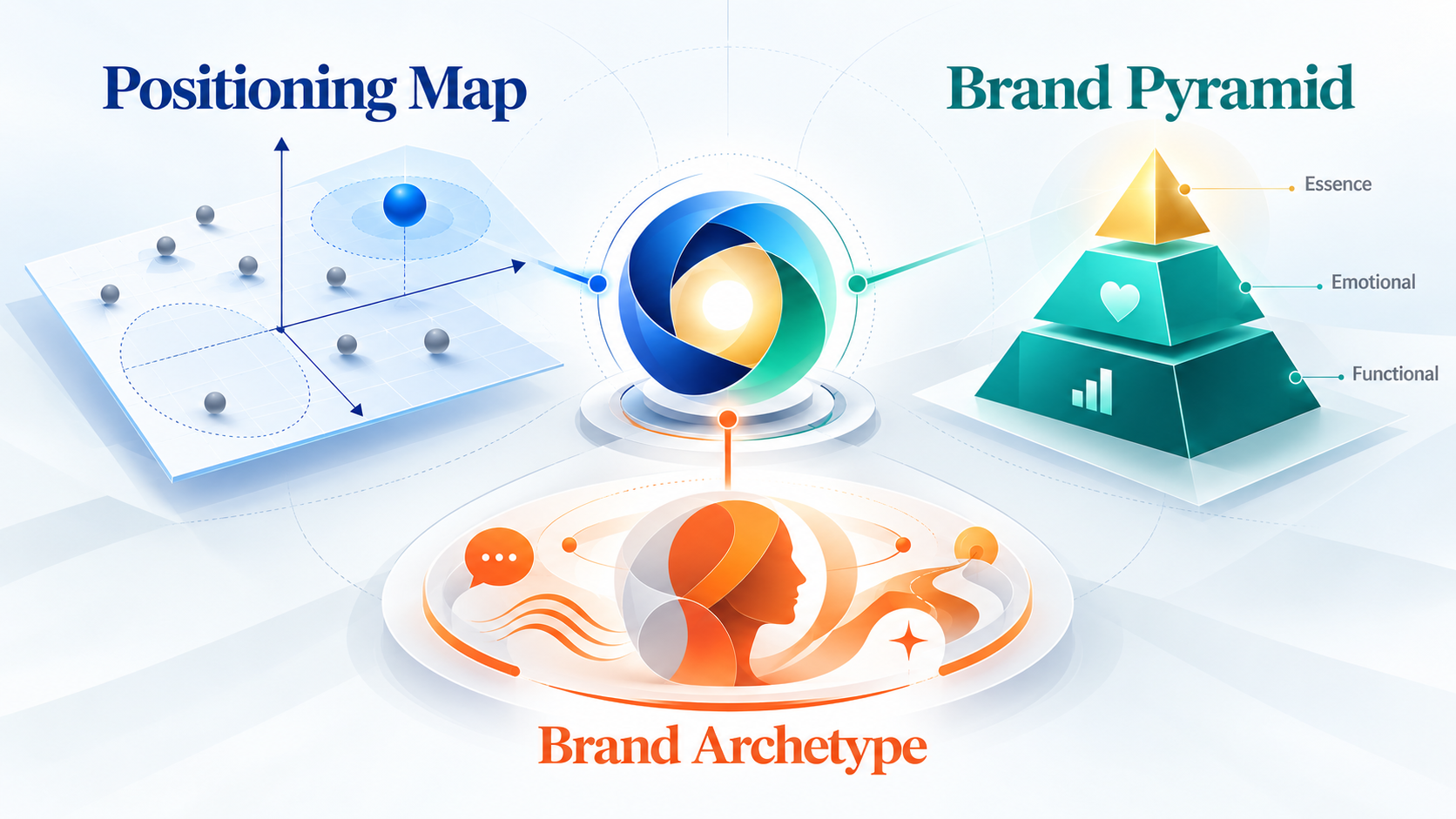
Rather than building strategy from scratch, most practitioners use proven frameworks to structure their thinking and ensure no critical pieces are missed. Three frameworks stand out for their clarity and applicability to businesses of any size: positioning maps, brand pyramids and brand archetypes.
Positioning Map and Competitive Differentiation
A positioning map is a simple two-axis chart that plots where your brand sits relative to competitors on attributes your audience actually cares about.
The process works in four steps:
Step 1: Identify the two attributes your audience values most. Not what you think matters. Ask customers directly. For a fintech targeting young professionals in Singapore, those attributes might be “ease of use” (vertical axis) and “affordability” (horizontal axis). For a premium furniture brand, it might be “sustainability” and “design innovation”. The axes must be attributes that segment the market meaningfully: things where reasonable people disagree about which end is better.
Step 2: Research where competitors sit. Visit competitor websites, read customer reviews on Google and Trustpilot, and talk to customers about how they perceive each player. Plot five to eight key competitors on your map. You should see clusters. If all competitors cluster in the same corner, that corner is crowded. If space exists where no competitor sits, that is white space, your opportunity.
Step 3: Choose your position. Pick a space where three conditions hold: (a) your audience values that combination of attributes, (b) no strong competitor already owns it, and (c) your business can authentically deliver on it. If you choose “premium plus easy to use” but your product takes three weeks to onboard, you cannot own that space.
Step 4: Articulate why you own it. For each axis, explain the proof. Why are you genuinely easier to use? Better data infrastructure? Simpler feature set? Fewer clicks? Specificity here is where strategy becomes credible. “Premium because we use ethically sourced materials and pay fair wages” is stronger than “premium because quality”.
Here is a blank positioning map template you can fill in:
| Attribute (Vertical) | Low | Mid | High |
|---|---|---|---|
| High (Horizontal) | Your Position | Competitor A | |
| Mid (Horizontal) | |||
| Low (Horizontal) | Competitor B |
Once you have chosen your position, every subsequent decision should reinforce it. If you own “affordable plus reliable”, your packaging should signal value, not luxury. Your customer service should prioritise response time over white-glove treatment. A positioning map forces these trade-offs into the open instead of letting them hide in conflicting messaging.
The Brand Pyramid
A brand pyramid is a three-layer model that organises your brand messaging from the concrete to the abstract. It forces you to answer the question most brands fumble: “Why should I care?”
The base layer is functional benefit: what the product or service actually does. A coffee brand’s functional benefit is caffeine and warmth. A logistics company’s is on-time delivery. A financial advisory service’s is portfolio optimisation. Functional benefits are measurable and rational. They are table stakes: if you cannot deliver the function, nothing else matters.
The middle layer is emotional benefit: how using the product makes the customer feel. This is where differentiation typically lives. Two coffee brands both deliver caffeine, but one makes you feel alert and energised while the other makes you feel calm and grounded. Both emotions are valuable; they just appeal to different moments and different people. A logistics company might make you feel peace of mind or confidence in growth. An advisory service might make you feel secure or empowered.
Emotional benefits are stickier than functional ones. A customer will switch for a cheaper alternative to functional benefits alone. But if the brand has earned an emotional association (“I feel smart and confident using this”), switching feels like a loss, not just a cost swap.
The peak of the pyramid is brand essence: the single core idea that sits above all messaging. Everything you say, show and do should ladder back to this one insight. For the calm-coffee brand, essence might be “a ritual that grounds you.” For the growth-focused logistics company, it might be “the backbone your business trusts.” For the empowerment-focused advisory service, it might be “wealth that frees you.”
The essence is not a tagline or slogan, though a slogan can express it. It is the idea you hold internally that keeps the brand coherent. When a team member asks, “Should we run this campaign?” or “Should we partner with this influencer?” they can test it against the essence. Does it reinforce “a ritual that grounds you”? If not, probably no.
Example: A sustainable fashion brand’s functional benefit is “durable, well-made clothing”. Its emotional benefit is “you feel good wearing it because there’s no guilt.” Its essence is “style with a conscience.” Now every decision serves that essence. Product choices (minimal waste, natural fibres), pricing (premium to signal quality), sourcing transparency (public and detailed), influencer partnerships (activists and thoughtful creatives, not micro-celebrities), even customer service tone (“we care about the details because we care about the planet”) all ladder back. The pyramid keeps you honest.
The Brand Archetype Framework
If a positioning map tells you where to sit and a pyramid tells you what to say, an archetype tells you who you are saying it as. Archetypes are recurring character types that appear across mythology, literature and storytelling. They carry built-in personality, value set and communication style.
The 12 classic archetypes are:
- the Hero (courageous, determined, proves worth through action)
- the Sage (analytical, truthful, committed to understanding)
- the Innocent (optimistic, safe, wants happiness)
- the Explorer (adventurous, curious, wants to experience)
- the Lover (intimate, sensual, craves deep connection)
- the Creator (inventive, self-expressive, wants to make something)
- the Magician (transformative, charismatic, makes things happen)
- the Regular Guy/Gal (grounded, relatable, wants to belong)
- the Caregiver (compassionate, service-oriented, wants to help)
- the Ruler (commanding, organised, wants control)
- The Jester (playful, funny, brings joy)
- The Mentor (wisdom-focused, mentor-like).
Each archetype brings consistency without being a straitjacket. If you choose the Magician archetype for a fintech brand, that means you see money management as something that feels hard but is actually transformable into something effortless and elegant. Your story choices lean toward moments of “aha” clarity. Your tone is explanatory but not condescending. Your partnerships favour thought leaders and educators. Your visuals might use light, reveal, or simplification as metaphors. Your customer success stories focus on customers who felt stuck and then suddenly could see the path forward.
If you had chosen the Sage instead, the same fintech would sound like an educator: rigorous, data-driven, focused on helping customers understand every detail. The tone would be careful and neutral. Visuals might use clear information design and transparency. Stories would focus on customers who became more knowledgeable, not more confident.
The archetype is not a personality imposed on real humans. It is a consistent lens that helps a diverse team make aligned decisions. A Magician brand’s social-media manager, product marketer, and customer service lead are not all literally performing magic, but they all ask: “Does this help our customer experience a transformation or a simplification?” That single question prevents drift.
To choose an archetype: run a small workshop with leadership. List the brands you admire, inside and outside your category. What archetypes do they embody? Then ask:
Which archetype feels truest to what we are and want to become?
Not which is trendiest. Authenticity shows. A logistics company trying to sound like the Jester will feel false. The Ruler (command, reliability, systems) or the Caregiver (dedicated to your success) fits better.
Once chosen, document it in your brand guidelines with examples. This single decision cascades across all communications, making the brand feel intentional and coherent instead of reactive and scattered.

Developing a Branding Strategy: Step-by-Step Process
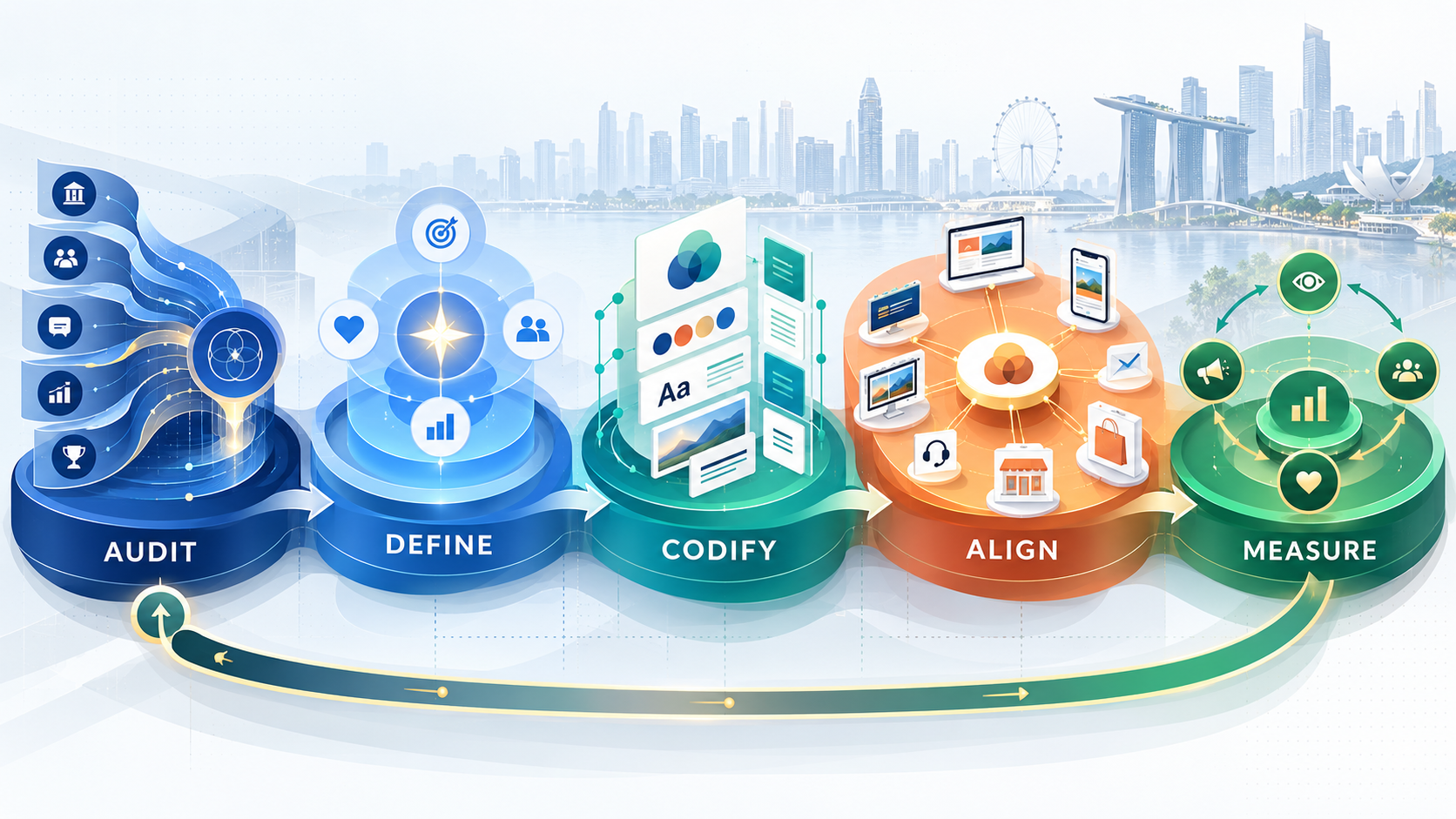
Building a branding strategy does not require a consultancy budget or months of deliberation. A small-to-medium business can move through a practical, five-step process that yields a defensible, documented strategy in weeks.
Step 1: Audit Internal Alignment and External Perception
Start by measuring the gap between what your business thinks it stands for and what the market actually believes.
Internal audit:
Schedule individual conversations with your leadership team and a cross-section of employees. Ask three direct questions: What does our brand stand for? What are we best known for? What would disappoint customers if we stopped doing it? Write down the answers verbatim. You will often find that leadership and frontline staff describe the brand differently. That misalignment signals where strategy work is needed.
External research:
Now learn what customers actually believe. You do not need a $30,000 market study. Singapore businesses can access low-cost, high-signal research methods:
- Online surveys: Use Google Forms or Typeform. Ask 100-150 current customers: “In one sentence, what does our brand stand for?” and “Why do you choose us over competitors?” The phrasing reveals whether your intended message is landing.
- Customer interviews: Call or video-chat with 10-15 customers (recent buyers, loyal repeat customers, lapsed accounts). Ask open-ended questions: “What was your first impression?” and “What would you tell a friend about us?” Record patterns, not just quotes.
- Community feedback: Monitor comments on your social media, Google reviews and industry forums. What words do customers repeat? What complaints surface again?
- Social listening: Search your brand name, product category and competitors’ names on Twitter, LinkedIn and local platforms. What sentiment do you see?
Document the findings in a simple table: “Internal belief vs. market perception.” Where they match, you have clarity to build on. Where they diverge, that is where strategy work begins.
Step 2: Define Purpose, Promise and Positioning
With audit insight in hand, write a one-page strategy document. This becomes your North Star: every hiring decision, product choice, pricing move and marketing campaign will be tested against it.
Answer four questions in writing:
- Why do we exist beyond making money? (Purpose). Example: “We exist to make professional financial tools accessible to freelancers who are overlooked by traditional banks.”
- What specific outcome do we guarantee? (Promise). Not a tagline, but a functional and emotional commitment. Example: “When you use our platform, you save 10 hours a month on invoicing and cash-flow tracking, and you feel in control of your business finances.”
- Who is our audience in concrete terms? (Target). Not “busy professionals” but “self-employed service providers in Singapore earning 80k-200k annually, managing their own cash flow, aged 28-42.”
- What do we own that competitors do not? (Competitive position). Not “best service” but something specific and defensible. Example: “We are the only invoicing platform built specifically for service-based freelancers; fintech platforms ignore this segment, and legacy accounting software is too complex.”
Write these four answers in plain language. A strategy document need not be fancy. It should be so clear that an employee hired next month could read it and answer “Why do we exist?” without guessing.
Step 3: Create Brand Guidelines and Visual Standards
Once positioning is locked, document the standards that will make the brand recognisable across every touchpoint.
A brand-guidelines document includes:
- Logo usage: Minimum size, clear space around it, acceptable backgrounds, incorrect versions to avoid.
- Colour palette: Three to five primary colours with Pantone numbers for print, RGB and hex codes for digital. A secondary palette for flexibility. Example: Pantone 2718C (deep navy), Pantone 116C (warm gold).
- Typography: Primary and secondary font families, sizes for headers, body text, captions. Example: “Headlines: Montserrat Bold, 28-32px; body: Open Sans Regular, 16px.”
- Imagery style: Photography tone (bright and modern? warm and lived-in?), whether you use illustration and in what style, stock photo philosophy.
- Tone of voice: Formal, friendly, irreverent, technical? Write three to five sample sentences in your brand voice. Example for a sustainable fashion brand: “We make guilt-free style simple. No greenwashing, no jargon, just clothes that feel as good as they look.”
- Messaging pillars: Three to five core messages your brand repeats across all channels. Example: (1) Accessibility, (2) Reliability, (3) Transparency.
Make these guidelines mandatory, not advisory. When a contractor, partner or new team member creates anything representing the brand (a social post, an email, a pitch deck), they should check the guidelines first. Consistency compounds over time.
Step 4: Test Consistency Across Touchpoints
Audit every customer interaction point and measure whether your brand shows up the same way.
Create a simple audit table:
| Touchpoint | Visual Alignment | Voice Alignment | Gap |
|---|---|---|---|
| Website homepage | Yes | Yes | None |
| Email signature | Yes | No | Update email template to match tone guide |
| Social media posts | Partial | Yes | Image style inconsistent; brief guidelines for social graphics |
| Customer service chat | N/A | No | Train support team on brand voice |
| Product packaging | Yes | Yes | None |
| In-store signage | Yes | Partial | Signage language too technical |
Touchpoints to audit: website (homepage, product pages, footer), email (newsletters, transactional emails, outreach), social media (all channels), advertising (paid and organic), packaging, in-store or office environment, customer service (chat, email, phone scripts), contracts or invoices, events or sponsorships.
Prioritise fixing the highest-traffic touchpoints first. A homepage redesign or email template update will affect more customers than refreshing a single landing page. Close the gaps over 90 days.
Step 5: Measure and Iterate
Branding strategy is not “set and forget”. Track brand health quarterly to catch drift early.
Measure four things:
- Brand awareness: Aided recall (“Have you heard of our brand?”) and unaided recall (“What brands do you think of in this category?”). Run this via a simple annual survey. Target: year-over-year growth.
- Perception: What does the market associate your brand with? Use sentiment analysis on social media or run quarterly surveys asking: “What three words describe this brand?” If your positioning is “innovative” but customers say “traditional”, perception is drifting. Net sentiment (positive vs. negative mentions) is a quick health check.
- Loyalty: Repeat purchase rate, customer lifetime value, net promoter score (NPS), referral rate. These reveal whether the brand promise is being delivered. A high-awareness brand with low loyalty has a broken promise.
- Share of voice: How often is your brand mentioned in relevant online conversations compared to competitors? Monitor brand mentions on social, forums, review sites and news. Growing share of voice suggests the strategy is gaining traction.
Review these metrics quarterly. If perception is drifting from your intended positioning, adjust messaging. If loyalty is falling despite awareness rising, investigate whether you are delivering the brand promise. Do not change core strategy every quarter, but do adjust tactics (marketing channels, messaging emphasis, partnerships) to keep strategy and reality aligned.
Common Branding Strategy Mistakes and How to Avoid Them
Most branding failures do not come from bad design or slow execution. They come from strategic confusion. Here are the four most common missteps and how to avoid them.
Pursuing Everyone (and Reaching No One)
A brand that tries to appeal to all customer segments ends up resonating with none. “Everyone who needs a reliable solution” is not a positioning. It describes the entire market.
The strongest brands own a specific customer in a specific moment with a specific need. IKEA owns “affordable, well-designed furniture for budget-conscious renters and first-time homebuyers.” Netflix owns “the entertainment you want to watch, when you want to watch it, without ads or commitment.” Both statements would fail if Netflix tried to add “and also the cheapest option” or IKEA tried to position itself as “luxury and affordable”.
Specificity feels scary. You worry you are leaving money on the table. But research from the Ehrenberg-Bass Institute at the University of South Australia shows that brands with narrow positioning build stronger category presence and grow faster than broad brands.
The fix: Write down your target customer as a real person. What is their age, income, job, family situation? What does a week in their life look like? What problem are they trying to solve, and why do the existing alternatives fail them? Now, can you own one thing they care deeply about that no competitor is claiming?
Confusing Brand Messaging with Marketing Campaigns
A brand is not a campaign. A campaign is a time-bound push (90 days, a quarter, a product launch). A brand is the consistent identity you build over years.
Many businesses mistake a successful campaign for a successful brand. They run a clever social-media campaign, see a spike in engagement, and think they have solved branding. The engagement disappears when the campaign ends because the brand underneath was never solid.
Worse, different teams run different campaigns without a north star. Sales runs one message (“best prices”), customer success runs another (“most reliable”), content runs a third (“most innovative”). Customers see contradictory claims. The brand splinters.
The fix: Lock your core brand promise first, before any campaign launches. Campaigns should be variations on that same theme. If your brand promise is “we are the simplest platform to use,” then every campaign (whether about speed, cost, features, or results) should prove simplicity in a different way. Consistency across campaigns compounds brand equity. Contradictory campaigns scatter it.
Ignoring What Competitors Own
The strongest positioning sits in white space. It claims something the customer values that no competitor is claiming well.
Many businesses position themselves on something a strong competitor already owns. You claim “fastest shipping” when Amazon has already owned that for a decade. You claim “most reliable” when an incumbent has built that reputation over 20 years. You will lose.
The temptation to copy is strong. A competitor gains traction with a message, so you copy it. But me-too positioning means you can only win on price or features. You cannot build a defensible brand.
The fix: Before you settle on a positioning, audit the top three competitors in your category. What attributes do they claim? What emotional benefits do they own? What white space exists? That white space is your opportunity. It could be an under-served customer segment (the competitor owns “enterprise”, you own “small business”). It could be an emotional benefit nobody has claimed (they own “reliable”, you own “empowering”). It could be a functional benefit (they own “fast”, you own “sustainable”). Pick the white space where your business has a real, defensible