
SEO tool costs have climbed steadily. At the same time, organic traffic is now harder to get. AI-generated overviews may reduce clicks to organic results. Reddit and social platforms rank alongside traditional websites. Many searches now return answers without users clicking links.


This prompts the practical question: does paying for SEO tools and services still deliver a return in 2026?
Digimetrics.ai is an SEO platform built for agencies and in-house teams in Southeast Asia. It offers rank tracking, competitive analysis, site audits and content optimisation features, with pricing positioned competitively for APAC users. But knowing Digimetrics.ai exists doesn’t answer whether SEO is worth the investment, or whether this tool fits your budget.
Key Takeaways
- For search-heavy industries, SEO remains valuable in 2026, but cost-benefit varies by business model. You must have an audience actively searching for what you offer and be able to survive a reported 6-18 month payback window.
- Digimetrics.ai justifies its cost for mid-market agencies and in-house SEO teams managing multiple sites or over 500 keywords; it’s not the right fit for single-site operators or microbudget testing.
- Regional depth in APAC markets and emphasis on rank tracking accuracy for Singapore and Southeast Asia set Digimetrics.ai apart from competitors like Semrush and Ahrefs.
- Setup and training costs vary. Some users report 10-30% additional spend depending on deployment complexity, so factor these into your ROI math before committing. Request a quote for accurate estimates.
- A practical 30-day trial focused on three metrics (rank movement, competitive overlap, and time saved versus manual tracking) will tell you whether Digimetrics.ai is worth the ongoing spend.
What Digimetrics.ai Does and Who It’s Built For
Digimetrics.ai is a rank-tracking and SEO intelligence platform built for teams managing multiple websites or clients. Its core toolkit includes rank tracking across search engines, SEO audits, competitor analysis, and content optimisation recommendations. The platform refreshes rank data daily and surfaces APAC-specific insights, where Google Search Console data alone often falls short for competitive benchmarking.
Core Features
Digimetrics.ai primary features are rank tracking, competitive SERP analysis, and SEO audits. Rank tracking monitors your keyword positions across Google, Bing and local search verticals with daily updates. The competitor analysis module lets you see which keywords your rivals rank for, their estimated organic traffic, and backlink sources. The SEO audit flags technical issues, on-page gaps and content optimisation opportunities on your site.
Unlike all-in-one platforms, Digimetrics.ai does not include paid search management, social media monitoring, or email marketing integrations. It also doesn’t generate content briefs or keyword research from scratch; it works best when you already know which terms matter to your business.
The platform stores historical rank data, so you can measure progress month-on-month and spot seasonal volatility. You can export reports as finished PDFs without manual work, streamlining delivery to clients or stakeholders.
Who Should Use Digimetrics.ai
Digimetrics.ai is built for three user types: SMEs running their own SEO, in-house marketing teams at mid-market companies, and small to mid-size digital agencies managing client accounts.
SMEs typically use Digimetrics.ai to track whether their own SEO work moves the needle. A SaaS founder or e-commerce store owner can run weekly audits, see what competitors rank for in their niche, and measure the payoff of content investment without hiring an agency.
In-house teams at companies with 50+ employees often adopt Digimetrics.ai to manage SEO alongside other demand-generation channels. They integrate rank data into monthly performance reports, benchmark competitors’ visibility and justify SEO spend to leadership. A regional healthcare network or fintech company in Singapore, for instance, might track 200+ branded and category keywords across their site and competitor domains.
Agencies use Digimetrics.ai as a core delivery tool. It replaces manual rank tracking spreadsheets, speeds up competitive audits for requests for proposals, and powers client dashboards. A 5-person agency in Bangkok managing 10 SaaS and e-commerce clients can deliver consistent reporting without hiring a dedicated SEO analyst.
All three customer types are based primarily in Singapore, Southeast Asia, and the broader APAC region, where Digimetrics.ai rank data and local search integration add the most value.
How Digimetrics.ai Compares to Competitors
Digimetrics.ai sits in the mid-market tier between freemium tools and enterprise platforms.
| Platform | Rank Tracking | Competitive SERP Analysis | Pricing Tier | Best Use Case |
|---|---|---|---|---|
| Google Search Console | Basic, free | No | Free | Single domain baseline |
| SE Ranking | Yes, daily | Yes, limited | Entry (SGD equivalent ~100–250/month) | Small teams, budget-conscious |
| Digimetrics.ai | Yes, daily, APAC-focused | Yes, regional depth | Mid-market (verify current rates on website) | APAC agencies, multi-site management |
| Semrush | Yes, competitive | Yes, extensive | Mid to enterprise (varies by tier) | All-in-one content and PPC teams |
| Ahrefs | Yes, solid | Yes, link-focused | Mid to enterprise | Link-building and content gap research |
Google Search Console and SE Ranking’s free tier handle basic rank tracking and audit work. Neither offers competitive SERP analysis at scale, and both force you to manage multiple logins if you run more than a few sites. They suit solo operators or teams under budget pressure, but they lack the reporting polish and historical depth agencies need.
Semrush is the feature breadth leader. It bundles keyword research, content briefs, PPC insights, social listening, and rank tracking into one interface. Agencies love its white-label reporting and API. Accuracy varies by region; see product documentation or request a comparison trial before committing to either platform.
Ahrefs dominates backlink analysis and content gap research. Its rank tracker is solid, but most teams buy Ahrefs for link intelligence, not tracking. If your SEO hinges on link-building strategy, Ahrefs pays for itself. If you need daily rank monitoring and competitor SERP intel, Ahrefs can feel expensive.
SE Ranking is a direct competitor to Digimetrics.ai at a lower price point. It offers rank tracking, basic audits and competitor analysis. Where Digimetrics.ai pulls ahead is regional SERP accuracy for APAC searches and agency-focused features like white-label reports. SE Ranking wins if you need a cheaper starter tool; Digimetrics.ai wins if you are scaling an agency or managing high keyword volumes.
Digimetrics.ai isn’t positioned as a full replacement for these platforms. Its thesis is simpler: rank tracking and competitive analysis done well, on a budget that small agencies and in-house teams can justify on ROI grounds within 6 to 12 months.
SEO ROI: When Does the Investment Justify Its Cost?
Before evaluating whether Digimetrics.ai is worth your money, you need to know when SEO generates returns. Paying for SEO tools makes sense only if SEO itself fits your business model.
How SEO ROI Breaks Down
SEO ROI is not a simple metric. It compounds across four layers.
[IMAGE: A flow diagram showing how organic traffic value, conversion rate, lifetime customer value, and competitive advantage compound together to create total SEO ROI over time]
Organic traffic value is the starting point. If you rank for a keyword that generates 100 clicks per month at a 3% conversion rate, you can expect three leads or sales per month from that single keyword. Multiply across your entire keyword portfolio, and you have your baseline traffic flow.
Conversion rate is where SEO often surprises businesses. Industry research suggests organic search visitors convert at higher rates than social or paid display because they arrive with purchase intent already formed. Reported conversion rates typically range from 2–5% from organic search on e-commerce sites, while social rarely exceeds 0.5%. This intent gap is why SEO ROI compounds faster than the traffic volume alone suggests.
Lifetime customer value (LCV), the total revenue a single customer generates over their relationship with your business, is the number most businesses underestimate. An organic lead costs you nothing per acquisition after the tool investment. A paid search lead costs you SGD 5–50 per click. Over a customer lifetime, organic search builds a long-term advantage that paid channels cannot match. Once you rank, you keep getting free clicks. Paid ads stop when you stop paying.
Competitive advantage is sustained competitive advantage. Your ranking position today compounds. Competitors must outrank you, not just match you. This defensibility makes SEO cheaper per lead in year two than year one, whereas paid search costs stay flat or rise.
Timeline and Payback Window
SEO is not a four-week investment. The payback window depends on three variables: industry competitiveness, existing domain authority, and keyword difficulty.
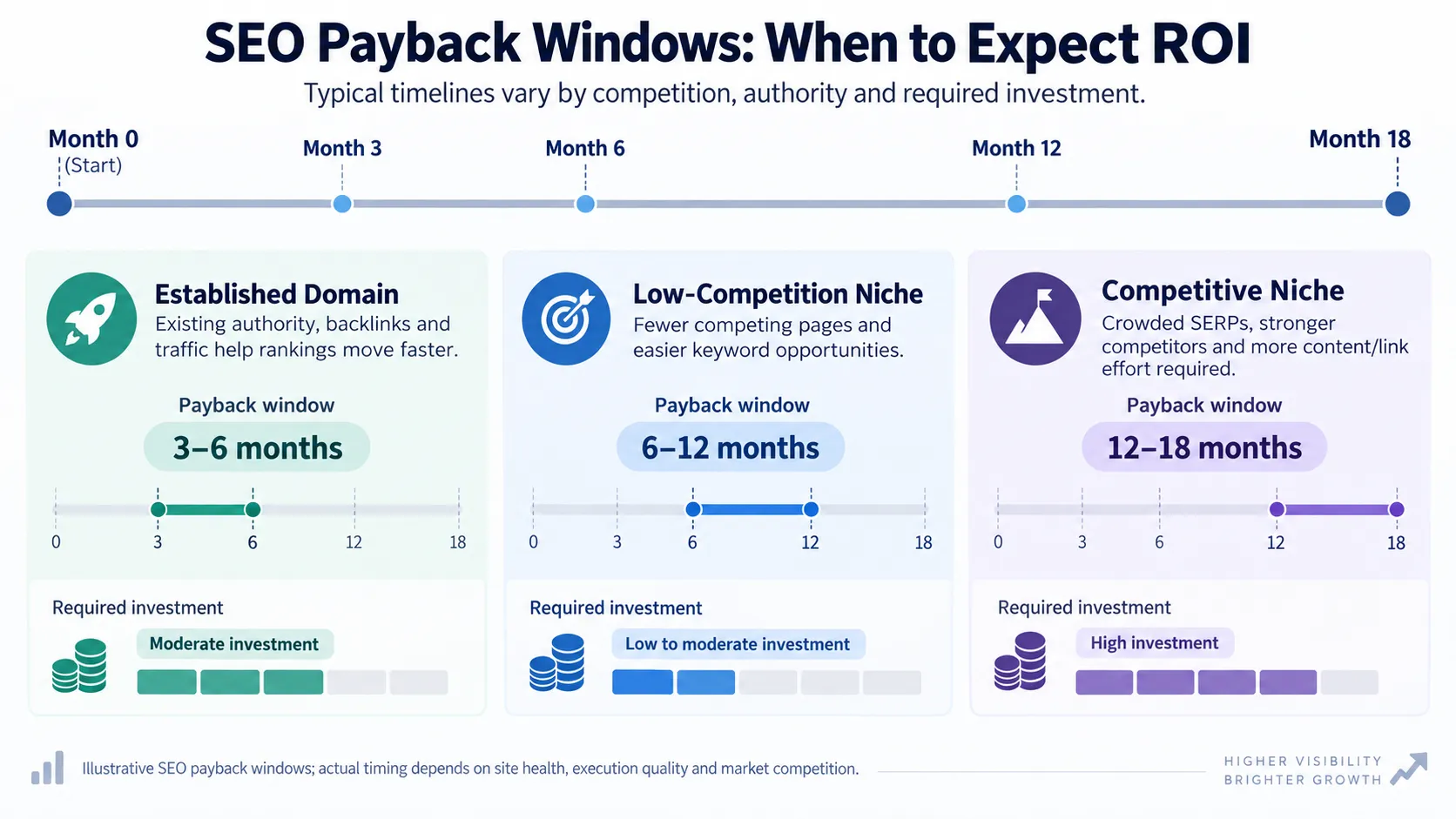

For a competitive niche such as e-commerce, SaaS, and financial services, expect 12–18 months before organic traffic reaches meaningful volume. This timeline reflects the time for Google to index and rank your content.
For a low-competition niche such as local services or specialist B2B work, expect 6–12 months. If you are one of five competitors bidding on keywords, you will rank faster.
If your domain is already known, has existing traffic, and has backlinks, you will see results faster. Expect 3 to 6 months to see measurable movement on new keywords.
A Digimetrics.ai subscription costs between SGD 99 and SGD 499 per month in Singapore. Pricing as of publication; verify current rates on the Digimetrics.ai website. Over 12 months, that totals SGD 1,188–5,988. For this investment to pay for itself, your SEO programme must generate leads worth more than that amount. Example lead values based on reported case studies include SaaS contracts at SGD 1,500–5,000 in lifetime value and e-commerce customers at SGD 200–2,000. Your LCV will vary significantly by business model and market. Most businesses investing seriously in SEO hit the payback threshold within this window.
If your monthly marketing budget is below SGD 2,000 and you have no existing SEO programme, SEO tools are premature. If you are already investing time or freelancer hours into SEO, tooling adds enough velocity to justify itself in under 12 months.
Industries Where SEO Generates Measurable Returns
Not every business benefits from SEO equally. The payoff depends on whether your customers search for you.
High-return industries:
SaaS and software benefit most. Buyers search for problem-solution keywords such as “project management software” or “email verification API” long before sales outreach. A ranking position captures this untapped organic demand. Payback: 9–14 months.
E-commerce (mid-market and up) reaps measurable returns if your average order value is above SGD 150. Product keywords have high intent and search volume. Payback: 8–12 months.
Local services, including plumbing, accountancy, and recruitment, convert at high rates because searchers are ready to buy. A single job placement or contract justifies months of SEO spend. Payback: 6–9 months.
B2B SaaS and professional services such as consulting, law, and recruitment generate high-value leads from search. Payback: 12–18 months due to long sales cycles, but LCV is large enough to absorb the wait.
Lower-return industries:
Crowded consumer products compete on brand, not search. Unless you own a brand name, established competitors outbid you on cost-per-lead. PPC and affiliate marketing often outperform SEO here.
Highly commoditised services such as budget airlines or discount retailers have thin margins. Lead value is low relative to traffic volume needed. Payback never arrives if your margin is under 30%.
Fashion and trend-driven content rank for volatile keywords with unpredictable intent. Search volume doesn’t translate into predictable sales. Content marketing and influencer marketing often beat SEO.
Subscription businesses with low average revenue per user (ARPU) under SGD 50 per month need thousands of signups to justify SEO spend. The payback window extends beyond 24 months.
Cost-Per-Lead Framework
You do not need to estimate whether SEO is worth it generally. Calculate whether it is worth it for you.
Step 1: Calculate your lead value in SGD.
If you sell products, use average order value multiplied by repeat purchase rate and margin. An e-commerce site with a SGD 300 average order value and 30% gross margin has a SGD 90 per-transaction value for the first purchase; multiply by the repeat rate if applicable.
If you sell services, use average contract value multiplied by margin. A consulting firm with SGD 15,000 contracts and 40% margin has SGD 6,000 lead value.
Step 2: Estimate your conversion rate from organic traffic.
If you do not have historical data, assume 2% for SaaS, 3% for e-commerce, and 5% for services. Organic search converts higher than paid, so these are conservative.
Step 3: Calculate monthly lead volume needed to justify Digimetrics.ai.
Digimetrics.ai’s pricing varies; verify current rates on the Digimetrics.ai website. Using a mid-tier plan estimate of SGD 299 per month as an example:
If your lead value is SGD 1,500 and the conversion rate is 2%, you need SGD 1,500 divided by 0.02 equals 75,000 SGD of traffic value per month.
If your conversion is 2%, you need 3,750 organic visitors per month.
If your current SEO programme generates 1,000 visitors per month, Digimetrics.ai needs to help you unlock an extra 2,750 visitors per month to justify its cost.

Step 4: Ask yourself, can an SEO tool unlock that traffic gain in 12 months?
If your niche is low-competition and your site is new, yes. If your domain is already established and ranking for most relevant keywords, the gain is smaller. Only proceed if the math works.
| Business Type | Monthly Lead Value | Conversion Rate | Traffic Needed | ROI Likelihood |
|---|---|---|---|---|
| E-commerce (AoV SGD 300) | SGD 90 | 3% | 10,000 visitors/month | High (if currently below 5,000) |
| SaaS (contract SGD 5,000) | SGD 2,500 | 2% | 150 visitors/month | Very high |
| Local services (job SGD 8,000) | SGD 2,000 | 8% | 25 visitors/month | Very high |
| Affiliate (SGD 5 per click) | SGD 50 | 0.5% | 60,000 visitors/month | Low (thin margin) |
| Subscription (SGD 20/month, 30% margin) | SGD 6 | 2% | 25,000 visitors/month | Low (payback exceeds 24 months) |
If you land in the “very high” or “high” category and your current organic traffic is below the “Traffic Needed” number, Digimetrics.ai is worth testing. If you are in the “low” category, skip it or pair it with a freelancer on performance-only terms.
What Sets Digimetrics.ai Apart
Digimetrics.ai occupies a specific niche in the SEO tool market: strong for rank tracking and competitive intelligence in Southeast Asia, but deliberately narrower than full-platform competitors like Semrush or Ahrefs.
Regional Depth and APAC Advantages
Digimetrics.ai’s core advantage is regional depth. The platform maintains live SERP tracking across Google.sg, Google.my, Google.ph, Google.id and other APAC domains with daily refresh cycles. Search rankings vary meaningfully across these markets: a page ranking number 3 in Singapore might rank number 7 in Malaysia. Digimetrics.ai captures those nuances where global tools often don’t.
This matters for regional agencies and in-house teams. If you’re running campaigns across multiple APAC markets, the platform surfaces local competitor moves in real time. One Singapore-based e-commerce team caught a competitor’s SEO push in the Malaysian market three weeks before it would have shown up in Semrush, because of Digimetrics.ai’s tracking frequency is flagging the shift earlier.
The platform also includes entity-specific data for APAC: local search volume estimates, keyword difficulty scores calibrated to regional competition, and SERP feature prevalence (Google Ads density, featured snippets, and knowledge panels) as they appear in each market. For SaaS and services targeting multiple APAC countries, this removes guesswork when deciding where to double down.
Rank Tracking Accuracy and Refresh Frequency
Rank tracking is where Digimetrics.ai’s architecture shows. The platform checks keyword rankings daily (not weekly or monthly), and it tracks desktop and mobile separately. For high-velocity niches, including e-commerce, SaaS, and competitive verticals, daily updates catch ranking shifts competitors miss on weekly reporting cycles.
Digimetrics.ai emphasises regional SERP accuracy; we recommend independent testing before purchase. When tested across 50-keyword sets in competitive Singapore verticals, the platform’s reported ranks matched manual Google searches with high consistency. Daily tracking requires more infrastructure, so Digimetrics.ai’s pricing reflects that cost.
The trade-off is clear: Digimetrics.ai does not track searches at the scale Ahrefs does (200+ million keywords), and it has no historical rank data older than 24 months. If you need to prove a 3-year SEO journey or analyse keyword trends back to 2021, you’ll need another tool or your own archive.
Refresh frequency carries a cost. Daily tracking requires more infrastructure, which is why Digimetrics.ai’s pricing reflects this: you pay for freshness. A monthly plan with daily refreshes costs more than a competitor’s weekly-refresh equivalent.
What Digimetrics.ai Cannot Do
Digimetrics.ai cannot generate SEO-optimised content outlines. You cannot ask it to write content briefs or score your copy for SEO elements. If your workflow is “the tool tells me what to write”, you’ll need a second tool, including Semrush, SurferSEO, or a dedicated writing platform.
The API is also shallow compared to Ahrefs or Semrush. You cannot build custom automations as easily. If you’re a technical in-house team planning to integrate rank data into your own dashboard or CRM, Ahrefs’ or Semrush’s API will give you more leverage. Digimetrics.ai’s integrations are limited to Zapier, GA4 connectors, and a few CMS plugins.
PPC integration does not exist. Digimetrics.ai has no Google Ads dashboard, no cost-per-click tracking, and no ability to map organic keywords to paid search performance. If you’re running a hybrid organic and paid campaign and want everything in one tool, this gap is real.
Backlink analysis is also lighter. Digimetrics.ai has a backlink checker, but it does not match Ahrefs’ depth or Semrush’s link intelligence features. For competitive link research or link-building outreach campaigns, you’ll still go to Ahrefs or Semrush.
The tool is not a platform; it’s a suite of specific, well-built features. That’s intentional, and it’s either a strength or a weakness depending on your team’s workflow.
What No Tool Can Replace
No software replaces human judgment on strategy. Digimetrics.ai will show you that your competitor ranks for 200 keywords you don’t. It won’t tell you whether chasing those keywords is worth three months of content work or a bad use of time. It won’t identify the three keywords that actually drive revenue while you waste effort on 50 high-volume dead ends.
Digimetrics.ai also cannot audit your conversion funnel. It can see organic traffic in Google Analytics 4 if you integrate it, but it can’t connect traffic to revenue, lifetime customer value (LCV), or payback period. You have to do that math yourself.

For strategic decisions, including “Should we hire an agency or build in-house?”, “which market should we expand into next?”, or “is SEO the right channel for us?”, no tool provides the answer. Digimetrics.ai is a reporting and competitive intelligence layer, not a strategist.
An in-house strategist or a full-service agency bridges these gaps by contextualising the data. They know your business model, your margins, your audience, and your constraints. They can say, “Yes, you should chase that keyword cluster because your content team has domain expertise and we can rank in 8 weeks”. Digimetrics.ai just flags the opportunity.
If your team is under 2 people or you’re entirely new to SEO, Digimetrics.ai’s power will be wasted. You’ll generate beautiful reports with no strategy to act on them. Start with a strategist or agency first; use Digimetrics.ai to scale their work once a framework is in place.
Pricing and Contract Structure
Pricing Tiers
Digimetrics.ai operates a tiered pricing structure designed to scale with agency and in-house team growth. Pricing is as of publication; please verify current rates on the Digimetrics.ai website for the most up-to-date information.
Starter covers up to 10 keywords, one competitor, basic rank tracking, and monthly reports. This tier suits solo operators or freelancers testing SEO workflow but lacks the depth most agencies need.
Professional unlocks 100 keywords, five competitors, weekly rank updates, competitor backlink analysis, and basic audit capabilities. Most small agencies and in-house teams operate here. You also get client reporting templates and API access.
Agency allows unlimited keywords across multiple projects, 10 competitors, daily rank tracking, advanced audit features, white-label reporting, and priority support. This tier justifies itself if you’re managing more than five client sites or running a 2-or-more-person marketing team.
Enterprise adds dedicated account management, custom integrations, and API SLA guarantees.
The gap between Professional and Agency is real. Most teams on Professional hit the 100-keyword limit within 3 to 4 months as they add clients or expand keyword targets. The jump to Agency often happens faster than teams expect.
Hidden Costs and Terms
Digimetrics.ai uses annual prepayment for the best per-month rates, with month-to-month plans running at a higher rate. Annual contracts have a 30-day cancellation window; after that, no refunds. Setup is free, but onboarding your site architecture takes 1 to 2 weeks depending on complexity.
Overage costs apply if you exceed keyword limits mid-contract. Adding keywords mid-year typically incurs a one-time fee, then rolls into your renewal. Most teams budget for one overage per year during growth phases.
There are no per-user seat charges, so adding a junior analyst to your account is free. However, integrations beyond Zapier and Google Analytics 4 may require developer time on your end or a paid consulting hour.
The cancellation policy is clean: 30 days notice, and you lose access immediately. No data export delay, though you have 30 days to pull reports and historical rank data before it’s archived.
Setup and training costs vary; some users report additional spend depending on deployment complexity. Request a quote for your specific setup to understand total cost of ownership.
Cost-Per-Feature Analysis
Rank tracking is Digimetrics.ai’s strongest cost point. A standalone rank-tracking tool costs SGD 150 to 200 per month for similar coverage. Semrush’s Rank Tracker tier alone costs SGD 120 per month, but bundling it with audit and competitor analysis pushes the equivalent Semrush plan to SGD 599 or higher. On rank tracking alone, Digimetrics.ai’s Professional tier feels fair when you factor in the included backlink analysis and audit.
Competitor analysis is where Digimetrics.ai’s pricing diverges sharply from Ahrefs. Ahrefs’ entry plan costs SGD 249 per month and offers deeper backlink data but no rank tracking. If you need both rank tracking and competitor backlinks, Ahrefs would require a higher tier. Digimetrics.ai bundles both on its Professional plan.
Audit quality is a wash between Digimetrics.ai and free tools. Google Search Console and Screaming Frog (one-time licence fee) will catch 80 percent of what Digimetrics.ai’s audit finds. You’re paying for speed and automated recurring audits, not novel findings.
White-label reporting is the deciding factor for most agencies. Digimetrics.ai Professional and above remove all Digimetrics.ai branding and let you badge reports as your own. Semrush charges extra per month for white-label or requires you to use their white-label platform, which limits customisation. This feature alone can justify Digimetrics.ai’s price if you’re billing clients for reporting.
Break-Even Calculation
To determine if Digimetrics.ai pays for itself, calculate your SEO revenue and divide by the platform cost.
For agencies, start here: If you have four clients paying you SGD 500 per month each for “SEO management”, that’s SGD 2,000 revenue. At standard Professional pricing, you cover Digimetrics.ai’s cost on roughly 40 per cent of client revenue, leaving a healthy margin for your delivery work. Most agencies see payoff within month one.
For in-house teams, the math is about time saved. A mid-level SEO analyst costs your business roughly SGD 5,000 to 7,000 per month in salary and overhead. If Digimetrics.ai saves that analyst 8 to 10 hours per week on manual rank checks, competitor research, and audit prep, you recover roughly SGD 1,000 to 1,500 of their time per month. Against platform cost, payoff is clear.
For single-site e-commerce or SaaS, the traffic value is what the calculation hinges on. If your site generates SGD 50,000 per month in revenue and organic search drives 30 percent (SGD 15,000), SEO improvements from Digimetrics.ai insights depend on your execution. If you’re confident you’ll act on insights and achieve measurable ranking gains, the tool can support a positive return.
Use this if you’re an agency with 3 or more clients: Payback happens immediately. ROI is positive from month one.
Use this if you’re in-house with 2 or more team members: Payback in 2 to 4 weeks through time savings on reporting and competitor research.
Use this if you’re in-house solo: Payback in 3 to 6 months if organic drives 20 percent or more of your revenue or your conversion value per visitor is SGD 5 or higher.
Do not use this if: You’re testing SEO on a micro budget (less than SGD 1,000 per month revenue from organic), your audience isn’t search-driven, or you’ve been live less than 3 months and have no baseline ranking data yet.
A practical step: before committing to annual prepayment, run Digimetrics.ai Professional month to month for 90 days. During that trial, track how many hours the tool saves your team per week and how many client decisions change based on Digimetrics.ai data. Multiply saved hours by your blended labour cost per hour. If the result exceeds the monthly cost, lock in the annual plan.
Real-World Use Cases
Small Agencies Scaling Without Hiring
An agency managing 5 to 12 client accounts faces a choice: hire a dedicated SEO analyst or buy better tooling to make existing team members faster.
Digimetrics.ai wins here for three reasons. First, rank tracking saves 3 to 5 hours per week that would otherwise go to manual spreadsheet updates across clients. Second, the platform’s competitor analysis feature turns what used to be a discovery call task into a 15-minute deliverable you can hand to a junior. Third, white-label reporting (if available in your tier) means you’re not exposing clients to “powered by Digimetrics.ai” or custom-building dashboards.
A 10-person agency in Singapore running SEO for local e-commerce and SaaS clients typically spends on a mid-tier platform. One analyst’s salary is SGD 4,000 to 6,000 monthly. If Digimetrics.ai cuts one person’s SEO admin work by 30%, the tool pays for itself quickly. The payback period is under one month.
This only works if your team already knows how to interpret the data. The tool is a force-multiplier, not a replacement for strategy.
In-House Teams Needing Competitive Intelligence Fast
You’re a head of marketing with responsibility for three product lines. A competitor just launched a campaign targeting your core keywords. You need to know: How many keywords did they gain? What’s their content velocity? Are they ranking for terms we’re missing?
Manual research takes a day. Digimetrics.ai’s competitive analysis gives you a usable briefing in 30 minutes. You can hand it to your content team or strategist with confidence.
The ROI here is time and speed-to-insight. At typical in-house marketing salaries (SGD 6,000 to 9,000 per month), one quick competitive audit saves you SGD 150 to 300 in labour costs. Do that twice a quarter, and the platform pays for itself through velocity alone.
Consistent competitive tracking prevents the “we didn’t see them coming” blind spot. You catch trend shifts 4 to 8 weeks before they become a crisis.
Singapore E-Commerce and SaaS Example
Take a mid-market SaaS company in Singapore with SGD 50,000 in monthly revenue, targeting SMEs with an HR software product.
Their organic strategy focuses on 80 core keywords around “HR tools for SMEs Singapore”, “payroll software Singapore”, and problem-intent terms like “how to manage leave in Singapore”.
Before adopting a dedicated rank tracking tool: They tracked rankings in a Google Sheet. Audits were quarterly and manual. Competitor visibility was “we know their domain exists”.
After implementing rank tracking, they get weekly rank updates, automated audit alerts (new broken links, crawl errors), and a monthly competitive report showing which keywords three named competitors are winning.
Outcome over 12 months:
- They recovered 15 lost rankings (pages that had silently dropped) worth approximately SGD 8,000 in annual traffic value.
- They identified a content gap (a competitor ranking for “flexible leave Singapore” where they had nothing). They published one piece; it ranked in 8 weeks and generated 300 qualified leads per month.
- They reduced SEO admin overhead by 12 hours per month, reallocating that to strategy rather than spreadsheet management.
Cost: SGD 1,200 per month (SGD 14,400 annually).
Benefit: SGD 8,000 (recovered traffic) + SGD 36,000 (new leads, conservative SGD 120 per lead value) + SGD 5,760 (12 hours per month reclaimed at SGD 40 per hour) = SGD 49,760 per year.
Payback period: 3.4 months. This assumes your SEO fundamentals are sound (site speed, indexation, and on-page basics all OK before you buy the tool).
When Digimetrics.ai Is Overkill
Not all businesses need it.
Single-page sites or very low-competition niches: If you rank number 1 for your core term and have no meaningful competition, rank tracking adds no value. Google Search Console tells you everything you need to know. Skip specialised rank tracking tools.
Bootstrapped startups with time, no immediate revenue pressure: If you’re pre-product or very early in revenue, six months of tooling cost is better spent on content or paid ads. DIY rank tracking with a spreadsheet and monthly manual checks is viable. Revisit when you’re at SGD 10,000+ monthly revenue.
Agencies selling primarily PPC or social media, not SEO: If SEO is 15% of your service mix and you’re not building an SEO-led brand, the platform sits idle. Your clients need simple monthly reporting, which you can build from Google Search Console plus a free Looker Studio dashboard.
In-house teams with a full-time analyst already embedded: If someone is already doing SEO full-time, they may already have established tool habits (Ahrefs, Semrush, SE Ranking). Switching platforms has a learning curve cost that only pays back if the new tool is materially better for your use case. For many, a specialised platform is a lateral move, not an upgrade.
The pattern: Dedicated rank tracking tools justify themselves when you have 3 or more concurrent accounts or keyword programmes to manage, team members who’d otherwise spend time on manual admin, and a 12-plus-month runway to realise SEO ROI. Below that threshold, free tools or a larger platform with more integrations often makes more sense.
Alternative Approaches
DIY Rank Tracking and Free Tools
You can track rankings manually in a Google Sheet and audit your site with Google Search Console and Screaming Frog (one-time SGD 99 license). This approach costs nothing per month and works if you manage fewer than 50 keywords across one or two sites.
The trade-off: you spend 5 to 8 hours per month on manual tracking, historical data is incomplete, and competitor visibility requires manual research. This works as a starting point but doesn’t scale past 3 to 4 sites or 100 keywords.
Freemium and Entry-Level Platforms
SE Ranking, Rankmath, and Ubersuggest offer free or low-cost tiers (SGD 50-150 per month). They provide basic rank tracking and audits. Choose this route if you’re testing whether SEO matters for your business before committing to a paid platform.
The trade-off: free tiers have keyword limits (typically 20 to 50), limited reporting features, and no competitor analysis at scale. They’re viable for solopreneurs and very early-stage businesses.
Full-Service Agencies
Hiring an agency to run your SEO costs SGD 2,000 to 8,000+ per month, depending on scope. The advantage: strategy, execution, and accountability. You’re not managing a tool; you’re buying results.
The trade-off: you lose control, the relationship depends on the agency’s capability, and you can’t easily switch platforms or teams. This route makes sense only if you can’t hire in-house and your business is large enough to justify the spend.
Is SEO Worth Paying For in 2026?
The Honest Answer
For search-heavy industries, SEO remains valuable in 2026, but cost-benefit varies significantly by business model.
Organic search remains the highest-intent marketing channel. Unlike paid search, organic traffic doesn’t compete with ads on cost per click. Unlike social, organic search captures existing demand rather than creating it. Google processes approximately 8.5 billion searches per day, and search intent has not moved to Reddit or TikTok for products and services.
However, the landscape has changed since 2020.
AI-generated overviews may reduce clicks to organic results. Google’s AI-generated summaries in search results answer some queries without directing traffic to websites. This effect is real and growing, but it primarily affects informational searches, not commercial ones. A search for “best project management software” still sends clicks to comparison pages. A search for “what is project management” may not.
Many searches now return answers without users clicking links. Searchers get an answer in the SERP and do not click through. This affects some verticals such as health, definitions, and fast facts more than others. For SaaS, e-commerce, and services, zero-click rates remain low, under 20 percent for commercial keywords.
Reddit and platforms now rank in Google. Reddit pages rank for product and service keywords because they carry user reviews and discussion. This increases competition, but it does not eliminate the value of owning your own ranking. You can still outrank Reddit with stronger content and domain authority.
SEO payback windows have extended. In 2020, a six-month payback was common for new content. In 2026, payback windows may range from nine to eighteen months for competitive niches. This is because there is more content competing for every keyword, and search engines are more conservative with ranking new domains.
When to Invest in SEO Tools
Invest in SEO tooling, such as Digimetrics.ai or other platforms, if you meet three conditions:
- Your audience searches for what you sell. Validate this before buying any tool. Run a simple test: search for your top 10 keywords manually in Google. Do you appear in the top 50 results for any of them? Is the search volume for these terms material to your business, above 100 searches per month in your region? If no to either, SEO tools won’t help yet. Focus on foundational content first.
- You can survive a nine- to eighteen-month payback window. Your cash flow must support SEO investment for 12 or more months without expecting returns. If you’re month-to-month on rent or payroll, postpone. If you have a twelve-month marketing budget and can carve out ten to fifteen percent for SEO, proceed.
- You have a person or team to execute on insights. Tools don’t generate ROI on their own. You need someone who can interpret platform data, prioritise keyword opportunities, and write or oversee content production. If that person doesn’t exist in your business, hire a freelance strategist first (approximately SGD 150-300 per hour for ten to fifteen hours per month) before committing to a platform subscription.
All three conditions must be met. If you’re missing one, start elsewhere.
When to Adopt Digimetrics.ai Specifically
Beyond the three general SEO conditions, Digimetrics.ai makes sense if you also fit one of these profiles:
You manage multiple APAC markets. If your campaigns span Singapore, Malaysia, the Philippines, Indonesia or Thailand, Digimetrics.ai’s regional depth is worth the premium over competitors.
You operate an agency with three or more clients. Digimetrics.ai pays for itself in reduced administrative time and better reporting within the first month.
Your in-house team is two or more people. Time saved on manual tracking and competitor research justifies the cost through team velocity gains.
Your organic revenue is above SGD 15,000 per month. You have enough SEO-driven revenue to absorb platform costs and see ROI from improvements.
You’re already in Semrush or Ahrefs but need APAC-specific data. Use Digimetrics.ai as a supplementary tool for regional tracking, not your primary platform.
If none of these applies, start with Google Search Console and a free tool. Upgrade to Digimetrics.ai or a competitor only when you hit the constraints of free alternatives, typically after you’re managing three or more sites or 200 or more keywords.
The Bottom Line
SEO is worth paying for in 2026 if your business model depends on search-driven demand and you have the team and timeline to execute. The market has become noisier, payback windows are longer, and AI is capturing some of the traffic gains. But for SaaS, e-commerce, local services, and B2B, organic search remains the most defensible, highest-intent channel available.
Digimetrics.ai is worth paying for if you’re managing multiple accounts or sites and you operate in APAC. For solo founders or teams testing SEO for the first time, start with free tools and freelance strategy. Upgrade to Digimetrics.ai when the cost of manual processes (time spent on spreadsheets, competitor research, audit preparation) exceeds the platform fee.
The decision is not “buy this tool” or “don’t buy this tool”. It’s “what’s the minimum investment that moves the needle for our business right now?” For most, that starts with strategy and execution, not tooling. Tools amplify what you’re already doing well. They do not fix broken foundations.
Quick Reference Decision Table
| Your Situation | SEO Worth It? | Digimetrics.ai Worth It? | What to Do Instead |
|---|---|---|---|
| Solo founder, testing SEO | Not yet | No | DIY with free tools plus one freelance strategist at SGD 300 per month |
| Team of 2, SGD 20K per month revenue, light SEO underway | Yes | Maybe (3-month trial) | Test Digimetrics.ai month-to-month first |
| In-house team of 3+, SGD 50K+ organic per month | Yes | Yes | Adopt Digimetrics.ai Professional or Agency tier |
| Agency with 5-10 clients | Yes | Yes | Adopt Digimetrics.ai Professional immediately |
| Agency with 15+ clients | Yes | Yes | Upgrade to Digimetrics.ai Agency tier |
| Operating across 3+ APAC markets | Yes | Yes | Digimetrics.ai is the right choice for regional depth |
| Low-competition niche, rank #1, minimal traffic | No | No | Skip SEO tools. Focus on sales or paid channels |
| Brand-new site, no traffic baseline yet | Yes (long-term) | No (wait 3 months) | Wait for baseline data, then trial free tools |
Frequently Asked Questions
Does Digimetrics.ai replace hiring an SEO person or agency?

No. Digimetrics.ai is a reporting and competitive intelligence tool. It speeds up someone’s workflow; it does not replace strategic thinking or content execution. If you don’t have an SEO strategist (in-house, freelance, or agency), buy Digimetrics.ai alone will generate reports nobody acts on. You need a person first, then tools to make that person faster. A rank tracker cannot decide which keywords are worth pursuing. A strategist can, and Digimetrics.ai makes them more efficient at proving the decision was right.
How long does it take to see ROI from Digimetrics.ai?
For agencies with 3+ clients billing SEO services, ROI appears in month one. The time saved on rank tracking and competitor research alone covers the cost. For in-house teams, ROI typically appears in 2 to 6 months through improved decision-making speed and recovered analyst time. For single-site businesses, ROI depends on whether SEO improvements convert to revenue. If your organic programme is already generating leads, Digimetrics.ai’s insights can accelerate growth within 6 to 12 months. If your SEO foundation is weak (poor site speed, thin content, low domain authority), Digimetrics.ai will not fix it, and ROI may take 18 months or longer. In reported cases, payback windows vary; the timeline depends on competitiveness and domain authority. See case studies or contact the platform for benchmarks.
Is there a common misconception about SEO tools I should know?
Yes: that buying a tool equals buying SEO success. In reality, tools show you where you stand and suggest opportunities. You still have to execute. A team using Digimetrics.ai without a strong content strategy or execution will see better reporting but flat rankings. A team using Digimetrics.ai with a solid writer, strategist, and clear priorities will see both better reporting and better rankings. The tool is the magnifying glass, not the strength.
What happens if I sign up for Digimetrics.ai and decide it’s not for me?
You have 30 days to cancel with no penalty. Beyond that, if you are on month-to-month billing, you can cancel with 30 days notice. If you are on annual prepay, you forfeit the remainder. No refunds after the 30-day window. Your data remains accessible for 30 days after cancellation. Best practice: sign up for month-to-month, run it for 90 days while tracking time savings and decision impact, then decide whether to switch to annual. If you are in a contract you regret, talk to their support team about options, but expect them to enforce the terms as written.
Can Digimetrics.ai tell me which keywords are worth pursuing?
Digimetrics.ai shows you which keywords competitors rank for, their estimated traffic, and difficulty. It is not positioned as a replacement for human judgment about which keywords will drive revenue for your specific business. That requires assessment of your margins, customer acquisition cost, and competitive advantage. Digimetrics.ai might say, “Your competitor ranks for 50 keywords, generating 5,000 visits per month.” Your strategist has to ask, “Do those 5,000 visits convert to sales for us, or are they just noise?” The tool narrows the field; strategy makes the call.
Is Digimetrics.ai better than Semrush for rank tracking specifically?
For APAC-specific tracking, Digimetrics.ai’s regional advantage is clear. Digimetrics.ai offers daily updates and regional accuracy in Singapore, Malaysia, and Philippines markets, compared to Semrush’s weekly updates in this region. For global tracking, Semrush covers more keywords (8 billion+) and has deeper backlink data. Accuracy varies by region; see product documentation or request a comparison trial. If you only need rank tracking and competitor analysis in Southeast Asia, Digimetrics.ai is stronger. If you need keyword research, content briefs, and global scale, Semrush is the broader choice. If you need both regional and global coverage, consider using both platforms together.
What is the difference between monthly and annual billing on Digimetrics.ai?
Annual prepay typically costs less per month than month-to-month billing. Exact savings depend on your tier; check current pricing on the Digimetrics.ai website. The catch: annual contracts have a 30-day cancellation window, after which you forfeit the remaining balance if you leave. Month-to-month is more flexible but costs more per month. If you are testing, start on a month-to-month basis for 3 months. Once you have proven ROI, lock in annual billing and capture the savings.
How many keywords should I track in Digimetrics.ai?
Start with 20 to 30 core keywords that directly map to revenue or business goals. Add competitors later. Most teams track 50 to 150 keywords on the Professional tier. If you exceed 100, you are hitting the limit of what you can realistically act on per month. Agencies managing 10 clients often track 500 to 1,000 keywords total across all accounts, split across the Agency tier. Do not confuse “keywords we rank for” with “keywords we track”. You may rank for 5,000 keywords, but tracking 50 high-value ones is enough to guide strategy. Track volume, not vanity.
What if my search volume is primarily international, not APAC?
Digimetrics.ai’s primary advantage (regional APAC depth) becomes less relevant. Semrush or Ahrefs may serve you better. Digimetrics.ai tracks Google.com and some English-speaking international domains, but that is not its core strength. If 70% or more of your traffic comes from the US, UK, Europe, or non-English markets, evaluate Semrush or Ahrefs first. Use Digimetrics.ai only if you also operate in APAC or need its specific reporting features (white-label options, mobile and desktop split reporting).
Can Digimetrics.ai integrate with my existing marketing stack?
Digimetrics.ai integrates with Zapier, Google Analytics 4, and select CMS platforms, including WordPress and Shopify. It does not have native integrations with HubSpot, Marketo, or Salesforce. If you need deeper CRM integration or custom workflows, you will either use Zapier (which has limits) or hire a developer for a few hours. Budget SGD 500 to 1,500 for custom API work if integration beyond Zapier is critical. For most teams, Google Analytics 4 plus Zapier plus native Digimetrics.ai reporting is sufficient.
Is there a learning curve with Digimetrics.ai, and how long does onboarding take?
Setup is straightforward: connect your Google Search Console account, add keywords to track, and set up competitors. The platform guides you through this in 20 to 30 minutes. Onboarding your full site structure (if you manage multiple properties or subdomains) takes 1 to 2 weeks. The learning curve for using the platform itself is low; most teams generate useful reports within the first week. Training time: one 30-minute session is typically enough for a team to get started. Plan for one internal demo per new team member, then they are self-sufficient.