| AI Summary
The top AI marketing agencies in Singapore differ in AI search, campaign management, automation and data integration. Compare MediaOne, Brew Interactive, OOm and Hashmeta by published capabilities, your sector and documented project evidence, rather than treating any list as a proven performance ranking. Use a common brief, realistic pilot, PDPA data controls and clear attribution measures before committing to an agency contract. |
Choosing among the top AI marketing agencies in Singapore takes more than comparing service lists or impressive claims.


The right partner should understand your customers, work with your existing technology, protect personal data under Singapore’s PDPA, and show how its recommendations improve measurable outcomes. Some agencies specialise in AI-powered advertising, while others focus on customer insights, automation, content or lead generation.
Before signing a contract, examine relevant case studies, ask about data governance, and agree on realistic targets and reporting.
Key Takeaways
- The top AI marketing agencies in Singapore should be compared by service fit, evidence, data handling and measurement, not by unsupported claims of being first or best.
- Singapore’s official digital economy report found AI adoption by SMEs rose to 14.5% in 2024, while non-SME adoption reached 62.5%. Those are economy-wide figures, not marketing-specific adoption rates.
- Request an itemised proposal rather than relying on a fixed market-wide monthly fee. The cost of native platform automation differs from custom model development.
- Under Singapore’s PDPA, organisations remain responsible for appropriate handling of personal data. A particular certificate is not a universal legal requirement.
- Set a baseline, run a bounded pilot and compare commercial outcomes against a control or a defensible before-and-after measure. No agency can guarantee an uplift in a fixed number of weeks.
Why AI Marketing Agencies Matter in Singapore’s Market
The Shift Towards Automation and Data-Driven Decision-Making
Singapore businesses compete locally and across Southeast Asia. AI-assisted marketing can help teams analyse first-party customer information, identify audiences, draft campaign variations, manage advertising bids and route sales enquiries. These capabilities differ by platform, and a small business may use them without commissioning a custom AI model.
Traditional campaign teams can also use data to make decisions. The practical difference lies in which activities are automated, how models are tested and how people review the outputs. Google and Meta, for instance, already offer automated campaign features; an agency should explain the added value of its own configuration, creative work or measurement rather than presenting platform features as proprietary inventions.
AI can support more timely decisions when suitable data is available. A model might reveal that returning customers respond differently to offers than first-time visitors, or that enquiries from one campaign convert into sales more often. Treat those findings as hypotheses to test, not truths simply because software produced them.
For Singapore organisations, the first question is whether an agency can work with existing analytics, sales and customer systems. A useful audit identifies incomplete conversion tracking, duplicate records, missing permissions and unclear success metrics before additional software is purchased.
If your company has limited data, rules-based automation may be more useful than prediction. A well-designed welcome email sequence or CRM follow-up rule can solve a real problem without model training. For a broader decision framework, review MediaOne’s AI marketing strategy guide.
Current Adoption Rates Among Singapore Businesses
AI adoption is growing, but broad economic adoption must not be mistaken for AI marketing adoption. IMDA’s Singapore Digital Economy Report 2025 reports that 14.5% of SMEs adopted AI in 2024, up from 4.2% in 2023; the comparable share for non-SMEs was 62.5%, up from 44%.
These figures cover AI used in different business functions, including IT, customer service, finance and accounting. They do not establish the proportion of firms using predictive advertising, personalised recommendations or AI content tools. Do not use broad AI adoption data to claim a matching percentage of marketing-specific AI usage.
What is relevant for a buyer is the gap between an agency’s sales language and your needs. Ask whether it is applying native tools, integrating third-party products or developing models. Each approach can be appropriate, but the required skills, running costs and ongoing oversight are different.
Organisations with smaller budgets should begin with one measurable problem, such as improving lead qualification or reducing manual campaign reporting. Firms with larger, well-governed datasets may be ready for more advanced experimentation. Treat adoption statistics as context, not evidence that every business must buy AI marketing immediately.
ROI Expectations: What Brands Should Realistically Plan For
AI marketing does not produce a universal first-year return. Treat reports of large improvements as case-specific until they identify a baseline, time period and comparable control; sector-wide uplift ranges require a transparent research method. Results depend on the channel, spending level, attribution method, existing performance and data quality.
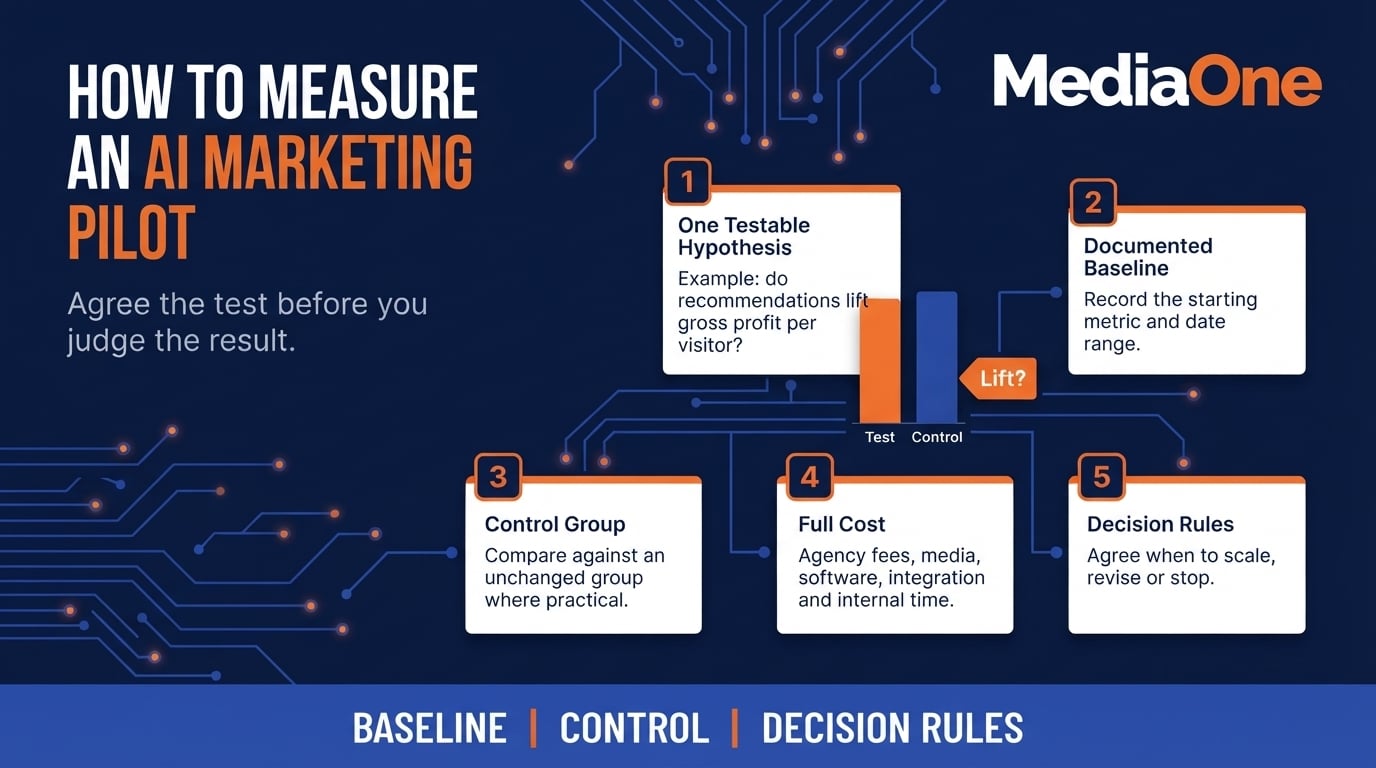
Begin by defining one testable hypothesis. A retailer might ask whether personalised product recommendations improve gross profit per visitor. A B2B company might ask whether automated lead routing increases the proportion of enquiries contacted within one business day. A service business might compare the time spent preparing reports before and after introducing approved automation.
Measure the cost of implementing and maintaining the change alongside any incremental revenue or labour savings. Include agency fees, media spend, software subscriptions, integration work and the internal time needed to approve output. When practical, compare a treatment group with an unchanged control group. If no control is available, acknowledge the limitations of a before-and-after comparison.
A pilot can reveal useful issues before it provides a statistically reliable sales outcome. Data gaps may need to be repaired first; niche B2B sales cycles may take months. Ask the agency to distinguish activity milestones, such as a CRM integration going live, from commercial results such as qualified opportunities or contribution margin.
SaaS and B2B firms can test lead scoring against eventual sales acceptance, rather than counting scored leads alone. E-commerce teams can measure revenue per session, return rates and gross margin instead of relying on clicks. Financial services firms must give particular attention to eligibility, privacy and whether automated decisions require human review.
The single most useful ROI commitment is a documented baseline, a test design and agreed decision rules. Data quality still determines how credible any outcome will be. Poor inputs can lead to misleading automated decisions, irrespective of the sophistication of the model.
MediaOne: An AI-Enabled Marketing Agency in Singapore
Core Service Offerings and Specialisations
MediaOne is a Singapore digital marketing agency that publicly describes AI-supported work across search engine optimisation, paid media and AI search visibility. Its own website identifies Digimetrics as an internal AI marketing workspace used for audits, content planning and campaign recommendations. These are the publicly described capabilities; buyers should request a live demonstration and evidence of the functions relevant to their brief.
MediaOne also offers generative engine optimisation services aimed at improving the clarity and visibility of business information in AI-assisted discovery. This is a specific service within the wider field of AI marketing. It should not be treated as proof that an agency also builds bespoke propensity models, dynamic-pricing engines or AI customer-service systems.
For e-commerce organisations, ask MediaOne which commerce platforms and product feeds it can support in your particular account. Confirm how its team handles inventory information, campaign creative, consent and sales attribution. For B2B businesses, discuss conversion tracking, lead quality and CRM hand-offs before commissioning sophisticated predictive scoring.
AI-based conversion rate optimisation can be valuable when a site has enough activity to compare alternative pages or messages. However, running more tests simultaneously does not automatically generate faster or more reliable answers. Require a written test plan, agreed sample criteria and clear rules for stopping or revising a test.
For customer support or chatbot projects, confirm whether conversational software is in scope, which vendor supplies it, and who handles support, security and escalation. Request working examples of any promised Zendesk, HubSpot or WhatsApp integrations rather than assuming they are included.
Track Record and Client Success Metrics
MediaOne publishes service information and examples of work. When comparing agency performance, request client-approved campaign records that explain the initial situation, intervention, observation window and calculations. A positive outcome in one sector does not establish what another client can expect.
A link to the ISO 27001 standard does not verify that a particular agency holds certification, and a SOC 2 Type II report is a separate form of assurance. Ask for the certificate number, issuing body, scope and valid dates, or for an appropriately shared third-party assurance report, before citing security credentials in procurement documents.
For a more useful assessment, request recent, client-approved case studies with the starting metric, dates, scope of work, media spend and calculation method. Look for results that match your use case and budget. Where an agency cannot share a named client, it can still demonstrate its measurement design or anonymised workflows without representing illustrative numbers as proven results.
Unique Differentiators in the Singapore Market
An agency’s genuine differentiator may be subject expertise, a well-run analytics process, native-platform knowledge or proprietary tooling. For MediaOne, a verifiable point of difference is that it publicly presents Digimetrics as an AI-assisted marketing tool. Whether that improves results for your business requires a live test against your existing workflow.
Do not assume that an agency maintains a dedicated in-country data science team, connects directly to public-sector databases or hosts all client data locally unless it demonstrates those capabilities. Singapore law does not require all personal data to stay in Singapore; overseas transfers are subject to PDPA requirements.
Ask who will actually work on the project, where personal data will be processed, which subcontractors are involved and how long information is retained. Compare service boundaries in writing. In a procurement process, specific evidence is more valuable than a broad claim of technical leadership.
Pricing and Engagement Models
AI marketing services may be sold on a retainer, by project milestone or through a mixture of fixed fees and outcome-related incentives. Compare current written quotations and contract terms rather than relying on published figures for unrelated service packages.
Retainer model: A monthly fee can cover recurring campaign management, reporting and optimisation. Define which platforms, creative assets, approvals and meetings are included and whether advertising spend is separate.
Performance model: A base fee plus an agreed outcome measure can make sense where lead qualification or sales attribution is clear. Specify how incremental results are calculated, who owns the accounts and what happens when external factors change performance.
Hybrid model: A fixed implementation phase followed by ongoing services can separate one-off setup from recurring optimisation. State whether data cleansing, integrations, licences, legal review and model maintenance are included.
Request quotations for a comparable scope from every shortlisted agency. The lowest monthly retainer may be more expensive after software charges, media spend, technical changes and reporting support are added. Compare total commitment, exit terms and the ability to export your own data.
How to Evaluate and Select an AI Marketing Agency
Choosing the right AI marketing agency is not a commodity purchase. The difference between a capable vendor and one that underperforms can significantly impact your campaign results. This section walks you through a replicable decision framework so you can assess agencies objectively, regardless of their sales pitch.
Critical Capability Assessment Framework
Before you speak to any agency, build a scorecard. The framework below maps the capabilities that matter most in Singapore’s market to practical scoring criteria.
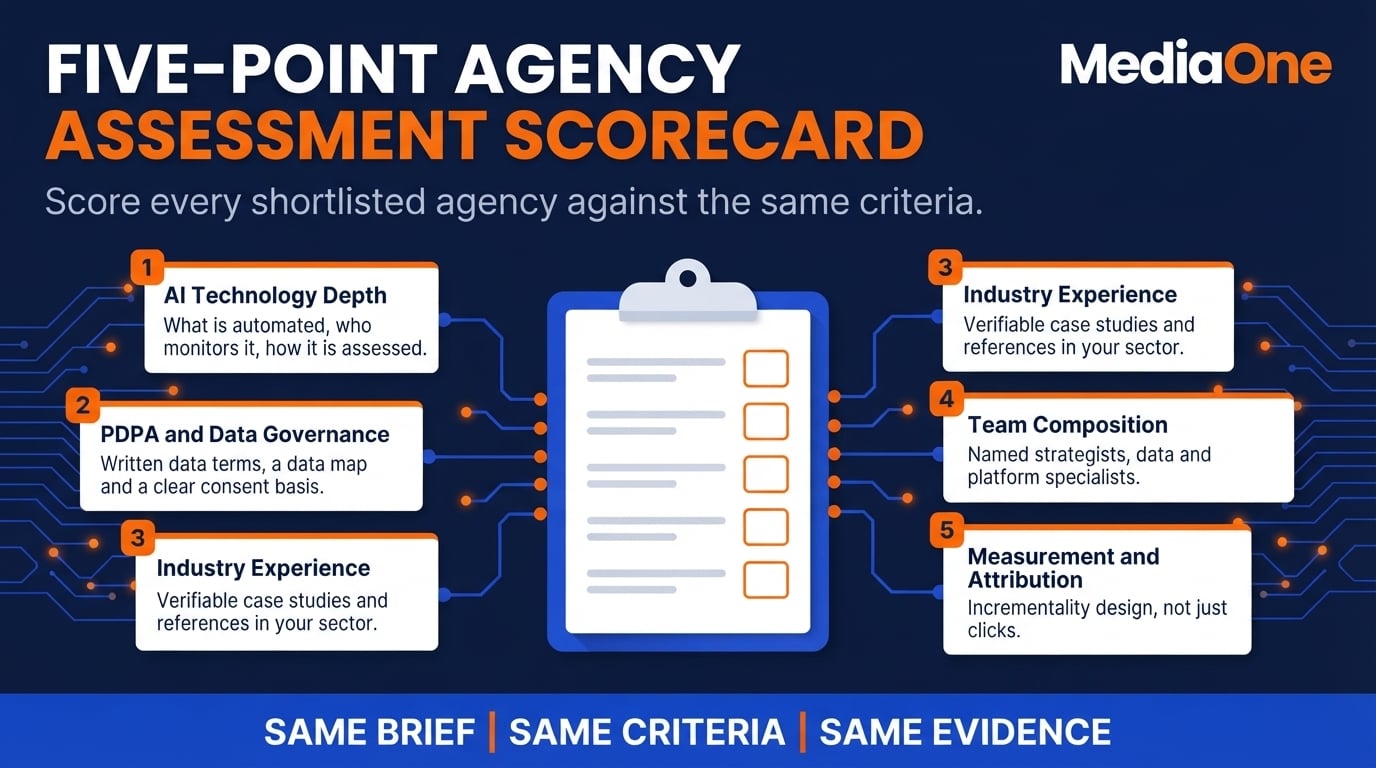
- AI Technology Depth (Not Just Tools)
Agencies vary in whether they configure off-the-shelf platforms, connect tools or build their own models. Each approach can be appropriate, depending on your use case. Ask prospective partners:
- Do they build proprietary models, or do they resell Salesforce, HubSpot, or Meta’s native AI?
- Can they explain how their AI learns from your data? What feedback loops exist?
- Do they have data scientists on staff, or is AI handled through integrations alone?
Red line: If they cannot explain what is automated, who monitors it and how performance is assessed, their proposal needs more detail. Proprietary model development is not a requirement for every useful engagement.
- PDPA Compliance and Data Governance
Singapore’s Personal Data Protection Act applies when organisations collect, use or disclose personal data. The PDPC’s guidance on personal data in AI systems explains relevant consent and data-intermediary considerations. Ask an agency to demonstrate:
- Written data processing agreements aligned to PDPA requirements.
- Clear separation of your data from other clients’ data.
- A lawful basis for each proposed data use, with documented consent where required and an explanation of any applicable exception.
- Proof of encryption and anonymisation where applicable.
Do not accept vague assurances. Ask for a data map, proposed safeguards and clear incident-response contacts. Have your privacy team or adviser assess any high-risk processing before signing.
- Industry Vertical Experience
Singapore’s economy has distinct sectors: fintech (banking and payments), proptech (real estate), e-commerce, B2B software, and financial services. Ask what experience the proposed delivery team has in your particular sector.
Score each agency on:
- Number of verifiable case studies in your sector.
- Client list in your vertical (ask for at least 3 named references).
- Custom methodologies or templates they have built for your industry.
Fintech and real estate demand different compliance and messaging approaches. If the agency treats all sectors identically, they lack the specialisation to deliver meaningful results for you.
- Team Composition and Certifications
A weak signal is an agency where one person does everything. Strong signals include:
- Dedicated data engineers who prepare and clean data.
- AI specialists with degrees or certifications in machine learning, data science, or statistics.
- Campaign strategists who translate AI outputs into business decisions.
- Account managers who have held marketing or analytics roles in-house.
Check credentials on LinkedIn. Certifications can show platform familiarity but do not independently prove delivery quality. Review the work of the people assigned to your project.
- Measurement and Attribution Capability
Many agencies measure what they can see (clicks, conversions) not what is important (incrementality, true ROI). Ask:
- Do they use multi-touch attribution models, or just last-click?
- Can they measure offline conversions (store visits, phone calls, in-app events)?
- What is their process for isolating the lift from AI interventions versus baseline performance?
A strong answer includes a plausible incrementality design when the budget and data permit it. Basic conversion tracking can still be an appropriate first step for smaller accounts.
Questions to Ask During Vendor Evaluation
Use these 12 questions in discovery calls. Note how the agency answers, not just what they say.
- Walk me through a real campaign you ran in my industry. What was the challenge, what did your AI do, and what was the result?
Listen for specifics about the measurement method. A useful case explains the starting situation, audience, intervention, test period, calculation and limitations. Ask whether the figures are client-approved and whether advertising spend and other changes were controlled for.
- Show me your contract and data processing agreement. What data do you store, how long, and where is it hosted?
Do not move forward without seeing this in writing. If they push back, walk. Regulators expect organisations to understand their data vendors’ practices thoroughly.
- If I stop working with you tomorrow, how quickly can I recover my data and models in a format I own?
A good agency shows export formats, data ownership, notice periods and handover responsibilities in the agreement. The turnaround should be appropriate to the systems involved rather than a universal 48-hour promise.
- What’s your typical project timeline from contract to first optimised campaign?
In Singapore, fast execution is a competitive advantage. An honest plan distinguishes setup, testing and commercial measurement. Configuration of existing campaign tools may be quicker than building integrations or testing a custom model; question any promised timeline that ignores these differences.
- How do you handle model drift and decay? When do you retrain, and how do you know when a model is no longer performing?
Model drift occurs when performance degrades over time due to changing customer behaviour or market conditions. Ask how the team monitors drift and what threshold triggers investigation or retraining. A fixed quarterly schedule is not suitable for every model.
- Can you provide references from three clients in my sector? May I call them?
Always speak to references. Ask them: How long did it take to see results? Did the agency hit their promised ROI? Would you hire them again? Check independent reviews on platforms like Clutch or G2 where available.
- Do you work with a dedicated team on my account, or do I rotate through specialists?
Continuity is important. A rotating team forgets context. Identify the named account owner and the specialists who will handle strategy, data and platform operations. Not every project needs a dedicated data engineer.
- What happens if your AI model underperforms? Do you have a refund or credit clause, or performance guarantees?
Many agencies avoid performance-based contracts because AI results depend on data quality, business maturity, and realistic KPIs. A strong agency will document the baseline, scope, testing assumptions and how outcomes are reviewed, rather than promising a result outside its control. Vague promises are red flags.
- How do you prevent model bias in your AI systems?
This is increasingly important in Singapore’s regulatory environment. Ask how they test for inappropriate bias where automated decisions affect people. A useful answer identifies the risks, test coverage, human oversight and response process.
- Walk me through your pricing. Are there hidden costs (training data cleaning, compliance work, infrastructure)?
Get a full scope of work and cost breakdown in writing. Ask specifically: Is training data cleaning included? Do I pay extra for compliance audits? Are model rebuilds included in the retainer, or billed separately?
- What’s your stance on our existing tools (CRM, email platform, analytics stack)? Can you work with them, or do you push proprietary alternatives?
A flexible agency integrates with what you own. One that insists you switch platforms is either technically limited or focused on locking you into their ecosystem.
- Show me an example of a campaign where you recommend we NOT use AI, or where you stopped an AI initiative because the data was poor.
This tests honesty. A confident agency admits when AI is not the right tool. Small customer bases, manual workflows, or immature data often do not warrant AI investment. An agency that always pushes AI is selling, not advising.
Red Flags and Warning Signs
Treat the following as warning signs to examine before signing.
Vague Case Studies: ‘We helped a client increase ROI’ without naming the client, sector, metric, or timeline. Real case studies include numbers, context, and verifiable details.
No Mention of Data Quality: AI runs on data. If an agency does not ask about your data maturity, completeness, and structure in the first call, they are glossing over the hardest part. Weak data produces weak models, and no agency can fix that quickly.
Overstated Speed or Certainty: ‘We guarantee 40% uplift in four weeks’ or ‘Our AI never fails’ are unrealistic promises. A better forecast identifies the metric, starting position, assumptions and what data would invalidate the estimate.
No Written Compliance Promises: If they offer verbal assurance on data protection but will not put it in a contract, they are not taking risk seriously. Data protection breaches carry significant penalties.
Overreliance on One Platform: An agency that only works within the Google Marketing Stack, for example, has limited options and will force your business into Google’s solutions even when a competitor’s tool fits better. Ask whether the proposed platform is sufficient for your needs and what happens if its features or pricing change.
High Pressure to Sign Quickly: Ask for time to review contractual terms, data-processing arrangements and a written scope. Pressure to sign before those are available is a warning sign.
No Named AI or Data Team: Ask to meet the specialists actually assigned to the work. The required roles depend on whether the project uses native tools, integrations or bespoke models.
Dismissing Your Existing Analytics: If they criticise your current setup without understanding it first, they are not listening. Strong partners assess before they prescribe.
Timeline and Implementation Considerations for Singapore-Based Teams
Implementation length depends on whether you are configuring existing tools or building and governing custom systems. The stages below are an illustrative planning sequence, not a market-wide timeline.
Phase 1: Discovery and Assessment (Illustrative Weeks 1 to 2)
You and the agency map your current state: data sources, marketing goals, team structure, and compliance obligations. If your team is new to AI, the agency should run a brief workshop to align expectations.
Key deliverable: A signed Statement of Work with scope, timeline, budget, success metrics, and data protection addendum.
Phase 2: Data Preparation (Illustrative Weeks 3 to 6)
This phase is unglamorous but critical. The agency cleans, validates, and structures your data. They document consent flows, check compliance alignment, and test integrations with your marketing stack.
Data work may take longer if records are fragmented, permissions are unclear or integrations are complex. Budget for it using a technical assessment rather than a generic estimate.
Deliverable: A data readiness audit and a clean, governed dataset.
Phase 3: Testing and Configuration (Illustrative Weeks 7 to 12)
The agency configures the selected tools or develops a model where necessary, then tests data flows and output quality in a controlled environment. A controlled campaign experiment may help measure incrementality, but test design must reflect available traffic, conversion volume and risk.
Expect weekly check-ins if working with a Singapore-based agency. Time zone alignment is important for momentum.
Deliverable: A tested, signed-off model and a full test report with lift metrics.
Phase 4: Limited Launch and Optimisation (Illustrative Weeks 13 to 16)
The agency launches at an agreed scale, monitors quality and conversion tracking, and checks for edge cases. The proportion of budget at risk should follow your traffic, goals and tolerance for disruption.
Deliverable: A pilot report, a decision on whether to scale, and the next test plan.
Scale and Continuous Improvement
Once confident in the pilot results, you scale to full budget. The agency continues to monitor and retrain models as needed, delivering monthly reports. This is a partnership, not a one-time engagement.
Local Considerations for Singapore Teams
PDPA compliance work should be scoped according to the data and decision-making involved. Ask where personal information will be processed, which providers have access, and how your organisation can exercise control over transfers, retention and deletion. A Singapore address alone is not evidence of compliance. For regulated industries, add sector-specific review with qualified counsel.
If your organisation serves several Southeast Asian markets, data flows, languages and advertising requirements will differ. Assign an internal owner who can approve messaging, identify poor outputs and assess whether operational savings are real. The agency should train your team on the system you are expected to manage after handover.
An agency quotation should break out discovery, platform licences, implementation, ongoing services and advertising. A small native-tool pilot is not comparable to an enterprise data integration, so a single market-wide budget band is of limited use.
For grants, check the current programme rather than relying on older PSG references. Enterprise Singapore says the former PSG, EDG and MRA schemes ceased on 29 September 2026 and were replaced by the EDGE Grant on 30 September 2026. Support depends on the specific eligible activity, company circumstances and application conditions; ordinary agency fees should not be assumed to qualify.
Do not begin a grant-dependent project on the assumption that support is guaranteed. Ask the agency for the relevant activity and vendor eligibility details, and confirm those against Enterprise Singapore’s current requirements before committing money.
Comparison of AI Marketing Agencies in Singapore

Comparing AI marketing agencies requires more than a brand list. The providers below have identifiable Singapore operations and publicly describe relevant AI, marketing automation or AI-search services. This is a capability-based shortlist, not an audited ranking of results or quality. MediaOne publishes this article and is included; its own claims should be tested against the same criteria used for other firms.
Named Agency Shortlist and Best-Fit Scenarios
| Agency | Publicly Described Capabilities | Worth Shortlisting When | Verification Needed |
| MediaOne | AI-supported search, paid marketing and Digimetrics; GEO services | AI search visibility plus integrated digital campaigns | Which Digimetrics functions will be used; team and evidence for your project |
| Brew Interactive | AI automation, CRM integration, marketing operations and performance channels | B2B automation and connecting marketing with sales tools | Scope of AI build versus platform setup; licences and ownership |
| OOm | SEO and GEO, paid media, and proprietary SEOCloud and Aurix tools | Search and AI discovery with related performance marketing | How AI visibility and lead handling will be measured |
| Hashmeta | AI-enhanced content, inbound marketing, lead scoring and automation | Content-led campaigns and marketing workflows | Demonstrated projects in your industry; data and model governance |
The descriptions come from each provider’s current public service information, not confidential audits of team performance. There is no defensible single winner for every business. Request client-approved examples, delivery-team details and a common-scope quote from your shortlist.
Service Breadth versus Specialisation Trade-Offs
MediaOne describes a range of AI-assisted marketing services, including search, advertising and visibility in AI-generated answers. Brew Interactive emphasises marketing and business-process automation, OOm combines search and GEO with performance channels, and Hashmeta presents AI-enhanced marketing workflows. These are positioning statements rather than independent proof of superior outcomes.
The trade-off is practical. Do you need one team to coordinate several channels, or a specialist to solve one measurable problem? A small marketing department may value consolidated reporting. A company with strong internal operations may prefer a partner specialising in a particular integration or AI search problem.
For AI discovery in particular, distinguish answer visibility work from broader paid media and lifecycle automation. MediaOne’s AI search visibility services are one example of a narrower scope. Our AEO and GEO comparison explains the difference between answering within search products and visibility in standalone AI interfaces.
Technology Stack and Platform Integrations
Ask each provider for a diagram of how data moves between your CRM, website, ad accounts and any model or automation layer. A connection using a documented API may be sufficient. An expensive custom build should earn its cost by solving something ordinary platform features cannot.
MediaOne publicly identifies Digimetrics; OOm describes SEOCloud and Aurix; Brew Interactive publishes AI automation and CRM integration services; Hashmeta describes predictive reporting and AI-assisted lead workflows. Confirm current access, subscription fees and which tools remain usable when the agency contract ends.
Do not treat third-party software as a negative by default. Native tools can be quicker to adopt and easier for staff to maintain. The question is whether the tool, agency setup and governance improve a measured outcome compared with the current process. MediaOne’s generative AI tools for marketers guide offers examples of tool categories and review questions. A custom model may be appropriate at scale, but makes documentation, monitoring and handover more important.
Team Expertise and Certifications
Ask who owns strategy, campaign operations, technical implementation, data governance and quality review. For a small automation project one technically capable account lead may coordinate the work. For custom model development you may need engineering, testing and security expertise.
Platform certifications indicate training or partner status, not independently established commercial results. A procurement panel should check the credentials and references of named project staff directly instead of inferring technical competence from an agency-level certification or unverified headcount.
Evaluate past work using three questions: What exactly was implemented? How did the team know it was working? Could you reproduce the measurement? If the agency cannot answer these, impressive credentials alone will not correct the gap.
Local Market Knowledge and Regional Capabilities
Singapore-based teams can offer familiarity with local business processes, advertising requirements and regulatory expectations. Still, quality depends on the people who do the work, not the location shown on an agency contact page. Regional work may require suitable expertise in multiple languages, payment systems and data-transfer arrangements.
PDPA compliance: Document collection and use purposes, lawful consent or exceptions, security measures, retention, access controls and any overseas transfers. Do not equate compliance with a particular hosting country or security certificate. Keep the client organisation’s data protection officer or adviser involved in higher-risk projects.
Local audiences: Test messaging against actual Singapore customer behaviour instead of claiming that one market-wide tactic always works. Consumer needs differ across regulated finance, health, property, retail and B2B sectors. Ask for evidence from the exact audience and channel relevant to your business.
Currency and pricing: Ask for all quotations in SGD with media spend, GST, software, data migration and model maintenance clearly separated. Avoid generic cross-country cost-per-click comparisons unless the industry, audience, placement, period and currency assumptions are stated.
Capability Comparison Table
| Procurement Question | MediaOne | Brew Interactive | OOm | Hashmeta |
| AI-related offer visible on its website? | Yes, Digimetrics and GEO | Yes, AI automation | Yes, SEOCloud, Aurix and GEO | Yes, AI-powered marketing |
| Publicly described focus | AI-supported search and digital campaigns | Marketing operations and CRM workflows | Search, GEO and performance media | Content, inbound and AI automation |
| Is exact custom model scope confirmed? | Ask | Ask | Ask | Ask |
| Published client-relevant ROI independently verified here? | No | No | No | No |
| Pricing for the proposed scope | Written quote required | Written quote required | Written quote required | Written quote required |
This table checks public service descriptions, not private delivery capability. Use the same request for proposal for each agency, and compare the proposed team, scope, controls, dependencies and outcome measures before shortlisting.
AI Marketing Use Cases: What Works in the Singapore Context
Not every business benefits equally from AI marketing. Fit depends on your transaction volume, data maturity, and sector regulations. This section maps realistic use cases so you can identify where AI delivers measurable value for your organisation.
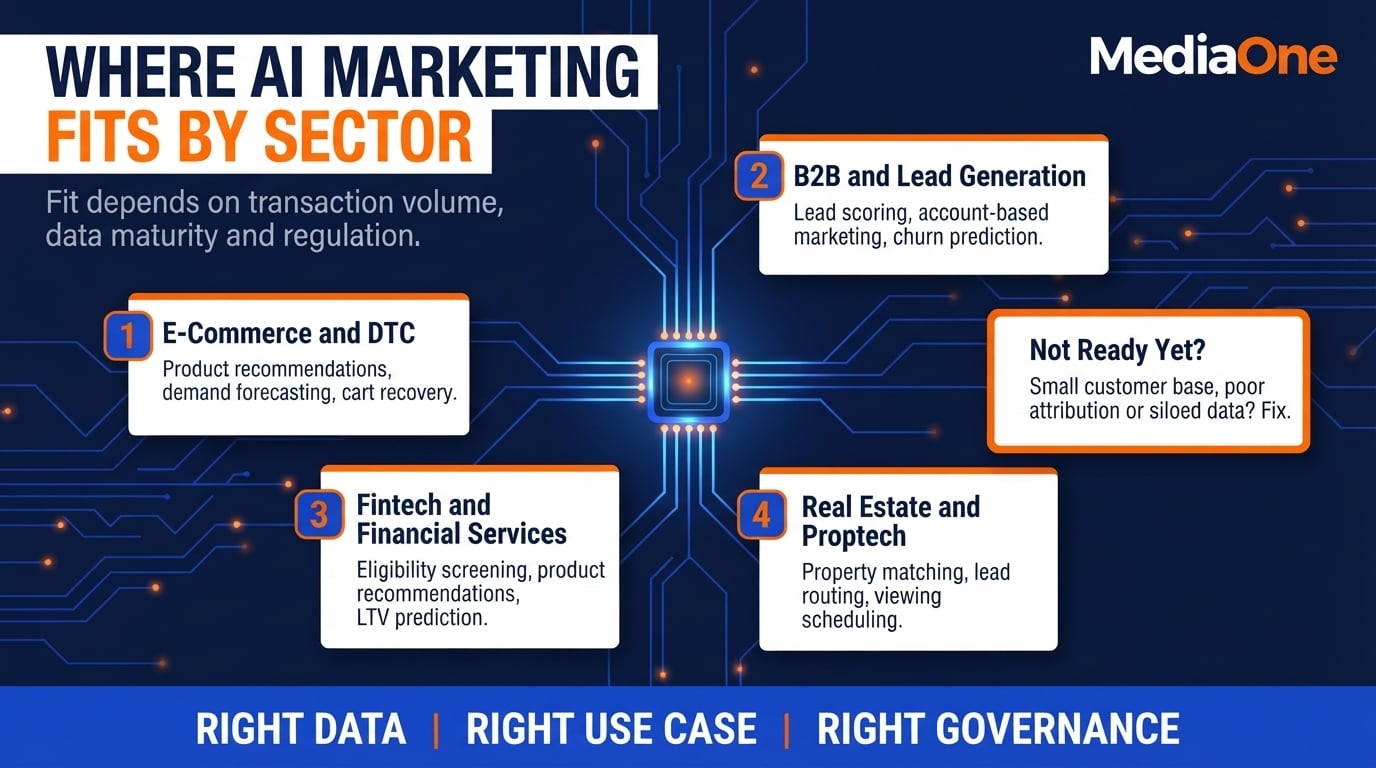
E-Commerce and Direct-to-Consumer Brands
E-commerce is the sweet spot for AI marketing. High-volume transactions, clear attribution, and abundant first-party data make this vertical ideal for algorithmic optimisation.
Product recommendations: AI models can analyse browsing and purchase history to suggest relevant items. Test revenue or margin per visitor against a control; a conversion uplift cannot be assumed in advance.
Dynamic pricing: Algorithms adjust price based on demand signals, competitor pricing, and inventory levels. A retailer selling electronics might lower prices on overstocked items or raise them when stock is constrained. Any change to gross margin depends on the pricing rules, demand and competitive context. Review customer fairness and any sector-specific restrictions before deploying automated prices.
Demand forecasting: AI predicts product demand by season, region, and customer segment. This allows inventory to be positioned before demand peaks, reducing both stockouts and overstock markdown losses. Compare forecast error, stockouts and inventory turnover against the prior approach.
Cart abandonment recovery: Rather than sending generic ‘complete your purchase’ emails, AI triggers personalised recovery sequences based on cart contents, customer lifetime value, and purchase history. Measure incremental recovered orders against an unchanged email flow, and check that personal-data use is authorised.
For Singapore direct-to-consumer brands, suitability depends on data accuracy and order volume rather than a universal SGD 50,000 ad-spend minimum. Start by validating purchase tracking, consent and measurement before running a limited live test.
B2B and Lead Generation
B2B marketing presents greater complexity, but AI delivers value by filtering high-intent prospects and shortening sales cycles.
Lead scoring and prioritisation: AI ranks prospects by likelihood to convert or deal size, allowing sales teams to work from a prioritised queue. Measure whether sales teams accept more scored leads and close a greater share, while testing for bias and feedback loops.
Account-based marketing (ABM): Instead of broad campaigns, you target specific accounts using lookalike audiences built from existing high-value customers. Personalisation should be tested against a relevant generic campaign instead of assigned a fixed uplift. This approach works well for Singapore B2B firms selling into mid-market segments across Asia-Pacific.
Email sequence optimisation: AI times sends to maximise open rates, personalises subject lines based on recipient profile, and adjusts follow-up cadence based on engagement velocity. Measure replies, sales-qualified meetings and unsubscribe complaints, not just email open rates.
Churn prediction: For SaaS and subscription businesses, AI identifies customers at risk of cancelling and triggers targeted retention campaigns before churn occurs. Test whether contacted at-risk customers retain more often than an appropriate comparison group.
B2B fit improves when the team has enough appropriately obtained examples for the selected tool, a defined sales cycle and CRM data that links engagement to outcomes. Smaller service firms often lack sufficient data volume for AI models to detect meaningful patterns.
Fintech and Financial Services
Finance is regulated and risk-averse, but also data-rich. AI marketing in this sector focuses on compliance, risk mitigation, and precise targeting of eligible customers.
Customer eligibility screening: Before marketing a product, AI models verify that a prospect meets regulatory criteria such as income, age, credit profile, and residency. This prevents wasted marketing spend on ineligible audiences and reduces compliance violations.
Fraud detection: AI flags suspicious signup patterns or transactional behaviour, reducing downstream losses. Keep fraud monitoring separate from marketing consent and eligibility decisions, with appropriate compliance oversight.
Product recommendation: Based on account balance, transaction patterns, and income signals, AI surfaces financial products (loans, insurance, investment accounts) that customers are likely to adopt. Any cross-sell benefit must be tested, and recommendations must be appropriate for eligible customers.
Customer lifetime value prediction: AI models identify which customers will remain profitable long-term, allowing acquisition budgets to be directed towards high-LTV cohorts. Measure incremental value and check how the model uses sensitive or regulated data.
Finance teams must assess relevant Monetary Authority of Singapore rules as well as the PDPA and sector-specific suitability requirements. Allow for higher governance needs where the models influence eligibility or recommendations; do not assume a standard SGD 30,000 retainer or a 90-day ROI outcome.
Real Estate and Property Technology
Proptech (property technology) is a growing sector in Singapore, with high customer value and long decision cycles. AI marketing here focuses on matching buyers to properties and optimising agent productivity.
Property recommendation: AI learns buyer preferences such as location, price range, size, and amenities, then surfaces properties they are likely to view or transact on. Measure qualified enquiries and subsequent viewings, using the prior routing process as the comparison.
Agent workload balancing: AI routes qualified leads to agents based on their specialisation, current pipeline, and historical close rates. Check response time, workload fairness and viewing outcomes before claiming a productivity gain.
Viewing scheduling optimisation: AI predicts which properties a prospect will transact on and schedules viewings at optimal times. Compare booked viewings and completed viewings with the previous scheduling process.
Market trend prediction: For proptech platforms that publish market insights, AI models predict which neighbourhoods or property types will see demand spikes. This allows content and marketing to be pre-positioned before trends peak, improving organic visibility and engagement.
Singapore’s proptech sector has seen rapid growth in recent years. Fit improves when your platform has transactional data (properties viewed, offers made, decision timeframes) and you operate across multiple agent partners.
What AI Marketing Is Not Suited For
Be honest about your readiness. AI marketing fails in these scenarios:
- Small customer bases: Custom predictive models may have too little labelled data, although native campaign automation and simple rules can still be useful.
- Offline-first businesses (restaurants, salons, clinics): Attribution may be incomplete if bookings, enquiries or transactions are not connected to marketing data. Simple automation can still help if outcomes can be measured.
- Highly regulated industries without digital infrastructure (pharmaceuticals, alcohol): Regulatory constraints often prevent the data collection AI requires. Check compliance requirements first.
- Commodity or price-driven categories (fuel, utilities): When customers buy solely on price, AI personalisation adds minimal value.
- Immature data infrastructure (siloed CRM systems, no email integration, manual lead tracking): Fix foundational data practices first. AI applied to poor-quality data produces poor results.
If most of these describe your situation, begin with a data and measurement audit. There is no standard 12- to 18-month waiting period: revisit advanced use cases once inputs, safeguards and a measurable question are ready.
Common Issues and Troubleshooting
Even strong implementations encounter challenges. Here are the most common issues Singapore organisations face and recommended solutions. IMDA’s AI Verify framework describes relevant testing principles such as fairness, security and explainability for teams assessing an AI system.
| Common Issue | Likely Reason | Recommended Action |
| Model performance degrades after launch | Model drift occurs when customer behaviour or market conditions shift. The model was trained on historical patterns that no longer hold | Agree monitoring triggers and retraining responsibilities with your agency. Agree upfront on retraining frequency and cost. Ask how they monitor drift using performance thresholds and holdout test groups. |
| Results underperform the previous approach | KPI misalignment: the agency optimised for clicks or impressions rather than conversions. Or data quality issues went undetected during setup | Audit the KPIs in your contract immediately. Verify they match your agreement. If data quality is suspect, pause and assess the data and attribution before drawing conclusions. Do not attribute failure to AI until data has been validated. |
| No visibility into model decision-making | The agency uses opaque models (such as deep neural networks) without interpretability tools. Or they are protecting proprietary logic and not sharing model mechanics | Request explainability reports using SHAP or LIME methodologies. For production models, you should understand which customer attributes and behaviours drive each prediction. Escalate to leadership if the agency refuses transparency. |
| Data privacy concerns or regulatory violations emerge | The agency stored data insecurely, or consent tracking was not properly implemented during model development | Contain the affected processing, notify the data protection officer and assess whether the incident is a reportable breach. Take legal or incident-response advice before restarting. |
| Campaign budget is allocated but results plateau | Audience saturation: the AI has optimised for all profitable segments and competes for marginal customers. Or the model is overfitting to training data | Discuss expanding audience definitions with the agency, such as lookalike audiences or geographic expansion. If saturation is genuine, shift budget to new channels or products rather than increasing spend in the same segment. |
| The agency cannot explain specific recommendations | Model outputs are probabilistic, not deterministic. The agency may lack clarity about uncertainty in their communication | Ask for confidence intervals and sensitivity analyses. ‘This audience has a 68% likelihood to convert’ is clearer than ‘this audience will convert.’ Insist on transparency about prediction uncertainty. |
| Integration with existing marketing systems fails | The agency underestimated integration complexity. Your CRM, email platform, or analytics tool may have API constraints or incompatible data structures | Before engagement, run a technical pre-flight assessment with your internal IT team and the agency. Document API capabilities, data schemas, and rate limits. Obtain a technical estimate based on the actual APIs and data structures. |
Getting Unstuck: Escalation and Support
If results underperform for two consecutive months, escalate immediately. Do not wait for the quarterly business review. Schedule an urgent call with the agency’s leadership (not just your account manager) and discuss:
- What metrics fell short and by how much?
- What hypotheses does the agency have for the decline?
- What diagnostics have they run (data quality checks, model performance tests, holdout group analysis)?
- What corrective action will they take and by when?
A strong agency will have a rapid response protocol. A weak one will defer and ask for more time. Push for specifics and timelines.
If issues persist after a second month, invoke any performance guarantees in your contract. If none exist, document the shortfall and involve legal counsel. Check the written remedies and dispute process, and obtain legal advice where necessary. Do not assume the agency will offer fee credits.
Frequently Asked Questions
How Much Should I Budget for an AI Marketing Agency Engagement?
Costs depend on the scope, existing data and software, media budget and whether any custom development is needed. Request a fixed-scope quotation listing implementation, subscriptions, recurring agency support, advertising, testing and ongoing maintenance. Agency price guides are rarely directly comparable without matching scope and service levels.
What Is the Difference Between AI Marketing and Traditional Marketing Automation?
Rules-based automation follows instructions such as sending an email after a form is completed. AI-assisted systems may use models to predict, generate or adapt content and decisions based on data. Both still need defined business objectives, quality checks and appropriate human oversight.
How Long Does It Take to See Results?
The first milestone may be technical, such as a working data integration or campaign test. Revenue results can take longer and depend on conversion volume, sales cycle and the intervention being measured. Ask for stage-specific milestones instead of a universal 30-day or 120-day promise.
What Is a Common Misconception About AI Marketing Agencies?
Many buyers assume that AI removes the need for human strategy. It can assist execution and analysis, but a team still has to choose the objective, review claims, control spending and interpret results. More automation without clear ownership can magnify mistakes.

How Do I Know If an AI Marketing Agency Is Right for My Business?
Assess whether there is one repeatable marketing problem worth solving and a way to measure improvement. Data quality, permissions, marketing volume and internal staff availability affect the choice. There is no universal minimum of 1,000 transactions or four positive answers to a checklist.
What Should I Watch for During Vendor Evaluation?
Ask for a plain-language demonstration, a delivery-team list, recent client-approved evidence, data-processing terms, export rights and a pilot plan. Compare the answers against the same brief for every shortlisted agency. Be wary of fixed ROI guarantees unsupported by a test design.
What Happens If an AI Model Makes a Discriminatory Decision?
Stop or contain the affected decision process as appropriate to its risk, investigate the data and model output, and involve the organisation’s responsible officers. Where personal data or regulated financial decisions are involved, obtain the relevant privacy or legal review. Document remediation and test the revised process before resuming.
Can an AI Marketing Agency Help with B2B Lead Generation If My Sales Cycle Is 6 to 12 Months?
Yes. A long sales cycle makes final-revenue attribution slower, but a team can measure data quality, sales acceptance, meetings and eventual pipeline progression. Agree how interim measures will connect to actual closed business, and avoid treating an AI lead score as proof of revenue.
What Data Maturity Do I Need Before Engaging an AI Marketing Agency?
A usable baseline includes reliable campaign and conversion records, clear data ownership, a lawful basis for personal-data processing and a way to evaluate output. You may begin with basic platform features even when historical data is limited. Bespoke prediction or customer-level personalisation generally requires stronger inputs and governance.
How Often Should AI Models Be Retrained and Updated?
Monitor model performance on a cadence proportionate to the use case, and set triggers for review when conditions change. Some tools are maintained by platform vendors; custom models need explicit maintenance ownership. Do not assume quarterly or twice-yearly retraining is appropriate for every implementation.
What Recourse Do I Have If the Agency Fails to Deliver Promised Results?
Check the signed statement of work, milestone definitions, reporting rights and contractual remedies. Raise underperformance promptly, ask for documented diagnostics, and use the agreed escalation process. Performance targets should reflect what the agency can control, and legal advice may be needed for disputes.