| AI Summary
SEO (search engine optimisation) helps websites improve their visibility in unpaid search results by making content relevant, useful and accessible to search engines and people. It combines technical SEO, on-page optimisation and off-page authority-building, supported by keyword research, helpful content and a sound website structure. Businesses can measure SEO performance through organic traffic, search visibility, click-through rate and conversions, then use those insights to refine their strategy over time. SEO takes sustained effort, and results vary depending on competition, site condition and search intent. |
What is SEO (search engine optimisation)? It is the process of improving a website so that it can appear more prominently in organic search results on Google, Bing and other search engines. Unlike paid advertising, SEO focuses on earning unpaid visibility by making pages useful, relevant and accessible to both search engines and people.


For many businesses, organic search is an important way to reach people who are actively looking for products, services or information. Strong search visibility can help attract relevant visitors over time, although results depend on competition, search intent, site quality and many other factors.
This guide explains how SEO works, why it matters, how to measure performance and how to build a practical SEO programme. Whether you run a Singapore-based e-commerce business, a professional services firm or a tech startup, the fundamentals are similar: understand your audience’s searches, publish helpful content, maintain a technically sound website and measure outcomes consistently.
The Three Pillars of SEO
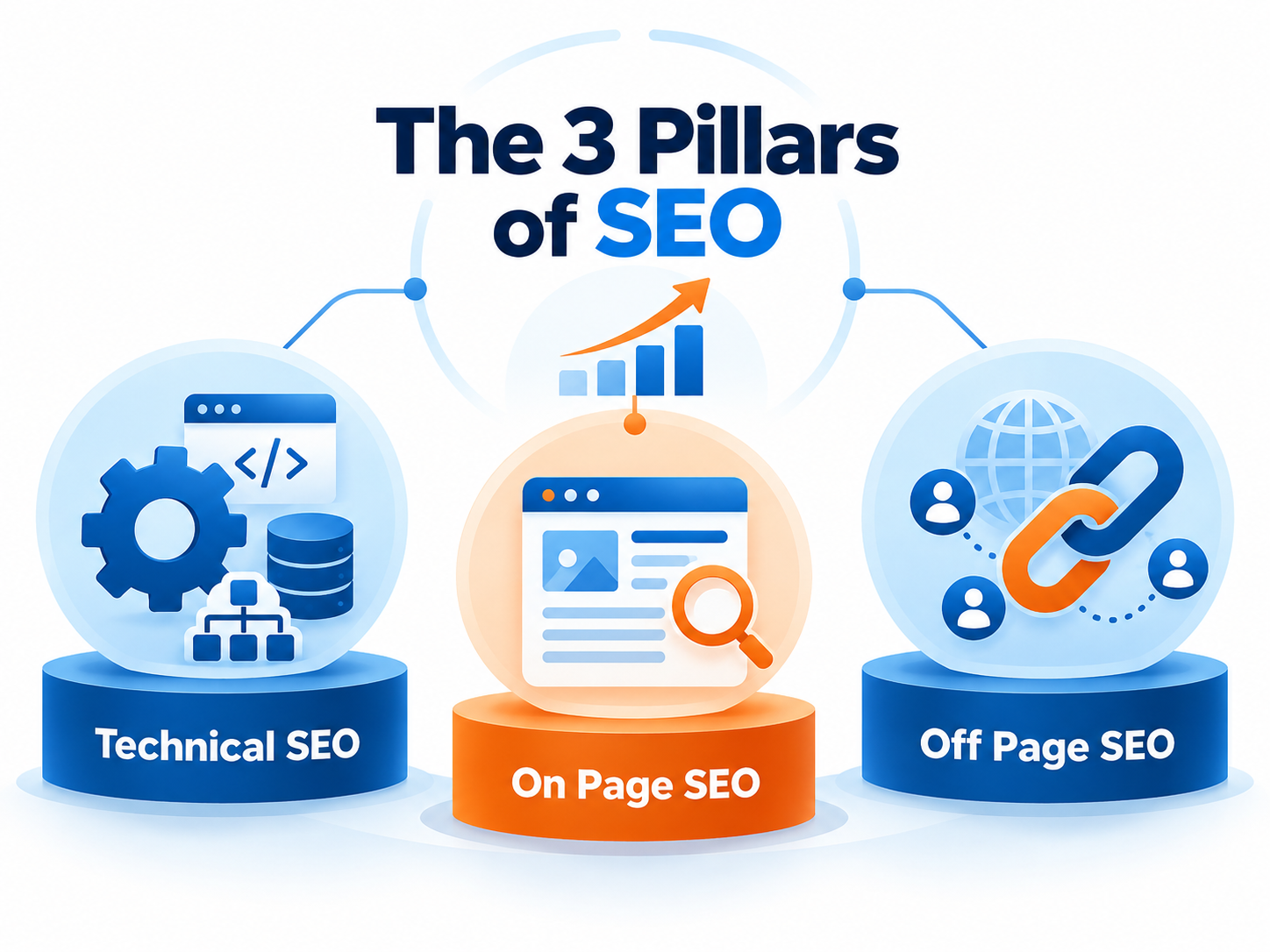
Effective SEO combines three connected areas: technical SEO, on-page SEO and off-page SEO. Each supports the others, so focusing on only one can limit results.
Technical SEO
Technical SEO ensures your website’s architecture, speed and code are optimised for search engine crawlers. It covers the foundational elements that determine whether search engines can discover, access and understand your pages.
Key technical elements include:
-
Site speed: Core Web Vitals measure how fast your pages load and respond to user interaction. Google introduced Core Web Vitals as part of its page-experience signals in 2021.
-
Mobile responsiveness: Mobile search is important for many audiences, so check how your visitors use your site and make sure key pages work well on smaller screens. A page that doesn’t display properly on phones can frustrate users and affect search visibility.
-
XML sitemaps and robots.txt files: These files help guide crawlers towards pages you want indexed and away from pages you don’t want crawled.
-
Structured data markup: Schema.org vocabulary helps search engines understand content, such as a product’s price, rating or availability.
-
HTTPS encryption: HTTPS helps protect users’ connections and is a lightweight ranking signal, although it does not guarantee stronger rankings.
-
Site crawlability and indexation: Search engines must be able to discover, fetch and parse every page you want to appear in search results.
A slow website or a poor mobile experience can frustrate visitors and may affect search performance. Technical issues are not always visible to users, but they can limit crawling, indexing or usability. A five-second load time is a useful warning sign to investigate, not a guarantee of a particular ranking outcome.
Similarly, if your site uses JavaScript to render content and Google’s crawler cannot execute that JavaScript, your page may be difficult to index. Diagnosing technical SEO problems requires the right tools. Google Search Console, which is free, can show indexing information, crawling issues and Core Web Vitals data.
Screaming Frog offers a free tier with a limited URL crawl and can help identify missing H1 tags, redirect chains and broken internal links. PageSpeed Insights is another free tool that identifies potential page-speed problems.
On-Page SEO
On-page SEO refers to content and HTML elements you control directly on each page. It bridges the gap between what people search for and what your page delivers.
Key on-page elements include:
-
Title tags and meta descriptions: These may appear in search results. A clear, compelling title and description can encourage clicks even when your ranking position doesn’t change.
-
Heading hierarchy (H1, H2 and H3): Headings organise your content and help readers and search engines understand its structure. Use them in a logical hierarchy, with a clear main heading and relevant subheadings.
-
Keyword integration in body copy: Include your target keyword naturally where it helps explain the topic. Avoid excessive repetition or awkward phrasing.
-
Internal linking strategy: Links from one page on your site to another help search engines discover pages and understand how your content is connected.
-
Image optimisation and alt text: Compress images to help reduce loading times. Add descriptive alt text, such as “professional working at a desk with a laptop”, when it helps communicate the image’s purpose or content.
-
Content length and depth: Comprehensive content can be useful when a topic needs depth, but word count alone does not determine rankings. A concise page that fully answers a query may outperform a longer page that adds little value.
-
User intent alignment: Search intent generally falls into four categories: informational (learning), navigational (finding a specific website), commercial (comparing options) and transactional (taking an action or making a purchase). Your page should match what the searcher wants.
For example, a product comparison page is suited to commercial intent, while a step-by-step tutorial is better suited to an informational query. Understanding this difference helps you create content that meets users’ needs.
Off-Page SEO
Off-page SEO covers activities outside your website that can contribute to your brand’s reputation, authority and visibility. It reflects how your business and content are referenced elsewhere online.
Key off-page elements include:
-
Backlinks: Links from other websites can help search engines assess a page’s relevance and authority. Quality, relevance and context matter more than simply accumulating links.
-
Brand mentions and citations: When a news site or industry blog mentions your company, it can help people discover your brand and may contribute to its wider online reputation.
-
Social media engagement: Shares, comments and discussions on platforms such as LinkedIn and Facebook can expand your content’s reach and create opportunities for other websites to reference it. Social engagement itself should not be treated as a guaranteed ranking boost.
-
Review sites and reputation management: Positive reviews on Google, Trustpilot or industry-specific platforms can build trust with potential customers. Their direct impact on organic rankings varies by search type and platform.
-
Local directory listings: Google Business Profile and relevant industry directories can help customers find local businesses. Keep your business name, address and phone number accurate and consistent across listings.
For Singapore businesses, relevant local citations can help establish a clear local presence. A listing in an industry directory or a mention on a local trade association website can help potential customers verify that your business operates in their market.
This is particularly important for service businesses, such as plumbing companies, accounting firms and marketing agencies, where local searchers want to know whether a provider serves their area.
To earn backlinks, create something worth referencing: original research, a useful tool, a practical resource or a comprehensive guide that offers value beyond what competitors already publish.
Then reach out to relevant websites, journalists and industry blogs where your resource could be useful. Focus on building genuine relationships rather than sending generic requests for links.
How Search Engines Discover and Rank Pages
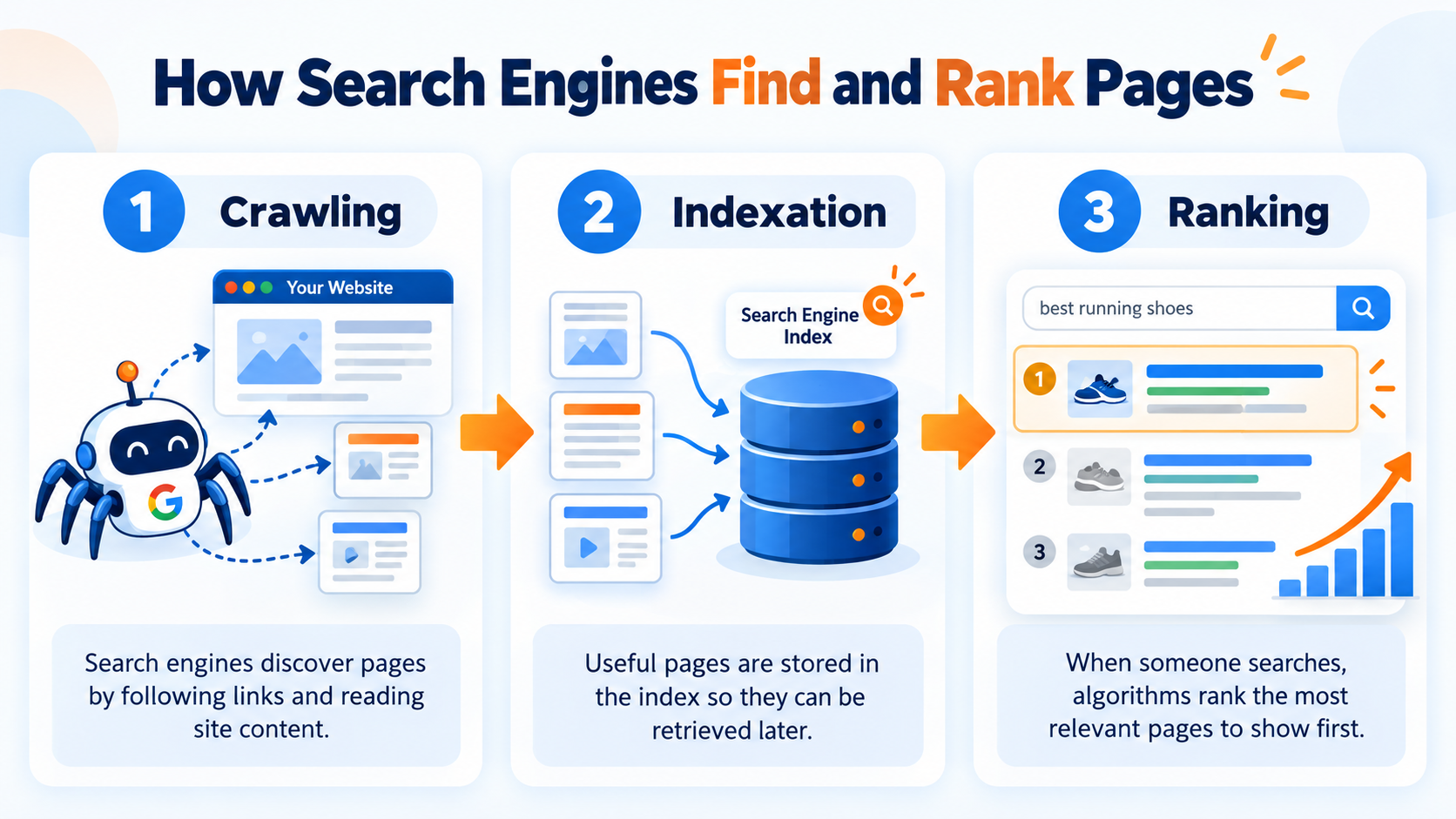
Search engines use automated programmes called crawlers to discover web pages. They process information from those pages and may add eligible content to their index. Ranking systems then determine which results are most relevant to a particular query.
Understanding this process helps explain why some pages appear prominently in search results while others receive little visibility, even when they contain useful information.
Suggested image: How search engines work
An infographic showing the three stages of crawling, indexing and ranking. Use a crawler icon visiting a website, a database icon representing indexed pages, and a search-results page showing ranked results. Connect each stage with arrows and include a brief explanation.
Crawling and Indexation
Crawlers, also called bots or spiders, start with known URLs and follow internal and external links to discover pages. They process a page’s code, text, structure and other information. If a website unintentionally blocks crawlers through a misconfigured robots.txt file or other technical settings, important pages may not be discovered or processed as intended.
For Google to index a page, it generally needs to:
-
Fetch the page over HTTP or HTTPS.
-
Process the HTML and render JavaScript where necessary.
-
Extract relevant text, images, links and structured data.
-
Discover related pages through internal links and other discovery methods.
-
Determine whether the page is eligible and useful enough to include in the index.
Internal linking is an important part of this process. If your navigation is unclear or pages have few links pointing to them, search engines may have difficulty discovering all the important content on your website.
JavaScript-heavy websites can require additional testing. Single-page applications, which are common in SaaS and fintech, may render content dynamically. If important content is not available when search engines process the page, it may not be indexed as expected.
Use Google Search Console to check how Google sees your pages. Its URL Inspection tool provides information about indexing and allows you to inspect the page’s rendered version. If important content is missing, investigate JavaScript rendering and other technical issues.
Ranking Factors and Algorithms
Google uses many signals to rank pages, and the exact weighting of individual signals is not public. No single tactic guarantees a particular position. Important areas to focus on include:
1. Content relevance and depth
Does the page answer the search query clearly and adequately? Content should address the reader’s main question, provide useful context and cover related details when they help satisfy the search intent.
A short page about SEO for e-commerce may not be sufficient for a complex query that requires guidance on product pages, technical setup, structured data and conversion tracking. However, adding words for the sake of length will not automatically improve rankings.
2. Experience, Expertise, Authoritativeness and Trustworthiness (E-E-A-T)
Google’s quality-rater guidance uses E-E-A-T to help assess content quality. E-E-A-T is not a single, standalone ranking factor.
Where relevant, demonstrate first-hand experience, explain authors’ qualifications, cite reliable sources and disclose potential conflicts of interest. These practices are particularly important for topics that may affect people’s health, finances or safety.
3. Backlink profile
Links from relevant, trustworthy websites can help search engines assess a page’s authority. Their impact varies by query and competitive landscape, so focus on earning useful, relevant links rather than pursuing a specific number.
4. Page experience
Core Web Vitals measure loading performance, visual stability and responsiveness. Good performance can contribute to a positive user experience, but meeting a particular speed threshold does not guarantee higher rankings.
Also consider mobile usability, intrusive advertising and HTTPS encryption when reviewing the overall page experience.
5. Mobile-friendliness
Make sure important pages work well on mobile devices, including readable text, accessible navigation and usable forms. Google primarily uses the mobile version of a site’s content for indexing, so key information should be available on mobile as well as desktop.
6. Content freshness
Freshness matters more for some queries than others. News, current regulations and time-sensitive information may need regular updates, while an evergreen guide can remain useful for years if it is accurate and relevant.
Update content when facts change or when you can make meaningful improvements. Changing a publication date without updating the substance does not guarantee better rankings.
Google also uses machine-learning systems, including RankBrain, to help interpret queries and relationships between words and concepts. This helps search engines understand meaning beyond exact keyword matches.
For example, a useful page about why Google rankings have dropped may also be relevant to searches about SEO troubleshooting or search visibility problems, even if it does not use every phrase verbatim.
This is why writing naturally for people, rather than forcing keywords into every paragraph, is a sound approach. A page’s performance also depends on its competitive context, the website’s existing content and reputation, and how well the page satisfies the query.
A site’s history, backlink profile and demonstrated expertise can contribute to how its pages perform, but none guarantees a particular ranking.
Monitor CTR in Google Search Console under the Performance report. Filter by query or page to identify weak performers.
Improve CTR by refining on-page elements:
-
Title tag: Include your primary keyword and a compelling value proposition. A title such as “Award-Winning Digital Marketing in Singapore: Certified Since 2015” communicates more value than a generic title, provided the claim is accurate.
-
Meta description: Summarise the page’s core value concisely. Include a keyword naturally if it fits; do not force it.
-
Structured data: Appropriate structured data can help search engines understand your content and may make a page eligible for enhanced search appearances. However, it does not guarantee additional features or higher CTR.
A CTR improvement can generate more visits from existing impressions without requiring a ranking change. For competitive keywords, refining titles and descriptions can be a useful part of your optimisation strategy.
Conversion Rate from Organic Traffic
Conversion rate is the percentage of organic visitors who complete a desired action, such as signing up for a free trial, purchasing a product, submitting a contact form or downloading a resource. Conversion rates vary significantly according to search intent, industry, offer and website experience.
Example comparison:
|
Search query type |
Illustrative conversion rate |
Reason |
|---|---|---|
|
Buy accounting software Singapore |
8–12% |
Transactional; the searcher may be ready to purchase |
|
How to choose accounting software |
0.5–2% |
Informational; the searcher may be researching options |
These figures are examples, not universal industry benchmarks. Actual performance will depend on the business, audience and conversion being measured.
Both pages can rank for related queries, but their visitors may have different needs. Mixing informational and transactional intent into one page can make it harder to serve either audience effectively.
Improve conversions by:
-
Aligning content with search intent: Answer the question the visitor searched for. Someone looking up “why should I use accounting software?” may need an explanation of the benefits before being asked to purchase.
-
Removing friction: Improve mobile usability, navigation, page speed and the clarity of calls to action. Make forms easy to complete and explain what happens after submission.
-
Building trust: Use relevant testimonials, case studies, transparent pricing and genuine qualifications or certifications. For Singapore-based businesses, accurate local business information and pricing in Singapore dollars may also help customers make informed decisions.
Track conversion rates by landing page in Google Analytics 4. Set up the relevant conversion events, such as form submissions or purchases, and segment the results by organic traffic.
Identify pages that attract visitors but generate few conversions. Test improvements such as a clearer headline, a more specific call to action, simpler forms or more useful supporting information.
On a page receiving 1,000 organic visits per month, a one-percentage-point increase in conversion rate would mean 10 additional conversions per month, assuming traffic and other conditions remain unchanged.
How to Start an SEO Programme: A Practical Roadmap
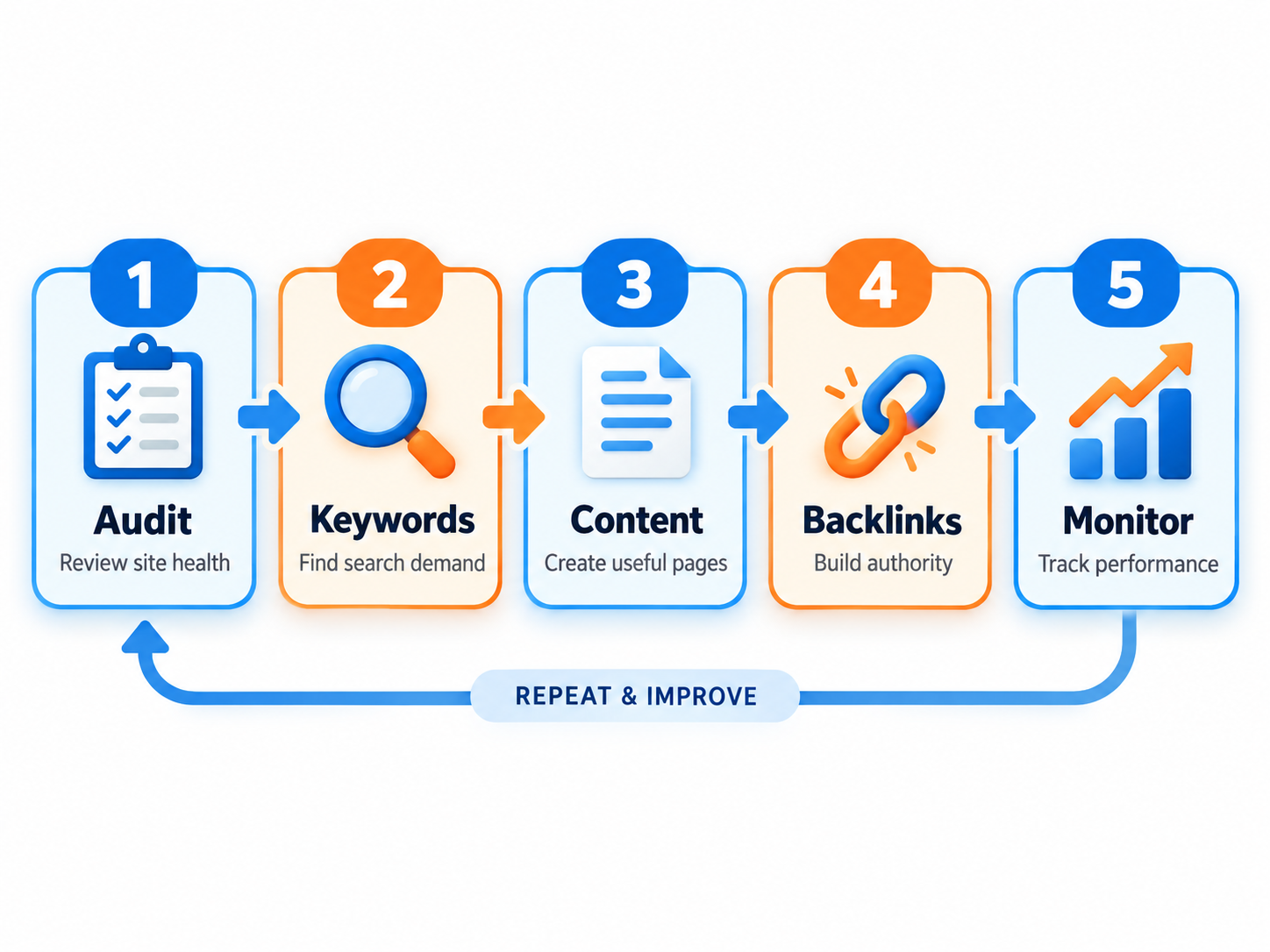

Effective SEO requires a structured approach. This framework can help businesses of different sizes, from solo founders to organisations with dedicated marketing teams.
Suggested image: A five-step SEO roadmap
Create a simple roadmap with five connected steps: Audit, Keywords, Content, Backlinks and Monitor. Use a checklist, magnifying glass, document, link chain and analytics graph as the corresponding icons.
1. Audit Your Current State
Before optimising your website, establish a baseline. An audit can reveal quick wins, technical blockers and gaps between your content and competitors’ pages.
Technical audit
Use tools such as Google Search Console, Google PageSpeed Insights and Screaming Frog to identify crawling errors, indexing issues, mobile usability problems and page-speed bottlenecks.
In Google Search Console, review the indexing reports to see which pages Google can access and index. Check Core Web Vitals to identify user-experience issues, then use PageSpeed Insights to investigate what may be slowing your pages down.
Run your homepage and important landing pages through PageSpeed Insights. Note which assets contribute to slow loading, such as large images, JavaScript or fonts.
Competitor audit
Identify the pages that rank for your target keywords. Use tools such as Ubersuggest, Ahrefs or Semrush to examine:
-
The topics and questions their pages cover.
-
Their content structure and subheadings.
-
Relevant backlinks pointing to their pages.
-
Related keywords and search intents they address.
-
The unique information or examples they provide.
This research helps you understand what searchers are being offered and where your content could add value. Do not assume that matching a competitor’s word count or backlink total will guarantee similar rankings.
Content audit
Create a list of your website’s important pages using a crawling tool or a manual inventory. For each page, record:
-
Its ranking queries, where available in Google Search Console.
-
Organic traffic.
-
Conversions, if tracked in Google Analytics 4.
-
The date it was last reviewed or updated.
-
Whether its content is still accurate and useful.
Prioritise pages with strong potential for improvement. A page that already attracts relevant visitors may benefit from clearer content, updated information, improved internal links or a more useful call to action. Pages receiving little traffic should be assessed before you decide whether to refresh, consolidate or remove them.
2. Define Your Target Keywords
Choose keywords that align with your audience, business goals and ability to compete. Three useful considerations are search demand, intent and ranking difficulty.
Search volume
Search volume estimates how often people search for a particular term over a given period. Use Google Keyword Planner, Ubersuggest, Ahrefs or Semrush to research potential keywords.
Do not dismiss a keyword simply because its search volume is low. Specific searches may attract a smaller but more relevant audience, especially when they relate closely to your products or services.
Commercial intent
Consider whether searchers want to learn, compare options, find a particular website or take an action.
For example:
-
“How to fix a leaky tap” is primarily informational. It may suit a plumbing company’s blog.
-
“Emergency plumber Singapore” has stronger transactional intent because the searcher may need a service urgently.
-
“Plumbing services Tanjong Pagar” has local intent because the searcher is looking for a provider in a specific area.
Build a balanced keyword strategy. Target relevant commercial and local searches while creating informational content that helps potential customers earlier in their decision-making process.
Ranking difficulty
Consider how competitive the search results are and whether your website can offer something useful and distinctive.
If established brands dominate the results, a newer business may need to focus first on more specific queries or topics where it has genuine expertise. Tools such as Ahrefs and Semrush provide keyword difficulty estimates, but these are indicators rather than guarantees of how difficult a keyword will be to rank for.
Start with realistic opportunities, monitor results and expand your strategy as your website develops.
3. Create and Optimise Content
For each target keyword, create or improve a page that meets the searcher’s needs.
Answer the search query comprehensively
Review the pages currently ranking for your target query to understand what searchers expect to find. Identify relevant questions, missing details and opportunities to provide more useful explanations.
Do not copy competitors. Use your research to understand the topic, then create original content that provides clear value.
Match search intent
An informational query such as “what is SEO” calls for an explanatory article. A transactional query such as “buy SEO tools” is more likely to require a product page or comparison.
A navigational query such as “Semrush login” usually indicates that the searcher wants to reach a particular website or page. Matching the format and purpose of your content to the search intent makes it more useful.
Include the primary keyword naturally
Use your target keyword in the page title, main heading and introductory content where appropriate. Include it in subheadings or body copy when it helps readers understand the topic.
For example, a page targeting “best plumbing services Singapore” could use a natural heading such as “How to Choose the Best Plumbing Services in Singapore”.
Related phrases and synonyms can help you cover the topic naturally. Avoid forcing an exact-match keyword into sentences where it sounds awkward.
Provide unique value
Consider what your business can contribute that other websites cannot easily replicate.
-
A financial adviser could explain a process using relevant professional experience.
-
A SaaS company could include product screenshots, customer examples or a practical walkthrough.
-
A local service provider could explain its service areas, process, qualifications and response times.
First-hand knowledge, original examples and useful evidence help make content more distinctive.
Include internal links to related pages
Link to relevant content elsewhere on your website. For example, an article about digital marketing strategy could link to related pages about content marketing, SEO and PPC advertising.
Internal links help readers navigate your website and help search engines discover and understand relationships between pages. Use descriptive anchor text so readers know what to expect when they click.
Improve page speed
Test important pages using PageSpeed Insights. Investigate large images, unnecessary scripts, render-blocking resources and other elements that may delay loading.
Compress images where practical, load only the fonts and scripts you need, and work with your developer or hosting provider to address technical bottlenecks.
There is no universal file-size limit that suits every image. Aim to preserve visual quality while keeping files as small as reasonably possible.
Make the page work well on mobile
Check your content on mobile phones, tablets and desktop screens.
Ensure that text is readable, navigation is usable, buttons are easy to tap and forms work properly on smaller screens. Important content should remain accessible across devices.
Mobile usability matters because a page that is difficult to read or use can cause visitors to leave before they find the information they need.
Choose content length based on the topic
Some subjects require a detailed guide; others can be answered in a few paragraphs. A longer article is not automatically better than a shorter one.
Write enough to answer the query clearly, address relevant follow-up questions and provide the necessary context. Remove repetition and unnecessary detail that does not help the reader.
4. Build Authority Through Backlinks
Relevant backlinks can help search engines assess a page’s authority, particularly in competitive search results. Focus on earning links through useful content and genuine relationships rather than purchasing links or pursuing large quantities of low-quality links.
Create original research, statistics or tools
Conduct a survey of your industry or customer base, then publish the findings with a clear methodology. Original research can provide useful evidence for journalists, bloggers and researchers to reference.
For example, a Singapore fintech company could survey customers about payment preferences and publish the findings alongside its methodology. If the research offers new insights, relevant industry publications may choose to cite it.
Write expert articles other websites want to cite
Publish original analysis, detailed guides or expert commentary that provides genuine value. Include relevant author credentials and support factual claims with reliable evidence.

Useful, well-supported content gives other websites a reason to reference your work.
Reach out to relevant websites, journalists and bloggers
Once you publish a useful resource, identify websites that cover the same topic and might find it valuable.
Keep outreach messages brief and personalised. Explain why the resource is relevant to their audience instead of sending a generic request for a backlink.
For example:

I read your recent article on e-commerce tips for SMEs. Our research on Singapore SME payment trends may provide useful additional context for your readers, so I thought I’d share it with you.
Outreach is most effective when the resource genuinely complements the recipient’s existing content.
Build relationships in your industry
Attend relevant industry events and connect with professionals, journalists and subject-matter experts. Over time, these relationships may lead to opportunities to share useful resources, contribute expert commentary and earn relevant links.
List your business in relevant directories
For local businesses, create and maintain an accurate Google Business Profile. Keep your business name, address, phone number, opening hours and service details up to date.
Consider reputable industry directories, local business associations and relevant professional organisations. Prioritise listings that help customers verify your business or discover your services rather than submitting your website to every directory available.
For Singapore businesses, relevant trade associations and professional bodies may provide useful visibility and credibility. Ensure that any membership or listing accurately reflects your business.
5. Monitor and Iterate
SEO is an ongoing process. After making improvements, monitor performance and use the results to decide what to do next.
Set up regular reporting to track the following:
Organic traffic and trends
Is organic traffic growing, declining or remaining stable? Which pages contribute most to the change? Look beyond the overall total to understand which topics and landing pages attract relevant visitors.
Keyword rankings

Track a focused set of important keywords. Review which terms are improving, which are losing visibility and whether the changes affect your business goals.
A ranking change from one month to the next is not necessarily a problem. Check for sustained trends and consider changes in search results, competition and search intent before deciding what action to take.
Backlink growth
Review new and lost backlinks. Consider whether links come from relevant, credible websites and whether they help users discover useful content.
Page-speed metrics
Monitor Core Web Vitals and investigate meaningful changes in loading performance, responsiveness or visual stability.
Conversion rates
Measure whether organic visitors complete important actions. If a page attracts visitors but produces few conversions, review the content, offer, page experience and call to action.
Google Analytics 4 (GA4) and Google Search Console (GSC) provide a useful starting point for measurement. GA4 can help you understand site traffic and conversions, while GSC reports search impressions, clicks, average position and click-through rate.
Adjust your strategy based on data
Three common scenarios can help guide your next steps.
1. The page ranks well but converts poorly. The page attracts visitors but does not encourage them to take the desired action. Improve the clarity of the call to action, simplify forms, explain pricing or add relevant evidence that helps build trust.
2. The page does not rank despite your efforts. Review whether the content matches search intent, whether technical issues prevent indexing and whether competing pages offer stronger or more relevant information. Improve the page where there is a clear reason to do so instead of adding words or backlinks indiscriminately.
3. Organic traffic remains flat. Reassess your target keywords, competition and content strategy. Consider improving existing pages, addressing technical problems or creating genuinely useful content for relevant search opportunities.
Meaningful growth may take months, and the pace varies widely between websites. Set realistic expectations, monitor progress and make decisions based on evidence rather than guaranteed growth percentages.
Common SEO Misconceptions and Why They Harm Your Strategy
Misunderstanding SEO can lead to wasted effort and unrealistic expectations. The following misconceptions persist among businesses of different sizes.
“SEO Is Dead” or “Keywords Don’t Matter Anymore”
Keywords still help you understand what people are searching for and how to make your content relevant. What has changed is the need to use them naturally rather than repeating the same phrase excessively.
Keyword stuffing can make content difficult to read and may violate search engine spam policies. Instead, create useful content that addresses the searcher’s intent and incorporates relevant terminology where it fits.
For example, a page about digital marketing agencies in Singapore can discuss services, specialisations, locations and selection criteria without repeating the exact target phrase in every paragraph.
Use keywords as a guide to the topic, not as a reason to make your writing sound unnatural.
“I Can Rank Without Backlinks”
Backlinks can contribute to a page’s authority, but rankings depend on multiple signals. Their importance varies according to the query and competition.
Some pages can rank without many external links, particularly for specific or less competitive searches. Other queries may be harder to compete for without a strong reputation and relevant references from other websites.
Focus on publishing useful content, making your website accessible and earning relevant links where appropriate. A smaller number of relevant links may be more valuable than a large quantity of unrelated or low-quality links.
“SEO Takes Two Weeks” or “SEO Is Too Slow”
SEO results do not follow a fixed timeline. Some technical fixes or improvements to existing pages may produce visible changes relatively quickly, while competitive keywords can take months or longer to gain meaningful visibility.
A new website may need more time to establish itself than a site with existing content, a history of relevant traffic and established external references.
Paid search can help generate traffic while an SEO programme develops, but it requires ongoing advertising spend. SEO can build long-term visibility, although rankings and traffic can change over time and still require maintenance.
Be cautious of agencies that promise specific rankings or guaranteed results within a short period.
“I Should Optimise for Google First and Other Search Engines Second”
For many Singapore businesses, Google is a sensible priority because of its substantial share of search activity. However, it can still be useful to monitor traffic from Bing and other search engines, particularly if your audience includes people who use them regularly.
Core SEO practices—such as creating useful content, maintaining a technically sound website and using clear internal links—can support visibility across multiple search engines.
If other search engines generate meaningful traffic for your business, consider their webmaster tools and performance reports as part of your monitoring process.
“Google Penalises Blogs and Fresh Content”
Publishing helpful articles and updating existing content can support an SEO strategy, but simply publishing frequently does not guarantee better rankings.
Freshness matters more for some searches than others. News, current regulations and time-sensitive information may need frequent updates, while an evergreen guide can remain useful for years if its information is still accurate.
Review your content when information changes, when user needs evolve or when performance data reveals a clear opportunity to improve it. Avoid changing dates or adding material solely to make a page appear newer.
Blogs can also provide useful internal links to related pages and help answer questions your audience has throughout the buying journey.
Why These Misconceptions Persist
SEO changes as search engines evolve, and advice can become outdated or oversimplified. Claims such as “keyword density is everything” or “backlinks are the only thing that matters” reduce a complex process to a single tactic.
Some agencies may also overpromise results to attract customers. Be wary of guarantees that a website will reach a particular ranking within a fixed period.
For more reliable guidance, consult Google’s Search Central documentation and use established analytics and SEO tools to monitor your own website’s performance.
When advice conflicts, look for clear evidence and consider whether the recommendation aligns with your audience’s needs and search engine guidelines.
Common SEO Issues and How to Resolve Them
SEO implementation can encounter practical obstacles even when your overall strategy is sound. The table below summarises common issues, their possible causes and recommended actions.
|
Issue |
Possible cause |
Recommended action |
|---|---|---|
|
Rankings drop after an algorithm update |
Search systems change, competitors improve or site issues emerge |
Review Google Search Console, investigate technical health and compare your content with relevant search results. |
|
Low click-through rate from search results |
Titles or descriptions may be unclear or unappealing |
Rewrite titles and descriptions to communicate the page’s value clearly and accurately. |
|
Page is indexed but does not rank well |
The page may not fully satisfy search intent or compete effectively |
Review content relevance, internal links, competition and the page’s overall usefulness. |
|
High bounce rate or low engagement from organic traffic |
The page may not meet visitors’ expectations or make the next step clear |
Compare the page with the search query, improve usability and make relevant next steps easier to find. |
|
Slow organic traffic growth |
Strong competition, limited demand or insufficient differentiation |
Review keyword opportunities, improve important pages and add genuinely useful information. |
|
Crawl errors or pages not being indexed |
Technical settings, server issues or weak discovery paths |
Review robots.txt, indexing directives, internal links and Google Search Console reports. |
What Is SEO and the Path to Sustainable Growth
SEO helps search engines discover, understand and surface useful pages to people searching for relevant information, products or services. By combining technical optimisation, helpful on-page content and credible off-page signals, businesses can improve their organic visibility and connect with audiences who are actively looking for what they offer.
Building a sustainable SEO strategy requires understanding search intent, auditing your website, improving important pages, earning relevant backlinks and monitoring performance with tools such as Google Search Console and Google Analytics 4. Rather than focusing on rankings alone, prioritise qualified traffic and meaningful conversions. Although SEO takes time and results are never guaranteed, consistent, data-driven improvements can strengthen your search presence and support long-term business growth.
Frequently Asked Questions
What is SEO?
SEO, or search engine optimisation, is the process of improving a website to increase its visibility in unpaid search results. It includes technical improvements, useful and relevant content, and efforts to build the site’s credibility.
How does SEO work?
Search engines discover pages through crawling, process and store information through indexing, then rank eligible pages in response to users’ queries. SEO helps by making pages accessible, relevant to search intent, useful to readers and easy for search engines to understand.
How long does SEO take to show results?
SEO timelines vary depending on your website’s starting point, competition, technical condition and the keywords you target. Some improvements may become visible within weeks, while meaningful growth for competitive queries can take several months. No agency or consultant can guarantee a specific ranking or timeline.
Do keywords still matter for SEO?
Yes. Keywords help you understand how people search and what information they expect to find. Use relevant terms naturally in page titles, headings and body copy, while prioritising clear, useful content that matches search intent. Avoid keyword stuffing.
What is the difference between SEO and SEM?
SEO focuses on improving visibility in unpaid search results. Search engine marketing (SEM) is sometimes used as an umbrella term for both SEO and paid search advertising, although many marketers use SEM specifically to mean paid search. Paid ads can deliver traffic quickly while a campaign is active; SEO aims to build organic visibility over time.