

A comprehensive approach can include ten blog posts, fifty target keywords, five directory packages, weekly “link building,” a technical audit, and a dashboard. But if your highest-value service pages are weak, your Google Business Profile is incomplete, your site cannot be measured properly, or Google is struggling to index important pages, then this activity can produce a lot of output without much business impact.
On a tight budget, SEO should be prioritised by expected business impact, not by the number of deliverables.
That approach matters in a highly digital SME market. IMDA reported that 95.1% of Singapore SMEs had adopted at least one of the digital areas it measures, while the Government continues to provide digitalisation support through SMEs Go Digital.
It also matters because Search itself is changing. In 2026, Google explicitly says that the same foundational SEO practices remain relevant to AI Overviews and AI Mode, while placing greater emphasis on unique, non-commodity, expert-led content rather than mass-produced pages.
Key Takeaways
- Fix measurement and indexability before scaling content. If you cannot tell which organic visits become leads or sales, you cannot allocate a tight budget intelligently.
- Optimise money pages before you publish large volumes of blog content. The pages nearest to revenue normally deserve the first investment.
- Use local SEO when location genuinely affects the buying decision. Google says that relevance, distance and prominence mainly drive local results.
- Do not buy “cheap SEO” by volume. Low-cost mass content and manipulative link schemes can create risk rather than value.
- SEO still matters for AI search. Google says its core SEO guidance remains foundational for generative AI features.
- Grant rules are changing now. PSG ends on 29 September 2026; from 30 September, businesses should review the new EDGE Grant.
What “Affordable SEO” Should Actually Mean
Affordable SEO should not mean the cheapest retainer or the most deliverables per dollar. It should mean the highest useful SEO impact your business can achieve within its current constraints.
Three Questions to Ask Before Spending Anything
- Where does organic search already intersect with revenue? Which services, products, locations or categories are actually worth ranking for?
- What is preventing those pages from performing? Is it technical access, weak content, poor search intent alignment, lack of local relevance, low authority, or conversion friction?
- Which problem has the highest expected return per dollar? Fix that first.
Google’s own SEO Starter Guide frames SEO as helping search engines understand your content and helping users decide whether to visit. It does not promise a magic tactic that automatically ranks a page first.
What a Tight-Budget SEO Programme Should Include
- Google Search Console and conversion tracking
- Indexability and crawl checks
- Optimisation of the highest-value commercial pages
- Internal linking and clear site structure
- Google Business Profile where relevant
- A focused content plan based on genuine buyer questions
- Basic technical and page-experience hygiene
- Transparent reporting tied to leads, bookings, purchases or qualified enquiries
For businesses that need specialist help, compare what your team can realistically execute in-house against MediaOne’s SEO agency services in Singapore.

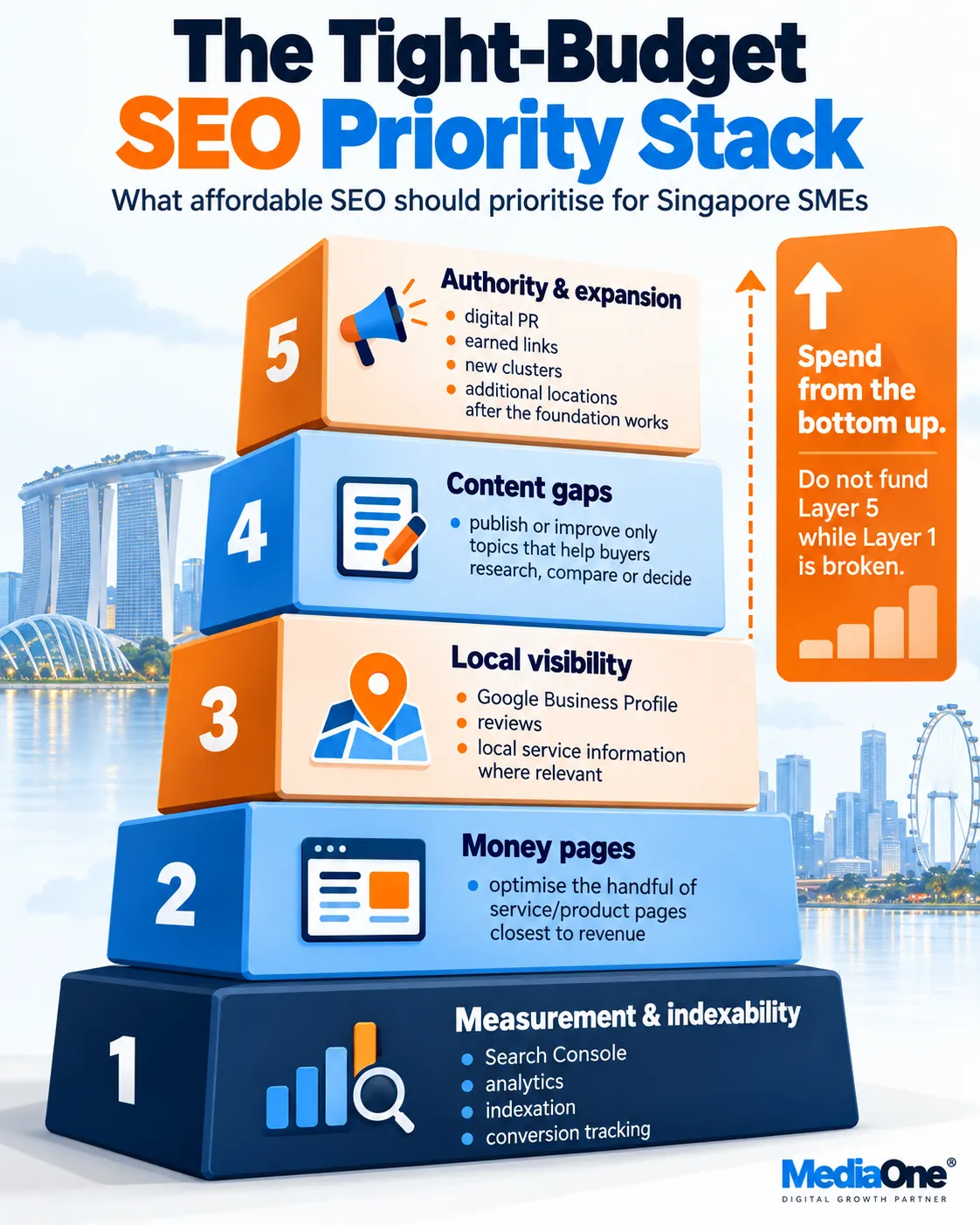
The 80/20 SEO Priorities for Singapore SMEs
The right priorities depend on your business model, but a constrained SME campaign usually benefits from concentrating resources in this order.
1. Make Sure Google Can Find and Understand the Important Pages
Confirm that revenue-critical pages are indexable, internally linked and technically accessible. Use Search Console to identify indexing issues, crawl problems and search queries already generating impressions. Google recommends Search Console as a core tool for understanding and improving Search performance.
2. Improve the Pages Closest to Revenue
Before writing another twenty informational posts, strengthen the pages that explain what you sell, who it is for, where you serve, why customers should trust you, what the process involves, what proof you can show, and what the visitor should do next.
3. Strengthen Internal Linking
Internal links are inexpensive and often underused. Link educational pages to relevant commercial pages, connect related service pages, and use descriptive anchor text. Google’s documentation notes that link text helps both users and Google understand the destination page.
4. Publish Fewer, Better Pieces of Content
In 2026, “publish more” is a particularly weak default strategy. Google now explicitly recommends unique, valuable, non-commodity content for both conventional Search and generative AI features. It warns against scaled content created primarily to manipulate rankings.
For an SME, one useful article based on real customer questions, pricing trade-offs, before-and-after examples or first-hand operational experience can be more defensible than ten generic articles that merely restate information already online.
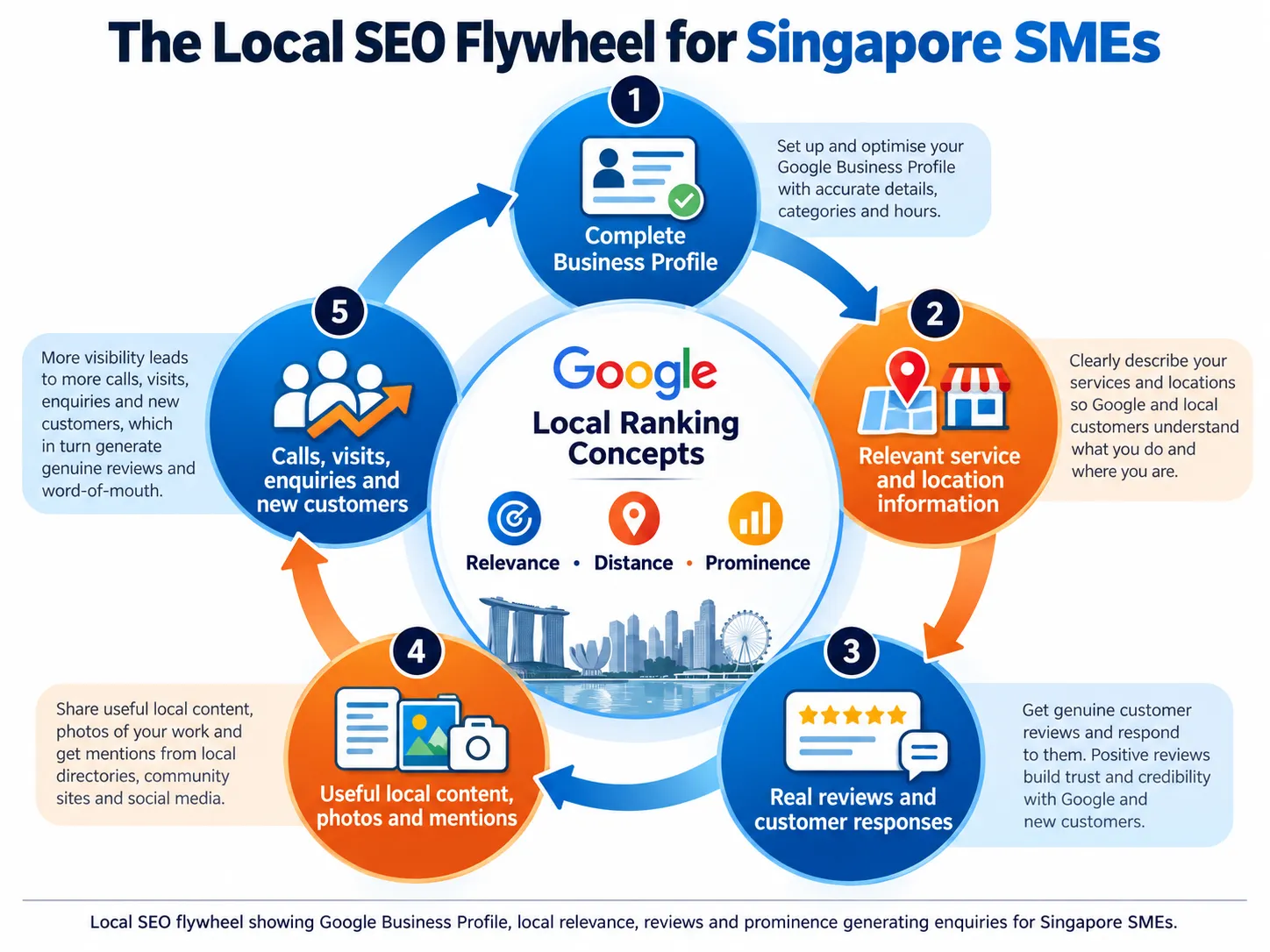
Local SEO: High-Leverage Work for Businesses That Serve Local Demand
Local SEO can be especially efficient for clinics, tuition centres, home-service businesses, retailers, restaurants, professional services and other organisations where customer location affects the buying decision.
Google says that relevance, distance and prominence mainly determine local rankings. It recommends verifying the Business Profile, keeping information complete and accurate, keeping hours updated, and managing reviews.
Budget-Friendly Local SEO Priorities
- Complete and verify your Google Business Profile. Use the correct business category, opening hours, website and contact details.
- Use real photos. Premises, staff, completed work, products and service environments provide both trust and context.
- Ask customers for genuine reviews. Never manufacture or buy them.
- Respond to reviews. Treat the profile as a customer-facing asset, not a one-time listing.
- Strengthen service and location relevance on your website. Mention locations only where genuinely useful, rather than creating thin pages for every neighbourhood.
- Earn real local prominence. Relevant local organisations, trade groups, media, suppliers and community relationships can create useful mentions and links.
For a deeper operational guide, see MediaOne’s local SEO services.
Do Not Manufacture Dozens of Near-Duplicate Location Pages
A common “budget SEO” tactic is to create a separate page for every neighbourhood by changing just a few place names. That creates little value when the business information, proof and service details are otherwise identical. If a location page exists, make it genuinely useful with relevant service information, real examples, FAQs, delivery or service details and evidence connected to that location.
SEO and AI Search in 2026: What SMEs Should Spend Money On
Small businesses are increasingly being sold separate “AI SEO”, “AEO” and “GEO” packages. Some of that work can be useful, but tight-budget SMEs should be cautious about paying for a second set of fundamentals they already need for SEO.
Google’s 2026 guidance says SEO best practices remain foundational for AI Overviews and AI Mode. It specifically recommends unique expert-led content, clear technical structure and crawlability, a strong page experience, useful images/video, and avoiding mass-produced pages and unnecessary AI-search hacks.
A Particularly Important 2026 Measurement Change
Google introduced dedicated generative AI performance reporting in Search Console in June 2026 and says it will roll out to all websites worldwide by 31 August 2026. That gives SMEs a first-party way to review visibility from generative AI features instead of relying entirely on third-party estimates.
If AI-search visibility is strategically important after the foundation is working, MediaOne’s GEO and AI search service covers the specialist layer.
What Singapore SMEs Can DIY vs What Is Safer to Outsource
| Task | Usually DIY-Friendly | Outsource When… |
|---|---|---|
| Google Business Profile | Yes | Multiple locations, suspensions or complex local strategy |
| Review responses | Yes | Reputation issues require escalation |
| Customer FAQs and subject expertise | Yes | Editorial/SEO structure needs professional support |
| Basic titles and page copy | Often | Search intent or conversion performance is unclear |
| Search Console monitoring | Yes | Diagnosing indexing/crawl anomalies becomes technical |
| Technical SEO audit | Limited | JavaScript, ecommerce, migrations, canonicalisation or architecture are involved |
| Schema implementation | Basic plugins may help | Custom or complex structured data is required |
| Digital PR / authority earning | Possible with relationships | Outreach, media strategy or scale requires dedicated resources |
| Site migration | No for most SMEs | Consider specialist oversight for revenue-critical sites |
A hybrid model is often the best answer for tight budgets: keep first-party knowledge, photos, reviews and routine updates in-house while outsourcing the tasks where mistakes are expensive.
How to Think About SEO Pricing Without Overpaying
Generic “Singapore SEO price lists” are often misleading because two campaigns with the same monthly retainer can require radically different effort.
What Are the Main Factors Driving SEO Costs?
- Competition: a niche local service differs from finance, insurance, legal, or property search.
- Technical condition: a clean five-page site differs from a legacy e-commerce platform with thousands of URLs.
- Content requirement: updating five existing money pages differs from building a complete topic library.
- Geographic scope: one Singapore location differs from regional or multilingual SEO.
- Authority gap: some categories require more digital PR, relationship building and link earning.
- Internal capability: an SME with a capable writer and developer needs a different package from one outsourcing everything.
Choose the Engagement Model That Matches the Problem
| Model | Best Use | Budget Risk |
|---|---|---|
| One-off audit / consultancy | You have people who can implement the recommendations | Advice can sit unused if ownership is unclear |
| Narrow monthly retainer | Ongoing optimisation of a small set of high-value priorities | Scope must be explicit to avoid shallow coverage |
| Hybrid in-house + specialist | SMEs with staff who can execute content or routine tasks | Needs clear division of responsibilities |
| Full-service SEO | Competitive categories or limited internal capability | Can become inefficient if the business cannot support the required investment |

As a concrete vendor example rather than a market benchmark, MediaOne’s current SEO service page publishes a Starter plan from S$850/month and an SEO subscription from S$350/month, with broader packages above that. These are MediaOne-specific prices and should not be treated as an industry average.
Singapore Grant Support: Important September 2026 Update
Under the current PSG programme, eligible local SMEs can receive up to 50% support for eligible costs, subject to the approved solution and application requirements. Enterprise Singapore lists core eligibility criteria, including:
- registered and operating in Singapore;
- at least 30% local equity;
- group annual sales turnover not exceeding S$100 million or group employment not exceeding 200 employees;
- the supported solution or equipment being used in Singapore; and
- no payment or deposit is made before the grant application is submitted.
IMDA’s SMEs Go Digital programme also highlights pre-approved digital solutions with up to 50% grant support and provides a Go Digital Advisor to match business needs with solutions.
Do Not Build Your SEO Decision Around a Grant Alone
A subsidy reduces cost. It does not make an unsuitable SEO package valuable. Evaluate the business case, scope, expected outcomes and internal workload as if you were paying the full price first. Then treat grant support as an efficiency gain.
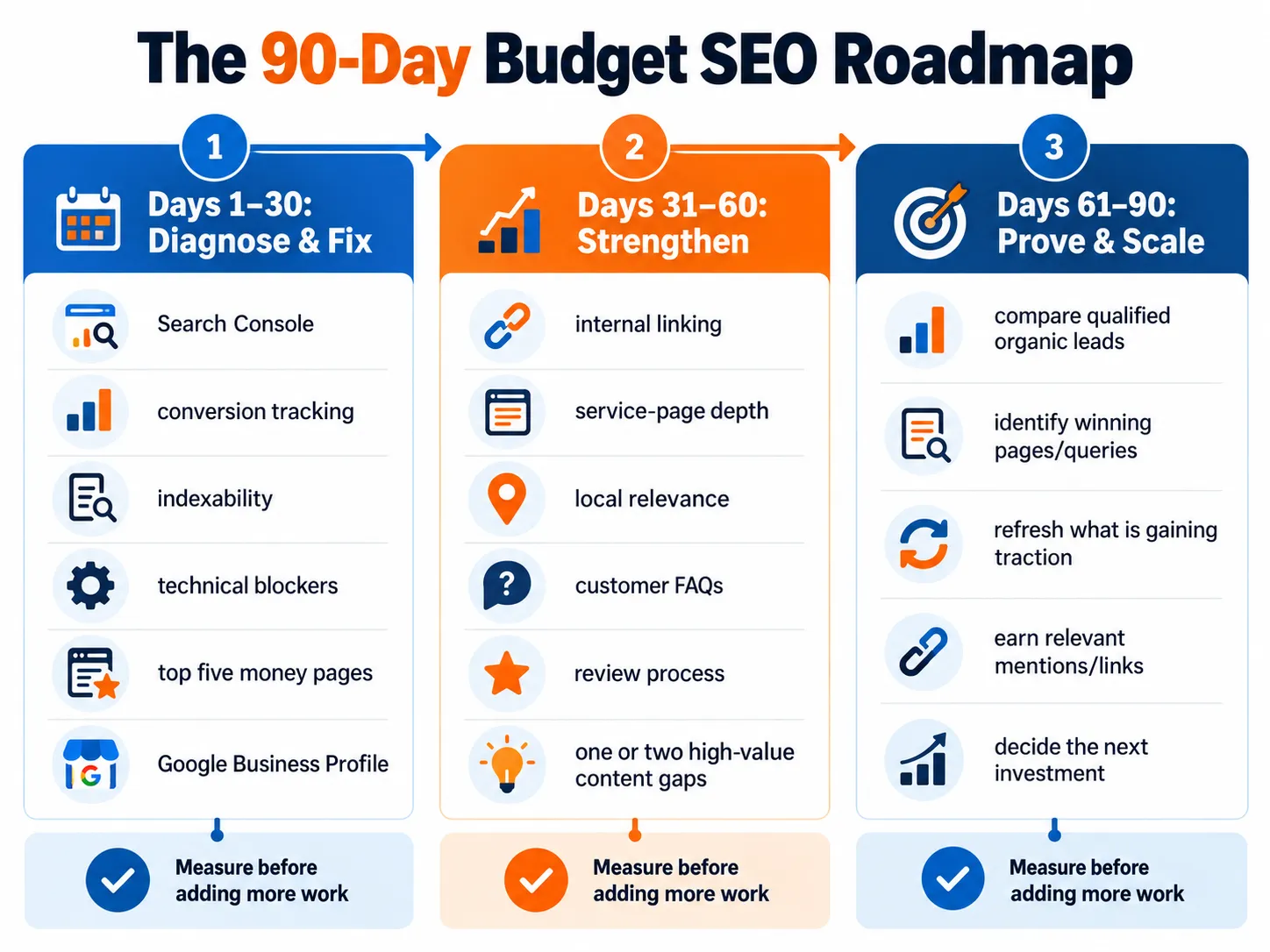
A 90-Day Tight-Budget SEO Roadmap
Days 1–30: Diagnose, Measure and Fix
- Verify Search Console and analytics.
- Set up meaningful conversion events: calls, forms, bookings, purchases or qualified enquiries.
- Check the indexation of your most important pages.
- Fix obvious technical blockers and broken internal links.
- Optimise your top three to five commercial pages.
- Verify and complete Google Business Profile if local search matters.
Days 31–60: Strengthen Commercial Relevance
- Improve service/product-page depth and trust signals.
- Add customer questions and objections to important pages.
- Improve internal links to existing informational content.
- Build a consistent review-request and response workflow.
- Create or substantially improve one or two high-value content assets.
Days 61–90: Use Evidence to Decide What to Scale
- Review which queries and pages are gaining qualified impressions and clicks.
- Compare organic leads with lead quality, not traffic alone.
- Refresh promising pages instead of automatically creating new ones.
- Earn relevant mentions, partnerships or links around proven commercial topics.
- Choose next quarter’s work based on observed bottlenecks.
How to Choose an Affordable SEO Agency in Singapore
“Affordable” is useful only if the work is understandable, measurable and sustainable.
Ask These Questions Before Signing
- What are the three highest-priority SEO problems on my site right now?
- Which work would you avoid at my current budget?
- Which pages or search themes are closest to revenue?
- How will you measure leads, calls, bookings or sales from organic search?
- What will your team do, and what does my team need to provide?
- How do you earn links or off-site authority?
- How will the strategy change if the first 90 days show a different opportunity?
- If grant support is involved, what happens to the commercial arrangement if eligibility changes?
Red Flags
- guarantees based only on vague “Page 1” language with no commercial context;
- hundreds of low-quality backlinks sold as a package;
- mass AI content with little first-hand value;
- reports focused only on rankings and traffic;
- no explanation of what will be deprioritised at your budget;
- location pages generated at scale with near-identical content;
- pressure to buy expensive tools before strategy is clear.
Budget SEO Mistakes That Cost SMEs More Than They Save
1. Chasing Too Many Keywords
Concentrate on the search themes that map to profitable products, services and customer problems.
2. Publishing Generic Content at Scale
Volume is not a substitute for originality, expertise or usefulness.
3. Paying for Link Quantity
Relevance and editorial credibility matter more than a large monthly link count.
4. Ignoring Conversion Tracking
Traffic without business outcomes can cause you to scale the wrong work.
5. Rebuilding the Website Before Diagnosing It
A redesign can consume an SME’s entire budget while leaving search intent and content problems untouched.
6. Buying Every SEO Tool
Search Console, Google Business Profile, PageSpeed Insights and analytics already cover many foundational needs at no software cost.
7. Treating Domain Authority as a Google KPI
Third-party authority scores can be useful diagnostics, but they are not Google ranking scores or business outcomes.
8. Expecting SEO to Solve an Urgent 30-Day Sales Gap
If cash flow requires immediate leads, paid search, outbound or existing-customer activity may be more appropriate while SEO compounds.
How to Measure Whether SEO Is Paying Off
A tight budget makes measurement more important, not less. You need enough visibility to decide what to stop funding and what deserves more investment.
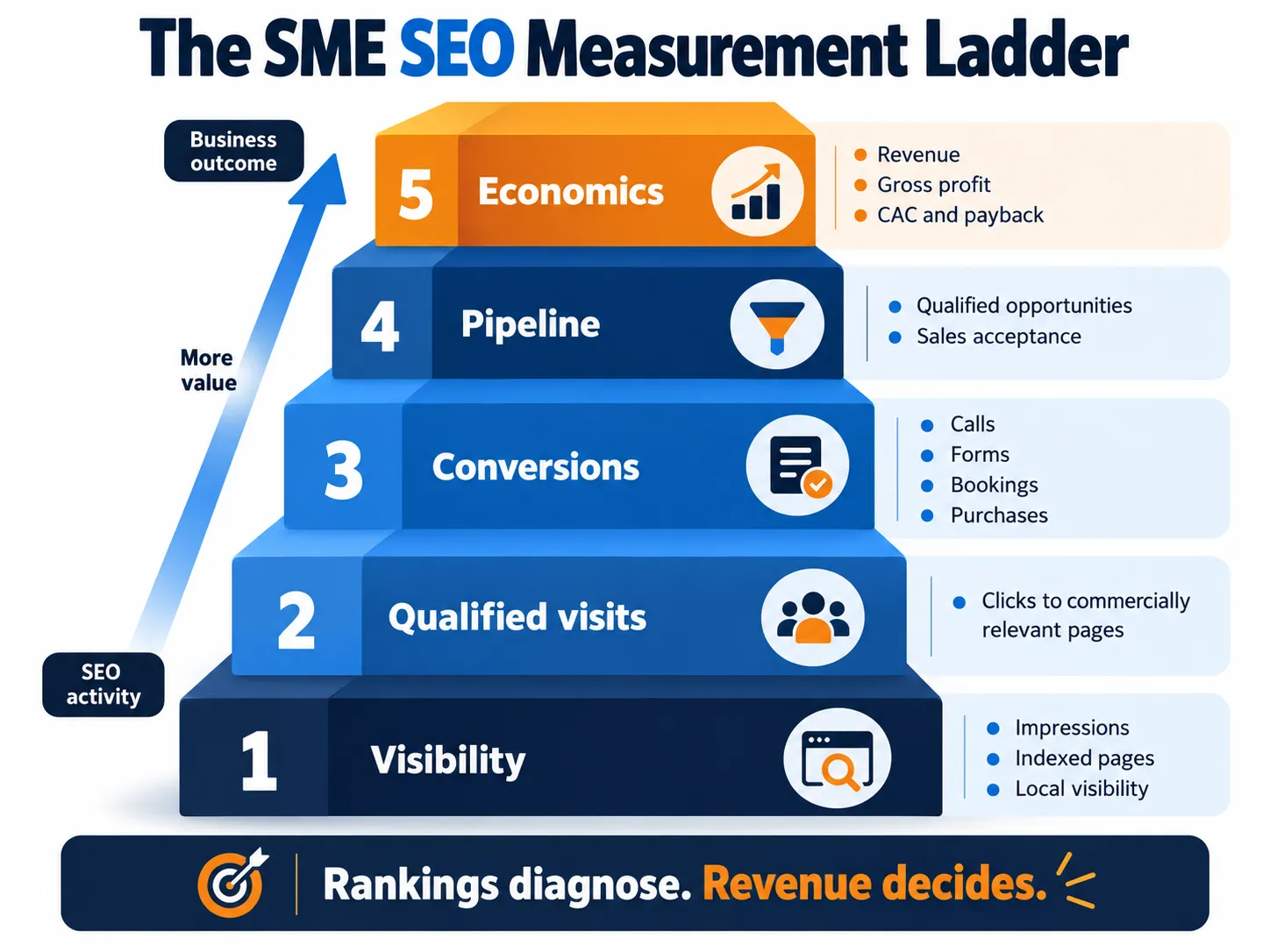
| Level | Metric | Why It Matters |
|---|---|---|
| Visibility | Impressions, indexed money pages, local visibility | Shows whether Google is surfacing the business |
| Qualified traffic | Clicks to relevant service/product pages | Separates useful discovery from broad traffic |
| Conversion | Calls, forms, bookings, purchases | Connects SEO with customer action |
| Pipeline | Qualified leads and opportunities | Shows lead quality |
| Economics | Revenue, gross profit, CAC/payback | Determines whether SEO deserves more budget |
Use Search Console for Both Classic and AI Search Visibility
Search Console remains the strongest free first-party source for queries, pages, clicks, impressions, indexing and technical diagnostics. Google’s new generative AI reporting adds a dedicated view of AI feature visibility for eligible sites.


Operator’s View: What to Cut First When the SEO Budget Gets Tight
When budgets contract, many businesses make the wrong cut: they reduce every SEO activity equally.
A better approach is to protect the work that maintains visibility and commercial relevance, then remove work with weak marginal value.
Cut or Defer First
- low-traffic content with no strategic purpose;
- vanity reporting and dashboards nobody uses;
- bulk directory submissions;
- speculative schema with no eligible search feature;
- low-value keyword tracking at excessive scale;
- content created merely to maintain a publishing frequency;
- link packages measured by quantity rather than relevance.
Protect for as Long as Possible
- tracking and Search Console access;
- revenue-critical page health;
- Google Business Profile and customer information;
- indexation and technical stability;
- high-performing pages already generating qualified demand;
- content based on proprietary expertise, customer questions and first-hand experience.
When money is tight, stop buying SEO activity. Keep buying SEO decisions.
That is the core of a sustainable SME strategy: every additional dollar should have a reason to exist.
Grant programmes, support levels, and eligibility criteria may change. Verify current terms with the relevant Singapore Government agency before committing to a purchase based on grant support.
Frequently Asked Questions About Affordable SEO for Singapore SMEs
How much should a Singapore SME budget for SEO?
There is no universal minimum that guarantees results. A useful budget depends on competition, website condition, geographic scope, content needs, and whether you handle the work in-house or outsource it. With a tight budget, focus spending on the few issues most likely to improve qualified visibility and conversions, rather than spreading money across dozens of keywords and deliverables.
Can SEO work with a budget of less than S$1,000 per month?
Yes, but the scope must be narrow. A sub-S$1,000 budget is usually best used for a hybrid model: free tools and in-house execution for routine tasks, with specialist help for technical audits, priority-page optimisation, local SEO, measurement or occasional expert content. Trying to buy full technical SEO, content production, link acquisition and reporting at that budget often creates shallow work.
How long should an SME expect SEO to take to deliver results?
SEO has no fixed timeline. A business can see indexing, click-through or local-profile improvements relatively quickly, while meaningful ranking and revenue gains in competitive categories can take much longer. Measure progress first by leading indicators, then by qualified organic leads, opportunities and revenue over an appropriate sales-cycle window.
What SEO work should an SME do in-house?
SMEs can usually manage Google Business Profile updates, review responses, first-party photos, customer FAQs, subject-matter input, basic page edits and monthly Search Console reviews. Technical diagnostics, site architecture, complex migrations, structured data, difficult indexing problems and specialist authority building are more sensible to outsource when the required expertise is not available internally.
Is local SEO worth prioritising for SMEs in Singapore?
For businesses that serve customers by location or service area, local SEO is often a high-priority use of a limited budget, as Google Business Profile is free and local search can carry strong commercial intent. Google says local ranking is primarily based on relevance, distance and prominence, so accurate business information, useful local pages, reviews and genuine prominence matter.
Can Singapore SMEs still use PSG support for SEO or digital marketing?
As of 24 September 2026, the existing Productivity Solutions Grant supports eligible pre-approved solutions at up to 50% of eligible costs for local SMEs, but Enterprise Singapore states that PSG will cease on 29 September 2026. From 30 September 2026, businesses should review the new EDGE Grant and current GoBusiness or IMDA guidance before committing to a grant-dependent purchase.
Does SEO still matter now that Google has AI Overviews and AI Mode?
Yes. Google states that its foundational SEO best practices remain relevant to generative AI features. For SMEs, the priority remains crawlable, technically clear pages; useful, non-commodity content; real expertise; strong local and business information; and measurement in Search Console rather than chasing separate AI-search hacks.
What should an SME measure to know if SEO is paying off?
Track qualified organic clicks, leads, calls or bookings, organic-assisted opportunities, conversion rate, revenue and customer acquisition economics. Rankings are diagnostic indicators, not the final business outcome. For local businesses, also monitor Google Business Profile interactions and the quality of enquiries generated by local visibility.