
AI Summary
The guide explains why SEO for healthcare in Singapore is a YMYL compliance issue first and a marketing tactic second, shaped by Google’s E-E-A-T standards, MOH advertising rules, the PDPA and SMC registration signals, before equipping practitioners with an actionable E-E-A-T framework, on-page formulas, compliance audit checklists, 2026 pricing benchmarks (SGD 2,000–15,000+ monthly), agency selection criteria and a 12–16 week implementation timeline. It closes by positioning MediaOne as the SEO agency for healthcare in Singapore, showcasing its three-pillar strategy (Forensic, On-Page and Off-Page SEO), its PHMC Compliance & Medical SEO Assurance framework, and case study results from SingHealth, SATA CommHealth, Ensoul Medical Clinic, Straits Podiatry and Dr Gerard Leong Cardiology Clinic, with a free healthcare SEO audit as the call to action.

Table of Contents
When a patient searches “chest pain treatment Singapore” or “diabetes clinic near me,” Google is not simply ranking web pages. It is making a life-safety decision. That is why the search engine applies its strictest ranking filter — YMYL, or “Your Money, Your Life” — to medical content, and why SEO for healthcare demands a different discipline from retail, SaaS or hospitality search. A single unsubstantiated claim, missing credential badge or outdated author bio can suppress your visibility for months. Conversely, a practice that invests in demonstrable expertise, authoritativeness and trustworthiness will accelerate past competitors relying on traditional SEO shortcuts.
In Singapore, this reality is amplified by local regulatory requirements. The Ministry of Health (MOH) publishes advertising standards for healthcare providers; the Personal Data Protection Act (PDPA) governs how clinics collect and handle patient data; and Singapore Medical Council (SMC) registration is now a visible trust signal that search engines actively verify. Without alignment across all three, your rankings will stall.
This guide walks you through the 2026 SEO landscape for healthcare providers, clinics and allied health professionals in Singapore. You will learn how YMYL compliance and E-E-A-T signals decide what ranks, how to optimise your title tags, meta descriptions and content structure for both patients and search engines, what healthcare SEO costs in 2026, and how to select — and work with — an SEO agency that is built for the sector, including following the compliance framework we apply to every medical client.
Key Takeaways
- SEO for healthcare in Singapore is a YMYL compliance issue first and a marketing tactic second. Choose a partner that understands MOH advertising guidelines, PDPA obligations and SMC registration signals — not just keywords.
- E-E-A-T is the primary ranking factor for medical content, not an afterthought: verifiable credentials, evidence-based claims and transparent sourcing decide whether your pages rank at all.
- Budget SGD 2,000–3,500 monthly for a small clinic, SGD 4,000–6,000 for multi-location practices, and SGD 8,000–15,000+ for competitive verticals such as aesthetics and fertility; setup and compliance audits add SGD 1,500–5,000 one-time.
- Expect 12–16 weeks to measurable organic traction. YMYL sites face slower indexation and lower initial visibility by design; long-tail rankings begin moving at weeks 8–10.
- Red flags to walk away from: guaranteed first-page rankings in 30 days, no discussion of compliance or PDPA, and healthcare treated the same as e-commerce.
- Small clinics with tight budgets can cut agency spend 30–40% with a hybrid model — agency-led technical and authority work, in-house clinician-reviewed content.
Why Healthcare SEO Is Non-Negotiable in 2026
Over 70% of patient journeys now begin with a Google search. In Singapore’s dense healthcare market — where patients can choose from hundreds of GPs, specialists and clinics within their district — visibility in Google’s top three results can mean the difference between a full appointment schedule and empty slots. A cardiac surgeon who doesn’t rank for “heart specialist Singapore” or “angina treatment Singapore” will lose patients to competitors who do, regardless of their qualifications or reputation.
Before a patient calls, they search. They research symptoms, compare specialists, read reviews and check qualifications online. If your practice does not rank, you lose that patient to a competitor who does. For a GP practice or specialist clinic, this directly translates to lost revenue and slower growth.
Why Google Treats Healthcare Differently
Google’s algorithm weights healthcare websites differently because medical advice, treatment options and provider credentials directly affect health outcomes. A misranked article about chest pain symptoms, or a ranking given to an unqualified provider, could harm someone. To prevent this, Google’s YMYL filter penalises healthcare sites that lack demonstrable author credentials, patient safety signals or regulatory compliance.
Unlike a recipe website or a product review site, a healthcare website cannot rank on backlinks and keywords alone. An inaccuracy on an e-commerce site inconveniences a customer. An inaccuracy on a healthcare site can cause harm. That asymmetry is why Google applies far stricter filtering to medical content. Its quality raters assess healthcare pages against four questions:
- Does the author have relevant qualifications?
- Are claims supported by medical evidence or expert consensus?
- Is the practice registered with a legitimate regulatory body?
- Does the page comply with local health advertising rules?
If a page fails this checklist, it won’t rank well, regardless of how many backlinks it has or how optimised the keywords are.
Singapore’s Regulatory Landscape
The Singapore Medical Council sets advertising standards for healthcare. Clinics cannot make unsubstantiated claims about treatments or outcomes. The PDPA restricts how patient data is collected, stored and used. The SMC maintains a register of licensed doctors, and Google’s systems now cross-reference it. Clinics that do not prominently display SMC registration, clinic accreditations or privacy policies rank lower than those that do. This is not coincidence — Google explicitly rewards transparency around credentials and data handling in healthcare.
Healthcare providers must also register under the Private Hospitals and Medical Clinics Act and follow MOH advertising guidelines that prohibit unsubstantiated medical claims. And the market itself is intensifying: a 2024–2025 analysis of healthcare search trends in Singapore showed a significant year-on-year increase in searches for “specialist near me” and “best [condition] doctor Singapore.” Without an SEO strategy, even an excellent clinic gets buried below newer, well-optimised competitors who may be inferior in care but superior in visibility.
The core principle: compliance-first, tactic-second. In Singapore’s healthcare market, SEO success requires navigating regulatory complexity — SMC registration, PDPA compliance, MOH guidelines — while building E-E-A-T signals Google can actually verify. Generic SEO tactics borrowed from retail or tech will not work. A perfectly structured title tag means nothing if Google cannot verify that the doctor behind it is genuinely qualified.
The SEO Disclaimer Standard: YMYL Compliance for Medical Content
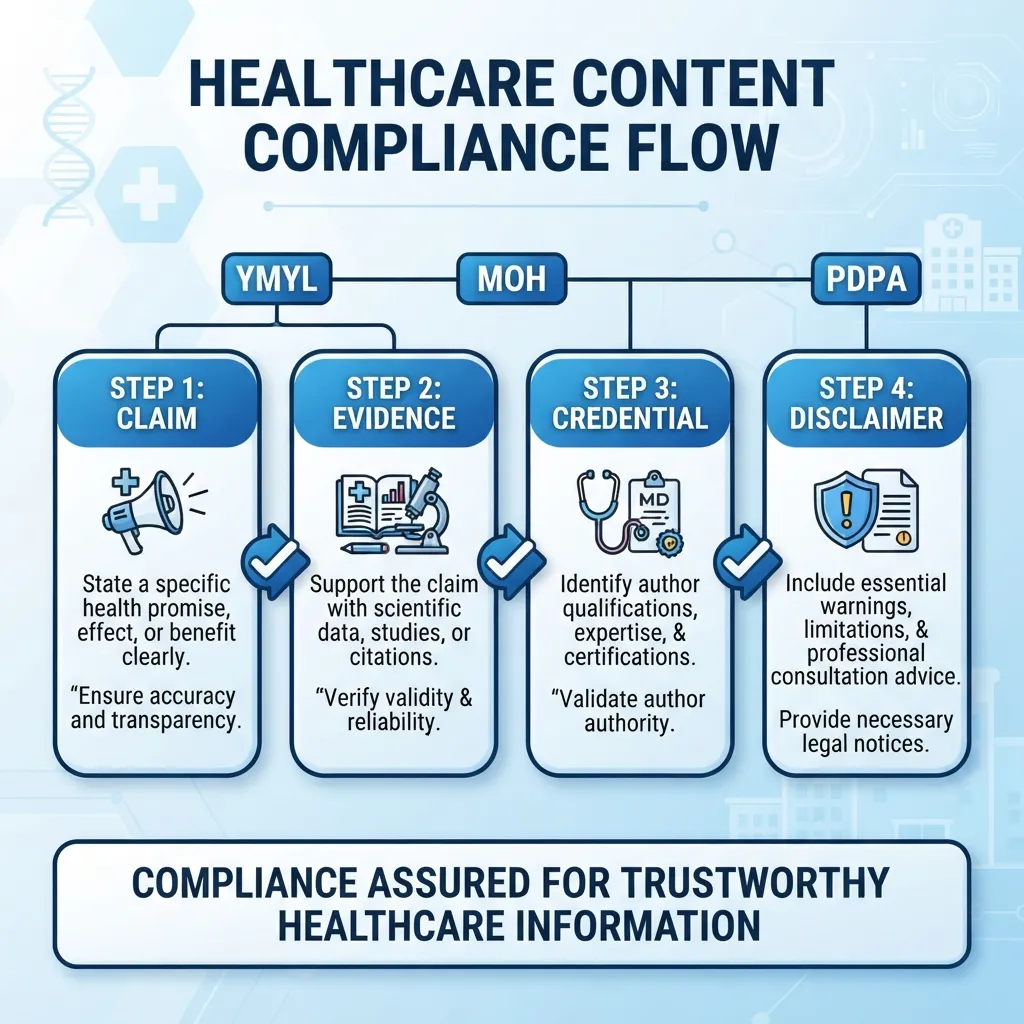
YMYL is not an abstract concept — it dictates how every page on your website is written, sourced and reviewed. Google applies stricter vetting to medical content than to any other vertical, and it expects visible safeguards: clear disclaimers on non-emergency content, transparent sourcing of clinical claims, and references that point to peer-reviewed journals (PubMed-indexed) or official MOH guidance documents.
Treat disclaimers and sourcing as a ranking baseline, not legal decoration. Every content type is covered — blog posts about conditions, treatment and procedure pages, practitioner bios, and patient testimonials must all demonstrate medical accuracy, regulatory compliance and transparent sourcing. This isn’t a competitive advantage; it’s a legal baseline. A standard agency treats healthcare like any other vertical; a specialist knows the difference.
Before publishing any healthcare content, run it against this compliance checklist:
- No comparative claims between treatments or providers — they can be misleading and violate advertising codes.
- No sensationalist language that exaggerates outcomes or creates unrealistic expectations.
- No unverifiable or speculative health claims that lack scientific evidence.
- Visible privacy and data-handling notices (PDPA), with explicit consent mechanisms on every enquiry form.
- Clear non-emergency disclaimers on educational content, directing patients to seek professional consultation.
The SEO Guide: E-E-A-T as the Foundation of Healthcare SEO
Google’s algorithm treats healthcare differently from every other sector. When someone searches for a heart specialist or reads about managing diabetes, Google assumes that page could influence a real health decision. That’s why the search engine weights E-E-A-T (Experience, Expertise, Authoritativeness, Trustworthiness) as the primary ranking factor for healthcare, not an afterthought.
For healthcare practitioners in Singapore, E-E-A-T is not optional optimisation — it’s the structural foundation on which all other SEO tactics rest. Without it, your title tags and schema markup won’t help you rank. With it, those tactics become powerful.
Breaking Down E-E-A-T for Healthcare Practitioners
Experience speaks to the depth of hands-on practice you bring to your specialty. Google wants evidence that you’ve actually treated patients with the conditions you’re writing about. This isn’t theoretical knowledge; it’s years of clinical decision-making in a real practice setting. Signals that demonstrate experience include case studies (with patient consent), treatment outcome data, patient testimonials mentioning specific results, and practitioner bios that state years in practice or number of procedures performed.
Expertise is your formal qualification to speak on the topic. In healthcare, this includes board certifications, specialist qualifications and continuing education in your field. A cardiologist with FRCP (Fellow of the Royal College of Physicians) carries a different credibility weight than a general practitioner discussing heart disease. For SEO purposes, expertise signals live in:
- Your author bio on every content piece
- An “About the Doctor” or “Our Team” page listing qualifications, board status and relevant memberships
- Professional credentials linked to verifiable registries (e.g., Singapore Medical Council)
- Specialist accreditations or advanced training completed recently
Authoritativeness is what third parties say about you. Google doesn’t just trust your claims; it looks for independent validation. In healthcare, that means citations from medical bodies, speaking invitations at medical conferences, published research, backlinks from reputable health institutions and media mentions. For a Singapore healthcare practice, authoritativeness might include:
- Registration with the SMC
- Membership in specialist colleges or medical associations (e.g., Academy of Medicine, Singapore)
- Speaking engagements at medical conferences or continuing medical education events
- Links from Health Ministry resources, hospital networks or peer-reviewed publications
- Patient reviews and ratings that accumulate over time (aggregate authority)
Trustworthiness is the most immediate signal: does the reader believe you’re honest, safe and aligned with their interests? For healthcare, trustworthiness includes PDPA compliance, transparent pricing, clear privacy policies and how you respond to negative reviews. Key trustworthiness signals for healthcare websites:
- A visible, complete privacy policy and data-handling practices (PDPA Singapore requirement)
- Clear pricing or a range for services (no hidden costs)
- Clinic accreditation badges from recognised bodies
- Patient testimonials with names and specific, verifiable outcomes
- Responses to negative reviews that are professional, solution-focused and prompt
- Transparent conflict-of-interest statements if you recommend products or supplements
What Google’s Algorithm Actually Sees
Google doesn’t read your practice brochure the way a human does. Its algorithm looks for structured, verifiable signals embedded in your website code and your digital footprint.
Structured author data (schema markup) tells Google who wrote a piece and what their qualifications are. A blog post with schema.org/Person markup that lists the author’s SMC registration number, specialist qualifications and years in practice ranks higher than the same post without it.
Your About page must be substantive, not promotional. Include: full name and professional photo; qualifications and certifications with years earned; SMC or professional registry number (if applicable); clinic accreditations; languages spoken (relevant in Singapore’s multilingual market); and a link to verifiable professional registries.
Regulatory registrations act as third-party validation. Displaying your SMC registration, clinic licence or accreditation from bodies like JCI (Joint Commission International) tells Google that you’ve passed independent scrutiny.
Patient testimonials are E-E-A-T signals only if they’re credible: include the patient’s real name, condition treated and specific outcome. Vague reviews (“Great doctor!”) carry less weight than detailed ones (“After three months of treatment, my blood pressure went from 160/100 to 130/80”).
Internal linking consistency also signals authority. If every condition page internally links back to your credentials page and your specialist qualifications, you’re reinforcing that expertise across your site.
Singapore-Specific E-E-A-T Pressures
SMC registration is a primary trust signal. Every doctor must be registered with the Singapore Medical Council to practise legally. Displaying your SMC registration number and linking to the public SMC register (where potential patients can verify you) is a direct E-E-A-T win.
Multilingual credibility matters. Many Singaporean patients search in Chinese, Malay or Tamil alongside English. If your About page lists qualifications in English but treats patients across all languages, keep credentials consistent across every language version of your site — inconsistencies are flagged by review systems.
PDPA compliance is a trustworthiness marker. Singapore’s Personal Data Protection Act is strict, and Google’s systems now check for visible PDPA acknowledgment on healthcare sites. A clear privacy policy and explicit patient consent mechanisms (e.g., “By submitting this form, you consent to our privacy terms”) demonstrate trustworthiness and reduce penalty risk.
On-Page Foundations: Title Tags, Meta Descriptions and Header Structure
Your title tag and meta description are the only real estate you control in Google’s search results. For healthcare queries, they’re also the first trust signals a patient sees. A poorly written title can cost you 30–40% of otherwise eligible clicks, while a meta description that omits your location or credentials sends patients directly to your competitors instead.
Title Tag Formula for Healthcare Keywords
Healthcare title tags must compress four pieces of information into 55–60 characters: what you treat, where you treat it, who you are, and why patients should trust you. The formula is: [Service/Condition] in [Location] | [Provider Name], [Credential]
Example: “Diabetes Specialist Singapore | Dr Lim, MRCP” — or, for broader services: “General Practitioner Orchard Road | Same-Day Appointments | Dr Sarah Wong”
Why this structure works:
- Service first: the condition or procedure appears immediately, matching the patient’s search intent.
- Location second: patients searching “cardiologist near me” or “ENT clinic Singapore” need to see location instantly. Google weights geographic modifiers heavily in local search rankings.
- Authority signal last: board certifications (MRCP, FRCP, board registration) and the provider’s name build credibility in the snippet itself, before the patient even clicks.
Keep it under 60 characters — Google typically truncates longer titles on desktop and mobile. Avoid generic titles like “Home” or “Welcome to Our Clinic,” which waste your only SERP real estate. And avoid keyword stuffing: “Diabetes Specialist Singapore | Diabetes Treatment Singapore | Diabetes Clinic Near Me” looks spammy and will be penalised.
Meta Description Strategy
Your meta description doesn’t directly affect rankings, but it drives click-through rate (CTR), which is a ranking factor. A weak description sends patients to your competitor’s result instead. Structure it as: [Patient benefit] + [Differentiator] + [CTA]
Example: “Award-winning diabetes care with same-day appointments. Personalised treatment plans. Book online now.” Or: “Advanced cardiac imaging and catheter lab services. Accredited by Joint Commission. Call or schedule a consultation.”
Aim for 155–160 characters so nothing is cut off on mobile, and include:
- A patient-facing benefit, not a clinic feature — not “We use the latest ultrasound equipment” but “Same-day diagnosis, no referral needed”
- A unique differentiator competitors can’t claim (“Accredited by [Body]”, “15+ years experience”, “Multilingual staff”, “Evening and weekend hours”)
- A clear call-to-action: “Book online”, “Call”, “Schedule”, “Enquire” or “Learn more”
Don’t repeat the title. Don’t keyword-stuff. And don’t make claims you can’t back up — under YMYL scrutiny, an unevidenced “best cardiologist” is a compliance problem, not just an SEO one.
Header Hierarchy: H1, H2, H3
Headers tell Google what your page is about and help patients scan for information quickly. In healthcare, clear header structure is itself a trust signal: disorganised headers suggest disorganised content.
H1 (one per page): use it for the main service or condition the page addresses, typically a close variant of your title tag. Example: “Diabetes Specialist in Singapore” or “Advanced Cardiac Care and Arrhythmia Treatment in Singapore”.
H2s (3–5 per page): each covers a distinct subtopic. For a cardiology service page: “What Is Coronary Artery Disease?”, “Symptoms and Risk Factors”, “Our Treatment Options”, “What to Expect During Your First Appointment”, “Book Your Appointment Today”. For a diabetes management article: “Understanding Type 2 Diabetes”, “How Diet Affects Blood Sugar”, “When to See a Specialist”, “Managing Diabetes in Singapore: Resources and Support”.
H3s (as needed): break H2 sections into specific points — e.g., under “Our Treatment Options”: “Medication and Insulin Therapy”, “Lifestyle Modifications”, “Bariatric Surgery for Severe Cases”. This structure helps Google parse topic relationships, helps patients find answers faster, and aligns with Google’s healthcare schema expectations, which read headers against your page’s main topic and authority claims.
The Practical Audit Checklist
Review your current pages against this checklist. These gaps often cost 2–5 ranking positions for local healthcare searches — and each “no” in the E-E-A-T section is a ranking gap to close before any tactic will work.
E-E-A-T audit:
- [ ] Does your About page list all your qualifications, SMC number and years in practice?
- [ ] Are your credentials linked to verifiable registries?
- [ ] Do patient-facing pages (blog, service pages) include author bylines with credentials?
- [ ] Is your privacy policy visible and PDPA-compliant?
- [ ] Do you have at least five patient testimonials with real names and specific outcomes?
- [ ] Is your clinic accreditation badge displayed on the homepage?
- [ ] Have you claimed and fully optimised your Google Business Profile with specialties and credentials?
Title tags:
- [ ] Does it include your main service or condition?
- [ ] Does it include your location (Singapore, district or landmark)?
- [ ] Does it include your name and at least one credential (MRCP, FRCP, board registration)?
- [ ] Is it under 60 characters?
- [ ] Does it avoid keyword stuffing?
Meta descriptions:
- [ ] Does it promise a patient benefit (not a clinic feature)?
- [ ] Does it include a unique differentiator?
- [ ] Does it end with a clear call-to-action?
- [ ] Is it 155–160 characters?
- [ ] Does it avoid repeating your title?
Headers:
- [ ] Does the page have exactly one H1?
- [ ] Does the H1 match or align closely with the title tag?
- [ ] Does the page have 3–5 H2s, each covering a distinct subtopic?
- [ ] Does each H2 break into 2–3 H3s where detail is needed?
- [ ] Are headers written for patients, not search engines (no keyword stuffing)?
- [ ] Do headers use plain language (“What to Expect During Your Appointment”, not “Appointment Expectations Overview”)?
Resource audit (decide your operating model):
- [ ] Do you have in-house staff with 5+ hours per week for content and Google Business Profile updates?
- [ ] Can your clinicians commit 2 hours monthly for content review and approval?
- [ ] Is budget under SGD 1,500/month? (Adopt the hybrid model below.)
- [ ] Is budget SGD 2,000–4,000/month? (Full-service agency with limited in-house support.)
- [ ] Do you need rapid compliance validation before launch? (Outsource entirely for 3 months.)
- [ ] Is compliance your biggest risk (e.g., new clinic, previous penalties)? (Hire a specialist, not a generalist.)
If more than two items are unchecked in any section, prioritise rewriting those pages — start with your top-traffic pages and highest-value service pages.
Medical SEO Services and 2026 Pricing in Singapore
Healthcare SEO goes beyond standard keyword optimisation. A specialist agency handling YMYL content must audit medical accuracy claims, verify practitioner credentials against the Singapore Medical Council registry and ensure PDPA compliance in all on-page and technical implementations. Core services include:
- Technical SEO: site speed, mobile responsiveness, schema markup for medical entities
- Medical content strategy: condition pages, treatment comparisons, practitioner bios
- Local SEO: Google Business Profile optimisation for clinic locations
- Link building: outreach to healthcare directories and medical publications
- Reputation management: review response and patient testimonial moderation — non-negotiable for healthcare practices, as Google’s algorithm now weighs patient feedback heavily in E-E-A-T ranking signals
2026 Pricing Breakdown
Healthcare SEO in Singapore ranges from SGD 2,000 to SGD 15,000+ monthly, depending on scope and competition:
- Small clinics (1 location, under 50 keywords): SGD 2,000–3,500/month
- Multi-location practices or specialist hospitals: SGD 4,000–6,000/month
- Highly competitive verticals (cosmetic dentistry, fertility clinics, aesthetics): SGD 8,000–15,000/month
Setup fees (initial audit, strategy, compliance review) range from SGD 1,500 to SGD 5,000, separate from monthly retainers. Expect 12–16 weeks before measurable ranking improvements appear, due to YMYL ranking delays.
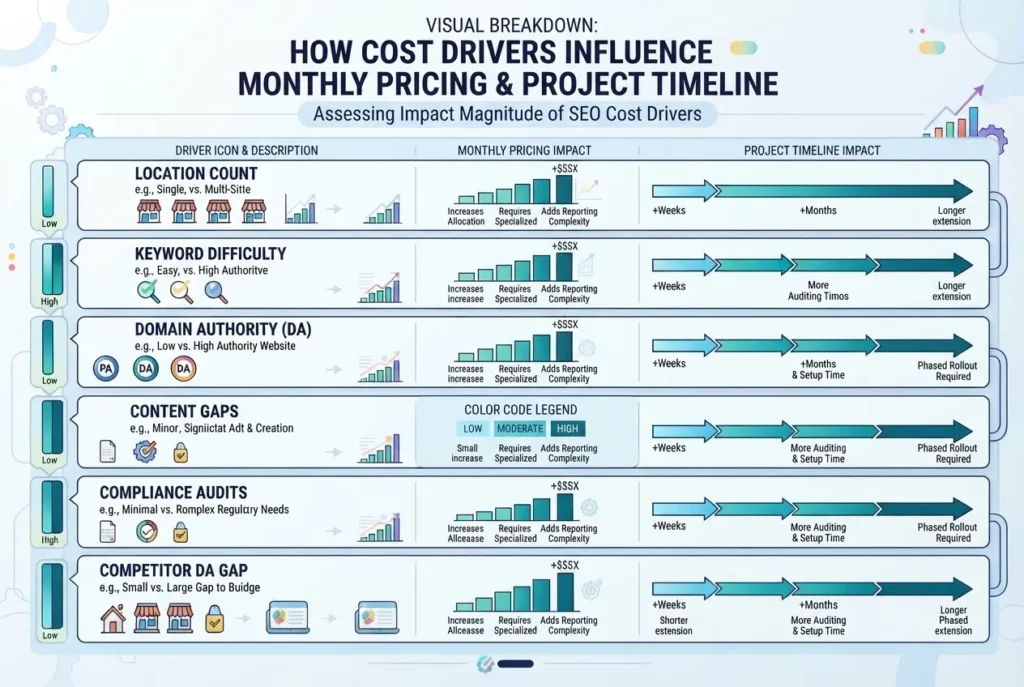
Cost Driver Framework
| Factor | Impact on Cost | Timeline Shift |
|---|---|---|
| Single vs. multi-location | +SGD 1,500–2,000 per location | +2–3 months per site |
| Keyword difficulty (search volume + YMYL density) | +SGD 500–1,000 per 10 competitive terms | +1–2 months per tier |
| Existing domain authority (DA > 40) | −SGD 500–1,000 | −2–3 months |
| Content gap (20+ new pages needed) | +SGD 2,000–4,000 | +3–6 months |
| PDPA + MOH compliance audit | +SGD 1,000–2,000 upfront | One-time |
| Competitor domain authority gap | +SGD 1,000 per 10-point DA gap | +1–2 months per gap |
Start with an SEO audit (SGD 1,500–2,500) to understand your specific cost drivers before committing to a retainer.
Selecting the Right Healthcare SEO Partner
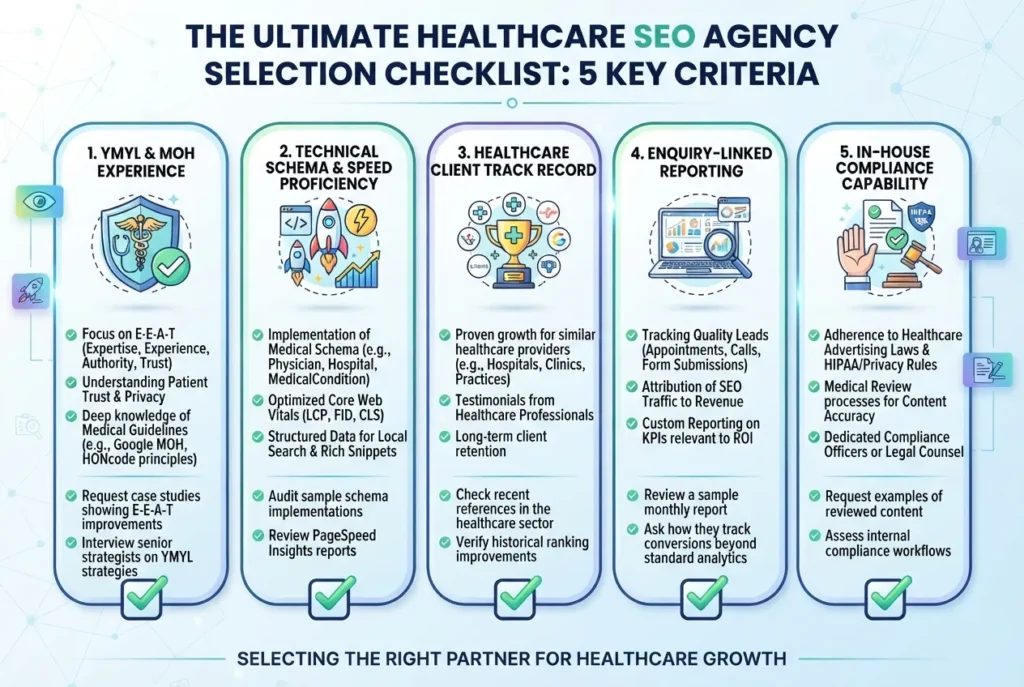
A specialist healthcare SEO agency must demonstrate five non-negotiable criteria:
- Documented experience with YMYL content and Singapore’s MOH guidelines
- Technical proficiency in medical schema markup and page-speed optimisation for clinic websites
- A proven track record with at least five healthcare clients (dentists, GPs, physios or hospitals)
- Reporting tied to patient enquiries and booked consultations, not vanity traffic
- Compliance capability in-house — someone who can review content against PHMC-style advertising codes, PDPA and SMC standards before it ships
Request case studies showing organic traffic growth over 12+ months, not vanity metrics like rankings alone. Ask directly: “Have you managed SEO for a regulated healthcare provider in Singapore?” If they hesitate or reference only general clients, move on. Verify their team includes someone with healthcare compliance knowledge, not just technical SEO. Finally, ensure they understand your specific sub-sector (primary care, aesthetics, mental health), because search intent and regulatory risk differ sharply between them.
Red Flags to Avoid
Avoid agencies promising first-page rankings in 30 days, guaranteeing top-three positions or offering “unlimited keywords for a flat fee”. These signal unsustainable tactics and a misunderstanding of Google’s YMYL scrutiny.
Flag any proposal that avoids discussing compliance, PDPA data handling or content review cycles. If an agency can’t articulate why healthcare SEO costs more than e-commerce SEO, they lack healthcare domain depth. Reject partners unwilling to sign an NDA or clarify which staff will own your account (freelancer rotation is a red flag in regulated sectors).
Never hire based on a pitch alone. Request a free technical audit first. Professional agencies willingly invest 2–3 hours upfront to earn trust.
Hybrid Model: What to Outsource vs. Keep In-House
Outsource technical SEO audits, schema implementation and backlink strategy. Retain in-house content review and clinician sign-off on medical accuracy.
Small clinics can reduce agency spend 30–40% by handling their own blog drafting (outlines supplied by the agency) and social-media posting. Use a freelance medical writer for content (SGD 150–300 per 1,000 words) instead of agency copywriting (typically 3x the cost). Keep local link-building and Google Business Profile management in-house, as your team knows your community best.
Hire an agency for the 90-day technical setup and quarterly strategy reviews, then hand routine updates to a part-time admin or marketing coordinator you train on the framework they build.
Implementation Timeline and Realistic Expectations
Healthcare SEO in Singapore rarely delivers results in weeks. Expect 12–16 weeks before measurable organic traffic shifts appear, though keyword rankings begin climbing at weeks 8–10.
Phase 1: Audit and Compliance (Weeks 1–4)
Technical audit and compliance mapping form the foundation: site crawl, YMYL content review against MOH guidelines, PDPA data-handling fixes and schema markup for medical entities. This groundwork is non-negotiable but invisible to users.
Phase 2: Content Restructure and Authority (Weeks 5–8)
High-intent keywords around specific treatments, practitioner credentials and patient FAQs move into optimised templates. Google takes time to re-index and re-evaluate E-E-A-T signals, particularly for healthcare.
Phase 3: Quick Wins and Early Rankings (Weeks 9–12)
Long-tail, lower-competition queries (such as “dermatologist near Clementi offering Mohs surgery”) rank faster than broad terms. Clinic websites often capture 15–30 additional qualified clicks per month by week 12, though major traffic spikes depend on domain age and initial authority.
Phase 4: Link Building and Expansion (Months 4–6)
Referral partnerships with other specialists, patient testimonial pages and local citation cleanup compound early gains. Competitive keywords begin moving into positions 8–15, where they convert more reliably than positions 1–3 for healthcare (users tend to compare multiple providers).
Budget-conscious practices should prioritise the first 12 weeks. Stopping before week 16 leaves foundational work incomplete and wastes compliance effort already spent.
Why MediaOne Is the SEO Agency for Healthcare in Singapore
Everything in this guide — the compliance checklists, the E-E-A-T framework, the technical foundations — is what we do for healthcare clients every day at MediaOne. We are an award-winning SEO agency in Singapore specialising in SEO for healthcare, helping medical practices turn organic search into a dependable patient-acquisition channel without compromising regulatory obligations.
Our Experience in the Healthcare Industry
MediaOne has optimised some of the most demanding healthcare SEO briefs in Singapore, across every scale of engagement: SingHealth, the nation’s largest public healthcare group; SATA CommHealth, a leading non-profit primary care provider; Ensoul Medical Clinic, a premium aesthetics practice; Straits Podiatry, a specialist foot and ankle clinic; and Dr Gerard Leong Cardiology Clinic, a private cardiology practice. That portfolio spans hospital-scale site architecture, multi-clinic content governance, clinic-level local SEO and regulated YMYL content — the full range of challenges healthcare businesses face in search.
Who we help:
- Public healthcare groups and hospitals managing multi-site content, subsidiary brands and large-scale technical SEO.
- GP, specialist and dental clinics competing for high-intent local searches in their district.
- Aesthetic and wellness clinics in tightly regulated advertising verticals.
- Allied health practices — physiotherapy, podiatry, mental health and more — building authority against larger networks.
- Telehealth and health-tech brands competing on national, not neighbourhood, keywords.
Our SEO Strategy for Healthcare Businesses
Every MediaOne healthcare engagement is built on three pillars:
1. Forensic SEO — improving website performance for a heightened user’s experience (and Google loves it). We optimise Core Web Vitals, apply best practices for web security and crawl budget, optimise page performance including best-practice image formatting, and find and fix errors such as response codes and server errors.
2. On-Page SEO — increasing your visibility by helping customers (and Google) find you easier and understand you better. Our keyword methodology is based on your business objectives and competitive landscape; we optimise site structure and meta assets, work together with your clinicians to create SEO-optimised content hubs, and implement structured data.
3. Off-Page SEO — building a strong reputation and presence to improve E-E-A-T. We execute advanced backlink strategies with high-quality links from authoritative health and community sites, pursue guest posting and authorship opportunities for your specialists, and manage forum and community engagement.
PHMC Compliance & Medical SEO Assurance
At MediaOne, we understand the critical importance of compliance and accuracy in medical content — especially for trusted healthcare institutions. Our approach ensures:
- Expert medical authorship & review: all content is created by medically trained professionals and undergoes thorough review by qualified healthcare experts to guarantee factual accuracy, clinical relevance and clarity.
- Adherence to the PHMC advertising code: we rigorously follow the guidelines set forth by the Pharmaceutical and Healthcare Marketing Code, ensuring no content violates regulations concerning medical advertising and promotions.
- Ethical content standards: our content strictly avoids comparative claims between treatments or providers (which can be misleading), sensationalist language that exaggerates outcomes or creates unrealistic expectations, and unverifiable or speculative health claims that lack scientific evidence.
- Patient-centric messaging: by focusing on transparent, evidence-based information, we help your practice maintain and enhance patient trust, support informed decision-making, and uphold the highest standards of medical communication online.
- Ongoing compliance monitoring: content is periodically reviewed and updated to reflect evolving PHMC guidelines, medical advances and SEO best practices, sustaining both compliance and authority.
SEO Case Studies: Healthcare Businesses MediaOne Has Optimised
Here is what our three-pillar approach has delivered for healthcare organisations in Singapore.
| Healthcare business | Sector | Headline results |
|---|---|---|
| SingHealth | Public healthcare group | +1.2M organic traffic; keywords up 403% (52k to 262k) |
| SATA CommHealth | Non-profit primary care | +2.87M impressions; +413k new users in 9 months |
| Ensoul Medical Clinic | Aesthetic & medical clinic | 9x increase in organic traffic; +110% keywords ranked |
| Straits Podiatry | Specialist podiatry | 40% of keywords on page 1 in 3 months; +551 ranking jumps |
| Dr Gerard Leong Cardiology Clinic | Specialist cardiology | 65% of keywords on page 1 in 6 months; <100X ROAS from SEM |
SingHealth

Who: SingHealth is Singapore’s largest public healthcare group, managing hospitals, polyclinics and specialist centres. It provides patient-centred care, advanced medical research and education, serving millions with comprehensive healthcare services across the entire care continuum — from primary care to highly specialised treatments.
The challenge: competing in a heavily competitive healthcare information space; subsidiary hospitals competing with the parent brand due to unregulated push-content management; disorganised page hierarchies and lack of navigation; and outdated content, UX/UI and URL taxonomy.
What MediaOne did:
- Aligned content across SingHealth and its subsidiaries to reduce internal competition.
- Simplified site architecture with clear navigation paths.
- Refreshed design, improved UX and updated content regularly.
- Optimised URL structure for better search visibility and logic.
The results: +1.2M increase in organic traffic, and a 403% increase in ranked keywords — from 52k to 262k.
SATA CommHealth

Who: SATA CommHealth is a leading non-profit healthcare organisation in Singapore, providing quality primary healthcare services, diagnostics and preventive healthcare for the community. With a focus on accessible and affordable healthcare, SATA CommHealth operates a network of clinics serving thousands of patients across the country.
The challenge: technical issues such as spam links and redundant JavaScript affecting website performance; a lack of clear content structure and outdated topic organisation; low keyword rankings and limited visibility on search engines; and website traffic primarily driven by non-organic sources.
What MediaOne did:
- Fixed technical errors, including the removal of spam links and redundant scripts, to enhance site health.
- Proposed and implemented a new content structure with relevant topics to improve search rankings.
- Achieved 60% of target keywords on page 1 of Google within 9 months.
- Grew organic search to 80% of total site visitors.
The results: +2.87M impressions and +413k new users in 9 months.
Ensoul Medical Clinic

Who: Ensoul Medical Clinic is a premium aesthetic and medical clinic specialising in advanced skin and body treatments. With a focus on personalised solutions and cutting-edge technologies, the clinic aims to enhance skin health and overall well-being.
The challenge: website content was not fully optimised for search engines, limiting online visibility; insufficient volume and quality of website traffic affected brand awareness and patient acquisition; and weak domain authority stemmed from a lack of diverse, high-quality backlinks.
What MediaOne did:
- Optimised and reformatted website content to be search-engine-friendly, improving keyword relevance.
- Increased website traffic volume and enhanced visitor quality, leading to greater brand visibility.
- Strengthened the backlink profile by acquiring a variety of high-authority links to boost domain credibility and rankings.
The results: 9x increase in organic traffic and a 110% increase in keywords ranked.
Dr Gerard Leong Cardiology Clinic

Who: Dr Gerard Leong Cardiology Clinic is a trusted specialist cardiology clinic providing comprehensive heart health services. The clinic focuses on early diagnosis, preventive care and expert treatment to ensure optimal cardiovascular health for patients.
The challenge: low search visibility for cardiology-related keywords, limiting online presence; a lack of authority and trust signals affecting patient confidence; difficulty reaching the right audience for lead generation; and the need for an effective ad strategy to convert website visitors into clinic appointments.
What MediaOne did:
- Developed optimised content to build trust and authority in the cardiology space.
- Acquired high-DA backlinks to strengthen website credibility.
- Implemented precise audience segmentation to execute a profitable ad campaign.
- Converted 75% of leads into booked consultations at the clinic.
The results: 65% of keywords ranked on page 1 in 6 months, and <100X ROAS from SEM campaigns.
Frequently Asked Questions
1. How long does healthcare SEO take to show results?
Measurable organic traffic growth typically appears at 12–16 weeks, due to YMYL ranking delays. Long-tail keywords rank first at weeks 8–10, followed by higher-volume terms at months 4–6. Stopping before week 16 wastes the compliance and technical groundwork already paid for.
2. How much does SEO for healthcare cost in Singapore?
Small clinics with one location typically invest SGD 2,000–3,500 per month; multi-location practices and specialist hospitals SGD 4,000–6,000; and highly competitive verticals such as aesthetics and fertility SGD 8,000–15,000. Setup fees (initial audit, strategy, compliance review) add SGD 1,500–5,000 one-time. Start with an audit (SGD 1,500–2,500) to identify your specific cost drivers before committing to a retainer.
3. Can I do healthcare SEO myself without an agency?
You can handle blog content and Google Business Profile updates in-house. However, YMYL compliance audits, medical schema implementation and link-building from authoritative healthcare sources require specialist knowledge. Many small clinics combine in-house content with agency-led technical and authority work — the hybrid model described above.
4. What’s the difference between healthcare SEO and general SEO?
Healthcare SEO requires compliance with MOH advertising guidelines and PDPA standards, medical accuracy verification, and stricter E-E-A-T checks from Google. General SEO agencies lack this expertise and often expose healthcare practices to ranking penalties or legal risk.
5. Do I need an agency if I hire a medical writer?
A medical writer ensures content accuracy but can’t handle technical SEO, schema markup, PDPA compliance or backlink strategy. Most practices benefit from pairing in-house or freelance medical writing with agency-led technical and authority work.
6. What happens if I hire the wrong agency?
Poor healthcare SEO practice can result in ranking penalties, compliance violations or wasted budget on non-compliant content. Vet agencies against the five criteria in this guide, and always start with a technical audit before committing.