
A practical framework for turning fragmented traffic, content, campaigns and sales activity into a measurable system for qualified pipeline and profitable growth.

The most useful funnels are not pretty diagrams. They are decision systems. They tell you what to do when traffic is healthy, but leads are weak, when leads are plentiful, but sales reject them, or when opportunities are created but few close.
That matters because modern buying journeys are not neat or linear. In B2B, buyers often research long before they identify themselves. In 6sense’s 2025 study of nearly 4,000 buyers, buying groups averaged about 10 people, 94% said they had ranked their shortlist before seller engagement, and the winning vendor was already on the Day One shortlist 95% of the time.
The implication is important: your funnel cannot begin at the form submission. It begins when a buyer first encounters your brand, an article, a recommendation, a review, an AI-generated answer, an advertisement, a colleague’s referral, or a previous customer story.
Key Takeaways
What Is a Lead Generation Funnel?
A lead generation funnel is a structured way to understand how a potential buyer progresses from an unknown audience member to a known prospect, a qualified sales opportunity and eventually a customer.
It differs from a conventional sales funnel in where it starts. The sales funnel usually focuses on opportunities sales already knows about. The lead generation funnel starts earlier, with market visibility, audience creation, education, demand capture and qualification.
Lead Generation Funnel
Starts with: unknown or anonymous audiences.
Main job: create awareness, capture demand, identify fit and surface buying intent.
Primary owners: marketing, demand generation, growth, and SDR/BDR teams.
Sales Funnel
Starts with: known leads or opportunities.
Main job: discovery, validation, commercial negotiation and closing.
Primary owners: SDR/BDR, account executives, and sales leadership.
The Funnel Is Useful Even Though Buyers Do Not Behave Like a Funnel
A buyer may discover you through search, disappear for three months, return through a colleague’s recommendation, ask an AI assistant to compare vendors, read two case studies and then request pricing. That path does not invalidate the funnel. It shows why the funnel should organise signals, ownership, and measurement, rather than pretend that every buyer follows the same sequence.
Google Analytics makes the same underlying point in its attribution. Guidance: customers can have several searches, ad interactions and other touchpoints before completing a meaningful action, which is why attribution models distribute credit across a path rather than assuming one touchpoint did all the work.
The Five Stages of a Lead Generation Funnel
Stage 1: Awareness
The buyer’s question: “What is this problem, and who can help me understand it?”
This stage creates mental availability. Prospects may not be ready to buy, but they should begin associating your brand with a category, problem or outcome.
Useful channels: SEO, educational content, paid social, video, digital PR, industry media, events, creator/KOL content and referrals.
Useful content: explainers, trend reports, educational videos, research, checklists and problem-led articles.
Primary metrics: qualified reach, non-branded search visibility, engaged visits, relevant audience growth and assisted conversions.
Stage 2: Interest and Consideration
The buyer’s question: “Is this product relevant to my situation, and should this vendor make my shortlist?”
Prospects deepen their research. They compare approaches, read customer stories, attend webinars, return to the site and begin consuming content that indicates a specific use case.
Useful content: case studies, comparison guides, webinars, solution pages, calculators, detailed FAQs, implementation guides and category-specific thought leadership.
Primary metrics: repeat visits, content depth, return visitor rate, high-value content engagement, webinar attendance, email engagement and first-party account signals.
For complex B2B buying, this stage is strategically important because many vendors are shortlisted before sellers ever speak to the buying group. The 6sense research cited earlier found that 94% of buyers had already ordered vendors by preference before engaging sellers. 6sense.
Stage 3: Decision and Intent
The buyer’s question: “Can this vendor solve our problem at an acceptable cost and risk?”
Behaviour becomes more commercially relevant. Pricing views, demo requests, proposal enquiries, trial activity, security documentation and implementation questions often appear here.
Useful content: pricing or scoping information, ROI tools, customer proof, implementation timelines, technical documentation, compliance evidence, product demonstrations and factual competitor comparisons.
Primary metrics: high-intent sessions, demo or consultation requests, proposal requests, trial-to-qualified-opportunity rate and cost per qualified opportunity.
For Singapore organisations in regulated sectors, compliance content should be specific to the actual requirements. Avoid vague statements such as “PDPA certified” unless a specific, recognised certification is referenced. For telemarketing to Singapore telephone numbers, the PDPC’s DNC rules and exceptions should be checked directly.
Stage 4: Qualification and Handoff
The buyer’s question: “Is this opportunity worth taking into a serious sales process?”
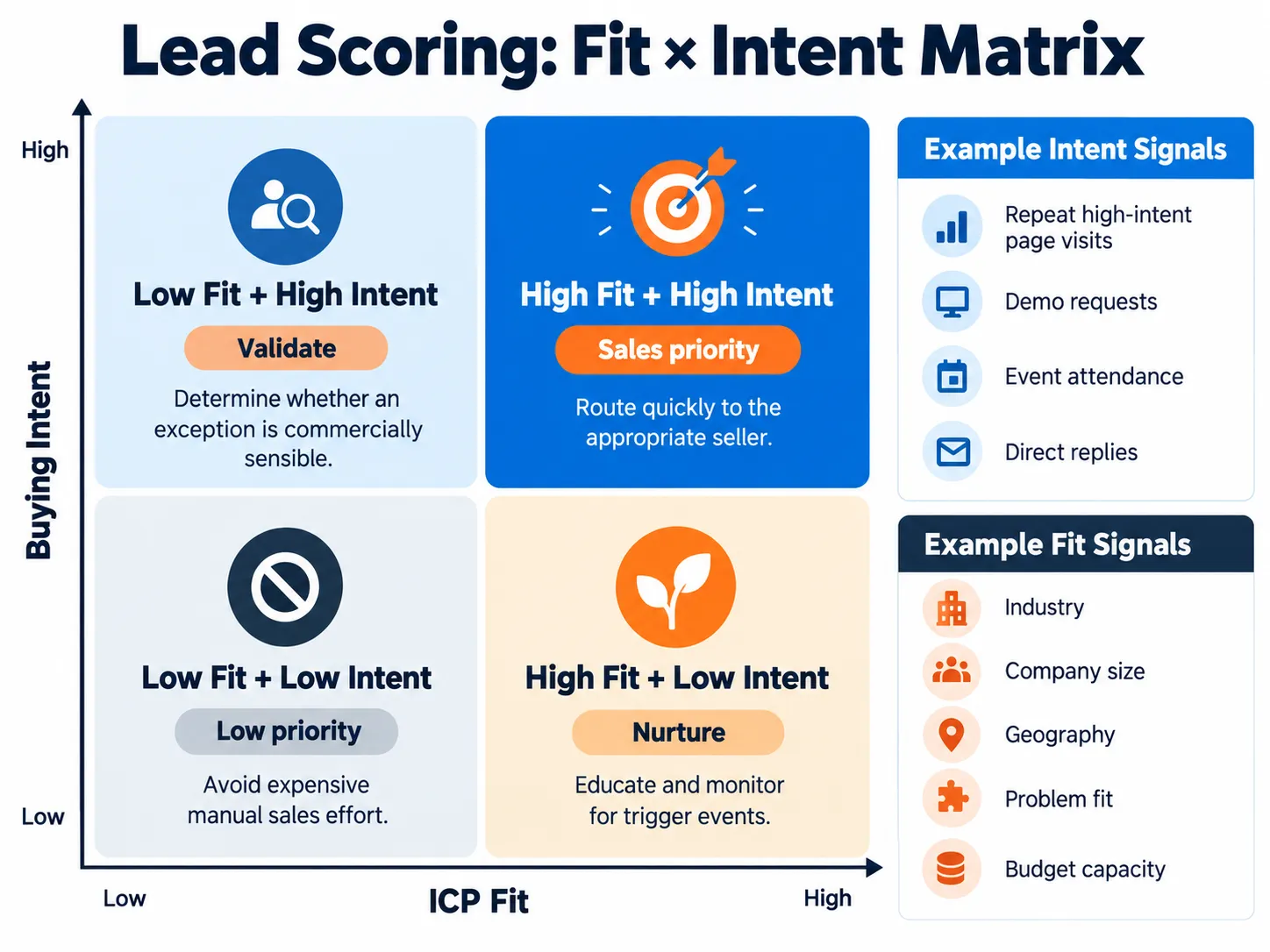
Marketing engagement alone is not qualification. A strong handoff combines fit, commercial relevance and evidence of intent.
A practical qualification model asks:
- Fit: Does the organisation resemble the customers you can serve profitably?
- Problem: Is there a real problem with meaningful business consequences?
- Access: Is the contact part of the buying process or able to reach the right stakeholders?
- Timing: Is there a trigger or decision window?
- Commercial viability: Can the likely deal support your acquisition and delivery cost?
BANT can still be useful as a checklist, but rigidly demanding confirmed Budget, Authority, Need and Timeline too early can eliminate valid future opportunities. In longer B2B journeys, qualification should mature as information becomes available.
Primary metrics: lead-to-SQL conversion, sales acceptance rate, time-to-first-sales-action, SQL-to-opportunity conversion and disqualification reasons.
Stage 5: Conversion and Retention
The buyer’s question is: “Can we confidently choose, implement and continue with this provider?”
A signed contract is not the end of the revenue journey. The quality of onboarding affects retention, expansion, referrals and the customer proof that feeds future demand.
Useful activities: structured onboarding, time-to-value milestones, customer education, adoption monitoring, executive reviews, renewal planning, advocacy and referral programmes.
Primary metrics: opportunity win rate, customer acquisition cost, time to value, retention, expansion revenue, churn and net revenue retention where applicable.
Why Small Funnel Improvements Compound
Funnel optimisation is powerful because each stage multiplies the next.
Consider a simplified B2B funnel with 10,000 relevant visits per month:
| Stage | Conversion | Volume |
|---|---|---|
| Relevant visits | — | 10,000 |
| Visit → Lead | 3% | 300 |
| Lead → SQL | 25% | 75 |
| SQL → Opportunity | 50% | 38 |
| Opportunity → Customer | 30% | 11–12 customers |
If you increase traffic by 20% but leave every conversion rate untouched, customer growth is roughly proportional to traffic. But if you improve several stages modestly, the gains multiply.
For example, improving visit-to-lead from 3% to 3.4%, lead-to-SQL from 25% to 28%, and opportunity win rate from 30% to 34% can produce materially more customers from the same traffic base.

How to Build a Lead Generation Funnel: A Seven-Step Framework
Step 1: Define the Ideal Customer Profile Before Choosing Channels
Start with the customer economics, not the advertising platform.
Define the organisations you can serve well and profitably using attributes such as industry, company size, geography, operating maturity, business model, problem severity, buying triggers and likely deal value.
For B2B, separate the ICP from the buyer persona. The ICP describes the company. Personas describe the different people inside that organisation who influence the decision.
Step 2: Audit Existing Demand Sources Using Downstream Quality
List where leads and customers currently originate: organic search, paid search, paid social, email, referrals, partners, events, outbound, direct and other meaningful sources.
Then compare sources with a scorecard that goes beyond CPL:
| Source | Leads | Qualified Opportunities | Customers | Acquisition Spend | Revenue |
|---|---|---|---|---|---|
| Organic search | Record | Record | Record | Include content/SEO cost | Record |
| Paid search | Record | Record | Record | Media + management | Record |
| Paid social | Record | Record | Record | Media + creative + management | Record |
| Referrals/partners | Record | Record | Record | Fees/commissions/programme cost | Record |
Do not automatically label organic or referral leads “free”. Content, SEO, partnerships and staff time have costs. The objective is comparative economics, not artificially flattering one channel.
Step 3: Build Content Around Buyer Questions, Not Funnel Labels
“Top of funnel content” is useful internal terminology, but customers do not think in funnel stages. They think in questions:
- What is causing this problem?
- What options exist?
- What are the trade-offs?
- Which providers should we consider?
- What will implementation cost?
- What evidence makes this choice safe?
Build content around these questions and map it to the stage where it is most useful. This creates a much more natural content journey than forcing every topic into “awareness, consideration or decision” before understanding its actual search intent.
Step 4: Match Landing Pages and Calls-to-Action to Intent
| Buyer Intent | Page Type | Strong CTA Example | Weak CTA Example |
|---|---|---|---|
| Exploratory | Educational guide | Download checklist / subscribe / see examples | Buy now |
| Problem aware | Solution guide / case study | See how it works / compare approaches | Learn more |
| Commercial evaluation | Service / product / pricing | Request proposal / book consultation / calculate ROI | Read our blog |
| High intent | Demo / contact / proposal | Book a time / send requirements / start trial | Follow us |
A page should make the next action obvious without asking for a commitment that doesn’t match the visitor’s current intent.
Step 5: Capture Only the Information You Can Use
Form length should be based on the value of the offer and what the next workflow genuinely needs. Do not collect eight fields because your CRM has eight empty columns.
A low-friction resource may need only a work email and perhaps the company name. A high-value consultation can justify additional questions about challenge, company size, timing or budget.
Use progressive profiling where possible: collect the minimum now and enrich or ask additional questions later.
Step 6: Define Lead Scoring and Sales Handoff Together
Lead scoring should answer a business question: Which prospects deserve which next action?
Avoid arbitrary point systems that reward easy-to-measure actions. Email opens, for example, are a weak signal compared with a demo request, reply, pricing view or verified trigger event.
Define:
- what qualifies as an MQL;
- what qualifies as an SQL;
- what disqualifies a prospect;
- who owns each stage;
- what sales must do after accepting an SQL;
- what happens when sales rejects it;
- how rejected leads return to nurture.
The most valuable part of lead scoring is not the number. It is the shared agreement between marketing and sales on what deserves attention.
Step 7: Instrument the Funnel Before Scaling It
Before increasing spend, make sure you can connect the acquisition source to downstream outcomes.
At minimum, establish consistent:
- UTM naming conventions;
- CRM source fields;
- campaign and landing-page identifiers;
- lead status definitions;
- opportunity source and influence fields;
- closed-won revenue reporting;
- stage timestamps for velocity analysis.

For multi-touch digital journeys, review attribution paths rather than relying solely on the last recorded source. Google Analytics’ attribution tools are designed specifically to show initiating, assisting and closing touchpoints and how different models assign credit.
Lead Generation Funnel Strategies by Channel
The wrong question is “Which channel is best?” The better question is what job should this channel perform in our funnel?
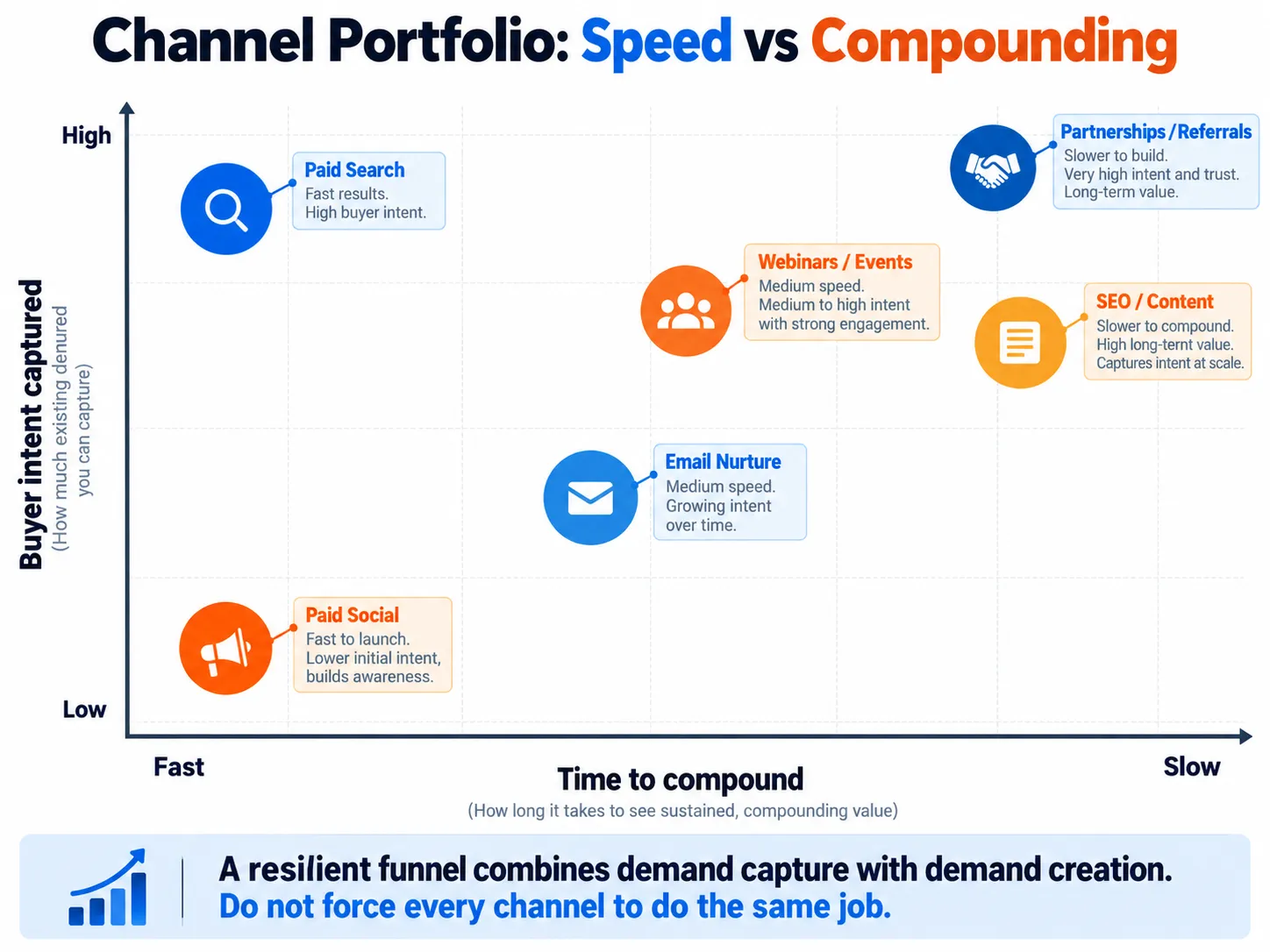
| Channel | Best Funnel Job | Strength | Constraint | Metric to Prioritise |
|---|---|---|---|---|
| SEO & Content | Discovery, education, demand capture | Compounds and captures self-directed research | Requires time, authority and sustained quality | Qualified organic pipeline and assisted revenue |
| Paid Search | Capture existing demand | High intent and fast feedback | Competitive terms can become expensive | Cost per qualified opportunity / CAC |
| Paid Social | Demand creation, retargeting, account reach | Precise audience and creative testing | Many users are not actively buying | Qualified engagement and downstream conversion |
| Nurture and reactivation | Owned audience and personalised sequences | Quality depends on permission, relevance and list health | Progression to high-intent actions | |
| Webinars & Events | Education, trust, qualification | High information density and direct interaction | Operational effort and variable attendance | Qualified meetings/opportunities per event |
| Partnerships & Referrals | Trust transfer and warm acquisition | Strong credibility and fit when partners overlap | Harder to scale quickly | Opportunity and win rate by partner |
| Outbound / ABM | Create conversations with known target accounts | Control over who receives attention | Low-quality outreach damages response and brand | Account progression/meetings / opportunities |
Organic Search and Content
SEO works best when it captures genuine problem-and-solution research, not when it publishes content merely to hit a word count or frequency target. Prioritise topic depth, search intent, internal linking and evidence that makes the page worth citing or recommending.
For high-value B2B categories, create content across the full evaluation journey: problem education, methods, comparisons, implementation, costs, alternatives, case studies and decision support.
Paid Search
Paid search is most effective when search intent matches landing-page intent. Separate educational queries from commercial queries. A user searching for “what is lead scoring?” should not see the same offer as someone searching for “lead scoring software pricing”.
Use negative keywords aggressively, feed closed-loop CRM outcomes back into optimisation where available, and evaluate search terms by qualified pipeline rather than conversion count alone.

Paid Social
Paid social can build category awareness, reach defined job roles or account segments, and retarget people already familiar with the brand. It should not be forced to imitate paid search.
Creatives should earn attention first. Then use stage-matched offers: research or insights for colder audiences, proof and comparison for engaged audiences, and demos or consultations for retargeted high-intent groups.
Email Nurture
Email is most valuable when it changes what happens next. Segment by meaningful differences such as industry, use case, buying stage or behaviour rather than simply sending every lead the same sequence.
Use replies, booked meetings, high-intent page visits and content progression as stronger signals than open rate alone.
Webinars and Events
Events work when the topic itself qualifies the audience. “Lead Generation 101” attracts broad interest. “How CFOs Can Reduce SaaS Acquisition Payback Without Cutting Pipeline” attracts a narrower group with a clearer problem.
Measure event performance beyond registrations. Track attendance quality, engagement, meetings, opportunities, and revenue influenced by the event.
Partnerships and Referrals
Partnerships work because the introducing organisation transfers some of its trust to the partner. The strongest partners share your ICP but solve a different problem.
Operationalise referrals with clear qualification rules, attribution, assets partners can share, and fast feedback on what happened to referred opportunities.
Modern Funnel Trends Marketers Should Account For
1. More of the Funnel Is Invisible
Prospects can research through AI assistants, communities, review platforms, private messages, internal buying-group discussions and vendor content without producing a clean sequence of trackable website sessions.
6sense’s 2025 research reports that 94% of buyers used LLMs during the buying process, while buyers still relied on vendor content and human validation for high-stakes decisions.
This finding means marketers should not interpret “untracked” as “uninfluenced”. Brand, content, digital PR, reviews and expert mentions can influence a shortlist before analytics identifies a lead.
2. Buying Groups Matter More Than Individual Leads
Groups make complex B2B purchases. A single contact can appear highly engaged while finance, security or procurement remains unconvinced.
For higher-value opportunities, measure account coverage: how many relevant stakeholders you know, whether multiple functions are engaging, and whether the buying group is broadening.
3. Attribution Should Inform Decisions, Not Pretend to Be Perfect
Google Analytics’ data-driven attribution uses converting and non-converting path data to estimate the contribution of different ad interactions rather than assigning every conversion to the last click.
That is useful, but no attribution model can observe every offline conversation, private recommendation or untracked influence. Treat attribution as evidence for resource allocation, not an audited reconstruction of human psychology.
4. Singapore Compliance Needs Channel-Specific Thinking
Do not reduce PDPA compliance to the statement that “all B2B marketing requires opt-in.” Rules depend on the channel, purpose, data use and context.
For marketing calls and text/fax messages to Singapore telephone numbers, the PDPC states that DNC provisions generally prohibit marketing messages to numbers listed on the DNC Registry, subject to specific exceptions, including certain B2B messages. The PDPC also requires organisations to honour opt-out requests within the specified time frame.
For campaign design, confirm the relevant obligations with current official guidance or qualified legal counsel rather than relying on generic marketing templates.
Common Lead Generation Funnel Mistakes to Avoid
1. Optimising for Lead Volume
Cheap leads can produce expensive customers. Compare sources using opportunity rate, win rate, CAC and revenue, not CPL alone.
2. Using One CTA Everywhere
Match the ask to the intent. Educational visitors need a useful next step; high-intent visitors need commercial clarity.
3. Confusing Engagement With Qualification
Someone can read five articles and still be a poor-fit customer. Score fit and intent separately.
4. Treating MQL and SQL as Marketing Definitions
Sales and marketing should jointly define both stages and review them against actual downstream outcomes.
5. Slow or Unclear Handoff
A lead should never disappear between systems or teams. Define owner, trigger, expected action and rejection workflow.
6. Measuring Every Channel With the Same KPI
Paid search captures demand; paid social can create it; referrals transfer trust. Their jobs and evaluation windows differ.
7. Believing Last Click Tells the Whole Story
Use path and assisted-conversion analysis for journeys with multiple touchpoints.
8. Adding Complexity Before Volume Exists
A 40-rule lead-scoring model is meaningless when only five leads arrive each month. Start with simple criteria and add complexity when data justifies it.
Lead Generation Funnel Metrics That Matter
No universal “ideal” conversion rate fits every business. Deal size, buying cycle, source mix, brand strength, geography and definition of a lead can change the benchmark dramatically.
The most useful benchmark is therefore usually your own segmented baseline over time, supplemented by external benchmarks where the methodology and population actually match your situation.
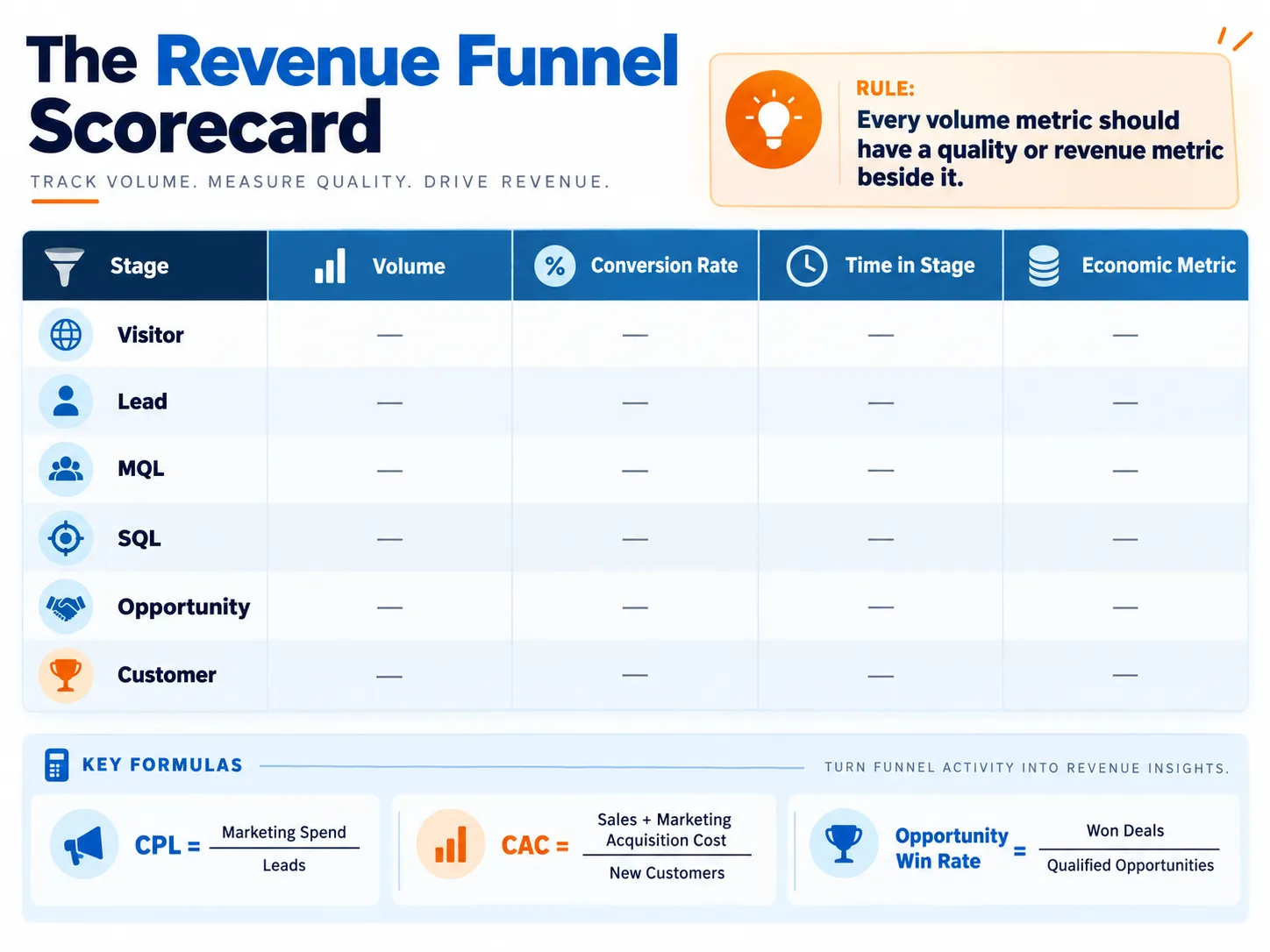
| Metric | Formula / Definition | What It Tells You | Common Misread |
|---|---|---|---|
| Visitor → Lead Rate | Leads ÷ relevant visits | Whether traffic, offer and page convert together | High conversion can still be poor if traffic quality is weak |
| Cost Per Lead (CPL) | Acquisition spend ÷ leads | Top-level acquisition efficiency | Cheapest CPL does not equal cheapest customer |
| Lead → SQL Rate | SQLs ÷ leads | Targeting and qualification quality | Definitions can vary dramatically between teams |
| SQL → Opportunity Rate | Qualified opportunities ÷ SQLs | Sales acceptance and discovery effectiveness | Low rates may reflect scoring or the sales process, not traffic |
| Opportunity Win Rate | Won deals ÷ qualified opportunities | Commercial competitiveness and deal quality | Can be inflated by over-disqualifying hard opportunities |
| Customer Acquisition Cost (CAC) | Relevant sales + marketing acquisition cost ÷ new customers | True acquisition economics | Leaving sales labour or agency costs out understates CAC |
| CAC Payback | CAC ÷ monthly gross profit per new customer | How quickly acquisition investment is recovered | Using revenue instead of gross profit can overstate efficiency |
| Stage Velocity | Average/median time in each stage | Where deals stall | Only looking at the total sales cycle hides the bottleneck |
| Revenue per Lead | Revenue attributed to cohort ÷ leads in cohort | Lead quality and source value | Needs an appropriate time horizon for long cycles |
A Better Funnel Dashboard
Instead of a dashboard with 40 metrics, give management a small number of linked measures:
- Qualified traffic or account reach
- Leads
- SQLs
- Qualified opportunities
- Pipeline created
- Customers won
- Revenue / gross profit
- CAC and payback
Then allow channel, campaign, ICP and cohort drill-down underneath.
A Practical Monthly Funnel Optimisation Routine
Avoid random optimisation. Use a repeatable process:
1. Reconcile the Data
Check CRM, analytics, ad platforms and revenue records for broken tracking, duplicate leads and source inconsistencies.
2. Find the Biggest Economic Leak
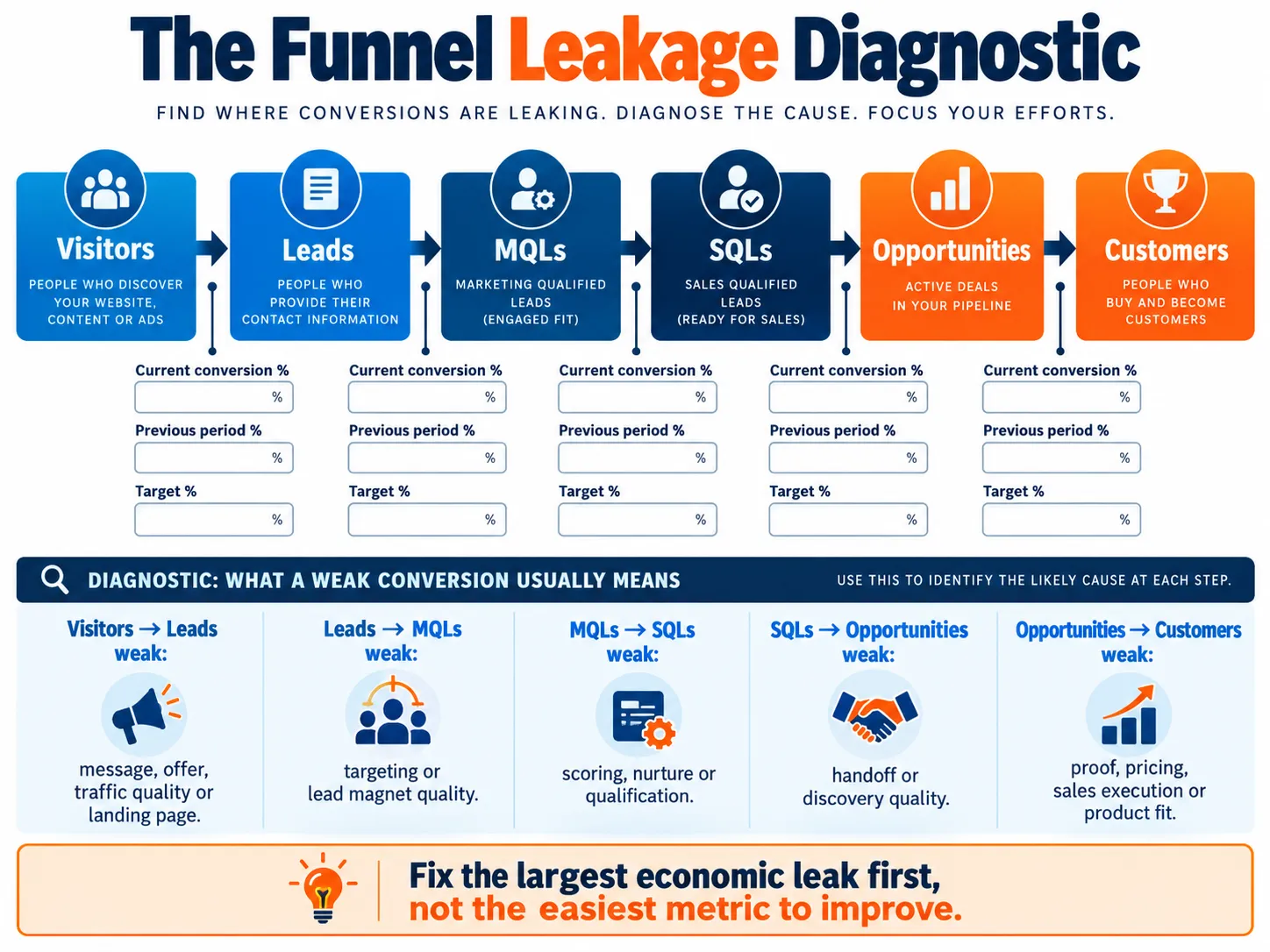
Identify the stage losing the most potential revenue, not simply the stage with the lowest percentage.
3. Segment Before Diagnosing
Break the problem down by source, campaign, ICP, device, landing page or sales team. Aggregate averages often hide the cause.
4. Form a Specific Hypothesis
Example: “Decision-stage visitors are abandoning because pricing and implementation expectations are unclear.”
5. Change One High-Leverage Variable
Consider changing one of the following high-leverage variables: offer, landing-page proof, CTA, targeting, scoring rule, nurture sequence, or sales response process.
6. Measure the Downstream Effect
Do not declare victory because clicks improved if qualified opportunities or revenue did not.
Eight Useful Quick Wins
- Compare your top lead source with your top customer source. If they differ, lead volume may be misleading.
- Review rejected SQLs. Look for patterns in why sales reject them.
- Shorten one unnecessarily long form. Remove fields nobody uses.
- Add proof to the highest-intent page. Include a case study, implementation detail, security evidence, or a transparent process.
- Create one stage-specific comparison page. Help evaluators decide rather than forcing them to assemble the comparison themselves.
- Build or refresh one nurture sequence. Use behaviour to branch the next message where it makes sense.
- Audit source attribution. Check whether “direct” or “organic” is absorbing traffic that should have campaign tags.
- Hold one joint marketing-sales funnel review. Discuss conversion and rejection reasons, not departmental activity totals.
Operator’s View: Optimise for Revenue Quality, Not Funnel Beauty
The most common funnel mistake is building a sophisticated-looking system that nobody trusts.
Marketing has its dashboard. Sales has another. Finance has the revenue numbers. Each system provides a different answer, so the company debates attribution instead of improving acquisition.
A more useful operating principle is:
Every marketing metric should eventually connect to a sales or customer outcome, and every sales outcome should be traceable far enough upstream to improve acquisition.
This changes how teams behave.
- You stop asking which campaign generated the most forms and instead ask which created profitable opportunities.
- You stop treating an MQL as success and start treating it as a prediction that sales outcomes must validate.
- You stop adding channels because competitors use them and add them only when they solve a specific funnel constraint.
- You stop assuming “more traffic” is growth when the real bottleneck is qualification or win rate.
The best lead generation funnel is not the one with the most stages, automations or dashboards. It is the one that makes the next resource-allocation decision clearer.
Frequently Asked Questions About Lead Generation Funnels
What is a lead generation funnel?
A lead generation funnel is a structured system for attracting potential buyers, identifying meaningful engagement, qualifying fit and intent, and moving the strongest prospects into a sales process. Treat it as a measurement and decision framework rather than a literal path every buyer follows.
What is the difference between a lead generation funnel and a sales funnel?
A lead generation funnel begins earlier, with discovery, awareness, engagement and qualification. A sales funnel usually begins once a prospect is identified as a lead or opportunity, focusing on moving that opportunity toward a closed sale.
What are the five stages of a lead generation funnel?
A practical five-stage model consists of Awareness, Interest and Consideration, Decision and Intent, Qualification and Handoff, and Conversion and Retention. The exact labels matter less than having clear entry criteria, content, ownership and metrics for each stage.
How do I know where my lead generation funnel is leaking?
Measure conversion and time spent between adjacent stages rather than looking only at total leads. High traffic volume with weak lead capture indicates a problem with the message or landing page; strong lead volume with poor qualification indicates an issue with targeting or scoring; and strong opportunities with a low close rate indicates a problem with the offer, proof, pricing, or sales execution.
What metrics should I track in a lead generation funnel?
Track stage conversion rates, cost per lead, cost per qualified opportunity, sales cycle length, customer acquisition cost, revenue by source, CAC payback and customer retention. The goal is to connect marketing activity to qualified pipeline and profitable customers rather than stop at clicks or raw lead counts.
How should MQLs and SQLs be defined?
Define them jointly with marketing and sales. An MQL should meet the agreed fit and engagement criteria that justify continued marketing attention. An SQL should meet a higher threshold that warrants direct sales effort. Use explicit rules and review them against actual win data, rather than relying on arbitrary scores.
How long does it typically take to build a lead generation funnel?
Paid channels can provide learning within weeks, while SEO, partnerships and content usually need longer to compound. The more important milestone isn’t a fixed number of days but the point at which you have enough volume to identify repeatable stage-conversion patterns and make decisions with confidence.
How often should you optimise your lead generation funnel?
Review operational metrics weekly or fortnightly and make strategic changes monthly or quarterly. Avoid reacting to tiny samples. Prioritise the largest bottleneck first, test one or two changes, and measure whether the downstream outcome improves.