If you are a business competing in Singapore today, you are not just fighting for attention; you’re fighting for trust in one of the world’s most digitally connected markets. As of 2024, Singapore’s internet penetration rate stands at over 96 per cent, according to DataReportal.
That level of connectivity changes the game. Buyers research. They compare. They scrutinise reviews. They click away fast. This is also why searches for branding agency services in Singapore continue to rise, as business owners seek more than just design. They are looking for direction.
This is why brand strategy is not a branding exercise– it’s revenue architecture.
Too many businesses in Tanjong Pagar, Orchard, or Jurong East invest SGD 20,000 into a website redesign and call it a day. The logo looks sharp. The colour palette feels modern. But leads do not move. Sales teams still chase cold prospects, and cost per acquisition continues to climb.
In this guide, you will build a positioning-first framework that aligns your message, pricing, and marketing so you attract the right leads before your sales team even speaks to them.
Key Takeaways
- Brand strategy aligns positioning, messaging, and audience understanding to attract the right leads.
- Clear differentiation and value articulation improve lead quality and conversion.
- Consistent strategy reduces acquisition costs and strengthens SEO and paid media performance.
- Strategic clarity shortens sales cycles and builds trust before first contact.
What Is Brand Strategy in Singapore?
A brand strategy is the deliberate plan that defines how you want to be perceived and why someone should choose you over every alternative in your category.
Branding is execution, which includes your logo, design, and tone of voice. Meanwhile, your brand strategy is the decision behind those executions.
In Singapore’s dense business landscape, that distinction matters. According to the Department of Statistics Singapore, there are over 354,700 small and medium‑sized enterprises operating locally. Your buyer is not choosing between you and one competitor. They are filtering through dozens.
A strong brand strategy influences:
- How quickly prospects trust you
- Whether you can command premium pricing in SGD
- How qualified are your inbound leads are
- How short does your sales cycle becomes
Singapore’s multicultural demographic also demands nuance. The 2020 Census shows that 74.3 per cent of the resident population is Chinese, 13.5 per cent Malay, 9.0 per cent Indian, and others make up the remainder.
If your messaging is generic, you risk resonating with no one. But if your positioning is sharp, your marketing does not need to shout. It attracts on its own.
Why Brand Strategy in Singapore Requires a Positioning-First Approach

Many industries here are saturated: Digital agencies, tuition centres, F&B concepts, and SaaS startups. You see it in Clarke Quay. You see it in a single LinkedIn scroll. The risk is “me too” messaging. Everyone claims to be innovative, customer-centric, and results-driven.
Positioning is what stops you from blending in.
That repositioning was not cosmetic. It shifted public perception from a taxi alternative to an ecosystem platform. And as of 2023 (end of year), Grab reported 47.7 million monthly transacting users across Southeast Asia (as of Q3 2025).
Here’s how positioning influences your brand:
| Impact Area | Weak Positioning | Strong Positioning |
| Pricing Power | Competes on discount | Commands a premium for expertise |
| Trust | Needs heavy proof every time | Assumed credibility |
| Authority | Seen as one of many | Recognised category leader |
| Conversion Rates | Visitors browse and leave | Visitors enquire with intent |
If you want more qualified leads in Singapore, positioning is not optional. The filter determines who clicks “Contact Us”.
The Brand Strategy Framework That Drives Leads
Most businesses in Singapore do not struggle for ideas. They struggle because they lack structure.
You might have a capable marketing team and a healthy marketing budget, yet if your positioning is unclear, every campaign becomes an isolated experiment rather than a compounding asset. Leads fluctuate unpredictably, messaging shifts by channel, and sales conversations repeatedly start from zero rather than building on prior trust.
A framework changes that dynamic by replacing opinion with evidence and scattered tactics with coordinated strategic decisions. Instead of asking what sounds good in a meeting, you begin asking what differentiates, what resonates, and what converts.
In a market where buyers conduct extensive research before speaking to sales, your positioning must do most of the persuasive work long before a discovery call is booked.
According to Google’s research on B2B purchasing behaviour, buyers complete a significant portion of their evaluation before engaging with a sales representative. If your message does not clearly differentiate you during that silent evaluation phase, you are already at a disadvantage before the conversation begins.
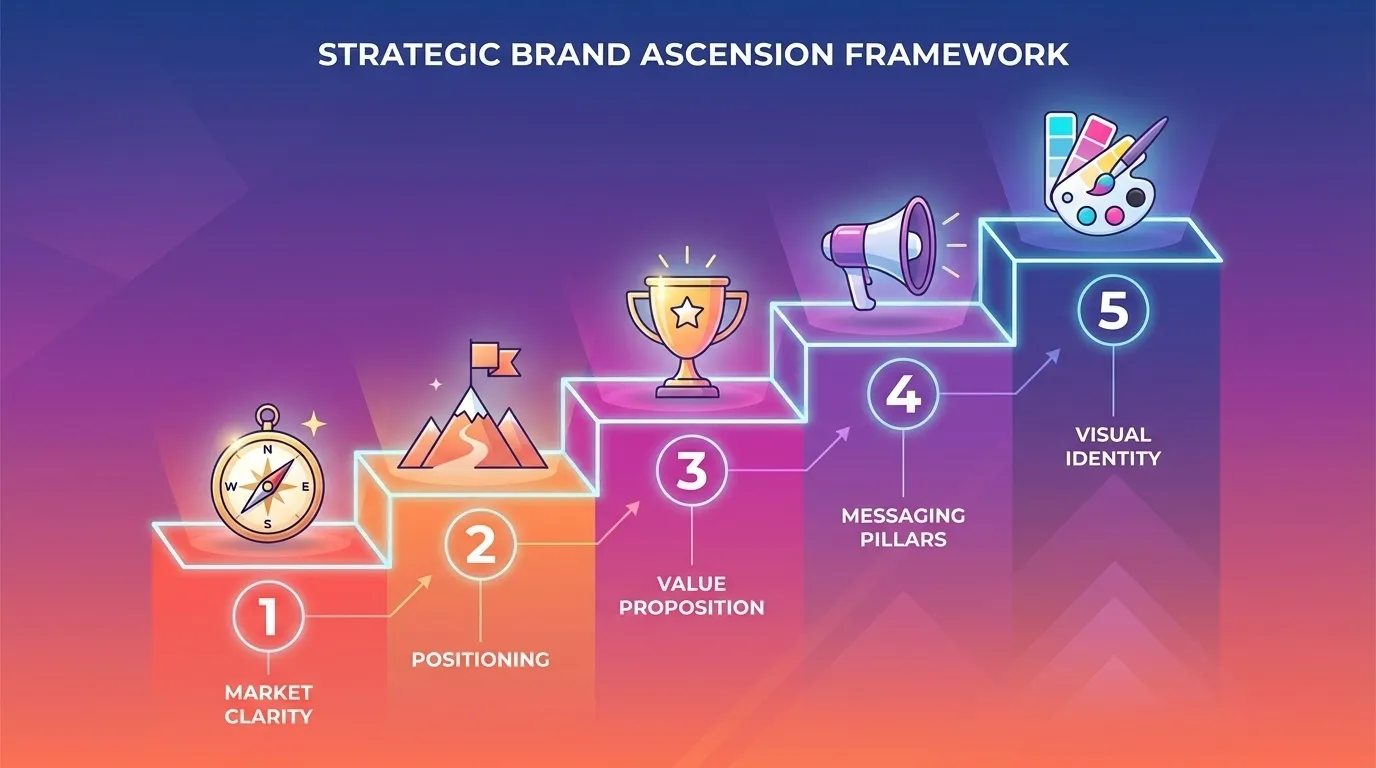
This framework is designed to prevent that outcome. It connects audience insights, positioning, value articulation, messaging alignment, and visual identity into a coherent system in which each step reinforces the next.
When executed with discipline, your marketing stops chasing attention and instead attracts intent-driven prospects who already understand why you are the right choice.
Now, let us break it down into steps:
Step 1: Market and Audience Clarity in Your Brand Strategy
You cannot position what you do not understand, so begin by gaining clarity around three critical areas.
- First, define your primary buyer persona rather than attempting to appeal to everyone.
- Next, identify what actually drives their decisions, whether that is compliance requirements, pressure to demonstrate ROI, or the need for strong social proof.
- Finally, evaluate competitors in your exact price bracket, not just the largest names in the market.
Use real data to ground your assumptions. Study how your competitors describe themselves and pay attention to where their messaging clusters. Notice the claims they repeat and the promises that sound interchangeable. That overlap often reveals whitespace.
For example, if every digital agency in Singapore promotes itself as “data-driven”, you could differentiate by positioning around commercial accountability and tie campaigns directly to revenue growth instead of vanity metrics.
This is the point at which your brand strategy shifts from simply describing what you do to decisively stating where you stand.
Step 2: Define Your Brand Positioning Statement
A strong positioning statement clarifies four essential components:
- Your target audience
- Your category
- Your differentiator
- And the proof that supports your claim
You can use a simple structure to guide your thinking:
For [target audience] who need [category outcome], we are the [differentiator] because we deliver [proof].
However, structure alone does not guarantee strength. Avoid being overly broad in your audience definition, relying on adjectives rather than tangible outcomes, or copying global competitors without adapting their approach to Singapore’s local realities.
Validation is just as important as formulation. Test different website headlines, run paid search ads that reflect your positioning, and gather feedback from sales calls. When prospects repeat your differentiator back to you without prompting, you know your positioning is resonating clearly and credibly.
Step 3: Craft a Clear Brand Value Proposition
Positioning defines where you stand in the market, while your value proposition explains why that position matters to your audience.
As you refine your brand strategy, challenge your messaging by asking whether it communicates measurable value. According to HubSpot’s 2018 State of Inbound report, 61 percent of marketers say that generating traffic and leads remains their top challenge..
If your value proposition directly addresses revenue growth, cost efficiency, or pipeline performance, you are addressing a real, documented pain point.
Translate strategic ambition into practical benefits. Instead of promising “innovative solutions”, articulate how you reduce cost per lead by optimising conversion pathways. Instead of describing yourself as “full service”, explain that you deliver integrated campaigns aligned to measurable pipeline targets.
Clear value propositions attract decision-makers who have budgets and accountability. Vague promises attract casual browsers who are not ready to commit.
Step 4: Develop Brand Messaging Pillars That Support Your Brand Strategy
Messaging pillars anchor your communication and ensure consistency across channels. Three to five well-defined themes are typically sufficient, provided they are strong and distinct.
Clearly introduce these pillars before rolling them out across your marketing ecosystem. For instance, your pillars might centre on commercial impact, regulatory understanding, data transparency, and long-term strategic partnership.
Once defined, they must appear consistently in your website copy, LinkedIn thought leadership, paid advertising campaigns, and email nurture sequences.
Consistency is not just aesthetic discipline. According to Lucidpress, consistent brand presentation can increase revenue by up to 33 per cent. That increase reflects recognition and trust built over time through repetition and clarity.
Step 5: Align Visual Identity With Brand Strategy
Your design should reinforce strategic intent rather than distract from it.
If you position yourself as a premium advisory firm serving SMEs in Raffles Place, your typography, colour system, and layout choices should convey authority and stability rather than playful experimentation. Every visual decision should support how you want to be perceived.
Key elements to align include logo simplicity, colour psychology, typography readability, and the visual tone of your photography.
When visual identity is detached from strategic intent, branding becomes decorative noise. When design is rooted in positioning, it creates coherence and strengthens perception at every touchpoint.
How Brand Strategy Drives Lead Generation
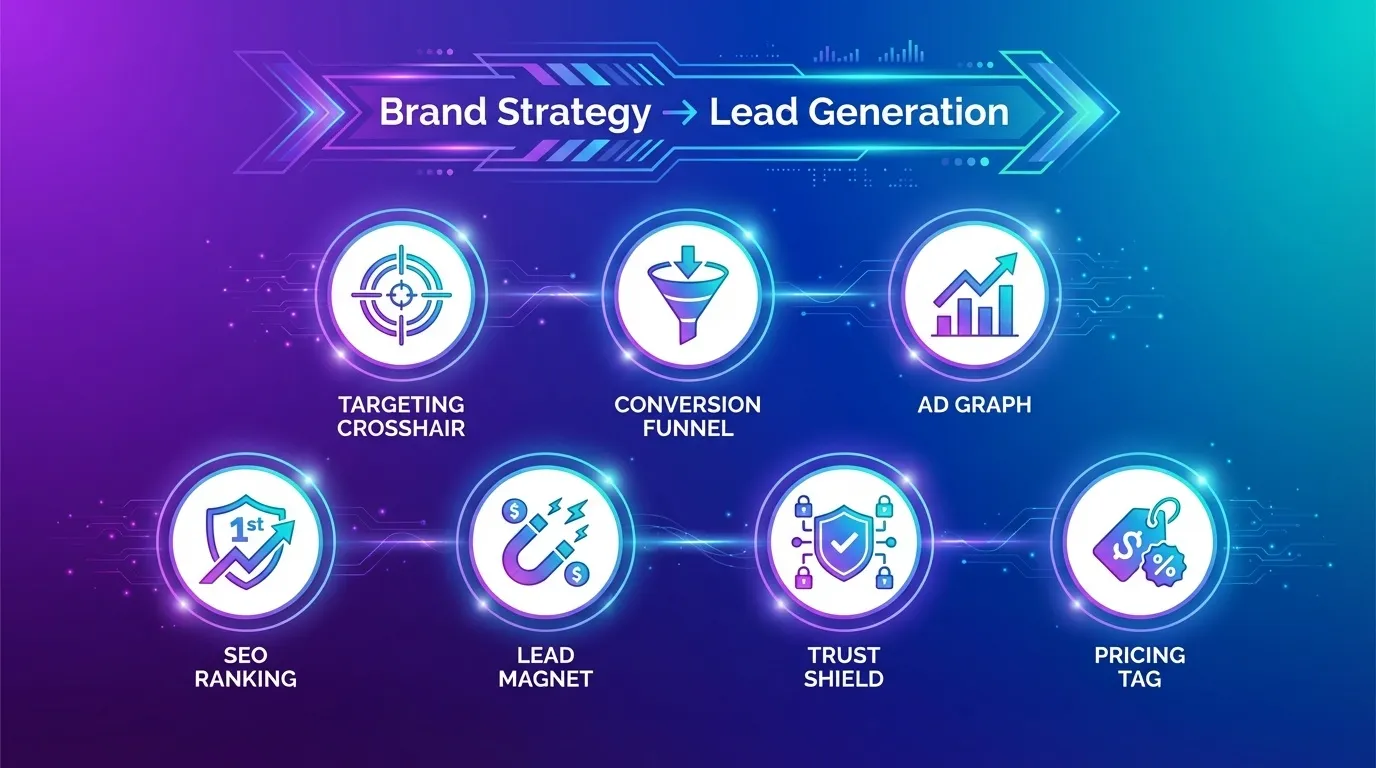
You do not generate consistent, high-quality leads by publishing more content or increasing your ad budget. You generate them when the right people recognise themselves in your positioning and believe you are the obvious choice.
That is what brand strategy does. It reduces friction between attention and action. By the time someone completes your enquiry form, they have already compared you with alternatives. Your job is not just to be visible. Your job is to be meaningfully differentiated.
Let us break down exactly how that happens:
Brand Strategy Clarifies Who You Attract
When your positioning is vague, your leads will be vague. You will receive enquiries from businesses that fall outside your ideal budget range, industry focus, or service capability.
A defined brand strategy sharpens targeting at the messaging level before targeting even begins at the advertising level.
For example:
- Instead of “Digital Marketing for All SMEs”, you position it as “Revenue-Focused Digital Strategy for B2B Professional Services Firms in Singapore”.
- Instead of “Corporate Training Solutions”, you position as “Leadership Development Programmes for High-Growth Tech Teams in Southeast Asia”.
Notice what changes. The second example automatically filters out misaligned enquiries.
This clarity reduces wasted sales effort and improves conversion rates because the conversation starts from relevance rather than explanation.
Brand Strategy Increases Conversion Rates
Conversion rate is not only a technical optimisation problem. It is a positioning problem.
WordStream reports that the average landing page conversion rate across industries is 2.35 percent, while the top 10% of performers achieve 11.45% or higher.. The gap is rarely just about button colour. It is about clarity of value.
When your brand strategy communicates:
- A specific audience
- A defined problem
- A differentiated approach
- Evidence of results
Your website stops being informational and starts being persuasive. Visitors should immediately understand:
- Who this is for
- Why is it different
- Why is it credible
- What happens next
If they need to decode your offering, they will leave.
Brand Strategy Improves Paid Media Performance
Paid advertising amplifies whatever foundation you give it. If the underlying positioning is weak, you simply pay to distribute confusion.
Consider search advertising. WordStream’s Google Ads benchmarks indicate that average cost per click varies widely by industry, from $1.43 in Advocacy to $6.75 in Legal services, with some competitive industries like Technology reaching $3.80 and Consumer Services at $6.40.
If your messaging is generic, you pay for traffic that does not convert. Your cost per lead rises. Your return on ad spend drops. With a clear brand strategy:
- Ad copy mirrors your core positioning
- Landing pages align precisely with search intent
- Offers speak to defined buyer pain points
This alignment improves Quality Score, reduces bounce rates, and increases conversion probability. It also lowers customer acquisition cost over time because you are not attracting the wrong audience.
Brand Strategy Strengthens SEO and AI Search Visibility
Search engines and AI systems prioritise clarity, authority, and topical depth. When your brand strategy defines a focused category and specialisation, your content becomes more structured and more relevant.
Instead of publishing broad articles about “marketing tips”, you build authority around a defined niche such as “Local SEO for Medical Clinics in Singapore”. This strategic narrowing has two effects:
- It improves keyword alignment and topical authority for traditional search.
- It makes your expertise easier for AI systems to summarise and recommend because your positioning is coherent.
Clear positioning leads to consistent content themes. Consistent themes lead to stronger semantic signals. Stronger signals increase visibility.
Brand Strategy Attracts Higher-Intent Inbound Leads
There is a significant difference between traffic and intent. According to HubSpot’s 2026 State of Marketing report, 30% of marketers cite generating leads as one of their top challenges, though lead generation is becoming easier, with 55.7% saying it’s easier now than a decade ago.
The real challenge, however, is generating the right leads. When your brand strategy communicates expertise tied to commercial outcomes, you attract decision-makers rather than researchers.
For instance, imagine you run a compliance consultancy in Singapore. If your positioning focuses on “PDPA-aligned Data Protection Advisory for Regulated SMEs”, you anchor your message to the Personal Data Protection Act, which is a real regulatory requirement in Singapore.
That framing appeals to business owners concerned about compliance risk, not to students writing research papers. The result is fewer enquiries, but significantly higher deal value and shorter sales cycles. Quality increases even if volume remains stable.
Brand Strategy Builds Trust Before the Sales Call
Trust is cumulative. It is built through consistency across channels. When your website messaging, LinkedIn thought leadership, proposals, and sales scripts all reinforce the same positioning, prospects perceive professionalism and coherence.
Without a strategy, marketing says one thing, sales says another, and proposals sound different again. That fragmentation creates doubt.
With strategy:
- Your elevator pitch matches your homepage headline.
- Your case studies reinforce your differentiator.
- Your pricing reflects your positioning.
By the time you speak to a prospect, much of the persuasion work has already been done.
Brand Strategy Reduces Price Sensitivity
Price objections often signal positioning weakness. If your brand strategy is unclear, prospects compare you primarily on cost. If your differentiation is strong and specific, prospects compare you on outcomes.
When you position around measurable value, such as reducing cost per acquisition or improving operational efficiency, you shift the conversation from “How much do you charge” to “What is the return”.
This does not eliminate price discussions. Nothing guarantees that. It does, however, anchor pricing in value rather than commodity comparison.
The Practical Connection Between Positioning and Pipeline
Let us summarise the mechanics in a structured way:
| Strategic Element | Lead Generation Impact |
| Clear Target Audience | Attracts relevant traffic |
| Defined Differentiator | Increases engagement and recall |
| Evidence and Proof | Builds trust faster |
| Consistent Messaging | Improves conversion rates across channels |
| Focused Content Themes | Strengthens SEO and AI discoverability |
| Value-Based Positioning | Reduces price-driven objections |
Every one of these elements originates from the brand strategy. None of them is a tactical hack. If your pipeline feels unpredictable, do not immediately look at campaign performance. Look at positioning clarity.
Brand strategy drives lead generation by aligning perception with intent. It ensures that the people who discover you understand who you are, what you solve, and why you are different.
When that alignment is strong, marketing becomes efficient. Sales conversations become shorter. Revenue becomes more predictable. That is not a theory. It is structural logic. And in Singapore’s competitive market, structure wins.
Common Brand Strategy Mistakes Singapore Businesses Make

If you operate in Singapore’s dense commercial environment, you cannot afford strategic ambiguity. The market is compact, digitally mature, and highly competitive. When your positioning is weak, that research process works against you.
Below are the mistakes we repeatedly see among SMEs, funded startups, and even established firms in areas like Raffles Place, Tanjong Pagar, and One-North. Each one quietly erodes lead quality and inflates acquisition costs:
Mistake #1: Confusing Branding With Brand Strategy
Many businesses invest heavily in design before making any strategic decisions. They commission a logo, build a sleek website, refine their typography, and then assume they have a brand. Unfortunately, they don’t.
Branding is execution. Brand strategy is intent. If you cannot clearly articulate:
- Who are you for?
- What problem do you solve better than your competitors?
- Why do you deserve premium pricing?
then design will not compensate for that absence of clarity.
You can see this pattern in oversaturated sectors such as digital marketing and tuition services, where visual quality is high but messaging remains indistinguishable. Without positioning, you compete on price or convenience. Both are fragile advantages.
Mistake #2: Copying Competitors Instead of Studying Them
Singapore’s market size encourages close observation. Competitors often cluster geographically and digitally. This proximity creates a subtle trap. Businesses mirror each other’s claims.
- “Innovative.”
- “Customer-centric.”
- “End-to-end solutions.”
When everyone claims the same attributes, none of them differentiates.
The right approach is competitive mapping, not imitation. Study what your competitors are emphasising and identify what they are ignoring. That whitespace is your opportunity.
For example, if every agency highlights “performance marketing”, you might position around commercial accountability and board-level reporting. Instead of promising clicks, you promise revenue alignment.
Copying reduces risk in the short term. It destroys strategic leverage in the long term.
Mistake #3: Trying to Appeal to Everyone in a Multicultural Market
Singapore’s demographic composition is diverse, and cultural nuance matters. Buying behaviour differs across income brackets, industries, and regulatory contexts. Yet many businesses respond to this diversity by becoming generic. They dilute their message in hopes of broader appeal.
In reality, specificity increases conversion. When you speak clearly to a defined segment, such as regulated SMEs subject to PDPA compliance or growth-stage tech firms seeking Series A funding, you create resonance. Those outside that segment may not respond.
That is acceptable. Precision attracts better leads.
Mistake #4: Failing to Connect Positioning to Revenue
A brand strategy that does not link to commercial outcomes becomes decorative. You should be able to answer this question without hesitation: How does your positioning reduce acquisition cost or increase lifetime value?
The difference is rarely designed alone. It is message clarity and audience alignment. If your strategic positioning does not translate into:
- Higher conversion rates
- More qualified enquiries
- Shorter sales cycles
- Reduced cost per lead in SGD
Then it remains theoretical.
Strategy must guide performance.
Mistake #5: Ignoring Regulatory and Market Context
Singapore operates within a structured regulatory framework. In sectors such as healthcare, finance, and data security, compliance is not optional. When businesses ignore regulatory realities in their messaging, they miss a powerful positioning lever.
For example, a cybersecurity consultancy that positions itself around PDPA-aligned frameworks speaks directly to compliance-driven decision-makers. A generic “enterprise security” message does not carry the same urgency.
Local context is not a footnote. It is often the differentiator.
Mistake #6: Running Campaigns Before Aligning Internally
One of the most expensive mistakes is external inconsistency caused by internal misalignment. Founders describe the company one way. Sales teams pitch it differently. Marketing produces another narrative altogether. The result is fractured perception.
Before launching paid campaigns, LinkedIn thought leadership, or SEO content, leadership must agree on:
- Core positioning
- Value proposition
- Target segment
- Pricing logic
Without alignment, marketing becomes a volume game. You generate traffic but struggle to convert it.
Mistake #7: Treating Brand Strategy as a One-Off Exercise
Markets shift. Buyer expectations evolve. Competitive density increases. If you defined your positioning three years ago and have not revisited it since, you are operating on outdated assumptions.
A disciplined business reviews its positioning when:
- Entering a new segment
- Scaling beyond initial traction
- Experiencing declining lead quality
- Facing intensified competition
Brand strategy is infrastructure, and it requires maintenance.
The Real Cost of Making These Strategic Mistakes
None of these errors appears dramatic in isolation. A slightly generic message. A loosely defined audience. A campaign launched before clarity. But over time, they compound.
You pay more per click. You attract price-sensitive leads. Your sales team works harder for lower close rates. Revenue growth plateaus despite increased marketing spend.
The uncomfortable truth is that many businesses in Singapore do not have a marketing problem. They have a positioning problem.
If you correct that foundation, every channel performs better. SEO gains traction faster. Paid ads convert at higher rates. Sales conversations begin with trust instead of persuasion. That is the difference between activity and strategy.
When to Invest in Brand Strategy in Singapore

You do not revisit brand strategy because it sounds strategic. You do it because commercial signals tell you something is misaligned. Here are the moments that justify serious investment:
When You Enter a Crowded Market
If you are launching in a saturated market without a defined brand strategy, you will:
- Sound interchangeable
- Compete on price
- Attract low-intent enquiries
But with clear positioning:
- You define a niche
- You justify pricing
- You attract higher-fit leads
In crowded markets, clarity is leverage.
When You Rebrand or Pivot
A visual refresh without strategic recalibration rarely drives revenue. If you are:
- Moving upmarket
- Targeting a new industry
- Expanding beyond Singapore
- Changing your service model
Your positioning must evolve. Otherwise, your messaging attracts yesterday’s clients, not tomorrow’s.
Singapore’s economy continues shifting towards high-value sectors such as advanced manufacturing and digital services, as outlined by the Ministry of Trade and Industry. If your business evolves but your narrative does not, growth stalls.
When Marketing Costs Rise but Lead Quality Drops
If ad spend increases while close rates decline, the issue may not be your campaigns. If your positioning is weak, you pay for attention that never converts.
A strong brand strategy filters before the click. It clarifies who you serve and the measurable value you deliver. That precision improves lead quality and protects your cost-per-acquisition.
When Sales Cycles Feel Longer Than Necessary
Your prospects are informed before they speak to you. If sales conversations revolve around explaining basic differentiation, your positioning is not doing enough heavy lifting.
A refined brand strategy:
- Establishes authority early
- Clarifies outcomes clearly
- Reduces friction in decision-making
Shorter sales cycles are often the result of sharper positioning, not better persuasion.
When Internal Messaging Is Inconsistent
If leadership, marketing, and sales describe your company differently, confusion spreads externally. You will notice:
- Inconsistent website messaging
- Misaligned campaigns
- Sales decks that contradict brand claims
Brand strategy creates a documented framework that aligns everyone around:
- Target audience
- Core differentiator
- Strategic priorities
In a competitive market like Singapore, alignment accelerates growth.
When You Want to Command Premium Pricing
If clients negotiate heavily or compare you purely on cost, your value is not clearly positioned. Premium pricing requires:
- Clear specialisation
- Credible proof
- Confident positioning
When you invest in brand strategy at this stage, you reframe the conversation from price to value.
Here’s How to Know You Need to Invest in Brand Strategy:
You likely need to refine your brand strategy if:
- You cannot summarise your differentiation in one sentence
- Lead quality feels inconsistent
- Marketing spend keeps rising
- Growth has plateaued
In Singapore’s competitive landscape, clarity compounds. If those signals are present, investing in brand strategy is not optional. It is commercial self-defence.
Turning Your Brand Strategy Into a Lead-Generating Asset

If you have read this far, you already understand something most businesses overlook. Growth is not driven by more activity. It is driven by sharper positioning.
When your messaging is precise, your audience self-qualifies. When your value is clear, price resistance drops. When your differentiation is documented and aligned internally, every campaign works harder. That is how strategy becomes commercial leverage rather than a theoretical exercise.
Singapore’s market is sophisticated and competitive. Buyers research before they enquire. They compare before they commit. If your positioning does not immediately communicate relevance and authority, you are simply another option in a long list. This is where execution matters.
A refined brand strategy must be translated into messaging, website architecture, campaign structure, and sales enablement. It requires market validation, competitive analysis, and commercial clarity. It is not a logo project. It is revenue infrastructure.
If you are serious about turning positioning into pipeline, work with professionals who understand how strategy connects to measurable growth. MediaOne delivers professional branding agency services designed to align your positioning with lead generation and long-term scalability.
If your leads are inconsistent, your pricing is under pressure, or your differentiation feels unclear, now is the time to act. Call us today to discuss how a sharper brand strategy can transform your marketing from a cost centre to a growth engine.
Frequently Asked Questions
How long does it take to develop a brand strategy?
The time to develop a brand strategy varies by organisation size, market complexity, and research depth. It often ranges from several weeks for smaller projects to several months for comprehensive strategic work. It includes stages like audience research, competitive analysis, positioning formulation, and internal alignment.
Can small businesses benefit from a brand strategy?
Yes, small businesses can benefit significantly from a clear brand strategy, as it helps them define their market position, attract the right customers, and compete effectively against larger competitors. A focused strategy makes marketing efforts more efficient by clarifying who the business serves and what unique value it offers.
What are the core components of a strong brand strategy?
Core components typically include a clear purpose and vision, a defined target audience, a unique positioning, consistent messaging, and a visual identity aligned with the strategy. These elements work together to present a coherent experience across every channel and customer interaction. Research, testing and iteration are essential to ensure these components resonate with the intended audience.
How often should a brand strategy be reviewed?
Brand strategy should be reviewed regularly, especially when entering new markets, experiencing shifts in customer behaviour, or seeing changes in competitive dynamics. Annual reviews are common, with additional check-ins after major campaigns or organisational changes.
Regular review ensures the strategy remains relevant, aligned with business goals, and responsive to new market data or feedback.
How long does it take to see results from a brand strategy?
Results from brand strategy typically appear in stages rather than all at once. Early signals, such as clearer messaging, higher engagement rates, and more relevant enquiries, may emerge within the first few months after implementation. Measurable commercial outcomes such as improved conversion rates, stronger lead quality, and shorter sales cycles often become clearer over six to twelve months, depending on market conditions and execution consistency.