AI for SEO is changing how we research keywords, plan content, optimise websites, interpret search behaviour, and measure visibility. It is no longer just about using an AI tool to produce faster drafts.

The bigger shift is how artificial intelligence helps marketers understand search intent, structure information, improve technical SEO workflows, and prepare content for both traditional Google results and AI-generated answers.
For Singapore businesses, this matters because search behaviour is already highly digital. DataReportal’s Digital 2026 Singapore report found that Singapore had 5.78 million internet users at the end of 2025, with a 98.4% internet penetration rate.
When most customers are already online, SEO content needs to be clear, useful, technically sound, and ready for both Google Search and AI-assisted discovery. But AI for SEO is not a shortcut. Used poorly, it can result in generic content, inaccurate claims, duplicate pages, and a weak user experience.
Used properly, it can help you make better SEO decisions faster while still keeping human judgment, compliance, and originality at the centre of the strategy.
In this guide, we will look at how AI for SEO affects rankings, local visibility, Google Business Profile optimisation, content quality, technical SEO services, GEO services, and business growth.
Key Takeaways
- AI for SEO should improve decision-making, not replace strategy. It can support keyword research, content briefs, technical audits, local SEO, GEO, and reporting, but human review is still needed for accuracy, compliance, and commercial relevance.
- AI-assisted content can rank when it is useful, original, and properly reviewed. Google’s concern is not AI itself, but low-value content created mainly to manipulate rankings rather than help users.
- Search visibility now goes beyond traditional rankings. Businesses need content that performs well in Google Search, AI Overviews, and answer engines, being clear, structured, trustworthy, and easy to summarise.
- Local SEO can benefit from AI, but the fundamentals still matter. AI can analyse review themes, service gaps, local queries, and Google Business Profile opportunities, but relevance, distance, prominence, and accurate business information remain essential.
- Compliance must be built into AI SEO workflows. Businesses should be careful when using AI with customer data, reviews, regulated claims, healthcare content, financial information, or any content that requires subject matter review.
What Is AI For SEO?
AI for SEO refers to the use of artificial intelligence to support SEO tasks, including keyword research, content planning, search intent analysis, technical audits, internal linking, local SEO, reporting, and GEO visibility.
In practical terms, AI helps us process more information faster. It can group keywords, summarise competitor pages, identify content gaps, suggest FAQs, detect technical issues, and turn messy data into clearer action points.

However, AI does not replace SEO strategy. I would treat it as a support layer, not the final decision maker. AI can show patterns, but we still need human review to decide what matters commercially, what is accurate, what aligns with the brand, and what genuinely helps the reader.
| SEO Area | How AI Helps | What Still Needs Human Review |
| Keyword research | Group keywords by topic, intent, funnel stage, and search behaviour | Search volume, commercial value, ranking difficulty, and business relevance |
| Content strategy | Identifies missing subtopics, FAQs, competitor angles, and content opportunities | Original insights, positioning, tone, and factual accuracy |
| On-page SEO | Suggests title tags, headings, meta descriptions, schema ideas, and internal links | Keywords: naturalness, readability, and search intent alignment |
| Technical SEO | Summarises crawl issues, duplicate pages, metadata gaps, and structured data problems | Developer implementation, canonical logic, redirects, and indexing decisions |
| Local SEO | Analyses reviews, service terms, Google Business Profile gaps, and local query patterns | Business accuracy, local context, customer proof, and compliance |
| GEO | Maps entities, claims, citations, FAQs, and answer-ready content | Source quality, factual validation, and brand consistency |
The strongest use of AI for SEO is workflow acceleration. It helps us move from research to planning faster, but the final page still needs substance, proof, and human judgment.
How AI For SEO Is Changing Search Results

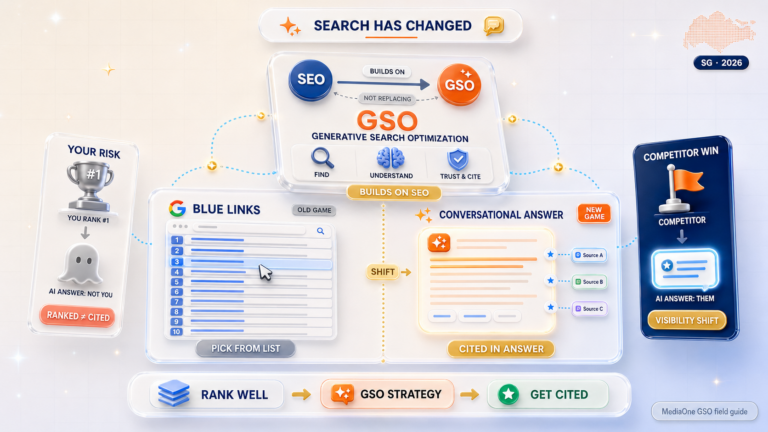
AI is changing search in two major ways. First, search engines are getting better at understanding natural language, entities, context, and user intent. Second, users are seeing more AI-generated answers directly within search experiences.
Google’s documentation on AI features and your website explain AI Overviews and AI Mode from a site owner’s perspective. Google also states that site owners should continue focusing on helpful, reliable content and standard SEO best practices for inclusion in these experiences.
That means businesses should not treat AI search as a completely separate discipline from SEO. The fundamentals still matter:
- crawlable and indexable pages
- clear page structure
- helpful content
- reliable information
- strong internal linking
- relevant schema markup
- good user experience
- clear brand and entity signals
What changes is how content may be discovered and summarised. A page may need to rank in traditional search, appear as a supporting link in AI Overviews, and be understandable enough for answer engines to extract useful information from it.
For businesses, this means one thing: SEO content needs to be clearer, more structured, and more trustworthy than before.
How AI Overviews Change SEO Planning
AI Overviews are changing how users interact with Google Search, as they may receive an AI-generated summary before clicking through to a website.
This means AI for SEO is not only about ranking in traditional blue links. We also need to consider whether our content is clear, trustworthy, and well-structured enough to be considered useful in AI-assisted search experiences.
To prepare content for AI Overviews, we should focus on:
- direct answers to important user questions
- clear headings that match search intent
- concise summaries followed by deeper explanations
- reliable sources for data and claims
- strong internal links to relevant pillar pages
- schema markup where appropriate
- clear entity signals around the brand, service, author, and location
- original examples that make the content more useful than generic AI output
This does not mean every page will appear in AI Overviews. It means we should structure content so that both users and search systems can understand it more easily.
A practical example is a page targeting AI for seo. If the page only says “AI helps with keyword research and content writing”, it is too thin.


A stronger page explains how AI supports keyword clustering, technical audits, Google Business Profile optimisation, content briefs, compliance review, AI visibility, and GEO. That gives search engines and users more useful information to work with.
Practical Ways To Use AI For SEO

AI for SEO works best when it supports specific tasks rather than replacing the entire process. We do not want to ask AI to write an SEO article and publish it as is. That is usually how brands end up with generic content that sounds correct but adds very little value.
A better approach is to use AI across the SEO workflow.
Use AI For Keyword Research And Intent Mapping
AI can help group related keywords into intent clusters. For example, instead of looking at hundreds of keywords manually, we can categorise them into:
- informational searches
- commercial comparison searches
- local searches
- service-based searches
- problem-led searches
- conversion-ready searches
This helps us decide whether a keyword should become a blog post, landing page, FAQ, service page, comparison page, or local page.
For example, the keyword AI for seo has mixed intent. Some users want a beginner explanation, others want tools, others want workflows, and others are comparing whether they need an agency.
That is why this article should not only discuss AI in local SEO, but also address AI in other areas of SEO. It also needs to cover AI tools, GEO, content risks, technical SEO, measurement, and business use cases.
Use AI To Build Better Content Briefs
AI can help compare top-ranking pages and identify what your draft is missing. This is useful when we are optimising an existing blog because we can quickly see whether the page lacks:
- definitions
- examples
- data
- checklists
- tables
- FAQs
- internal links
- case studies
- compliance notes
- commercial next steps
However, the brief should still be reviewed by an SEO strategist. AI may suggest unnecessary sections if it does not understand the client’s business model or the page’s role in the wider SEO strategy.
Use AI To Improve On-Page SEO
AI can support title tags, meta descriptions, H2 suggestions, FAQ ideas, schema recommendations, and internal link opportunities.
For example, if we are optimising this article for AI SEO, we can use AI to identify where the main keyword naturally fits within H2S without forcing it into every heading.
Good examples include:
- What Is AI For SEO?
- Practical Ways To Use AI For SEO
- AI For SEO And Local Rankings
- AI For SEO, GEO, and Answer Engine Visibility
- How To Measure AI For SEO Performance
This is better than repeating the exact keyword unnaturally across the whole page.
Use AI To Support Technical SEO Audits
AI can help summarise crawl data, identify recurring metadata issues, group duplicate titles, flag thin pages, and prioritise technical fixes.
For larger websites, this is useful because technical SEO audits often involve large datasets from tools such as Screaming Frog, Google Search Console, GA4, server logs, or site crawlers.
AI can help us find patterns faster, such as:
- pages with missing titles
- pages with duplicate meta descriptions
- indexable pages with thin content
- orphan pages
- redirected internal links
- inconsistent canonical tags
- schema errors
- slow templates
- duplicate location pages
The important point is that AI should not make technical decisions on its own. Redirects, canonicals, noindex rules, and site architecture decisions still need proper SEO review because mistakes can affect crawlability, indexation, and rankings.
Where AI SEO Tools Fit
AI SEO tools are useful, but they should not all be used for the same purpose. Some tools are better for research, others for content optimisation, others for technical analysis, and others for reporting.
| Tool Category | Best Used For | Example SEO Tasks |
| AI keyword research tools | Finding topics, clusters, and long tail opportunities | Keyword grouping, intent mapping, topic expansion |
| AI content optimisation tools | Improving topical coverage and structure | Content briefs, heading suggestions, and semantic gaps |
| AI technical SEO tools | Analysing large websites faster | Crawl summaries, duplicate checks, schema validation |
| AI writing assistants | Drafting and editing support | Meta descriptions, FAQs, summaries, and outline development |
| AI reporting tools | Turning data into clearer insights | Trend summaries, anomaly detection, and monthly reporting |
| AI visibility tools | Tracking GEO and answer engine visibility | Brand mentions, AI citations, prompt testing |
The best tools are not necessarily the ones that generate the most content. The best tools help us make better SEO decisions.
AI For SEO Workflow: From Research To Results

AI for SEO works best when it is built into a proper workflow. I would not use AI as a one-step content generator. We get better results when AI supports each stage of the SEO process, from research to optimisation, review, and measurement.
| Step | What We Do | How AI Helps | What Still Needs Human Review |
| 1. Audit the site | Review rankings, traffic, indexation, content quality, and technical SEO health | Summarises large datasets and highlights recurring issues | Confirm root causes, business priorities, and technical feasibility |
| 2. Map search intent | Group keywords by what users actually want to achieve | Clusters queries by topic, funnel stage, and user need | Decide which keywords deserve service pages, blogs, FAQs, or local pages |
| 3. Analyse competitors | Review top-ranking pages, SERP features, content gaps, and page formats | Identifies repeated themes, missing sections, and common questions | Decide what your page can add that competitors do not |
| 4. Build the content brief | Create a structured outline with headings, FAQs, sources, and internal links | Suggests subtopics, questions, and related search terms | Add brand context, local examples, proof, and original insight |
| 5. Optimise the page | Improve headings, metadata, internal links, schema, and content clarity | Generates title options, meta descriptions, FAQ ideas, and linking suggestions | Review for accuracy, tone, keyword naturalness, and usefulness |
| 6. Review compliance and accuracy | Check factual claims, regulated statements, and customer data usage | Flags possible unsupported claims or vague statements | Final review must be done by a human, especially for sensitive sectors |
| 7. Measure performance | Track rankings, impressions, clicks, conversions, local actions, and AI visibility | Summarises trends and highlights anomalies | Interpret whether performance changes are caused by SEO, seasonality, tracking, or market shifts |
This workflow keeps AI useful without letting it control the strategy. AI can help us move faster, but it should not decide what is commercially important, what is compliant, or what the final message should be.
AI For SEO Checklist For Businesses
Use this checklist before publishing or refreshing AI-assisted SEO content.
| Checklist Item | Why It Matters |
| Define the primary keyword and search intent | Prevents the article from drifting into unrelated topics |
| Analyse top-ranking pages | Helps identify expected subtopics and missing angles |
| Group related keywords by intent | Supports better structure and internal linking |
| Use AI to create a brief, not the final, unchecked article | Keeps human judgment in control |
| Add verified data where useful | Improves trust and E-E-A-T |
| Link to sources using anchor text | Makes claims easier to verify |
| Include practical examples or case studies | Shows application beyond theory |
| Add compliance notes where relevant | Reduces risk in sensitive sectors |
| Include tables and checklists | Improves readability and usefulness |
| Review for originality | Avoids generic AI content |
| Check all facts manually | Prevents hallucinated or outdated claims |
| Add internal links to pillar pages | Strengthens site architecture |
| Review schema opportunities | Helps search engines understand the page |
| Measure rankings, traffic, leads, and AI visibility | Connects SEO work to business outcomes |
This checklist keeps AI useful without diluting content quality.
AI For SEO And Local Rankings

AI for SEO is especially useful for local rankings because local search depends on relevance, accuracy, trust, and user behaviour. However, AI does not replace the fundamentals of local SEO.
Google’s guidance on improving local ranking states that local results are mainly based on relevance, distance, and prominence.
AI helps by identifying gaps that may affect these areas, but the business still needs accurate information, strong local proof, and a well-maintained Google Business Profile.
| Local Ranking Factor | What It Means | How AI Can Help |
| Relevance | How well your business matches the user’s search | Analyse service descriptions, local keywords, review themes, FAQs, and page content |
| Distance | How far the business is from the searcher or searched location | Support accurate branch pages, service area pages, and location-specific content |
| Prominence | How recognised and trusted the business appears to be | Analyse reviews, citations, backlinks, brand mentions, and local authority signals |
For a Singapore clinic, AI can help identify recurring patient questions from reviews and enquiries, such as consultation availability, insurance questions, treatment concerns, or nearby MRT access.
For a tuition centre, AI can group parent and student queries by level, subject, location, and exam concern. For a restaurant, AI can analyse reviews to identify common themes in food quality, wait times, halal options, group dining, or delivery.
These insights can then improve:
- Google Business Profile services
- review response templates
- branch pages
- local landing pages
- service FAQs
- internal linking
- schema markup
- content briefs
For local businesses, Google Business Profile is often the first search result users see before visiting the website. AI can help improve Google Business Profile optimisation, but accuracy must come first.
AI can support Google Business Profile work by helping us:
- identify missing service descriptions
- group review themes
- draft review responses
- suggest post ideas
- detect repeated customer concerns
- summarise competitor profile gaps
- create location-specific FAQ ideas
However, AI should not publish business information without review. Opening hours, addresses, service areas, medical claims, pricing, promotions, and regulated service descriptions must be checked manually.
Practical Use Case: Multi-Location Local Business
A multi-outlet education provider may have several branches across Singapore. Without a proper local SEO workflow, each branch page may look almost identical except for the address.
Using AI, we can compare each branch’s search intent, nearby landmarks, course demand, FAQs, and parent enquiries. Instead of creating duplicate location pages, each branch page can include more useful local details, such as:
- available programmes at that branch
- nearest MRT station
- class schedule context
- parent FAQs
- tutor credentials
- branch-specific reviews
- internal links to related course pages
The result is a stronger local page because it gives users real decision-making information rather than a thin template.
AI For SEO Use Cases By Business Type

AI for SEO becomes more useful when applied to specific business problems. Different industries need different workflows because search intent, compliance risk, and conversion behaviour vary.
| Business Type | AI For SEO Use Case | Practical Output |
| Healthcare clinic | Analyse common patient questions and review themes | Better service FAQs, location pages, and medically reviewed content |
| E-commerce brand | Group product and category searches by purchase intent | Stronger category pages, product descriptions, and internal links |
| B2B service provider | Identify problem-led, comparison, and solution-based searches | Better landing pages, case studies, and bottom funnel blogs |
| Multi-location business | Compare local search demand by branch or service area | More useful location pages and Google Business Profile updates |
| Education provider | Map parent and student questions by level, subject, and exam concern | Better programme pages, FAQs, and local content |
| Home services provider | Analyse emergency, pricing, and location-based queries | Better service pages, call-focused content, and local landing pages |
| Professional services firm | Identify trust-based and commercial intent queries | Stronger service pages, credentials, case examples, and compliance-reviewed content |
For example, a B2B company may use AI to identify that prospects are not just searching for the service name. They may also be searching for implementation timelines, pricing factors, comparison terms, compliance risks, and vendor selection criteria.
That insight can shape a stronger content strategy that supports both SEO visibility and lead generation.
For e-commerce brands, AI can support product and category optimisation by grouping search queries around size, price, material, use case, delivery, reviews, and comparison terms. This helps you improve category pages without stuffing them with repetitive keywords.
For professional services firms, AI can help identify trust-based questions such as qualifications, process, fees, case experience, timelines, and risk factors.
These insights can improve service pages, FAQs, and supporting articles, but the final claims should still be reviewed by the relevant subject matter expert.
AI For SEO, Content Quality, and Compliance

One of the biggest mistakes businesses make is assuming AI for SEO means publishing more content faster. That is risky.
Google’s guidance on using generative AI content explains that generative AI can be useful for research and adding structure to original content.
However, Google also warns that using generative AI tools to create many pages without adding value for users may violate its spam policy on scaled content abuse.
Google’s spam policies define scaled content abuse as creating many pages mainly to manipulate search rankings rather than help users, regardless of how the content is created.
In simple terms, Google is not saying that AI-assisted content cannot rank. The issue is whether the content is useful.
AI-assisted SEO content still needs:
- original insight
- clear structure
- factual accuracy
- first-hand or business-specific knowledge
- reliable sources
- proper editing
- search intent alignment
- compliance review where needed
- clear next steps for the reader
This is especially important for sensitive sectors such as healthcare, finance, legal, education, insurance, and high-value B2B services. In these industries, inaccurate AI-generated claims can damage trust and create compliance risk.
| AI Content Risk | Why It Hurts SEO | How To Reduce The Risk |
| Generic content | It does not add anything new to the search results | Add expert input, examples, data, and real business context |
| Hallucinated facts | It can create inaccurate or misleading claims | Fact-check every claim and link to verified sources |
| Duplicate location pages | It may create thin or doorway-like content | Add unique branch details, local proof, and service-specific information |
| Over-optimised FAQs | It can look written for search engines instead of users | Answer real customer questions naturally |
| Weak compliance review | It can create risk in regulated sectors | Review claims against sector rules before publishing |
| No human editing | It can sound repetitive or vague | Edit for clarity, tone, usefulness, and brand accuracy |
Compliance Considerations When Using AI For SEO
Compliance matters when AI for SEO involves customer data, regulated claims, testimonials, reviews, medical information, financial products, advertising content, or sector-sensitive advice.
In Singapore, businesses should comply with data protection obligations when using personal data in AI systems. The Personal Data Protection Commission’s Advisory Guidelines on the use of Personal Data in AI Recommendation and Decision Systems provide clarity on the use of personal data for training, developing, and deploying AI systems that make recommendations, predictions, or decisions.
This matters for SEO because marketing teams may use AI tools to process customer reviews, enquiry logs, CRM exports, call summaries, survey responses, or user behaviour data.
Before uploading any data into an AI tool, we should check whether the data contains personal information and whether the tool is approved for that use.
| SEO Activity | Compliance Risk | Safer Approach |
| Review analysis | Reviews may include names, complaints, health details, or personal identifiers | Anonymise data before analysis and avoid uploading sensitive details into unapproved tools |
| AI content creation | AI may create unsupported claims, exaggerated outcomes, or misleading statements | Fact-check claims and link to verified sources |
| Healthcare SEO | Content may imply guaranteed results, medical advice, or treatment suitability | Use medically reviewed content and avoid unsupported treatment claims |
| Financial SEO | Content may imply returns, suitability, or product recommendations | Review claims against applicable financial advertising and regulatory expectations |
| Legal SEO | Content may be mistaken for legal advice | Use clear educational framing and specialist review |
| Local SEO | Incorrect opening hours, services, or address details may mislead users | Verify Google Business Profile details manually |
| Case studies | Client data may reveal confidential or commercially sensitive information | Use approved, anonymised, or publicly available examples |
| AI-generated schema | Incorrectly structured data may misrepresent the business or service | Validate the schema before publishing |
When AI For SEO Needs Human Review
AI can support SEO, but there are situations where it should never be used without careful human review. This is especially important when the content affects trust, safety, money, health, legal decisions, or business-critical technical changes.
Do not rely on AI alone for:
- medical, legal, financial, or regulatory claims
- technical SEO implementation decisions
- redirects, canonicals, noindex rules, or migration plans
- customer data analysis involving personal information
- competitor comparison claims
- Final Google Business Profile updates
- schema markup for regulated services
- case studies involving client results or confidential data
- content that requires subject matter expertise
- final approval of titles, claims, statistics, or recommendations
This is why our approach should be simple: use AI to assist the SEO process, but do not let it replace expertise, judgement, or accountability.
Common Mistakes Businesses Make With AI For SEO
| Mistake | Why It Hurts SEO | Better Approach |
| Publishing AI content without adding value | The content may repeat what already exists and give Google no reason to rank it | Add original insights, examples, data, and brand-specific knowledge |
| Ignoring search intent | The page may answer the wrong question or target the wrong funnel stage | Map keywords by intent before writing |
| Treating AI as a technical SEO replacement | AI may misread crawl, indexation, canonical, or redirect issues | Use AI for analysis, then validate decisions manually |
| Creating thin local pages at scale | Pages may look duplicated, weak, or doorway-like | Add unique branch information, local proof, and useful decision-making details |
| Uploading sensitive data into AI tools | Customer data may be exposed or processed inappropriately | Anonymise data and follow approved data handling processes |
| Measuring output instead of outcomes | More articles do not automatically mean better SEO | Track rankings, traffic, leads, conversions, local actions, and AI visibility |
| Forgetting internal links | The page may not support wider site architecture | Link to relevant pillar pages and commercial pages naturally |
| Overusing AI phrases | The article may sound generic and lose brand trust | Edit for tone, clarity, and real experience |
The best AI SEO strategies are not built on volume. They are built on better decisions, better structure, better evidence, and better execution.
AI For SEO, GEO, and Answer Engine Visibility

AI for SEO is no longer limited to traditional Google rankings. Businesses also need to consider how their brand appears in AI-generated answers across platforms such as Google AI Overviews, ChatGPT, Gemini, Perplexity, and other answer engines.
This is where Generative Engine Optimisation, or GEO, becomes important.
GEO focuses on making your brand easier for AI systems to understand, verify, summarise, and cite. It is not just about adding more keywords. It is about improving entity clarity, factual consistency, source quality, and answer readiness.
A strong GEO setup usually includes:
- clear brand and service entities
- consistent company information
- verified claims with credible sources
- well-structured FAQs
- author and reviewer information where relevant
- schema markup
- third-party mentions
- comparison-ready content
- concise answers to commercial questions
- content that can be extracted and summarised accurately
For example, if a user asks an AI assistant, “Which SEO agency in Singapore can help with AI search visibility?”, the AI system needs to understand what your brand does, where you operate, what services you offer, what proof supports your claims, and whether your content answers the question directly.
That is why businesses seeking to improve visibility for AI-generated answers should consider MediaOne’s GEO services as part of a broader AI search strategy.
How To Measure AI For SEO Performance

AI for SEO should not be measured by how many pages you publish. More content does not automatically mean better SEO performance.
We should measure whether AI-assisted SEO improves visibility, engagement, trust, and conversions.
| Measurement Area | Metrics To Track | Why It Matters |
| Organic SEO | Rankings, impressions, clicks, organic sessions, indexed pages | Shows whether visibility is improving in Google Search |
| Content performance | Engagement rate, scroll depth, assisted conversions, time on page | Shows whether users find the content useful |
| Local SEO | Google Business Profile actions, calls, direction requests, reviews, and local pack visibility | Shows whether local search is driving commercial actions |
| Technical SEO | Crawl errors, indexation, Core Web Vitals, schema validity, duplicate pages | Shows whether the site can be crawled and understood properly |
| GEO | AI mentions, AI citations, brand inclusion in answer engines, and prompt level visibility | Shows whether the brand is appearing in AI-generated answers |
| Business outcomes | Leads, enquiries, bookings, transactions, assisted revenue | Shows whether SEO supports commercial growth |
For most businesses, the best reporting approach is to separate SEO performance into three layers:
- Visibility: Are we being found?
- Engagement: Are users interacting with the content?
- Conversion: Are we generating meaningful enquiries or sales?
AI should improve the quality of SEO decisions, not just increase the volume of output.
How To Make AI For SEO More Competitive In 2026
AI for SEO is becoming more competitive because more businesses now have access to the same AI tools. That means the advantage is no longer just about using AI. The advantage is how well we guide it.
| Priority | What To Do | Why It Matters |
| Strengthen search intent alignment | Match each page to the exact user need | Helps the page satisfy both users and search engines |
| Add first-hand insight | Include business experience, examples, and observations | Makes the page harder to copy |
| Use verified sources | Link data and claims to credible references | Improves trust and E-E-A-T |
| Improve entity clarity | Make the brand, service, location, and expertise clear | Supports SEO and GEO visibility |
| Build stronger internal links | Connect blogs, service pages, and pillar pages | Helps users and search engines understand site structure |
| Review compliance | Check claims, data use, and regulated content | Reduces legal, trust, and brand risk |
| Track AI visibility | Monitor AI mentions, citations, and answer engine appearances | Shows whether the brand is visible beyond traditional rankings |
For a business targeting competitive keywords, generic AI output is not enough. The article needs a clear point of view, strong examples, verified data, and practical guidance that reflects real SEO work.
AI For SEO Needs Strategy, Not Just Automation
AI for SEO can help businesses move faster, make better decisions, and compete more effectively in both traditional search and AI-generated answers. It can support keyword research, content planning, technical audits, Google Business Profile optimisation, local SEO, reporting, and GEO.
But AI works best when it is guided by strategy. The businesses that benefit most will not be the ones that publish the most AI content. They will be the ones who use AI to improve accuracy, structure, usefulness, and decision-making while still relying on human review.
For Singapore businesses, this matters even more because search behaviour is highly digital. With DataReportal’s Digital 2026 Singapore report reporting 5.78 million internet users in Singapore at the end of 2025, SEO content needs to be clear, credible, technically sound, and ready for both Google Search and AI-assisted discovery.
If your business wants to improve Google rankings while adapting to AI search, working with a trusted SEO agency in Singapore can help you build a stronger, more future-ready search strategy. For brands looking to improve visibility for AI-generated answers, MediaOne can provide the next layer of search visibility. Contact us and let’s talk!
Frequently Asked Questions
Is AI for SEO safe to use?
Yes, AI for SEO is safe to use when it supports research, planning, analysis, and optimisation under human review. The risks include publishing unchecked AI-generated content, uploading sensitive data to unapproved tools, or relying on AI for regulated claims.
Can AI for SEO replace an SEO specialist?
No. AI can speed up tasks such as keyword grouping, content briefs, metadata drafts, and reporting summaries, but it cannot replace SEO judgement, technical implementation, compliance review, commercial prioritisation, or brand strategy.
What is the best way to start using AI for SEO?
Start with lower-risk tasks such as keyword clustering, content gap analysis, FAQ ideation, metadata drafts, and reporting summaries. Once the workflow is stable, you can use AI to support technical audits, local SEO analysis, internal linking, and GEO planning.
How does AI for SEO help with existing blog optimisation?
AI can compare an existing blog against search intent, competitor coverage, related questions, internal link gaps, and missing sections. However, the final improvements should still include human-written insights, verified sources, examples, and a clear business angle.
Can AI for SEO help with Google Business Profile optimisation?
Yes. AI can help analyse review themes, draft review responses, suggest post ideas, group service queries, and identify missing profile information. However, business details such as address, opening hours, phone number, services, and pricing should always be checked manually.
What is the difference between AI SEO tools and GEO tools?
AI SEO tools usually help with traditional SEO tasks such as keyword research, content optimisation, technical audits, and reporting. GEO tools focus more on how brands appear in AI-generated answers, including mentions, citations, entity clarity, and prompt level visibility.
How often should AI-assisted SEO content be updated?
Important SEO pages should be reviewed at least quarterly, especially in competitive industries. You should also update pages when rankings drop, search intent changes, Google introduces new AI search features, or business information changes.
Does AI for SEO work better for blogs or service pages?
AI can support both, but the approach is different. Blogs usually need stronger search intent coverage and helpful explanations, while service pages need clearer commercial messaging, proof, internal links, FAQs, and conversion-focused content.