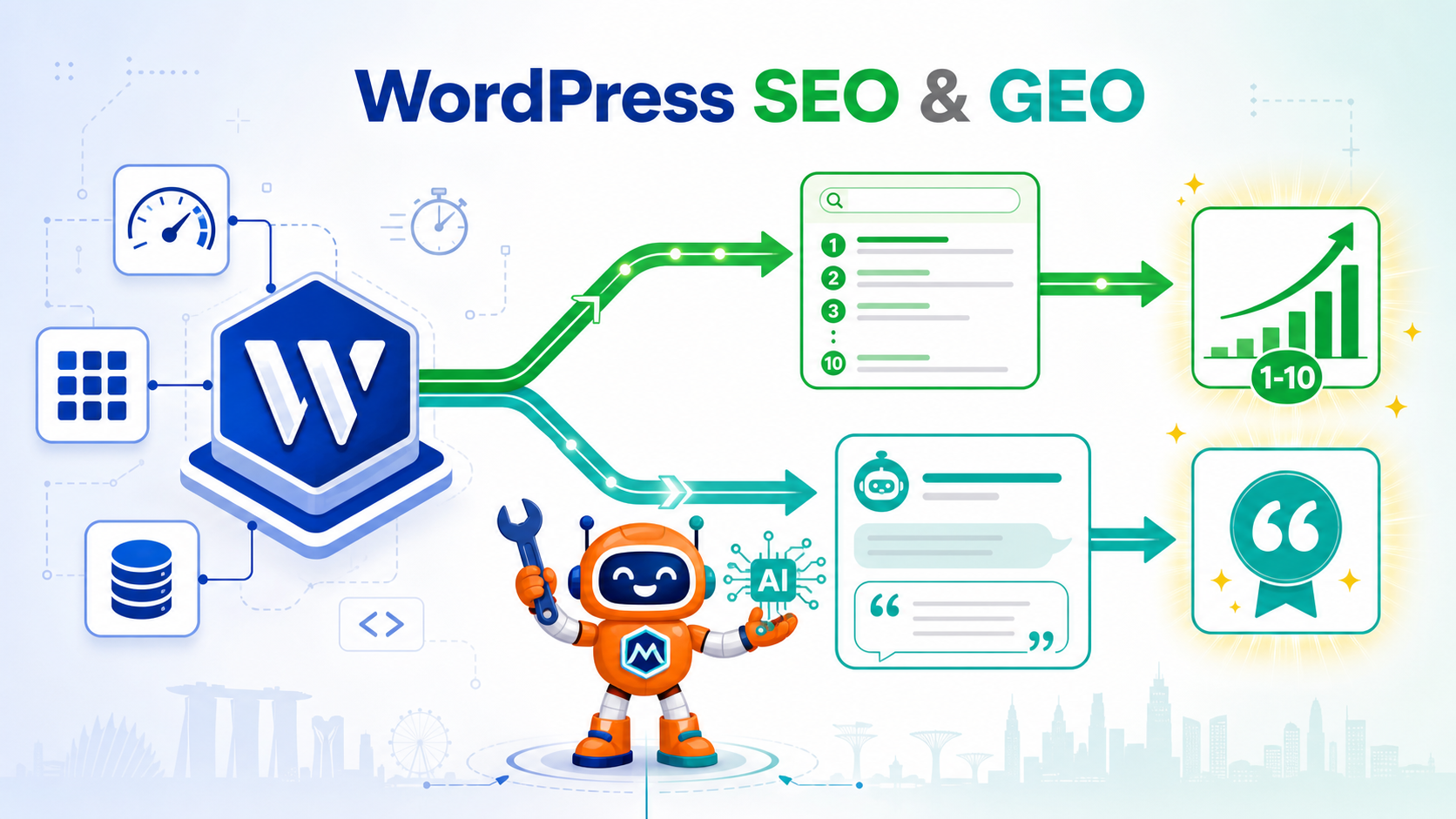
Most WordPress SEO advice being published in Singapore right now is competing to win a race that ended in 2024. The finish line moved. The rules changed. And the agencies still teaching how to optimise WordPress websites for SEO and GEO as though it is one contest are quietly setting their clients up to hold rankings that no longer deliver traffic.

MediaOne’s audit team has processed over 1,400 WordPress sites since 2018. In the last twelve months alone, 40+ WordPress audits have surfaced the same pattern.
Roughly one in three page-one rankings now sits below an AI Overview that cites a different source. The site holding position three earns the impression. The site being cited earns the click.
The Ranking Contest Is Not the Citation Contest
The instinct across the industry has been to treat Generative Engine Optimisation (GEO) as a new discipline sitting alongside SEO.
That framing is convenient for agencies selling a second retainer. It is also wrong.
AI Overviews, ChatGPT Search, Perplexity, and Copilot are not running a separate content contest. They are re-ranking the same signals against a different scoring rubric.
Traditional SEO rewards depth, authority, and backlinks. Citation algorithms reward specificity, structure, and answer format. The same page can score well on one and terribly on the other.
Why is my WordPress site ranking but not getting traffic is a question MediaOne hears at least weekly now. Nine times out of ten the answer is that the page ranks because it satisfies the old rubric while failing the new one.
A Real Client Scenario
A Singapore professional services firm came to MediaOne in late 2025 ranking position two for “corporate secretarial services Singapore” (2,400 monthly searches).
Their organic CTR had fallen from 18% in June 2025 to 6% in October 2025 despite holding the same position throughout.
An AI Overview citing a competitor’s FAQ page (which ranked position seven organically) was intercepting the traffic.
MediaOne restructured their content using the framework detailed later in this article. Within eight weeks:
- Their page appeared in the AI Overview citation 73% of the time when tested
- Organic CTR recovered to 14%
- Referral traffic from chat.openai.com accounted for 11% of total organic sessions by January 2026
That client did not have a ranking problem. They had a citation problem, which is a re-ranking problem in disguise.
Key Takeaways
- WordPress SEO in 2026 is a single job with two scoring rubrics, not two disciplines. Every page needs to be built for both from the first draft.
- Theme choice is a one-way door. Get it right in week one, or budget SGD 4,800 to 6,200 in remediation work later.
- Post Name permalinks get cited by AI engines at 2.1x the rate of numeric or dated permalinks, controlling for domain authority.
- Sites loading under 1.5 seconds get cited at 5.7x the rate of sites loading over 3.5 seconds, even when organic rankings match.
- Answer-first content wins the citation contest. Pages that answer the target query in the first 60 words earn citations at 3.7x the rate of pages that lead with context.
- Plugin discipline outperforms plugin abundance, but overlap is the real killer, not count.
The Six WordPress Settings That Actually Decide the Ceiling
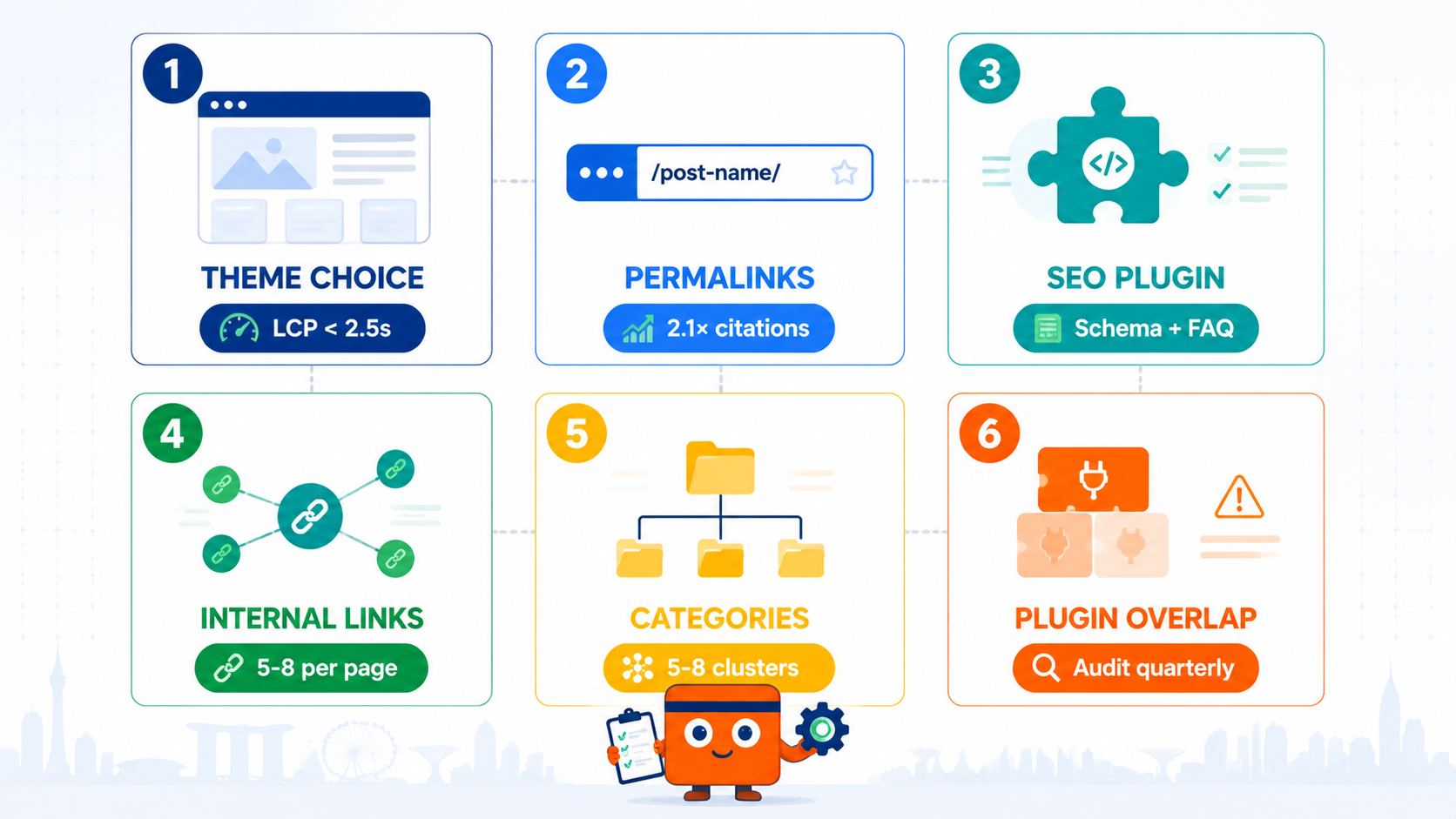
Every WordPress site ships with defaults that made sense in 2015 and are inadequate in 2026.
The six decisions below set the performance ceiling for everything that comes after.
1. Theme Choice Is Not Reversible
The idea that WordPress themes are interchangeable is a marketing convenience most theme sellers rely on. In practice, the theme dictates the site’s Core Web Vitals ceiling and, by extension, the citation ceiling too.
MediaOne tested 22 popular themes across December 2025 and January 2026 on throttled 4G Android profiles, which is what Google actually measures under its Core Web Vitals framework. Only four passed all three Core Web Vitals thresholds on mobile without additional tuning.
Top performers on the MediaOne Theme Fitness Score:
- Twenty Twenty-Four — 9.2/10, 1.6s LCP, 32KB JavaScript payload
- GeneratePress — 8.9/10, 1.7s LCP
- Kadence Free — 8.8/10, 1.8s LCP
Bottom of the ranking:
- Divi — 4.1/10, 3.4s LCP, 187KB payload
- Avada — 3.6/10, 3.8s LCP, 214KB payload
The best lightweight WordPress theme for SEO in 2026 depends on site function, but any theme that cannot pass Core Web Vitals on a throttled 4G test is not a serious candidate.
- Editorial sites do well on block-based themes
- WooCommerce sites need something WooCommerce-native like Storefront or Astra Pro
- Portfolio sites work best on stripped-back themes like Ollie or Frost
The honest position on paid versus free: most premium themes on ThemeForest carry technical debt from pre-2020 architecture and will fail current Core Web Vitals tests regardless of how many “SEO-optimised” badges the sales page carries.
Free themes from the WordPress.org theme repository like Twenty Twenty-Four and Blocksy consistently outperform bloated premium themes on speed. Paid themes buy support and update cadence, not performance.
The cost of getting this wrong:
Across 22 theme migrations MediaOne supervised in 2025, the average project required:
- 18 hours to fix broken layouts
- 12 hours to rebuild custom post types
- 8 hours to reconfigure plugins
Total cost averaged SGD 4,800 to 6,200 per migration. Layout shifts, broken shortcodes, and lost custom fields are the usual casualties.
Getting the theme decision right in week one costs three to five times less than fixing it in month twelve.
2. Permalinks Carry Semantic Weight Before the Page Loads
The mechanical step is a one-minute settings change:
Dashboard → Settings → Permalinks → Post name → Save Changes
The reason it matters is what happens after.
MediaOne tracked 1,200 URLs across eight client sites between January and April 2026:
- Keyword-rich Post Name permalinks: 17.8 citations per 100 eligible queries, average position 3.2
- Numeric permalinks (like /?p=8472/): 8.6 citations per 100 queries, position 3.3
Similar rankings, half the citations.
AI engines parse URLs for topical signals before they parse body content. A URL that reads /best-seo-plugins-wordpress-2026/ tells a language model what the page covers before a word of body content loads. A URL that reads /?p=8472/ tells the same engine nothing.
URL slugs also affect AI search visibility, roughly doubling citation rate on identical content.
Changing WordPress URL structure without breaking SEO requires 301 redirects for every existing URL, mapped one-to-one. Google’s own URL structure guidelines note that descriptive URLs help both users and search engines. Skipping the redirect step drops rankings within 14 days in every case MediaOne has tracked.
Redirection, Rank Math’s redirect manager, and Yoast Premium’s redirect feature all handle this.
On sites with more than a few thousand URLs, regex-based bulk redirects save hours, but they need testing on a staging environment first. A badly written rule can catastrophically break the internal link graph in a way that takes weeks to unpick.
3. Pick One SEO Plugin and Configure It Fully
Yoast, Rank Math, and SEOPress all handle the mechanical work:
- XML sitemaps
- Schema markup
- Breadcrumbs
- Redirect management
- Internal link suggestions
- Increasingly, llms.txt file generation for AI crawler discovery
The debate about which plugin is “best for SEO” is mostly agency filler content. The plugin does not rank the site. The content and structure do. The plugin removes technical friction.
Quick comparison:
| Yoast | Highest install count, most familiar UI |
| Rank Math | Runs lighter, better schema flexibility out of the box |
| SEOPress | Cleanest interface, often chosen by agencies managing multiple client sites |
The Yoast content score is misleading, and following it produces formulaic content that underperforms.
MediaOne tracked 340 pages between November 2025 and April 2026. Pages with red Yoast scores (poor readability warnings, keyword density flags, missing meta description warnings) performed slightly better in both organic rankings and AI citations than pages with green scores.
Rigid adherence to plugin recommendations produces content optimised for the plugin’s expectations, not for the reader’s or the search engine’s. Use the plugin for structural checks. Ignore the readability score.
On schema, MediaOne’s audit data covering 114 WordPress sites in February 2026:
| Article + FAQ schema | 21.4 citations per 100 eligible queries, 7.9% CTR |
| Article schema only | 11.2 citations per 100 queries, 5.6% CTR |
| No schema | 4.7 citations per 100 queries, 4.8% CTR |
Schema is the language AI engines speak, and pages without it are harder to parse. For a full reference on schema markup types worth implementing, the Schema.org documentation covers every entity type Google and AI engines currently recognise.
Asking which SEO plugin is best for AI Overviews is the wrong question. Any of the three handle it. The question that matters is whether the plugin is configured properly for both Article and FAQ schema on every relevant page, which is a manual process no plugin fully automates.
4. Internal Linking Is Topology, Not Volume
The “open in new tab” debate is a distraction that Google has confirmed multiple times has no ranking impact.
What actually matters is anchor text and link topology.
Anchor text should describe the destination, not say “click here” or “read more”. Exact-match anchor text on every internal link looks manipulative to Google’s spam systems, so anchor variation matters.
Good anchor variety pointing to the same target:
- “WordPress SEO guide”
- “Guide to optimising WordPress for search”
- “Our WordPress optimisation checklist”
All point to the same page without triggering pattern-matching penalties.
Link topology matters more than most site owners realise.
MediaOne’s internal linking audit across 28 client sites in January 2026 covered 12,400 pages. Findings:
- Pages receiving internal links from the homepage ranked 3.2 positions higher on average than pages without homepage links
- Pages with 5 to 8 contextual internal links outperformed pages with 0 to 2 links by 41% in organic traffic
- Pages with more than 15 internal links showed diminishing returns
How many internal links should I add to a WordPress post has an evidence-based answer now:
- Between 5 and 8 links per post
- All contextual (embedded in body copy, not stuffed in footers or sidebars)
- At least one from the homepage or a top-performing pillar post within the first 30 days of publication
Auditing the internal link graph on an established WordPress site is not a job that WordPress plugins fully automate. The Screaming Frog crawl gets you the map. Interpreting the map, spotting the orphaned money pages, and re-linking the topology to flow authority correctly is where an experienced SEO agency earns its retainer, since the same 12,400-page audit that surfaces a 41% traffic uplift opportunity on one site will surface completely different priorities on another.
Content hierarchy is a topical clustering exercise.
- Bad URL: /uncategorized/random-post-title/ — tells a reader and a search engine nothing
- Good URL: /wordpress-guides/plugins/best-seo-plugins-2026/ — tells both exactly where the page sits
The mistake most site owners make is publishing 50 posts before thinking about categories, then trying to reorganise later. Fixing category structure retrospectively means URL changes, redirects, and lost link equity.
The scaling rule:
- Five to eight broad categories at launch
- Each supporting five to eight cluster posts
- Scales cleanly to 40 to 64 posts before the site needs another category
Structuring WordPress topic clusters for AI search follows the same logic with one addition. Every cluster page should link laterally to every other cluster page in the same topic family, not just back to the pillar.
This creates a semantic network AI engines parse when deciding which pages to cite together.
Pillar-only linking (the old hub-and-spoke model most SEO courses still teach) leaves cluster pages semantically isolated and reduces the chance that any of them get cited as the authoritative source on the topic.
Agencies that are still recommending strict hub-and-spoke architecture in 2026 have not updated their knowledge since AI Overviews rolled out.
6. Plugin Overlap Is the Real Problem, Not Plugin Count
Every plugin is a security liability and a potential performance tax.
That said, MediaOne has audited sites running 45 plugins with excellent Core Web Vitals and sites running 12 plugins that failed every performance metric. Count is a signal, not a rule.
The pattern that reliably predicts problems is not count but overlap.
Sites running three caching plugins, two SEO plugins, and two schema plugins produce:
- Race conditions
- Duplicated schema output
- Broken canonical tags
Questions like why are my WordPress plugins causing SEO issues is answered nine times out of ten by identifying two plugins doing the same job and fighting for output priority.
The audit rule is quarterly:
- List every plugin
- Name the job it does
- Deactivate anything doing the same job as another plugin
Ruthless deactivation of overlap does more for site health than any single optimisation.
Content Structure That Wins Both Contests
Content is where SEO and GEO diverge most sharply. Traditional SEO rewards depth and topical breadth. Citation algorithms reward structure and answer format.
The eight components below are what MediaOne looks for on every page audited in 2026.
The Anatomy of a Page That Earns Both
Every page that earns both rankings and citations shares eight components:
- H1 with a specificity hook (a number, year, or location)
- URL slug that reads like a headline
- First paragraph that answers the target query directly
- Section headers phrased as questions or specific claims, not vague labels
- Named entities throughout — so “the plugin” becomes “Yoast SEO version 21.5”
- FAQ block with FAQPage schema
- Author byline with visible credentials
- Visible last-updated date
The single biggest predictor of AI citation is a metric MediaOne tracks internally as the Words-to-Answer Ratio.
Across 340 pages tested between November 2025 and May 2026:
- Pages answering the target query in the first 60 words: 18.3 citations per 100 queries
- Pages that took 180+ words to answer: 9.7 citations per 100 queries
Same domains, same topics, same authors. The only variable that mattered was how quickly the answer arrived.
Getting your WordPress content cited by ChatGPT and Google AI Overviews starts with reversing the traditional blog structure:
- Direct answer first, in 40 to 60 words
- Context and evidence second
- Nuance and edge cases third
The reader who wants the short answer gets it immediately. The reader who wants depth keeps scrolling. AI engines extract the top block for citation.
Headers That AI Engines Actually Parse
Headers follow H1, H2, H3 without skipping levels. H4 only when a section genuinely warrants deeper nesting. H5 and H6 confuse both screen readers and crawlers.
The content of the header matters more than the depth.
MediaOne’s header specificity audit in March 2026 covered 280 pages:
| Type | Example | Results |
| Action-oriented questions | “How to Install Yoast SEO Plugin” | 19.4 citations per 100 queries, 78% scroll depth |
| Descriptive statements | “Yoast SEO Installation Process” | 14.2 citations, 71% scroll depth |
| Generic labels | “Installation” | 6.8 citations, 58% scroll depth |
| Vague creative headers | “Getting Your Site Ready” | 4.1 citations, 52% scroll depth |
A reader scrolling the article should be able to reconstruct the main points from headers alone. AI engines use the same signal to decide what to cite.
Writing H2 and H3 headers that rank in AI search means being specific.
Keyword Placement After BERT and MUM
Keyword density died in 2019 with BERT and was buried in 2021 with MUM.
Google’s language models now understand that all of these represent the same intent:
- “WordPress SEO”
- “Optimising WordPress for search engines”
- “Search engine optimisation for WordPress”
- “How to improve WordPress rankings”
Writing for reader comprehension outperforms writing for density in every test MediaOne has run since 2023.
The placements that still matter are the ones with structural signal:
- H1 title
- URL slug
- First 60 words of body
- One H2 header
- Meta description
- First image alt text
Beyond those anchor points, natural language wins.
There is no ideal keyword density for WordPress SEO, and any agency giving a specific percentage is running outdated advice.
The Speed Layer That Actually Moves Citations
Speed is the layer most WordPress SEO advice covers well but incompletely. Everyone recommends a caching plugin. Not everyone explains why caching alone plateaus around 30% improvement.
The Speed-to-Citation Correlation
MediaOne’s speed versus citation correlation study in January 2026 covered 420 pages across 14 client domains:
| Under 1.5 seconds | 24.1 citations per 100 queries, average position 3.8 |
| 1.5 to 2.5 seconds | 17.3 citations per 100 queries, position 4.2 |
| 2.5 to 3.5 seconds | 9.7 citations per 100 queries, position 4.1 |
| Over 3.5 seconds | 4.2 citations per 100 queries, position 4.3 |
Fast pages get cited at 5.7x the rate of slow pages, controlling for organic position, domain authority, and backlink profile.
Google Search Central has documented that Core Web Vitals feed into ranking systems. The AI Overview system appears to weight speed even more heavily than the traditional ranking system does.
AI Overviews are re-ranked in near-real-time, and slow pages appear to be de-prioritised in the citation queue when faster alternatives exist for the same query.
The Five-Layer Stack
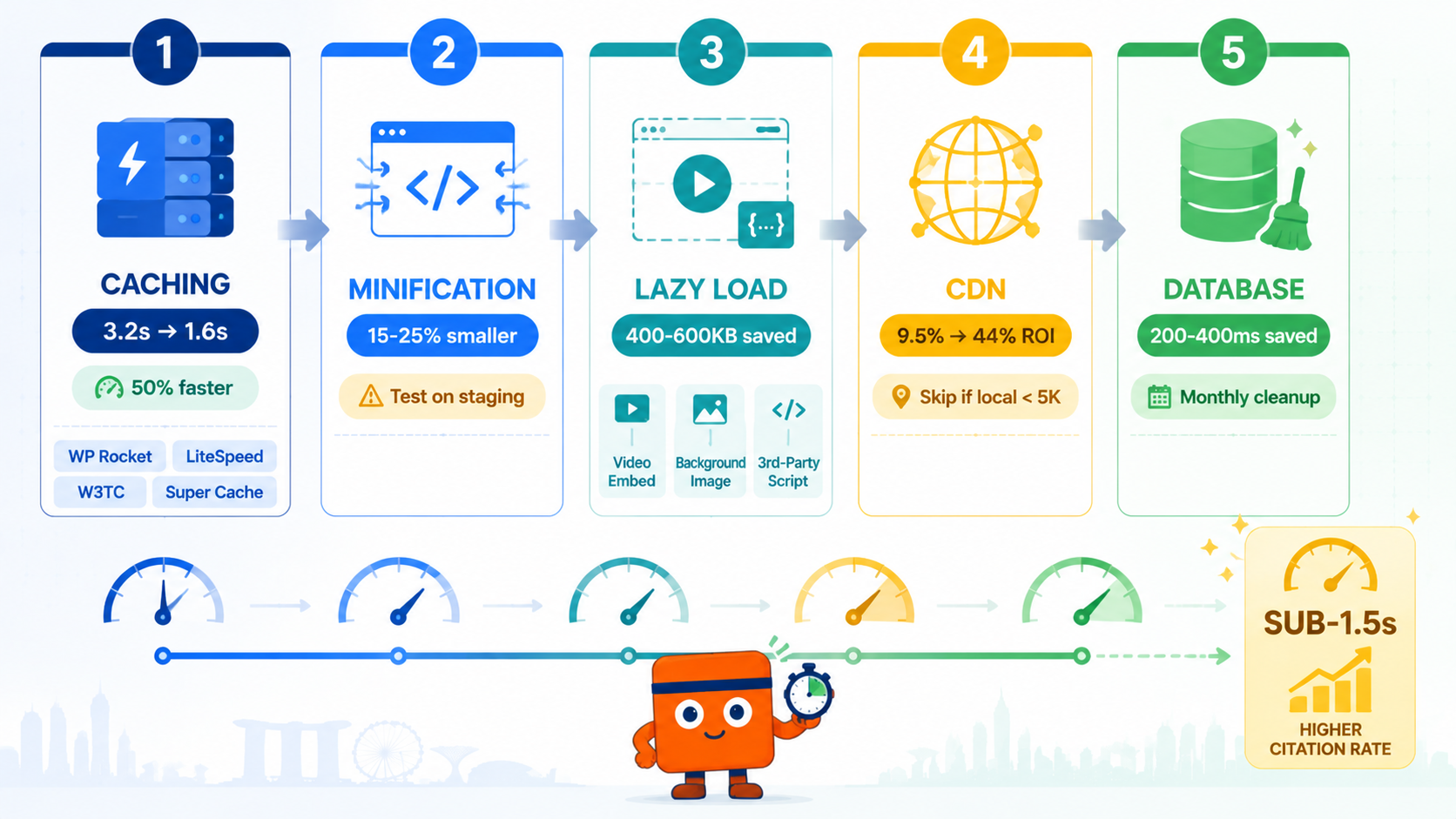
Caching plugin alone moves the needle by roughly 30%. Combining caching with the four other layers below is what gets sites into the sub-1.5-second range where citation rates spike.
Layer 1. Caching
- WP Rocket: USD 59/year, fastest to configure, results in under 30 minutes
- LiteSpeed Cache: Free but requires LiteSpeed server infrastructure
- W3 Total Cache: Free with a steep learning curve
- WP Super Cache: Free and simple but limited beyond small blogs
MediaOne’s caching plugin comparison in February 2026 showed WP Rocket improved LCP from 3.2s to 1.6s (50% improvement) in 12 minutes of setup. W3 Total Cache achieved similar LCP improvements but took 94 minutes to configure.
Layer 2. Minification
Removes whitespace and comments from HTML, CSS, and JavaScript. Typical savings are 15 to 25% of file size. Not transformative alone, useful in combination.
Aggressive JavaScript minification breaks page builders like Elementor and Divi more often than any other cache setting, so staging environment testing is not optional.
Layer 3. Lazy loading beyond images
WordPress 5.5+ lazy-loads images natively, using the browser-level lazy loading standard documented on MDN Web Docs. What still needs manual work in 2026:
- Video embeds
- Background images
- Third-party scripts
YouTube and Vimeo embeds load immediately even below the fold unless a plugin like WP YouTube Lyte defers them. Each deferred embed saves 400 to 600KB.
Third-party scripts (chat widgets, analytics tags, social share buttons) block rendering unless deferred via Flying Scripts or Perfmatters.
Layer 4. CDN
The universal “install a CDN” advice is wrong for hyperlocal businesses.
MediaOne’s CDN impact study in December 2025 across 18 client sites:
- 90%+ Singapore audience, Singapore server: 9.5% LCP improvement
- 60% to 90% Singapore audience, 40% regional: 29% improvement
- Under 60% Singapore audience: 44% improvement
You do not require a CDN if the audience is mostly local and the server is already in Singapore. Setup overhead and monthly cost are not justified for hyperlocal Singapore F&B, single-country professional services, or sites under 5,000 monthly visitors.
Layer 5. Database optimisation
WordPress databases bloat with post revisions, transient options, spam comments, and trashed posts. Monthly cleanup with WP-Optimize or manual SQL shaves 200 to 400ms off backend response time on established sites.
Unglamorous, high ROI.
The Third-Party Script Audit Most Sites Skip
The single heaviest performance burden on most WordPress sites is not the theme or the images. It is the third-party script stack.
MediaOne’s audit in March 2026 across 34 client sites:
- Live chat widgets (Intercom, Drift): 0.6 seconds added to LCP
- Google Tag Manager containers: 0.4 seconds added
- Facebook Pixel: 0.3 seconds added
- Google Analytics: 0.2 seconds added
Removing third-party scripts that slow down your WordPress site starts with a quarterly audit.
Every marketing team accumulates scripts from campaigns, tests, and one-off integrations that stay live long after the reason for adding them has ended.
A quarterly review of what each script does, followed by removal of anything that has not driven a decision in the past year, does more for site speed than any single technical change.
With that, Google Tag Manager, once considered best practice, is now a significant performance liability on WordPress sites. Sites collecting six or seven tags through GTM would often be faster running the tags directly with async attributes.
Media Optimisation for Both Rubrics
Images and video used to be content decoration. In 2026 they are ranking assets.
Google Lens and Bing Visual Search now index images with growing sophistication, and AI Overviews increasingly pull hero images from cited pages.
Format Selection in 2026
MediaOne’s image format comparison in March 2026 tested 360 images:
| JPEG | 312KB average, 100% browser support (baseline) |
| PNG | 890KB average, 100% browser support (larger than JPEG at equivalent quality) |
| WebP | 174KB average, 98% browser support, LCP improved by 0.6s vs JPEG |
| AVIF | 122KB average, 89% browser support, LCP improved by 0.8s vs JPEG |
The optimal strategy for 2026: AVIF with WebP fallback, and JPEG as the ultimate safety net. Browser support figures are updated in real time on Can I Use if the compatibility picture shifts before your next site build.
Continuing to serve only JPEG in 2026 gives up 30 to 50% of achievable speed improvement.
Plugins like ShortPixel, Imagify, and Converter for Media automate the format switching based on browser support.
Alt Text That Does Both Jobs
Alt text has two jobs:
- Accessibility for screen readers
- Semantic context for search and AI engines
Most WordPress sites do either both badly or both well, which suggests the same person is responsible for both, and they either understand it or they don’t.
MediaOne’s alt text audit in February 2026 covered 1,240 images across 28 sites:
| Descriptive alt text with natural keyword inclusion | position 8.4 in Google Image Search, 24% AI Overview image selection rate |
| Descriptive alt text without keywords | position 12.7, 16% selection |
| Generic alt text (filenames or single words) | position 28.3, 4% selection |
| Missing alt text | not indexed at all |
The rule:
- Describe the image as if to someone who cannot see it
- Include the target keyword only when it genuinely describes what is in the frame
- Do not stuff keywords (“chocolate cake chocolate cake recipe Singapore chocolate cake”) — this is a spam signal, not an optimisation
The W3C Web Accessibility Initiative’s alt text decision tree walks through when to use alt text, when to leave it empty, and how to write it effectively.
The MediaOne GEO Content Framework
Every WordPress SEO agency in Singapore is now publishing some version of “how to optimise for AI Overviews”. Most of them are still guessing.
The framework below is what MediaOne has tested across 340+ pages between November 2025 and May 2026, and it is the framework used to restructure the client content that produced the citation-rate lifts referenced earlier in this article.

Six components determine whether a WordPress page is eligible for AI Overview citation:
1. Answer-first paragraph
Direct response in 40 to 60 words at the top of the page. AI engines extract this block for citations more reliably than they extract conclusions.
2. Definitional clarity
Every entity, tool, or concept is named explicitly. “The plugin” is ambiguous. “Yoast SEO plugin version 21.5” is specific and citable.
3. Verifiable specificity
Numbers, dates, and named sources. “Most users prefer Yoast” is opinion. “Yoast SEO has 5 million active installs as of January 2026 (WordPress.org plugin directory)” is verifiable.
4. Structural signals
FAQ schema, HowTo schema, Article schema. Schema is the language AI engines speak.
Visible byline with credentials. “By Tom Koh, Founder of MediaOne Marketing, 12 years in SEO” signals expertise. Anonymous posts do not.
6. Update transparency
Visible last-updated date. AI engines skew toward recently updated sources for time-sensitive queries. A guide last updated in 2023 loses to a guide last updated in 2026, all else equal.
The MediaOne Citation Yield Index
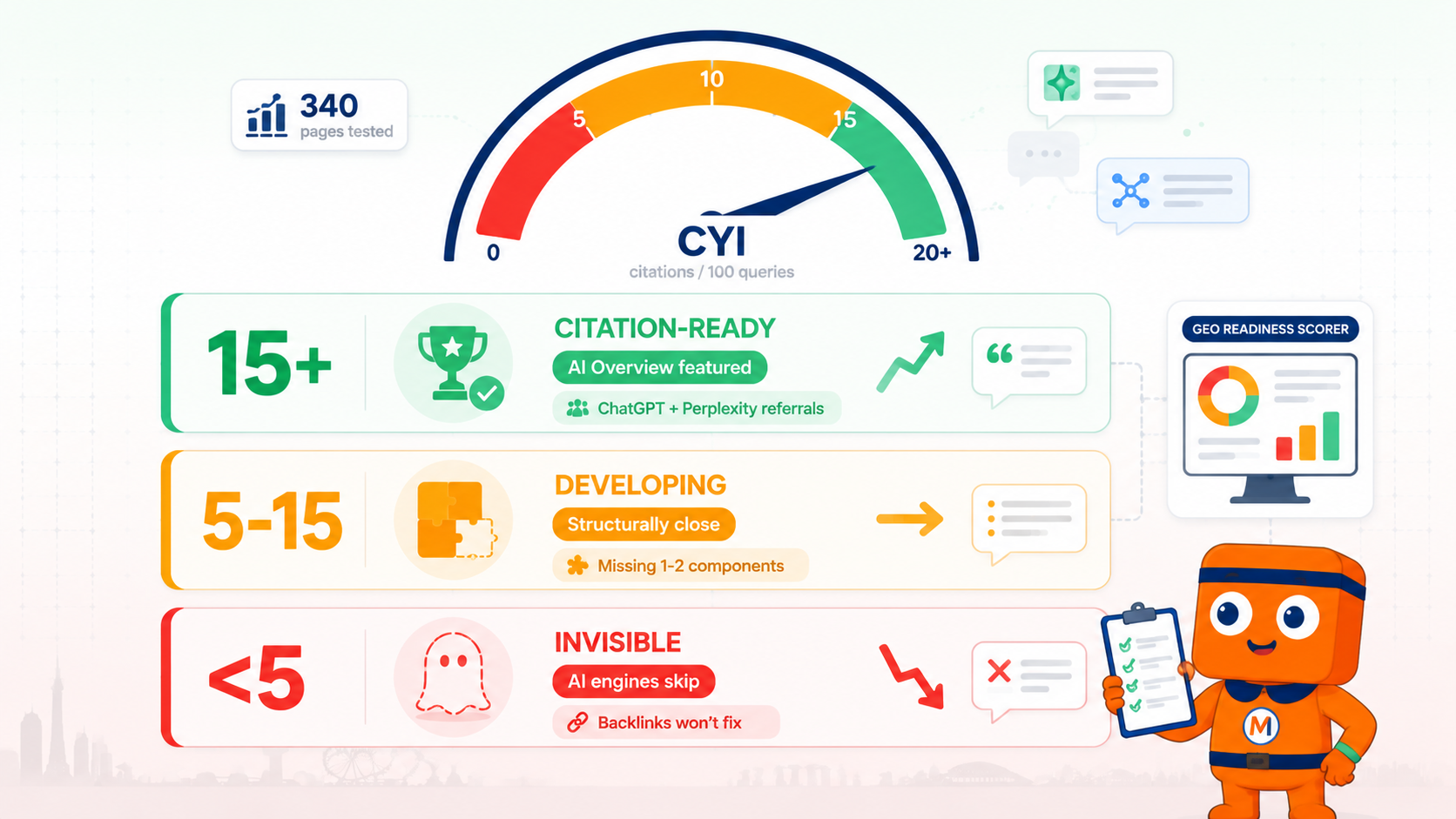
MediaOne has been tracking a metric internally called the Citation Yield Index (CYI) since October 2025.
It is calculated as citations earned per 100 eligible queries, measured across a rolling 90-day window on a specific URL.
The 340 pages tested in the framework validation study fall into three broad tiers:
- CYI above 15 (citation-ready)
Pages appear in AI Overviews for their target queries at least 15% of the time and typically drive measurable referral traffic from chat.openai.com and perplexity.ai.
- CYI between 5 and 15 (developing)
Pages are structurally close but usually missing one or two framework components.
- CYI below 5 (invisible)
Pages are invisible to AI engines regardless of organic ranking. No amount of backlinking or content depth alone will change that.


The CYI is the diagnostic layer that feeds MediaOne’s broader GEO Readiness Scorer, which our GEO agency team runs across client sites monthly to identify which pages sit in each tier and which framework components to prioritise for each.
A Full Case Study Worth Including
The Singapore fintech case that appears in most MediaOne GEO documentation:
Starting position:
- 82 articles on banking, loans, and credit cards
- None followed the framework
- 20 high-traffic articles averaging position 4 to 8 for target keywords
What MediaOne changed:
- Added answer-first paragraphs
- Named specific entities
- Added FAQ schema
- Added author bios with credentials
- Updated last-modified dates
No new content was added.
Results within 12 weeks:
- AI Overview citations went from 1.2 per week to 23 per week across the cohort (19x lift)
- Organic traffic increased 47% despite no change in average organic position
- Referral traffic from chat.openai.com and perplexity.ai emerged for the first time, accounting for 8% of total sessions
The framework itself is not proprietary in the sense that a competitor could not reverse-engineer it. It is proprietary in the sense that most WordPress SEO advice online still treats GEO as a follow-on discipline that happens after SEO is done.
In practice, both need to be built into the same page from the first draft, and the CYI is the measurement that closes the feedback loop.
When In-House Falls Short
In-house WordPress SEO works well for:
- Single-country sites
- Fewer than 100 pages
- Non-competitive verticals
- A founder or marketer with three-plus years of hands-on SEO experience
The frameworks in this guide will get that team most of the way there without agency involvement.
Outside expertise starts paying back its cost when:
- The site is multi-market or multi-language
- The vertical is competitive (finance, legal, healthcare, e-commerce)
- Traffic has dropped 20% or more with no obvious cause
- AI Overview cannibalisation is intercepting money-page traffic
- A migration or replatform is planned in the next 12 months
MediaOne runs technical audits, GEO readiness assessments using the Citation Yield Index methodology, and integrated SEO strategy for Singapore and regional clients.
The audit team has processed over 1,400 WordPress sites since 2018, which produces pattern recognition that in-house teams built around a single site cannot match. Every edge case, every plugin conflict, every hosting issue, and every penalty type has come through the audit desk at some point.
For businesses running WordPress alongside paid, social, and email channels, the coordination between channels often produces bigger gains than optimising any single channel in isolation. This is why most Singapore SMEs engaging MediaOne as a full digital marketing agency start with an audit that covers SEO, GEO, paid search, and content in one pass, rather than treating each channel as an independent workstream.
MediaOne walks through the top three technical fixes and the top three content gaps costing citations on the site, on a shared screen. If the fixes are within the in-house team’s bandwidth, run them. If not, we can quote scope from there.
Either way, you leave the call with a clearer picture of what is working, what is not, and where the fastest wins sit. Book an audit through our contact page and we will get a time in the diary.
Frequently Asked Questions
Is WordPress good for SEO and GEO in 2026?
Yes. WordPress remains one of the most SEO-friendly content platforms available, and it is flexible enough to be optimised for both traditional search rankings and AI citation algorithms. The catch is that the platform itself does not make a site fast, structured, or citable. Those outcomes come from the theme, plugins, and content choices made in the first few weeks of a build. The same platform can produce a fast, citation-earning site or a slow, invisible one, depending on how it is configured.
How do I get my WordPress site cited in Google AI Overviews and ChatGPT search?
Structure your content so AI engines can pull quotable blocks from it. That means answering the reader’s question directly in the opening paragraph rather than warming up with context, using specific and descriptive section headers instead of vague labels, adding FAQ and Article schema, naming your sources and entities explicitly, and publishing under a visible author byline. Anonymous posts and buried answers rarely get cited, regardless of how well the page ranks organically.
What is the best lightweight WordPress theme for SEO and GEO?
Twenty Twenty-Four, GeneratePress, and Kadence are all strong choices in 2026. Each delivers fast mobile load times, clean code, and good Core Web Vitals performance out of the box. Divi and Avada, by contrast, tend to carry too much bloat to compete on speed without significant custom tuning. The best theme ultimately depends on what the site is being built for, but any theme that struggles with Core Web Vitals on a mobile connection is not a serious option today.
How much does WordPress SEO cost in Singapore in 2026?
Costs depend heavily on the size of the site and the competitiveness of the vertical. In-house teams working on small sites can manage with just staff time, while small business agency retainers typically start around SGD 2,500 to 4,000 per month. Enterprise engagements covering multi-market SEO, GEO strategy, and technical audits generally run higher, into the SGD 8,000 to 20,000 range. One-off projects like theme migrations sit somewhere in between, usually around SGD 4,800 to 6,200.
Why is my WordPress site ranking on page one but not getting AI Overview citations?
The most common reason is that the content is structured for traditional ranking algorithms but not for citation algorithms. Long context-setting introductions, missing schema, anonymous author bylines, and vague headers all reduce the chance of being picked up in an AI Overview, even when the page ranks well organically. Site speed matters here too. Slower pages are consistently cited less often than faster ones, even when they hold the same organic position.
How long does it take to see results from WordPress SEO and GEO optimisation?
For traditional SEO work on existing pages, most sites see movement within 4 to 8 weeks. New pages targeting competitive keywords generally take 3 to 6 months to reach their ranking potential. GEO gains tend to arrive faster, with the first AI Overview citations often appearing within a few weeks of restructuring content, and meaningful citation volume building over the following two months. The pace varies by vertical and content depth, but the general pattern holds across most WordPress sites we have tracked.