Introduction: The 87% Statistic That Changes Everything
Every Singapore marketer knows Google’s Singapore market share sits at 92.95% according to StatCounter’s June 2026 data. That number gets quoted in every SEO proposal, every pitch deck, every quarterly review. It has also become the single biggest strategic blindspot in B2B search marketing.
Here is the statistic that should reshape your 2026 strategy. According to Seer Interactive’s research on 240 million ChatGPT citations, 87% of SearchGPT citations match Bing’s top-ranking pages. Microsoft Copilot pulls from Bing’s index by architectural design. Windows 11 integrated search runs on Bing. Edge browser defaults to Bing. Every one of the 20 million paid Microsoft 365 Copilot enterprise seats that Satya Nadella confirmed in April 2026 executes Bing queries with every conversational search.
Why should you care about Bing when Google dominates Singapore? Because the buyers who make enterprise purchase decisions in Singapore are doing their research inside Microsoft’s ecosystem, not Google’s. Microsoft’s 2026 Work Trend Index confirms Singapore’s workforce leads regional AI adoption. When a finance director opens Copilot inside a Teams meeting to research vendor options, they never touch Google. When a procurement manager verifies supplier credentials through Edge’s default search, they never touch Google. When Enterprise Singapore’s Microsoft Copilot for SMEs Programme rolls Copilot into thousands of local businesses, each installation becomes a Bing search endpoint.
A digital marketing agency building strategies for the AI search economy must approach both engines as fundamentally different systems. From auditing 40+ Singapore B2B and e-commerce sites over the past 18 months, one pattern emerges consistently. Pages ranking in Google’s top 10 often sit outside Bing’s top 30 for identical queries, not because the content is weak, but because it was written for an engine that infers rather than confirms.
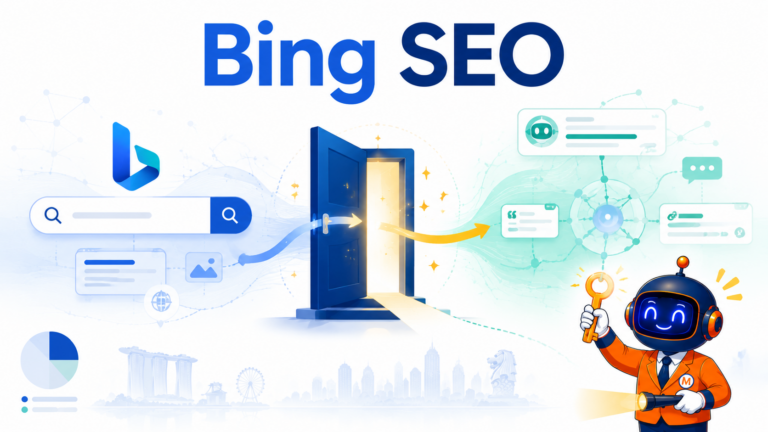
Bing SEO is the discipline of optimising for Microsoft’s search index, which now feeds ChatGPT Search, Microsoft Copilot, and the wider AI-powered discovery ecosystem. The critical difference from Google SEO is philosophical rather than technical. Google infers relevance from behaviour at scale. Bing demands explicit confirmation before it ranks anything. This guide unpacks why that gap creates the most defensible opportunity in modern search marketing.
Key Takeaways
The 2026 data reveals a search economy where Bing punches materially above its market share. Here are the numbers that should shape budget conversations:
- 87% of ChatGPT citations match Bing’s top-ranking pages
- 20 million paid Microsoft 365 Copilot enterprise seats as of April 2026, each generating Bing-powered searches
- 73.9% combined AI search market share for ChatGPT and Copilot, both reliant on Bing’s index
- Bing global market share climbed to 4.1% in 2026, up 0.8 percentage points year-over-year
- Singapore workforce leads regional AI adoption per Microsoft’s 2026 Work Trend Index, concentrating high-value B2B queries in Microsoft-powered environments
- AI Performance Report launched in Bing Webmaster Tools (February 2026) now shows citation counts across Copilot and ChatGPT
The strategic reframe worth internalising is that Bing is not a smaller Google. It is a different search philosophy operating on a different user base at a different decision moment. Treating it as Google’s poor cousin explains why so many Singapore marketing teams have never captured the qualified traffic waiting for anyone willing to optimise for clarity rather than cleverness.
Bing SEO fundamentals at a glance:
| Bing SEO Principle | Practical Requirement | Business Impact |
| Explicit clarity over inferred relevance | Exact keyword alignment across title, H1, URL, opening paragraph | 30–50% incremental organic visibility |
| Trust signals over engagement signals | Author attribution, source citations, factual consistency | Higher AI citation likelihood |
| IndexNow protocol adoption | Instant URL notification to Bing index | Discovery timeline compressed from weeks to hours |
| Lower ranking volatility | Fewer algorithm-driven fluctuations | More stable ROI predictions |
| Direct AI citation tracking | AI Performance Report in Bing Webmaster Tools | Measurable AI search attribution |
The Fundamental Divide: How Bing and Google Think Differently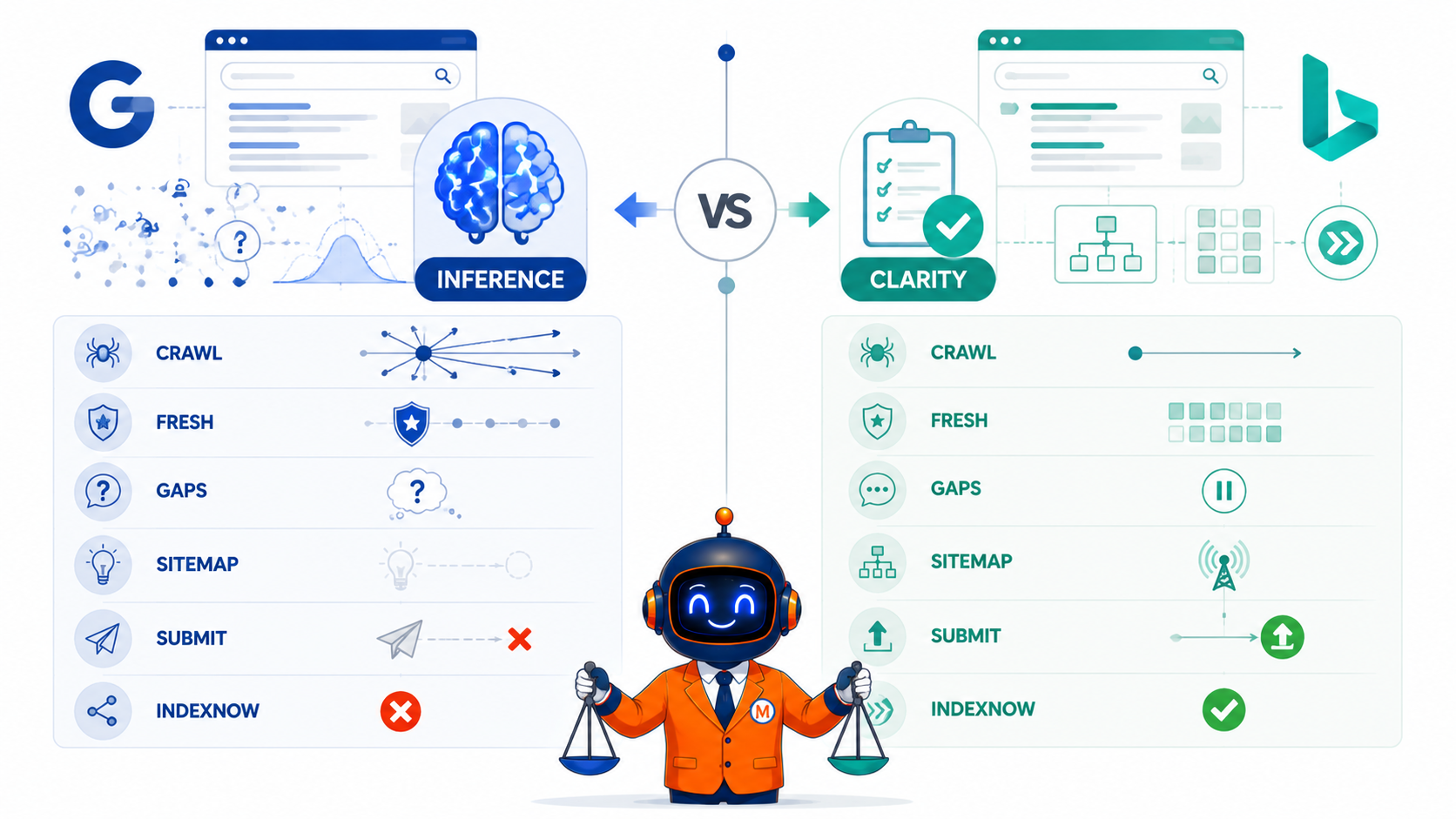
Before touching keywords, content briefs, or technical fixes, reset one assumption that quietly costs Singapore marketers meaningful traffic. Bing and Google are not trying to solve search in the same way. When a page performs well on one engine and struggles on the other, the outcome is rarely accidental. It typically reflects alignment with one philosophy and clash with the other.
The distinction is simple at its core. Google is built for inference at scale. Bing is built for clarity and confirmation. That single difference explains most of the ranking behaviour Singapore marketers observe in practice.
How Each Engine Approaches Search
| Dimension | Google’s Approach | Bing’s Approach |
| Core philosophy | Inference at scale | Clarity and confirmation |
| Crawling behaviour | Aggressive, frequent revisits | Conservative, intent-driven |
| Fresh content | Rewards established domains | Rewards clear structure regardless of domain age |
| Missing signals | Fills gaps with educated guesses | Waits for explicit confirmation |
| XML sitemaps | Helpful hint | Genuine discovery signal |
| Manual URL submission | Largely ignored | Legitimate acceleration tool |
| IndexNow protocol | Not supported | Native support since 2021 |
Google’s tolerance for ambiguity reflects its data advantage. With trillions of user interactions to draw from, the algorithm can infer intent, satisfaction, and relevance from behaviour patterns that individual page signals cannot capture. When users click, stay, and do not return to search, Google assumes the page served its purpose regardless of how precisely it was structured.
Bing takes a more conservative approach. It crawls with intent rather than volume. It looks for confirmation that a page knows exactly what it is about and who it is for. When that confirmation is present, Bing can rank fresh content surprisingly fast, even on newer or less authoritative domains. When it is missing, the page may sit unnoticed for far longer than any Google-first SEO would expect.
According to Microsoft’s Bing Webmaster Guidelines, Bing actively encourages webmasters to help the crawler understand their site rather than assuming it will figure things out on its own. To get Bing to index your new pages faster, submit them through Bing Webmaster Tools or via the IndexNow protocol within 24 hours of publishing. This single habit compresses discovery timelines from weeks to hours.
The IndexNow Protocol: The Game-Changer Most Singapore Marketers Have Not Adopted
One 2026 development deserves particular attention because Google-first marketers routinely miss it. The IndexNow protocol is a free, open-source standard that Bing, Yandex, Naver, Seznam, and Yep support natively. Google does not. When you ping IndexNow with a new or updated URL, Bing receives the notification instantly and typically crawls the page within minutes.
For Singapore businesses publishing time-sensitive content, campaign landing pages, product launches, or news updates, IndexNow adoption represents one of the highest-leverage moves available in 2026. WordPress sites can add IndexNow through a single plugin. CDN providers including Cloudflare and Akamai offer native integrations. Enterprise CMS platforms increasingly ship IndexNow support by default.
The MediaOne pattern from client onboarding audits is stark. Sites without IndexNow typically see new pages indexed by Bing within 5–14 days. Sites with IndexNow properly configured see indexing within 2–48 hours. For lead generation, e-commerce launches, and time-sensitive B2B content, this compression translates directly to captured demand that competitors miss.
Keyword Strategy for Bing: Why Google Tactics Backfire
Keyword strategy is where many Singapore marketing teams accidentally undermine their own Bing performance. This happens not because the strategy is poor, but because it inherits Google’s assumptions wholesale. What works passably well on Google can quietly fail on Bing, even when the content itself is strong.
In 2026, Bing rewards clarity over cleverness. Google rewards inference over precision. Once you internalise that difference, keyword strategy stops being guesswork and becomes predictable.
Exact Match and Phrase Sensitivity in Bing SEO
When your pages rank on Google but not on Bing, the gap almost always traces back to three explicit signals Bing parses early in the crawl. Page titles carry the strongest weight. H1 headings reinforce topical alignment. URL slugs confirm intent. When the search query is “cloud compliance audit checklist,” Bing expects to see that wording or a very close variant in those elements. A creative alternative may still work on Google because engagement data compensates. On Bing, ambiguity typically costs rankings.
This does not mean keyword stuffing. It means accurate labelling. Consider a real example from MediaOne’s client work. A finance SaaS page titled “How Enterprises Stay Compliant in the Cloud” performed well on Google, ranking positions 4–7 for its target cluster. The same page performed materially better on Bing after being retitled to “Cloud Compliance Audit Checklist for Enterprises,” even when the body content remained largely unchanged. Bing rankings jumped from position 34 to position 6 within three weeks of the retitle and IndexNow resubmission.
The MediaOne Trust Signal Alignment Framework 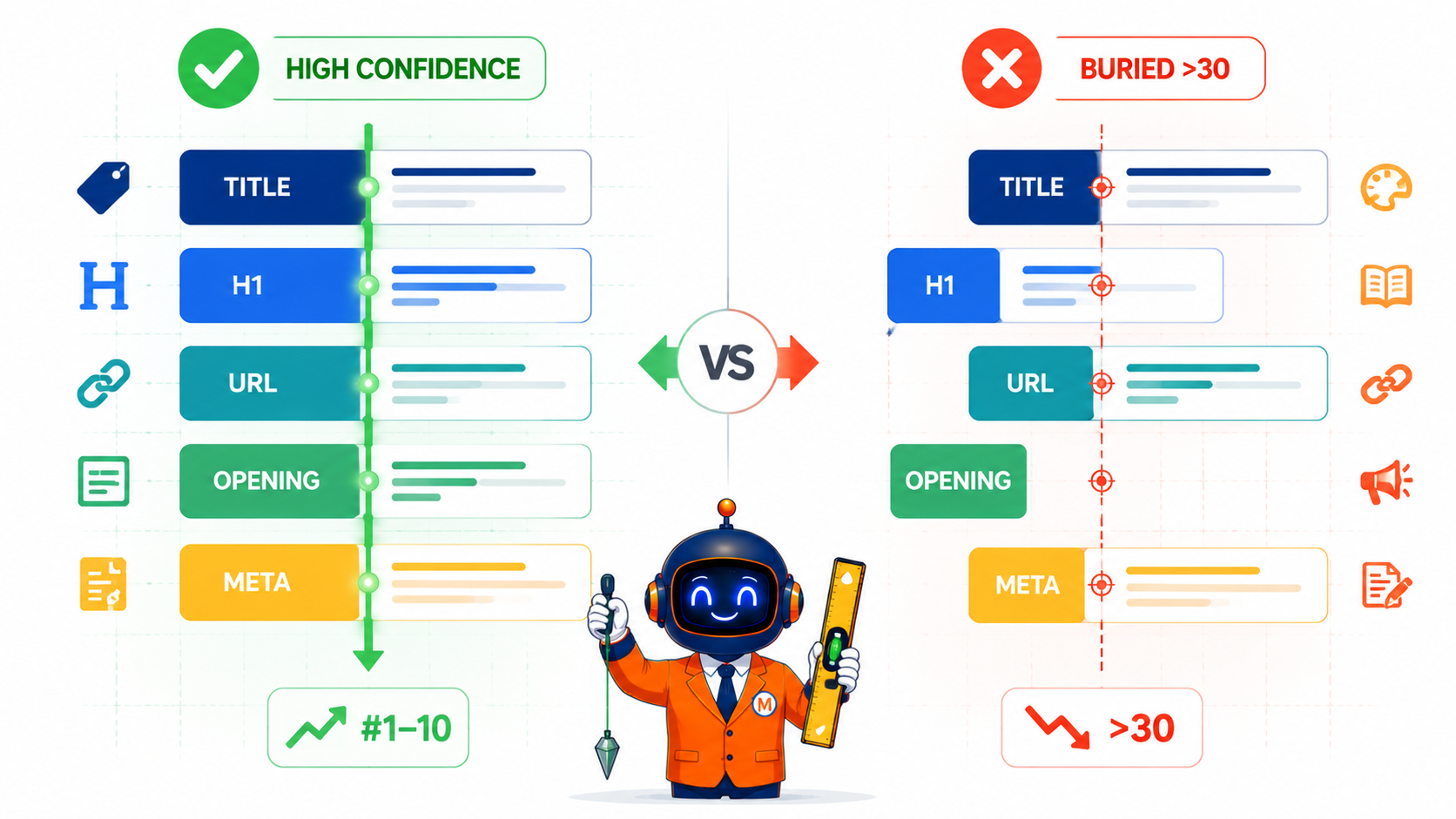
Through auditing Singapore B2B and e-commerce sites, MediaOne developed a proprietary framework called Trust Signal Alignment. The framework identifies five alignment points that must match for Bing to rank a page with confidence.
Trust Signal Alignment Check (MediaOne Proprietary Framework)
| Signal | Requirement | Common Failure Mode |
| Title tag | States exact query intent | Creative or branded phrasing |
| H1 heading | Restates title in plain language | Different angle or wording |
| URL slug | Contains primary keyword phrase | Auto-generated or shortened |
| Opening paragraph | Confirms intent within first 50 words | Story-driven intro that delays intent |
| Meta description | Reinforces query language verbatim | Marketing copy or brand messaging |
When all five align, Bing treats the page as high-confidence and ranks it accordingly. When any two diverge, Bing hedges its bets and typically buries the page beyond position 30. This framework applies across industries and page types, from service pages to blog posts to product listings.
Bing Webmaster Tools provides its own keyword research module pulling directly from Bing’s search data. Ahrefs and Semrush track Bing rankings but source their data less comprehensively than for Google. For serious Bing work, combining Bing Webmaster Tools with a third-party tool like Ahrefs yields the most reliable picture. Businesses building complete keyword frameworks often benefit from professional SEO agency services that combine both engines under one strategy.
Why This Matters for AI Search and LLM Visibility
AI systems that rely on Bing’s index, including Microsoft Copilot and ChatGPT Search, must quickly and safely understand a page before citing it. Content with clear labels, consistent terminology, and explicit intent is easier to summarise and more likely to be cited. Pages that rely on clever phrasing or abstract framing introduce uncertainty. Uncertainty reduces citation likelihood.
So, how do you get content cited by ChatGPT and Copilot? The same clarity that improves Bing rankings also improves AI citation. This is why brands treating Bing as a checkbox after Google are systematically losing ground in the AI search citation ecosystem. Businesses building for the AI search shift should explore GEO agency services that address how content gets cited across Bing-powered AI systems.
On-Page SEO Requirements: Where Bing Is Less Forgiving
If your on-page SEO relies on Google’s tolerance for interpretation, Bing will expose the cracks. Bing does not generously infer intent. It looks for confirmation. That makes on-page execution less flexible but far more controllable once you understand what Bing wants.
From MediaOne client audits, five elements carry disproportionate weight.
Bing On-Page Priority Order (from MediaOne Client Audits)
Bing On-Page Priority Ranking
- Title tag must contain exact primary query
- H1 heading restates title in plain language
- URL slug includes primary keyword phrase
- Opening paragraph confirms intent within 50 words
- Meta description reinforces query language verbatim
1. Title Tags and Meta Descriptions
On Bing, title tags behave like relevance anchors. They are not branding opportunities; they are classification signals. Treat your title tag as a contract with the query. When the query promises one thing and the title delivers a variation that feels adjacent rather than exact, Bing typically downgrades relevance.
Meta descriptions, while not direct ranking factors, influence click behaviour and reinforce topical clarity. Bing often uses meta descriptions verbatim, unlike Google, which frequently rewrites them. That makes accuracy and tone materially more important on Bing than on Google.
2. Header Hierarchy
Bing reads headers literally. H1 to H3 hierarchy is not a suggestion; it is a map. The H1 should state the primary topic in plain language. Subheaders should expand, not wander.
An effective header structure typically shows three characteristics. A single focused H1 that matches the page’s core intent. Logical progression from broad concepts to specific subtopics. Consistent formatting that avoids visual or semantic confusion.
This approach also benefits AI summarisation. Well-structured headers make content easier to extract, quote, and cite in AI-generated answers from Copilot and ChatGPT Search.
3. Content Formatting and Readability
Bing favours content that reads cleanly and predictably. That does not mean dull writing. It means writing that does not hide meaning behind style. Paragraphs should introduce one idea at a time. Transitions should be explicit rather than implied. Use lists when they genuinely improve clarity, not as a design habit.
From an AI search perspective, this also reduces the risk of misinterpretation during summarisation. Content that states facts clearly, qualifies claims, and avoids exaggerated language is more likely to be reused accurately by AI systems generating answers. Content strategy that supports both Bing and AI citation is best developed through structured content marketing services that treat search and AI visibility as unified goals.
Why This Matters More in AI-Driven Search
As Bing powers more AI-driven answers through Copilot and ChatGPT Search, on-page structure becomes even more consequential. AI systems rely on explicit cues to extract, summarise, and attribute information. Pages with clean titles, clear headers, and well-scoped sections are easier to cite. Pages that rely on nuance, metaphor, or buried ledes are harder to trust at scale.
This is not about writing for bots. It is about writing so clearly that bots do not need to guess.
AI Performance Report in Bing Webmaster Tools
Until February 2026, the honest answer was “with difficulty.” That changed when Microsoft launched the AI Performance Report in Bing Webmaster Tools as a public preview, expanded in June 2026 with Intents, Topics, Citation Share, and Compare views.
This launch fundamentally reshapes measurement for any brand pursuing AI search visibility. For the first time, marketers can see which specific pages are being cited by Microsoft Copilot, ChatGPT Search, and other Bing-powered AI experiences, alongside citation counts, query intents, and competitor comparison data.
What the AI Performance Report Shows
AI Performance Report Capabilities (as of June 2026)
| Capability | What It Reveals | Strategic Use |
| Citation counts by URL | Which pages AI systems reference most | Prioritise content investment |
| Query intents driving citations | What users ask when your content surfaces | Refine content angles |
| Topics and topical share | Categories where you earn AI visibility | Identify content gaps |
| Citation Share view | Your share of AI citations vs total category citations | Competitive benchmarking |
| Compare view | Head-to-head citation comparison with competitors | Strategic positioning insights |
The strategic implication is significant. Marketers no longer guess about AI visibility. They measure it directly through the same authoritative source that powers the citations. This transforms AI search from a marketing hypothesis into a measurable channel with attribution.
MediaOne’s Point of View on the AI Performance Report
The launch of the AI Performance Report ends a two-year period where AI search citations were essentially unattributable. Third-party tools attempted to reverse-engineer citation patterns through query sampling, but the data was fragmented and often inconsistent. Now, Microsoft provides first-party citation data directly from the source system.
Singapore B2B brands should treat verification and integration of the AI Performance Report as a Q3 2026 priority. The report requires site verification in Bing Webmaster Tools, which most Singapore SMEs have never completed because Google Search Console dominated their measurement stack. Sites verified now capture retroactive citation data as it accumulates. Sites verifying in 2027 lose that historical baseline permanently.
For businesses wanting to understand where their content earns AI citations and where competitors capture visibility they should be earning, a structured technical SEO audit that includes Bing Webmaster Tools setup and AI Performance Report interpretation delivers immediate strategic value.
Content Quality: How Bing Measures Authority Differently
If you optimise content the same way for Bing and Google, you are leaving authority on the table. Both engines claim to reward “high-quality content,” but they define quality through different lenses.
Google asks one dominant question. Did users seem satisfied after landing on this page? Bing asks a different one. Can this information be trusted, verified, and clearly attributed?
Google’s Engagement-Driven Model
Google has spent years training its systems to read user behaviour at scale. While it does not expose every signal, its documentation and court disclosures consistently point to engagement as a core proxy for quality. Google learns authority indirectly. It watches what users do after they click.
Strong brands gain a quality advantage because users trust them before reading a word. Well-written but unfamiliar sites often need time to earn trust through usage data. Content that is persuasive, narrative-driven, or emotionally resonant can outperform content that is technically more precise. Google’s own documentation confirms that search systems aim to reward content demonstrating experience, expertise, authoritativeness, and trustworthiness.
Bing’s Trust-Based Model
Bing approaches quality from the opposite direction. It looks for proof first, then allows engagement to reinforce that proof. Microsoft’s webmaster guidelines place repeated emphasis on clarity, accuracy, and sourcing. Pages are evaluated on whether claims can be substantiated, whether authorship is clear, and whether the content aligns cleanly with the target query.
Bing tends to reward content that does four things consistently. States claims plainly and avoids exaggerated language. Cites reputable external sources when referencing facts, statistics, or industry standards. Identifies authors, organisations, or responsible entities clearly. Maintains internal consistency across pages on the same topic.
This explains why Bing performs disproportionately well in AI-powered summaries and enterprise search contexts. Conservative, verifiable content is safer to quote and easier to summarise without distortion. The Seer Interactive study confirming 87% overlap between ChatGPT citations and Bing’s top results validates this pattern at scale.
The Dual-Test Content Framework (MediaOne Proprietary)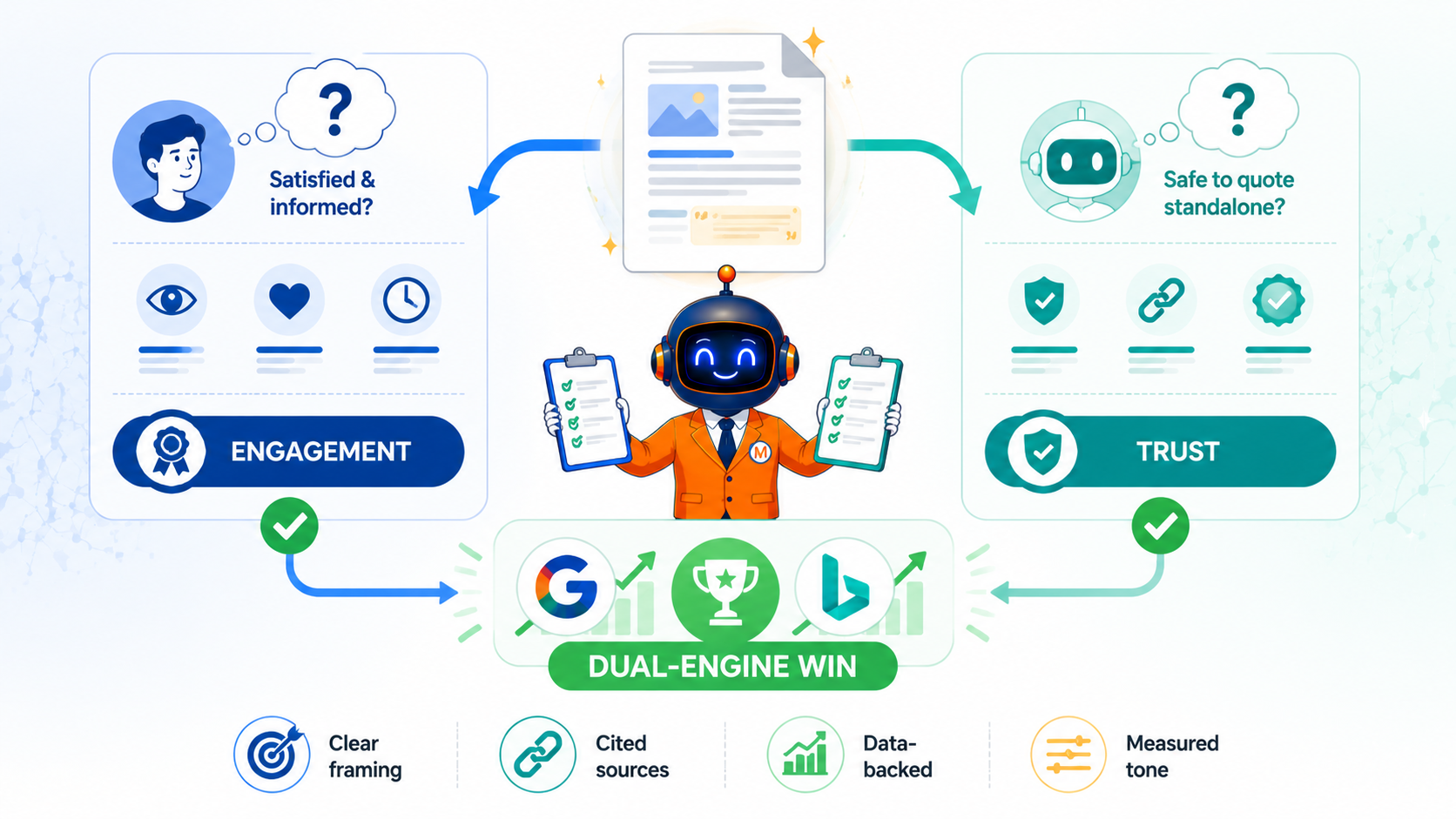
Dual-Test Content Framework
| Test | Question | What It Validates |
| Google reader test | Would a reader feel satisfied and informed after reading this? | Engagement signals |
| AI citation test | Could an AI safely quote this paragraph without additional context? | Trust and verifiability |
Content passing both tests tends to perform well across engines. Practical adjustments that raise authority without sacrificing readability include introducing topics with clear framing so intent is obvious within the first paragraph, attributing facts to recognised sources instead of relying on implied industry knowledge, avoiding sweeping claims unless backed by data or official guidance, and keeping tone confident but measured. Precision builds trust faster than hype.
These changes rarely hurt Google performance. In many cases, they improve it. They almost always help Bing.
Backlink Evaluation: Why Bing Weighs Links Differently
If your link strategy was built entirely around Google’s rules, you are likely underperforming on Bing without realising it. Google has spent the last several years reducing the mechanical value of links. Bing has not kept pace. That divergence matters.
How Each Engine Weighs Backlinks in 2026
| Factor | Google’s Weighting | Bing’s Weighting |
| Anchor text precision | De-emphasised | Rewards exact-match and descriptive anchors |
| Topical alignment | Contextual inference | Explicit topical clarity required |
| Behavioural reinforcement | Amplifies or dilutes link value | Less influence on link authority |
| Source credibility | One of many signals | Weighted heavily against link volume |
| Link neighbourhood quality | Central to evaluation | Considered but less nuanced |
Google looks at links through a contextual lens. Topical relevance requires the linking page to live inside the same semantic neighbourhood as your content. Link neighbourhood quality dilutes value when the surrounding graph is weak. Behavioural reinforcement amplifies links whose users engage meaningfully.
Bing’s model is simpler and more literal. Microsoft’s Bing Webmaster Guidelines state that high-quality relevant backlinks help search engines discover content and may influence performance, but they are one of many ranking signals rather than a primary indicator of authority. Bing places more weight on what the link clearly says and where it clearly comes from.
When you want backlinks performing well on Bing, favour precision over volume. Effective Bing-aligned link strategies often include editorial links from industry publications that explicitly cover your topic, citations from professional associations, standards bodies, or educational resources, local or regional directories that are well-maintained and category-specific, and partner or supplier links where the relationship is clearly explained.

These links tend to look boring by Google hype standards. They work because they remove ambiguity. For Singapore businesses looking to build authoritative link profiles that satisfy both engines, white-hat link building strategies provide the sustainable approach.
Technical SEO: Where Bing and Google Diverge in 2026
If you have a solid technical SEO foundation, it is tempting to assume that Bing will simply follow Google’s lead. That assumption costs visibility. While the two engines overlap on many fundamentals, they diverge in how they interpret technical signals, how strictly they enforce them, and how those signals inform AI-driven search results.
Technical SEO Differences at a Glance
Bing vs Google Technical SEO (2026)
| Signal | Bing | Practical Implication | |
| Schema markup | Enhancement signal | Literal instruction manual | Bing rewards clean, consistent schema more directly |
| Core Web Vitals | Explicit ranking factor | Considered but softer weighting | Content-rich B2B sites with moderate speeds can still rank |
| JavaScript rendering | Aggressive full rendering | Conservative reliance | Server-render critical content for Bing |
| XML sitemaps | Helpful hint | Genuine discovery signal | Bing rewards actively maintained sitemaps |
| IndexNow protocol | Not supported | Native support | Instant URL notification cuts discovery to hours |
| Manual URL submission | Largely ignored | Actively supported | Priority pages get faster indexing |
Schema and Structured Data
Structured data matters to both engines, but Bing uses it more literally. Google often treats schema as a supporting signal. Bing treats it as an instruction manual. Microsoft’s documentation confirms that structured data helps Bing understand page intent, relationships between entities, and eligibility for enhanced search features and AI-generated answers.
Several schema types carry disproportionate weight in Bing when implemented cleanly. Article and BlogPosting schema that clearly define author, publish date, and topic scope. Organisation schema establishing brand identity, official website, and contact details. Product and Service schema that removes ambiguity around offerings, pricing ranges, and availability. FAQ schema providing concise, verifiable answers suitable for AI summarisation.
Over-marking is where many sites go wrong. Bing is more likely to ignore or devalue schemas that are inconsistent with visible content. When structured data claims expertise, authorship, or attributes not obvious on the page, trust erodes rather than improves. Businesses implementing structured data strategically should reference schema markup best practices to avoid common alignment failures.
IndexNow: The 2026 Discovery Multiplier
The most consequential technical SEO update Singapore marketers routinely miss is IndexNow protocol adoption. Google does not support IndexNow. Bing does, natively, and has since 2021. What changed in 2026 is that CDN providers, hosting platforms, and CMS ecosystems now offer IndexNow as a default option rather than a manual integration.
How does IndexNow work?
When you publish or update a URL, your CMS or CDN sends a lightweight ping to the IndexNow endpoint. Bing receives the notification within seconds and typically crawls the page within minutes to hours. This bypasses the traditional crawl schedule entirely.
For e-commerce sites launching new products, B2B brands publishing time-sensitive content, or service businesses updating landing pages for campaigns, IndexNow adoption represents the single highest-leverage technical SEO move available in 2026. The setup takes minutes for WordPress sites via a plugin. Cloudflare users can activate IndexNow directly from their dashboard. Custom sites can integrate the API in under an hour.
Local and Business SEO: Where Bing Gives You a Quiet Advantage
When your business depends on local discovery, service-area visibility, or high-intent leads, Bing quietly gives you leverage that Google often withholds unless you are already a dominant brand.
Most marketers underestimate Bing because they look at raw market share. That is the wrong lens. Bing’s local ecosystem feeds directly into Microsoft products that decision-makers actually use. Windows search. Edge. Microsoft Copilot. Enterprise tools within Microsoft 365. That changes who sees your business and when they see it.
For service businesses, professional firms, and B2B providers targeting decision-makers who work within the Microsoft ecosystem, the answer is unequivocally yes. Bing is not trying to show everything. It aims to present the most defensible answer. That bias works in your favour when your business information is clean, consistent, and verifiable.
Bing Places vs Google Business Profiles
| Local Factor | Google Business Profile | Bing Places |
| Ranking driver | Reviews velocity, user interactions | Data trust, consistency across sources |
| Volatility | High; review spikes shift visibility | Low; stable once trust established |
| Spam prevalence | Higher; fake service-area businesses | Lower; conservative filtering |
| Ownership verification | Standard process | More stringent |
| Integration | Google Maps and Search | Windows, Edge, Copilot, Microsoft 365 |
Google’s local results are heavily influenced by engagement signals. Reviews velocity. User interactions. Behavioural data. That makes rankings powerful but volatile. Bing takes a more conservative approach. It relies more heavily on data trust and consistency across sources.
For service businesses, professional firms, and B2B providers, this stability matters. You are not competing for attention from casual browsers. You are competing for credibility during evaluation.
Practical Optimisation Moves for Bing Local SEO
Bing does not require complexity, but it does require discipline. Three actions consistently improve local visibility when executed properly.
First, treat your Bing Places listing as a primary asset, not a mirror of your Google listing. Complete every applicable field. Choose conservative categories reflecting what you actually sell.
Second, align your website content with your local listing. When your Bing Places profile says you serve Jurong and Tampines, your site should reflect that naturally in service pages or location references. This reinforces trust rather than stuffing keywords.
Third, prioritise citations that Bing actually trusts. Large established directories and industry-specific listings carry more weight than broad consumer platforms. Businesses building local visibility across both engines benefit from structured local SEO strategy guidance that treats Bing and Google as complementary channels.
Common Mistakes: Where Google-First Strategies Fail on Bing
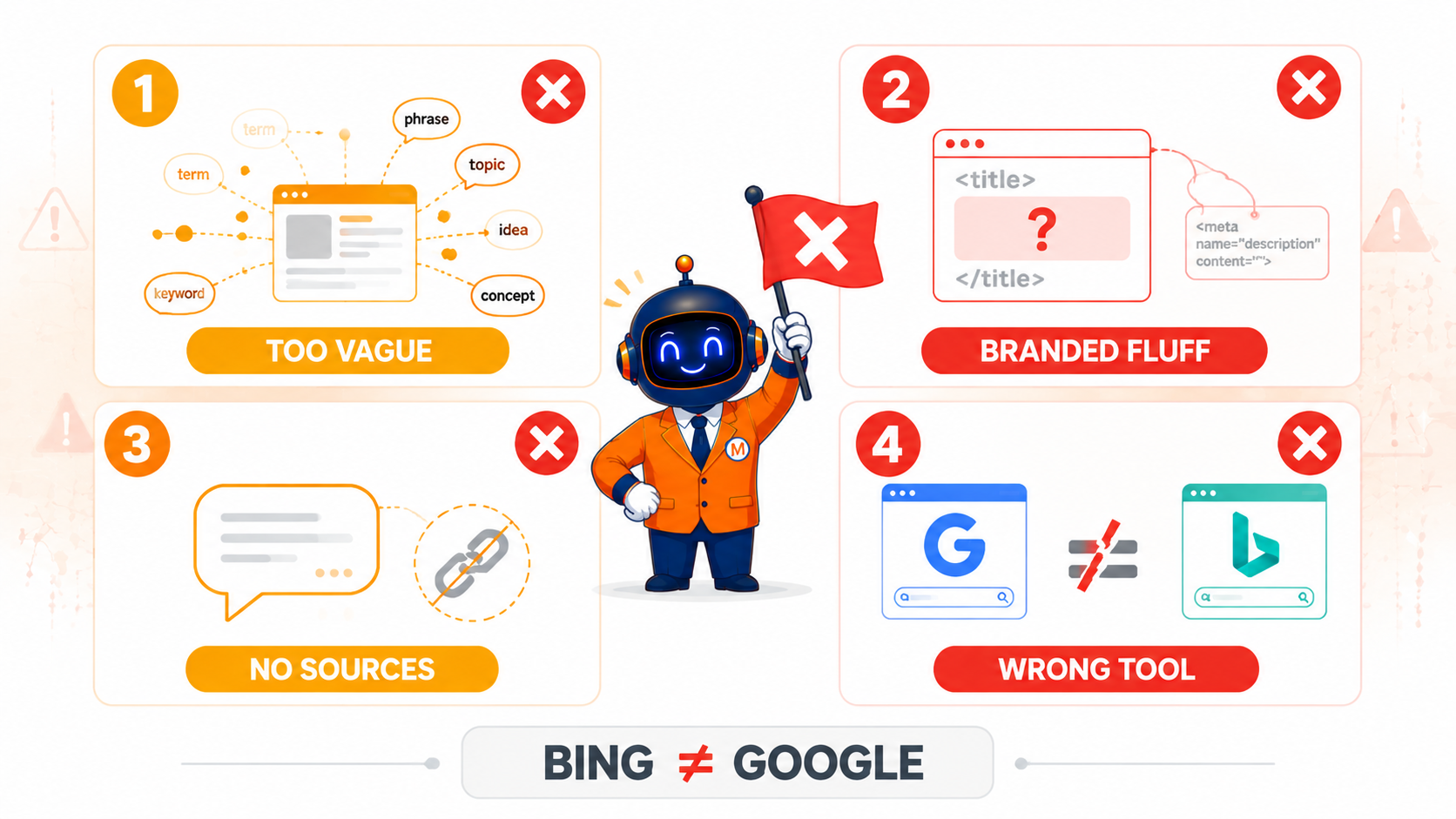
Many Singapore sites fail on Bing for one reason. They optimise out of habit, not intent. Bing does not behave like Google. When you apply Google-first logic without adjustment, Bing rankings quietly stall.
MediaOne encounters four failure patterns most frequently during client audits.
The Four Failure Patterns (Before vs After)
Mistake 1: Semantic Variation Over Clarity
| Google-First Approach | Bing-Optimised Approach |
| Spread across 40+ related terms | One clear primary keyword anchor |
| Loose semantic phrasing in title | Exact query phrase in title, H1, URL |
| Relies on engagement to prove relevance | Confirms intent within first 50 words |
| Result: Ranks 4–7 on Google, 30+ on Bing | Result: Ranks well on both engines |
Mistake 2: Vague or Branded Metadata
| Google-First Approach | Bing-Optimised Approach |
| “Everything You Need to Know About Growing Online” | “B2B SEO Strategy Guide for SaaS Companies 2026” |
| Descriptions tease intent | Descriptions confirm intent |
| Assumes Google will rewrite | Assumes Bing uses verbatim |
| Result: Google infers intent, Bing does not | Result: Both engines gain classification confidence |
Mistake 3: Opinion-Heavy Content Without Sources
| Google-First Approach | Bing-Optimised Approach |
| Confident takes without citations | Claims backed by reputable sources |
| Narrative-style writing | Fact-first structure with verification |
| Opinion presented as fact | Opinion labelled explicitly |
| Result: Ranks on engagement signals | Result: Earns AI citations and stable rankings |
Mistake 4: Assuming Penalty Parity
| Google-First Approach | Bing-Optimised Approach |
| Uses Google Search Console for diagnosis | Uses Bing Webmaster Tools for Bing issues |
| Assumes penalties transfer between engines | Treats each engine’s enforcement independently |
| Applies Google recovery playbook | Diagnoses using Bing’s published guidelines |
| Result: Ranking issues persist unexplained | Result: Engine-specific recovery works |
The bottom line is straightforward. Bing does not reward SEO muscle memory built on Google success. When you optimise for inference, Bing underperforms. When you optimise for clarity, precision, and verification, Bing responds. The fastest way to improve Bing visibility is not more content, more links, or more creativity. It is fewer assumptions and clearer signals.
Implement a Dual-Engine SEO Strategy for 2026
If there is one takeaway to internalise from this guide, it is this. Optimising for Google alone is no longer a complete search strategy. In 2026, visibility is shaped by multiple engines, multiple interfaces, and increasingly by AI systems deciding what surfaces before a user clicks a link.
Google still matters. It drives scale, discovery, and brand familiarity. Bing matters differently. It influences AI responses, enterprise research, and high-intent decision-making. Treating Bing as a secondary concern means leaving qualified opportunities on the table, especially in B2B, professional services, and complex buying journeys.
A dual-engine strategy does not mean duplicating effort. It means designing content with clear intent, precise structure, and verifiable claims that both engines can understand.
The MediaOne 4-Step Dual-Engine Framework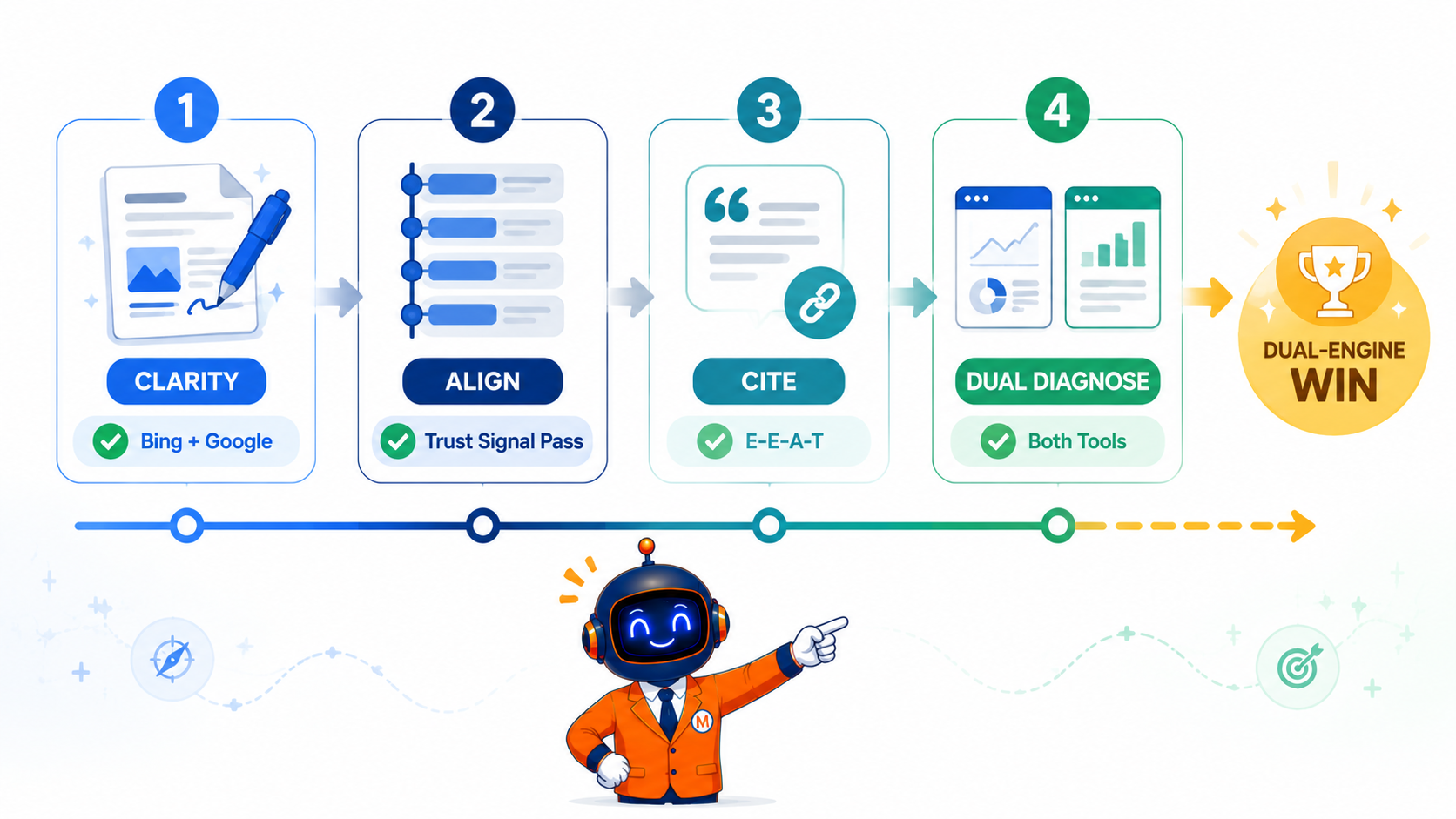
| Step | Principle | Action | Benefit |
| 1 | Write for clarity | Remove ambiguity that requires inference | Satisfies Bing, does not hurt Google |
| 2 | Structure alignment | Verify title, H1, URL, opening paragraph, meta description all agree | Passes Bing’s Trust Signal check |
| 3 | Verifiable sourcing | Cite authoritative sources for every substantive claim | Reinforces E-E-A-T and Bing trust simultaneously |
| 4 | Diagnostic parity | Use Bing Webmaster Tools alongside Google Search Console | Surfaces issues each tool misses individually |
Balancing the nuances of two ecosystems requires experience rather than guesswork. It requires knowing when to lean into semantic breadth and when to lock down exact alignment. It requires understanding how AI-driven search changes visibility across platforms.
The Business Case for Dual-Engine Investment
The business case for dual-engine SEO is straightforward. Based on MediaOne client audits, dual-engine optimisation delivers 30–50% incremental organic visibility beyond Google-only strategies, particularly for B2B, SaaS, professional services, and brands targeting decision-makers who work within the Microsoft ecosystem.
The incremental cost of dual-engine strategy is modest. Content structural improvements benefit both engines simultaneously. Bing Webmaster Tools submissions add approximately 30 minutes per week to existing workflows. Schema markup benefits both engines when implemented cleanly. The main incremental effort involves discipline around exact-match alignment and manual URL submission, both of which pay for themselves within 60–90 days for pages targeting commercial intent.
For Singapore businesses serious about long-term search visibility, expert guidance on Bing SEO that complements Google efforts delivers measurable growth. MediaOne helps businesses build search strategies that perform across Google, Bing, and AI-powered discovery channels through integrated GEO optimisation services built for the 2026 search landscape.
Conclusion: The Search Channel Your Competitors Are Ignoring
The reframe worth internalising is that Bing rewards discipline that Google’s tolerance often lets you avoid. The fastest way to improve Bing rankings is not to write more content, chase more links, or invest in more tools. The fastest way is to remove ambiguity from what you already publish.
Three closing truths for Singapore marketers considering dual-engine investment.
1. Bing Powers the AI Search Economy
87% of ChatGPT citations match Bing’s top-ranking pages. 20 million paid Microsoft 365 Copilot enterprise seats generate Bing-powered searches daily. Windows 11, Edge, and Microsoft 365 integrations concentrate Singapore’s most valuable B2B decision-makers inside Bing’s ecosystem. Brands treating Bing as a checkbox after Google are systematically losing citation opportunities in the AI ecosystem that will define search visibility through 2027–2030.
2. The Dual-Engine Investment Compounds
The incremental cost of dual-engine SEO is modest when done correctly. Content structural improvements benefit both engines. Schema implementation benefits both engines. IndexNow adoption benefits Bing and multiple non-Google search engines simultaneously. The AI Performance Report delivers first-party attribution data for Copilot and ChatGPT citations at zero additional cost. These practices deliver 30–50% incremental organic visibility for a fraction of the cost of duplicating your Google strategy.
3. Bing Rewards Clarity in Ways Google Does Not
Where Google can infer intent from behaviour, Bing demands confirmation from structure. When you optimise for clarity, precision, and verification, Bing responds within weeks rather than months. When you optimise for cleverness, semantic breadth, or brand voice at the expense of alignment, Bing quietly buries your pages regardless of how well they perform on Google.
The Singapore brands winning search visibility in 2026 are those treating Bing as a distinct search philosophy worth mastering, not a smaller Google worth ignoring. The ones still optimising exclusively for Google are competing for the same 10 positions their competitors are chasing. The ones investing in dual-engine strategy are capturing the qualified buyers researching in Microsoft-powered environments that Google-first competitors never see.
Next Steps for Singapore Businesses
- Verify your site in Bing Webmaster Tools and activate the AI Performance Report. Historical citation data begins accumulating from verification date forward.
- Deploy IndexNow protocol through your CMS or CDN. WordPress sites can add IndexNow through a single plugin. Cloudflare users activate it from their dashboard.
- Apply the Trust Signal Alignment check to your top 20 highest-value commercial pages. Verify that title, H1, URL, opening paragraph, and meta description all confirm the same primary query intent.
- Request a dual-engine SEO audit to identify specific Bing optimisation opportunities alongside your existing Google strategy. A structured audit typically surfaces 20–40 pages where minor structural adjustments deliver disproportionate visibility gains.
We offer free diagnostic sessions covering Bing visibility analysis against your Google performance, Trust Signal Alignment scoring across your top 20 commercial pages, AI Performance Report interpretation showing your current Copilot and ChatGPT citation activity, IndexNow readiness assessment, and dual-engine strategy roadmap tailored to your Singapore market position.
Even when you choose not to engage MediaOne, you leave with a prioritised roadmap you can execute in-house or hand to any vendor. Book your free dual-engine SEO audit and see how it applies to your business through our SEO agency.
Frequently Asked Questions
How much does Bing SEO cost compared to Google SEO?
The incremental cost of adding Bing optimisation to an existing Google SEO programme is typically 15–25% of the Google budget rather than a doubled investment. Content structural improvements benefit both engines simultaneously. Bing Webmaster Tools setup takes 2–4 hours one-time. IndexNow integration takes under an hour for most platforms. Ongoing dual-engine reporting adds 30–60 minutes weekly. The compounding benefit is 30–50% incremental organic visibility, making dual-engine SEO one of the highest-ROI SEO investments available in 2026.
Social signals such as shares and engagements can inform Bing’s understanding of content popularity. Bing has indicated that social media activity influences search signals more visibly than other engines do, helping the algorithm identify content that resonates with real users. This makes social sharing part of a broader quality signal set that supports visibility, especially for content that is widely distributed.
Does Bing use exact match domains in its SEO ranking?
Yes, historical and practical evidence indicate that exact-match domains still contribute to Bing’s ranking signals. Unlike Google, which has largely downplayed exact-match domains as a direct ranking factor, Bing continues to give weight to domains where the keywords align with search queries. This does not mean buying a new domain solely for this purpose is essential, but domain relevance remains part of Bing’s broader signal set.
How do I track AI search citations for my Singapore business?
Yes, through the AI Performance Report in Bing Webmaster Tools. The report launched in public preview in February 2026 and expanded in June 2026 with Intents, Topics, Citation Share, and Compare views. Site verification takes 15 minutes. Data begins accumulating immediately. This is the most consequential AI search measurement tool available in 2026, and it is free.
How important is Bing Webmaster Tools for SEO success?
Bing Webmaster Tools provides direct insight into how Bing crawls, indexes, and ranks your website, allowing you to submit sitemaps, priority URLs, and monitor performance. Using these tools accelerates discovery of new and updated pages for Bing and helps diagnose issues unique to that engine. In 2026, it also delivers the AI Performance Report showing Copilot and ChatGPT citation activity, making it essential for any brand pursuing AI search visibility.
Does structured data improve performance in Bing SEO?
Structured data helps Bing understand relationships among content elements, page purpose, and entity attributes, supporting relevance classification. While both major engines use schema, Bing tends to interpret structured data more literally, treating it as a direct instruction set for content categorisation. Clean, accurate implementation of schema types such as Article, Organisation, or FAQ improves Bing’s confidence in your page’s intent and boosts eligibility for enhanced search features and AI summaries.
What is IndexNow and should Singapore businesses use it?
IndexNow is a free open-source protocol that instantly notifies Bing, Yandex, Naver, Seznam, and Yep when you publish or update URLs. Google does not support it. For Singapore businesses publishing time-sensitive content, launching products, or updating landing pages for campaigns, IndexNow compresses Bing discovery timelines from days to hours. Setup takes minutes on WordPress, Cloudflare, and most modern CMS platforms. This is one of the highest-leverage technical SEO moves available in 2026 and remains widely under-adopted.