


| AI Summary
Search Experience Optimisation combines SEO, user experience and conversion thinking so a page satisfies the searcher after the click, not just earns search visibility. Effective SXO aligns search intent with fast, stable pages, clear content, mobile usability and low-friction conversion paths. Measure Core Web Vitals, Search Console CTR, GA4 engagement and key events, and business conversions together. Use engagement metrics as diagnostic evidence rather than presenting them as confirmed direct Google ranking factors. |
What is SXO? Search Experience Optimisation (SXO) is the practice of designing your website around what searchers need after they arrive from a search engine, rather than focusing only on rankings or traffic.
In short: SXO treats search as a user experience discipline. It sits between traditional SEO and UX design, asking a question that SEO alone doesn’t always answer: “Did the person who clicked on my result get what they came for?” If the answer is yes, they stay, engage, convert, and never return to Google. If not, they bounce, and your ranking signals deteriorate.
The term gained traction in the mid-2020s as Google’s ranking algorithm shifted decisively toward user satisfaction metrics. Core Web Vitals became a ranking factor. Click-through rate and dwell time became measurable proxies for content-search alignment. Tools that measure actual user behaviour (heatmaps, session recordings, scroll depth) became affordable. The result: teams realised that ranking position and user satisfaction are no longer the same thing. You can rank first and still lose the user.
Key Takeaways
- SXO (Search Experience Optimisation) prioritises user satisfaction over ranking position. It is the evolution of SEO that treats search as a user experience discipline, not purely a technical ranking exercise.
- SXO bridges three critical pillars: page speed and technical performance, content relevance and intent matching, and user engagement signals. Together, these determine both whether a page ranks and whether the user is satisfied when they land on it.
- The core difference from traditional SEO: where SEO asks “how do I rank for this keyword?”, SXO asks “why would a real user return to search results after landing on my page?”
- For SXO measurement, track Core Web Vitals, Search Console CTR, GA4 engagement metrics and conversions together. Rankings without user satisfaction produce poor-quality traffic, missed conversions and weak business outcomes.
- SXO requires testing, measurement and iteration based on user behaviour. Tools like Google Analytics, heatmapping software and SERP analysis platforms are essential to understand what works.
- Common SXO mistakes include prioritising search engine signals over real user needs, ignoring mobile experience, overlooking page speed, and creating content for robots instead of people. Each is addressable through a structured audit and a user-centred redesign process.
The Core Definition: SXO vs SEO
Search Experience Optimisation (SXO) is the practice of optimising a website to satisfy users at every stage of their search journey, from the moment they land on a search results page until they complete their goal. Unlike traditional SEO, which focuses primarily on achieving high rankings through keywords and links, SXO treats search as a user experience discipline.
The distinction matters in practice. An SEO strategy might push a page to position one for a competitive keyword. An SXO strategy asks: does the page actually answer what the searcher is looking for? Will they leave the site immediately because the content misses their intent? Will they click back to the search results, frustrated? SXO starts with those questions first.
Why SEO Alone Is No Longer Enough
Traditional SEO was built around scarcity. Ranking positions were limited. Organic visibility was a zero-sum game. The focus became earning a top-three position through technical optimisation, backlinks, and keyword matching.
A mock analytics dashboard or report showing a high-ranking page (position 2) with high traffic volume but a 75% bounce rate and low time-on-page, contrasted with a lower-ranking competitor page (position 4) showing lower traffic but higher engagement and conversion metrics.
That model still works in isolation. But it breaks down when you optimise for ranking position without optimising for user satisfaction.
Consider this scenario: a page ranks second for a commercial keyword, driving consistent traffic. But data shows a 75% bounce rate. Visitors land, scan the content, and return to Google within seconds. They find what they need on a competitor’s page ranked fourth. Your SEO succeeded. Your business outcome failed.
Google’s algorithm now includes user experience signals (Core Web Vitals) as a ranking factor. Google AI Overviews and AI Mode have changed how information can appear in Search. These experiences can answer parts of a query directly while also surfacing supporting website links, so a high organic ranking does not automatically guarantee a click.
Relying on SEO without SXO leaves money on the table: lower conversion rates per visitor, higher customer acquisition costs, and vulnerability to algorithm shifts that now reward user outcomes, not just authority signals.
The Shift from Rankings to User Outcomes
The search landscape has moved from an output-focused metric (your ranking position) to an outcome-focused metric (did the user get what they needed?).
This shift is driven by three forces:
Google’s algorithm evolution. Rankings were once dominated by backlinks and keyword density. Today, Core Web Vitals (page speed, visual stability, interactivity), content relevance, and engagement signals carry substantial weight. Google began incorporating Core Web Vitals into its page-experience ranking considerations in June 2021. Interaction to Next Paint (INP) later replaced First Input Delay (FID) as a Core Web Vital in March 2024.
User behaviour change. Searchers now expect instant answers. If your page takes three seconds to load when a competitor’s loads in one second, they leave. If your content buries the answer below five paragraphs of preamble, they click back. Mobile devices accounted for about 59% of worldwide web traffic in September 2026, reinforcing the importance of mobile usability. (StatCounter Global Stats, September 2026)
Competition from AI and summarisation. Google’s Generative AI Overviews and competitors like ChatGPT mean search rankings alone do not guarantee visibility. A well-ranked page might never be clicked if an AI engine summarises the answer above the organic results. Only pages that deliver exceptional, original value compel clicks.
The practical shift: teams now measure search success not by rankings but by outcomes. Did the page generate qualified traffic? Did visitors stay long enough to engage? Did they convert? Did they find what they came for, or bounce? These metrics determine whether a page is truly optimised for search.
How SXO Bridges Search Intent and Behaviour
SXO connects two disciplines that traditional SEO kept separate: understanding what users are searching for (intent) and understanding what they do once they arrive on your site (behaviour).
Search intent is the underlying need driving a query. When someone searches “how to fix a leaky kitchen tap,” their intent is instructional: they want to know the steps. When someone searches “cheap kitchen taps London,” their intent is transactional: they want to buy. When someone searches “best kitchen tap brands,” their intent is informational: they want to evaluate options.
Traditional SEO often treated intent as binary: match the keyword to a page type. SXO goes deeper. It maps the user’s full path: What do they know before they search? What question are they actually solving? What friction points will they hit on the page? What will make them stay or leave?
Behaviour data reveals whether your intent assessment is correct. Analytics show whether people engage with the content you created for them. Heatmaps show where they click, scroll, or abandon. Session recordings show what confuses them. If your page is built for “informational intent” but behaviour data shows 80% of visitors skip the comparison table and go straight to product links, your intent assumption was wrong. SXO means iterating based on that signal.
Search Console shows how users interact with your listings through metrics such as clicks and CTR. GA4, heatmaps and session-recording tools can then show what users do after landing. We use these metrics to diagnose intent and experience problems rather than treating dwell time or scroll depth as confirmed Google ranking factors. Pages that miss intent, no matter how technically perfect, fall.
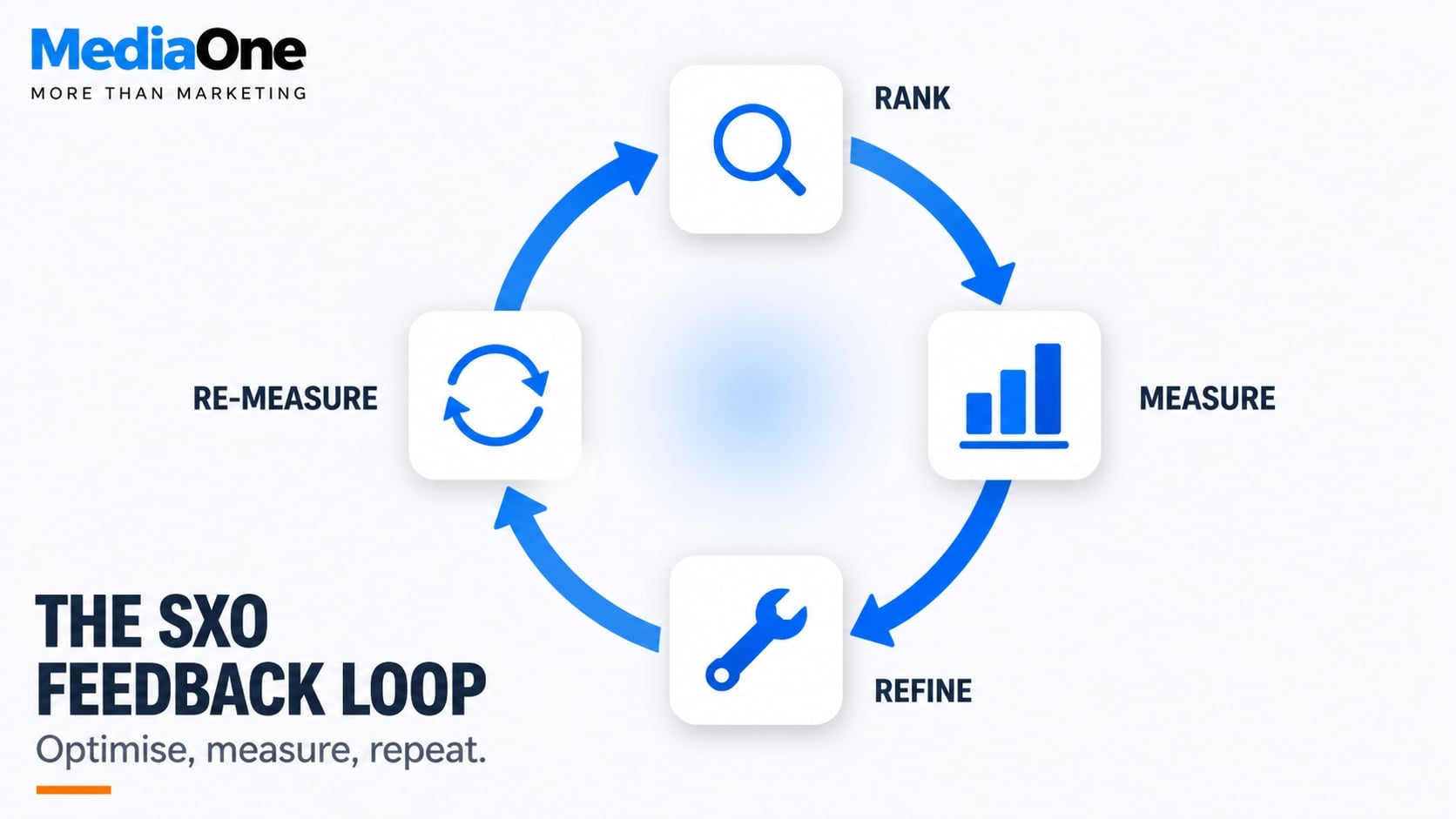
The bridge: SXO requires you to validate your understanding of intent through actual user behaviour, then feed that validation back into the page. This creates a feedback loop. Rank for the keyword. Measure whether searchers find what they need. Refine the page. Measure again. That cycle moves you toward both better rankings and better outcomes.
In practice, this means auditing your current rankings not by position, but by search satisfaction: which of your top-ranking pages have the highest bounce rates or lowest time-on-page? Those are the first targets for SXO refinement. Which pages have strong behaviour signals but mid-page rankings? Those are high-potential wins. Traditional SEO would ignore the first group (they rank). SXO sees them as broken conversions waiting to be fixed.
The Three Pillars of SXO
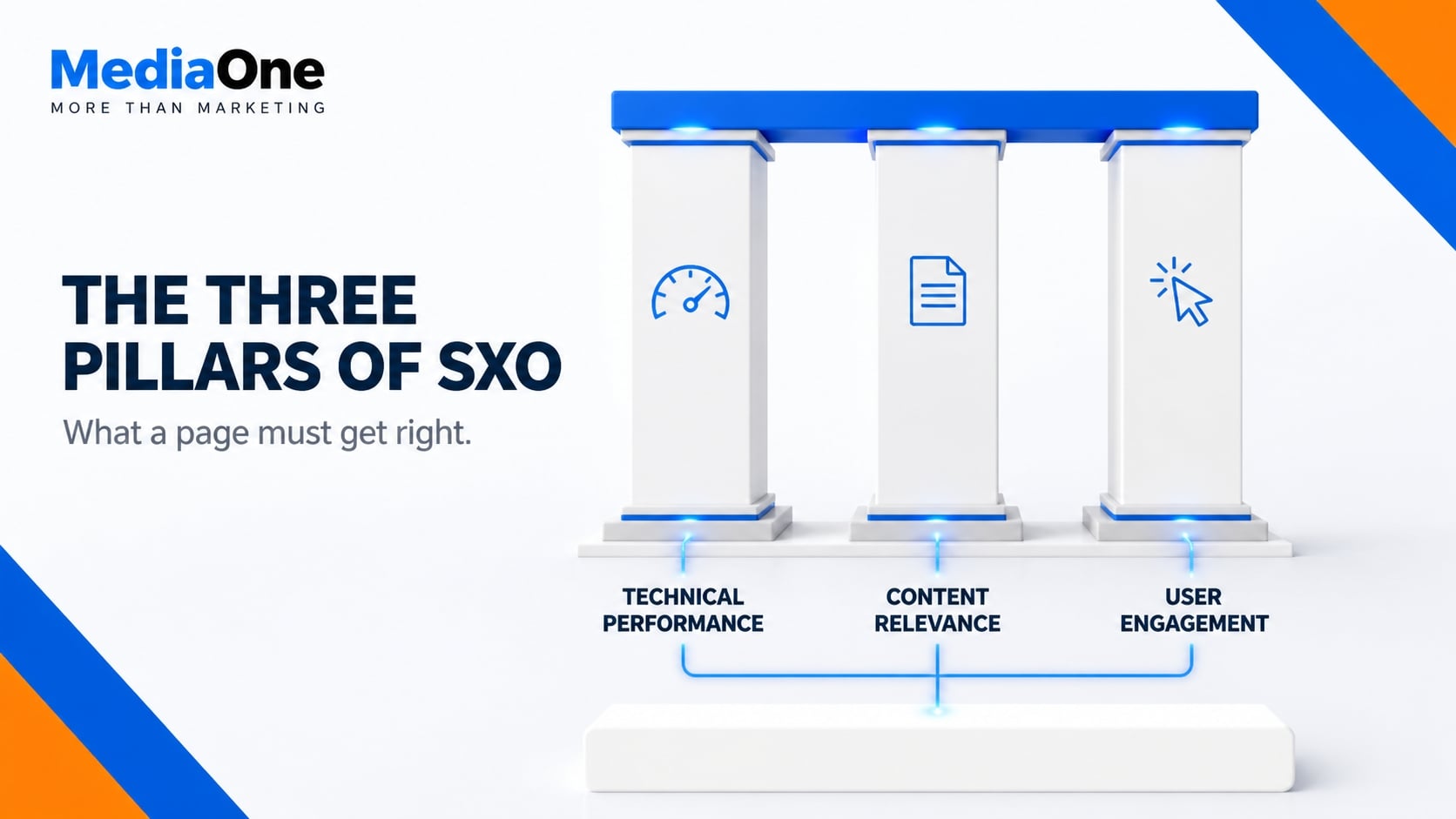
SXO rests on three interconnected foundations that work together to satisfy both search engines and users. Each pillar is measurable, actionable and directly tied to whether a user returns to the search results or stays on your page.
Technical Performance and Page Speed
Page speed is no longer optional. Google’s current Core Web Vitals are Largest Contentful Paint (LCP), Interaction to Next Paint (INP) and Cumulative Layout Shift (CLS). These metrics measure loading performance, responsiveness and visual stability, and they form part of Google’s broader page experience signals.
A 100-millisecond delay in page load time reduces conversion rates by 7%, according to research from major analytics platforms. For SXO, this means a fast page isn’t a feature: it’s a prerequisite. Users who land on slow pages bounce instantly, signalling to Google that your result didn’t satisfy their intent.
The three Core Web Vitals are:
- Largest Contentful Paint (LCP): The time it takes for the main content to load. Target: under 2.5 seconds.
- First Input Delay (FID), now measured as Interaction to Next Paint (INP): How responsive the page is to user interaction. Target: under 200 milliseconds.
- Cumulative Layout Shift (CLS): Visual stability as the page renders. Target: under 0.1.
These aren’t abstract metrics. They directly predict whether a user can engage with your content. A page with poor CLS might shift your call-to-action button as images load, causing accidental clicks and frustration.
Tools like Google PageSpeed Insights, GTmetrix and WebPageTest provide actionable diagnostics. But measurement alone changes nothing. You must act: compress images, defer non-critical JavaScript, upgrade hosting, enable caching, minify CSS. The threshold for SXO isn’t “good enough”: it’s faster than 80% of competitors in your vertical.
Content Relevance and Query Satisfaction
Technical speed is wasted if the content doesn’t answer the user’s actual question. Content relevance in SXO means matching the explicit and implicit intent of the search query with precision.
When someone searches “best running shoes for flat feet,” they’re not asking for a product directory. They’re asking for curated recommendations based on a specific biomechanical need. Content that lists 50 generic shoes fails on relevance. Content that addresses flat-foot pronation, recommends three specific models with heel-to-toe drop measurements, and links to expert reviews satisfies the query.
Relevance has two dimensions:
Explicit intent is whether your page answers the question asked. A how-to query needs steps. A product query needs specifications and comparisons. An informational query needs credible explanation.
Implicit intent is what the user is really trying to do. Someone researching “how to start a podcast” might be validating the decision before investing in equipment. That requires a section on whether podcasting suits their goals, not just a checklist of mic models.
SXO practitioners audit content against intent by asking: Would this user need to return to Google to complete their task? If yes, the content is undercooked. If they can act, buy, understand or decide based on what’s on your page, relevance is high.
This ties to a concept called query deserves freshness (QDF). Some searches decay rapidly: breaking news, seasonal trends, new product launches. Content must reflect current information. A guide to “best SEO tools 2024” published in 2022 fails on relevance, even if the writing is excellent.
User Engagement Metrics
The third pillar measures whether users actually engage with your content once it loads and satisfies their intent.
Engagement signals are not ranking factors in isolation. Google does not confirm that “time on page” directly boosts rankings. However, users who spend time on your page, click internal links, or return for more content are signalling something: your result was useful.
SXO uses engagement metrics as diagnostic tools, not ranking goals. If your page has high traffic but a 75% bounce rate, relevance is broken. If users click through to a subpage but never return, internal linking is weak. If users scroll halfway and leave, content length or structure is miscalibrated.
Key engagement signals to track:
In GA4, bounce rate is the percentage of sessions that were not engaged sessions. An engaged session lasts longer than 10 seconds, includes a key event, or has at least two page or screen views. Baseline varies by content type (news articles expect 70%+; product pages expect 40%+). A bounce isn’t failure: it’s context-dependent. An informational query with a direct answer might have a 60% bounce rate and still be highly satisfying.
Time on page shows how long users stay. Compare against competitors. If competitors average 4 minutes and you average 90 seconds, users are leaving early. Diagnose why: unclear navigation, information gaps, or overly long introductions.

Scroll depth measures how much of the page users see. Tools like Hotjar and Contentsquare measure this. Pages where 50% of visitors scroll below the fold are engaging users; pages where 20% scroll are losing them before they reach valuable content.
Internal link clicks signal satisfaction and trust. Low internal link engagement suggests users don’t see value in going deeper or can’t find your calls-to-action.
These signals feed into a feedback loop. High engagement tells you relevance works. Low engagement tells you to test format (is text better than video for this query?), length (are you burying the answer?), structure (are key sections visible without scrolling?) or freshness (is the information outdated?).
Combined with technical speed and content relevance, engagement metrics complete the SXO triangle. A fast page with relevant content that users actually interact with is a page that dominates search results, not through manipulation but through genuine user satisfaction.
How SXO Differs from Traditional SEO
SXO is not a rebrand of SEO. It is a different discipline that happens to share the same channel. Traditional SEO optimises for the search engine’s ranking algorithm. SXO optimises for the person on the other side of the screen, then trusts that satisfying that person will move the rankings. The two overlap, but they diverge sharply in what they prioritise, how they are executed, and what counts as success.
If you have spent a decade building backlinks and tuning title tags, the shift is not a small one. It changes what you do every day.
SEO’s Historical Focus versus SXO’s Modern Focus
Classic SEO grew up around a simple model: identify a keyword, build a page targeting it, earn links pointing to it, rank. Ranking position was the product. Traffic was the outcome. Conversions were somebody else’s problem.
That legacy still shapes most agency reporting. In the traditional model, success means:
- Keywords ranked in top-three positions for a target list
- Domain authority driven by backlink volume and quality
- Organic sessions counted as the headline metric
- Pages crawled versus pages actually ranking
There is nothing wrong with these numbers, and they still matter. The problem is that each one is a proxy for something upstream. A number-one ranking with a 20% bounce rate and no conversions is a ranking nobody asked for.
Google Search Central documentation on helpful content states that its systems aim to reward “content created primarily for people, not for search engines,” and its ranking systems have increasingly weighted page experience signals alongside relevance. Ranking well and satisfying the searcher are no longer the same job.
SXO, by contrast, treats the search result as the beginning of a user journey, not the end of a marketing task. The question is not “did we rank?” but “did the searcher get what they came for, and did they know it within seconds?”
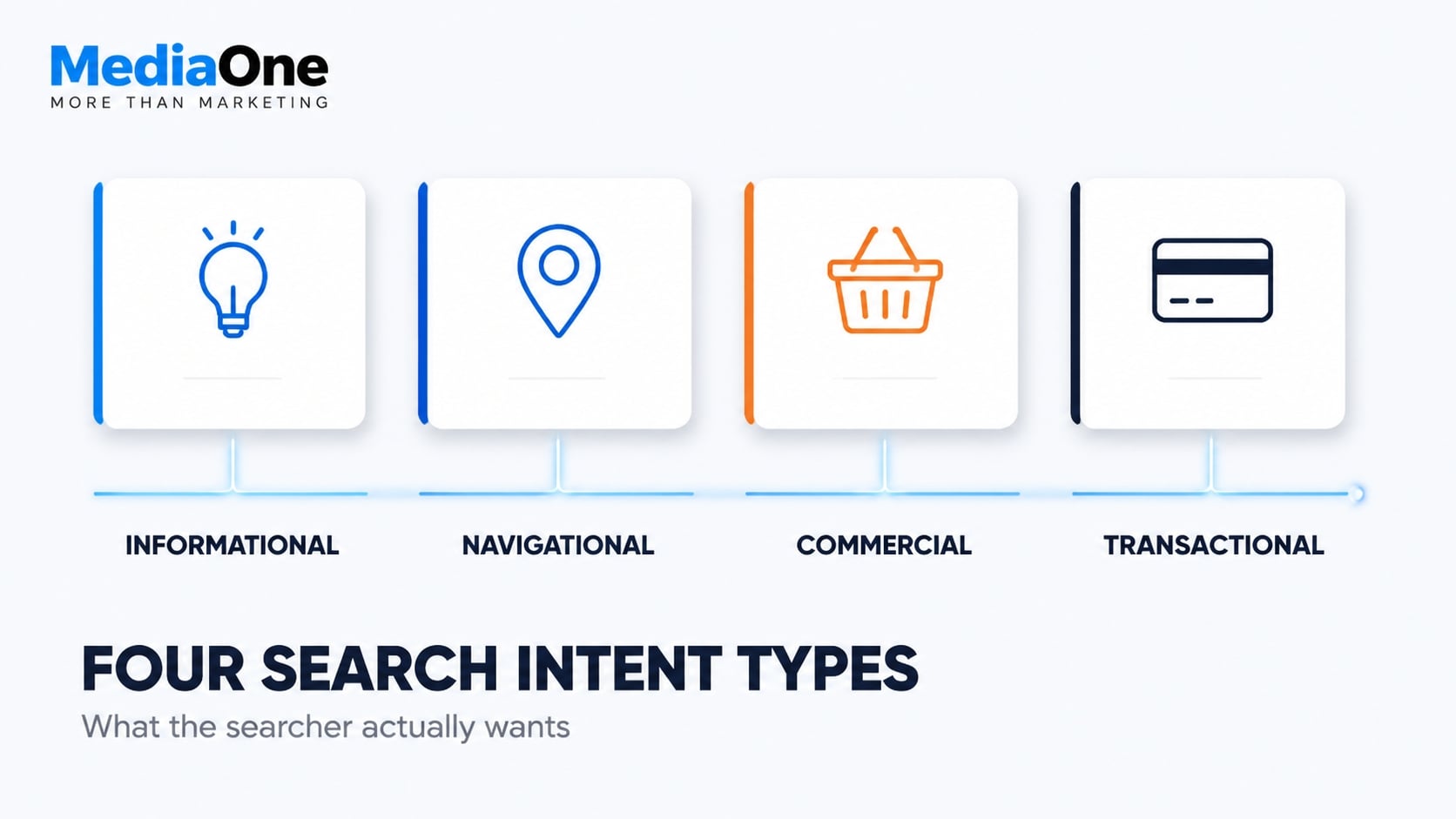
That reframing changes the unit of analysis. Instead of a keyword, SXO works on a query, a searcher, and a moment. Four intent types drive behaviour:
| Intent type | What the searcher wants | SXO success looks like |
|---|---|---|
| Informational | An answer, fast | They leave the SERP and do not come back |
| Navigational | A specific destination | They arrive at the right page, not the homepage |
| Commercial | Confidence to choose | They shortlist you, or buy from you |
| Transactional | To complete a task | Friction is removed; the task finishes |
The unifying metric is what the industry calls pogo-sticking: a user clicks your result, fails to find what they need, and returns to the search results. In SXO terms, that return trip is a failure signal. In traditional SEO terms, it was an unexplained dip in session quality. Your real competitor is not the site ranking one position above you. It is the search bar, and the user’s willingness to go back to it. Every element of SXO exists to make returning feel unnecessary.
Practical Differences in Execution and Measurement
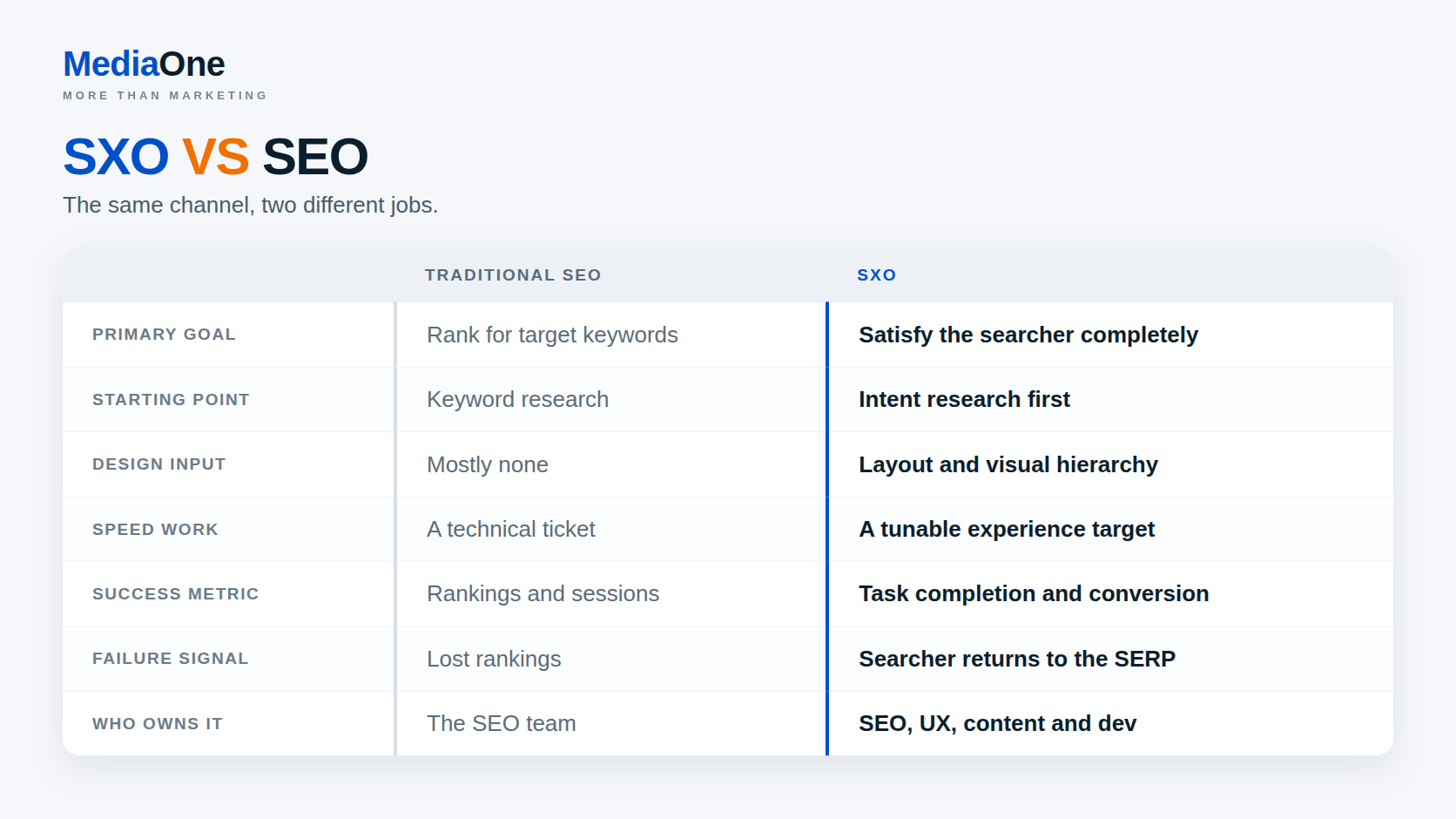
The clearest way to see the gap is to compare what each discipline actually does, and what counts as success.
| Dimension | Traditional SEO | SXO |
|---|---|---|
| Primary goal | Rank for target keywords | Satisfy the searcher completely |
| Starting point | Keyword research | Intent research, then keyword research |
| Content brief | Keyword density, headings | What must this page make clear in 5 seconds |
| Design input | Mostly none | Layout, mobile ergonomics, visual hierarchy |
| Speed work | A technical ticket | A tunable experience target |
| Success metric | Rankings, sessions | Task completion, conversion, return rate |
| Failure signal | Lost rankings | Searcher goes back to the SERP |
| Who owns it | SEO team | SEO, UX, content, and dev jointly |
That last row is where most implementations stall. Traditional SEO can run inside a single team. SXO cannot. It requires a content writer to care about layout, a developer to care about copy, and a UX designer to care about the query that brought the user there.
The measurement shift is just as uncomfortable. The most trustworthy diagnostic is not a rankings dashboard. It is a query-to-page satisfaction review: for each significant query landing on a page, does the page answer the implied follow-up question without a scroll, a click, or a second search? If the answer is no, the page is failing regardless of where it ranks.
In practice, you will run SXO in increments rather than projects. Rank the site’s top twenty pages by organic sessions, then ask of each: what is the one thing this visitor came for, and can they see it on the first screen on a mid-range Android phone? Fix the ones that fail. Re-measure CTR, scroll depth, and conversion rate thirty days later. That loop, not a keyword spreadsheet, is the engine of SXO.
Core SXO Metrics You Must Track
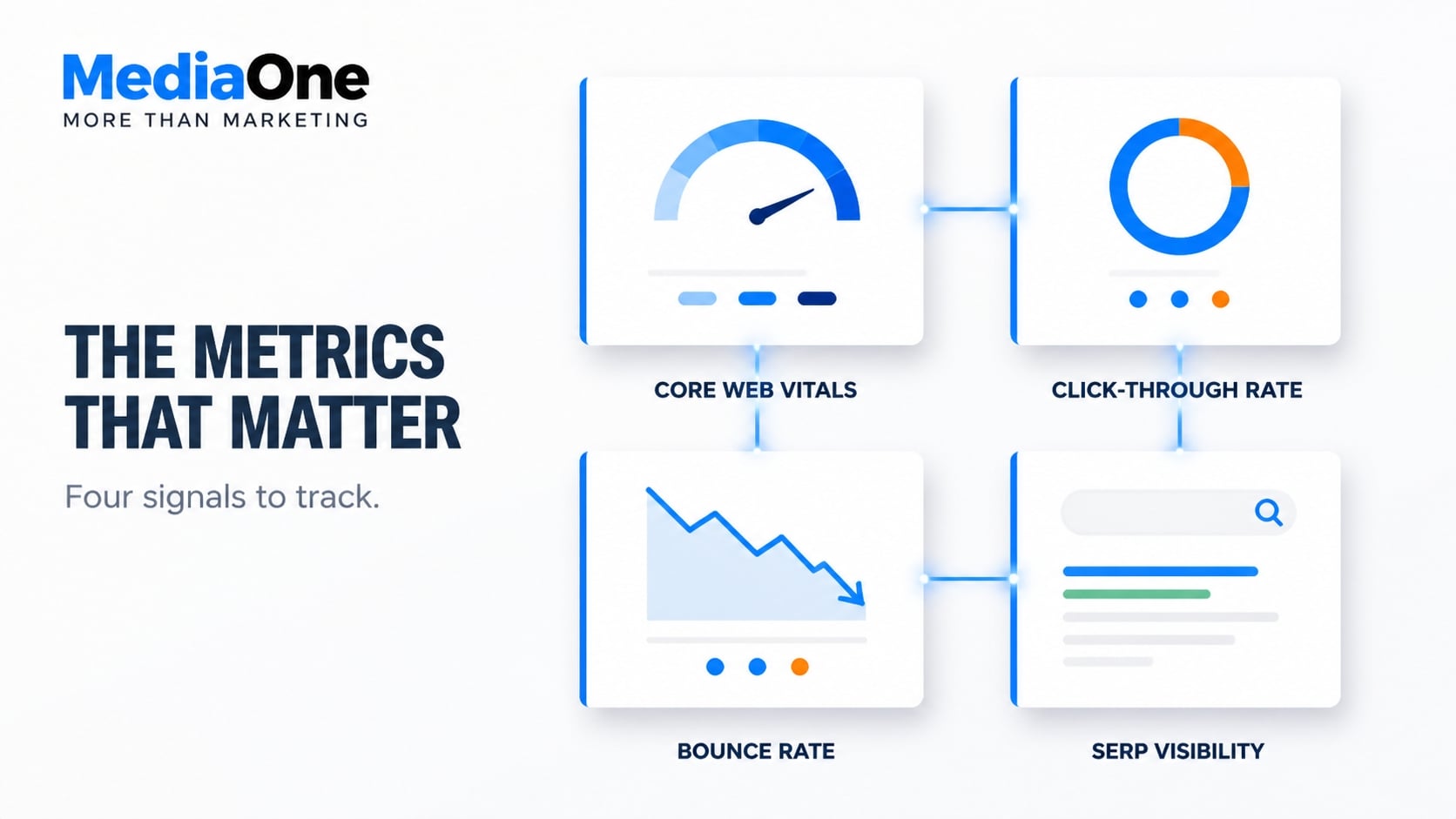
Not all metrics matter equally. If you optimise for the wrong signals, you’ll boost rankings without improving the experience that keeps visitors from bouncing back to search results.

SXO success lives in four metric categories: technical performance, relevance matching, user satisfaction, and search visibility. Each tells you something different about whether your page truly serves its audience.
Core Web Vitals and Their Impact on Rankings
Core Web Vitals measure how a real person experiences your page in the moment they use it. Google has confirmed these three metrics directly affect ranking position.
Largest Contentful Paint (LCP) measures when the main content loads. Google’s threshold is 2.5 seconds or faster. Pages that hit LCP in under 2 seconds see a measurable ranking lift.
First Input Delay (FID), or Interaction to Next Paint (INP) in newer measurements, tracks how long your page waits before responding to a user’s click or keystroke. A threshold of 100 milliseconds matters. Most sites miss this because JavaScript executes before user input is processed.
Cumulative Layout Shift (CLS) counts unexpected visual movement. A score under 0.1 is the target. This is where ads, late-loading images and injected content destroy the metric. Asynchronous loading of non-critical elements solves this.
You monitor these three in Google Search Console under the Core Web Vitals report. The report tells you how many of your pages meet the “good” threshold on real-world data. Real data (from Chrome User Experience Report) matters more than lab data (from tools like Lighthouse). A page can pass Lighthouse and fail on real devices because real users have slower connections and older hardware.
The stakes are concrete: pages failing Core Web Vitals see lower click-through rates from search results. Users simply assume the page is broken and click elsewhere before it finishes loading.
Click-Through Rate and Query-Result Matching
Click-through rate measures the gap between search visibility and actual interest. High CTR signals that your title and snippet match what the searcher was actually looking for.
You see CTR in Google Search Console under Performance. The metric shows: clicks divided by impressions. A page ranking in position one but converting at 15% click-through is underperforming. Position one pages typically convert at 25-35% CTR depending on intent.
Low CTR often means your snippet is misleading, your title buries the answer, or your featured snippet (the rich result preview) is stealing clicks by showing the answer before users reach your page.
To improve CTR, audit your page title for the primary keyword. Frontload the benefit or answer. “Core Web Vitals: What They Are and Why Rankings Depend on Them” converts higher than “An Introduction to Core Web Vitals”. The first tells the reader they’ll get both definition and business impact in one place.
Your snippet (the description shown in search results) should confirm relevance. Google auto-generates snippets from your page content if you don’t provide a meta description. Writing a targeted meta description of 150-160 characters is worth the time. Answer the implied question: if someone searched for this, what will they find here?
Featured snippet optimisation matters too. If a competitor holds the featured snippet (position 0), your page ranking position 2 or 3 loses 20-40% of potential clicks. That snippet answers the query in 40-60 words directly in the search results, so users never visit your page.
Bounce Rate and Time on Page as Satisfaction Signals
Bounce rate measures pages where someone lands and leaves without visiting a second page. Time on page shows how long they spent before leaving.
These metrics correlate with relevance. High bounce and low time-on-page suggest the search result promised something the page didn’t deliver.
Track these in Google Analytics, not Search Console. In Analytics, filter by landing pages that came from organic search. A page bouncing above 70% is worth investigation. A page spending under 30 secondsbefore bouncing suggests either wrong audience or poor readability.
But context matters. A definition page might have a 60% bounce rate because the reader found the answer and left satisfied. That’s not a failure. A product page with identical metrics is failing because the visitor didn’t engage with price, images or reviews.
Use this framework: pages with bounce rate above 70% and average time on page under 45 seconds need content audit. Did the page promise match the search query? Is the answer in the first paragraph, or buried below the fold? Is the text scannable, or is it dense blocks of prose?
SERP Visibility and Featured Snippet Capture
SERP visibility is the real estate you own on the search results page. It’s not just about ranking position. It includes featured snippets, rich snippets (ratings, prices), knowledge panels and answer boxes.
A page ranking position 5 but holding a featured snippet gets more clicks than a position 2 page without one. The featured snippet occupies prime visual real estate above all organic results.
Track this manually for your highest-value keywords using a SERP analysis tool like SEMrush or Moz. Record: which page holds the featured snippet for your target keyword, what type of snippet is shown (paragraph, list, table, video), and whether it’s yours or a competitor’s.
To capture featured snippets, analyse the current snippet holder. If it’s a paragraph answer, your page needs the same answer but written more clearly. If it’s a list (which converts higher for instructional queries), restructure your content into a numbered or bulleted list with a clear intro line that matches the query.
Featured snippets for “how to” queries favour lists with 5-8 items. Query intent matters: “What is” favours 40-60 word paragraph answers. “Why” questions often show tables comparing options or causes.
A practical SXO audit checks: Do I hold featured snippets for my top 20 keywords? If not, which competitor does, and what format are they using? This single metric shift (moving one competitor snippet to your page) can increase organic traffic by 15-30% without ranking position changing.
Monitor SERP visibility weekly for competitive keywords. Position shifts happen, but featured snippet changes signal someone is optimising harder than you. Reclaim it within seven days or the traffic loss compounds.
SXO Best Practices: A Practical Checklist
Turning SXO theory into action requires a structured approach. Use this checklist to audit and improve your pages.
Pre-Launch Content and Design Checklist
Before publishing or redesigning a page, verify:
- [ ] Intent mapping: Have you identified the primary, secondary, and tertiary intents driving searches for this query?
- [ ] First-screen answer: Can a visitor understand what this page covers in 5 seconds on mobile?
- [ ] Page speed: Does the page load in under 2.5 seconds on a 4G mobile connection?
- [ ] Mobile layout: Is the main content visible on a mid-range Android phone without horizontal scroll?
- [ ] Content length: Does the page answer the query fully without unnecessary preamble?
- [ ] Headings: Are subheadings scannable and keyword-relevant, using proper H2/H3 hierarchy?
- [ ] Call-to-action: Is the primary CTA visible above the fold without a click?
- [ ] Link anchor text: Do internal links use descriptive text, not “click here”?
- [ ] Media load time: Are images optimised to under 100KB each? Are videos lazy-loaded?
- [ ] Readability: Is the Flesch Reading Ease score above 60? Are paragraphs under 75 words?
Post-Launch Measurement Framework
After launch, track these signals for 30 days, then quarterly:
- [ ] Click-through rate from search results (compare against baseline and top-ranking pages)
- [ ] Bounce rate from organic landing (target: at or below your content-type baseline)
- [ ] Time on page (target: above 2 minutes for informational content)
- [ ] Scroll depth (target: 50% of visitors reach the main CTA)
- [ ] Pages per session (target: at least 1.3 internal clicks per visitor)
- [ ] Core Web Vitals (target: all three in the “good” category)
- [ ] Search visibility (track rank, featured snippet status, and impression share)
- [ ] Conversion rate (if applicable to your page goal)
Iterative Improvement Loop
SXO doesn’t end at launch. Run this loop quarterly:
- Identify underperformers: Which pages have organic traffic but low engagement (high bounce, low time-on-page)?
- Diagnose the gap: Use session recordings and heatmaps to watch actual user behaviour. Where do they struggle?
- Test a single variable: Rewrite the first paragraph, move the CTA above the fold, restructure into a list, or add a comparison table. Change one thing.
- Measure the change: After 14 days, has CTR, bounce rate or scroll depth moved?
- Iterate or move on: If the change helped, keep it and test another variable. If not, revert and test something else.
- Document wins: Record what worked so you can apply it to similar pages.
Real-World Applications: Where SXO Matters Most
SXO delivers the highest ROI in these scenarios, because the gap between ranking and satisfaction is widest.
High-Intent Commercial Queries
Searches like “best CRM software for small business” or “cheapest hosting UK” drive purchase decisions. A page ranking high but losing 80% of visitors to competitors is leaving revenue on the table.

SXO here means: Does your comparison table load visibly above the fold? Can the visitor compare price, features and reviews on one page, or do they need to click away? Is your CTA (free trial, pricing page, contact form) accessible without scrolling past 2,000 words of preamble?
Case in point: an e-commerce site ranking third for “best running shoes for flat feet” saw a 45% CTR increase after restructuring the page to show three specific shoe models with side-by-side spec comparison in the first 300 pixels. No ranking change. No link-building. Just matching the page layout to user intent.
Informational Content with Answer-Seeking Behaviour
Queries like “how to fix a leaky tap” or “what is Docker” are answer-seeking. The searcher wants the answer in the search results or on the first page of your site. They’re not willing to read ten paragraphs of background.
SXO here means: Can the visitor see the answer (the step-by-step process, the definition, the diagnosis) above the fold? Is the content scannable with bold keywords and numbered steps? Or does the page bury the payoff in a 1,500-word narrative?
Local and Geo-Targeted Searches
Searches like “plumber near me” or “best Italian restaurant Manchester” are heavily location-dependent. A user searching this query wants to know: is your business nearby, what are the hours, and can I book or contact you immediately?
SXO here means: Is your address visible above the fold? Is your phone number clickable on mobile? Does the page load fast enough for someone on a 3G connection in a moving car? Does the map show up, or does it load after three seconds of spinning?
SXO Tools and Technologies
You don’t need an elaborate tech stack. Start with these four categories of tools, each addressing one SXO pillar.
Speed and Technical Performance
- Google PageSpeed Insights: Free, quick diagnostics for Core Web Vitals on real-world data.
- GTmetrix: Detailed waterfall charts showing where load time is lost.
- WebPageTest: Advanced testing including filmstrips and video playback of page load.
Behaviour and Engagement Measurement
- Google Analytics 4: Tracks bounce rate, time on page, scroll depth (with event setup) and conversion.
- Hotjar: Heatmaps and session recordings showing exactly where users click, scroll and abandon.
- Contentsquare: Enterprise-grade session recording with rage-click detection and frustration signals.
SERP Analysis and Featured Snippet Tracking
- Google Search Console: Free, shows CTR, impressions, average position and featured snippet status.
- SEMrush: Tracks competitor rankings, featured snippet holders and search volume trends.
- Moz Pro: Rank tracking, SERP features, and on-page SEO audits.
Content and Intent Research
- Ahrefs: Shows which pages rank for a query, their content length and structure.
- Answer the Public: Visualises follow-up questions people search for based on your seed keyword.
You don’t need all of these. Start with Google Analytics, Google Search Console, and Hotjar. That combination covers technical performance, engagement and search visibility. Add SEMrush or Moz if you need to track competitors or monitor featured snippets.
Common SXO Mistakes and How to Avoid Them
Most SXO failures follow the same pattern. Avoid these traps.
Mistake 1: Optimising for Robots Instead of People
You write content stuffed with keywords, hitting a “SEO keyword density” of 3%, and structuring sentences awkwardly to include the target phrase. The page ranks. Users bounce at 85%.
Solution: Write for a real person first. Read the page aloud. Does it sound like natural English, or does it sound like a machine? If you pause to pronounce a keyword-stuffed phrase, so will your reader. Delete it and rephrase naturally. An SXO-ready page should have a Flesch Reading Ease score of 60+, meaning an 8th-grade reader can understand it on the first pass.
Mistake 2: Ignoring Mobile Experience
Your desktop page is fast and looks great. Your mobile version loads in 4 seconds, squashes text into an unreadable width, and requires horizontal scrolling to see images.
Solution: Test your page on real devices, not Chrome’s mobile emulator. Use a slow 4G connection simulation in DevTools. If you can’t answer the first question within 5 seconds on a mid-range Android phone (like a Moto G), redesign it. Mobile-first design means building for the slowest, smallest experience first, then enhancing for desktop.
Mistake 3: Missing First-Screen Clarity
A user lands on your page. They see a hero image, three navigation items, and a tagline. They don’t know what your page is about or why they should stay. They bounce.
Solution: The first 200 pixels of your page, visible without scrolling, must answer: What is this page about, and why should I care? This is your “above the fold” moment. Use a clear H1, a benefit-driven subheading, and one CTA. Remove everything else from the first screen. Navigation, logos, social proof, these all come after the user knows what they’re looking at.
Mistake 4: Overlooking Page Speed
You write great content and structure it well. The page ranks. But it loads in 5 seconds on 4G. 60% of users leave before it finishes.
Solution: Speed is not a “nice to have”. It’s a ranking factor and a conversion factor. A 100ms delay costs you 7% of conversions. Audit page load time with PageSpeed Insights and identify the biggest bottlenecks. Usually it’s unoptimised images (use modern formats like WebP), synchronous JavaScript (defer non-critical scripts), or uncompressed CSS. Fix the top three issues and retest.
Mistake 5: Hiding Your CTA Below the Fold
You write a comprehensive product comparison. Users can see it on desktop by scrolling. But your CTA (free trial button, pricing page link, contact form) is at the bottom of a 3,000-word page. Mobile users never scroll that far. They leave.
Solution: Your primary CTA must be visible above the fold on mobile. If your page’s goal is a purchase, sign-up, or contact, the button needs to appear before any scrolling. Secondary CTAs (related articles, deeper product details) can live further down. But the main action should require zero scrolling. Test: on a mid-range Android phone, can you tap your main CTA without scrolling? If not, move it up.
Mistake 6: Creating Content Nobody Actually Needs
You identify a keyword with decent search volume. You write a 2,000-word guide about it. The page ranks. But users search for a quick answer, not a thesis. Bounce rate is 78%, time on page is 45 seconds.
Solution: Match content depth to search intent. Not every query deserves a long-form guide. A “how to replace a car battery” query might convert better with a 400-word, step-by-step article plus a video than a 2,000-word narrative. Analyse the top-ranking pages for your target keyword. If they are all under 1,000 words, your 2,500-word piece is overshooting. If they average 4,000 words, you’re undershooting. Intent always wins. Length is secondary.
Mistake 7: Neglecting Data-Driven Iteration
You publish a page, set it to rank, and never touch it again. Six months later, CTR has fallen from 22% to 15%. You’re not sure why. You blame the algorithm.
Solution: SXO is a continuous process, not a one-time project. After publishing, check performance metrics at 30, 60, and 90 days. If bounce rate is rising, scroll depth is dropping, or CTR is declining, investigate and test a fix. A small change (rewording the intro, adding a table, moving the CTA) often reverses the trend. Without this feedback loop, pages naturally decay as user behaviour shifts and competitors optimise harder.
The Future of SXO: What’s Coming Next
SXO is not static. It evolves as search engines, user behaviour, and technology change. Understanding these shifts now positions you ahead of the curve.
AI Overviews and Zero-Click Search
Google’s Generative AI Overviews (formerly SGE) are expanding into more search results, showing AI-synthesised answers at the top of the SERP. For informational queries, users may never visit your page. The answer sits in the overview.
SXO response: Pages must offer something no AI overview can: original research, unique perspective, or visual/interactive content. Data, interviews, case studies, and proprietary tools all drive traffic even when an overview exists. Factual recitation alone no longer competes.
Mobile and Voice Search Dominance

Mobile already accounts for over 60% of search. Voice search (through smart speakers and mobile assistants) is growing. Queries become more conversational: “how can I fix my leaky tap” instead of “fix leaky tap”.
SXO response: Content must answer natural language questions, not just keywords. Heading structure matters more. FAQ sections, numbered lists, and concise first paragraphs (under 40 words) rank higher. Voice-search-optimised content reads like a conversation, not a technical manual.
E-E-A-T and Author Authority
Google describes E-E-A-T as Experience, Expertise, Authoritativeness and Trustworthiness. E-E-A-T is not a single ranking factor, although Google uses signals that can identify these qualities, with trust particularly important for YMYL topics. Pages without author credentials, verified citations, or demonstrable authority will struggle in competitive verticals. (Google Search Central)
SXO response: Author bios with credentials will move above the fold for informational content. Cited sources, publication dates, and third-party validation matter more. For health, finance, and legal topics, YMYL (Your Money, Your Life) scrutiny is already high and rising.
Interactive and Visual-First Content
Static text is becoming standard. Differentiation comes from tools, calculators, interactive comparisons, and video. Google increasingly favours pages with diverse media formats.
SXO response: A page answering “how much will my mortgage cost” ranks higher if it includes an interactive calculator than a pure text explanation. Product comparison pages with interactive filters outrank static tables. The future of SXO is media-rich and interactive.
Make Search Experience Optimisation Work for Your Business
SXO brings SEO, user experience and conversion performance into one strategy. The goal is simple: attract the right searcher, give them a fast and relevant experience, and help them complete the action they came to take.
Start with pages that already receive organic traffic. Review search intent, Core Web Vitals, mobile usability, engagement and conversions. Then improve the areas creating the most friction.
At MediaOne, we help businesses connect SEO performance with stronger user experience and measurable business outcomes. If your rankings are generating traffic but not enough leads or sales, our SEO services can help identify where the search journey needs improvement.
Frequently Asked Questions
What is the difference between SXO and traditional SEO?
Traditional SEO focuses on achieving high rankings through keywords, links, and technical optimisation. SXO focuses on satisfying the person who clicks the result. SEO asks “how do I rank?”. SXO asks “did the user get what they needed?” Both matter, but SEO optimises for search engines while SXO optimises for people, then trusts that user satisfaction will improve rankings.
How long does it take to see SXO results?
Quick wins (improved CTR, scroll depth, engagement) appear within 14-30 days of a page change. Ranking impacts take 6-12 weeks because Google recrawls and re-evaluates periodically. Trust the process: a page optimised for user satisfaction will rank higher over time, even if the ranking shift lags behind the engagement improvement.
Can SXO work for all types of content?
Yes. SXO principles apply to product pages, blog posts, category pages, local pages, and guides. The specifics change (a product page CTAs for purchase; a guide CTAs for newsletter sign-up), but the principle remains: match user intent, deliver fast, and measure satisfaction. The content type changes the success metric, not the framework.
Is SXO a replacement for paid advertising?
No. SXO improves organic search quality and reduces customer acquisition cost. Paid advertising accelerates reach. Both are complementary. SXO makes your organic traffic more qualified; paid ads make that traffic arrive faster. The combination is more powerful than either alone.
What’s the most common SXO misconception?
That SXO means ignoring rankings. Wrong. SXO means recognising that rankings are a means, not an end. A page ranking first with a 70% bounce rate is a failure, not a success. Conversely, a page ranking fifth with a 30% bounce rate and high conversion is a success. SXO doesn’t abandon rankings; it contextualises them within user satisfaction.
How do I prioritise SXO improvements across multiple pages?
Start with pages that drive the most organic traffic but have poor engagement (high bounce, low scroll depth, low conversion). These are your biggest opportunities. Second, target pages ranking in positions 2-5 with low CTR. A title or snippet rewrite often moves them to position 1. Third, tackle pages with the lowest Core Web Vitals scores. Finally, work on emerging opportunities: pages ranking 6-10 with strong intent match but poor execution.
What happens if my page provides the right answer but Google indexes an AI overview instead?
You lose direct traffic but retain association. Your page is still cited as a source for the overview. In some cases, Google links back to your page (“Learn more” links). Focus on being the best source for the information, and Google will credit you even if the overview shows first. Differentiate with original research, unique perspective, or interactive tools that no overview can replicate.
Can SXO improve conversion rate on product pages?
Absolutely. A product page optimised for SXO shows the product image, price, and primary CTA above the fold. It loads fast on mobile. It addresses the most common objections (shipping cost, return policy, warranty) in the first 300 pixels. Reviews, comparison tables, and secondary CTAs come lower. SXO principles turn window shoppers into buyers by matching the page to what the visitor came to accomplish.
How often should I update my SXO strategy?
Quarterly. Every three months, review your top 20 pages for engagement trends, check whether competitors have optimised harder, and test one new variable per underperforming page. More frequently than that, you lack enough data to validate changes. Less frequently than that, you fall behind competitors and miss emerging user behaviour shifts.
What’s the ROI of investing in SXO?
High. A 10% improvement in CTR from your existing rankings is additional traffic with zero ranking cost. A 20% reduction in bounce rate means the traffic you already have converts better. A 15% uplift in scroll depth exposes more internal links, increasing pages per session. SXO compounds these small wins across your entire site, turning wasted traffic into revenue. The ROI typically appears within 90 days.
Can an in-house team run SXO, or do I need an agency?
In-house teams can run SXO if they have content, UX, development, and analytics skills. The challenge is that SXO requires collaboration across silos. A content writer alone cannot optimise layout; a developer cannot diagnose intent mismatch. An agency brings cross-functional expertise and benchmarks against other industries. For teams under five people, an agency audit plus in-house execution is efficient. For larger teams, a fully in-house SXO program scales better.