| AI Summary
Google AI Overview changes search visibility by generating answers inside Google Search while linking to supporting web pages, which can reduce clicks on some queries even when a site remains visible. Google says standard SEO fundamentals still apply, with no special AI markup or writing format required. For Singapore marketers, the practical response is to publish useful original content, keep pages technically accessible and measure generative AI visibility separately from conventional search performance. |
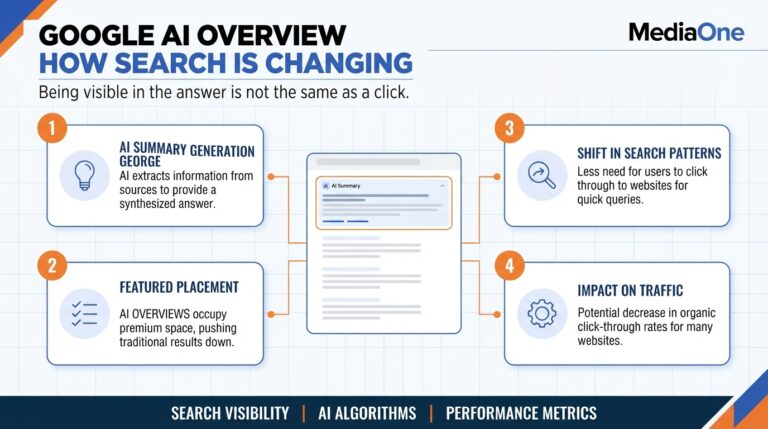
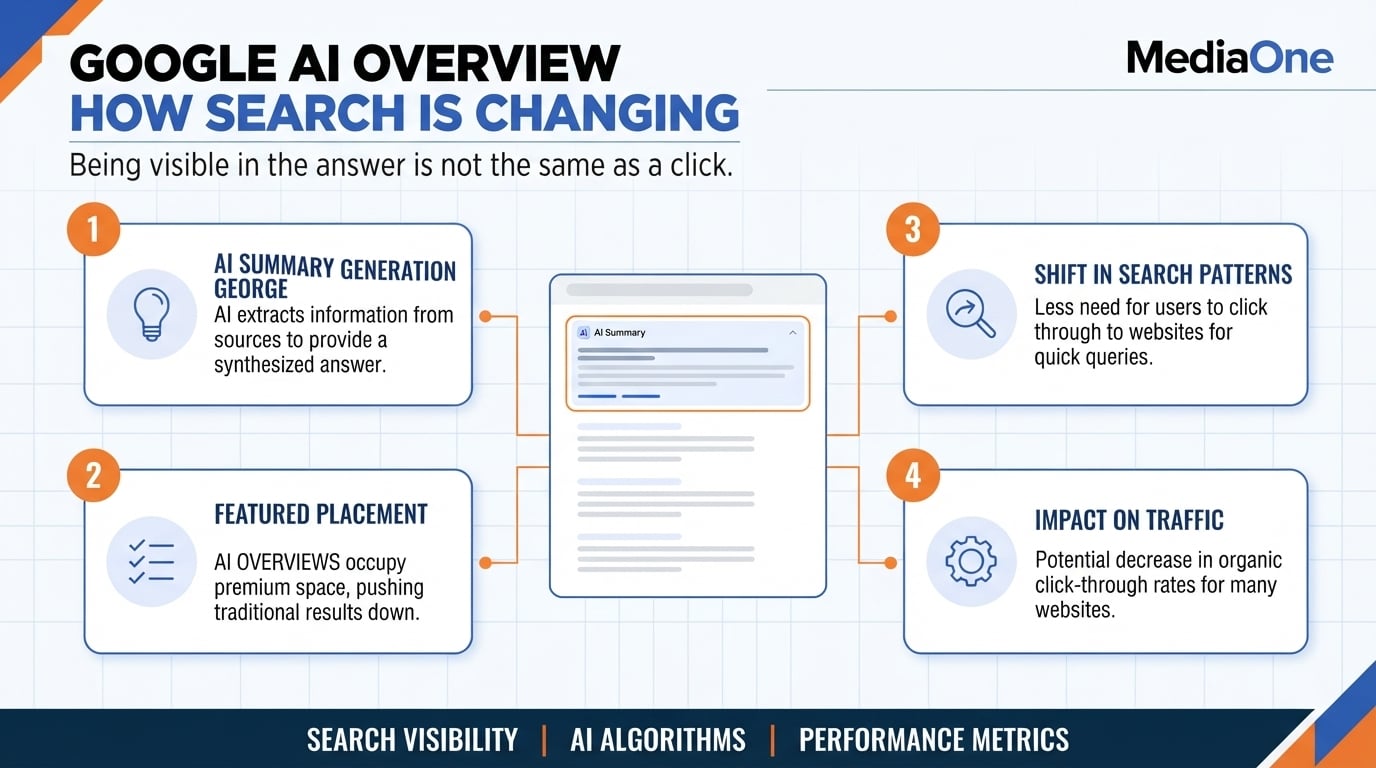
Google AI Overviews represent a major change in how search results appear. Instead of relying only on a ranked list of web pages, users can see an AI-generated summary that draws on information from relevant sources and provides links for further exploration.


For website owners, content creators and marketers, AI Overviews present both opportunity and challenge. They can expand visibility when content is selected as a supporting source. They can also reduce click-through on queries where the generated answer satisfies the user’s immediate need.
This guide covers the mechanics of AI Overviews, their impact on organic traffic and practical strategies to keep content useful and visible as Google Search adds more generative AI features.
Key Takeaways
- AI Overviews generate answers from Search systems and relevant web content, with links that let users explore supporting sources.
- Independent behavioural research has found lower click-through when a Google AI summary appears, although impact varies by query, audience and content type.
- A page does not need a special AI file, special schema or an AI-only writing style to be eligible for Google AI features.
- Useful, original content, sound technical SEO, good page experience and accurate structured data remain worthwhile.
- Search Console now provides a dedicated Generative AI performance report for visibility in AI Overviews, AI Mode and other generative AI Search features.
- Publishers should measure generative AI visibility alongside organic clicks, conversions, branded demand, repeat visits and direct traffic rather than relying on rankings alone.
What Google AI Overview Is and Why It Affects Search
The shift from traditional search results to AI-generated summaries
For decades, Google Search centred on ranked links, snippets and specialised search features. AI Overviews add a generated answer layer that can appear when Google’s systems determine that the feature adds value beyond the conventional results.
The summary can combine information from more than one source and include links that let the user explore the supporting pages. Google’s own guidance describes AI Overviews as a way to help people get the gist of a complicated topic or question more quickly while providing a starting point for further exploration.
For publishers, the important change is that search visibility and website traffic are no longer the same measurement. A page can contribute to an AI-generated answer or appear as a supporting source without receiving the same click volume that a prominent blue link once produced.
MediaOne has a separate explainer on what AI Overviews are and why Google created them for readers who want a shorter introduction to the feature.
Why Google Launched AI Overviews and Kept Expanding Them
Google first introduced the Search Generative Experience in Search Labs in 2023, then launched AI Overviews more broadly in the United States in May 2024 before expanding the feature internationally. The product has continued to change through 2025 and 2026 as Google has added model upgrades, new link treatments and closer integration with other AI Search experiences.
The draft originally framed this mainly as a defensive response to ChatGPT and Perplexity. Competition is part of the wider market context, but Google’s published rationale focuses on helping users ask more complex questions, understand topics faster and discover relevant pages across the web.
By 2026, AI Overviews were no longer a small Search Labs experiment. Google had expanded them to more than 200 countries and territories and more than 40 languages, while continuing to change when and how the feature appears.
How AI Overviews differ from featured snippets and knowledge panels
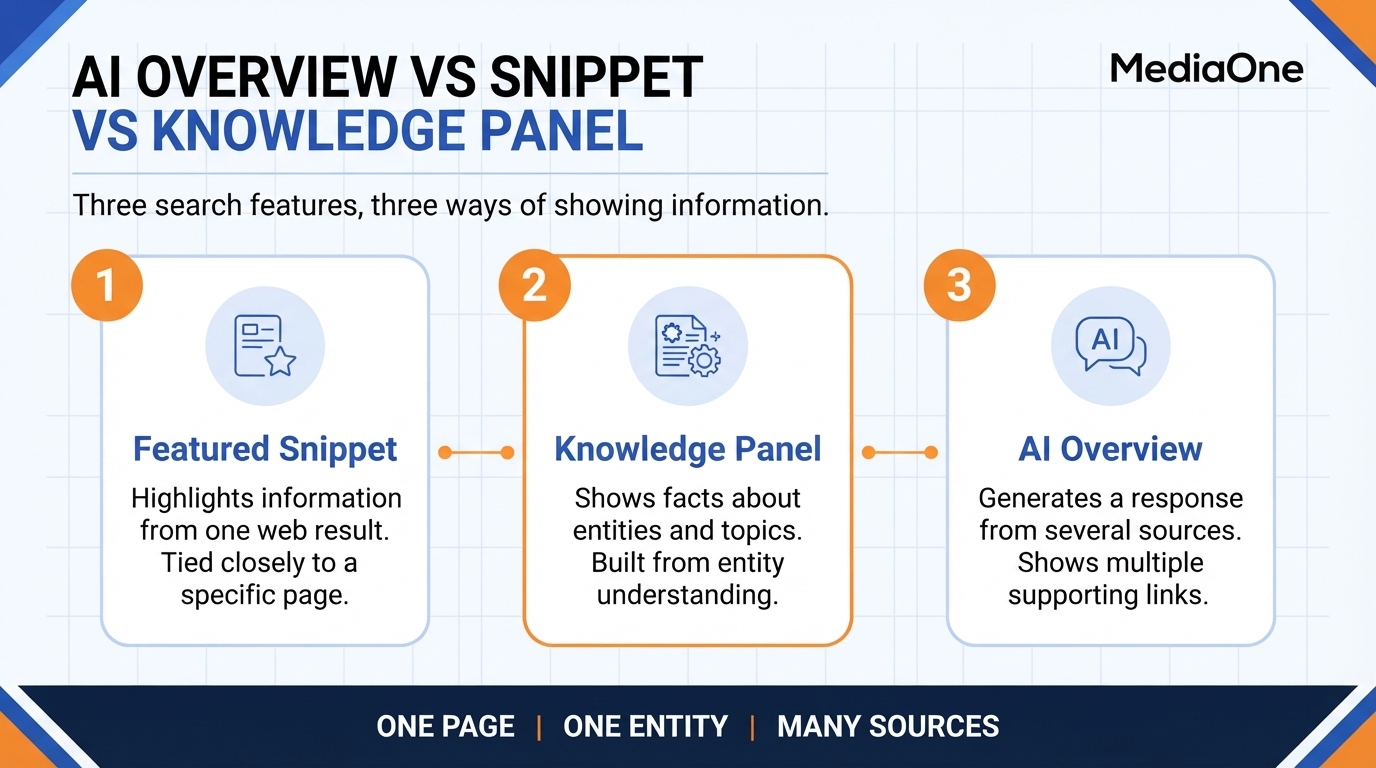
Featured snippets typically highlight information from a web result in a prominent search feature. Knowledge panels present information about entities and topics using Google’s structured understanding of those entities. AI Overviews use generative AI to create a response and can draw on multiple supporting sources.
That difference affects attribution. A featured snippet is closely tied to a specific result, while an AI Overview can show several supporting links around a generated answer. The user may recognise more than one source and may choose whether to click any of them.
AI Overviews also appear selectively. The draft repeatedly claimed that specific query classes almost always or never trigger the feature. Google does not publish a fixed trigger list, so marketers should treat query-level appearance as variable rather than guaranteed.
How Google AI Overviews Work
Retrieval, grounding and query fan-out
Google’s current Search documentation explains that its generative AI features are rooted in core Search ranking and quality systems. They can use retrieval-augmented generation, which grounds an AI response in relevant pages retrieved from Google’s Search index, and query fan-out, where the system issues related searches to gather information across subtopics.
That means AI Overviews are not simply a model recalling a fixed training corpus. Google’s systems retrieve current web information and use it to support the generated response. The exact implementation can vary by feature and query.
This is more accurate than the original claim that every AI Overview is generated from a fixed set of top-ranking pages in real time. Google does not publish a rule that restricts supporting sources to the top three, top five or top ten conventional organic results.
Source attribution and citation mechanisms
AI Overviews show links that support the generated response, and Google has continued experimenting with how those links appear. In 2026, Google also added more inline links and website previews in its generative AI Search experiences.
Attribution does not guarantee traffic. A source can be visible without receiving a click if the user has already obtained enough information from the summary. At the same time, a well-placed source link can introduce a page to users who may not have discovered it through conventional ranking alone.
The practical objective is therefore not to chase a fixed ‘citation algorithm’, but to make valuable pages eligible, discoverable and useful within Search as a whole. Google does not disclose a citation formula that marketers can optimise against independently of Search.
Gemini models and what Google does not disclose
Google uses Gemini models in its AI Search experiences and has continued updating the model layer. In January 2026, Google said Gemini 3 had become the default model for AI Overviews, while later Search updates continued to change AI Mode and the wider AI Search experience.
Google does not publish a training-data cutoff for AI Overviews or a complete rule set for selecting supporting URLs. The original draft included several unsupported claims about fixed confidence scores, domain-authority weighting, training-data dates and source-count ranges. Those details have been removed rather than presented as fact.
The safest way to describe the system is narrower: Google’s Search systems retrieve relevant information, generative models produce the response, and supporting links are selected through processes Google does not fully disclose.
This distinction changes how SEO teams should investigate visibility. If a page is not appearing as a supporting source, do not jump straight to rewriting the article into shorter sentences or adding unsupported schema. First check whether the page is indexed, whether Google can generate a normal snippet from it, whether the content actually answers the relevant search intent and whether the information offers something distinct enough to be useful.
Next, review the wider site. Important pages should be reachable through internal links rather than isolated. Canonicalisation, redirects and duplicate versions should be handled correctly. Key information should exist as indexable text, even when the page also relies on video, interactive tools or imagery. None of those steps is unique to AI Overviews, but they are prerequisites for dependable Search visibility.
Source diversity also means a publisher should not assume that the same pages will appear every time. Query wording, location, freshness and the system’s fan-out searches can change which supporting material is relevant. A marketer can observe recurring patterns, but a handful of manual searches should not be converted into a universal rule about ranking position or citation probability.
That is especially important for research reports that claim exact ‘AI citation factors’. Unless the method controls for ranking, query class, site authority, geography and product changes, a correlation may not reveal the cause. Use third-party studies to generate hypotheses, then verify those hypotheses against Search Console, analytics and live result checks for your own site.
Key Capabilities and Limitations of Google AI Overviews
What AI Overviews do well
AI Overviews are designed to help users understand a topic or question quickly. They are especially useful when a query benefits from synthesis, comparison or a concise explanation that brings together several pieces of information.
A user researching a broad question can get an initial orientation before deciding whether to open a supporting source. A user comparing options can also receive a structured starting point before going deeper into product pages, reviews, documentation or specialist analysis.
Google has increasingly connected AI Overviews with follow-up exploration. In 2026, the company made it easier to continue from an Overview into a conversational AI Search experience, reinforcing the role of the feature as a starting point rather than simply a replacement for web links.
Where AI Overviews can fall short
Generative AI can still make mistakes. Google’s own Search Help documentation warns that AI Overviews can provide inaccurate information and recommends checking important information in more than one place.
Very recent events, specialist topics and questions with disputed or incomplete evidence can be harder to summarise accurately. The original draft went further, claiming fixed delays for breaking news and systematic bias towards large retailers. Those statements were too specific to support as universal rules.
The same caution applies to high-stakes subjects. Marketers should not assume that an AI Overview is a substitute for professional medical, legal or financial advice, and publishers in those areas should continue prioritising precise sourcing and appropriate expert review.
Recent information deserves a separate check. A page can be crawled quickly without guaranteeing that every new fact is immediately reflected in every AI Overview. Indexing, retrieval and feature generation are separate processes, and Google does not promise an hours-based refresh window for a particular summary. Publishers covering fast-moving events should therefore keep timestamps clear, update corrections visibly and avoid claiming that ‘real-time indexing’ guarantees immediate AI inclusion.
Commercial content also needs nuance. The draft suggested AI Overviews systematically favour brand-owned sites and large retailers. A more defensible approach is to recognise that commercial results can combine several Google systems, including product data, merchant information, organic pages and other Search features. The mix varies, so marketers should review the actual queries that drive revenue rather than assuming one source type always wins.
Hallucination risk and quality safeguards
Hallucination is the generation of information that is unsupported or incorrect. Google uses Search quality systems, retrieved sources and safety processes to reduce that risk, but the company does not claim the feature is error-free.
The original draft said every claim in an Overview is ‘anchored’ to a source and that the system suppresses entire categories of medical, legal and financial queries. That language was too absolute. Google may show supporting links and applies safety systems, but the exact relationship between each generated statement and each visible source is not disclosed as a one-to-one guarantee.
For publishers, the defensible response is simple: publish accurate information, make original sources easy to identify and correct errors quickly. An AI system can only work with the information it can retrieve, and weak sourcing creates risk for both users and publishers.
Impact on Search Traffic
The direct-answer effect on organic clicks
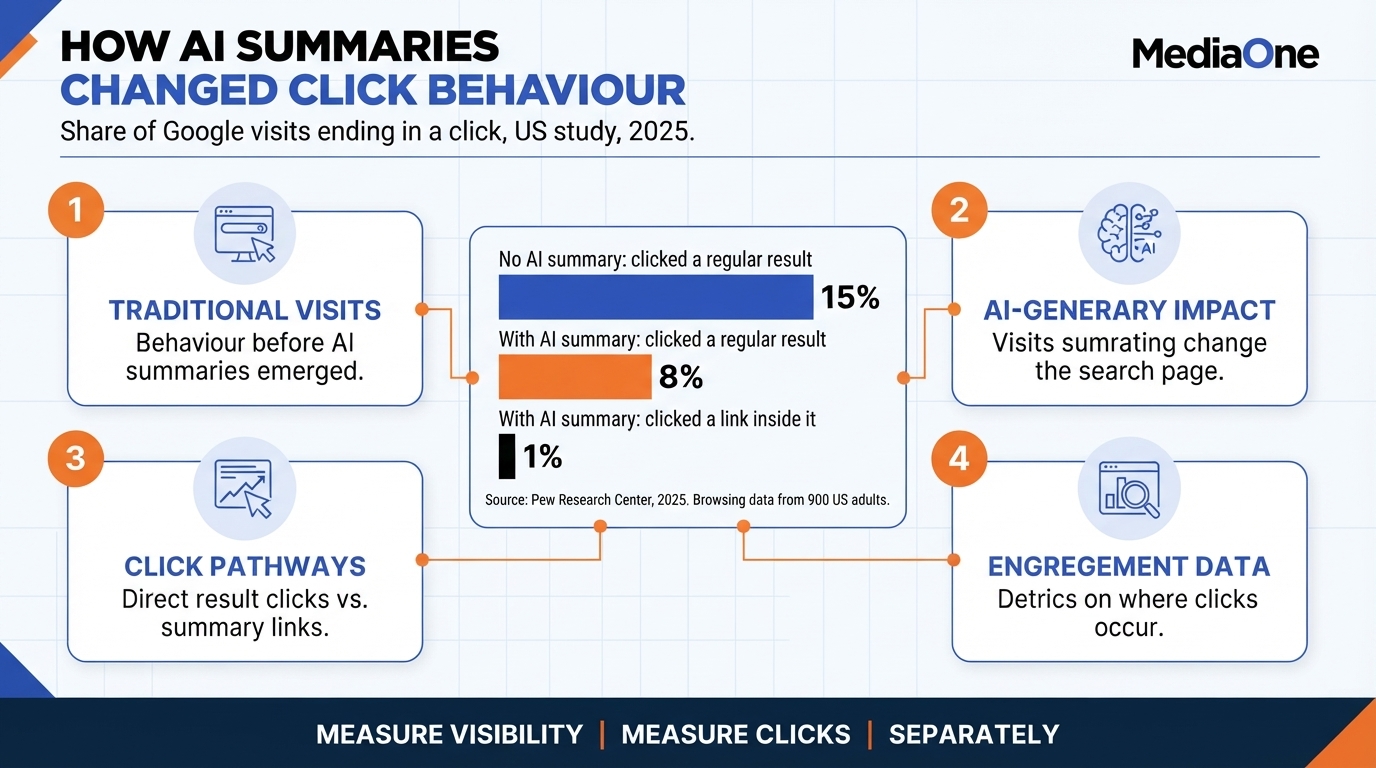
AI-generated summaries can reduce the need to click when the search results page already answers the immediate question. Independent research provides evidence for that effect.
A 2025 Pew Research Center analysis of browsing behaviour among 900 US adults found that users clicked a traditional search result in 8% of visits when a Google AI summary appeared, compared with 15% of visits without one. Users clicked a link within the AI summary itself in 1% of visits. These results are US behavioural data rather than a universal forecast for every market or industry, but they show why publishers should measure the effect on their own query sets. Pew Research Center’s analysis of Google AI summaries provides the methodology and full context.
The article’s earlier 10 to 20%, 20 to 40%, 30 to 50% and similar traffic-loss ranges were removed because they were not tied to a named, authoritative source and were presented too broadly.
AI Overview visibility can therefore increase while organic clicks fall, so impressions and clicks should be interpreted separately. The effect will differ by query intent, search layout, citation position, device, audience and how much detail the user still needs after reading the Overview.
Which content types are more exposed or resilient
Direct-answer content can be more exposed because a concise generated summary may satisfy the user without another page view. Definitions, simple procedural questions, basic comparisons and quick factual lookups are obvious examples of queries where that can happen.
More detailed content may still attract clicks when the user needs evidence, examples, tools, first-hand experience, original research, code, a transaction or specialist detail. The draft treated certain categories as reliably ‘resilient’ or ‘heavily affected’, but Google does not publish fixed traffic outcomes by content type.
A useful distinction is depth of need. If the user only needs a short answer, the search results page may be enough. If the user needs to inspect methodology, review evidence, use a calculator, download a template, compare terms, see images or complete a purchase, the supporting page can still provide value beyond the summary.
That is why content strategy should focus on giving users a reason to visit, not on creating pages that merely restate information already available across the web.
How to interpret traffic impact without overclaiming
Published studies and platform data can provide direction, but they should not be converted into a universal traffic forecast. Two pages ranking for similar terms can experience different outcomes depending on their audience, brand strength, search features, device mix and whether users need more detail after the generated answer.
Website owners should compare changes in impressions, clicks, conversions, branded queries, direct traffic and engagement rather than treating one metric as a complete explanation. A decline in clicks with stable or rising visibility may reflect a search-interface change, but it can also reflect ranking movement, seasonality, changing demand or other SERP features.
A useful audit starts by separating pages according to what the user still needs after receiving a short answer. A definition page may have little additional value once the definition appears in Search. A comparison page may still earn a visit if it contains original testing, pricing conditions, methodology or a decision tool. A service page may still be necessary because the user needs location details, proof of work, terms or a way to contact the provider.
The same reasoning applies to revenue models. Publishers funded mainly by page views are more exposed when an answer is consumed on the results page. Lead-generation and ecommerce businesses may care less about raw visit volume if the remaining visitors have stronger intent. Subscription publishers may want to measure whether AI visibility increases brand searches or newsletter sign-ups even when article clicks decline. These are business-model questions, not a single SEO benchmark.
Segment analysis also helps prevent false conclusions. Compare informational and commercial pages separately. Review mobile and desktop behaviour separately. Check brand and non-brand queries separately. Where possible, compare a page’s performance before and after a material change in AI visibility while also checking for ranking movement, seasonality and other Search features.
Do not treat a supporting-source appearance as equivalent to a normal organic position. The user interface, prominence and surrounding answer can change what the impression means. Likewise, do not treat an impression as a conversion proxy. An impression shows visibility; the commercial value still has to be demonstrated through downstream behaviour.
MediaOne’s article on AI Overview mentions and online visibility provides additional context for measuring brand presence alongside traffic.
Optimising Content for Google AI Overviews in 2026
Clear useful content rather than an AI-only writing style
The original draft repeatedly said AI systems favour short declarative sentences, one claim per section and tightly extractable chunks. Those practices can improve readability, but Google does not require an AI-specific writing style.
Google’s current guidance says the same foundational SEO practices remain relevant for generative AI Search. It also explicitly says there is no requirement to break content into tiny pieces, rewrite content specifically for AI systems or create new machine-readable files just to appear in AI Overviews or AI Mode. The practical focus remains helpful, reliable and people-first content. Google’s guidance for optimising websites for generative AI Search also recommends unique, expert-led content that provides value beyond common information.
Clear headings, readable paragraphs and useful lists still help readers. They also make a page easier to understand as a document. The reason to use them is not that Google has published a special extraction score for short sentences. It is that well-organised pages are better for users and align with established SEO practice.
Avoid filler, unsupported superlatives and vague claims. Define technical terms when readers may not know them. Put the answer close to the question when that improves the page, but do not distort a complex topic into a collection of disconnected snippets.
Write for the person who needs the information first, then make sure Search can crawl, index and understand the page. That approach is more durable than trying to reverse-engineer an undocumented AI citation formula.
Use examples where they help the reader make a decision. A software comparison can explain the test conditions behind a recommendation. A local service article can explain Singapore-specific eligibility or process differences. A technical guide can include working code and known failure cases. These additions create value that remains useful even when a short summary appears above the result.
Editing standards still apply. Remove duplicated sections, unsupported statistics and claims copied from secondary commentary when they cannot be traced to an authoritative source. Update platform names and feature descriptions when products change. A page that is easy for an editor to verify is also easier to maintain when Search evolves again.
For organisations that want broader help with generative search visibility, MediaOne’s GEO and AI search service focuses on visibility across AI-assisted discovery without replacing conventional SEO fundamentals.
Structured data and its actual role
Structured data helps Google understand information on a page and can make pages eligible for supported Search features. It should accurately reflect visible page content and follow the documentation for the specific structured-data type being used.
The original draft overstated its role in AI Overview selection. Google says there is no special Schema.org markup required for AI Overviews or AI Mode, and marketers should not overfocus on structured data as an AI-specific tactic.
This point is important because several recommendations in the draft were outdated. HowTo rich results were deprecated in Google Search in 2023. FAQ rich results were later retired from Google Search in May 2026. Adding those markups is therefore not a shortcut into an AI Overview.
Article, Product, Recipe, LocalBusiness and other currently supported types can still be appropriate when they accurately describe the visible content and when Google supports a relevant search feature. The reason to implement them is the normal structured-data use case, not a promise of AI citation.
Validate supported markup before deployment, keep it consistent with the page and revisit implementation when Google’s documentation changes. Invalid or misleading structured data can create technical problems and does not improve a weak page.
The same principle applies to publication dates, author properties and review markup. Adding a recent dateModified value does not make stale information current, and attaching an author name does not prove expertise. Structured data should describe what the user can actually see and verify on the page. When a property is unsupported for a particular Search feature, keep it only if another legitimate consumer of the markup needs it, not because an AI Overview theory says it will improve citation probability.
For ecommerce and local businesses, keep product, merchant and Business Profile information accurate because Google can use those systems across Search experiences. Again, this is established Search hygiene rather than a hidden AI Overview ranking factor. The goal is consistency between what the page says, what structured feeds say and what the user receives after clicking.
Creating content worth surfacing
The strongest strategic part of the original draft was its emphasis on content that offers more than a generic summary. That idea remains useful, with one adjustment: there is no evidence that Google maintains a fixed checklist of byline credentials, table counts or source formats that guarantees an AI Overview citation.
Focus on content that earns attention because it contributes something useful:
- Original evidence: Publish first-party data, experiments, surveys, benchmarks, testing notes or case studies when your organisation genuinely has them.
- Clear expertise: Use qualified authors and reviewers where subject knowledge affects accuracy. Do not invent credentials or publication history.
- Primary sourcing: Link claims to original research, platform documentation or official records rather than repeating unsupported numbers from other blogs.
- Useful depth: Give readers methodology, examples, caveats and decision criteria that a short search summary cannot fully replace.
- Maintained information: Review pages when products, regulations, prices, software features or platform policies change.
- Strong internal structure: Connect related articles so users and crawlers can find deeper material across the topic.
Topical coverage can help a site serve users across related questions, but avoid publishing thin pages merely to occupy every possible keyword variation. Google specifically warns against low-value content created primarily for ranking systems.
A content audit for AI Overview exposure can stay close to a conventional SEO and editorial audit. Start with the pages that already attract meaningful impressions or revenue, then ask whether each one offers information that a generated summary cannot fully replace. The answer may be a proprietary dataset, a worked example, screenshots, an interactive tool, a downloadable template, local knowledge, expert commentary or a transaction the user must complete on the site.
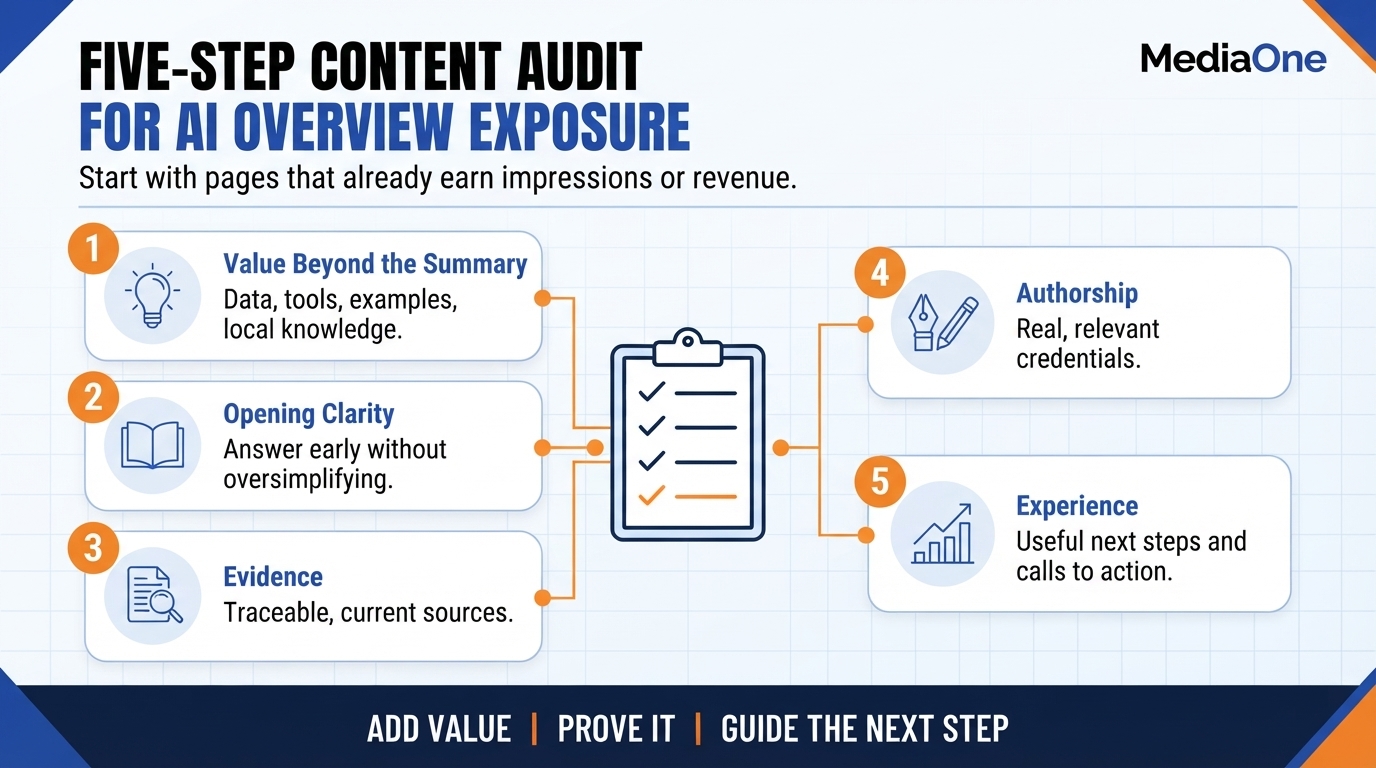
Review the page’s opening section for clarity, but do not force every answer into the first sentence. Some questions need context before a responsible answer can be given. The objective is to remove unnecessary delay, not to make complex subjects sound simpler than they are.

Review evidence next. Statistics should have traceable sources. Product features and platform policies should point to current official documentation. Case studies should distinguish measured results from illustrative examples. If the evidence is old, decide whether the fact is stable enough to remain or whether the page needs an update.
Then review authorship. A named author can help readers judge who is responsible for the content, but credentials should be real and relevant. A byline should not be padded with unverifiable publication credits merely because an editor believes ‘E-E-A-T’ requires them. If specialist review is necessary, identify the reviewer and the scope of that review accurately.
Finally, review the experience around the article. Internal links should take readers to genuinely useful next steps. Images and video should add information rather than decorate the page. Calls to action should fit the user’s stage of research. A page that answers the query well and then gives the reader a reason to continue is more useful commercially than a page designed only to be copied into an AI answer.
For WordPress teams, MediaOne’s guide on how to optimise WordPress for AI search offers a related technical workflow around access, indexability, content and trust.
Monitoring performance in Search Console
Measurement has changed materially since earlier versions of this article were drafted. Google introduced dedicated Search Generative AI performance reports in Search Console in June 2026 and said the insights had rolled out to all websites worldwide by 31 August 2026.
The dedicated report provides visibility data for generative AI features such as AI Overviews and AI Mode. Google’s published description lists impressions, pages, countries, devices for Search, and date-based trends. It does not say the report provides a citation rate, a list of exact queries that triggered each Overview, a separate click-through rate for citations or a count of how often a page was paraphrased.
Use Google’s Search Generative AI performance report documentation to understand what the report currently exposes, then combine it with the normal Search performance data and analytics on your own site.
A practical measurement framework can include:
- Generative AI impressions by page and market.
- Conventional Search clicks and impressions.
- Conversion rate and assisted conversions from organic traffic.
- Branded search demand over time.
- Direct and returning-user traffic.
- Newsletter, account or lead growth where those are meaningful business outcomes.
- Engagement with original tools, reports, templates or product pages.
Do not infer a causal relationship from one metric alone. For example, rising direct traffic during a period of increased AI visibility may be worth investigating, but it does not prove the AI Overview caused those visits.
Use the Generative AI report as visibility evidence, then connect it to business outcomes with broader analytics rather than inventing a ‘revenue per citation’ metric.
Google AI Overview Rollout Across Markets and Devices
Availability in Singapore and other markets
AI Overviews have expanded substantially since the initial United States rollout in May 2024. Google said in May 2025 that AI Overviews were available in more than 200 countries and territories and more than 40 languages.
Singapore is included in Google’s current list of supported AI Overview countries and territories. Availability still varies by query, account state, language and Google’s assessment of whether an Overview adds value for a particular search. The feature appearing in a market does not mean it appears for every user or every query.
For a current country and language list, refer to Google’s AI Overviews availability page. That is more reliable than preserving rollout dates that may have changed across earlier drafts and experiments.
The original article said Singapore received AI Overviews in July 2024 and offered specific adoption patterns for Mandarin, Tamil and Bahasa Indonesia. Those claims could not be confirmed from an authoritative source and have been removed.
Desktop mobile and Google app visibility
AI Overviews can appear across supported Google Search experiences, including desktop and mobile. Presentation changes by screen size and product surface, and Google continues to test link treatments and interaction patterns.
The draft claimed mobile consistently shows fewer sources, that the Overview normally occupies a fixed 200 to 400 pixels and that device differences reliably create larger click losses on mobile. Those details were too specific and variable to present as stable product facts.
Publishers should instead segment their own Search and analytics data by device. If mobile and desktop behaviour diverge, that evidence is more useful than assuming a universal layout effect.
Check the search result itself when investigating a major change. Search Console can show that visibility changed, but it does not recreate the exact result a user saw. Manual checks can help identify whether an AI Overview, local pack, shopping unit, video feature, featured snippet or other module is occupying attention around the same query. Because Search is personalised and tested continually, treat screenshots as observations rather than permanent rules.
The same applies to local and transactional queries. Google keeps changing how AI features interact with Maps, shopping, local results and conventional Search modules. A strategy that assumes one query class is permanently protected from AI Overviews is likely to age quickly.
For Singapore businesses, this is particularly relevant when content mixes national information with strong local intent. A query about company registration, GST, grants, property, education or local services may surface government, commercial and local-search features together. The appropriate response is to maintain accurate local information and monitor the actual result environment rather than importing a US-only assumption about how the SERP behaves.
Rollout timeline and continuing product change
The broad timeline is clear. Google introduced Search Generative Experience in 2023, launched AI Overviews in the United States in May 2024, expanded the experience internationally through 2024 and 2025, and continued adding model and interface changes through 2026.
In January 2026, Google said Gemini 3 had become the default model for AI Overviews and added easier follow-up conversations. In May and June 2026, Google announced further AI Search and publisher-related changes, including more ways to connect users with websites, Preferred Sources, additional controls and the new Generative AI reporting in Search Console.
That pace makes long-range predictions risky. The original draft forecast transactional expansion within 12 to 18 months, increasing personalisation and specific multilingual developments. Those may be plausible directions, but they were predictions rather than confirmed product plans and have been removed.
For SEO teams, the stable strategy is to monitor Google’s documentation and your own performance data instead of building a plan around a fixed 2026 screenshot of the SERP.
Google AI Overview Compared With Other AI Search Experiences
Google AI Overviews operate inside Google Search, so they affect users who are already performing a web search. ChatGPT, Perplexity, Claude and Microsoft’s Copilot Search also provide web-connected answer experiences, but their interfaces, ranking methods, model choices and reporting tools differ.
The original comparison table listed fixed source counts, model names and geographic descriptions. Those details change frequently and some were already outdated, so the comparison below focuses on stable product differences.
| Experience | Where it appears | Web-connected answers | Source links | Follow-up interaction |
| Google AI Overview | Within Google Search results | Yes | Yes | Can lead into further AI Search interaction |
| ChatGPT search | ChatGPT | Yes | Yes | Conversational follow-up |
| Perplexity | Perplexity search and research interface | Yes | Yes | Conversational follow-up |
| Claude web search | Claude | Yes | Yes | Conversational follow-up |
| Copilot Search in Bing | Bing | Yes | Yes | Follow-up and related exploration |
ChatGPT search
ChatGPT can search the web and cite sources when current information is useful. By 2026, web search was available across ChatGPT plans rather than being limited to Plus and Team, as the original draft stated.

For publishers, the practical difference is context. A Google AI Overview appears in a conventional search-results environment alongside other Google results. ChatGPT search presents the answer inside a conversational assistant, where the user can continue asking questions without returning to a traditional results page.
The draft also described ChatGPT as relying on a fixed April 2024 knowledge cutoff for recent queries. That framing is no longer suitable for a web-search comparison because current ChatGPT can retrieve up-to-date web information when search is used.
Perplexity and Copilot Search
Perplexity is built around web research and source-linked answers. Its current products include standard search and deeper research modes, with follow-up questions and direct source links. The original table’s fixed count of one to three or three to eight sources has been removed because the number of sources varies by query and product mode.
Microsoft’s Copilot Search in Bing also provides summarised answers with cited sources and suggestions for further exploration. That makes it another relevant answer-search experience, although it should not be described as simply ‘Bing Chat’ in a 2026 article.
For SEO teams, neither platform should be treated as having the same eligibility rules as Google Search. Google’s own documentation applies to Google. Visibility in another answer engine depends on that provider’s crawling, retrieval and product design.
Claude web search
The original article said Claude had no built-in live web access except through third-party integrations. That became outdated in 2025. Anthropic introduced web search in Claude, and the feature later became available globally across Claude plans.
Claude can use web search when current information is helpful and provides citations to source material. It also supports deeper research workflows in some product configurations.
This correction illustrates why comparison sections need frequent review. Product capabilities change faster than evergreen SEO principles, so model names, plan restrictions and feature availability should be checked before every publication update.
What the comparison means for publishers
Google remains especially important to businesses that depend on organic Search because AI Overviews occupy the same environment as conventional rankings. Other answer engines can still influence discovery, referral traffic and brand awareness, particularly among audiences who use conversational research tools.
The strategic overlap is content quality. Accurate, original and accessible information can support visibility across more than one system, even though no single tactic guarantees citation everywhere.
The strategic difference is measurement. Google now provides dedicated Generative AI visibility reporting in Search Console. Other platforms expose different levels of referral, citation or publisher insight, so marketers should avoid forcing every channel into the same KPI framework.
A practical channel plan separates what you can control from what you can only observe. You can control whether pages are crawlable, whether the content is accurate, how well the site is internally linked, whether structured data matches the page and whether your organisation publishes information that deserves to be referenced. You cannot control whether a particular model cites the page for a particular prompt on a particular day.
This is also why owned audiences remain relevant. A search platform can change its interface, source presentation or reporting without the publisher’s permission. Email subscribers, registered users, direct visitors and repeat customers give the organisation a relationship that is less dependent on one results-page format. That does not mean abandoning Search. It means using Search visibility to build a durable audience where the business model allows it.
Teams should also distinguish brand monitoring from traffic acquisition. If a company starts appearing more often in AI-generated answers, brand mentions may rise before referral traffic does. That can be useful evidence, but it should be tracked alongside real business outcomes rather than converted into an invented monetary value.
The same principle applies to content investment. Direct-answer pages can still be worthwhile if they introduce the brand, support a topic cluster, answer customer questions or help existing users. A page does not have to generate the last click to have a role, but the role should be explicit enough to measure.
If AI-assisted discovery is commercially important to your organisation, a GEO strategy for AI search can sit alongside technical SEO, content and brand work. It should not replace the fundamentals that keep pages useful and discoverable in ordinary Search.
Frequently Asked Questions
How does Google decide which sources to cite in an AI Overview?
Google does not publish a complete source-selection formula. Its documentation says AI features rely on core Search ranking and quality systems, can use retrieval and query fan-out, and show supporting links to relevant pages.
A page must be indexed and eligible to appear in Google Search with a snippet to be eligible as a supporting link, but meeting those requirements does not guarantee inclusion. Claims that a top-three position, author credential score or specific schema type guarantees citation are unsupported.
Can I prevent my content from appearing in AI Overviews?
Yes, there are controls, so the original answer saying there was no meaningful opt-out mechanism was outdated. Google documents standard Search preview controls such as nosnippet, data-nosnippet, max-snippet and noindex, and in 2026 it also began rolling out a Search Console control for whether a site appears in and grounds generative AI Search features.
Using broader indexing controls can affect visibility beyond AI Overviews, so publishers should understand the consequences before applying them. This is a technical and commercial decision rather than a simple SEO tactic.
What is the difference between an AI Overview and a featured snippet?
A featured snippet is a prominent Search result that highlights information from a web page. An AI Overview is a generated response that can synthesise information and show multiple supporting links.
Both can answer a question before the user clicks, but the generation and source presentation are different. Neither should be treated as a guaranteed result type for a particular query.
Will AI Overviews eventually eliminate organic click-through entirely?
There is no authoritative basis for predicting that organic clicks will disappear. AI Overviews can reduce clicks on some searches, while many users still need to visit a website to inspect evidence, complete a task, compare options, buy something or get deeper information.
Publishers should plan for lower click opportunity on some direct-answer queries without assuming all organic traffic will vanish. The useful question is which pages still create value after the initial answer has been summarised.
How should I measure whether AI Overviews are affecting my traffic?
Start with Search Console’s Generative AI visibility data, then compare conventional Search clicks and impressions over the same period. Add site analytics for conversions, engagement, branded demand, returning users and direct traffic.
Avoid attributing every traffic change to AI Overviews. Ranking changes, seasonality, demand shifts, paid features and other Search modules can move at the same time.
Is optimising for AI Overviews worth the effort if my site is small?
A small site does not need a separate AI-only content programme. It does need sound technical SEO, accurate information and pages that provide something useful enough to compete in Search.
For specialist sites, original expertise can be an advantage because a focused page may answer questions that generic publishers cover poorly. The goal should be strong content and Search eligibility first, not a collection of unverified AI citation tricks.
What happens if my content is cited but receives no additional traffic?
That outcome is possible because visibility and clicks are separate. Treat the appearance as a visibility signal, then check whether it contributes to branded search, repeat visits, conversions or other business outcomes over time.
If a page consistently earns visibility but creates no measurable value, consider whether it needs stronger original material, a clearer next step or a different role in the content portfolio. Do not assume a citation is valuable simply because it exists.
How does AI Overview citation affect my search rankings?
Google has not documented AI Overview citation as a direct ranking boost for conventional organic results. The same underlying content quality and Search systems can influence both visibility types, which can create correlation without proving that one causes the other.
Measure rankings and generative AI visibility separately. Avoid claims that higher Overview engagement feeds directly back into rankings unless Google documents that behaviour.
Are there Singapore regulations I should know about when optimising for AI Overviews?
There is no separate Singapore SEO law created specifically for AI Overview optimisation. Existing obligations can still apply to the content and data practices around a website, including privacy, advertising, consumer protection and sector-specific requirements.
If a page collects personal data, makes regulated claims or operates in a high-risk industry, use current legal or compliance guidance rather than treating an SEO article as legal advice. AI visibility does not remove the organisation’s existing obligations.
Which competitors to Google AI Overview matter most in 2026?
ChatGPT search, Perplexity, Claude web search and Copilot Search in Bing are all relevant web-connected answer experiences. Which one deserves attention depends on where your audience researches products, services and information.
For businesses that still receive material demand from Google Search, AI Overviews remain a direct SEO concern because they appear inside the Google results environment. The broader response is diversification rather than choosing one answer engine and ignoring the rest.