
| AI Summary
SEO costs vary by business size, market, service model, and competitive complexity. This guide compares UK and Singapore pricing for freelancers, agencies, projects, and in-house teams, while explaining hidden costs, realistic timelines, common pricing red flags, and how to calculate SEO ROI before committing to a budget. |
SEO spend varies dramatically across regions and business models. A small local business in the UK might invest £500 per month with a freelancer, or SGD 900–1,500 in Singapore. A mid-market SaaS company could pay £5,000 monthly (or SGD 9,000–10,000) to an agency. Enterprise organisations often commit £15,000+ monthly (or SGD 27,000+), or negotiate custom arrangements worth six figures annually.

The price tag rarely tells you what you’re actually getting. Two agencies charging identical fees may deliver significantly different results because SEO itself changes continuously. Search algorithms shift. Your competitors optimise. Your technical baseline differs from theirs. Content quality compounds over time in ways that resist flat pricing.
This guide maps what SEO actually costs across service models, business sizes and markets. More importantly, it shows you how to calculate whether your spend returns money, and how to avoid providers whose low prices reflect resource constraints rather than efficiency. By the end, you’ll know whether £2,000 per month (or SGD 3,600) is cheap or expensive for your situation, and what to expect before results arrive.
Key Takeaways
What you’ll learn in this guide:
- Cost range by business size: Small businesses spend £500–£2,000/month (SGD 900–3,600); mid-market firms £2,000–£7,500/month (SGD 3,600–13,500); enterprise clients pay £7,500+/month (SGD 13,500+) or custom rates.
- Typical models: Monthly retainers are most common, but fixed-project and in-house builds are viable for specific goals.
- The ROI threshold: Timelines vary widely depending on competition, baseline rankings, and conversion setup. Commonly reported timelines range from 4–14 months before positive ROI, though individual results vary significantly.
- Hidden costs matter: Budget 20–40% extra beyond the agency fee for content, tools (SEMrush, Ahrefs), and technical fixes. Total cost of ownership is 30–50% higher than headline pricing.
- Red flags to avoid: Guaranteed rankings, pricing under £400/month (SGD 720) in competitive sectors, and vague scope of work warrant clarification with providers.
- ROI justification framework: Calculate customer lifetime value (CLV), map organic traffic to qualified leads, then divide total cost by incremental revenue to find your break-even month.
What is SEO and What Costs Money?
SEO services encompass a range of activities designed to improve your visibility in organic search results. When you buy SEO, you are paying for specialist labour applied to several core areas:
- Technical audits and site health assessments
- Content strategy and creation
- On-page optimisation (title tags, meta descriptions, heading structure)
- Technical fixes (page speed, structured data, mobile usability)
- Link building and authority development
- Ongoing monitoring and reporting
SEO outcomes are not guaranteed. Results depend on market conditions, competitor activity, implementation quality, and your organisation’s ability to publish and update content. Professional advice should be sought when evaluating whether SEO is appropriate for your specific industry and business model.
What You’re Actually Paying For When You Buy SEO
When an agency quotes you an SEO retainer, the price is labour allocated across a portfolio of activities, each with its own real cost.
Understanding what sits underneath that monthly number matters because it explains why two agencies with similar pricing can deliver significantly different results, and why low-cost SEO is often a warning sign, not a bargain.
The Four Core Cost Categories in SEO Services
- Audit and Strategy Work
A credible SEO program begins with a technical and content audit. This is diagnosis: identifying which pages rank, why, what competitors do better, and where quick wins sit. A thorough audit for a mid-sized ecommerce site (500+ pages) takes 40 to 80 hours. It uncovers crawl errors (pages Google cannot read), duplicate content, missing schema markup (code that labels content type), and backlink gaps.
This work is often front-loaded in months one and two but must recur at least annually. A good agency builds this into the retainer or charges separately (typically £2,000–£8,000 per audit, or SGD 3,600–14,500).
- On-Page Optimisation and Content Production
On-page work means rewriting title tags, meta descriptions, heading structures, and body copy to match search intent. For a site with 100 priority pages, this alone represents 20 to 40 hours of work per month.
Content creation (new blog posts, guides, product descriptions, or landing pages) is the single largest cost driver for most retainers. Professional agencies report content costs ranging from £300 to £800 per 2,000-word article. A full content calendar (eight to twelve pieces monthly) runs £2,400–£9,600 in writing fees alone.
- Technical SEO and Site Maintenance
Technical SEO fixes redirect chains, improves page speed, implements structured data (JSON-LD for products, articles, FAQs), handles duplicate content, and audits Core Web Vitals (page performance metrics). These tasks are ongoing: new pages introduce new problems, template updates require testing, and algorithm changes can affect your indexation.
Technical work often accounts for 15 to 25 hours per month for an active website. For businesses with significant technical debt (outdated CMS, poor site architecture, slow hosting), this cost increases significantly.
- Link Building and Authority Work
Building high-quality backlinks takes time and relationship capital. An agency might spend 10 to 30 hours per month on outreach, guest posting coordination, and earned media placement. This is not a guaranteed outcome: link building must comply with search engine guidelines; manipulative tactics risk penalties.
Cost-per-link acquisition reported by some providers varies from £100 to £500+ depending on industry and target domain authority. Competitive sectors (finance, health, technology) require more work to earn relevant links.
Why SEO Pricing Varies So Widely
Four factors explain most pricing variation.
Client Portfolio Mix
An agency serving B2B SaaS companies with complex buying cycles charges more than one focused on local services (plumbers, dentists). SaaS SEO demands deeper conversion funnel analysis, longer content, and more strategic positioning work. Local SEO is less time-intensive but requires location-specific optimisation.
Staffing and Geography
A UK agency based in London will charge more than an equivalent agency in Eastern Europe or Southeast Asia. A senior SEO strategist in London costs the agency £50,000–£80,000 annually in salary; the same person in Eastern Europe might cost £25,000–£35,000. These costs flow directly into retainer pricing.
In Singapore, experienced in-house SEO specialists command salaries of SGD 48,000–80,000 annually. This affects both agency pricing and the cost of building internal teams in the region.
Boutique agencies (5 to 15 people) charge higher hourly rates than larger firms because they cannot spread fixed costs across as many clients. They also often attract more experienced practitioners.
Specialisation
An agency specialising in ecommerce SEO for large retailers will charge more than a generalist. Specialisation means deep domain knowledge: they understand product feed optimisation, category page challenges, and how inventory changes affect indexation. A generalist agency may require longer onboarding in your sector, extending time-to-value.
Track Record and Demand
Agencies with documented case studies and long client tenure command premium pricing. Newer or less-visible agencies charge less because they have to compete on price to build a portfolio.
Monthly Retainer vs. Project-Based vs. In-House: A Cost Comparison
Each model has fundamentally different economics. Choosing the wrong one costs money directly and in opportunity lost.
[IMAGE: SEO pricing models comparison dashboard showing side-by-side cost ranges, typical scope, advantages and disadvantages for retainer, project-based and in-house models with visual cost indicators]

Monthly Retainer Model (Most Common)
A retainer is a fixed monthly fee for a defined scope of work. You typically receive strategy, monthly reporting, a set number of content pieces, on-page optimisation, link building and technical fixes.
Typical retainer ranges:
UK agencies:
- Small business retainers: £500 to £2,000/month
- Mid-market retainers: £2,000 to £7,500/month
- Enterprise or specialised retainers: £7,500 to £25,000+/month
Singapore agencies and freelancers:
- Small business retainers: SGD 800 to SGD 3,200/month
- Mid-market retainers: SGD 3,200 to SGD 12,000/month
- Enterprise or specialised retainers: SGD 12,000+/month
The main advantage is predictable budgeting and continuity. An agency has incentive to build long-term results because they own a revenue stream tied to your success.
The main disadvantage is that scope creep is common. Many retainers define deliverables loosely, such as “ongoing optimisation” or “link-building efforts”. This can justify inconsistent output. Over time, if your site improves and requires fewer fixes, you pay for less work but remain locked into the same fee. Many retainer relationships experience scope drift, increasing your cost-per-output without corresponding value gains.
Project-Based Pricing (Fixed-Scope Work)
With project pricing, you agree on a specific deliverable (a full site audit, a content gap analysis, a technical overhaul of category pages) and the agency quotes a fixed fee.
Typical project costs (UK):
- Full technical and content audit: £3,000 to £10,000
- Content strategy and pillar-page build-out: £5,000 to £15,000
- Site migration SEO audit and implementation: £4,000 to £12,000
- Competitor analysis and strategic recommendations: £2,000 to £6,000
Typical project costs (Singapore):

- Full technical and content audit: SGD 5,000 to SGD 16,000
- Content strategy and pillar-page build-out: SGD 8,000 to SGD 24,000
- Site migration SEO audit and implementation: SGD 6,500 to SGD 19,000
- Competitor analysis and strategic recommendations: SGD 3,200 to SGD 9,600
Project-based work is useful for one-off work or businesses that want to handle SEO partially in-house and hire agencies for specific problems.
The advantage is clarity. You know exactly what you will receive and what it costs.
The disadvantage is that without ongoing partnership, work does not compound. A one-time audit decays within six months if no one implements the findings. You end up paying repeatedly for similar work because there is no continuity of effort.
Building an In-House SEO Team
Hiring in-house assumes you have sufficient work to justify dedicated headcount.
UK salaries (2024, indicative figures based on market surveys; actual salaries vary by location, employer and experience):
- Junior SEO specialist (entry-level, 0-2 years): £24,000 to £32,000
- Mid-level SEO manager (3-6 years): £35,000 to £50,000
- Senior SEO strategist or lead: £55,000 to £80,000
- Head of SEO (managing a team): £65,000 to £100,000+
Singapore salaries (2024, indicative figures; actual salaries vary by experience and employer):
- Junior SEO specialist: SGD 36,000 to SGD 50,000
- Mid-level SEO manager: SGD 55,000 to SGD 75,000
- Senior SEO strategist: SGD 80,000 to SGD 120,000
- Head of SEO: SGD 100,000 to SGD 160,000+
On-costs (National Insurance, Central Provident Fund contributions, benefits) add roughly 15 to 25 per cent to base salary in the UK and 17 per cent for CPF in Singapore.
Monthly software and tools:
- SEO platform (Ahrefs, SEMrush, Moz Pro): £100 to £500/month (UK) or SGD 160 to SGD 800/month (Singapore) depending on tier
- Google Search Console and Google Analytics: free
- Content planning and optimisation tools: £50 to £400/month (UK) or SGD 80 to SGD 640/month (Singapore)
- Link research and backlink monitoring: £100 to £400/month (UK) or SGD 160 to SGD 640/month (Singapore)
- Technical SEO and crawl analysis: £50 to £200/month (UK) or SGD 80 to SGD 320/month (Singapore)
Total tech spend for a fully equipped in-house team is typically £500 to £1,500/month in the UK or SGD 800 to SGD 2,400/month in Singapore.
Break-even threshold: Hiring one in-house SEO specialist costs roughly £42,000 to £58,000 annually (salary plus on-costs) plus £6,000 to £18,000 in tools. That is £48,000 to £76,000 per year in the UK, or SGD 77,000 to SGD 122,000 in Singapore. You should only hire in-house if your SEO spend justifies this investment. A business spending less than £24,000 annually on SEO will save money with freelancers or small agencies instead.
In-house work scales effectively. A second specialist costs a fraction more because tools and training are shared, and output multiplies. Many mid-market companies find that an in-house manager plus a part-time contractor (15 to 20 hours weekly) at £35 to £50/hour beats a £5,000/month retainer once you factor in continuity and control.
Comparison Table: Total Cost of Ownership by Model
| Scenario | Monthly cost (UK) | Annual cost (UK) | Monthly cost (SGD) | Annual cost (SGD) | Setup friction | Continuity | Scalability |
|---|---|---|---|---|---|---|---|
| Freelancer/small agency | £1,000 | £12,000 | SGD 1,600 | SGD 19,200 | Low | Medium | Low: difficult to expand scope |
| Mid-market agency | £4,000 | £48,000 | SGD 6,400 | SGD 76,800 | Medium: onboarding, contracts | High: assigned team | Medium: depends on agency capability |
| In-house specialist plus tools | £4,500* | £54,000* | SGD 7,200* | SGD 86,400* | High: hiring, legal, training | Very high: your IP and process | High: you control hiring |
| In-house manager plus part-time contractor | £3,500* | £42,000* | SGD 5,600* | SGD 67,200* | High: hiring process | High: your control | Medium: limited by contractor hours |
| Enterprise agency | £12,000 | £144,000 | SGD 19,200 | SGD 230,400 | High: legal, implementation | Very high: dedicated team | High: but expensive to scale |
*In-house figures include salary (fully loaded) plus tools; freelancer figures exclude your time to manage them.
Key insight: The monthly number hides real differences in output and risk. A £1,000/month freelancer might accomplish 60 hours of real SEO work monthly. A £4,000/month mid-market agency delivers approximately 120 hours but spreads it across strategy, oversight and quality control. The £4,000/month investment pays for consistency and accountability that a freelancer cannot guarantee.
Typical SEO Service Costs by Business Size and Market
Most agencies use business size (revenue, headcount or website scope) as a primary pricing anchor. This section maps approximate business size to typical SEO spend.
Small Business SEO (£500–£2,000/month UK; SGD 800–SGD 3,200/month Singapore)
Who this is: Local services (hairdressers, dentists, plumbers), small ecommerce (50 to 500 SKUs), local B2B (accountants, solicitors) and small B2B SaaS.
What you get:
- Monthly strategy and reporting calls
- 2 to 4 pieces of content monthly (blog posts or optimised landing pages)
- Basic on-page optimisation of existing pages
- Technical issue fixes (no major architectural work)
- Limited link building if included (1 to 3 links monthly)
Why the price: Low volume of pages (50 to 200) means fewer pages to optimise. Less competition for keywords. Smaller content lift. The agency is often a freelancer or small team using semi-templated processes.
Realistic outcome: For a local business starting from near-zero organic visibility, 6 to 12 months at this tier can establish a baseline. You can expect ranking for 20 to 50 relevant local keywords, organic traffic of 500 to 1,500 monthly visitors and 5 to 20 organic leads per month (depending on your conversion rate).
Red flag: If an agency promises guaranteed first-page rankings at this price point, they are overselling. You are paying for effort and expertise, not guaranteed outcomes.
Mid-Market SEO (£2,000–£7,500/month UK; SGD 3,200–SGD 12,000/month Singapore)
Who this is: Regional ecommerce (1,000 to 10,000 SKUs), growing B2B SaaS (£1M to £10M ARR), mid-sized professional services and content-forward publishers.
What you get:
- Quarterly strategy reviews and monthly reporting
- 4 to 8 content pieces monthly (blog posts, guides, case studies, optimised category or landing pages)
- Comprehensive on-page optimisation across 50 to 200 priority pages quarterly
- Ongoing technical SEO work: Core Web Vitals optimisation, structured data implementation, crawl error fixes
- Active link-building programme (5 to 15 links monthly)
- A dedicated account manager and support team
Why the price: More pages (200 to 2,000). More content demand. More technical complexity. Often a team of 2 to 4 people divided among strategy, content, technical work and link building.
Realistic outcome: Year one shows significant traction. Expect 30 to 100 additional ranking keywords, organic traffic growing to 5,000 to 25,000 monthly visitors and qualified lead volume improving by 50 to 150 per cent depending on your starting point and industry.
At this tier, you should see a clear ROI conversation. If organic traffic generates £200,000 in annual revenue and your retainer is £60,000, your payback is three months. That justifies staying in the relationship.
What to watch: Agencies at this tier sometimes under-invest in strategy and over-deliver content. If your retainer fee is mostly funding blog posts and your core ranking pages are not being optimised, you are paying for visibility rather than conversion.
Enterprise SEO (£7,500+/month UK or SGD 12,000+/month Singapore, or custom)
Who this is: Large ecommerce (20,000+ SKUs), major B2B SaaS or software (£50M+ ARR), financial services, healthcare, media companies and multinational brands.
What you get:
- Dedicated, multidiscipline team: strategist, content lead, technical SEO engineer, link builder
- Weekly or bi-weekly strategy and performance meetings
- Custom solution design (for example, faceted navigation, multi-language SEO, API-based content sync)
- 10 to 30 content pieces monthly (or more), often in-house editorial integrated with agency work
- Advanced technical work: site speed, Core Web Vitals, JavaScript rendering, indexation at scale
- Sophisticated link and authority building programme (20+ placements monthly)
- Monthly custom reporting and quarterly business reviews
- International SEO support if applicable
Why the price: Complexity of site and organisation. Hundreds of thousands to millions of pages. Competitive, high-stakes keywords. Integration with other marketing teams (content, product, analytics). Algorithm changes hit revenue directly, so diligence is expensive.
Pricing is often custom, not listed: £10,000 to £50,000+ monthly depending on scope.
Realistic outcome: Enterprise SEO focuses on sustained market share and defending against competition, not starting from scratch. ROI timing depends on industry competitiveness, budget allocation and lead quality. Individual results vary significantly. At this level, you should see modest but consistent organic revenue growth (10 to 25 per cent annually), reduced paid search dependency and market visibility through brand keyword rankings and thought leadership positioning.
The business case is defence and leverage: Enterprise clients could spend 2 to 3 times the SEO budget on paid search to reach the same audience. SEO is the margin extender.
Consumer protection note: SEO outcomes are not guaranteed. Results depend on market conditions, competitor activity and implementation quality. Timelines for organic growth vary by sector and starting position.
Hidden Costs and Tool Spending Most Businesses Underestimate
The monthly retainer is visible. Many additional expenses are not, and they accumulate quickly.
SEO Software and Platform Subscriptions
If you hire an in-house team or manage SEO yourself, you will pay monthly for several categories of software.
Keyword research and competitive analysis platforms such as Ahrefs, SEMrush, Moz Pro, or SimilarWeb range from £100 to £500 per month in the UK (roughly SGD 180 to SGD 900 in Singapore) depending on data volume and user limits.
Content optimisation tools such as Clearscope, MarketMuse, or Surfer cost £80 to £300 monthly (SGD 145 to SGD 540).
Technical SEO auditing requires either Screaming Frog (£199 one-time purchase), or subscription services such as DeepCrawl or Botify (£500 to £2,000+ monthly), or SE Ranking’s technical module (£100 to £300 monthly). These translate to roughly SGD 180 to SGD 3,600 for the subscription tools.
Rank tracking platforms such as Rank Ranger, SERP Watcher, or Authority Labs cost £100 to £500 monthly (SGD 180 to SGD 900).
Backlink monitoring through Ahrefs or SEMrush backlink modules, plus Citation Lab or Linkody, runs £50 to £300 monthly (SGD 90 to SGD 540).
Google Analytics 4 and Google Search Console are free, though integrating them with your content management system or business intelligence tool may incur costs.
For a small in-house team, total software spending typically ranges from £800 to £2,500 monthly (SGD 1,440 to SGD 4,500). Most agencies incorporate these costs into their retainers. If an agency charges £2,000 per month and software costs £400 of that figure, they allocate £1,600 to labour for 40 to 50 hours of work: roughly £32 to £40 per hour. This represents fair compensation for junior-level execution, but it should prompt questions about team seniority and strategic depth.
Content Creation and Technical Debt
A £4,000 monthly retainer often includes “four blog posts per month”. If each post is 2,000 words and costs £500 in research and writing, content creation alone consumes £2,000 monthly.
Auditing and rewriting existing pages for on-page optimisation is frequently underfunded within retainers. Rewriting 50 product descriptions to match search intent, incorporate target keywords, and improve scannability requires 40 to 60 hours of skilled labour: £1,600 to £2,400 at typical agency rates.
Many organisations carry technical debt: outdated content, broken links, duplicate pages, poor site structure, or pages attracting zero traffic that should either be improved or removed. Fixing technical debt is often quoted as a separate project (£3,000 to £10,000) because it addresses past gaps rather than ongoing work.
If your agency retainer does not explicitly include on-page optimisation and technical corrections, you will be asked to pay for these separately. Understand what “ongoing optimisation” means in your contract before signing. A generalist agency may require longer onboarding in your sector, extending time-to-value.
Opportunity Cost of Slow Implementation
SEO produces compounding returns over time, but only when work reaches your live website quickly. A piece of content published three months after completion loses timeliness and competitive advantage. A backlink secured six weeks after outreach still carries value, but speed influences ranking velocity and click-through gains.
Delayed implementation (waiting for your developer to deploy changes, approval delays for content briefs, or slow review of technical recommendations) does not appear as a direct expense. However, it creates significant hidden cost: if your agency spends 10 hours monthly on work you do not implement, and this continues for six months, you have wasted 60 hours of agency time. This equals £2,400 to £3,000 in fees applied to invisible output.
To mitigate this: clarify internal approval workflows before engagement begins. Grant your agency direct access to technical systems where appropriate. If building an in-house team, hire or contract someone with authority to push changes live without additional sign-off layers.
How to Calculate ROI and Justify SEO Spend
Cost alone reveals nothing. Return on that cost is what matters.
The Revenue Waterfall: From Organic Traffic to Qualified Leads
This framework helps you determine whether SEO investment is justified for your business.

Step 1: Define your target keyword set and current ranking positions.
Use Google Search Console or your SEO platform to identify keywords you rank for. Filter to keywords with commercial intent (searches by people looking to buy, not purely informational searches). For ecommerce, this means product or category keywords. For B2B, target bottom-of-funnel terms such as “how to choose [solution]”, “[solution] pricing”, “[solution] demo”, and branded keywords.
As an example, assume you currently rank on pages two and three for 30 keywords with high purchase intent. Your goal is to reach page one (top 10) within 12 months.
Step 2: Estimate traffic uplift from improved rankings.
Research data indicates that ranking in position 1 generates roughly 25 to 30% of clicks for a given keyword. Position 5 generates 10 to 15%. Position 10 generates 5 to 7%.
If you move 10 keywords from position 5 to position 2, and each keyword receives 300 monthly searches, you move from roughly 450 monthly clicks (10 keywords × 300 searches × 5%) to roughly 900 clicks (10 keywords × 300 searches × 15%). This represents 450 additional monthly clicks.
Step 3: Apply your conversion rate.
If your website converts visitors to leads at 2% (standard for B2B SaaS; lower for ecommerce where conversion often means adding to cart), 450 clicks equal 9 new leads monthly, or 108 leads annually.
Step 4: Calculate revenue impact.
If your average customer lifetime value (LTV) is £8,000, and 30% of leads close (your sales conversion rate), you generate 108 leads × 30% = 32 new customers × £8,000 LTV = £256,000 in annual revenue.
Your SEO cost to achieve this: £48,000 annually (£4,000 monthly retainer). Your return: £256,000. Your ROI: 433%, or 5.3x payback.
This framework should guide your conversation with any agency. If they cannot articulate this revenue waterfall, they are not approaching your business strategically, and pricing becomes irrelevant. SEO outcomes are not guaranteed; results depend on market conditions, competitor activity, and implementation quality.
Benchmarking Your Spend Against Competitors
A useful benchmark: B2B SaaS companies typically allocate 5 to 10% of marketing budget to SEO. SaaS companies with strong product-led growth and high organic conversion spend closer to 10 to 15%.
Ecommerce companies with thin margins (fast fashion, commodities) spend 2 to 5% of marketing budget. High-margin ecommerce (luxury, specialised categories) spend 5 to 15%.
If your marketing budget is £500,000 annually and you spend £40,000 on SEO (8%), this represents reasonable investment for B2B SaaS. Spending £10,000 (2%) suggests underinvestment; competitors allocating 8 to 12% will gain market share.
Direct competitor benchmarking is possible using SEMrush’s organic traffic reports. Estimate monthly organic visitors for your five main competitors. If a competitor with similar revenue receives 50,000 monthly organic visitors while you receive 8,000, they are either outspending you on SEO or started earlier. This gap signals competitive risk.
Note: you do not need identical spending if your strategy proves stronger or your site structure is more efficient. However, you must invest sufficiently to compete. Underfunding SEO while competitors invest aggressively is a reliable path to market share loss.
Break-Even Timeline and When to Expect Results
Organic rankings develop gradually. This timeline establishes realistic expectations and helps you recognise when strategy requires adjustment.
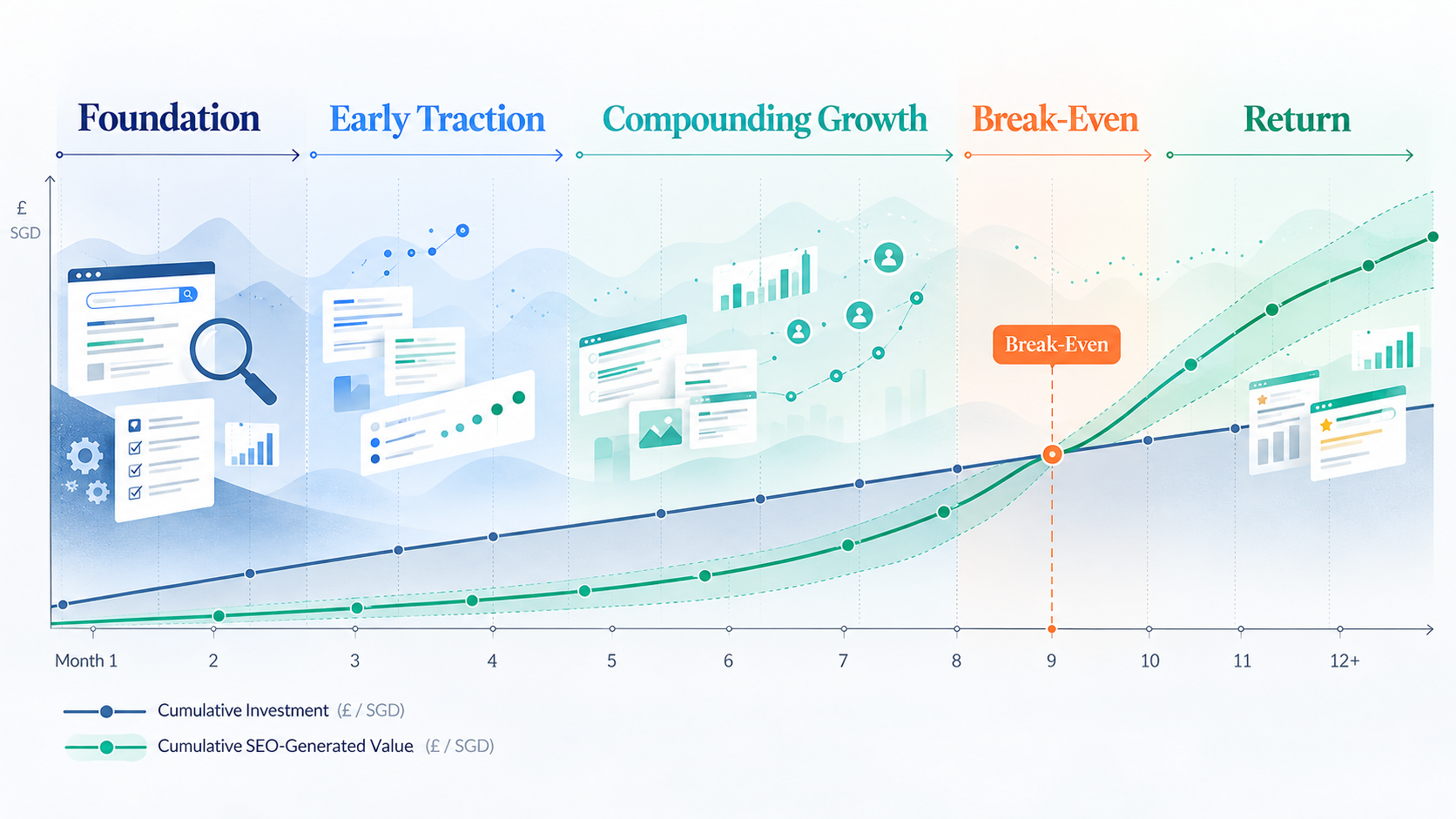
Months 1–2: Audit and strategy phase. Crawl activity from SEO tools increases, but ranking positions remain unchanged. Traffic typically stays flat or dips slightly if technical changes temporarily affect search engine indexation.
Months 3–4: Early content publishes. On-page optimisations roll out. Backlink outreach begins. A small number of new keyword rankings appear, usually long-tail keywords. Traffic typically increases 5 to 15% from baseline.
Months 5–8: Content accumulates and begins ranking. You will see rankings for 20 to 60 new keywords, concentrated in lower-volume or lower-competition terms. Traffic increases 30 to 80% from baseline. First qualified leads may arrive.
Months 9–12: Momentum accelerates. Core, higher-volume keywords achieve rankings. You now have 50 to 150 new keyword rankings. Organic traffic reaches 100 to 250% above baseline. Lead volume grows month-on-month.
Year 2 onwards: Diminishing returns emerge (fewer quick wins remain), but site authority strengthens. Rankings stabilise or improve further. Organic traffic should reach 150 to 400% above year-zero baseline, depending on market competitiveness and initial state. Timelines vary widely depending on competition, baseline position, and conversion setup.
Critical threshold: If you do not observe 20 to 50% traffic growth by month six, ask your agency for explanation. Competitive sectors may slow content ranking speed. However, flat traffic at month six warrants strategy review.

For B2B SaaS, break-even (where retainer cost equals organic lead value closed) typically arrives between months 9 and 18. For ecommerce with direct transaction tracking, break-even often occurs faster (6 to 12 months) when targeting high-intent product keywords. For local services, break-even is typically 4 to 8 months due to lower competition and faster ranking velocity.
ROI timing depends on industry competitiveness, budget allocation, and lead quality. Individual results vary based on sector and starting position.
Red Flags in SEO Pricing and Service Quality
Not all low-cost SEO is ineffective. Not all premium-priced SEO delivers results. However, several consistent warning signs indicate wasteful spending.
Suspiciously Low Pricing
Pricing under £400 per month (approximately SGD 700) for competitive SEO work may indicate resource constraints. Ask providers to clarify their scope and resource allocation.
Here is the mathematics behind sustainable pricing. A full-time SEO specialist costs an agency at least £24,000 to £35,000 annually in salary before on-costs. In Singapore, equivalent roles range from SGD 36,000 to SGD 60,000 annually. Even if your account shares that specialist across eight clients, your portion of their labour cost alone is £3,000 to £4,400 per year (SGD 5,200 to SGD 7,600) simply to cover that agency’s direct costs. Add platform subscriptions, management overhead, and business margin, and responsible pricing typically begins around £1,000 per month (SGD 1,700).
Agencies quoting significantly below these thresholds typically fall into one of these categories:
- Employ junior or inexperienced staff with limited billable value.
- Outsource work to lower-cost geographies without direct oversight.
- Promise ongoing optimisation while delivering minimal actual work each month.
- Operate an unsustainable business model vulnerable to client churn.
The practical test: Request a detailed scope document. What specific tasks will the agency perform each month? How many hours are allocated? Which team members will execute them? If they avoid providing specifics, this is a warning sign.
Guaranteed Rankings
Any agency guaranteeing first-page rankings for specific keywords makes a claim they cannot substantiate.
Google’s algorithm remains opaque and changes continuously. No credible SEO agency can guarantee a particular ranking position. Agencies making such promises either misrepresent their capabilities or rely on tactics that Google’s guidelines explicitly prohibit, such as purchasing links, hidden text, private blog networks, or doorway pages.
If your site violates Google’s guidelines and Google identifies the violation, recovery typically takes months or years. A manual penalty can eliminate 50 to 100% of organic traffic overnight. Recovery costs frequently exceed the original SEO investment.
Instead, listen for this language: “We will improve your rankings for X keywords, with an expected outcome of Y organic traffic and Z qualified leads. Here is our documented track record for similar clients.” Reputable agencies share anonymised data from past work and explain why results require time.
How to Vet an Agency
Use this checklist when evaluating potential SEO partners.
- “Walk me through your process from discovery to implementation.”
A capable agency outlines clear stages: audit, strategy alignment, content planning, on-page optimisation, technical remediation, link building, and measurement. If they skip discovery or gloss over any phase, their thinking is incomplete.
- “What role will our development team play, and what access do you require to our CMS and hosting?”
Effective SEO requires direct access to implement changes. If an agency says “we will send recommendations and you deploy them”, expect implementation delays and misinterpretation. They should request direct control or establish a clear escalation process.
- “Describe a client you worked with in my industry. What were the specific results, and how long did they take?”
Request concrete details: organic traffic percentages before and after, timelines to see movement, and which keywords ranked where. If answers lack specificity or they request you sign an NDA to view case studies, move forward with a different provider. Confident agencies can share anonymised performance data.
- “What SEO tools and platforms do you use, and how do you stay current with algorithm changes?”
They should name specific tools such as Ahrefs, SEMrush, Google Search Console, or similar platforms. Ask how they monitor updates. Professional agencies track Google’s official announcements, follow industry publications, and adjust strategy in response. If they lack a documented process for staying current, they lack required expertise.
- “How do you measure success, and how often do we review progress?”
They should propose measurement frameworks spanning ranking improvements, organic traffic, lead generation or revenue, and conversion rates. They should specify review frequency such as monthly reporting and quarterly strategy review. If they focus only on rankings without linking rankings to business outcomes, they are misaligned with your business goals.
- “Have you experienced a client penalty from Google, and how did you resolve it?”
Honest agencies will confirm they have faced this (any large agency has). Their answer matters: did they quickly identify the cause, recommend disavowal or content removal, and recover the traffic? Or do they claim it has never occurred (indicating they are either new to the industry or not being truthful)?
- “What happens if I want to end our relationship, and can I take my content and rankings with me?”
Your content belongs to you. Rankings belong to your domain and are earned through your site’s authority, not owned by any agency. A professional agency will confirm this arrangement clearly. If they resist or claim to own your content, do not engage them.
Summary and Key Takeaways
SEO spending ranges from £500 per month (SGD 850) for freelancers serving small local markets to £50,000 per month (SGD 85,000) or more for enterprise programmes. Most mid-market companies in the UK spend £2,000 to £7,500 monthly with an agency, equivalent to £24,000 to £90,000 annually. In Singapore, comparable mid-market retainers range from SGD 3,400 to SGD 12,750 monthly.
You are paying for labour allocated across audits, content creation, on-page optimisation, technical fixes, and link building. Cost varies by geography, specialisation, agency scale, and your business complexity.
Monthly retainers provide continuity but may lock you into fixed fees even as required work decreases. In-house teams offer better long-term scalability but demand significant upfront investment and ongoing tool costs. Project-based work suits specific problems but lacks the continuity that drives compound improvement.
SEO outcomes depend on your starting position, industry competition, and strategy quality. Service quality and implementation rigour vary; results depend on strategic fit and execution capability. ROI timing varies widely depending on sector competitiveness, budget allocation, and lead quality. Individual outcomes differ based on these factors.
Red flags include pricing that appears unsustainable for your market size, agencies offering guaranteed rankings, vague scope documents lacking specific deliverables, and agencies resistant to providing direct CMS access. Professional agencies name the tools they use, reference past work with specific metrics, explain their process clearly, and tie SEO outcomes to business growth, not just keyword rankings.
SEO outcomes are not guaranteed; results depend on market conditions, competitor activity, and implementation quality.
Next step: Use the ROI waterfall framework described earlier to calculate your target traffic growth and expected revenue impact. Then ask a prospective agency how they would achieve it. If they cannot articulate a credible plan tailored to your specific situation, they are not yet ready for your business.
Frequently Asked Questions
How long does it typically take before I see measurable SEO results?
Most businesses observe some traffic movement between months three and six, with more significant growth typically visible by months nine to twelve. Highly competitive sectors may extend this timeframe to eighteen months. Timelines vary based on your current traffic volume, keyword difficulty in your sector, and the agency’s execution speed. Do not expect meaningful results before month three.
Can I receive professional SEO work for under £1,000 per month?
This depends on your market and competitive environment. For a local service business operating in a low-competition area, £800 to £1,000 monthly can be effective. For competitive sectors such as SaaS, ecommerce, or financial services, pricing below £1,000 typically indicates insufficient staffing or outsourced junior work with limited oversight. In Singapore, SGD 1,700 to SGD 1,900 represents a similar minimum threshold.
Is hiring an in-house SEO team better than working with an agency?
In-house teams deliver better long-term value if you have sufficient ongoing work (minimum £5,000 monthly spend justified). Agencies excel at providing specialist expertise, flexibility, and faster hiring without permanent overhead. Many organisations benefit from a hybrid model: an in-house manager overseeing strategy plus agency support for specialist functions like link building or content production at scale.
Why does pricing vary so significantly between agencies?
Premium-priced agencies invest in senior strategists, maintain stronger performance records, and retain higher-calibre talent. Lower-cost agencies may staff with junior personnel, outsource labour to lower-cost regions, or reduce time spent on strategy development. Compare based on team composition and deliverable scope, not headline fees alone.
Does paying a higher fee guarantee faster SEO results?
Increased spending does not accelerate SEO results. Google’s indexing and ranking processes operate on algorithmic timescales, not financial ones. Google requires weeks to re-crawl updated pages and months to assess shifts in domain authority. Higher fees purchase more comprehensive strategy and greater output volume per month, not faster indexation or ranking acceleration.
What should I do if my current agency is delivering poor results?
First, confirm your expectations are realistic. You should observe 20 to 50% traffic growth by month six if the agency is executing competently. Request a detailed performance review comparing actual results against agreed benchmarks. If the agency cannot explain gaps or propose a credible improvement plan within thirty days, provide notice. Most contracts allow thirty to ninety-day termination. Do not continue a relationship out of loyalty if measurable improvement stalls.
How much should I budget for SEO software tools if I build an in-house team?
Plan for approximately £800 to £2,500 monthly depending on team size and platform selection. Begin with one premium platform such as Ahrefs or SEMrush supplemented by free Google tools, then add specialist tools as your team grows. Avoid purchasing every available tool; most offerings have overlapping functionality that makes redundant subscriptions wasteful.
Is content creation included in most monthly retainers, or is it billed separately?
Content inclusion varies by contract. Some agencies include two to four articles monthly in the retainer fee; others charge separately at £300 to £800 per piece (these figures are reported by some providers and may vary by region). Always clarify in writing how many content pieces per month are included, who produces them, and what you pay for additional content. Hidden content charges frequently double your effective monthly cost.
What is the most widespread misconception about SEO pricing?
Many assume that higher fees guarantee proportionally better results. A £10,000 monthly agency is not inherently ten times more effective than a £1,000 freelancer. Price reflects organisational scale, geography, and business model rather than results alone. What matters is whether the agency understands your sector, possesses a credible strategic approach, and executes reliably. Smaller, leaner operations frequently deliver stronger results than larger agencies despite charging lower fees.
If I switch to a new SEO agency, will I lose my existing rankings?
No. Your domain owns its rankings and content, not the previous agency. A new agency can access your Google Search Console data, analyse what is performing, and build on that foundation. You may observe a temporary traffic dip of one to two months during transition if the previous agency made changes requiring ongoing active maintenance, but rankings themselves do not disappear when you change agencies.
How do I determine if I am paying more than a fair market rate?
Request an itemised scope of work detailing hours allocated per activity per month, which team members will execute that work, and what deliverables you will receive each month. Compare this scope against the benchmarks in this article. Small business agencies typically charge £500 to £2,000 monthly; mid-market work ranges £2,000 to £7,500; enterprise work starts at £7,500 or higher. In Singapore, apply a currency conversion of roughly 1 GBP to SGD 1.7. If an agency cannot itemise work and justify their time allocation, that is a significant warning indicator. Obtain comparative quotes from at least one additional provider.

What qualifications should I look for when evaluating an agency?
Relevant qualifications include Google Partner certification, membership in professional bodies such as SEOUK, and demonstrable case studies in your industry. However, certification alone does not guarantee results. Equally important are their process clarity, team experience with your sector, and willingness to set realistic expectations. Ask about their average client retention rate and whether they have lost clients due to poor performance.