
| AI Summary
Internet marketing channels work best when they are chosen to fit the customer journey, audience behaviour, unit economics and business stage. This guide explains nine core channels, covering search, social media, email, content, affiliate, display, video, influencer and automation, and sets out a five-step process for choosing between them. It also covers the metrics to track at each funnel stage, how multi-channel attribution works and how to build a stack of three to five channels that you can test, measure and scale. |
The channels you choose to market through will determine how much you spend, how long it takes to see results, and whether you reach the right person at the right moment. Most businesses treat channel selection as an afterthought: they follow trends, copy competitors, or spread their budget evenly across every platform they can find.

This guide takes a different approach. Rather than listing channels in isolation, it shows you how to match channels to your customer journey, measure performance against real thresholds, and build a sustainable marketing stack that grows with your business. Channel choice is not about finding the one “best” option. It is about understanding which combination fits your audience behaviour, your current business stage, and your ability to measure return on investment (ROI).
Whether you are running a B2B SaaS company, an e-commerce store, or a professional services firm, the framework here will help you move from guessing to deciding.
Key Takeaways
- Internet marketing channels are not interchangeable. The right channel depends on your customer journey, audience location and business stage, not on trend or platform size.
- Most businesses fail by spreading budget thinly across too many channels. Three well-chosen channels with consistent messaging will outperform seven channels with split budget and mismatched tone.
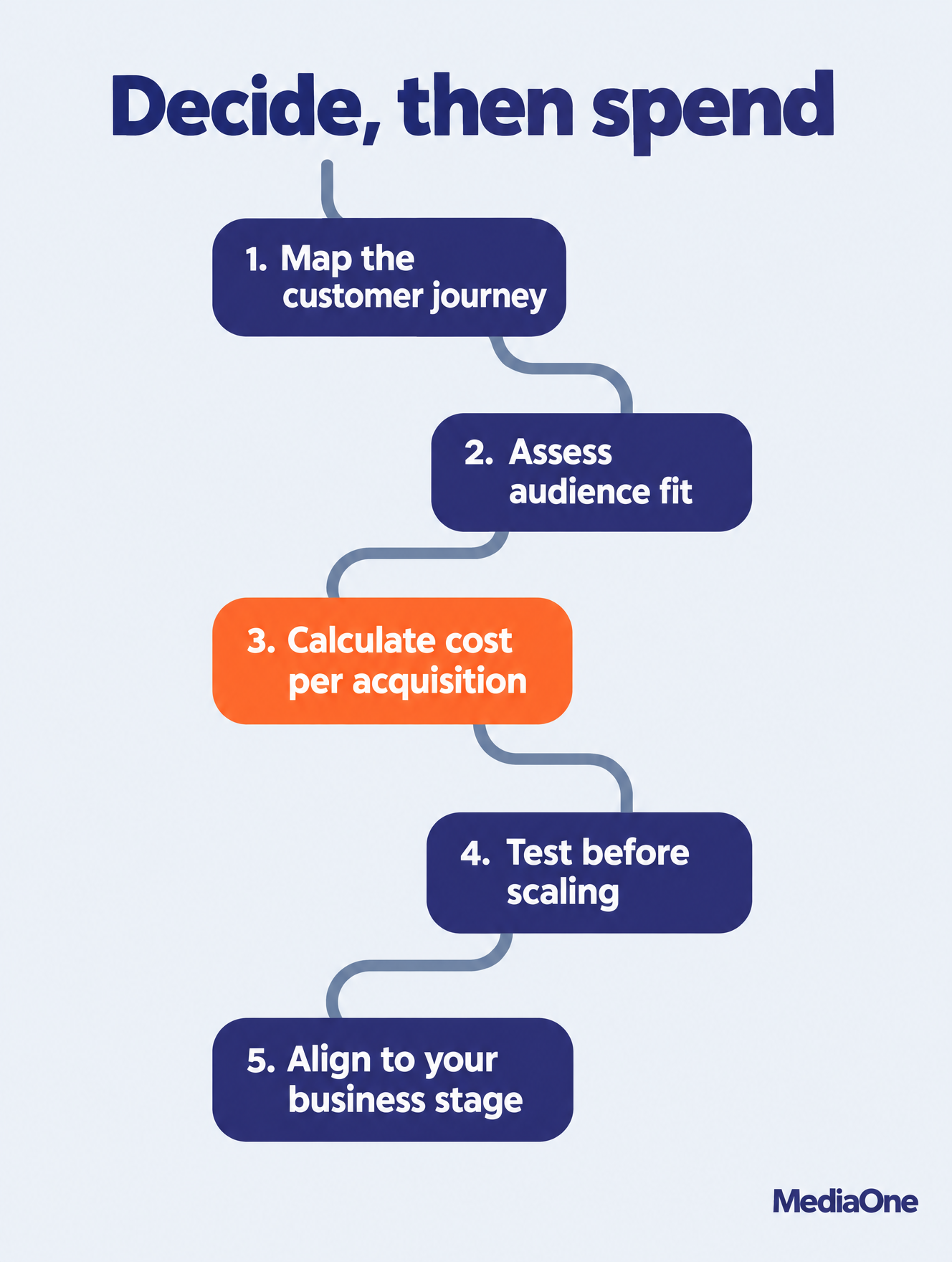
- Use a five-step framework: map your customer journey, assess audience fit, calculate cost per acquisition, test before scaling, and align channels to your business stage.
- Channel effectiveness is measurable from day one. Set baselines for reach, engagement and conversion before spending significantly.
- Performance varies by industry, audience, creative quality and market conditions. B2B organisations benefit from LinkedIn and thought-leadership content; e-commerce thrives on Google Shopping and social commerce; consumer brands win with TikTok and influencer partnerships.
What Are Internet Marketing Channels?
An internet marketing channel is any digital platform, medium or pathway through which you communicate with, reach or convert your target audience. Unlike traditional channels (TV, radio, print), internet channels operate through owned, earned or paid digital properties.
The scope spans everything from Google Search and Facebook ads to your company email list, a LinkedIn article you publish, or a TikTok partnership with a creator. Some channels generate traffic (search, social). Others build authority (content marketing). Others sell directly (email, retargeting). Most perform multiple functions at once.
A channel is not the same as a tactic. Paid search (search engine marketing or SEM) is a channel; keyword bidding is a tactic within it. Email is a channel; segmentation is a tactic. This distinction matters because your channel choice comes first: tactic optimisation comes after.
The nine core channels covered in this guide represent the routes through which most businesses reach their customers online: search engine marketing, social media marketing, email, content marketing, affiliate marketing, display and programmatic advertising, video marketing, influencer partnerships, and marketing automation and retargeting. Other channels exist (podcasting, local search, SMS), but these nine account for the majority of business marketing spend and audience reach.
Why Channel Choice Matters to Your ROI
Channel selection is your single highest-leverage marketing decision. The channel you choose determines your cost per acquisition (CPA) before any optimisation. This is the amount you spend to acquire one customer.
A B2B software company spending on TikTok will struggle to reach decision-makers cost-effectively. An e-commerce retailer ignoring Google Shopping will miss high-intent buyers. A professional services firm skipping LinkedIn will allow competitors to capture these leads instead.
Choosing the wrong channel wastes not just budget but team capacity. Running a campaign on an unsuitable channel consumes designer time, copywriter time and analyst time on a platform where your audience is not present or not ready to buy. That same effort on the right channel multiplies in impact.
Industry benchmarks suggest significant differences in efficiency across channels. For example, paid search typically delivers lower cost per acquisition than untargeted display advertising for the same audience. The channel, not the creative, sets the floor on efficiency.
Return on ad spend (ROAS) varies widely by channel too. ROAS means the revenue you earn for every pound spent on advertising. Retargeting campaigns have been reported to achieve stronger returns than cold prospecting on new audiences. Email to an engaged subscriber list typically achieves higher ROAS than cold paid channels. However, results depend on existing audience size, list quality, targeting accuracy, creative quality and market conditions.
How Channels Differ by Audience Behaviour and Business Model
Your audience’s behaviour on each channel is fundamentally different. Matching your message to that behaviour is essential.
On Google Search, your audience is mid-funnel and ready to compare. They have already identified a problem and are actively researching solutions. They ask specific questions: “best project management software for teams under 10” or “affordable accounting software UK”. This behaviour suits bottom-funnel conversion content and direct offer messaging.
On Instagram and TikTok, your audience is top-of-funnel and browsing for entertainment or inspiration. They are not asking a question; they are scrolling. They may not yet know they have a problem. This behaviour suits storytelling, education, community building and brand awareness. Direct offers underperform because the audience is not in shopping mode.
On LinkedIn, your audience is professional and information-seeking. They engage with thought leadership, data, case studies and insights relevant to their role. A finance director will engage with an article on cost reduction in procurement. LinkedIn suits B2B, education, credentials and authority.
On email, your audience has opted in to hear from you. They are warm. Email is the only channel where your audience has given explicit permission and expects communication. This makes email the highest-ROI channel for retention, upsell and nurture.
Business model shapes channel fit as well. B2B SaaS with a long sales cycle (60 or more days to close) needs channels where you can nurture leads over months: email, content marketing, LinkedIn. B2C e-commerce with a short cycle (instant to 7 days) needs channels with fast feedback and high frequency: paid search, display retargeting, social commerce.
A high-ticket service (£10,000 or more project value) can afford expensive channels like LinkedIn ads because one client pays for many failed attempts. A low-ticket product (£5 to £50) needs high-efficiency channels or organic growth because the maths does not work on paid channels with cost per acquisition above £2.
Your business stage matters too. A pre-launch startup needs channels where word-of-mouth and organic reach are possible: content, social, community building. A mature brand can buy scale on display and paid social because brand recall is high and return on ad spend is predictable.
The channel you choose matches where your audience is present, what behaviour they exhibit on that channel, whether they are ready to hear your message, and whether your unit economics support the cost. The right channel amplifies your effort. The wrong channel makes efficient marketing impossible.
Results vary based on targeting, creative quality, audience size and market conditions. Performance metrics are illustrative and vary by industry, audience, creative, market conditions and seasonality.
The Nine Core Internet Marketing Channels Explained
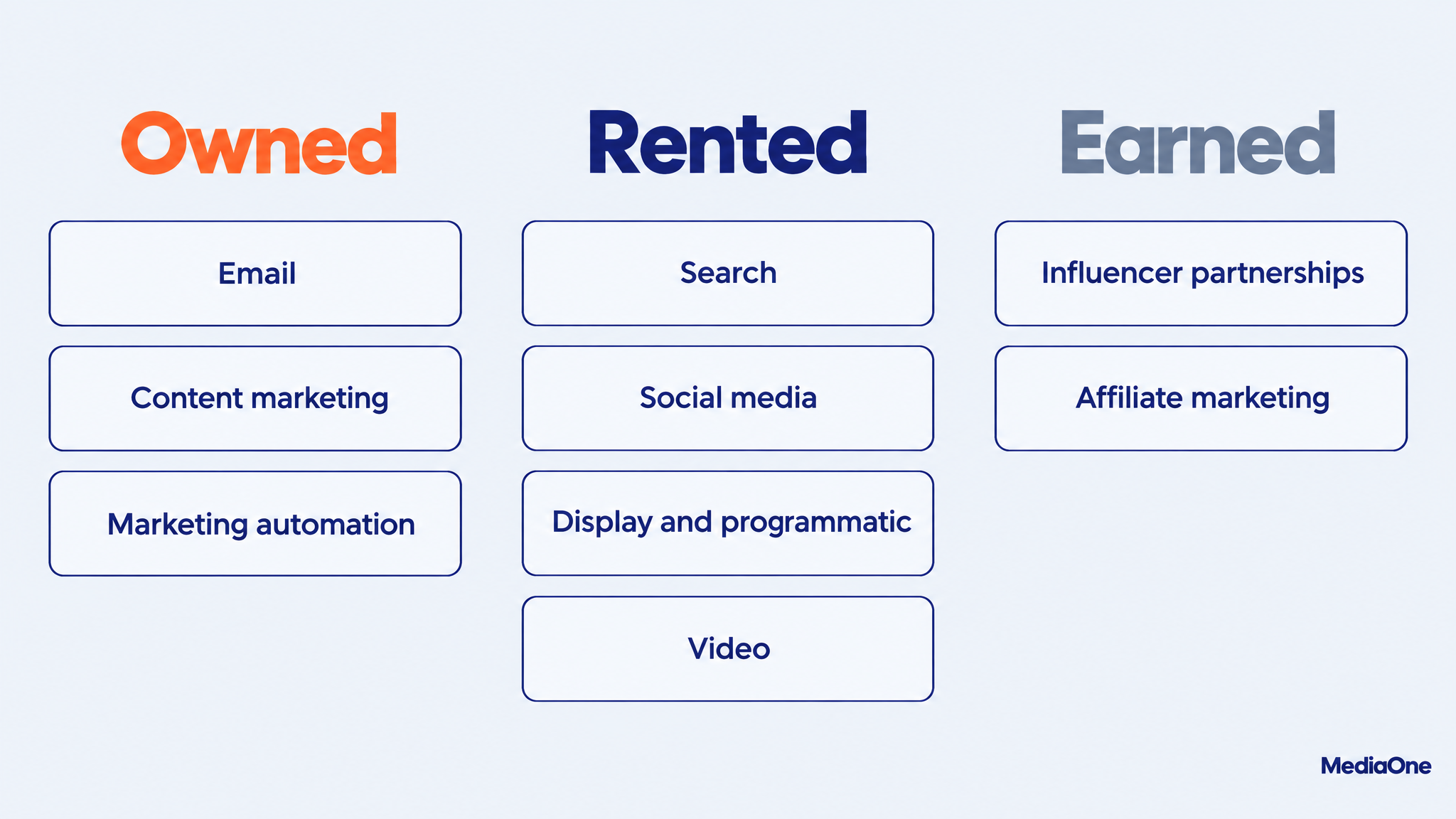
Internet marketing channels fall into three categories: those you own (email, content on your website), those you rent (search, social media, display ads), and those you earn (referrals, earned media). Understanding how each channel works, what it costs, and which audiences respond to it is essential before you allocate budget.
Search Engine Marketing (SEM): Paid and Organic
Search engine marketing combines Google Ads (paid search) and organic search engine optimisation (SEO). Both compete for visibility when someone types a query into Google, Bing or other search engines.
- Paid search (Google Ads) means you bid on keywords and pay per click. A user searching “best project management software” sees your ad at the top of results if your bid and quality score are high enough. You control the message, timing and budget. The downside is that the moment you stop paying, visibility stops.
- Organic search (SEO) means you optimise your website content, technical structure and backlink profile so Google ranks your pages naturally. This takes time to deliver results, but traffic is free once earned. Google’s Search Quality Rater Guidelines emphasise that pages must demonstrate experience, expertise, authoritativeness and trustworthiness (E-E-A-T) to rank for competitive queries.
The best businesses use both. Organic search builds long-term brand authority and reduces customer acquisition cost over time. Paid search captures high-intent traffic immediately and funds testing new keywords before investing in organic optimisation.
Cost: Paid search averages between 2 and 5 times typical customer acquisition costs, depending on industry competitiveness. Organic search has zero per-click cost but requires content investment upfront.
Timeline: Paid results appear within hours. Organic results typically take 3 to 6 months for moderate-competition keywords and vary by domain authority and keyword difficulty.
Social Media Marketing: Platform Selection and Audience Fit
Social media channels are not interchangeable. Your audience, message and product type determine which platform will work.
- LinkedIn is used by B2B decision-makers in finance, HR and IT. Content is educational, data-backed and professional. Best for service firms, software companies and recruitment.
- Instagram and TikTok are visual and video-first. Instagram reaches audiences aged 18 to 45 with strong Gen Z adoption. TikTok captures Gen Z and younger millennials, though older demographics are growing rapidly. Ideal for consumer brands, fashion, food and lifestyle.
- Facebook is the largest social platform globally with approximately 3.1 to 3.2 billion monthly active users (as of 2024), but skews toward older age groups. Strong for local businesses, community groups and retargeting existing customers via ads.
- YouTube is the second-largest search engine after Google. Long-form and short-form video content (Shorts) serve how-to guides, tutorials, product reviews and brand storytelling.
- WhatsApp and local platforms dominate in Singapore. WhatsApp is the primary messaging channel for personal and business communication. Instagram and TikTok are strong for consumer brand awareness. For businesses targeting broader Asia-Pacific audiences, understanding local platform preferences is critical.
- A common mistake is posting identical content across all platforms. Instead, choose 2 to 3 platforms where your audience spends time, and adapt your message to each platform’s norms and format. Platform choice significantly influences conversion rates depending on audience targeting, creative quality and audience size.
Cost: Organic reach is limited on most platforms. Paid social ads range from approximately 0.5 to 5 times your target cost per acquisition, depending on audience targeting and platform.
Timeline: Organic audience growth typically takes 6 to 12 months to build responsiveness. Paid ads generate leads within days.
Email Marketing: Direct Communication with Owned Audiences
Email is the only channel you fully own. No algorithm change, no fee increase and no platform shutdown can take it away. You communicate directly with subscribers who have opted in to hear from you.
Email performs best for three purposes:
- re-engagement (bringing back past customers)
- nurturing (moving prospects closer to a purchase decision)
- retention (keeping existing customers spending). Email typically achieves higher returns on ad spend than cold paid channels, particularly when list quality and segmentation are strong.
Email works because it assumes consent and prior interest. A subscriber has given you permission to message them. This differs fundamentally from cold outreach or display ads, which interrupt uninvited.
Segmentation matters enormously. Sending the same email to everyone dilutes results. Instead, segment your list by purchase history, industry (if B2B) or engagement level. A welcome email to a new subscriber will underperform an email to someone who clicked your last message.
Cost: Email platforms (Mailchimp, ConvertKit, Klaviyo) cost between 10 to 500 pounds sterling per month depending on list size. Cost per subscriber is negligible once the message is sent.
Timeline: Results show within hours. Open rates and click rates are measurable immediately.
Content Marketing: Building Authority and Attracting Visitors
Content marketing is the creation of valuable material such as blog posts, guides, case studies, podcasts and whitepapers designed to answer questions your audience is asking.
Content works because it builds trust before you ask for a sale. A prospect reads your guide on “How to Choose a CRM” and learns you understand their problem. When they are ready to buy, they remember you.

Content marketing also feeds other channels. A blog post can be repurposed into an email series, a social media thread or a video script. It creates internal linking opportunities that help SEO. It gives journalists and influencers material to reference, earning backlinks.
The challenge is consistency. Content takes time to produce and time to rank. Companies publishing content consistently see significantly more leads than those that do not. However, “consistent” means weeks or months, not days.
Content marketing ROI is hardest to measure directly because the path from a blog post to a sale is long. Attribution becomes complex: did the blog post cause the sale, or did it simply warm up a prospect who was about to buy anyway? This is why content is best paired with email or retargeting. Capture the visitor’s email after they read your content, then track the downstream conversion.
Cost: In-house production of one blog post costs between 200 and 800 pounds sterling (writer time). Outsourced production costs 500 to 2,500 pounds sterling per piece depending on research depth and word count.
Timeline: A blog post takes 3 to 6 months to reach meaningful traffic. Long-tail SEO content (lower-volume keywords) can begin generating leads within 8 weeks.
Affiliate Marketing: Leveraging Third-Party Networks
Affiliate marketing means paying external partners such as bloggers, agencies, or review sites a commission for each sale or lead they send you. You pay only for results, not for clicks or impressions.
For example, a SaaS company might partner with a software review site (Capterra, G2) or an agency that specialises in comparisons. When a user clicks the affiliate link and signs up, the affiliate receives a commission, often 20 to 50 per cent of first-year subscription value.
Affiliate marketing scales your reach without paying upfront. The partner is incentivised to convert because they only earn if you do. This aligns interests perfectly.
The downside is less control over messaging and brand positioning. An affiliate may describe your product inaccurately or position it in a way that attracts the wrong customer type. You also need a competitive commission structure: too low, and affiliates ignore you; too high, and margins shrink.
Affiliate marketing works well for e-commerce, consumer apps and subscription software. It is less suitable for high-touch B2B sales where relationships and customisation matter more than price-driven comparison.
Cost: Zero upfront cost. You pay 15 to 50 per cent commission per conversion. In e-commerce, this often reduces to 5 to 15 percent.
Timeline: Affiliate networks take time to recruit and train partners. First conversions may take 2 to 3 months, but then scale quickly.
Display and Programmatic Advertising: Reaching Audiences Across the Web
Display advertising means showing banner, text or video ads on websites, apps and platforms outside of search. Google Display Network alone reaches 90 percent of internet users globally.
Display ads are paid for by impression (cost per thousand impressions, or CPM) or by click (CPC). Unlike search ads, display ads interrupt rather than respond to intent. Someone is reading a news article, and your ad appears in the sidebar. They did not ask for it.
This makes display ads effective for awareness and retargeting rather than direct response. Retargeting is particularly powerful: show an ad to someone who visited your website but did not buy. Retargeted users have been reported to be significantly more likely to convert than cold audiences.
Programmatic advertising automates the buying process. Instead of negotiating placements manually, algorithms bid on ad inventory in real time, targeting specific audiences (age, interests, behaviour) across thousands of websites simultaneously. Programmatic offers scale but requires clear audience definition and sufficient budget to allow the algorithm to learn, typically a minimum monthly investment.
Cost: Display CPM ranges from approximately 2 to 15 pounds sterling depending on audience specificity and website quality. Retargeting CPM is lower (1 to 8 pounds sterling) because the audience is warm.

Timeline: Awareness builds over weeks. Retargeting converts within days.
Video Marketing: YouTube, TikTok and Streaming Platforms
Video is now the dominant content format. YouTube has 2.5 billion logged-in monthly users. TikTok reaches 1.5 billion users, with particular strength in Asia and younger age groups.
YouTube works for product demonstrations, educational content, customer testimonials and how-to guides. YouTube Shorts (under 60 seconds) compete directly with TikTok. YouTubers have built loyal audiences, making influencer partnerships valuable. YouTube is also searchable: users type queries into YouTube as they would Google, so SEO principles apply.
TikTok dominates short-form video (15 to 60 seconds). Tone is irreverent, trend-led and highly personal. Brands that succeed on TikTok lean into authenticity and trend participation rather than polish. Best for consumer brands and younger audiences.
Streaming platforms such as Netflix and Disney+ are adding ad-supported tiers. As cord-cutting accelerates, streaming is becoming a significant ad platform, though targeting is less granular than digital channels.
Video performs well because it conveys emotion, movement and complexity better than text. A 2-minute product demonstration shows functionality faster than 500 words of written description.
The challenge is production cost and time. A basic YouTube video requires scripting, filming, editing and voiceover work. Outsourced production ranges from 1,000 pounds sterling for simple explainers to 10,000 pounds sterling or more for broadcast-quality content. TikTok rewards volume, so budget-constrained businesses should start with phone-recorded shorts rather than polished production.
Cost: Organic upload is free. YouTube ads (skippable in-stream) cost between 0.15 to 3 pounds sterling per view depending on targeting. TikTok ads cost 0.50 to 2 pounds sterling per click.
Timeline: Organic TikTok videos can gain significant traction within hours. YouTube videos typically build views over weeks and months.
Influencer Partnerships and Brand Collaborations
An influencer is an individual with a loyal audience in a specific niche. They might be a beauty YouTuber, a fitness TikToker, a business commentator on LinkedIn or a newsletter writer.
Influencer partnerships work because audiences trust the creator more than they trust branded messages. When an influencer recommends your product, it feels like a peer recommendation, not advertising.
Influencers come in tiers. Mega-influencers (1 million plus followers) charge the most but reach the broadest audience with lower engagement rates. Micro-influencers (10,000 to 100,000 followers) have higher engagement and more niche audiences, often at 20 to 40 percent of mega-influencer rates. Nano-influencers (under 10,000 followers) have the highest engagement but require more partnerships to scale reach.
Partnerships are structured in three ways:
- paid posts (influencer is paid a flat fee)
- commission (you pay per sale generated)
- product seeding (influencer receives free product).
The best approach depends on your budget and the influencer’s audience alignment.
The risk is authenticity. If an influencer promotes too many products, their audience perceives it as inauthentic. Also, influencer audiences are often younger and may not match your target customer. Choose influencers whose audience demographics align with your ideal customer profile.
Cost: Micro-influencers typically charge 500 to 5,000 pounds sterling per post. Mega-influencers charge 10,000 to 100,000 pounds sterling or more.
Timeline: Campaign setup takes 2 to 4 weeks. Results appear within days of posting.
Marketing Automation and Retargeting
Marketing automation uses software to trigger messages based on user behaviour. An example: when someone abandons a shopping cart, an automated email sequence reminds them, offers a discount, and asks why they did not complete the purchase.
Retargeting shows ads to users who have already visited your website. When someone leaves without buying, retargeting allows you to follow them across the web with relevant ads. Retargeting has been reported to achieve significant returns when audience size and existing conversion rate support the investment. Results depend on the size of your existing audience and baseline conversion rate.
Automation and retargeting reduce cost per acquisition because you are marketing to warm, known audiences rather than cold prospects. They also allow personalisation at scale. Different email sequences can be triggered for different user segments automatically.
The platforms that power automation and retargeting include Google Ads (for retargeting display and search campaigns), Meta Ads (for retargeting on Facebook and Instagram), and email platforms like HubSpot, ActiveCampaign and Klaviyo.
Cost: Retargeting ad spend typically starts at 500 to 2,000 pounds sterling per month to let algorithms optimise. Email automation platforms cost 50 to 1,000 pounds sterling monthly depending on subscriber count.
Timeline: Retargeting shows results within weeks. Automation sequences build effectiveness as they gather more user data.
Performance metrics vary by industry, audience, creative quality and market conditions. Figures provided are indicative and subject to change based on targeting, competitive landscape and seasonality.
Influencer Partnerships and Brand Collaborations
Brands pay influencers to create content featuring their product or service. The influencer’s endorsement carries weight because their audience trusts them more than they trust brand advertising.
Influencer marketing works because it bypasses ad blindness. A user scrolls past 100 display ads but stops to watch a creator they follow unbox a product.
Effectiveness varies widely based on influencer-brand fit and audience authenticity. Partnering with a mega-influencer (1 million+ followers) feels safer but is expensive and often yields low engagement rates. Micro-influencers (10,000 to 100,000 followers) in your niche often convert better per pound spent because their audiences are hyper-focused and genuinely interested in the niche.
Verify audience authenticity before committing budget. Tools such as HypeAudience or Social Blade help check whether followers are real people or inactive accounts. A creator with 50,000 followers delivers no value if 80 per cent are bots.
Cost varies by influencer tier. Micro-influencers charge £500 to £5,000 per post. Mid-tier creators (100,000 to 1 million followers) ask £5,000 to £50,000. Mega-influencers command £50,000 or more. These are illustrative figures and vary by platform, geography and industry.
Campaign setup takes 2 to 4 weeks from brief to content approval. Content goes live within weeks and drives traffic immediately.
Marketing Automation and Retargeting
Marketing automation tools such as HubSpot, Marketo and ActiveCampaign, combined with retargeting platforms like Google Ads and Facebook Conversion API, address one core challenge: keeping your message in front of people who have already shown interest.
Retargeting works because it solves a specific problem. Most website visitors leave without converting. Retargeting shows them an ad later, reminding them of what they saw. Conversion rates on retargeted users have been reported to achieve 2 to 10 times higher performance than cold traffic. Results depend on your existing audience size and conversion rate baseline.
Marketing automation extends this by sending triggered emails, SMS or push notifications based on user behaviour. Someone abandons a shopping cart and receives a reminder email. Someone watches a video on your website and gets added to a nurture email sequence.
Automation works because it personalises at scale. You cannot email 10,000 people individually, but you can set up rules that send the right message to the right person at the right time based on their action.
Setup requires significant time to design workflows and integrate tools. Once active, ongoing cost per contact is minimal.
HubSpot ranges from £45 to £1,200 per month depending on features. Retargeting ad spend follows standard cost-per-click or cost-per-thousand-impressions pricing. These figures are illustrative and vary by industry, audience, creative and market conditions.
Automation takes weeks to set up but runs continuously once active. Results appear within days.
How to Choose the Right Channels for Your Business
The average business wastes between 20 and 40 percent of its marketing budget on channels that do not fit its customer base or business model. This happens not because the channels are weak, but because they were chosen without a clear decision framework.
Most businesses treat channel selection as an afterthought. The five-step process below moves you past gut instinct and platform hype. It asks: where do my customers actually make decisions, what can I afford to acquire them for, and which channels match my resources and timeline?
Step 1: Map Your Customer Journey and Touchpoints
Before choosing a channel, understand when and where your customer first becomes aware they have a problem.
The journey differs by product type. A software buyer spends weeks researching on Google and LinkedIn, reads case studies on your website, and talks to a sales team. A fashion buyer sees an Instagram post, clicks through, and buys within five minutes.
Map three layers:
- Awareness stage: How does your customer first realise they need what you sell? Do they search “how to solve X problem” on Google? Do they see peers discussing solutions on LinkedIn? Do they discover your product on TikTok?
- Consideration stage: Once aware, where do they compare options? Are they reading blog articles and reviews? Watching YouTube comparisons? Asking friends on Reddit?
- Decision stage: Where do they make the final choice? Are they visiting your pricing page directly? Booking a demo call? Re-checking reviews before checkout?
This map is not theoretical. Interview your last ten customers. Ask them explicitly where they first heard about you, what sources they consulted, and what made them choose you. You will often find that the channels you assumed were important barely figured in anyone’s journey.
For example, a London-based B2B accountancy practice might discover that 70 per cent of clients came through referrals or Google search, 20 per cent through LinkedIn content, and nearly zero per cent through Facebook ads. That discovery saves months of wasted budget.
Step 2: Assess Audience Demographics and Platform Preferences
Not all audiences use all platforms equally. Demographic data alone is incomplete. You need both demographics and platform usage behaviour specific to your target market.
Use these sources to build a clear picture:
Platform-native research: Meta’s Advertiser Insights, LinkedIn Campaign Manager, and YouTube Analytics all publish free audience breakdowns by age, gender, geography, and interest. These are your most reliable sources because they come directly from the platforms with the most recent user data.
Regional data: If you operate in the UK or Commonwealth markets, the Internet Advertising Bureau (IAB UK) publishes annual research on digital advertising spend and platform adoption. In Singapore and Southeast Asia, the Asian Digital Media Association (ADMA) tracks similar trends. These reports are more granular than US-only data. In Singapore specifically, WhatsApp and Instagram dominate consumer messaging and social commerce, whilst TikTok and Instagram are rising for consumer brands. Lazada and Shopee dominate e-commerce. These regional patterns differ from global trends.
Audience research tools: Semrush, Similarweb, and Meta Business Suite show you where your competitors’ audiences spend time and what they do there.
Once you have this data, ask three questions:
- Is your primary audience actually on this platform? If your product appeals to construction site managers aged 45 to 65, TikTok is not your channel, even if TikTok grows year on year.
- Does the platform’s culture match your message? A luxury brand may struggle on platforms associated with bargain hunting or informality. A sustainability startup thrives on platforms where audiences value ethical commerce.
- Can the platform’s format (video, static image, short-form text, long-form content) showcase your offer? If you sell industrial machinery, a 15-second TikTok is unlikely to serve you. If you sell consumer packaged goods, it might be perfect.
This step eliminates channels before you spend money.
Step 3: Calculate Cost Per Acquisition by Channel
Every pound spent on marketing should return more than a pound in profit. Cost per acquisition (the total cost of acquiring one new customer) is the metric that tells you whether it does.
Cost per acquisition is simple to calculate. Divide the total spend on a channel by the number of new customers it brought in. If you spent £2,000 on Google Ads last month and acquired ten customers, your cost per acquisition was £200.
The hard part is knowing whether £200 is good. That depends on your profit margin and customer lifetime value (the total profit you expect from one customer over the duration of your relationship with them).
Define your threshold: If a customer is worth £500 in profit over their lifetime, you can afford a cost per acquisition of around £150 to £200. If a customer is worth £2,000, you can afford a much higher cost per acquisition. If a customer is worth £50, you cannot afford £200.
Calculate your threshold first. Work backwards from your financial model, not forwards from what you think customers should cost.
Test early with a small budget. Many businesses skip the cost per acquisition calculation until they have already committed thousands to a channel. Start with a test budget of £200 to £500 per channel. Run the channel for at least two weeks (long enough to gather meaningful data, short enough to avoid sunk-cost bias). Track every penny and every customer.
Compare across channels: Once you have cost per acquisition data for two or three channels, compare them directly. If Google Ads gives you a cost per acquisition of £180 but email marketing (once you factor in list building and platform costs) gives you £45, email is more efficient at acquisition, even if Google brings more total volume.
Most businesses discover that one or two channels are two to three times more efficient than the others. Those become your priority.
Do not chase volume if margin is wrong. Some channels deliver many customers but at a cost per acquisition that erodes profit. Others deliver fewer customers but profitably. Choose margin over volume every time.
Step 4: Test and Measure Before Scaling Investment
A common pattern: a business finds a channel that works, then doubles the budget immediately, hoping for linear returns. Instead, the cost per acquisition doubles because they have exhausted the most responsive audience segment, and they end up spending twice as much for the same return.
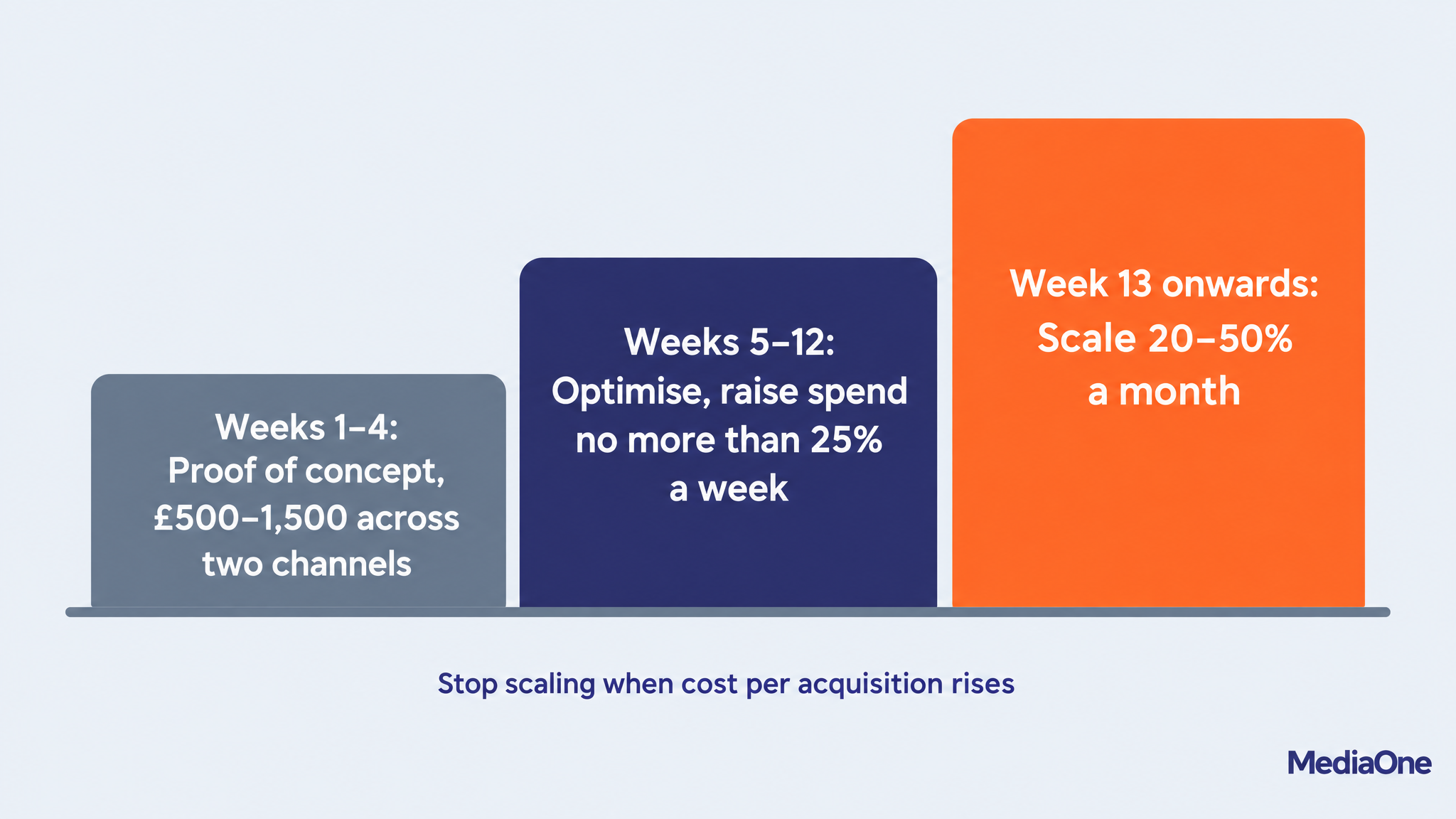
Structured testing prevents this. Use a disciplined scaling approach:
Phase 1: Proof of concept (weeks 1 to 4)
Spend £500 to £1,500 across your two most promising channels (based on steps 1, 2, and 3). The goal is not revenue; it is to confirm that the channel works at all. Can you acquire a customer through it? Does the message resonate?
Phase 2: Optimisation (weeks 5 to 12)
Keep spend flat or increase by no more than 25 percent per week. Use this time to refine targeting, creative, messaging, and landing pages. Test one variable at a time. Watch your cost per acquisition. If it stays below your threshold, move to phase 3. If it creeps above, pause and diagnose why before spending more.
Phase 3: Scaling (week 13 onwards)
Once you have a cost per acquisition that is 20 to 30 percent below your threshold and three consecutive weeks of stable or improving performance, increase spend by 20 to 50 percent per month. Increase spend slowly enough that you can still detect if cost per acquisition is rising. If it is, you have reached the efficiency frontier of that channel: stop scaling, optimise further, or move budget elsewhere.
Maintain a live measurement dashboard for each active channel. Check it weekly. This takes two hours per week and prevents thousands in wasted spend.
Step 5: Align Channels with Your Current Business Stage
A startup with £2,000 monthly budget, a growing mid-market firm with £20,000, and an established enterprise with £200,000 should use completely different channels.
Startup phase (bootstrapped or pre-seed)
You have no brand awareness and a very limited budget. Channels that require scale or brand equity (display advertising, influencer partnerships) will waste your money. Focus instead on:
- Google search and SEO: Free after the first few weeks. You capture intent that already exists (someone searching “how to…” or “best…”). Organic search takes three to six months for moderate-competition keywords; timelines vary by domain authority and keyword difficulty. Costs almost nothing to start.
- Direct outreach and cold email: Time-intensive but nearly free. Effective for B2B sales.
- Communities (Reddit, niche forums, Slack communities): Build audience and credibility by being helpful, not by advertising.
- Content marketing: Start writing or podcasting about the problem you solve. Takes months, but builds competitive moat.
- Expected channel mix: 60 percent organic search, 30 percent direct outreach or community, 10 percent experimental paid spend.
- Growth phase (product-market fit, £5,000 to £50,000 monthly budget)

You have proved that your product works and some channels are profitable. You can now afford paid channels and should diversify slightly to accelerate growth.
- Paid search (Google Ads, Bing): Double down if your cost per acquisition is below threshold.
- Email and retargeting: You now have an audience to market to repeatedly. Retargeting has been reported to achieve higher return on ad spend than cold paid channels; results depend on existing audience size and conversion rate.
- Social advertising: Test where your audience is (Instagram, LinkedIn, TikTok, Facebook). One or two will work.
- Partnerships and affiliates: You can afford commissions if the channel is profitable.
- Content marketing: Still write, but now you can amplify it with paid promotion.
- Expected channel mix: 30 percent paid search, 20 percent email or retargeting, 20 percent paid social, 15 percent organic search, 15 percent partnerships and content.
Mature phase (dominant market position, £50,000 or more monthly budget)
You have brand awareness and can afford channels based on reach and brand building, not just direct response. Expect longer sales cycles and softer metrics (awareness, sentiment) to matter more.
- Brand awareness campaigns: Display ads, video, podcast sponsorships. Return on investment is harder to measure but critical for long-term share.
- Thought leadership: Paid distribution of whitepapers, research, speaking engagements.
- Influencer and creator partnerships: You can negotiate partnerships rather than relying on ad auctions.
- Owned channels: Community platforms, email newsletters, regular content.
- Paid search and social: Still efficient, but no longer your only growth lever.
Expected channel mix: 25 percent paid search, 20 percent paid social, 15 percent display and brand awareness, 15 percent email and owned, 10 percent partnerships, 10 percent organic, 5 percent experimental.
This does not mean startups should never test paid social, or that enterprises should ignore organic search. It means your primary allocation should match your resources and stage. A startup with £200 per month will see a return on organic search work; the same spend on Facebook ads will disappear without signal. An enterprise ignoring SEO will lose market share to competitors who dominate search.

Ask yourself: Do I have the budget and brand to support this channel?
If the answer is no, move down the priority list.
Results vary based on targeting, creative quality, audience size, and market conditions. Performance metrics are illustrative and vary by industry, audience, creative, and market conditions.
Channel Performance Metrics: What to Measure and Why
Choosing the right channel means nothing if you cannot measure whether it is working. Most businesses measure traffic or clicks and call it done. That approach sinks channel investment.
The funnel is not linear anymore. A customer might see your brand on LinkedIn, click through from an email two weeks later, and buy after finding your guide in Google search. Each touchpoint matters. You need metrics that tell you what each channel actually does in that journey, not just how many people saw it.
Top-of-Funnel Metrics: Reach, Impressions and Awareness
Top-of-funnel channels introduce your business to people who do not yet know you exist. They are measured differently than channels deeper in the funnel.
Reach is the number of unique people who see your content. Impressions are the total number of times that content is displayed, whether the same person sees it once or ten times. Display advertising, YouTube and organic social thrive here.
Reach and impressions alone do not prove a channel works. They show only that you are visible. A campaign with 100,000 impressions and zero follow-up clicks tells you your message is not resonating.
The real metric at this stage is awareness lift: whether people who see your message later visit your site, search for your brand, or mention it online. You measure this through brand search uplift studies or via a control group (served no ads) against a test group (served your campaign). Facebook and Google Ads both offer brand-lift measurement tools.
For organic content and SEO, measure organic impressions (how many times your pages appear in Google search results) and click-through rate from search results, or CTR. If your page ranks at position 3 but has a CTR of 1.5 per cent when position 3 averages 5 per cent, your title or meta description is not compelling enough. That is actionable.
Why it matters: Reach without conversion is vanity. But reach is necessary. You cannot convert people who never knew you existed. Measure reach alongside a downstream metric, such as brand searches or email sign-ups, to confirm top-of-funnel activity is creating real interest.
Mid-Funnel Metrics: Click-Through Rate and Engagement
Mid-funnel channels are where consideration happens. Someone knows about you now and is deciding whether to explore further.
Click-through rate (CTR) is the percentage of people who see your content and click on it. If 1,000 people see your email and 50 click, your CTR is 5 per cent. CTR varies by channel and audience warmth. Cold Facebook ads often see 0.5 to 2 per cent CTR. Email to a warm list sees 2 to 5 per cent. Search ads see 3 to 8 per cent depending on keyword relevance.
Engagement rate is broader and includes clicks, shares, comments and saves. A LinkedIn post with 200 impressions and 10 reactions, 2 comments and 1 share has a 6.5 per cent engagement rate. This signals whether your message resonates. High CTR with zero engagement suggests you are misleading people with your headline. High engagement with low CTR suggests your offer is not clear enough.
Cost per click (CPC) is how much you pay per click on a paid channel. Google Ads charges per click. Social media charges per click or per impression. The key insight is this: do not compare CPCs across channels. A click on Google Ads is worth more than a click on Facebook because the intent is higher. Instead, compare CPC within channels over time. If your Google Ads CPC rises from one week to the next, something is wrong: weaker keywords, lower quality score or seasonal competition.
Why it matters: Mid-funnel metrics tell you whether your message is compelling and your offer is clear. A good mid-funnel channel is one where you can afford the cost per click and the CTR is high enough to move significant traffic.
Bottom-Funnel Metrics: Conversion Rate and Cost Per Acquisition
Bottom-funnel metrics are where the money is. They measure whether your channel actually generates customers, not just clicks.
Conversion rate (CR) is the percentage of visitors who complete a desired action: signing up for a free trial, adding to cart, completing a purchase or scheduling a demo. If 100 people land on your pricing page and 5 buy, your conversion rate is 5 per cent.
Conversion rate varies dramatically by funnel stage and audience temperature. First-time visitors to your pricing page might convert at 1 to 3 per cent. People returning to your site (via retargeting or direct) convert at 5 to 15 per cent. Email subscribers convert at 3 to 8 per cent depending on list quality and message relevance.
Never compare conversion rates across channels directly. A 2 per cent conversion rate on Google Ads (high-intent traffic) is better than a 5 per cent conversion rate on untargeted Facebook ads (low-intent traffic) because the Google customer quality is higher. Instead, look at customer lifetime value (CLV) by channel: total profit from customers acquired through that channel.
Cost per acquisition (CPA) is the core metric. Divide total channel spend by new customers acquired. If you spent 1,000 SGD on Google Ads and acquired 10 customers, CPA is 100 SGD. This is your north star for channel comparison and scaling decisions.
Return on ad spend (ROAS) measures revenue divided by spend. If you spent 1,000 SGD and generated 3,000 SGD in revenue, ROAS is 3:1. ROAS is higher than the actual profit return because revenue includes cost of goods and overhead. Use it to trend performance, not to set profitability thresholds. Results vary based on targeting, creative quality, audience size and market conditions.
Why it matters: Bottom-funnel metrics separate good channels from bad ones. They tell you which channels are actually paying for themselves. A channel with high reach and engagement but zero conversions is a sunk cost.
Troubleshooting Common Measurement Issues
Even with the right metrics in place, teams often struggle to interpret channel performance. Here are the most common measurement mistakes and how to avoid them.
| Common Challenge | Why It Happens | How To Avoid |
|---|---|---|
| Comparing conversion rates across channels without accounting for audience intent | Different channels attract different audience temperatures; a cold paid social visitor has lower intent than a Google search visitor | Always compare within channel or by audience segment; use customer lifetime value (CLV) instead of raw conversion rate |
| Over-crediting the last touchpoint and defunding awareness channels | Last-click attribution only gives credit to the final channel a customer touched before buying | Use multi-touch attribution or linear attribution; measure awareness channels by brand search uplift or consideration metrics instead |
| Scaling a channel based on reach alone without tracking downstream conversions | Reach and impressions feel like progress but do not guarantee customers | Build a dashboard linking each channel to at least one mid-funnel metric (CTR, email open rate) and one bottom-funnel metric (CPA, ROAS) |
| Ignoring seasonality and external factors when comparing channel performance week-to-week | Channel performance shifts with competition, seasonality and market conditions; a 20 per cent CPC increase might reflect industry trends, not poor management | Compare performance month-over-month or year-over-year; use a control group to isolate channel effects; note external events (competitor campaigns, seasonality) |
| Using industry benchmarks as targets instead of internal baselines | Industry averages hide the fact that your business model, audience and creative quality are unique; chasing a benchmark is guesswork | Establish your own baseline (typical CPA, CTR, ROAS for each channel) and improve week-on-week; use benchmarks only to spot obvious outliers |
| Measuring channels in isolation instead of understanding the full customer path | Single-channel measurement ignores the fact that most customers touch multiple channels before converting | Build attribution models (linear or data-driven) that show how each channel contributes; measure channel combinations, not just individual channels |
Multi-Channel Attribution: Understanding the Full Customer Path
Here is the problem with single-channel measurement: almost no customer buys from a single touchpoint. They encounter your brand across multiple channels before converting. If you measure each channel in isolation, you either over-credit the last touch or under-credit the channels that built awareness and trust.
A customer might follow this path:
- See a LinkedIn article (awareness)
- Search your brand on Google and land on your homepage (consideration)
- Receive an email nurture sequence (consideration)
- Click a retargeting ad (consideration)
- Return to your pricing page directly and buy (decision)
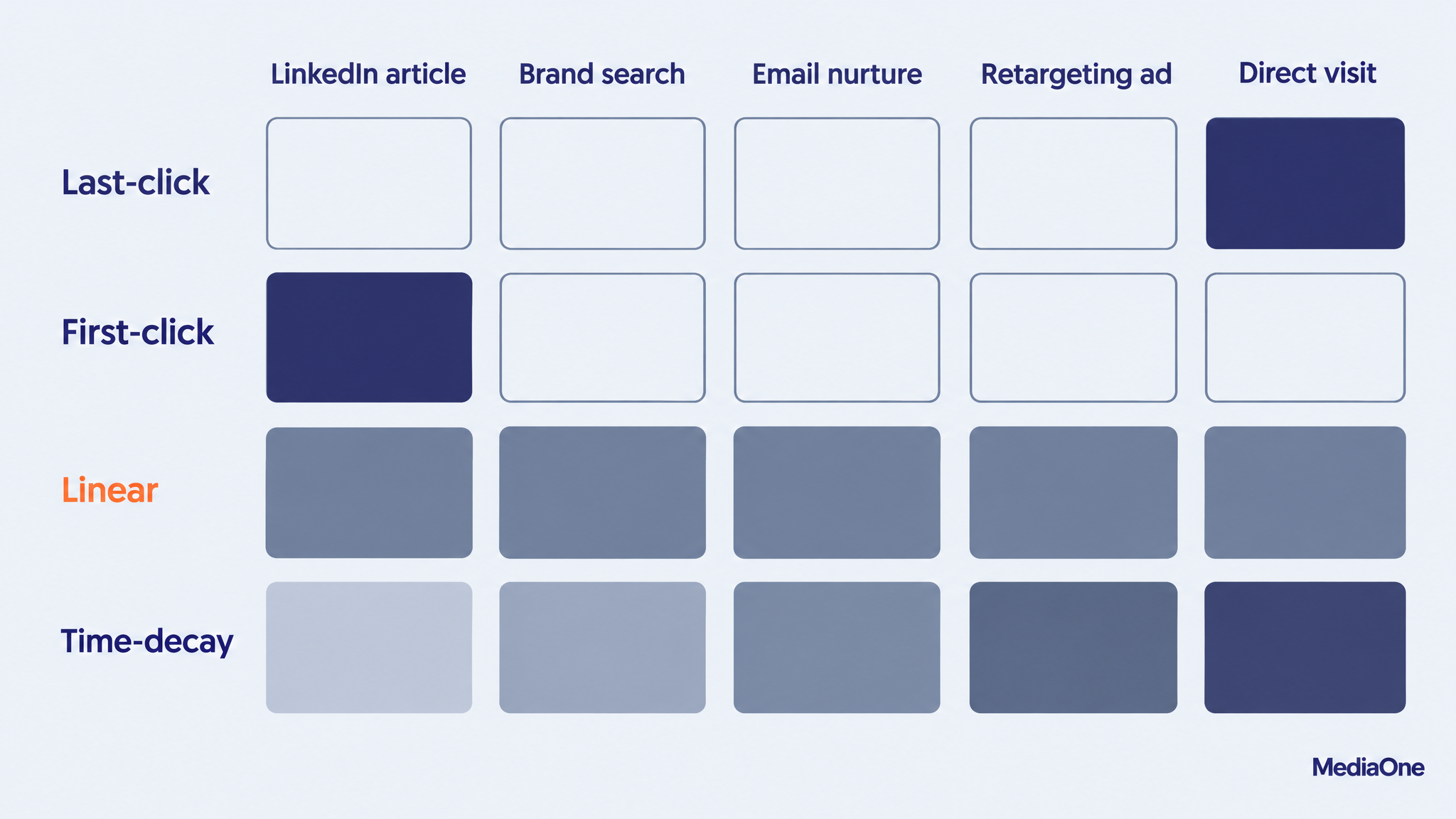
If you use last-click attribution, you credit only the direct visit. Email, LinkedIn and retargeting get zero credit, even though they did the real work. If you use first-click attribution, you credit only LinkedIn. The truth is somewhere in between.
Most tracking platforms offer attribution models that weight touches differently.
Linear attribution assigns each touchpoint equal credit. This is fair but does not recognise that awareness and decision points play different roles.
Time-decay attribution gives more credit to touchpoints closer to conversion. This recognises that later touches matter more but may undervalue early awareness building.
Data-driven attribution (available in Google Analytics 4) uses machine learning to assign credit based on actual historical conversion data from your own customers. This is the most accurate but requires significant data volume to work well.
For small businesses, the practical approach is simpler. Use last-click as your baseline (because it is most conservative), then build a second dashboard using linear attribution to see which channels are truly building the customer path. Compare them quarterly.
The key lesson: do not defund a channel because last-click attribution shows low conversion. Awareness channels (LinkedIn, content, display) often show low last-click conversion because their job is to introduce, not to close. Measure them by whether they move people from unawareness to consideration, not by direct sales.
Building a Sustainable Multi-Channel Marketing Stack
The businesses with the most stable growth use three to five channels in concert, not seven channels spread thin.
A good channel stack works because channels do different jobs and are sequenced to match customer behaviour:
Awareness channels: Where new people discover you exist. Usually organic (search, content) or paid (display, paid social, YouTube). Metrics: reach, impressions, brand search uplift.
Consideration channels: Where aware prospects compare you to alternatives. Email, content marketing (guides, case studies), paid social retargeting, LinkedIn. Metrics: click-through rate, email open rate, time on page, pages per session.
Conversion channels: Where decisions are made. Paid search (high intent), retargeting ads, email (final nurture), affiliate partnerships. Metrics: conversion rate, CPA, ROAS.
Retention channels: Where you keep existing customers coming back. Email (post-purchase), content (loyalty building), referral programmes, community. Metrics: repeat purchase rate, customer lifetime value, net promoter score (NPS).
A B2B SaaS company might build this stack:
- Awareness: Organic search (SEO) and content marketing (blog, guides, case studies). Free, scalable and attracts high-intent traffic.
- Consideration: Email nurture sequences (from blog subscriber list), LinkedIn sponsored content (targets specific job titles), retargeting ads on Google Display.
- Conversion: Paid Google search (high-intent keywords), sales-assisted (email plus sales call), affiliate partnerships with review sites.
- Retention: Email (product updates, upsell), in-product messaging, community (Slack, user group), customer success plays.
An e-commerce retailer might build this stack:
- Awareness: Organic search (SEO product pages), TikTok (brand building, viral potential), Instagram (visual product showcase).
- Consideration: YouTube (product reviews, tutorials), email (abandoned browse recovery), Pinterest (visual inspiration and direct to product).
- Conversion: Paid search (Google Shopping, Google Ads for high-intent keywords), retargeting ads, Instagram shopping posts, affiliate partnerships.
- Retention: Email (post-purchase, cross-sell, loyalty programme), SMS (exclusive offers), social proof (reviews, user-generated content).
The power of this approach: each channel has a clear job. You are not asking Instagram to convert (it will not) or Google search to build brand awareness (expensive). You are matching channels to customer intent and measuring each against realistic thresholds.
As you build your stack, use this decision matrix to determine priorities:
| Channel | Funnel Stage | Your Business Fit | Budget Required | Decision |
|---|---|---|---|---|
| Google Search (Organic) | Awareness, Consideration | High (99% of businesses) | Low (content production) | Prioritise |
| Google Search (Paid) | Conversion | High if customers search for solutions | Medium (500+ SGD per month to test) | Test early |
| Awareness, Consideration | High for B2B, professional services | Low (organic) to Medium (paid ads) | Prioritise if B2B | |
| Consideration, Conversion, Retention | High (owns audience, repeatable) | Low (email platform 20-100 SGD per month) | Build list from day one | |
| Awareness, Consideration | High if audience is under 45 | Medium (organic content plus ads) | Test if visual product or service | |
| TikTok | Awareness | High for Gen Z and younger millennials, though older demographics growing rapidly | Medium (content production plus ad budget) | Test if targeting under 40 |
| YouTube | Awareness, Consideration | High if explaining, demonstrating or building trust is valuable | Medium (video production plus ads) | Test before scaling |
| Retargeting (Display Ads) | Consideration, Conversion | High (recaptures warm audiences) | Low (100-300 SGD per month) | Implement once you have traffic |
Performance metrics are illustrative and vary by industry, audience, creative and market conditions. CPA, ROAS and CPM figures cited elsewhere in this guide are examples only. Results depend on audience quality, campaign execution, competitive landscape and seasonality. Seek professional advice before committing significant budget to any single channel.