| AI Summary
A digital media planner turns business goals into measurable paid-media strategies by choosing the right audiences, channels, budgets, and performance metrics across search, social, display, video and programmatic platforms. Strong planners combine platform fluency, analytics, attribution and first-party data with privacy-aware targeting and continuous optimisation, making the role increasingly strategic as third-party tracking declines. Career paths often begin in media planning, paid social or performance analysis before progressing into specialist and senior strategy roles. |
The digital media landscape has fragmented. Where a planner once worked within a handful of channels (display, search, video), today they navigate dozens of platforms, each with its own auction mechanics, audience data model, and attribution challenges. A digital media planner designs audience journeys across multiple targeting methods and brand-safety frameworks simultaneously, without relying on third-party cookies. This role sits at the intersection of strategy, analytics, and negotiation.

On any given day, a digital media planner might design a quarterly campaign brief, model budget allocation across channels using machine-learning forecasts, audit campaign performance against privacy regulations, and defend ROI projections to stakeholders. Whether you’re exploring whether this role is right for you, hiring for this position, or advancing within it, this guide walks through the core definition, the practical skills that matter, the tools you’ll use, the real career path, and the challenges you’ll face.
Understanding the Digital Media Planner Role
A digital media planner is a strategic professional who designs, recommends and oversees paid media campaigns across digital channels. Unlike a media buyer (who executes trades), a planner architects the entire media strategy: which channels to use, which audiences to target, how much budget to allocate to each tactic, and what success looks like.

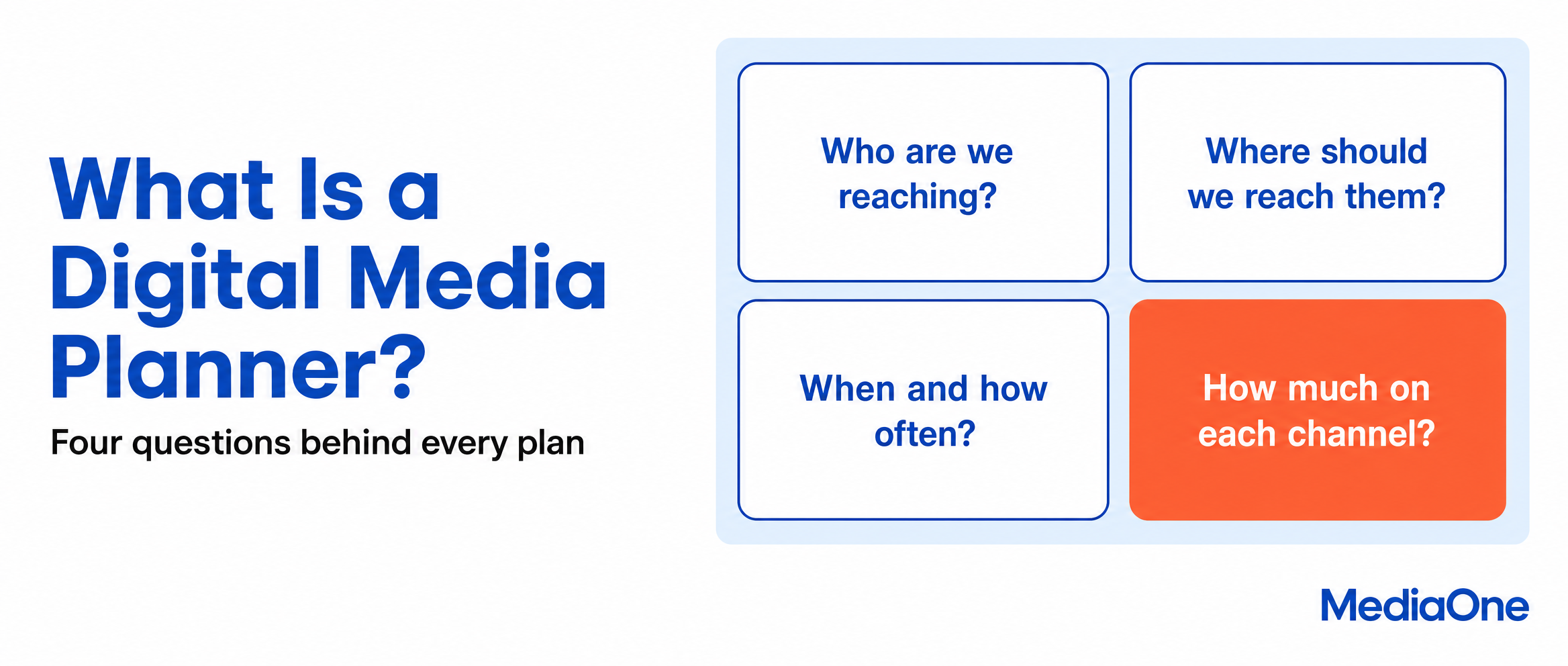
Digital media planning answers four core questions:
- Who are we reaching? (audience definition and segmentation)
- Where should we reach them? (channel mix: display, video, social, search, native, audio)
- When and how often should they see the message? (frequency, dayparting, seasonality)
- How much should we spend on each channel and tactic? (budget allocation and ROI thresholds)
Day-to-day responsibilities include research, strategy development, vendor negotiation, and performance oversight. A digital media planner works with brand partners or internal marketing teams to understand business goals (awareness, consideration, conversion), translates those into media objectives (impressions, clicks, qualified leads), and builds a plan to reach them within budget and competitive cost-per-acquisition thresholds.
The role requires both data analysis and creative partnership. Planners interpret audience insights from first-party data, customer relationship management systems, and marketing analytics platforms. They evaluate competing platforms (Google Display Network, Facebook Ads Manager, programmatic demand-side platforms, or DSPs) for audience reach and brand safety. They also collaborate with creative teams to understand ad formats and messaging, ensuring creative aligns with the channels and contexts where it will run.
How Digital Media Planning Differs from Traditional Media Planning
Traditional media operated on fixed schedules with limited flexibility. Demographic surveys and broadcast ratings provided the only audience insight. A television spot ran at a set time; purchase options were limited. Modern digital media differs in four key ways.
Real-time data and optimisation. Traditional planners locked in a media schedule months in advance. Digital planners see live performance within hours and can adjust tactics accordingly. If a campaign’s cost per acquisition deviates significantly from target, a planner can shift budget to better-performing channels or audience segments immediately. This real-time optimisation is possible within platform reporting latency and frequency caps; actual optimisation speed varies by platform.
Granular audience targeting. Traditional media reached broad demographics (women 25 to 54). Digital media can target by age, location, interests, purchase intent, job title, website behaviour, and first-party customer data simultaneously. A planner can run separate creative and budgets for high-value existing customers versus cold prospects using the same platform.
Measurability and attribution. Traditional media used proxy metrics (impressions and reach estimates). Digital media ties spending directly to outcomes: clicks, conversions, customer lifetime value. However, this creates complexity. If a customer saw a display advertisement, clicked a search advertisement, and then visited the website three days later to buy, which channel receives credit? Attribution is central to modern planning and barely existed in traditional media.
Cost and flexibility. Traditional media required minimum spends that were often significantly higher than digital. Digital campaigns can run on nearly any budget and can be paused, scaled or suspended within minutes. A planner managing a monthly budget of SGD 5,000 and a planner managing SGD 500,000 use the same tools and frameworks.

Digital media planners therefore need different skills from traditional planners. Where traditional planners were relationship managers and demographic statisticians, digital planners combine analytical work (reading dashboards and reports), platform proficiency (managing multiple systems), strategic thinking, and vendor management.
The Evolution of the Role in a Cookieless Future
For 25 years, digital media planning relied on third-party cookies. Advertisers could track users across websites, see what they browsed, and follow them with retargeting advertisements on other sites. The model was scalable and effective.
This approach has shifted significantly. Apple removed third-party cookie support in Safari, and Google phased out third-party cookies in Chrome during 2024. Privacy initiatives such as Google’s Privacy Sandbox initiative and regulations including the EU General Data Protection Regulation (GDPR) and Singapore’s Personal Data Protection Act (PDPA) have restricted cookie-based tracking.
Under Singapore’s PDPA, attribution complexity arises from consent-based data collection and cross-platform tracking restrictions. Cookie-based tracking remains legal in Singapore under PDPA with explicit consumer consent, but technical and regulatory barriers have increased significantly.
This shift has fundamentally changed what a digital media planner must do.
First-party data becomes central. Planners now help brands build owned audience databases: email lists, website visitors, mobile app users, loyalty programme members. Campaigns increasingly run on lists of known customers and prospects rather than anonymous browsing behaviour.
Contextual and cohort targeting replace individual behavioural tracking. Instead of following an individual user across websites, planners use contextual signals (the content they are reading at that moment) and cohort models (such as Google’s Topics API) to find similar audiences without tracking individuals.
Consent and transparency become planning constraints. Planners can no longer assume they can retarget everyone who visits a website. Visitors must opt in to tracking, usually through a cookie consent banner. Plans must account for lower available audiences and consent rates in efficiency assumptions.
Attribution models shift away from cross-site tracking. Without cross-site tracking, measuring what a user saw before converting becomes extremely difficult. Planners increasingly rely on aggregated, privacy-safe reporting from Google and Meta rather than user-level data.
The digital media planner role in 2024 is more strategic and less dependent on a single technical mechanism. Based on industry recruitment trends across APAC, planners who understood only retargeting and lookalike audiences face declining demand. Those who understand first-party data strategy, brand-safety frameworks, contextual matching, and how to build campaigns with deterministic (known customer) and probabilistic (modelled) audiences simultaneously are increasingly sought after.
This shift also blurs the line between media planning and marketing technology strategy. Modern planners increasingly need to understand how first-party data flows into a media plan, which sits outside the traditional media agency scope and closer to brand-side marketing operations.
Essential Skills Digital Media Planners Need Today
Digital media planners operate at the intersection of data science, creative strategy and business discipline. The role demands a skill set distinct from legacy media buyers. You are not simply selecting inventory; you are architecting campaigns across multiple targeting models, privacy-first data frameworks and real-time performance signals simultaneously.
Technical and Analytical Competencies
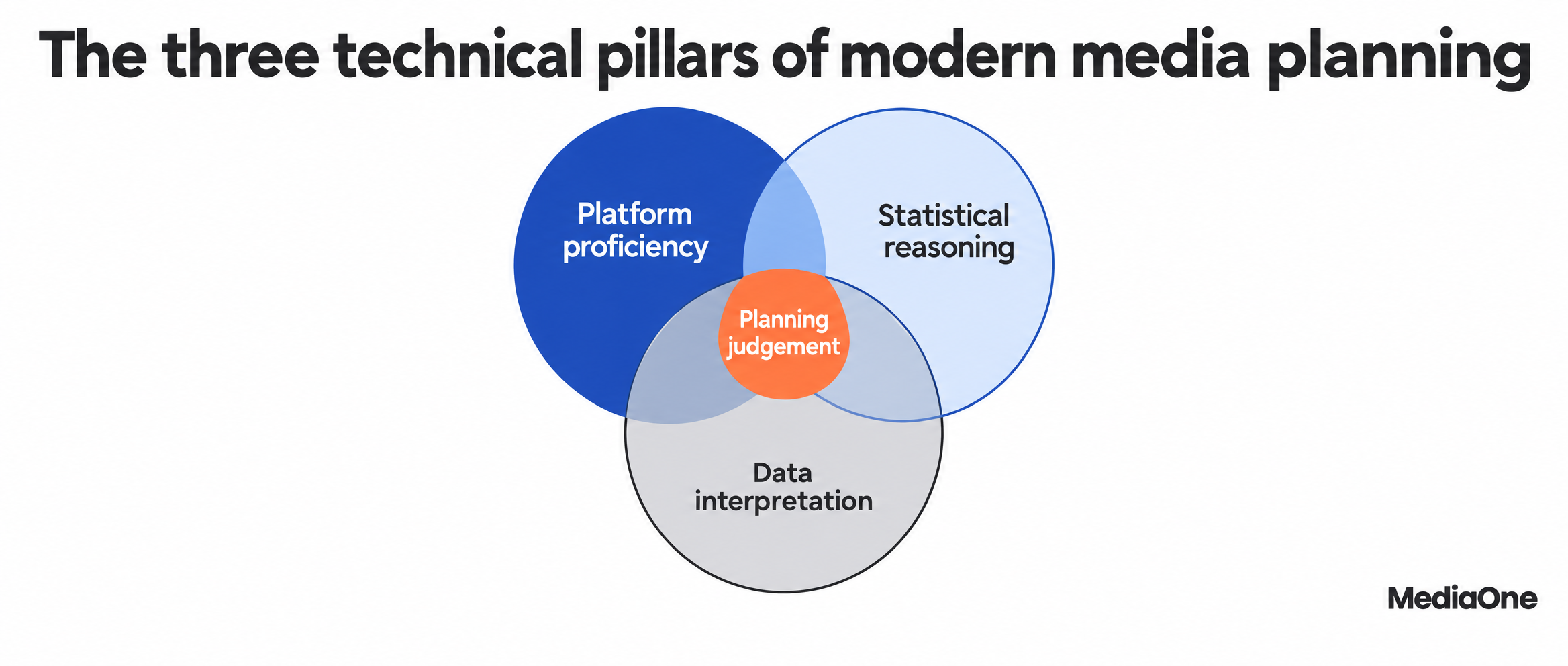
A modern digital media planner must combine three technical pillars: platform fluency, statistical reasoning and data interpretation.
Platform proficiency means working confidently across demand-side platforms (DSPs, tools that buy advertisements automatically) like Google Marketing Platform, Amazon DSP or The Trade Desk. You need to navigate audience libraries, set bid strategies and read performance dashboards independently. This is a fundamental requirement. More importantly, you should understand what data feeds each platform consumes: first-party data, contextual signals and cohort models. You must also track how algorithm updates shift performance.
Statistical literacy separates planners from order-takers. You must be able to read lift studies, spot sampling bias (where a test group does not truly represent the broader audience), interpret confidence intervals (the range within which true results are likely to fall) and challenge claims built on insufficient data. Many campaigns suffer because planners accept vanity metrics such as impressions delivered or reach without testing the underlying assumptions. A working knowledge of multivariate testing (MVT, a method that tests multiple variables simultaneously) and multi-touch attribution models (which track how different touchpoints contribute to a conversion) is essential. You do not need to run the statistical analysis yourself, but you should know when to request it and how to interpret the output.

Analytics fundamentals are non-negotiable. Hands-on experience with Google Analytics 4 (GA4), server-side event tracking and basic SQL queries distinguishes practitioners from strategists. You should be able to define custom events, troubleshoot tag implementation issues and pull cohort analysis without relying on an analyst for every question. Understanding UTM parameters (URL codes that track campaign source), first-party data collection consent flows and identity resolution methods (how systems match users across devices) is now core to the job, not optional.
Practical threshold: if you cannot explain why a 2% lift in post-click conversion rates might not justify a 20% increase in media spend, you are not yet thinking like a planner. For example, if advertisements cost 20% more but only 2% more people buy, the additional spending does not deliver value.
Strategic Thinking and Campaign Architecture
Technical skills unlock execution. Strategic thinking determines whether you are executing the right plan.
This means moving beyond channel selection into ecosystem design. How do search, social, display and video work together to move a specific user segment from awareness through to action? A DSP can buy impressions. A planner decides whether those impressions should target engaged audiences through contextual placement, new audiences through lookalike cohorts, or retargeting pools across multiple touchpoints, and why each choice serves the business goal.
Budget allocation is where strategy meets constraints. You must build a decision framework. Typically, acquisition campaigns allocate 60–75% to proven high-intent channels such as search and shopping, and 25–40% to reach and upper-funnel awareness such as display, video and social. This varies by industry vertical. Ecommerce and SaaS follow different splits than personal services or fast-moving consumer goods (FMCG). Your job is to map out the expected return curve for each channel, set your confidence threshold (where does the data support increased investment?) and make the trade-off explicit to stakeholders.
Attribution and causality thinking separates junior planners from strategists. In a cookieless environment (where browsers no longer allow third-party tracking by default), you cannot rely on last-click attribution to show which channels drive conversion. Instead, you design incrementality tests, define contribution models and use holdout groups to isolate channel impact. Under Singapore’s Personal Data Protection Act (PDPA), attribution complexity arises from consent-based data collection and cross-platform tracking restrictions. A strategic planner frames the measurement question before building the campaign, not after.
Campaign architecture requires naming the hypothesis. Instead of “run a retargeting campaign,” a strategic brief reads: “Users who engaged with our product demonstration but did not convert within 7 days show a measurable conversion lift when exposed to a comparison video within 14 days (based on pilot testing). We will test scaling this segment from 5,000 to 50,000 daily impressions, expecting a 3x return on ad spend (ROAS), with confidence thresholds set at 2x ROAS and held for 21 days before scaling.” That specificity is not perfectionism. It is accountability.
Cross-functional Communication and Vendor Management
A digital media planner rarely works alone. You are the hub connecting creative, analytics, product, legal (for privacy compliance) and vendor partners.
With creative teams, you translate brief into targeting language. Creatives need to know: who are we reaching? What do they already know about the brand? What is the next logical step in their journey? This informs tone, format and messaging. Conversely, you need to understand what creative performance signals matter: does the video hold attention until frame 50%? Do different creative variants perform with different audience segments? Feeding this back into your planning cycles demonstrates you are thinking about creative-media fit, not just channel economics.
With analytics and data teams, you must speak both languages. They own the measurement framework; you own the business hypothesis. Weekly alignment calls should answer: Are we tracking the right events? Can we isolate channel contribution? Do we have enough sample size to declare a winner? If you cannot read a statistical summary, you will miss the moment to act.
With vendors and agency partners, establish clear service level agreements (SLAs) from the start. Define success metrics, reporting cadence, escalation paths and decision authority. Many underperforming campaigns fail not because the channel choice was wrong, but because feedback loops were slow or accountability was unclear. A competent planner writes a statement of work that specifies: exact targeting parameters, pacing rules, bid strategy thresholds and who decides when to pause or scale a campaign.
Stakeholder communication requires translating jargon into business impact. Your Chief Financial Officer does not care about click-through rate (CTR) improvements. They care about cost per acquisition trending down and return on ad spend staying above 3:1. Your job is to deliver those numbers and explain the drivers: “CTR improved 12% because we tightened audience targeting, which means we reach fewer people but with higher purchase intent, so we can afford to pay more per click while staying within budget.” That narrative connects data to decision.
Practical checkpoint: If a team member cannot explain to a non-marketer why you chose that channel or audience, the plan needs simplification.
Key Skills Audit for Self-Assessment or Hiring
| Competency | Minimum Expectation | Advanced |
|---|---|---|
| DSP / Programmatic Platform | Navigate audience libraries and set bids independently | Debug audience definitions, audit data feeds, recommend algorithm strategies |
| Analytics Tools (GA4, Tag Manager) | Read dashboards, understand UTM parameters | Configure custom events, implement server-side tracking, troubleshoot discrepancies |
| Statistical Reasoning | Spot red flags in claimed results | Design test plans, interpret confidence intervals, propose attribution models |
| Budget Architecture | Allocate by channel based on historical benchmarks | Model return curves, set dynamic allocation rules, defend trade-offs with data |
| Stakeholder Communication | Present results clearly | Translate business questions into measurable hypotheses, manage expectations under uncertainty |
Tools and Platforms Every Digital Media Planner Should Master
Digital media planners operate across a fragmented technology ecosystem. You cannot execute strategy without hands-on fluency with the platforms that power audience buying, performance measurement and data activation. What distinguishes planners from traders is the ability to choose the right tool for the strategic goal: you need to know not just how to use a DSP, but when a cohort-based audience management platform serves your brand safety requirement better than a traditional data management system.
Programmatic Buying Platforms and DSPs
A Demand-Side Platform (DSP) is an automated tool that lets you buy digital advertising inventory at scale. It is the interface between your media plan and the real-time bidding auctions that fill your digital inventory. Unlike older manual media-buying workflows, a DSP allows you to set targeting rules, bid strategies and campaign parameters once, then automate the purchase of thousands of ad impressions across multiple publishers simultaneously.
The major platforms differ in depth and ease of use. Google Marketing Platform (formerly DoubleClick Bid Manager) dominates because it integrates natively with Google’s audience graph and first-party data tools. The Trade Desk holds significant share in programmatic display and connected TV, and is valued by planners for its transparency and detailed audience controls. Amazon DSP has grown rapidly for retail media and brand campaigns. Xandr (owned by Microsoft) and Magnite serve large-scale, channel-specific buying for connected TV, mobile and display. For regional APAC campaigns, some agencies use specialised regional platforms, though consolidation has reduced the available options.
Critical skill: Budget pacing and bid strategy. A DSP should never be left in automatic mode. You need to understand how cost caps, bid floors and impression-pacing rules interact. Many planners fail to prevent spending front-loading (burning the budget in day one) or tail-off (flat performance in week three). Set impression caps by day-part, review velocity hourly in the first 48 hours and adjust bid caps based on cost-per-acquisition (CPA) or cost-per-click (CPC) thresholds, not just hunches.
Audience input and first-party data integration. Today’s critical DSP competency is feeding your own audience segments into the platform. This is now essential: cookie-deprecation strategies depend on it. Understand how to onboard customer lists, build lookalike audiences and layer contextual or cohort signals (like Google’s Audience Segments) alongside traditional targeting. Each DSP has different data ingestion speeds and privacy compliance gates; test upload latency in your system before critical campaigns.
Decision framework: When to use a DSP versus a specialist vendor.
Use a DSP if you need multi-channel flexibility, brand-safety controls and real-time budget reallocation. Use a specialist platform (like a connected-TV-native buyer or a retail-media console) if a single channel dominates your media mix and vendor-native tools offer superior insights. Never run the same campaign across two DSPs simultaneously; the deduplication and frequency-capping logic breaks down, inflating waste.
Analytics and Measurement Tools
What gets measured gets managed. A media plan without a measurement architecture is strategy divorced from reality. Google Analytics 4 remains the baseline: you need to understand event-tracking logic, audience-creation pathways and the shift from sessions to user-centric reporting.
For attribution and cross-channel measurement, you operate in a constrained environment. The phase-out of third-party cookies (Chrome began deprecation in 2024; however, cookie-based tracking remains legal in Singapore under the Personal Data Protection Act with proper consent) means vendors like Google Ads and Facebook (for conversion lift studies), incrementality testing platforms (like Measured, Recast or Adverity) and media-mix modelling (MMM) software are now fundamental requirements, not optional tools. MMM uses historical campaign and sales data to isolate media contribution without relying on individual-level cookies. Tools like Neurolytical, Rockerbox or bespoke implementations through consultancies are common in APAC mid-market and enterprise teams.
Key competency: Designing measurement plans before campaigns launch. Too many planners inherit analytics setups after media has started. Insist on defining success metrics, deciding between last-click attribution versus modelled contribution and agreeing on holdout groups (control audiences) before the campaign goes live. In Singapore and APAC markets, ensure your analytics tags comply with local data-protection rules, particularly Singapore’s Personal Data Protection Act (PDPA) and similar regulations in Malaysia, Vietnam and Indonesia.
Practical framework: A well-structured analytics foundation should let you answer these questions within 48 hours of campaign launch:
- Impression delivery match versus plan (within plus or minus 5% acceptable)
- Cost per acquisition (CPA) versus target (flag if more than 10% above threshold)
- Audience overlap with other active campaigns (flag if more than 40% to avoid waste)
- Geographic, device or day-part performance variance (identify underperformers for real-time reallocation)
Without real-time dashboards, you will not catch these signals until data is stale.
Tool choice by budget and team size:
Smaller teams (under £1 million monthly media spend) often rely on Google Analytics 4 plus DSP native reporting. Mid-market teams (£1 million to £10 million) add incrementality testing software and manual MMM spreadsheets. Enterprise teams (£10 million and above) invest in dedicated MMM platforms or hire data scientists to build proprietary models. Do not over-invest in complexity early: start with event-based Google Analytics 4 and performance-based budget reallocation, then layer measurement depth as spend grows and stakeholder sophistication rises.
Audience Segmentation and Data Management Platforms
A Data Management Platform (DMP) is historical terminology: it refers to systems that ingest, store and activate first-party audience data. In practice, the category has fragmented. Traditional DMPs (like Krux, acquired by Salesforce, or Neustar MarketShare) are less common in 2024. Instead, planners work with Customer Data Platforms (CDPs) such as Segment, mParticle or Tealium, DSP-native data management tools (Google Audience Manager, The Trade Desk Unified ID) and identity resolution platforms (like LiveRamp, Zeotap).
The practical distinction for a planner: CDPs own your customer data. Identity platforms own the connection between your data and cookieless targeting IDs.
Critical skill: Audience hygiene and segment refresh rates. A poorly maintained audience segment wastes budget. You need discipline around:
- Recency windows: How old can customer data be before re-engagement campaigns become irrelevant? (Typical rule: refresh every 30 to 90 days)
- Overlap suppression: If segment A (recent purchasers) and segment B (high-value browsers) overlap 60%, suppress segment B to avoid wasted frequency
- Decay logic: A lookalike audience built from customers acquired 18 months ago decays in accuracy; refresh monthly using recent converters
First-party data activation in a cookieless era. Your audience platform must support deterministic targeting (ID-based matching that reaches known users directly) through integrations with DSPs and probabilistic amplification (cohort-based matching through tools like Google Audience Segments or contextual signals). This means you reach known users with deterministic approaches and scale reach to lookalikes without individual-level cookie tracking.
Audience segmentation decision tree:
Does your brand own customer data (email, CRM)? If yes: invest in a CDP and identity resolution platform (LiveRamp or DSP-native options) to activate that data deterministically. If no, or primarily relying on website behavioural data: use DSP-native audience management (Google Analytics 4 audiences fed into DSP, or Trade Desk’s The Pixel) plus contextual and cohort layers. For APAC compliance: ensure your platform is PDPA or LGPD-certified and does not rely on non-consented tracking for personalisation.
Vendor evaluation checklist:
Check API speed (audience segment refresh latency should be under 6 hours for real-time pacing), privacy compliance (SOC 2 certification, PDPA audit trail) and DSP integrations (can data flow directly to your primary buying platform?). Free tiers like Tealium’s iQ Tag Management serve smaller teams; enterprise deployments at brands typically use integrated CDP and DSP stacks with dedicated data engineers.
The gap between platforms and practitioner skill is where media plans succeed or fail. Master the three layers: buying, measurement and audience activation. Then focus on the decision logic that ties them together: which audience, for which channel, measured by which metric and optimised at which frequency.
The Digital Media Planning Process: A Step-by-Step Framework
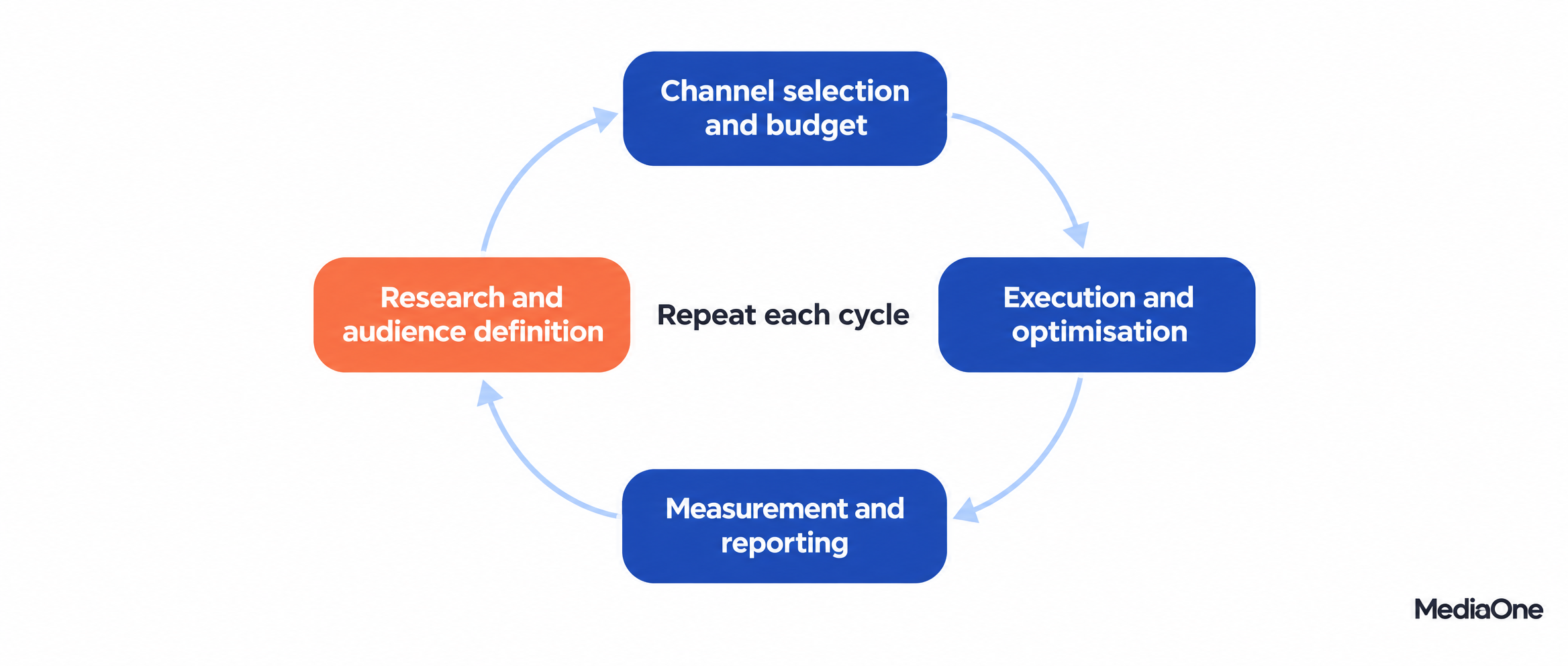
A digital media planner’s day-to-day work follows a repeatable cycle: research the audience, choose channels, execute the plan and measure what worked. This framework applies whether you are running a three-month awareness campaign or optimising a year-long performance initiative. The discipline lies in doing each step properly rather than skipping ahead.
Research and Audience Definition
Before allocating budget, you need to know who you are trying to reach and what behaviour you want to influence.
Start by auditing your first-party data. If you work in-house, pull customer data from your CRM, website analytics and email platforms. If you work in an agency, ask the client what data layers they control. First-party data is now essential because third-party cookies have been phased out. You are building segments from real customer records, not inferred audiences from a demand-side platform (DSP).
Next, layer in behavioural intent signals. Google Search Console, Google Analytics 4 and search trend tools like SEMrush show what your target audience is actually searching for right now. A fintech planner might find that search volume for “low-fee trading apps” peaks in January. That timing matters for channel selection later.
Define your audience by segment, not by a single persona. A consumer electronics company might segment into: early adopters (high-income, tech-engaged), mainstream buyers (price-sensitive, comparison shoppers) and holdouts (low digital engagement, trust existing brands). Each segment will need different channels and messages.
Document the behaviour you want to change. Are you driving trial (awareness phase)? Reducing churn (retention)? Upselling existing customers? This intent shapes everything downstream: channel mix, bid strategies, frequency caps and success metrics.
Key research questions to answer:
- What first-party data do we control?
- Where is demand highest (by season, geography, device)?
- Which audience segments are most profitable?
- What is the primary behaviour change we want?
Channel Selection and Budget Allocation
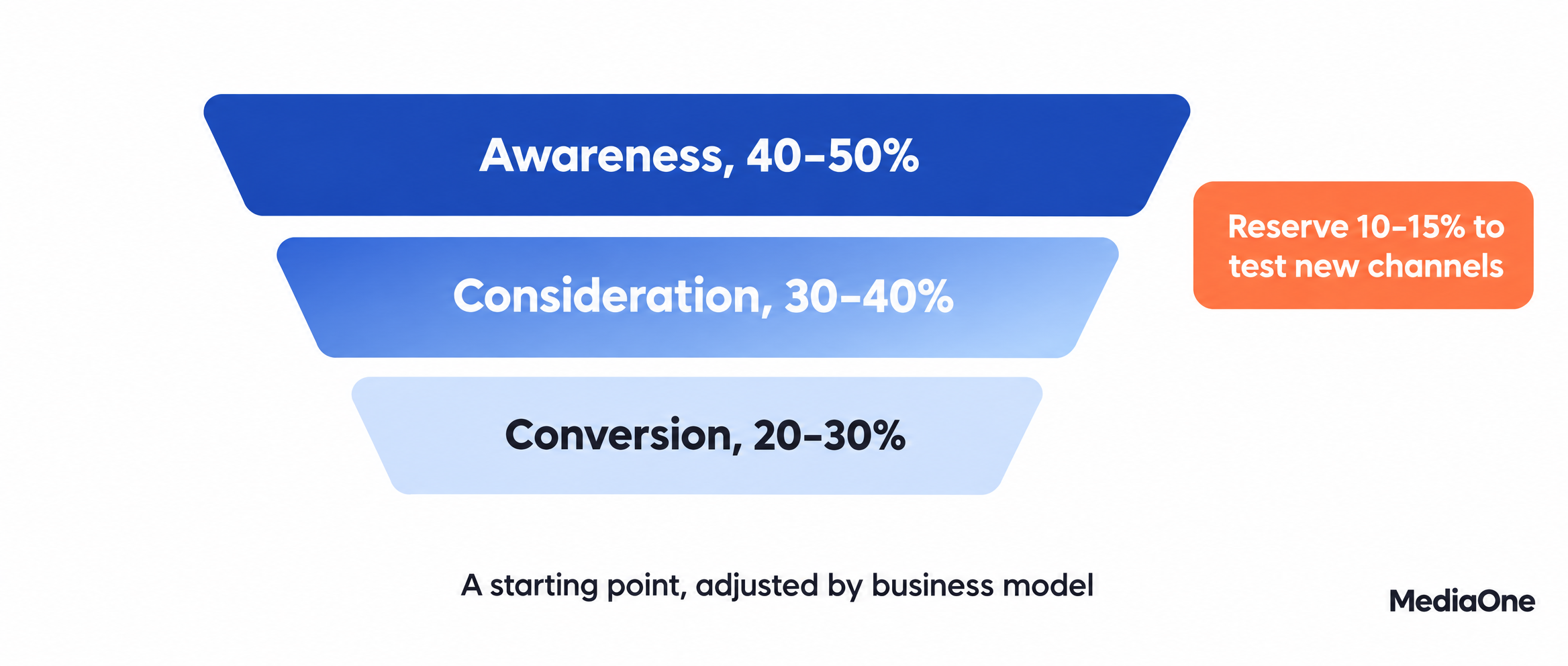

Once you understand your audience, choose channels that match where they spend time and how they make decisions.
Start with a simple decision tree. If your audience is high-intent (actively searching for your product category), allocate more to search. If they are unaware of your brand or category, prioritise awareness channels like display, video and social. If you are building long-term brand equity, include out-of-home or podcast sponsorships. If you need fast conversion, lean on performance channels.
A common allocation pattern in APAC is:
- Awareness (top of funnel): 40-50% of budget to display, video, social and podcasts. Cast a wide net.
- Consideration (mid-funnel): 30-40% of budget to search, retargeting and YouTube. Target people showing intent.
- Conversion (bottom funnel): 20-30% of budget to performance search, shopping ads and email. Drive the sale.
This is a starting point. An ecommerce brand selling high-value items might weight consideration heavier. A quick-service restaurant might frontload conversion channels because trial is the barrier.
Budget allocation within channels follows the spend multiplier rule: allocate incrementally to channels that deliver favourable return on ad spend (ROAS) or cost per acquisition (CPA) until marginal returns diminish. If search delivers 3.5x ROAS and display delivers 1.2x, increase search budget first. But do not abandon display; it often seeds awareness that converts later through search.
For APAC-specific context, consider regulatory and platform dominance: TikTok, WeChat and Xiaohongshu drive engagement in China and Southeast Asia. LinkedIn dominates B2B in Singapore and Australia. Google and Facebook remain effective across all markets, but their dominance has weakened in some segments (for example, younger audiences on TikTok, Japanese audiences on LINE).
Allocate at least 10-15% of budget to test and learn channels. These are platforms or tactics you have not used before: a new large language model-powered prospecting tool, contextual targeting as a cookieless alternative or a vertical video format. Testing keeps your media mix from becoming stale and reveals the next high-performing channel before competitors exploit it.
Budget allocation checklist:
- What phase of the funnel does each segment sit in?
- Which channels reach them at that phase?
- What ROAS or CPA threshold signals underfunding or overfunding?
- What percentage can we safely test in new channels?
Campaign Execution and Real-time Optimisation
Once channels are chosen and budgets set, execution is about staying agile.
In the first week, monitor delivery. Check that impressions, clicks and conversions are flowing at the expected volume. If a campaign is vastly underdelivering (for example, receiving 50% of expected impressions on day one), flag it immediately. Common culprits are targeting too narrow, bids too low, ads not approved or platform changes that throttled your audience pool.
Set up monitoring dashboards in your analytics platform (Google Analytics 4, a customer data platform like Segment or your DSP’s native reporting). Track real-time metrics: cost per acquisition, ROAS, impression share (search), view-through rate (display and video) and frequency per user. You should check these daily in the first two weeks and at least twice weekly thereafter.
Optimise bid strategies based on performance. If a keyword, placement or audience segment is delivering CPA 20% below your target, increase spend there by raising bids or broadening the target. If another segment is performing significantly worse than your CPA target, pause it or reduce budget. Set thresholds before the campaign begins (for example, “pause keywords with CPA above SGD 15 for 7 consecutive days”).
Real-time optimisation is possible within platform reporting latency and frequency caps; actual optimisation speed varies by platform and data feed configuration. Monitor your platform’s update frequency to understand how quickly performance data reflects actual delivery.
Manage frequency carefully. Serving the same ad too often causes banner blindness and resentment. Most platforms default to unlimited frequency, so set caps: typically 3-5 impressions per user per day for awareness and 8-12 per week for performance campaigns. Monitor frequency data and dial it down if click-through rates are dropping.
A/B test creative ruthlessly. Run two ad variants in parallel for at least 200-500 conversions each before declaring a winner. Changes might be headline copy, image, call-to-action, landing page URL or value proposition. Rotate tests so learning compounds: the winner of round one becomes the control for round two.
Communicate with stakeholders weekly, not just at the end. Show them which tactics are working and where spend is moving. This transparency prevents surprises and builds trust when mid-campaign pivots are necessary.
Real-time optimisation dashboard (minimum metrics):
- Conversions, cost per conversion, ROAS (daily)
- Impressions, clicks, click-through rate (daily)
- Frequency per user, reach (twice weekly)
- A/B test performance, winner announced (weekly)
Performance Measurement and Reporting
Measurement is not a post-campaign afterthought. It begins at research phase when you set the baseline and define success.
Start by choosing your primary success metric. For awareness campaigns, it might be reach (distinct users reached) or brand lift (lift in aided awareness post-campaign measured through brand tracking studies). For consideration, it might be cost per qualified lead. For conversion, it is ROAS or CPA. Choose one metric per campaign; a campaign cannot simultaneously optimise for reach, engagement and ROAS without trade-offs.
Set a realistic benchmark. Use historical data from your own previous campaigns or reference industry benchmarks. For example, average click-through rates on display ads across industries hover around 0.05-0.1%. If yours are 0.02%, either your targeting is too broad or your creative is not resonant.
Build an attribution model. In a cookie-lite world, simple last-click attribution is insufficient. Use a data-driven approach if your platform supports it (Google Analytics 4 offers data-driven attribution; Facebook offers multi-touch conversion windows). If you lack sophistication, use rules-based attribution: 40% credit to first touch (awareness), 20% to mid-funnel interactions (consideration) and 40% to final click (conversion).
Under Singapore’s Personal Data Protection Act (PDPA), attribution complexity arises from consent-based data collection and cross-platform tracking restrictions. Ensure your attribution model respects these consent requirements and does not rely on unauthorised tracking data.
Separate incrementality from correlation. Just because a user saw your display ad and later bought does not mean the ad caused the purchase. If possible, run a geo-lift test: run campaigns in some regions but not others, then measure whether purchases grew more in test regions. If they did, the lift is incremental. If growth was the same, the campaign may be reaching people who would have converted anyway.
Report monthly, not just at campaign end. Show stakeholders three things: (1) are we hitting our primary metric? (2) which channels or segments are most efficient? (3) what is the next optimisation? Never bury bad news. If a channel is underperforming, say so and explain the recovery plan (pause it, change targeting, reduce frequency).
Use a standard report format so comparisons across campaigns are easy. At minimum, include: metric (for example, ROAS), target, actual, variance and narrative explanation.
Measurement framework template:
- Primary success metric and target KPI
- Attribution model (last-click, data-driven, rules-based)
- Performance baseline (historical or industry benchmark)
- Monthly review cadence (results, which channels led, next actions)
- Post-campaign reporting: ROAS, audience insights, learnings for next cycle
Practical reality: most planners rush research and jump to execution. The campaigns that outperform spend more time in research and measurement. The fastest campaigns to plan are often the slowest to optimise because the foundation was weak. Respect the framework, and your results compound.
Career Path: From Entry-Level to Senior Strategist
The digital media planning career ladder has expanded significantly over the past five years. Unlike traditional media planning, which followed a narrow progression (coordinator > planner > senior planner > director), today’s digital media professionals can specialise early, move laterally into adjacent disciplines or build strategic authority without entering management.
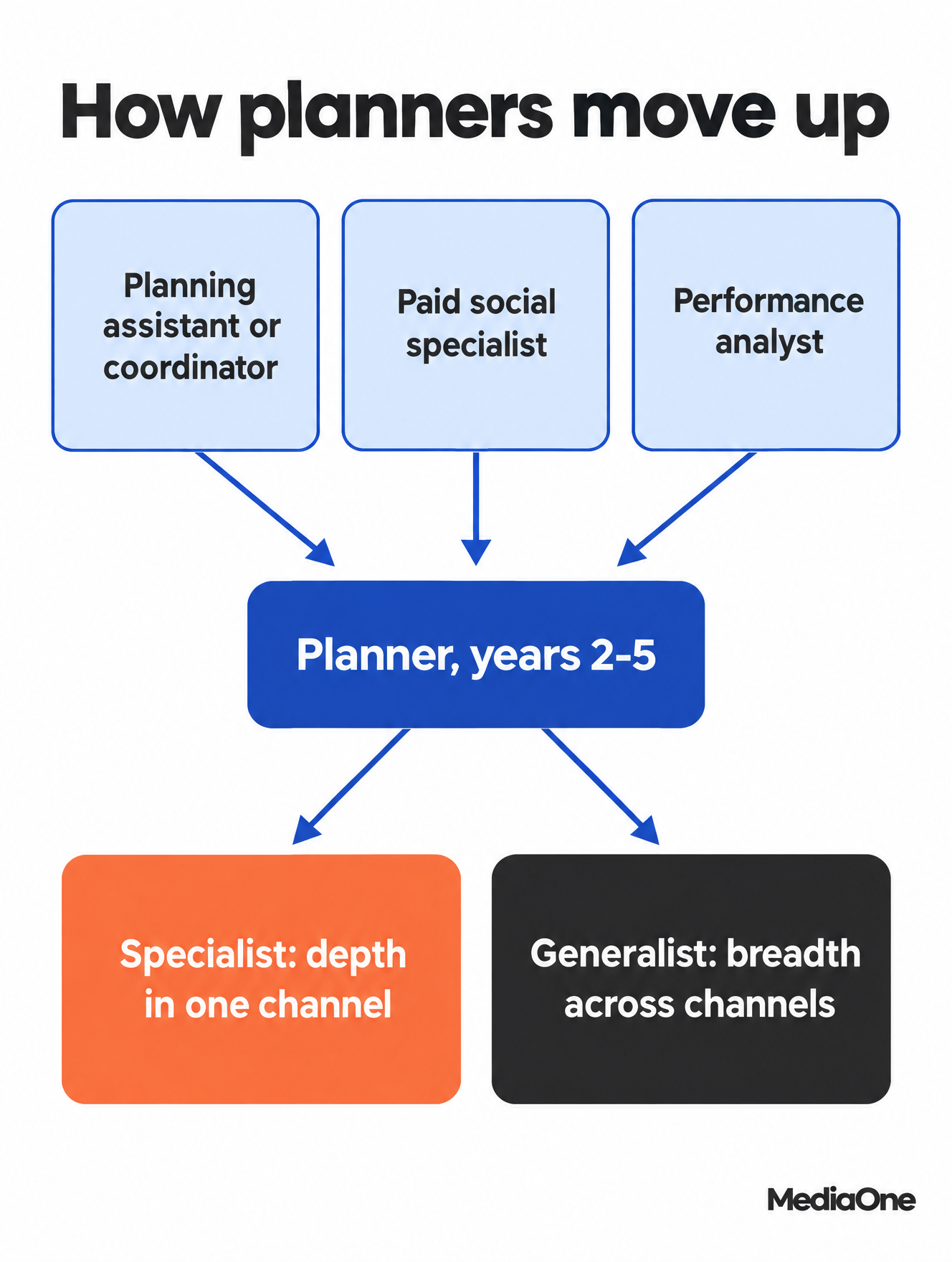
Entry-Level Positions and How to Break In
Most entry points sit in three roles.
Media Planning Assistant or Coordinator. You manage spreadsheets, quality assurance trafficking, reconcile buys against insertion orders and prepare campaign performance decks. This role teaches platform navigation and basic spreadsheet skills but rarely involves strategic decision-making. Most assistants report to a mid-level planner.
Paid Social Specialist. Often easier to secure and typically the fastest path into planning. You manage daily budgets on Facebook Ads Manager, Instagram, TikTok and LinkedIn, optimise bid strategies and respond to performance alerts in real time. This role teaches how audiences behave under shifting conditions and forces constant decision-making, though within a single channel.
Performance Analyst or Junior Analyst. You pull reports from Google Analytics, GA4 (Google Analytics 4) and ad platforms, build dashboards and flag anomalies. Analytical foundations matter less than curiosity here. Analysts who ask “why did conversions drop 15% on Thursday?” develop faster than those who simply report numbers.
Breaking in without prior experience:
- Build a portfolio. Run a small paid campaign on Instagram, Google Ads or TikTok with a modest budget (SGD 200 to 500 monthly). Document what you tested, what metrics moved and why. Employers value proof of decision-making over certification alone.
- Pursue the Google Marketing Professional Certificate (Coursera). It covers Search, Display, Shopping and Video fundamentals in 3–6 months and provides credible grounding in platform navigation and targeting options.
- Start in performance roles, not strategy. Buyers and analysts have higher hiring volume than planners at entry level. After 6–12 months shipping campaigns and analysing performance data, the transition to planning feels natural.
- Target agencies over in-house roles. Agencies hire more junior staff due to higher turnover and broader client portfolios, exposing you to multiple industry verticals within a year. In-house teams typically hire planners with 2–3 years prior experience.
Entry-level roles in Singapore and ASEAN typically pay SGD 2,500 to 3,500 monthly (gross) depending on agency reputation and client sector. Growth happens fastest during your first 18 months as learning curves are steepest.
Mid-Career Growth and Specialisation Opportunities
Between years two and five, you choose between depth and breadth. This is where career trajectories diverge sharply.
The Specialist Path:
You become a domain expert in one channel or audience type.
Programmatic Display Specialist. Deep expertise in DSPs (demand-side platforms such as Google DV360, The Trade Desk and Xandr), contextual targeting, audience buying and creative optimisation. This path suits those who enjoy technical problem-solving and prefer working with self-serve platforms over human vendors. Specialists typically earn 15–25% more than generalists at equivalent seniority levels.