| AI Summary
Outsourcing marketing can reduce costs, improve execution speed, and give businesses access to specialist expertise without expanding full-time headcount. The strongest model keeps strategy and accountability in-house while outsourcing execution such as content, SEO, paid media, email, social media, and analytics. Success depends on choosing the right partner, setting measurable KPIs and service-level agreements, maintaining regular oversight, and documenting processes to prevent dependency and knowledge loss. |
Outsourcing marketing is not a sign of weakness or a shortcut. For most companies, it is the faster, cheaper route to specialist expertise and scaled execution.

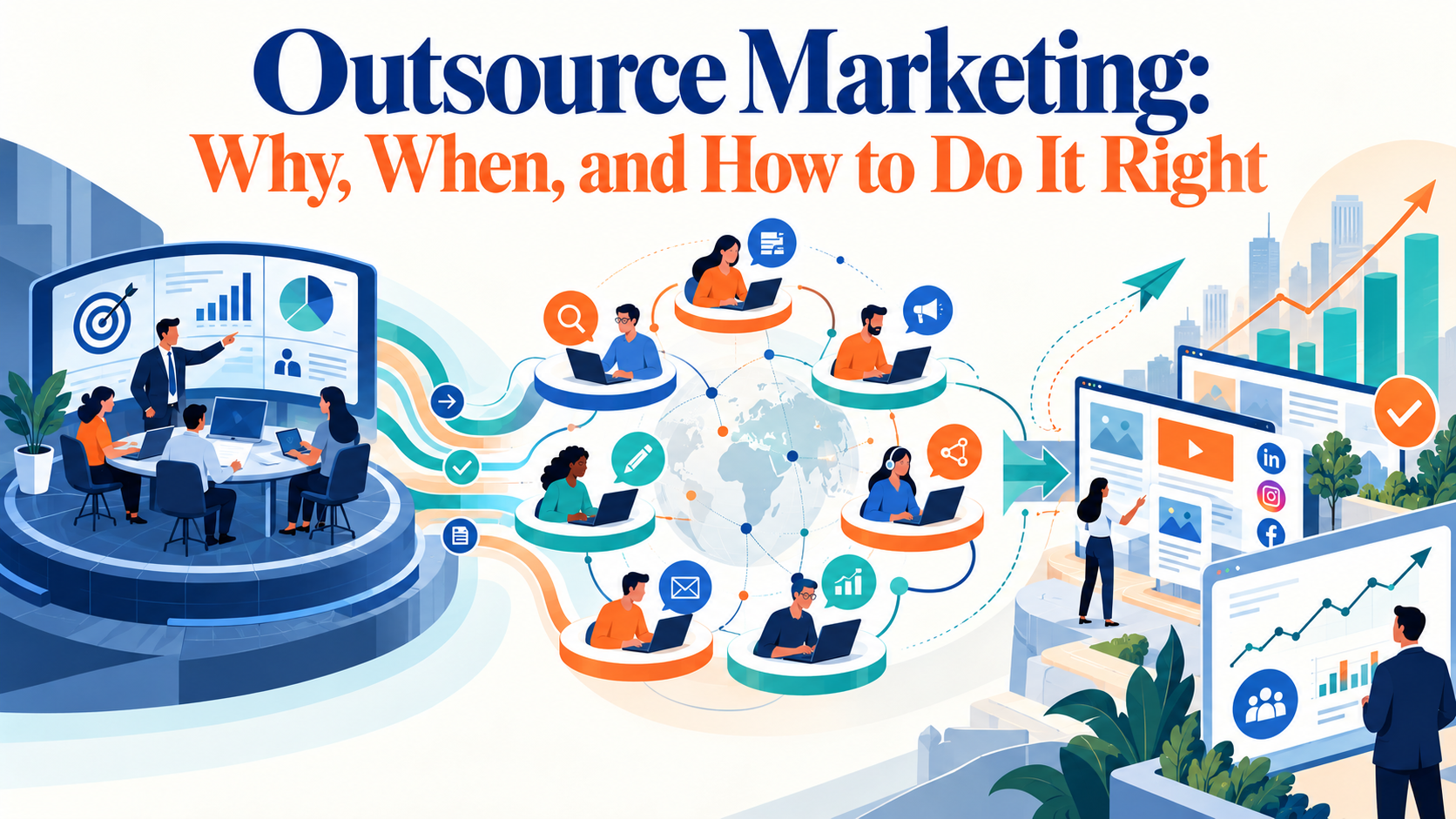
When you outsource marketing, you transfer execution tasks (content creation, paid media management, analytics, social media) to external partners: agencies, freelancers or dedicated remote teams. You retain strategic decisions and accountability in-house. This model lets you access expertise you could not afford to hire full-time, scale campaigns without hiring headcount, and free up your leadership to focus on product and revenue.
The maths is straightforward. A mid-level marketing hire in the UK costs £40,000 to £50,000 annually in salary plus 25% in benefits and overhead. That buys you one generalist. An agency retainer of £3,000 to £5,000 per month gives you access to multiple specialists: a strategist, a copywriter, a paid-media expert, and an analyst. You pay only for the hours you use, not the overhead of employment.
This guide covers the full picture: what to outsource and why, how to structure oversight so you don’t lose control, pricing benchmarks, and how to avoid the pitfalls that sink outsourcing relationships. Whether you are a startup with zero marketing staff or an established company looking to scale, this framework applies.

What Outsourcing Marketing Actually Means
The Business Case: Why Companies Outsource Instead of Hiring In-House
Outsourcing marketing means shifting marketing functions to external specialists or agencies rather than building an in-house team. It is not about abdicating responsibility. It is about allocating resources where they create the most value.
The financial argument is compelling. Hiring a full-time marketer costs you salary, benefits, equipment, software licences and office space. A marketing agency or freelancer costs you a monthly retainer or hourly rate. You pay only for the work delivered, not the idle time. An agency’s costs are distributed across ten to fifty clients, so their per-unit cost for design, copywriting or paid-media management is lower than hiring one designer or copywriter full-time.
Beyond cost, outsourcing buys you access to specialist skills without long-term commitment. A conversion-rate optimisation specialist might cost £100,000 per year to hire; outsourcing that skill for a three-month project costs £6,000 to £12,000. You also avoid recruitment risk: hiring the wrong person is expensive. With an agency, if the fit is poor, you move to a competitor.
Outsourcing also enables scalability. If you need to double your content output in Q2 for a product launch, an in-house team cannot scale instantly. An agency can. When the launch ends, you contract back down. An in-house team would face redundancy costs and morale damage.
Finally, agencies hit the ground running. They have workflows, tools, templates and playbooks. A new in-house hire needs three to six months to become productive. An agency is productive in one to two weeks.
The Two Models: Agency Partnership vs. Freelance Networks
Marketing outsourcing takes several forms. Understanding the trade-offs helps you choose the right fit.
Full-service agencies offer strategy, design, copywriting, paid media, content production and analytics under one roof. They work best when you need multiple disciplines and want one point of accountability. Typical retainer: £5,000 to £15,000 per month. Setup is slower (two to four weeks) because the agency needs to understand your business deeply. You trade flexibility for consistency and breadth.
Specialist boutique agencies focus on one or two disciplines: SEO, paid media, content marketing or conversion optimisation. They go deeper in their domain than generalists. Typical retainer: £2,000 to £5,000 per month. Setup is faster (one to two weeks). Use this model if you have a specific, high-priority need and do not need full-service coverage.
In-house remote teams are contractors hired as dedicated staff. You pay them a monthly salary and manage them like employees, but they stay remote, and you avoid employer overhead. Typical cost: £2,000 to £8,000 per month per person. Consistency is high because they are “yours”, but you need to manage them actively. This works best if you need stable, full-time coverage and want to build internal expertise over time.
Freelancers and platforms (Upwork, Toptal, industry-specific networks) are best for one-off projects or highly specialised skills. Typical cost: £1,000 to £5,000 per project or £30 to £150 per hour depending on expertise. Setup is fast (one to three days). Oversight is high because freelancers lack context and process. Turnover is common, so knowledge transfer is spotty.
What You Actually Outsource vs. What You Keep In-House
Not all marketing decisions should be outsourced. The highest-leverage work stays in-house.
Keep in-house: brand positioning, audience strategy, marketing KPIs and business metrics, competitive positioning, and customer insights. These decisions drive everything else. They require intimate knowledge of your business, customer and competitive landscape. Outsourcing them leads to strategies that miss the mark.
Outsource: content production, paid-media management and optimisation, paid social advertising, technical SEO execution, email campaign setup, social-media posting, and reporting and analytics. These are execution-heavy, repeatable tasks where agencies achieve economies of scale.
The hybrid model is most common: an in-house marketing leader (often part-time in early-stage companies) sets strategy and holds agencies accountable. External teams execute against that strategy. The in-house person is not writing every blog post or managing every ad account. They are making sure the work aligns with business goals and hitting targets.
Core Benefits That Justify the Cost
Financial Leverage: How Outsourcing Reduces Marketing Spend
The unit economics of outsourcing favour you, especially at smaller scales.
A mid-level marketing manager in the UK costs £35,000 to £50,000 in annual salary. Add National Insurance employer contributions (15%), holiday pay, equipment, and tools. Total employment cost: £44,000 to £63,000 per year, or £3,700 to £5,250 per month.
An agency retainer of £3,000 to £5,000 per month provides access to a strategist, designer, copywriter and analyst. The same retainer also covers their tools, software, office and equipment costs. You are leveraging their infrastructure across multiple clients.
Freelancers are even cheaper per project: £1,000 to £3,000 per month for specialist work. However, you pay in management overhead. One in-house person may need to coordinate three to five freelancers, adding coordination costs.
The financial advantage holds at scale too. A company with a £5,000 to £15,000 monthly marketing budget almost always saves money by outsourcing. The crossover point is around £6,000 to £8,000 per month, after which hiring a full-time marketer becomes cost-competitive if you need constant coverage.
Speed and Flexibility in Execution
Agencies move faster than in-house teams. They have pre-built workflows, approved vendor relationships and campaign templates. A new piece of content moves from brief to publication in two to three weeks via an agency. Building this capability in-house takes months.
Flexibility is the second advantage. If your sales team lands a major enterprise deal and needs six product guides written in six weeks, an in-house team of one writer is stuck. An agency can. When the project ends, you scale back without severance liability.
This flexibility is critical during growth spurts. Rapid revenue growth requires rapid marketing growth. In-house hiring moves at hiring-cycle speed, typically three to six months. Outsourcing scales in weeks.
Access to Specialist Expertise You Would Struggle to Hire Solo
Few companies can hire a conversion-rate optimisation specialist, a technical SEO auditor, and a marketing-attribution expert as full-time staff. The expertise is too specialised, and the workload does not justify full-time headcount.
Agencies employ these specialists. They also maintain relationships with media partners, advertising platforms and data providers that smaller companies cannot access. An agency managing £10 million in annual Google Ads spend across fifty clients gets priority support from Google and access to beta features.
Agencies also see patterns across industries. An agency working in healthcare, finance, e-commerce and SaaS learns what works in each vertical. A single in-house marketer sees only your industry and your company. This cross-industry knowledge is a source of competitive advantage.
Finally, external teams spot blind spots. When you are inside the business, you miss things. An agency walks in with fresh eyes and asks uncomfortable questions: Why is your homepage focused on features instead of outcomes? Why are you not mentioning your cost advantage? Why is your email signup rate so low compared to competitors? In-house teams avoid these conversations because they assume “that is just how we do it”.
Improved Focus on Core Business
Marketing is not your core business unless you are a marketing agency. Your core business is product, sales and operations.
When the founder or CEO spends ten hours per week managing freelancers, coordinating campaigns and creating reports, that is ten hours not spent on revenue-driving activities. If outsourcing frees up even five of those hours, and those hours are worth £100 per hour to the business (closing deals, fixing product bugs, improving operations), the agency fee is already paying for itself.
Real Risks and How to Mitigate Them
Loss of Control and Brand Consistency
External teams work on multiple clients. Yours may not receive continuity. This risk is real.
An agency managing ten clients and operating at capacity will prioritise projects with tighter deadlines or higher revenue. Your project slips. Your tone of voice drifts because the same writer is not touching every piece of content. Campaign launches are delayed because creative requests compete for resources.
Mitigation: Create detailed brand guidelines. Include voice, tone, approved messaging, visual style and content examples. Have a strategy-alignment meeting every two weeks. Audit samples before launch. If your brand-voice consistency score drops below 85% in quarterly audits, something is wrong. Address it in the monthly business review.
Quality Variability and Poor Performance
Not all agencies are created equal. Some are overextended, inexperienced or simply mismatched with your business.
An agency might deliver good work for their other clients but miss the mark for you. They might not understand your customer or industry. They might be resource-constrained and assign your work to a junior. Their dashboards might hide underperformance for weeks.
Mitigation: Set explicit, measurable KPIs before you sign. Define SLAs (service-level agreements): response time within 24 to 48 hours, revision turnaround within three to five business days, reporting delivered by the fifth of each month. Request weekly dashboards, not monthly. If an agency resists tying fees to results or won’t share performance data, that is a red flag.
Communication Friction and Misalignment
Time zones, email delays and cultural differences slow decisions. Scope creep happens because briefs are vague and assumptions are unspoken.
You think the agency is writing a product guide; they think you want a case study. Three weeks are lost. Frustration grows. The relationship deteriorates.
Mitigation: Schedule weekly sync calls at a fixed time. Use a shared project tool (Asana, Monday.com, Notion). Document decisions and assumptions in writing within 24 hours of every call. Appoint one person at your company to be the agency’s single point of contact. Avoid the “everyone pings the agency” dynamic; it leads to conflicting requests and wasted cycles.
Dependency and Knowledge Loss
If an agency relationship ends, what happens to your work? If the agency closes, shuts down your account, or you fire them, you have lost playbooks, strategy documentation and intellectual property.
You also lose the ability to evaluate whether results came from the agency’s work or external factors (market shifts, seasonal trends, competitor inaction).
Mitigation: Require agencies to document campaigns, strategies, results and learnings in your system (Google Drive, Notion, your CMS). Create a monthly playbook: what worked, what did not, what to test next. Maintain a spreadsheet of all active campaigns, content URLs, media partner contacts, audience segments and KPI baselines. If the agency leaves, can a replacement onboard within two weeks? If the answer is no, your documentation is incomplete.
Hire or retain at least one marketer in-house to oversee the agency and build internal knowledge. This person becomes the institutional memory and prevents total dependency.
Types of Marketing Functions You Can Outsource Effectively
Content Creation and Production
Blog posts, long-form guides, email copy, ad creative, video scripting and motion graphics are the most commonly outsourced marketing functions.
Why it works: A clear brief produces a clear deliverable. Quality is easy to audit. Revisions are straightforward. There is no ambiguity about what success looks like.
Outsourcing barrier: Low. Most companies start here because the risk is minimal and the payoff is immediate.
Pricing: Blog writers typically charge £800 to £2,500 per month for four to eight posts, depending on research depth and SEO optimisation. Video production ranges from £2,000 to £10,000 per project depending on length and complexity.
Paid Media Management (PPC, Social, Display)
Google Ads, Meta (Facebook and Instagram), LinkedIn Ads and programmatic display advertising are data-driven channels where agencies excel.
An agency manages campaigns daily, testing ad copy, audience targeting, bid strategies and landing pages. They interpret data and optimise spend allocation in real time.
Why it works: Results are measurable within weeks. You can see which campaigns drive leads and revenue. The feedback loop is tight, so agencies improve quickly.
Cost model: Typically a retainer of £1,500 to £5,000 per month plus a 10% to 15% management fee on total ad spend. If you spend £10,000 per month on ads, expect to pay £1,000 to £1,500 in management fees, plus the base retainer.
Minimum viable ad budget to justify outsourcing: £2,000 to £5,000 per month. Below that, the management fees consume too much of the budget.
Search Engine Optimisation (SEO)
Technical SEO audits, on-page optimisation, link building and content strategy are outsourced frequently because the skillset is specialised and labour-intensive.
SEO has a longer payoff cycle. You do not see ranking improvements for three to six months. But the ROI compounds over time. Traffic acquired through organic search is free traffic going forward.
Why it works: Methodology is repeatable. Agencies have tools (Ahrefs, SEMrush, Screaming Frog), scale and playbooks. They know which technical fixes move the needle and which are vanity work.
Red flag: Agencies that guarantee “#1 ranking” are overselling. Legitimate SEO is slower but proven. Guarantees often come with loopholes (guaranteed for a specific, low-competition keyword) or pressure to add paid ads when organic does not work.
Pricing: £2,000 to £8,000 per month depending on technical complexity, competition and content volume. Expect three to six months before meaningful results.
Email Marketing and Marketing Automation
Campaign setup, segmentation, template design and drip sequences are well-suited to outsourcing because the execution is straightforward and ROI is measurable.
Agencies set up automation workflows, design templates, segment audiences and optimise send times. They also integrate your email platform with your CRM so data flows automatically.
Why it works: Setup is one-time; ongoing optimisation is routine. ROI is easy to track: revenue per email sent, click-through rate, unsubscribe rate.
Pricing: £1,000 to £3,000 per month depending on list size and send volume. Smaller lists (under 5,000) cost less.
Social Media Management
Content calendars, posting, community management and paid-social advertising are commonly outsourced.
An agency plans content, schedules posts, responds to comments, and manages paid-social budgets. If posting frequency is high (three or more times per week), outsourcing saves time.
Pitfall: Outsourcing organic social media alone (without paid promotion) often underperforms. Organic reach on Facebook, Instagram and LinkedIn has collapsed. Paid social amplifies organic content and drives real results. Pair social management with a paid-social budget of at least £500 to £1,000 per month.
Pricing: £1,000 to £3,000 per month for organic social management and monthly community oversight.
Analytics, Reporting and Performance Tracking
Monthly and quarterly performance dashboards, attribution modelling and customer-journey analysis are well worth outsourcing.
Most in-house teams spend twenty to forty hours per month on reporting: pulling data from Google Analytics, Ads Manager, email platforms and CRM, consolidating it in a spreadsheet, and writing a summary. An analyst can automate ninety per cent of this work.
Recommendation: Outsource reporting; keep strategy analysis in-house. An analyst builds dashboards and handles data wrangling. Your internal team interprets results and makes decisions.
Pricing: £2,000 to £4,000 per month for a dedicated analyst managing multiple platforms and building custom reports.
Marketing Strategy and Campaign Planning
Audience research, competitive analysis, campaign blueprints and positioning strategy are sometimes outsourced.
Caution: Strategy is usually not outsourced as a retainer; it is a one-off project. You hire a consultant or agency for six to twelve weeks to develop a positioning strategy, content roadmap, or competitive analysis.
Better model: In-house strategic lead plus external execution teams. Your CMO or marketing director sets the strategy and priorities. External teams execute against that plan. This hybrid approach prevents strategy drift and maintains accountability.
How to Choose the Right Outsourcing Partner
Agency vs. Freelancer vs. Freelance Network: A Comparison Table
| Factor | Full-Service Agency | Specialist Agency | In-House Remote Team | Freelancers | Platforms (Upwork, Fiverr) |
|---|---|---|---|---|---|
| Setup time | 2–4 weeks | 1–2 weeks | 2–3 weeks | 3–7 days | 1–3 days |
| Cost | £3–10k/month+ | £2–5k/month | £2–8k/month per person | £1–5k/month | £500–3k/month |
| Expertise breadth | Wide (all disciplines) | Deep (one to two disciplines) | Variable | Deep (specialised) | Highly variable |
| Consistency | High (dedicated account team) | High | Very high | Low (staff turnover) | Very low |
| Scalability | Easy (add services) | Moderate | Easy (hire or fire) | Easy | Very easy but risky |
| Oversight required | Low to moderate | Low to moderate | High | Very high | Very high |
| Contract flexibility | Low (3–12 months typical) | Low to moderate | High (month-to-month common) | Very high (project-based) | Very high (hourly) |
| Best for | Mature companies wanting full-service | Growth companies with specific needs | Teams needing dedicated, stable staff | One-off projects or specialist skills | Ad-hoc work, low budgets |
Five Questions to Ask Before Signing
1. What does success look like? The agency must define KPIs, timelines and success metrics upfront. If the answer is vague (“we will grow your awareness”) or soft (“we will improve your brand presence”), move on. Success must be measurable and tied to business outcomes.
2. Who is my day-to-day point of contact? Confirm one named person. This person is your escalation path for blockers and questions. Rotating contacts slow down decisions and damage relationships.
3. What reporting will I receive and how often? Weekly dashboards beat quarterly decks. Confirm the reporting is automated (generated by tools, not hand-crafted every time). If you are waiting for a custom report every month, something is broken.
4. What happens if results do not hit targets? Legitimate agencies offer optimisation cycles or fee adjustments if KPIs are missed. Agencies that promise results but have no refund or rebate clause are betting you will not track results carefully.
5. Can you show me case studies from companies like ours? Similar company size, industry and budget. Ask the agency for permission to contact references. Call two references and ask: “Would you hire them again? What would you do differently?” Their answer tells you everything.
Red Flags That Signal a Bad Fit
No data: They claim outcomes like “grew client revenue by 300%” with no numbers, timeframe or benchmarks. If they cannot be specific, they did not measure.
Resistant to SLAs: They push back on defining KPIs, committing to response times or tying results to fees. This is a sign they do not want accountability.
Long commitment with no trial: They pressure you to sign a 12-month contract with no pilot or exit clause. Legitimate agencies offer 30 to 60-day trials because they are confident in their work.
Vanity metrics: They focus on followers, impressions and clicks instead of leads, revenue and customer acquisition cost. These are easy to inflate and meaningless to your business.
Poor communication: They take 24+ hours to respond to non-emergency questions. How will they respond when you need a quick decision?
No dedicated account manager: You are assigned to a junior coordinator. Decisions and feedback loop through a chain of command. Expect slow progress.
Trial Period and SLA Checklist
Before signing a 12-month contract, propose a 30- to 60-day pilot.
- [ ] Agency agrees to pilot on same terms (hourly rate or scaled retainer)
- [ ] Explicit KPIs set and measured daily or weekly
- [ ] Go/no-go decision gate at day 30
- [ ] SLA includes: response time (24–48 hours), revision rounds (two to three included; additional at £150 per hour), revision turnaround (three to five business days)
- [ ] Exit clause: either party can terminate the pilot with one week’s notice, no penalty
- [ ] Full-contract discount if pilot succeeds (e.g., 10% reduction if you sign a 12-month renewal after pilot)
This trial costs you nothing upfront but protects you from a bad hire. Any agency worth hiring will agree to this structure.
Structuring Your In-House Oversight
Why You Need At Least One Marketing Lead In-House
The single biggest mistake companies make is outsourcing everything and having no one in-house to oversee the work.
You need at least one person who understands your business, your customers and your strategy. This person becomes your agency’s internal client: they brief campaigns, provide feedback, make decisions and hold the agency accountable to KPIs.
This person also ensures brand consistency. If the agency is writing all your content, your brand voice drifts unless someone is auditing every piece.
This person also learns. If the agency leaves or fails, they can bring another agency up to speed in weeks instead of months.
Finally, this person prevents the “ghost account” problem where no one at your company understands what the agency is doing, why, or what results they achieved.
Typical in-house role: Part-time CMO, marketing manager or founder (if marketing-literate). For a company with £3,000 to £10,000 monthly marketing spend, this is often a 10 to 20 hour per week commitment. You do not need a full-time hire initially.
Weekly Sync Cadence and Agenda
Structure a one-hour weekly sync call with your agency. Run it the same day and time every week so it is non-negotiable.
Agenda (60 minutes):
- Last week’s KPIs (10 minutes): Did we hit targets? Traffic, leads, revenue, engagement, cost-per-acquisition. No excuses; just facts.
- Blockers and decisions needed from you (15 minutes): What is waiting on your input? What decisions do we need to make to move forward? Make decisions in the meeting, not after.
- This week’s deliverables (15 minutes): What ships this week? What is in review? What might slip? Agree on revised timelines if needed.
- Quarterly goal progress (10 minutes): Are we on track to hit Q-end targets? If not, what changes?
- Ad hoc issues (10 minutes): Escalations, urgent questions, anything else.
Use a shared Google Doc or Notion page as the agenda. Circulate it 24 hours before the call. Take notes in real time so both sides have a record. Share the notes within 24 hours.
Email chains kill momentum. Decisions made in an email feel provisional. Decisions made in a meeting with a written record feel final.
Documentation and Knowledge Transfer
Require your agency to document everything as they work.
What to document:
- Campaign briefs (audience, messaging, objective, KPI)
- Creative rationales (why this headline, why this audience, why this channel)
- Audience segments (definition, size, characteristics, acquisition cost)
- KPI baselines (what was performance before we made changes)
- Test results (A vs. B test, winner, why it won)
Monthly playbooks: At the end of each month, ask the agency to write a two-page summary: what worked, what did not, what to test next. This document is gold. It becomes your institutional knowledge.
Spreadsheet of active campaigns: Who owns what? What are the KPIs? What is the budget? What is the status? Links to all assets, reports and dashboards. Update it every week.
Handover plan: If the agency leaves, can a replacement onboard in two weeks? If not, your documentation is incomplete.
Cost Benchmarks and How to Budget
Typical UK and Asia-Pacific Pricing (2024)
| Service | Retainer Range | Typical Included | Useful Context |
|---|---|---|---|
| Content creation (blog) | £800–2,500/month | 4–8 posts/month, basic SEO optimisation | Specialist writers or niche expertise cost more |
| Paid media management | £1,500–5,000/month plus % of spend | Campaign setup, daily optimisation, monthly reporting | Add 10–15% fee on top of ad spend; minimum £2–5k ad budget needed for outsourcing to make sense |
| SEO (technical plus content) | £2,000–8,000/month | Audit, on-page optimisation, link strategy, content plan | Results appear 3–6 months in; budget for slow payoff |
| Email marketing setup plus management | £1,000–3,000/month | Sequence design, segmentation, monthly optimisation | Costs scale with list size; small lists (under 5k subscribers) cheaper |
| Social media management | £1,000–3,000/month | Content calendar, posting, community management, monthly reporting | More effective when paired with paid social budget (minimum £500–1,000/month) |
| Analytics and BI specialist | £2,000–4,000/month | Dashboard setup, custom reporting, optimisation recommendations | Often underbudgeted; pays for itself in decision clarity and saved time |
| Full-service agency (five plus services) | £5,000–15,000+/month | Strategy, creative, paid media, content, analytics | Economies of scale; cheaper per discipline than bundling individual freelancers |
These are 2024 UK and Asia-Pacific ranges. US pricing runs 10 to 20% higher. Prices vary by agency experience, location and market competition.
Total Budget Allocation: How to Divide It
If your total marketing budget is £5,000 to £10,000 per month, here is how to split it:
- 40–50%: Paid media (where ROI is most measurable and feedback is fastest)
- 20–30%: Content and SEO (long-term compounding returns; sustainable growth)
- 15–20%: Email and automation (high lifetime value per customer)
- 10–15%: Analytics and measurement (enables the rest)
Adjust based on your growth stage. Early-stage startups lean on paid media for fast feedback loops. Established companies lean content and SEO for compounding returns that do not depend on ad budgets.
When Outsourcing Does Not Save Money
Outsourcing fails financially in three scenarios.

Scenario 1: Agency retainer plus your oversight time (30 to 40 hours per month) costs more than a junior in-house hire. If you are spending £5,000 per month on an agency and 40 hours per month managing them, and your time is worth £40 per hour, your total cost is £6,600. A junior marketer might be £2,500 per month. Do the maths.
Scenario 2: You are outsourcing low-complexity tasks that do not need specialist knowledge. Posting to social media three times per week or sending monthly newsletters does not need an agency; a freelancer or part-time coordinator is cheaper.
Scenario 3: Agency setup time plus learning curve eats the ROI for short-term projects (under three months). If you hire an agency for a one-time campaign, expect two to three weeks of setup and briefing before real work starts. That is 25% of the project timeline. For longer projects (six months plus), setup is amortised, and outsourcing makes financial sense.
Rule of thumb: Outsourcing pays off when the specialist can deliver two to three times the output of an in-house hire, or when you need expertise you cannot hire for at any price.
Building Your Outsourcing Brief and Handover Process
The Essential Outsourcing Brief Template
Every project or engagement should start with a written brief. This template ensures clarity upfront and prevents misalignment downstream.
Project Overview
- Business objective (increase qualified leads by 30% in Q3; launch new product category; enter new geography)
- Target audience (who are we reaching? how big is the segment?)
- Timeline and key milestones (kickoff, review gates, launch date)
- Success metrics (how will we measure success? what are acceptable ranges?)
Brand and Messaging
- Brand voice and tone (formal, conversational, technical, friendly?)
- Key messages (the three to five things you want customers to remember)
- Differentiators (what makes you different from competitors?)
- Approved case studies, testimonials, proof points (what evidence can we reference?)
Audience and Segmentation
- Primary audience persona (job title, company size, challenges, buying triggers)
- Secondary audiences (if any)
- Where they consume information (LinkedIn, industry blogs, podcasts, Twitter?)
Scope and Deliverables
- What is in scope? (four blog posts, two whitepapers, one case-study video)
- What is out of scope? (no custom photography, no strategic consulting, no brand design)
- Revision process (how many rounds of feedback included?)
Timeline
- Key dates (kickoff, internal review, external review, final launch)
- Turnaround expectations (when do you need feedback? How long do we have to revise?)
Constraints
- Budget (fixed or flexible?)
- Brand guidelines and approved templates
- Tools and platforms you use (Asana, Salesforce, HubSpot?)
- Access credentials and who grants them
Contact and Escalation
- Your primary contact (name, title, email, phone)
- Response SLA (when do they need to hear back?)
- Escalation path (if your primary contact is unavailable, who do we contact?)
- Meeting cadence (weekly sync, biweekly, monthly?)
A one-page brief beats a ten-page document. Be specific. “Increase leads by 30%” is clearer than “improve lead generation“.

Handover Checklist: First Two Weeks
The first two weeks set the tone for the relationship. Move slowly here and save time later.
- [ ] Agency has logins to all tools (Google Analytics, Ads Manager, CRM, email platform)
- [ ] Brand guidelines shared (logo files, colour palette, approved messaging, brand book)
- [ ] Historical data provided (last year of campaign results, audience data, content inventory, CAC benchmarks)
- [ ] Competitor analysis shared (if you have done it; saves the agency from duplicating work)
- [ ] Team introductions done; roles and responsibilities crystal clear
- [ ] First week deliverables sketched (even if rough; shows momentum and prevents misalignment)
- [ ] Weekly sync call scheduled and set as recurring (same day, same time, every week)
- [ ] Shared document or project board set up (Asana, Monday.com, Notion, Google Workspace)
- [ ] Escalation and decision-making process documented in writing
- [ ] Success metrics and reporting structure agreed (what data each week, what format?)
Common Pitfalls and How to Avoid Them
Pitfall: “We Outsourced Everything and Lost Control”
What went wrong: You hired an agency and checked out. No in-house oversight. Unclear KPIs. The agency treated as set-and-forget.
How to fix it:
- Hire or appoint one person (part-time is fine) to be your marketing lead and the agency’s internal client.
- Set explicit KPIs each week; measure and review every Monday.
- Request weekly reporting (not monthly). The more frequently you measure, the faster you catch problems.
- Require the agency to document decisions, results and learnings. This builds institutional knowledge.
- Run a 30-day pilot before committing to a longer contract. Month-to-month is fine until you trust them.
Pitfall: “Agency Quoted Low, But Hidden Costs Added Up”
What went wrong: Scope creep. “Rush” fees for expedited work. Extra charges for revisions or reporting. Nickel-and-diming.
How to fix it:
- Get pricing proposal in writing. Ask: what is included? What costs extra? (Rush fees, revision rounds, reporting templates, tool fees.)
- Define revision rounds upfront (e.g., “two rounds of revisions included; additional rounds at £150 per hour”).
- Confirm deliverable format upfront (design files, plain text, both? What resolution? What file formats?).
Pitfall: “They Promised Results, But Nothing Happened”
What went wrong: No clear KPIs were set. The agency delivered activity (campaigns launched, posts published, leads generated) but these did not translate to business outcomes (revenue, customer acquisition, brand awareness lift).
How to fix it:
- Before the engagement starts, agree on business KPIs, not activity metrics. Not “publish four blog posts per month” but “generate 50 qualified leads per month at under £40 CAC”.
- Tie agency fees partially to results. “Base retainer of £3,000, plus bonus if we hit lead target” aligns incentives.
- Review trends, not snapshots. One month of underperformance is normal. Two months is a pattern. Three months is a problem.
Pitfall: “Onboarding Took Forever; We Lost Momentum”
What went wrong: The agency spent six weeks learning about your business, competitors and customers. By the time they shipped anything, the energy had dissipated.
How to fix it:
- Compress onboarding to two weeks. Provide documentation upfront (brand book, competitor analysis, customer data). Do not require the agency to discover these from scratch.
- Insist on a small, quick win in week one. A blog post, a social media campaign, a landing page variant. Something shipped, even if rough, builds momentum.
- Agree on a minimum viable brief, not a perfect brief. An 80% brief executed in week two beats a perfect brief delivered in week five.
Pitfall: “They Left, and We Had No Idea How It All Works”
What went wrong: The agency was a black box. No documentation. No playbooks. They owned the strategy, the workflows, the audience data. When they left, you had nothing.
How to fix it:
- Require documentation as a deliverable, not an afterthought. “Monthly playbook” (what worked, what did not, what to test) should be built in from day one.
- Maintain an asset repository in your system, not the agency’s. All campaigns, content, email templates, ad creatives, audience segments. Your ownership.
- Do quarterly knowledge-transfer sessions. The agency walks you through how they do paid-media optimisation, content strategy, and audience segmentation. You take notes. You learn.
- Hire or retain a part-time marketing leader in-house who is not dependent on the agency. This person becomes your institutional memory.
Pitfall: “They Over-Promised and Under-Delivered”
What went wrong: During the sales pitch, the agency promised “30% lead growth in three months” and “dedicated account manager weekly updates”. By month two, results were flat, and your contact was unresponsive.
How to fix it:
- Start with a pilot. A promise made in a sales meeting is just talk. A promise backed by a 30-day pilot with guaranteed performance is real commitment.
- Ask the agency: “If we do not hit 30% growth in month three, what happens?” If they cannot answer, they over-promised.
- Get commitment in writing. “Weekly updates, delivered by Friday 5 pm in this format” is measurable. “Regular communication” is not.
- Reference check ruthlessly. Call two past clients. Ask: “Did they deliver what they promised?” Their answer is gold.
Troubleshooting Common Issues Table
| Common Issue | Why It Happens | What To Do |
|---|---|---|
| Slow response times; questions unanswered for 48+ hours | Agency is capacity-constrained, or you are a low-priority account. Your contact is handling too many clients. | Escalate in the weekly meeting. Reset SLA in writing (24-hour response commitment). If it continues, move to another agency during pilot or contract renewal. |
| Results flat or declining; no explanation from agency | Strategy is wrong, execution is sloppy, or external factors have shifted (market changes, competitor actions). Agency is not measuring or is hiding underperformance. | Request weekly dashboards (automated, not hand-made). Ask the agency: “Why are we down month-on-month?” Demand testing hypotheses and fixes. If they cannot diagnose the problem, they are not doing the work. |
| Revisions take weeks; deliverables feel rushed or low quality | Agency is overextended, or your brief was unclear. They are resource-constrained, and your work sits in queue. | Tighten brief (one-page, specific). Define revision rounds upfront and timelines. Request in-progress updates (day 3 of a 7-day project). If quality does not improve, escalate or switch partners. |
| Brand voice inconsistent across content; does not sound like your brand | Multiple writers without a clear style guide. Agency did not read your brand book. They are using templates that do not fit your voice. | Create a detailed style guide with examples (approved content, word choice, tone, sentence structure). Audit the first piece before they publish the rest. Require all writers to read the guide and examples before starting. |
| Scope creep; costs balloon beyond retainer | Brief was vague. Agency adds “rush fees” or “revision rounds” unanticipated in the original contract. They nickel-and-dime for tools or reporting. | Define scope in writing at the start. List what is included and what costs extra. Get pricing upfront (£150 per rush hour, £100 per extra revision round). Confirm in contract before work starts. |
| Team turnover at agency; new contact lacks context | High staff turnover at the agency. Your account was handed off without proper documentation. New person is learning as they go. | Request a transition meeting with the old and new contacts. They must walk you through all active campaigns, KPIs, audience data, and next steps. If they cannot, demand a three-week overlap or fee reduction. |
| Reporting is late or incomplete; you cannot track performance | Reporting is manual, not automated. Your contact is overbooked. They prioritise other clients with complaints. | Request automated dashboards via Google Data Studio or similar tool. Confirm dashboard updated by the 5th of each month, delivered automatically. If manual reporting, require weekly (not monthly) updates. Track this in SLA. |
| Agency pushes you to spend more on their services; feels like upsell | Agency has incentive to increase retainer (their revenue). They may be recommending services you do not need or cannot afford to prove value. | Ask for ROI before committing to new service. “What is the expected payback on a £2,000 email automation setup?” If they cannot quantify it, decline. Work with agencies that are transparent about costs vs. value. |
| You do not understand what they are doing or why; feels like a black box | Agency jargon and lack of transparency. You did not set expectations for education and documentation. Agency assumes you understand their methods. | Request monthly playbooks (plain English, not jargon). “Here is what we tested, here is what worked, here is what we will try next.” Require quarterly strategy reviews. You should be able to explain what they are doing to someone else in 10 minutes. |
Frequently Asked Questions
How much should I budget for outsourced marketing?
A simple rule: allocate 5 to 10% of your annual revenue to marketing if you are a B2B company, or 3 to 7% if you are B2C. Outsource 50 to 80% of this (the execution) and keep 20 to 50% for in-house oversight and strategic work. If your company has £2 million in annual revenue, allocate £100,000 to £200,000 for marketing. Outsource £60,000 to £150,000 of this to agencies. Keep £40,000 to £50,000 for a part-time marketing leader or coordinator who manages the agencies. This budget can flex based on growth stage: early-stage companies spend more on paid media for fast feedback; established companies invest heavily in content and SEO for compounding returns.
What is the difference between hiring a freelancer and hiring an agency?
A freelancer is a solo operator or small team offering specialised services (writing, design, SEO). You hire them project-by-project or month-to-month. An agency is a larger team offering multiple services under one roof (strategy, creative, paid media, analytics). You sign a retainer, and they act as your extended marketing team. Freelancers are cheaper per hour but require more management; you coordinate between multiple freelancers and integrate their work. Agencies cost more but provide integrated services and a single point of accountability. Freelancers are best for one-off projects or specialist needs (a custom video, a one-time SEO audit). Agencies are best for ongoing campaigns and when you need multiple disciplines.
Should I outsource strategy, or just execution?
Outsource execution; keep strategy in-house. Strategy requires intimate knowledge of your business, customers, competitive position and goals. If you outsource strategy, you outsource the brain of your marketing. You will end up executing strategies that do not fit your business. The exception is a one-time strategy project: hire a specialist for six to twelve weeks to develop a positioning framework, content roadmap or audience segmentation. Once the strategy is done, bring in an execution team to build campaigns against that strategy. Your in-house leader oversees both the strategy and the execution teams, ensuring alignment.

How long does it take to see results from outsourced marketing?
Depends on the channel. Paid media (Google Ads, Facebook Ads) shows results within two to four weeks; you can optimise campaigns in real time. Email marketing shows results within days to weeks. SEO takes three to six months for meaningful improvements in rankings and traffic (you are competing against established sites). Content marketing is a long game, six to twelve months or longer, but compounds over time. Social media is weeks to months depending on audience size and paid amplification. When evaluating an agency, agree on realistic timelines upfront. If they promise “#1 Google ranking in 30