| AI Summary
Influencer marketing works when creator fit, tier selection, contracts, disclosure and measurement are treated as one operating system. This article gives brands practical ways to vet audiences, choose creator tiers, structure compensation and usage rights, and write briefs that preserve creator credibility while keeping commercial requirements clear. It also covers the compliance and attribution issues that can derail otherwise strong campaigns. |
Influencer marketing has shifted from a novelty tactic to a core channel in most growth strategies. Yet most brands still approach it ad hoc: they spot a creator with a large following, send a brief, hope for results, and move on.
This article takes a different angle. Rather than defining influencer marketing strategies in isolation, we focus on how to execute it at scale without sacrificing authenticity or wasting budget on mismatched creators. You will learn how to tier your partnerships strategically, vet for genuine audience fit, structure campaigns that creators actually want to be part of, and measure results that matter beyond vanity metrics.
The frameworks here are drawn from practitioner experience across B2B, B2C and DTC brands in British and Singapore markets. They prioritise decision-making over theory: by the end of each section, you will have a concrete threshold, checklist or diagnostic to use immediately.
What Influencer Marketing Is and Why It Works
Influencer marketing is paid or unpaid endorsement of a product or service by a creator with a dedicated, trusted audience. It works because audiences trust recommendations from people they have chosen to follow more than they trust corporate messaging.
When a brand runs an advertisement, the audience knows a company paid for the message. Users perceive standalone advertisements as interruptive rather than conversational content. When an influencer recommends something, the audience believes the creator has already vetted it, used it, and stands behind it. This shift from corporate messaging to peer endorsement allows brands to sidestep banner-blindness and ad scepticism at scale.
How influencer partnerships build trust differently than brand messaging
Direct brand messaging is one-way communication. A company states its value proposition, and consumers either believe it based on the brand’s track record or they do not.
Influencer partnerships work through a different mechanism. The audience has already validated the influencer’s judgment through their own experience. They have watched the creator’s other recommendations, read their reviews, or seen how they use products in their own life. By the time the influencer endorses your product, the audience has independent evidence of the creator’s standards.
This creates what the marketing industry terms “third-party credibility”. The influencer becomes a trusted filter between brand and consumer. Audiences trust the influencer more than the brand because the influencer has no obligation to promote anything. Every endorsement is a choice, not a contractual requirement.
Additionally, influencer content sits alongside the creator’s non-sponsored work. A recommendation from someone who posts daily lifestyle content or product reviews appears authentic because it fits the creator’s existing pattern. This depth of endorsement, tied to the creator’s own expertise, carries weight that brand messaging alone cannot replicate.
Current ROI benchmarks in the influencer economy (2024)
Influencer marketing campaigns typically generate reported returns of 5:1 to 6:1 depending on tier and campaign structure. However, actual ROI varies significantly by industry, audience composition, and attribution method.
Nano-influencers (1,000-10,000 followers) typically deliver higher engagement per pound invested because their audiences are highly engaged and fees are low. Engagement rates for nano-influencers often fall in the 3-5% range, though this varies by platform and industry. Macro-influencers (1-10 million followers) deliver faster absolute reach but lower engagement rates, typically 0.5-1.5%, because fees are higher and audiences contain more passive followers.
The key tension is straightforward: smaller influencers give you efficiency per pound spent; larger influencers give you absolute volume. Most mature programmes use a mix of both.
These benchmarks assume clean attribution. Many influencer campaigns drive conversions that tracking systems cannot connect to the original post, including offline purchases, word-of-mouth referrals, and repeat customers. Actual ROI is likely higher than tracked numbers suggest, though proving this requires dedicated testing.
One practical threshold: if a campaign returns less than 2:1 spend within the campaign period, diagnose whether the influencer’s audience matched your target market or whether product fit was poor. Returns below 2:1 signal a need to tighten targeting or vetting in future rounds.
The Five Tiers of Influencer Partnerships: Comparison and Selection
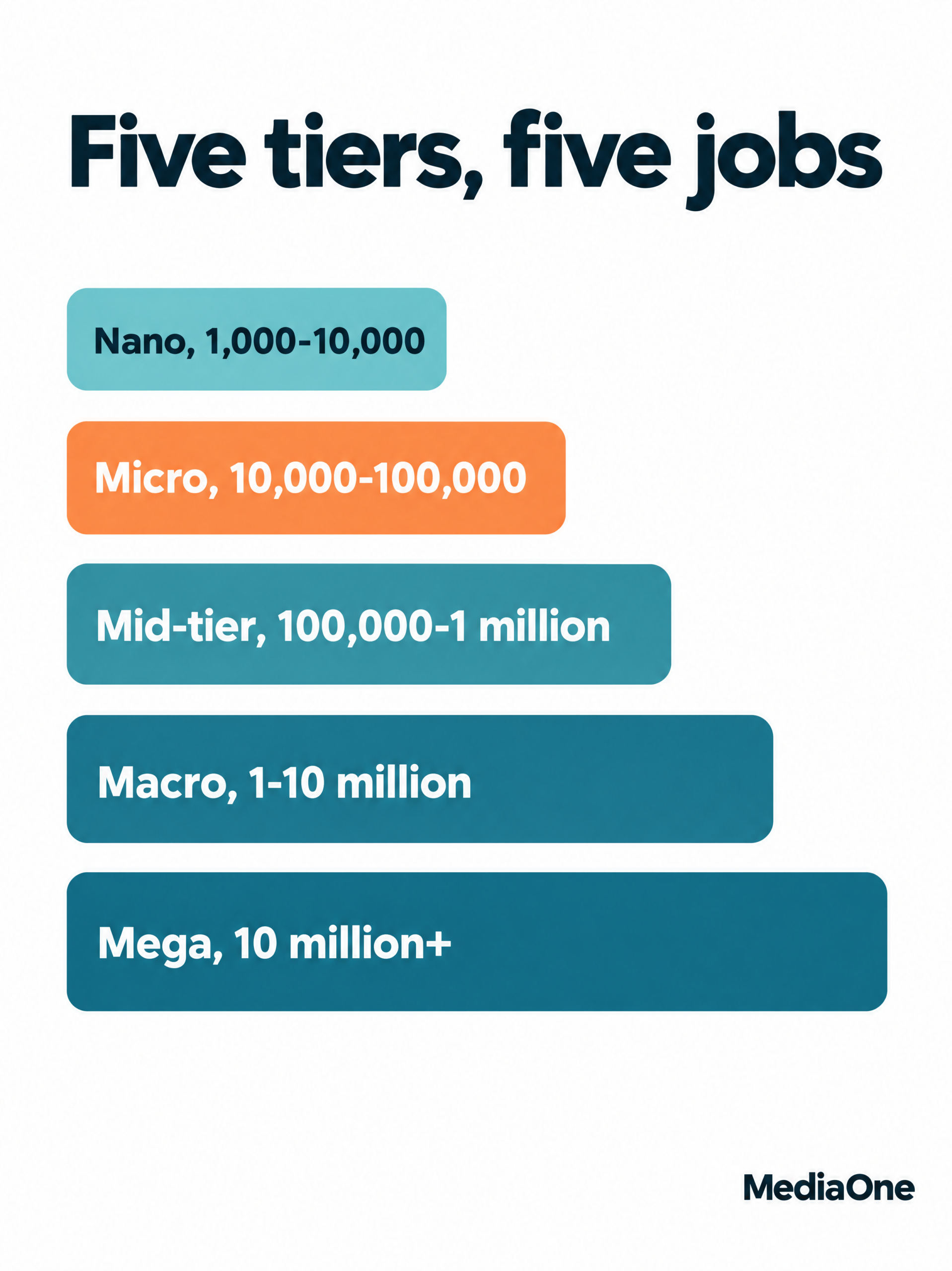
Influencer Tier Comparison Table
| Tier | Follower Range | Typical Engagement Rate | Indicative SGD Cost per Post | Best Use Case | Typical ROI Range |
|---|---|---|---|---|---|
| Nano-influencers | 1,000–10,000 | 3–5% | SGD 300–1,500 | Hyper-niche products, community building, high-touch audiences | 4:1–8:1 |
| Micro-influencers | 10,000–100,000 | 1–3% | SGD 1,000–8,000 | Targeted B2C campaigns, authentic recommendations, regional focus | 2:1–5:1 |
| Mid-tier influencers | 100,000–1 million | 1–2% | SGD 5,000–30,000 | Mainstream awareness, balanced reach and engagement, category authority | 1.5:1–3:1 |
| Macro-influencers | 1–10 million | 0.5–1.5% | SGD 20,000–100,000+ | Rapid mass awareness, event promotion, broad category reach | 1:1–2.5:1 |
| Mega-influencers and celebrities | 10+ million | 0.1–0.5% | SGD 50,000–500,000+ | Maximum broadcast reach, brand prestige, product launches | 0.5:1–1.5:1 |
Note: Indicative rates vary by platform, creator location, agency representation, and campaign scope. These ranges reflect 2024 Singapore market conditions and may fluctuate. Engagement rates are platform and industry dependent.
Choosing Your Tier: Decision Framework
Use the following numbered questions to determine which tier best suits your campaign:
- What is your primary objective: brand awareness, engagement, or direct conversion? Nano and micro-influencers excel at conversion. Macro and mega-influencers excel at awareness.
- What is your total campaign budget? Nano-influencers cost less per post but require more partnerships to reach scale. Macro-influencers deliver reach quickly but require larger investment per creator.
- How niche is your product or service? Highly specific offerings (e.g. specialist fitness equipment, regional B2B services) perform better with nano and micro-influencers whose audiences are pre-qualified.
- Do you need regional specificity or mass appeal? If you operate in specific Singapore neighbourhoods or serve a particular community, nano and micro-influencers who serve that geography will outperform national creators.
- How much time do you have? Nano-influencers have faster decision timelines and shorter content production cycles. Macro-influencers may require months of negotiation.
- What is your risk tolerance for brand fit? Larger tiers carry higher financial risk if audience misalignment occurs. Smaller tiers allow faster iteration and learning.
Decision Matrix: Quick Reference
| Your Priority | Best Tier | Why |
|---|---|---|
| Maximise engagement and conversion rate | Nano or Micro | Hyper-engaged audiences, authentic fit |
| Reach a specific niche community | Nano or Micro | Audience is pre-qualified by interest |
| Achieve rapid mass awareness | Macro or Mega | Volume and speed trump engagement % |
| Balance reach with authenticity | Micro or Mid-tier | Offers reasonable scale without audience dilution |
| Minimize cost per engagement | Nano | Lowest fees, highest engagement %, highest ROI per pound |
| Test product-market fit quickly | Nano or Micro | Faster timelines, lower investment per test |
Key Takeaways
- Influencer tiers matter more than follower count alone. Nano and micro-influencers (1,000–100,000 followers) often deliver higher engagement and ROI per pound than macro-influencers, especially for niche products or services.
- Vetting is non-negotiable. Fake followers, sudden engagement spikes, and misaligned audiences will waste budget and damage brand reputation. Use tools like HypeAuditor or Creator.co to verify authenticity before outreach.
- Authenticity requires creative freedom. Overly scripted briefs kill the influencer’s voice and audience trust. Effective campaigns balance brand requirements (key messages, usage rights, legal compliance) with creator autonomy.
- Platform strategy is not interchangeable. Instagram Reels work differently from TikTok trends; YouTube reviews build authority in ways LinkedIn thought leadership does not. Each channel demands its own creative approach and measurement lens.
- Measurement goes beyond likes and impressions. Track actual conversions, customer lifetime value, and sentiment quality. Attribution across multiple touchpoints is complex, but actual ROI may differ from tracked figures due to offline conversions and word-of-mouth effects.
- Longer-term relationships outperform one-off campaigns. Sustained partnerships build audience trust, reduce negotiation friction, and allow collaborative content that feels earned rather than transactional.
What Influencer Marketing Is and Why It Works
Influencer marketing is the practice of partnering with individuals who have established credibility and engaged audiences in specific niches to promote your product or service. These creators, known as influencers, generate awareness, trust and conversions by endorsing brands to their followers.
Influencer marketing serves brands and businesses that need to reach specific audience segments authentically. It solves the core problem of traditional advertising: audiences no longer trust corporate messaging. Instead, they trust recommendations from people they follow and respect.
Key characteristics of influencer marketing:
- Audience trust built through peer recommendation rather than brand control
- Content that appears native to the creator’s channel, not visibly forced
- Targeted reach into niche communities or demographics
- Measurable engagement and conversion tracking
- Flexibility to work across budget sizes, from product gifting to six-figure campaigns
Influencer marketing differs from traditional advertising in one fundamental way. Users perceive standalone advertisements as interruptive rather than conversational content. By contrast, a recommendation from a trusted creator feels like advice from a friend. This psychological shift, from interruption to endorsement, is why influencer partnerships generate measurable business outcomes.
Trust building works differently through influencer partnerships than through brand messaging. Brands control their own messaging; they choose what to say and how to say it. Audiences are skeptical of this control. Influencers, however, have already earned trust through consistency, expertise and authenticity in their niche. When an influencer endorses your product, that trust transfers to your brand. This mechanism is sometimes called third-party credibility: the endorsement comes from someone outside your organisation, which makes it feel less biased.
Current ROI Benchmarks in the Influencer Economy (2024)
Reported influencer marketing ROI ranges from 5:1 to 6:1 depending on tier, campaign structure and industry. This means for every dollar spent, brands report between five and six dollars in return. However, actual outcomes vary significantly based on audience quality, product-market fit and attribution window.
Return on investment by tier (indicative ranges, 2024):
- Nano-influencers: Reported campaigns achieve 8–12x return on spend in some cases, though attribution complexity means actual conversions may be higher or lower than tracked
- Micro-influencers: Typically 4–8x ROI; most predictable tier for cost-per-engagement calculation
- Mid-tier influencers: 3–5x ROI; higher absolute reach offsets lower per-engagement cost
- Macro-influencers: 2–3x ROI; reach-focused, conversion rates lower than smaller tiers
- Mega-influencers: 1–2x ROI or brand lift only; purchase intent varies significantly by product category
These figures are indicative and subject to variation by geography, platform, industry and creator representation. Actual ROI may differ; offline and word-of-mouth conversions may not be captured in tracked metrics.
The Five Tiers of Influencer Partnerships: Choosing Your Level
Influencer tier is the primary lever for balancing budget, reach and authenticity. Each tier solves a different business problem. Your job is to match the tier to your campaign goal, not to chase follower counts.
Nano-influencers (1,000–10,000 followers): High engagement, tight niches
Nano-influencers typically achieve higher engagement rates than larger tiers. Their communities are small, loyal and active. On Instagram, nano-influencers often see engagement rates between 5–10%, compared to 1–3% for macro-influencers. This occurs because their audiences feel they know them personally.
The trade-off is reach. A single nano-influencer post will be seen by a few thousand people, not hundreds of thousands. You need volume to achieve scale.
Nano-influencers work best for:
- Product launches targeting niche customer segments (vegan cosmetics, indie games, sustainable fashion)
- Building word-of-mouth in tight-knit communities
- Testing campaign creative with low financial risk
- Reaching specific geographic areas (for example, a beauty influencer based in Singapore’s East Coast)
Micro-influencers (10,000–100,000 followers): Balance of reach and authenticity
Micro-influencers are the workhorse tier. They sit between the intimacy of nano-creators and the scale of mainstream platforms. Engagement rates typically hold at 2–5%, which is measurable and authentic.
Their audiences are real but not yet diluted by algorithmic reach. Most micro-influencers built followers through consistency in a single niche: a fitness coach, a tech reviewer, a parenting blogger. They have both credibility and reach.
Micro-influencers work best for:
- Mid-market brand campaigns with reasonable ROI targets
- Building affiliate programmes (they are sophisticated enough to track links and commissions)
- Content repurposing (a micro-influencer’s Instagram post becomes your case study; their YouTube video becomes your testimonial)
- Geographic expansion (find micro-influencers in each region or country you are entering)
Mid-tier influencers (100,000–1 million followers): Mainstream visibility with selective audiences
Mid-tier creators have crossed into mainstream awareness. People outside their niche know who they are. Engagement rates drop to 1–3%, but volume compensates: a single post reaches tens or hundreds of thousands of people.
At this level, influencers are often represented by agencies. You will negotiate through managers. Content becomes more polished and less spontaneous.
Mid-tier influencers work best for:
- Brand awareness campaigns with defined target demographics
- Product launches requiring rapid reach into a specific audience (a fashion brand launching with a fashion influencer at 500,000 followers reaches your exact demographic at scale)
- Co-created content and longer-term ambassadorships
- Campaigns requiring production quality (they have access to studios, editors, videographers)
Macro-influencers (1–10 million followers): Rapid awareness at scale
Macro-influencers are celebrities with internet platforms. Engagement rates fall to 0.5–2%, but a single post reaches millions. You are buying reach, not intimacy.
At this level, followers are often passive. They consume content but do not feel close to the creator. Conversion rates are lower than smaller tiers, though awareness spikes significantly.
Macro-influencers work best for:
- Product launches requiring immediate, country-wide or regional awareness
- Seasonal campaigns with fixed windows (Chinese New Year, Christmas)
- Brand partnerships that justify high cost per engagement
- Broadcasting a core message to a broad, non-segmented audience
Mega-influencers and celebrities (10+ million followers): Maximum reach, lower engagement rates
Mega-influencers and celebrities are household names. A single post reaches tens of millions of people globally. Engagement rates are often below 0.5%, but volume is enormous.
These creators are brands themselves. They are unlikely to feel passionate about your product. The partnership is transactional. You are not buying authenticity; you are buying distribution and association.
Mega-influencers work best for:
- Global product launches
- Building instant credibility in new markets
- Campaigns where brand association matters more than conversion
- One-off announcements requiring maximum reach
Influencer Tier Comparison Table
| Tier | Follower Range | Typical Engagement Rate | Indicative Cost (SGD per post) | Best Use | Typical ROI Range |
|---|---|---|---|---|---|
| Nano-influencer | 1k–10k | 5–10% | 300–1,500 | Niche testing, community seeding | 8–12x (attributed spend) |
| Micro-influencer | 10k–100k | 2–5% | 1,000–8,000 | Mid-market campaigns, affiliate programmes | 4–8x |
| Mid-tier influencer | 100k–1m | 1–3% | 5,000–50,000 | Brand awareness, product launches | 3–5x |
| Macro-influencer | 1m–10m | 0.5–2% | 50,000–250,000+ | Regional awareness, seasonal campaigns | 2–3x |
| Mega-influencer/Celebrity | 10m+ | Below 0.5% | 250,000–seven figures | Global launches, brand association | 1–2x |
Engagement rates are platform and industry dependent. These ranges reflect typical performance on Instagram and TikTok as of 2024. Pricing is indicative and varies by platform, creator location, agency representation and campaign scope. ROI figures are reported ranges and may not capture all conversions, particularly offline or word-of-mouth transactions.
Decision Framework: Choosing Your Tier
Use this framework to match your campaign goal to the right tier(s):
| Campaign Goal | Best Tier(s) | Why Choose This Tier | Decision Factors |
|---|---|---|---|
| Test product-market fit, niche awareness | Nano + Micro | Low cost, high engagement, tight feedback loop | Budget under SGD 5,000; targeting specific community |
| Build category authority, reach target segment | Micro + Mid-tier | Authentic credibility plus meaningful reach | Need both trust and visibility; budget SGD 5,000–30,000 |
| Drive conversions from known audience | Micro | Highest engagement-to-cost ratio | Focus on action over awareness; repeat audience |
| Launch product to new market segment | Mid-tier | Reach plus selectivity without mega-cost | Need 50k–500k reach; defined target demographic |
| National or regional awareness push | Macro | Fast penetration across broad demographics | Broad awareness goal; budget SGD 100,000+ |
| Global launch or celebrity association | Mega | Maximum reach and brand lift | Brand value matters more than conversion; budget seven figures |
Most successful campaigns use a tiered mix, not a single tier. For example: two to three mid-tier creators for reach, eight to ten micro-influencers for engagement and authentic endorsement, and twenty or more nano-influencers for niche community seeding. This pyramid approach delivers both scale and credibility. You reach many people through macro and mid-tier partners, but build trust and conversion through the micro and nano layers where engagement is real.
Building Your Influencer Identification and Vetting Playbook
Finding the right influencer is half discovery, half detective work. A creator with 50,000 followers and 0.3% engagement will waste your budget faster than one with 5,000 followers and 8% genuine interaction. This section walks you through auditing creators before you negotiate a single contract.
Auditing audience demographics and engagement authenticity
Start by asking: who actually follows this creator, and do they match your target customer?
Pull the influencer’s audience breakdown from their native platform analytics (Instagram Insights, TikTok Creator Dashboard) or a third-party tool. You need to see:
- Age range, gender, geography and primary language
- Whether the top countries match your market (for example, if you sell in Singapore, a UK-heavy audience adds friction)
- Whether the follower base skews toward your customer archetype (B2B services need professional and decision-maker followers; cosmetics need aspirational fashion-forward ones)
Engagement authenticity is harder to spot visually. Real engagement typically shows:
- Comment-to-like ratio between 3–8% (if 100,000 likes, expect 3,000–8,000 comments)
- Comments that are specific, not generic (“Love this” is a bot; “How did you get the finish so smooth?” is human)
- Consistent engagement across posts (not a spike on one post then silence)
- Replies from the creator to followers (signals two-way relationship, not broadcast)
Use a simple calculation: divide total comments on the last 10 posts by total likes, then multiply by 100. Anything under 1% suggests artificial inflation.
Checking for brand alignment and audience overlap
Brand misalignment wastes budget and damages credibility. A luxury skincare brand partnering with a creator known for budget hauls sends mixed signals to audiences on both sides.
Create a three-layer alignment audit.
Layer 1: Values and tone. Review the creator’s last 20–30 posts. Do they match your brand voice? A playful, irreverent creator is a poor fit for serious financial services. A sustainability-focused creator will not authenticate a fast-fashion brand.
Layer 2: Product category history. Check whether the creator has promoted similar or competing products before. If they have already reviewed your direct competitor, ask why their audience needs another recommendation, or proceed knowing loyalty may be split.
Layer 3: Audience overlap. Use a platform tool like HypeAuditor’s Audience Match feature to compare the influencer’s followers to your existing customer list or lookalike audience. Target 40% overlap minimum if the influencer’s niche is adjacent; 60%+ if it is core to your category.
A worked example: You sell premium workwear for remote professionals. A fitness influencer with 200,000 followers might seem valuable (size), but if their audience is 70% students and 60% under 25, overlap is low. A productivity-focused creator with 40,000 followers whose audience is 65% aged 25–45 and works in professional roles delivers better ROI despite smaller scale.
Red flags: fake followers, sudden engagement spikes and inconsistent posting
Watch for these warning signs before you commit.
Fake follower patterns:
- Follower growth of 5,000+ per week when posting frequency is once per week (unnatural velocity)
- Username comments in non-Latin scripts from accounts with no profile picture (bot networks)
- Followers from countries where the creator has never posted or mentioned (geographic mismatch)
Engagement spikes without explanation:
- One post gets 10x normal engagement with no apparent reason (viral moment, promotional push, or bot campaign)
- A sharp drop-off after the spike (engagement inflation then algorithm penalty)
- High-engagement posts that do not align with the creator’s usual content (suggests paid comment boosting)
Posting inconsistency:
- Gaps of 6+ weeks between posts signal burnout or account abandonment
- Sudden format shifts (daily stories then silence, or switching from educational to affiliate posts) suggest account takeover or algorithm desperation
- Recycled or heavily edited older content presented as new
Run a simple history check: visit the creator’s Instagram or TikTok feed, scroll back 3 months and document posting cadence. Open their profile page on HypeAuditor or similar tool and compare their stated engagement rate to what you see in the comments section. Discrepancies are a red flag.
Tools and platforms for discovery
Four categories of tools dominate creator discovery. Each has different strengths depending on your budget, platform focus and scale.
Integrated discovery platforms. HypeAuditor covers Instagram, TikTok and YouTube in one interface. Search by audience demographics, engagement rate, niche keywords and location. Paid plans start around SGD 800+ per month for SMBs. Strong for small teams managing multiple campaigns.
Creator.co focuses on nano and micro-influencers (1,000–100,000 followers) with UK and European data. Lightweight interface, lower cost (SGD 600+ per month). Better if you are running volume campaigns with smaller creators.
Native platform analytics. Instagram Insights, TikTok Creator Marketplace and YouTube’s Partner Programme all offer built-in discovery. Use these first for early-stage scouting. They are free but limited in search sophistication.
Specialist vertical tools. If you work in e-commerce, Influee indexes product mentions across platforms. For B2B, LinkedIn’s creator search is underrated and free to use.
Audit-first approach. HypeAuditor runs free single-profile audits. Paste a creator’s handle and get audience breakdown, engagement rate, growth trends and a fake-follower score (0–100). Social Blade (free) tracks follower and engagement trends over time. Useful for spotting unnatural growth patterns before you invest in deeper vetting.
Note: tool pricing is indicative and varies by region, plan tier and current promotional offers. Verify current costs with providers before committing budget.
Audience authenticity checklist
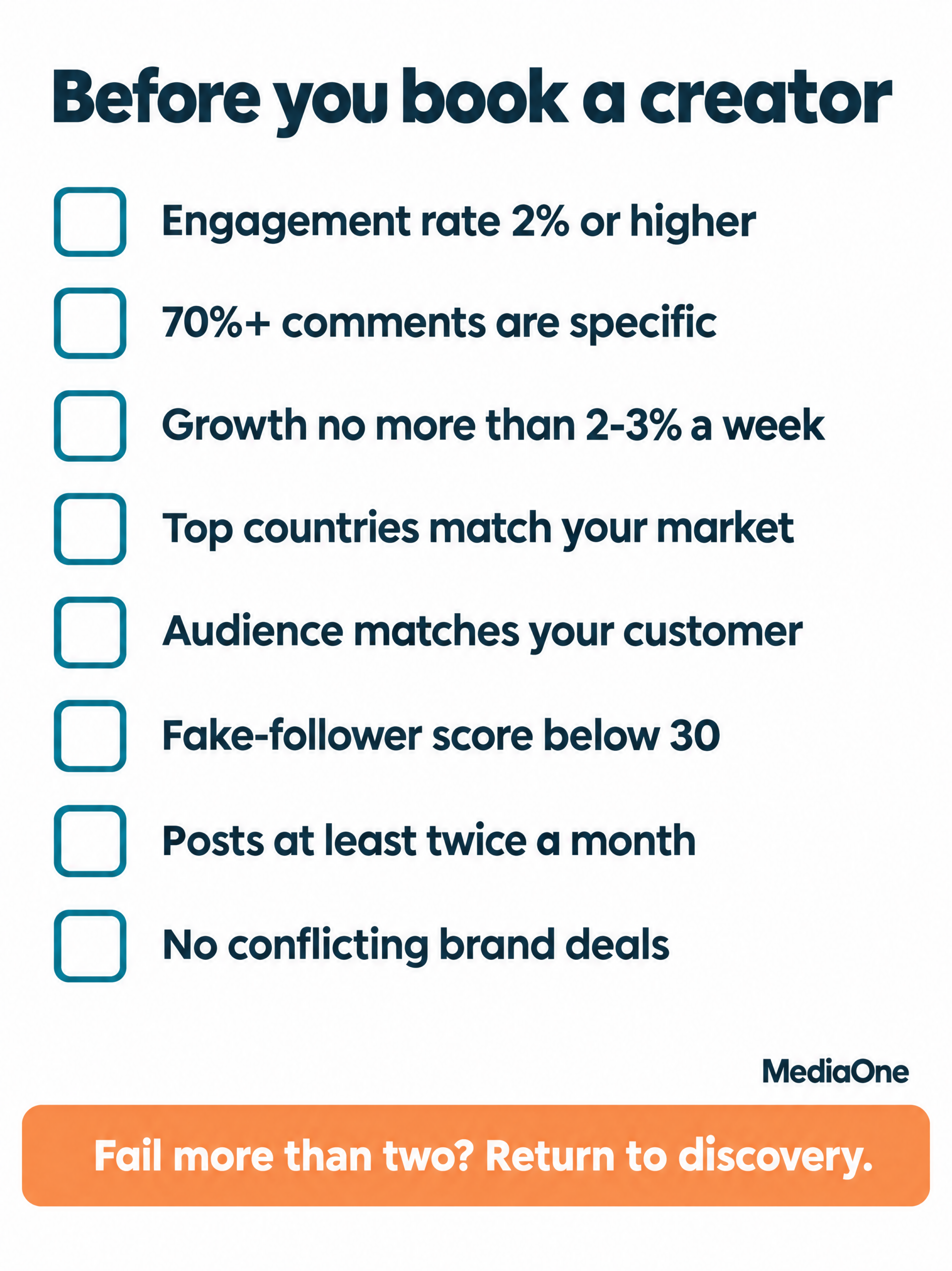
Before moving forward with any creator, work through this diagnostic:
- Engagement rate calculation: Is their engagement rate 2% or higher?
- Comment quality assessment: Do at least 70% of comments contain specific, contextual replies?
- Growth velocity: Did followers grow by no more than 2–3% per week over the last 3 months?
- Geographic alignment: Do the top 3 countries match your target markets?
- Audience demographic match: Does their audience profile align with your customer archetype on age, profession or interests?
- Fake-follower score: If using an audit tool, is the score below 30?
- Posting consistency: Have they posted at least twice per month over the last 90 days?
- Brand safety review: Have they promoted competing brands or products that conflict with your values?
If the creator fails more than two of these checks, return to discovery.
A structured discovery workflow
- List 15–20 creator candidates using platform hashtags, competitor-follower analysis or a paid tool’s search function.
- Run each through HypeAuditor’s free audit. Eliminate anyone with a fake-follower score above 30 or engagement below 2%.
- Manually audit the top 5 candidates: review last 30 posts, read comment quality, check posting cadence, compare audience to your customer profile.
- Request media kits and audience demographics from your final 2–3 choices.
- Vet references: ask previous brand partners about professionalism, delivery speed and audience response.
This process takes 2–3 hours per campaign and reduces wasted spend significantly.
Before moving to negotiation, ask yourself: “If this creator’s audience saw only my brand mentioned with no other context, would they buy?” If the answer is no, alignment is too weak. Return to discovery.
Campaign Structure and Negotiation Essentials
Before you pitch an influencer or accept an influencer pitch, you need a clear structural framework: what are you actually buying, how much will you pay, and what legal protections do both parties need? This section walks through the non-negotiable elements that separate smooth campaigns from disputes and legal exposure.
Defining Deliverables: Posts, Stories, Reels, Long-form Video and Exclusivity Terms
Most influencer partnerships fail because deliverables are vague. “A few posts” looks different to a creator earning SGD 2,000 than it does to a brand paying SGD 2,000. Write down exactly what you’re paying for.

A standard deliverable checklist should specify:
- Number and format of content pieces (for example, 3 Instagram feed posts, 5 Stories, 2 Reels)
- Minimum content length (for example, captions at least 100 words; video at least 30 seconds)
- Posting schedule and timing (for example, “post between 09:00 and 11:00 SGT on Mondays and Thursdays”)
- Hashtags, tagging and link requirements (for example, “must tag @brand_handle and use #partner_campaign”)
- Revision or re-shoot clauses (for example, “one round of feedback; additional requests billed separately”)
- Exclusivity window (for example, “no competing category posts for 30 days before and 30 days after launch”)
Exclusivity is a negotiation hot-spot. A micro-influencer with 25,000 engaged followers might accept a 30-day exclusivity window for SGD 500, but a macro-influencer commanding SGD 5,000 will resist it unless you’re paying premium rates. Exclusivity means they cannot promote a direct competitor in the same product category during the agreed period. Be specific about what counts as “competitor”: rival fast-fashion brands, or any clothing brand? The creator needs to know.
Format matters significantly. A single Instagram Reel reaches further and generates higher engagement than a carousel post, so pricing should reflect effort and reach potential. TikTok native content, rather than repurposed Instagram content, typically commands higher fees because TikTok audiences expect authenticity and creators must invest more production time.
Document exclusivity in writing even for small campaigns. Verbal agreements about “not posting competitors” evaporate when a second brand offers money mid-campaign.
Compensation Models: Fixed Fees, Performance-based, Product Trades and Gifting
You have four levers to pull: pay a fixed amount, tie payment to performance, provide products, or combine approaches.
Fixed fees are straightforward and most common. A creator quotes you a rate per deliverable: SGD 400 per Instagram Reel, SGD 150 per Story, SGD 2,000 for a brand partnership pack. Rates depend on follower count, engagement, niche authority and geographic audience concentration. Indicative rates vary by platform, creator location and agency representation. A Singapore-based fashion micro-influencer might charge SGD 250 to SGD 800 per post, depending on their audience quality and engagement metrics. Always request a rate card before negotiation.
Performance-based models (commission on sales, affiliate fees, or cost-per-conversion) shift risk to the creator. They work only if the influencer has a directly linkable audience: e-commerce drops, landing pages with unique promo codes, or shortened URLs. A beauty brand might offer a creator 10% commission on sales generated through their unique code. This requires trust and clean attribution. Use affiliate tracking platforms like ShareASale or Refersion (now part of Shopify) to automate payouts and auditing.
The risk: creators may prioritise pushing high-commission products rather than those that genuinely fit their audience. Align commission rates with your expected margin. If your product costs SGD 50 and you have a 40% margin, do not promise a creator 15% commission per sale.
Product trades and gifting suit smaller campaigns and emerging creators. You send products; they create content. This is low cost for you (product cost, not cash outlay) but lower-value for creators. It works only if:
- The product genuinely interests them, not generic “we’ll send you whatever”
- You’re not asking for exclusivity or multiple posts in return
- You’re transparent that this is a gift, not a paid partnership (required by law for disclosure)
Never use gifting as the sole compensation for an influencer with a significant audience. It reads as exploitative and risks platform warnings for undisclosed partnerships.
Mixed models are common at scale. Pay a creator SGD 1,500 as a base fee, then offer 5% commission on sales above SGD 10,000. This ensures they remain motivated without your costs spiralling if the campaign underperforms.
Payment timing matters for trust. Standard terms are 50% upfront on contract signature, 50% on delivery and approval. Some creators ask for 100% upfront; some demand 100% on delivery. Negotiate what feels balanced. If you’re new to an influencer, offer smaller upfront deposits (25 to 30%) until they’ve delivered on their first commitment.
Document all compensation in writing, including payment method (bank transfer, PayPal), currency (SGD, GBP, EUR) and any late-payment penalties. Creators are often freelancers with tight cash flow; delays damage relationships.
Contract Non-negotiables: Usage Rights, Approval Timelines and Disclosure Compliance
A handshake and a direct message are not a contract. Write one, even if it is one page. Disputes over deliverables, payment and content usage are common and escalate quickly.
Usage rights are critical. Clarify:
- Can you use the creator’s content on your own channels (Instagram, website, ads) after the campaign ends?
- For how long and in what format (social posts, paid ads, email, print)?
- Can you crop, edit or modify the content?
- Will you credit the creator each time?
Most creators retain ownership of the content they create. You’re buying a licence to use it, not the copyright. Standard language: “Brand may repost and repurpose Creator’s content on Brand’s owned channels (Instagram, TikTok, website, email) for 12 months from the post date, with Creator credited in each use. Paid media use (Facebook/Instagram ads, Google Ads) requires separate written approval and 20% fee uplift.”
Without a clause like this, you’ll need to ask permission each time you want to share their content. Many creators say no to ads, as they do not want their image used in paid campaigns, or charge extra. Lock this in upfront.
Approval and revision timelines prevent bottlenecks. Specify:
- Creator submits draft content by (date and time)
- Brand provides feedback by (date and time): usually 48 hours
- Creator revises and resubmits by (date and time)
- Brand approves or requests final revisions by (date and time)
- Creator posts live by (specific date and time)
A vague “we’ll review it when we can” derails campaigns. If a creator submits content 3 hours before the scheduled posting time and you spot issues, neither party can recover. Build in a 5 to 7 day window from submission to live posting.
Disclosure compliance is non-negotiable legally. The Advertising Standards Authority (ASA) Singapore mandates transparent disclosure of sponsored content under the Singapore Code of Advertising Practice (SCAP). Content qualifies as advertising if payment or material consideration (including free products with an expectation of promotion) is involved.
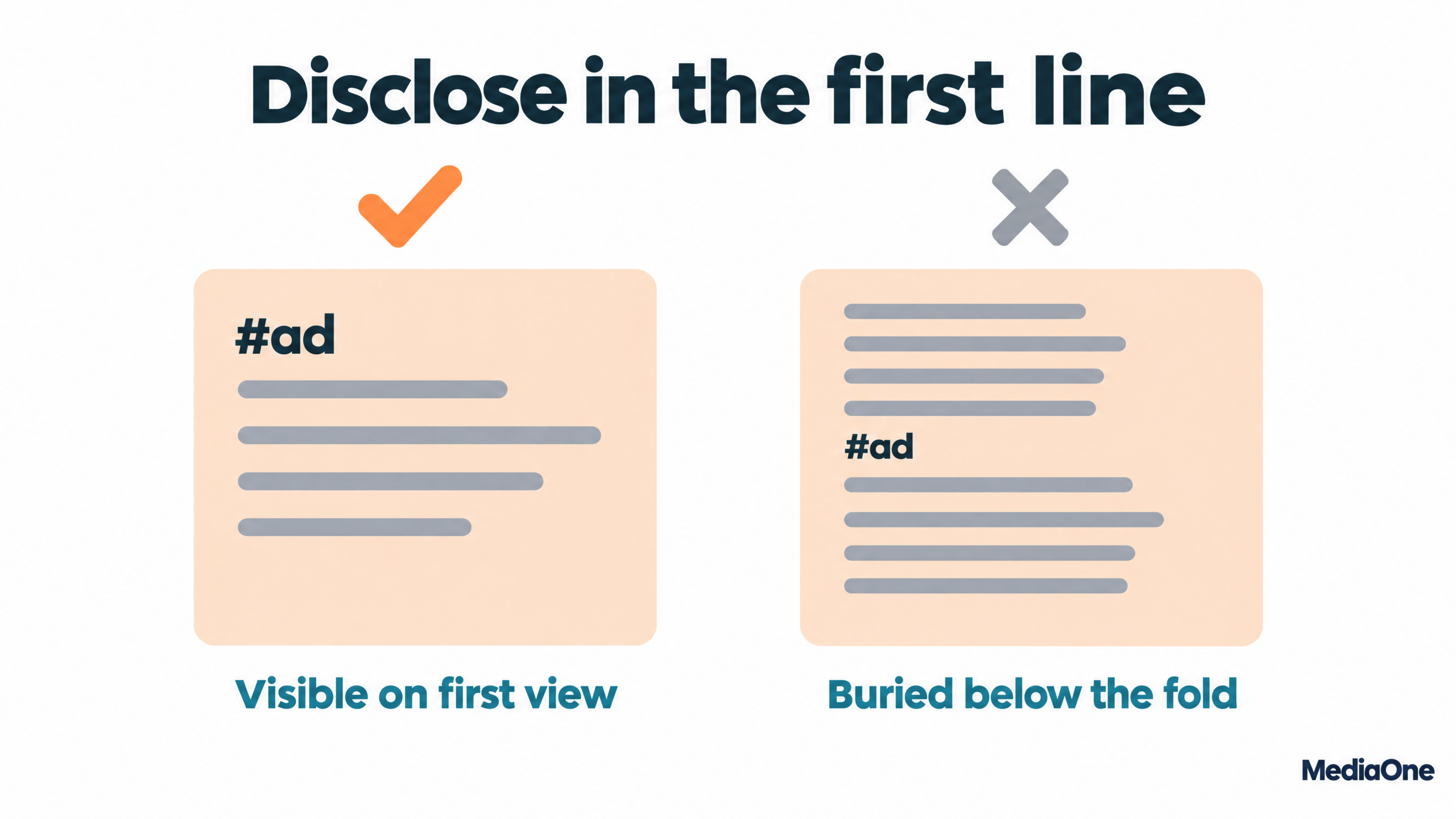
Include in your contract: “Creator agrees to include #ad or #sponsored in captions and prominently disclose the partnership on first-view, not buried in comments or link-in-bio. Creator is responsible for platform-appropriate disclosure format. Brand will flag non-compliant disclosures; Creator has 2 hours to correct.”
Undisclosed partnerships are enforceable violations. Regulatory bodies across jurisdictions have issued warnings and fines for posts missing required tags. Include language that both parties agree to disclosure standards upfront, and the creator understands they are liable if they fail to disclose to their audience.
Liability and indemnity clauses protect both sides. If a creator’s post defames a third party or infringes copyright, who pays the legal bill? Standard language: “Creator indemnifies Brand against claims arising from Creator’s content, excluding claims that Brand’s approved brief led to the violation. Brand indemnifies Creator against claims that Brand’s product caused harm, such as safety defects.”
Regional Legal Considerations: Singapore ASA Guidelines, FTC and CAP Equivalents, and Local Disclosure Law
Influencer marketing rules vary by jurisdiction. If your audience spans regions, you need to meet the strictest standard in each.
Singapore: The ASA Singapore oversees advertising standards under the Singapore Code of Advertising Practice (SCAP). Influencer content is advertising if it is for payment or consideration, including free products with an expectation of promotion. Disclosure must be clear: #ad, #sponsored, or equivalent language visible without clicking “more”. Do not bury disclosure in comments or link-in-bio.
Singapore also has the Personal Data Protection Act (PDPA), which restricts how brands can collect and use consumer data through influencer campaigns, such as giveaway entries. If you’re running a giveaway through an influencer, ensure data collection complies with PDPA requirements: clear consent, stated use, and the right to opt-out.
United Kingdom and European Union: The ASA’s CAP Code is the baseline. All advertising, including influencer posts, must be clearly identifiable as such. Use #ad or similar language on the first line of captions, not buried. A post saying “Love this lipstick” with #ad on the fifth line of a long caption has breached CAP Code because casual viewers scrolling quickly will not see the disclosure.
The ASA can fine brands and creators. Regulatory bodies have issued multiple fines for non-disclosed partnerships across Instagram, TikTok and YouTube. Do not assume “everyone knows this is an ad”; the rule requires clear, upfront notice.
United States: The FTC’s Endorsement Guides require clear and conspicuous disclosures. #ad, #sponsored, or “paid partnership” tags (built into Instagram and TikTok) satisfy this. The FTC has issued warning letters to creators and brands for inadequate disclosure. Penalties can reach GBP 5,000 or more per violation.
Australia: The AANA Code of Ethics requires clear disclosure of material connections. Similar to the FTC, use #ad or equivalent. The AANA regularly publishes rulings on non-compliant influencer campaigns.
Contract language for multi-region campaigns:
“Creator agrees to comply with advertising disclosure standards in all jurisdictions where this content will be visible. For UK and EU audiences, disclosures must appear in the first line of captions. For US audiences, #ad or paid partnership tags satisfy FTC requirements. For Singapore and Australia audiences, #ad or #sponsored in the first line satisfies ASA/AANA standards. Brand will specify which regions apply; Creator is responsible for meeting all applicable standards.”
If you’re uncertain about a region, contact your legal team or the relevant advertising authority (ASA, FTC, AANA, ASA Singapore). Ignorance of local rules is not a defence if a violation is discovered post-campaign.
Common Campaign Challenges and Solutions
| Challenge | Root Cause | Recommended Action |
|---|---|---|
| Creator misses posting deadline | Timeline not specified in contract; creator has competing commitments | Add 5-7 day approval window in contract with specific posting date and time (SGT). Include 48-hour feedback window. Build in a 3-day buffer before your desired post date. |
| Brand wants to use content in paid ads; creator refuses | Usage rights not negotiated upfront; creator uncomfortable with their image in ads | Negotiate and document usage rights before campaign launch. Offer 20-30% fee uplift for paid media use. Lock this in writing. |
| Disclosure missing or buried | Creator unclear on legal requirements; rushed posting | Include explicit contract clause on disclosure placement and format. Specify #ad or #sponsored must appear in first line, not comments. Provide a disclosure template. |
| Engagement or reach lower than expected | Audience partly fake or inactive; content not aligned with creator’s typical posting style | Run audience authenticity audit before booking (check HypeAuditor, Creator.co metrics for engagement genuineness). Ensure content brief allows creator creative freedom while hitting key messages. |
| Creator posts about competitor during exclusivity window | “Competitor” definition not specific; creator unaware of constraint | Define “competitor” in writing (e.g., “fast-fashion brands targeting 18-30 age group” vs. “any clothing brand”). Provide a list of prohibited brands. Send reminder 1 week before campaign. |
| Payment delayed; creator stops responding | Payment terms vague; no escalation path defined | Specify payment method, currency and due date in contract. Use invoicing platforms (Stripe, Wave) that send automatic reminders. Build in late-payment penalty clause (e.g., 1% per week). Pay creators on time; treat them as partners, not vendors. |
Pre-Campaign Checklist
Before signing any influencer deal, complete this checklist:
- Have you written down every deliverable (format, length, quantity, posting schedule)?
- Have you agreed on exclusivity and documented it in writing?
- Have you settled on compensation model and payment timing?
- Have you drafted or used a contract covering usage rights, approval timelines and liability?
- Have you confirmed the disclosure format and jurisdiction compliance requirements?
- Have you shared the contract and reviewed it with the influencer, allowing 5 business days for review?
If you have ticked all six, you are ready to execute. If any are unclear, that is a red flag for a campaign that will stall.
Content Briefs That Work Without Killing Authenticity
The tension between brand control and creator freedom
The most common failure point in influencer partnerships arrives not at negotiation but at the brief. Brand teams arrive with ten pages of prescriptive language, keyframe approvals and mandatory hashtags. Creators receive them, recognise the loss of voice, and either decline or deliver visibly templated work. Users perceive standalone advertisements as interruptive rather than conversational content. Engagement flattens.
The underlying conflict is real: brands need message consistency and legal compliance. Creators need narrative control to maintain the trust their audience has placed in them. A brief that skews entirely toward brand control produces safe, forgettable content. A brief with no structure invites off-brand positioning or regulatory exposure.
The resolution is structured permission: clarity on what is non-negotiable, paired with explicit creative autonomy in everything else. This distinction separates briefs that creators treat as constraints from briefs they treat as creative scaffolding.
Structuring briefs with hard requirements and creative room
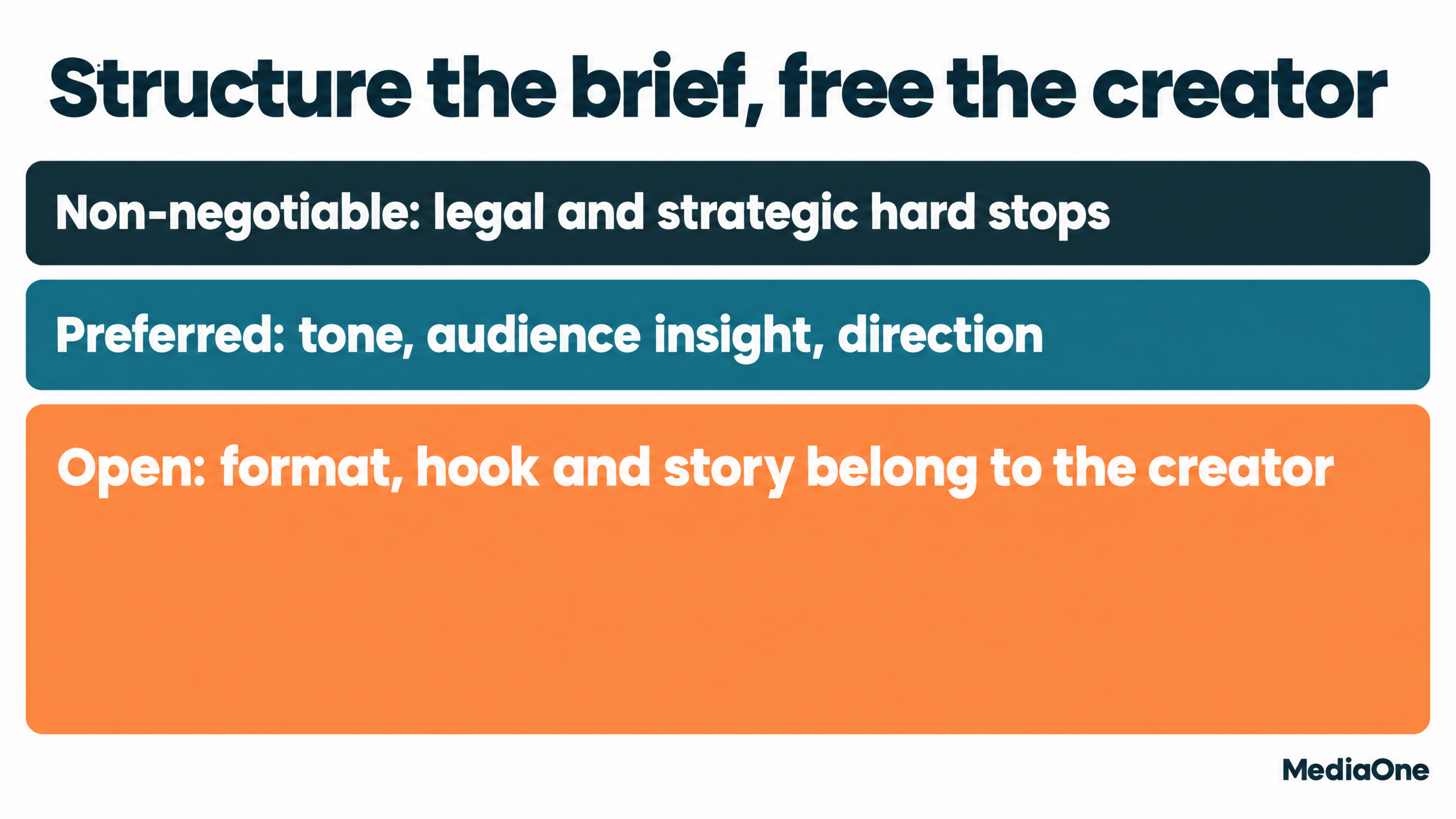
Divide your brief into three tiers. Mark each clearly.
Tier 1: Non-negotiable (the legal and strategic hard stops)
List what must appear and cannot be altered. This is typically your compliance line. Examples include:
- Product name and primary benefit statement must appear exactly as approved (e.g. “clinically proven to reduce wrinkles”)
- Content must be disclosed as #ad or #sponsored under IMDA advertising guidelines or equivalent regulatory requirement in your territory
- Must not reference competitor names directly
- Personal data collection statements (if applicable) must comply with PDPC requirements
Keep this section to five to eight items maximum. If your list is longer, you have a messaging or targeting problem, not a creator problem.
Tier 2: Preferred (the things you hope for, but not dealbreakers)
This is the tone, audience insight and narrative direction. Examples:
- “We’d like this to focus on the before-and-after story rather than product specifications”
- “Our audience is primarily working parents aged 28-42; the angle that resonates best is time-saving, not luxury positioning”
- “The emotional tone should feel aspirational but grounded, not exclusive”
Be specific about the emotion or problem you are addressing, not the exact words to use. “We want it to feel authentic and relatable” is more useful than “do not use words like elite or premium.”
Tier 3: Open (where the creator drives the story)
Explicitly state the creative freedoms. For example: “You choose the format (video, carousel, static post), the hook, the call-to-action and the creative framing. The product appears, but the story is yours.”
This third tier is where the brief earns creator buy-in. A creator reading Tier 3 knows they have room to make the content feel like their own work, not an unpaid advertisement.
Key message integration without scripting
Avoid prescribing words. Instead, provide the intent and evidence.
For example, do not write: “Say that our moisturiser reduces fine lines in just two weeks.”
Instead, write: “Our clinical study shows 43% of users reported visible fine line reduction within fourteen days. You can reference this finding if it fits your narrative, but do not claim it as personal experience.”
This approach gives creators the credibility hook without forcing them to become product spokespeople. The result is content that sounds like genuine recommendation, not recitation.