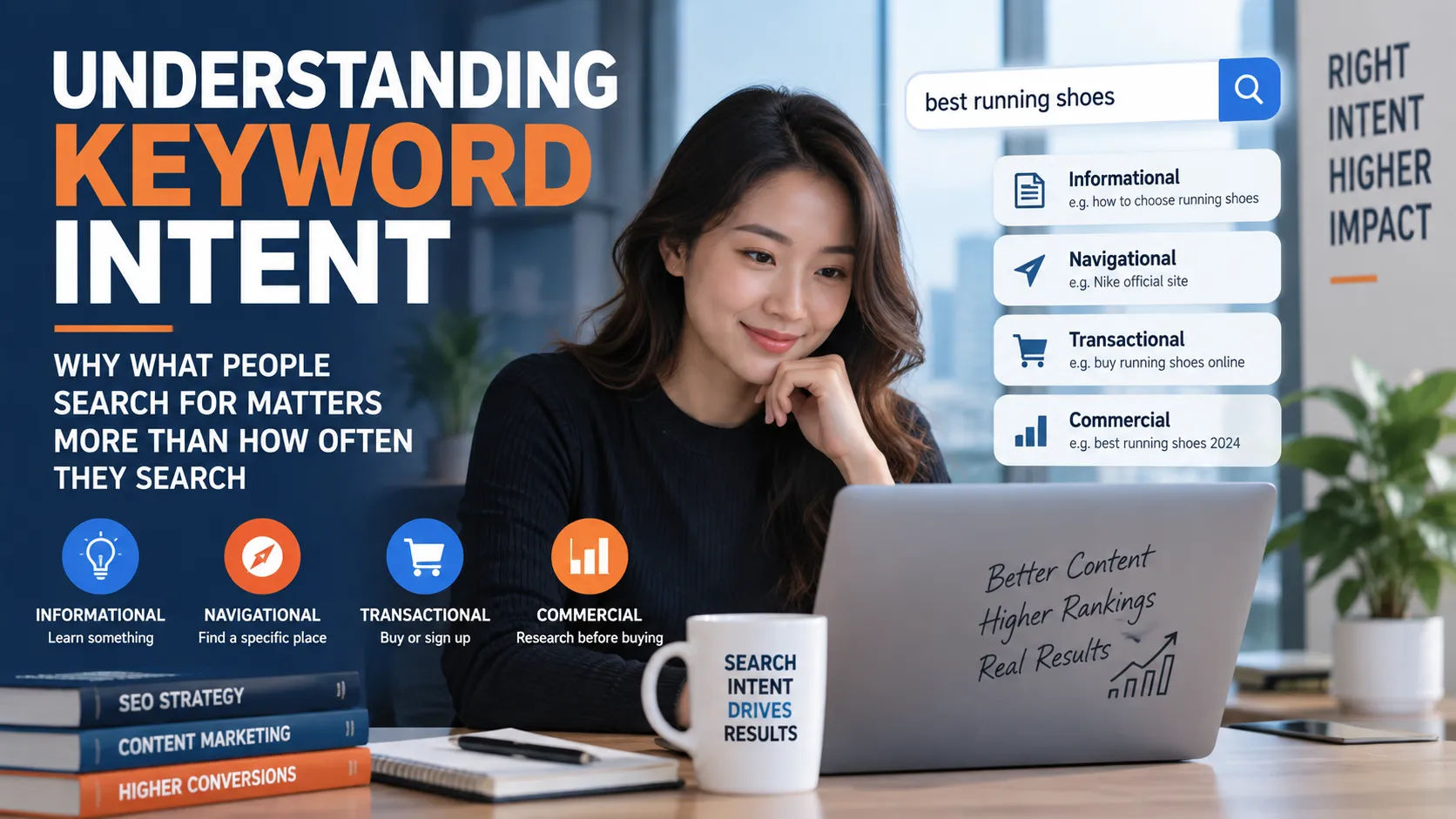
When a user searches for “best running shoes,” the query structure signals a specific intent. They want product recommendations, not the history of Nike, not a guide to shoelaces, and not a physics lecture on cushioning materials. That signal, embedded in your query, is keyword intent.


Keyword intent is the underlying reason someone searches. It answers the question, “What does this person actually want to accomplish right now?” Understanding it helps professionals identify keywords that drive qualified conversions, not just traffic that never converts.
In this guide, you’ll learn how to identify intent, match it to your content, and use it to build a keyword strategy that drives traffic qualified to act. We’ll move past surface-level definitions into the methods search engines use to detect intent, how it shifts across markets and devices, and why misaligning your content to intent significantly harms both rankings and conversions.
Key Takeaways
- Keyword intent is the reason behind a search: what the user actually wants to accomplish.
- Search engines prioritise matching intent over exact keyword matches.
- Four core intent types shape SEO strategy: informational, navigational, transactional, and commercial.
- Each intent type requires different content formats and structures.
- Intent mismatch damages search visibility and user satisfaction.
- Intent signals come from SERP layout, featured snippets, ads, and user behaviour.
- Intent varies by geography, language, device, and time.
- Most real keywords carry multiple weak intents layered on a primary one.
What Is Keyword Intent?
Keyword intent (or search intent) is the goal a person hopes to achieve when they type a query into a search engine. It’s the reason behind the search, not just the words used.
Someone searching “how to fix a leaky tap” wants instructions. Someone searching “plumber near me” wants a service provider. Someone searching “best kitchen taps” might be comparing products before a purchase. All three queries could contain the word “tap”, but they demand entirely different content to satisfy.
Search engines have spent two decades learning to detect and reward intent matches. When your page aligns with the intent behind the query, both user experience metrics and rankings improve. Misaligned content either fails to rank or attracts the wrong traffic.
Why Search Engines Care About Intent
Google ranks pages that match what you actually searched for. Google doesn’t measure usefulness by keyword density. It measures it by whether the page answers what you wanted to know or do.
In Google’s 2023 guidance on helpful content, the company emphasised that pages should be written for people first. That principle flows directly from intent. A page written with intent alignment in mind typically aligns better with user needs than one written around keyword metrics.
Search engines measure satisfaction through behaviour signals. Clicks, session duration, and pages visited all reveal whether results satisfy intent. A low-intent match generates poor signals across the board. Google learns the page didn’t satisfy the query and deprioritises it.
Search engines profit when users find what they want quickly. Low-intent pages damage user trust and reduce search volume. High-intent pages build loyalty. The incentive structure aligns with intent-first thinking.
Intent Signals Search Engines Use
Search engines infer intent from concrete signals, not by reading minds.
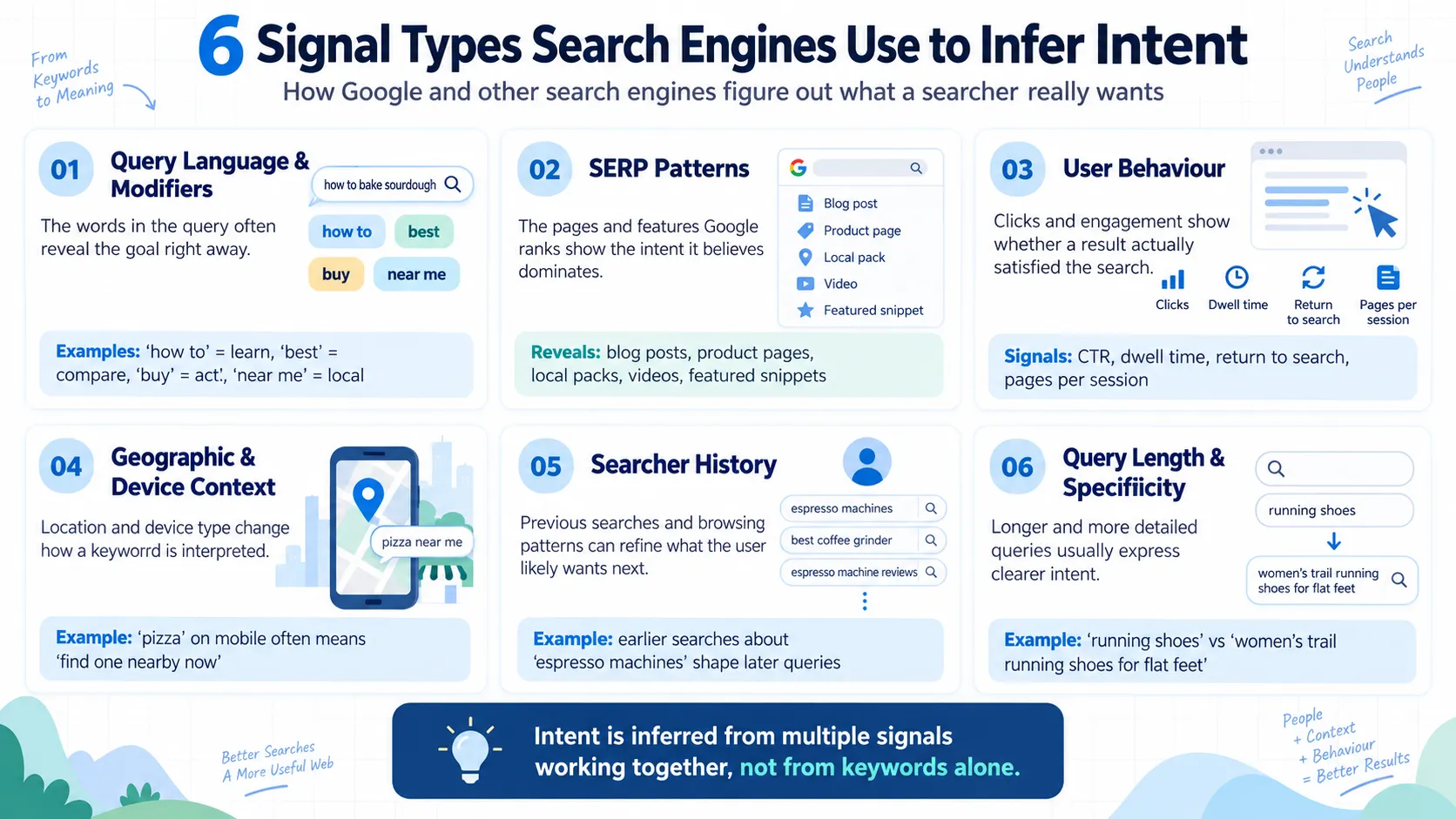
Query language and modifiers form the most obvious signal. Words like “how to”, “best”, “vs”, “near me”, “buy” and “price” carry strong intent markers. A search for “how to fix a leaky faucet” signals different intent than “faucet replacement”. The word “how” shifts the query toward educational content.
Search result patterns reveal what the engine currently believes the intent is. If the top 10 results for a keyword are all blog posts, the engine thinks the searcher wants information. If they’re all product pages, transactional intent dominates. SERP analysis can indicate intent because search engines have already processed millions of interactions with that query.
User behaviour data shows whether results satisfy intent. If most people click result number 4 and stay there for five minutes, while result number 1 gets clicked and immediately abandoned, behaviour signals are reranking intent markers over keyword match.
Geographic and device signals modify intent. A search for “pizza” on mobile from someone in London carries different intent than the same search on desktop. Context about where and how the search happens refines what the engine infers you want.
Searcher history and personalisation add another layer. Someone who searched for “best espresso machines” followed by “how to use an espresso machine” signals deepening intent around that topic. Their next search might be interpreted differently than the same query from a new searcher.

Query length and specificity matter. Longer, more specific queries usually have clearer intent. “Running shoes” is ambiguous. “Women’s trail running shoes for flat feet” is not. The added modifiers narrow intent significantly, which is why long-tail keywords often convert better than short ones.
Search engines combine many signals to determine intent: the words themselves, what competing results show, how past searchers have behaved with similar queries, device type, location, time of day, and the searcher’s own history. A page that perfectly satisfies intent can rank even if it doesn’t contain the exact query keywords.
Note: SERP analysis results may vary based on location, search history, and device. Test in private or incognito mode for more consistent results. This guide focuses on Google; intent signals may differ on other platforms like Bing or AI-powered search systems.
The Four Main Types of Keyword Intent
Most search queries fall into one of four intent categories. These are widely recognised SEO categories that align with search engine behaviour. Understanding which type your target keyword belongs to is the foundation of intent-aligned content strategy.
Informational Intent
Informational intent means the searcher wants to learn something. They’re not ready to buy, not looking for a specific business, and not navigating to a particular website. They want an answer to a question.
Queries with informational intent include “how to”, “what is”, “best practices”, “guide to”, “tips for” and “why does”. Someone searching “how to reduce sodium in a recipe” has informational intent. Someone searching “what is machine learning” does too.
Content that satisfies informational intent includes blog posts, how-to guides, explainers, whitepapers, video tutorials, and educational resources. The goal is to provide clear, thorough answers addressing what the person actually wants to know.
Informational keywords are usually easier to rank for than transactional ones, but they convert less directly into revenue. The play here is to rank, build authority, earn trust, and convert readers into leads or future customers. An in-home HVAC company ranking for “how to improve home ventilation” attracts homeowners who know they have a problem but aren’t ready to call a contractor yet. That’s valuable early-funnel traffic.
Navigational intent means the searcher wants to reach a specific website, business, or place. They might not know the exact address or URL, but they have a particular destination in mind.
Queries with navigational intent include brand names (“Nike running shoes”), place-based queries (“Starbucks near me”), branded searches (“Microsoft Office login”), and direct navigation (“Facebook home page”).
Content that satisfies navigational intent is the business itself: your website, your Google Business Profile, your social media pages, your store location. You don’t create navigational content so much as claim and optimise it.
If someone searches your brand name and lands on a competitor instead, you’ve failed the navigational intent test. Navigational keywords are high-value targets because the searcher has already chosen your business. Your job is to show up and make entry easy.
Transactional Intent
Transactional intent means the searcher is ready to do something: buy, sign up, download, book, request a quote, apply for a job, or take another commercially weighted action.
Queries with transactional intent include “buy”, “order”, “sign up”, “book”, “download”, “apply”, and specific product or service names. Someone searching “women’s size 8 running shoes buy online” has clear transactional intent. Someone searching “book a plumber” does too.
Content that satisfies transactional intent includes product pages, checkout pages, sign-up forms, booking pages, service quotes, pricing pages, and wherever the conversion action lives.
Transactional keywords are often highly competitive because their commercial value is obvious. A visitor with transactional intent is often worth far more than a visitor with informational intent. If you rank for transactional keywords in your industry, you can convert traffic directly into revenue.
The risk is that you can’t force transactional intent onto keywords that don’t have it. Writing a sales page for an informational keyword wastes effort and damages user experience. Matching content type to intent is what separates effective campaigns from ones that drain budget and talent with nothing to show.
Commercial Intent
Commercial intent means the searcher is researching options before buying. They’re in the consideration phase: comparing products, reading reviews, weighing pros and cons, and checking prices. They’re not ready to transact yet, but they’re moving toward it.
Queries with commercial intent include “best”, “review”, “comparison”, “vs”, “alternatives”, “cheap”, and “top rated”. Someone searching “best budget laptops” has commercial intent. Someone searching “Salesforce vs HubSpot” does too.
Content that satisfies commercial intent includes comparison guides, product reviews, buying guides, pros-and-cons breakdowns, rating roundups, and educational content that helps the searcher choose.
Commercial keywords are often less competitive than transactional ones since the searcher hasn’t committed to buying yet, but they’re warmer than pure informational traffic. Ranking for commercial keywords places your product or service in front of people actively considering options in your category. That traffic converts better than informational traffic, even though it doesn’t convert as well as transactional traffic.
Many B2B companies undervalue commercial-intent keywords. If you’re a SaaS platform, someone searching “best project management software” is much closer to buying than someone searching “how to improve team collaboration”. Both are valuable, but intent clarity matters for strategy.
Intent Type Comparison
| Intent Type | User Goal | Keywords | Content Format | Conversion Stage |
|---|---|---|---|---|
| Informational | Learn or understand something | “How to”, “what is”, “best practices”, “why does” | Blog posts, guides, how-tos, video tutorials, explainers | Awareness |
| Navigational | Reach a specific business or place | Brand names, “near me”, location + business type | Website, Google Business Profile, location pages | Existing relationship |
| Transactional | Complete an action (buy, sign up, book) | “Buy”, “order”, “sign up”, “book”, “apply” | Product pages, checkout, sign-up forms, booking pages | Decision/action |
| Commercial | Research before purchasing | “Best”, “review”, “vs”, “comparison”, “cheap” | Reviews, buying guides, comparisons, roundups | Consideration |
How Intent Varies Across Markets, Languages, and Devices
Intent isn’t universal. The same keyword can carry different intent depending on where it’s searched, the language, and the device the searcher is using.
Geographic Variation
Keyword intent shifts based on local market conditions, product availability, and consumer behaviour.
A search for “best coffee” in Italy carries different intent than the same search in the United States. In Italy, it might signal someone wanting to learn about espresso quality. In the US, it likely means they want to find good coffee nearby or purchase quality beans.
Search for “running shoes” in Singapore, and you’re more likely to find commercial and transactional intent since e-commerce adoption is high. The same keyword in a market with lower e-commerce penetration might skew more informational. Local search behaviour in Singapore also reflects strong commercial intent for transactional queries because of mobile payment adoption and fast delivery expectations.
Local regulations and availability also matter. Someone in the UK searching “best diet pills” might find restricted intent because certain products are regulated differently than in the US. Someone in Australia searching for “best cars under AU$30,000” has a different intent than someone in the US, where the market is broader, and prices differ.
When optimising for international markets, research local SERP behaviour. The top 10 results in Singapore for a keyword might look completely different from the top 10 in London, even if the query is identical. That difference reflects local intent variation.
Language Variation
The same concept expressed in different languages can carry different intent weights.
In English, “best running shoes” is primarily commercial. In some other languages, the equivalent phrase might skew more informational or use stronger transactional language. Literal keyword translation across languages is dangerous because searcher behaviour, market maturity, and e-commerce adoption differ.
A keyword that’s easy to rank for in one language might be fiercely competitive in another. A keyword’s commercial value varies by language because purchasing power and market size differ across language communities.
If you’re optimising across languages, don’t just translate your keywords. Research local search behaviour, SERP patterns, and searcher intent in each language market. What works in English SEO might be misaligned in Spanish or Mandarin.
Device Variation
Mobile and desktop searches carry different intent nuances, even for the same keywords.
Mobile searches are often more immediate and action-orientated. Someone searching “pizza” on mobile at 6 pm is probably looking for a restaurant nearby, not learning about pizza history. Desktop searches for the same term might skew more informational.
Mobile searches are shorter. Searchers want quick answers. Desktop searches allow for more detailed exploration. A mobile search for “best laptop” might expect a quick list. A desktop search for the same term might expect a longer buying guide.
Location-based intent is stronger on mobile. A search for “plumber” from a mobile device practically signals an urgent need. The same search on desktop might mean someone researching plumbing services for future use.
Voice search on mobile introduces another intent variation. Voice queries are often longer and more conversational (“How do I fix a leaky kitchen faucet?”) than typed mobile queries (“fix leaky faucet”). Intent might be the same, but the query structure is different, and search engines treat it differently.
Google now indexes and ranks mobile-first, meaning mobile intent patterns set the tone for how it classifies keywords. If most mobile searches for a keyword are transactional, Google will weight transactional results higher overall.
Identifying Keyword Intent: Practical Methods
You don’t need proprietary tools to identify intent. The methods below are available to anyone and reveal what search engines already know about your keywords.
SERP Analysis
The simplest, most reliable way to understand keyword intent is to look at what Google currently ranks for that keyword.
Open the search engine, type the keyword, and examine the top 10 results. Ask yourself:
- What type of pages are ranking (blog posts, product pages, review pages, local results, news articles)?
- What is the dominant content format (long-form guides, short-form answers, videos, directories)?
- Are there featured snippets, knowledge panels, or special result types revealing how Google classifies the query?
- Are ads showing, and what kind? Commercial ads suggest transactional intent; informational ads suggest informational intent.
- What is the common structure across results (similar headings, sections, or layouts)?
If the top 10 results are all blog posts with titles like “Ultimate Guide to X” and “How to Y”, the keyword has informational intent. Google is indicating that people who search this want to learn. If the top 10 are all product pages or shopping results, transactional or commercial intent dominates.
SERP analysis reveals what Google has learned through millions of searcher interactions. It’s the most direct evidence of how the engine classifies that keyword’s intent.
Example: Search “best budget headphones”. The top results are product reviews and buying guides. Shopping ads and affiliate-heavy comparison pages signal strong commercial intent. If you created a technical article about headphone engineering for this keyword, it would rank poorly because it doesn’t match the intent Google has identified.
Analyse Competing Content
Look at the pages currently ranking in the top 5 for your target keyword. What do they all do well? What questions do they answer? What angle do they take?
If all top-ranking pages are structured as listicles (“7 best X”), that’s a strong signal that Google expects that format for that intent. If they’re all comparison pages, that’s different. If they’re all how-to guides, different again.
Read the competing content and note:
- What questions does each article answer?
- What sections do they all have in common?
- What evidence or sources do they cite?
- How long are they?
- What type of call to action do they use?
- How recent is the content?
Competing content is a template for what satisfies that keyword’s intent. Your content doesn’t need to copy it, but it does need to meet or exceed what’s already working.
Example: For “how to train a puppy”, the top 5 results are all in-depth guides (2,000+ words) with sections on socialisation, housebreaking, and age-specific training. A 500-word quick-tips article won’t rank for this keyword because intent requires depth and comprehensiveness.
Examine Query Modifiers
Look closely at the keywords you’re targeting and the modifiers they contain.
- “How to” signals informational intent
- “Best” signals commercial intent (usually)
- “Cheap” or “free” signals commercial or transactional intent
- “Review” signals commercial intent
- “Near me” or “[city name]” signals navigational intent
- “Buy” or “order” signals transactional intent
- “Vs” or “compared to” signals commercial intent
- “What is” or “definition” signals informational intent
These modifiers are intent signals. Their presence or absence shapes what the searcher wants.
“Running shoes” is ambiguous. “Best running shoes” is commercial. “How to choose running shoes” is informational. “Buy running shoes” is transactional. “Running shoes near me” is navigational. You need the same core topic with four different intents and four different content types.
Check People Also Ask and Related Searches
At the bottom of Google search results, you’ll see “People Also Ask” and “Related Searches” sections. These show query variations and the related questions searchers ask.
If someone searches “best project management software”, the People Also Ask section might show “How do I choose project management software?” “What is the easiest project management software?” and “How much does project management software cost?”

These related questions often reflect different intent nuances or secondary intents layered on top of the primary one. That information helps you understand the full breadth of what satisfies that keyword’s intent.
Use Keyword Research Tools (With Caution)
Tools like SEMrush, Ahrefs, and Moz assign intent classifications to keywords. These are useful starting points, but don’t treat them as gospel.
Tool classifications are based on algorithms analysing SERP patterns and query language. They’re usually right, but they can be wrong, especially for niche keywords or keywords with mixed intent.
Always verify tool-assigned intent against actual SERP analysis. The top 10 results are your source of truth. Tool classifications are suggestions.
Matching Content to Keyword Intent
Once you’ve identified the intent behind a keyword, your next job is to create or align content that matches it.
Content Type by Intent
| Intent Type | Best Content Type | Example |
|---|---|---|
| Informational | Blog posts, guides, how-tos, explainers, video tutorials | “How to start a podcast” |
| Navigational | Business websites, Google Business Profiles, location pages | “Starbucks near me” |
| Transactional | Product pages, checkout pages, sign-up forms, booking pages | “Buy iPhone 15” |
| Commercial | Comparison guides, reviews, buying guides, roundups | “Best project management tools” |
Mismatching content type to intent is a common and costly mistake. Writing a how-to blog post for a transactional keyword attracts visitors who want to buy but find educational content instead. They leave without converting. Writing a product page for an informational keyword puts a sales pitch in front of someone who just wants to learn. They bounce.
The alignment works in both directions: better user experience and better rankings.
Structure Your Content for Intent
Beyond content type, structure your content to answer what the searcher with that intent actually wants.
For informational intent, include:
- A clear answer or summary near the top
- Step-by-step instructions (if applicable)
- Definitions and explanations of key terms
- Examples and use cases
- Visual aids where helpful
- Reliable sources and citations
For commercial intent, include:
- A comparison framework (features, price, pros/cons)
- Multiple options weighted against each other
- Real customer reviews or testimonials
- Buying advice (what to look for, common mistakes)
- Links to products or services being compared
- Clear answers to “which one should I choose?”
For transactional intent, include:
- Clear, obvious conversion path (add to cart, sign up, book, etc.)
- Prominent pricing information
- Product or service details
- Trust signals (reviews, guarantees, security badges)
- Minimal friction (few clicks to conversion)
- FAQ section addressing purchase objections
For navigational intent, include:
- Your business name, address, phone number in full view
- Hours of operation (for brick-and-mortar)
- Clear directions or map
- Contact information and quick messaging
- Your best entry point to your full website or service
Use Consistent Terminology and Framing
If Google has already classified a keyword’s intent, using terminology and framing that matches that intent signals alignment.
If the top 10 results for your keyword are all buying guides, use language and framing that reflects that lens. Include comparison language, product names, price discussion, and buying advice.
If the top 10 results are all how-to guides, use instructional language, step-by-step framing, and educational tone.
Intent Alignment and SEO Performance
Intent alignment directly affects both rankings and conversion rates. Misalignment damages both.
How Intent Alignment Affects Rankings
Google uses engagement metrics as ranking signals. A page that doesn’t match the searcher’s intent generates poor engagement metrics.
When someone lands on a page that doesn’t satisfy their intent, they leave quickly. High bounce rates, low dwell time, few clicks deeper into your site, and return-to-SERP signals all follow.
Google’s algorithm learns from these behaviour signals. A page with poor intent alignment accumulates weak engagement signals and loses ranking advantage over time.
Conversely, a page with strong intent alignment generates positive signals: low bounce rate, high dwell time, multiple clicks within the site, low return-to-SERP rate. These signals tell Google that the page satisfied the searcher, and the algorithm rewards it with higher rankings.
This is why a well-written page that mismatches intent often ranks lower than a mediocre page that matches intent perfectly. The algorithm weights satisfaction measured through behaviour over raw content quality.
How Intent Mismatch Harms Conversions
Even if a page somehow ranks for a mismatched intent keyword, conversion suffers.
Traffic from mismatched-intent keywords bounces more, clicks fewer internal links, and converts at much lower rates than traffic from aligned keywords. You pay for clicks via ads or spend effort to rank via organic SEO for traffic that doesn’t want what you’re offering.
A B2B SaaS company spending budget to rank for “how to manage projects” (informational) is capturing traffic that wants to learn, not buy. That traffic has lower intent to convert than traffic from “project management software for teams” (commercial) or “buy project management software” (transactional).
The pages that convert best align with searchers’ intent at the moment they search. Intent alignment is the closest thing SEO has to a conversion guarantee.
Ranking Difficulty Versus Intent Clarity
Keywords with crystal-clear intent are often more competitive than keywords with fuzzy or mixed intent.
A keyword like “iPhone 18 price” has transactional intent so clear that everyone competing knows exactly what to rank for. A keyword like “iPhone 18” is more ambiguous (could be informational, navigational, or transactional depending on the searcher), which can make it slightly easier to rank for if you’re nimble in addressing multiple intents.
However, clear intent keywords, despite being more competitive, deliver better ROI. The traffic is more qualified, and the path to conversion is clearer. It’s often worth fighting for a harder-to-rank keyword with clear intent over an easier one with muddled intent.

Advanced Intent Analysis
For larger keyword lists and more complex strategies, more sophisticated intent analysis methods help.
Identify Secondary and Layered Intents
Most keywords carry a primary intent plus secondary (weaker) intents layered on top.
A keyword like “best budget laptop” is primarily commercial (comparison, research before buying) but touches on informational intent (learning what makes a laptop good value). A keyword like “how to choose running shoes” is primarily informational but touches on commercial intent (the searcher is probably leaning toward purchasing soon).
Recognising these layered intents lets you write content that satisfies the primary intent while addressing secondary intents. Your commercial keyword page can include educational sections. Your informational page can mention where to buy or what to look for when purchasing.

The art is knowing which intent dominates and building your content hierarchy around that.
Example: For “best project management software for remote teams”, the primary intent is commercial (comparison, research before buying). Secondary intents include informational (what features matter for remote work?) and navigational (where can I try this?). Your content should lead with comparison and buying advice, then layer in educational information about what remote teams need, then include links to free trials and pricing pages.
Analyse Searcher Journey Position
Intent also signals where the searcher sits in their buying or learning journey.
Informational keywords signal early-journey searchers (awareness stage). They know they have a problem but might not know solutions exist.
Commercial keywords signal mid-journey searchers (consideration stage). They know solutions exist and are evaluating options.
Transactional keywords signal late-journey searchers (decision stage). They’ve chosen a solution and are ready to act.
Mapping your keywords to journey position helps you allocate content and effort strategically. You might prioritise ranking for transactional keywords first (highest conversion potential), then layer in commercial keywords (next best), then informational keywords (awareness and authority building).
Account for Search Freshness and Seasonality
Intent can shift with time and season.
“Halloween costumes” in October has transactional intent (people want to buy). In January, the same keyword has much lower commercial value. Intent is still there, but it’s weaker.
“How to get fit” in January (New Year’s resolutions season) has higher informational intent and higher volume than the same query in July. The intent type doesn’t change, but the volume and competition do.
Fresh content can shift intent. A news event can flip keyword intent from informational to news-seeking within hours. A new product launch in a category can shift commercial keywords from being dominated by one brand to more open competition.
Understanding these freshness and seasonality patterns helps you predict when certain keywords matter most and how content should adapt over time.
Building an Intent-First Keyword Strategy
A complete keyword strategy must be built on intent, not just volume and difficulty metrics.
Intent Audit and Classification Guide
Use this framework to evaluate your keyword targets.
What is the primary intent of the keyword?
- Ask: What do the top 10 results overwhelmingly show?
- Look for: Dominant content type and format patterns
- Result: Assign one of four: informational, navigational, transactional, commercial
What secondary intents are present?
- Ask: What other user needs do the top results address?
- Look for: Different content types mixed in (e.g., buying guides with educational sections)
- Result: Note any secondary intents as supporting goals.
Does your current content match the primary intent?
- Ask: Is your content type aligned with what Google ranks?
- Look for: format, structure, and depth match with top 5 results
- Result: Yes or No. If not, note what’s missing.
What is the conversion value of this keyword for your business?
- Ask: Does traffic with this intent align with what you sell?
- Look for: Direct revenue potential, funnel stage fit
- Result: High, medium, low. Reprioritise if low.
Is the keyword aligned with your business model?
- Ask: Do you actually serve this intent?
- Look for: Mismatch between intent and business offering
- Result: Yes or No. Stop targeting if No.
Create a spreadsheet with columns: Keyword, Primary Intent, Secondary Intent, Current Content Type, Intent Match (Yes/No), Conversion Value, and Priority Action.
Misaligned keywords are candidates for immediate action: rewrite the content to match the intent, or stop targeting the keyword because it doesn’t align with your business goal.
Example audit row:
| Keyword | Primary Intent | Secondary Intent | Current Content Type | Intent Match | Priority Action |
|---|---|---|---|---|---|
| best email marketing software | Commercial | Informational (how to choose) | 500-word blog post | No | Rewrite as a comprehensive buying guide with a comparison table |
Prioritise Keywords by Intent and Business Goal
Not all keywords matter equally. Prioritise based on what your business actually sells and the intent it serves.
If you sell a product, transactional keywords are your highest priority. They’re expensive to rank for, but they’re closest to conversion.
If you’re building authority and audience, informational and commercial keywords are your priority. They attract larger audiences and build trust, even if they don’t convert immediately.
If you have brand presence, navigational keywords are non-negotiable. Losing brand search traffic to competitors is unforgivable.
Segment your keyword list by intent and rank each segment by your business goals. This forces strategic decisions: are you chasing volume, revenue, or authority? Your keyword strategy should reflect your actual goal, not just “rank for keywords”.
Plan Content Around Intent Clusters
Rather than creating one piece of content per keyword, plan content clusters around intent families.
A content cluster might be all the commercial and transactional keywords around a specific product or category. You’d create one comprehensive buying guide that targets multiple related keywords at once, then layer in product pages for transactional keywords within that cluster.
This approach is more efficient than one-page-per-keyword thinking and creates natural internal linking opportunities. Informational content links to commercial pages, which link to transactional pages.
Example cluster (for a project management software company):
- Informational: “How to choose project management software”
- Commercial: “Best project management software for [use case]”
- Transactional: “[Software name] pricing” and “Buy [software name]”
- Navigational: “[Software name]” (branded search)
One cluster might generate five to ten pieces of content that reinforce each other and collectively rank for 20+ related keywords.
Content Audit and Restructuring Process
To align existing content with intent, follow this step-by-step audit process.
Analyse the SERP for your target keyword
- Search the keyword in incognito mode
- Note the top 10 results and their format (blog post, product page, review, etc.)
- Identify featured snippets and special result types
- Document what intent Google has identified
Classify your current content’s intent
- Review your existing page for that keyword
- Identify what intent your content currently serves
- Compare format and structure to top-ranking pages
Identify content gaps
- Note what sections the top results have that yours lacks
- Note what evidence or sources top results cite
- Note what questions top results answer that yours doesn’t
Plan your restructuring
- Decide: Rewrite to match intent, or stop targeting this keyword?
- If rewriting, outline changes needed (format, length, sections, conversion actions)
- Prioritise high-value keywords for rewriting effort
Realign and test
- Implement changes
- Monitor ranking position, engagement metrics, and conversion rate
- Iterate based on performance data
Intent Mismatch Troubleshooting
| Problem | Why It Happens | How To Fix |
|---|---|---|
| High ranking but low conversions | Keyword intent doesn’t match your offer (e.g., ranking an informational keyword with a product page) | Analyse keyword intent via SERP. If intent is informational, move the keyword to awareness content or stop targeting. |
| Low ranking despite good content | Content format doesn’t match what Google ranks for that intent (e.g., 500-word guide when the intent requires a 3000+ word guide) | Compare your content structure to the top 5 results. Match their depth, format, and sections. |
| High bounce rate | The user lands expecting one thing but finds another (informational query landing on the sales page, transactional query landing on blog) | Audit content type against SERP intent. Ensure content format and messaging align with what the searcher expects. |
| Traffic increased, but revenue didn’t | Ranking for keywords with wrong intent (early-funnel traffic that won’t convert) | Shift SEO focus toward transactional and commercial keywords that align with revenue goals. Continue building informational content for authority, but prioritise differently. |
| Competitors rank higher for the same keyword | They better matched the intent (e.g., their content format is closer to what Google identifies as satisfying that intent) | Analyse competitor content. Note format, length, sections, and evidence. Rebuild your content to match or exceed their intent alignment. |
| The SERP layout changed, but rankings didn’t | Search intent evolved, but your content didn’t (new content types are now ranking, and old formats are losing relevance) | Recheck SERP quarterly. If the layout changes, audit what new intent signals Google is responding to. Plan content updates to match new patterns. |
SEO Standards and Frameworks
| Framework / Guideline | Owner | What It Means for Your Content |
|---|---|---|
| <a href=”https://static.googleusercontent.com/media/guidelines.raterhub.com/en//searchqualityevaluatorguidelines.pdf”>Google Search Quality Rater Guidelines</a> | Guides how human raters assess page quality. Emphasises E-E-A-T (experience, expertise, authority, trustworthiness) and intent alignment. | |
| <a href=”https://developers.google.com/search/docs/beginner/get-started”>Google Search Central Guidance</a> | Official documentation on how Google processes and ranks content. Covers intent signals, indexing, and ranking factors. | |
| <a href=”https://schema.org/”>Schema.org markup</a> | Schema.org (community standard) | Structured data markup helps search engines |
Frequently Asked Questions About Keyword Intent
What is keyword intent in SEO?
Keyword intent is the reason behind a search query. It reflects what the user wants to learn, find, compare, buy, book, download, or accomplish when entering a keyword into a search engine.
What are the four main types of keyword intent?
The four main types are informational, navigational, commercial and transactional intent. Informational searches seek answers, navigational searches target a specific destination, commercial searches compare options, and transactional searches indicate readiness to take action.
What is the difference between keyword intent and search intent?
There is effectively no difference. Keyword intent, search intent and user intent are commonly used to describe the purpose behind a person’s search query.
How can I determine the search intent of a keyword?
Start by searching the keyword and examining Google’s top-ranking results. Look at the types of pages ranking, SERP features, advertisements, People Also Ask results and common content formats.
Why is keyword intent important for SEO?
Matching keyword intent helps your page satisfy what searchers actually want. This can improve relevance, engagement, rankings and the likelihood that organic visitors take meaningful action.
Can one keyword have more than one search intent?
Yes. Many keywords contain a dominant primary intent alongside one or more secondary intents. For example, “best SEO tools” is primarily commercial but also has informational intent because users want to understand and compare their options.
What is commercial search intent?
Commercial intent occurs when someone is researching products, services or solutions before making a decision. Searches containing terms such as “best”, “reviews”, “vs”, “alternatives” and “comparison” often indicate commercial intent.
What is transactional search intent?
Transactional intent means the searcher is ready, or close to ready, to take an action such as buying, booking, subscribing, downloading, applying or requesting a quotation.
Which keyword intent is best for conversions?
Transactional keywords generally have the strongest immediate conversion potential because the searcher is already close to taking action. Commercial keywords can also be highly valuable because they reach users while they are actively evaluating options.
Are informational keywords still valuable if they do not convert immediately?
Yes. Informational keywords can attract users earlier in their journey, build topical authority and introduce your brand before they are ready to purchase. Strong internal linking can guide these visitors towards commercial and transactional pages.
How do I know if my content does not match search intent?
Common signs include weak rankings, high bounce rates, low engagement and poor conversions. You should also compare your page with the pages currently ranking in the top results. If Google predominantly ranks a different content type, your page may be misaligned with intent.
Should I trust keyword research tools to identify search intent?
Use them as a starting point rather than the final answer. Tools such as Ahrefs and Semrush can classify intent automatically, but checking Google’s actual search results provides stronger evidence of what users currently expect.
Can search intent change over time?
Yes. Search intent can shift because of market trends, new products, seasonality, location, changing consumer behaviour and changes in Google’s search results. Therefore, review important keywords periodically.
Does search intent change by country or location?
It can. The same keyword may produce different results in Singapore, the United States or another market because purchasing behaviour, product availability and local search patterns differ.
How should I match content to keyword intent?
Use guides, tutorials and explainers for informational keywords; comparison and review pages for commercial keywords; product, service, pricing and booking pages for transactional keywords; and branded or location pages for navigational searches.
Should I target high-volume keywords or high-intent keywords?
Don’t consider search volume alone. A lower-volume keyword with strong commercial or transactional intent can generate more valuable traffic than a broad, high-volume keyword with unclear intent.
What is the best way to use keyword intent in a content strategy?
Group keywords according to intent and the buyer journey. Use informational content to build awareness, commercial content to support evaluation, and transactional pages to capture users who are ready to convert. Link these pages together so users can naturally progress towards action.