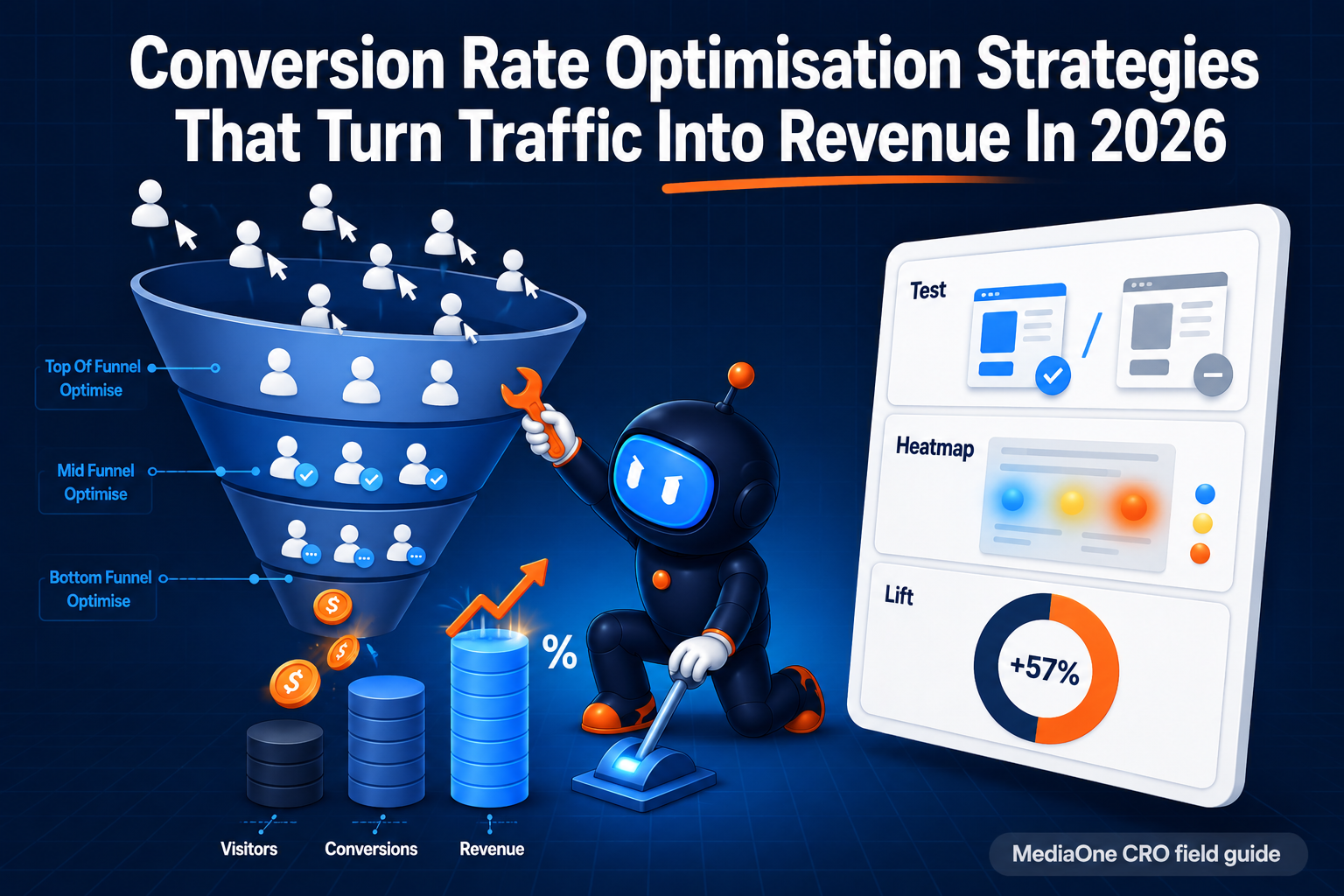
Every business with an online presence understands that traffic alone does not secure revenue. What matters is how you leverage that traffic.

Global e-commerce conversion rates currently average around 2.5% to 3%, while top sites convert at 11% or more according to Statista’s global e-commerce conversion rate benchmarks by industry and device for 2026. That gap between average and top-tier performance is the edge conversion rate optimisation offers in 2026 and beyond.
Businesses investing in SEO services often emphasise increasing visibility and rankings. Without strategic optimisation, much of that qualified traffic fails to deliver measurable results. This also applies to digital marketing. Acquisition and conversion must work together to maximise ROI.
As digital competition intensifies and user expectations rise, businesses that rigorously optimise conversion paths unlock significant revenue without increasing acquisition costs. In this article, you will learn proven frameworks, advanced tactics, Blue Ocean opportunities, and practical guidance to turn more visitors into customers and drive sustainable growth.
Key Takeaways
- Conversion rate optimisation strategies focus on increasing the value of existing traffic instead of simply driving more visitors. Even small percentage improvements generate significant revenue growth.
- High-performing CRO is built on intent alignment, friction removal, persuasion psychology, data-driven testing, and full-funnel integration. These pillars collectively enable sustainable performance gains.
- Scaling businesses benefit most from advanced optimisation techniques such as traffic segmentation, personalisation, and predictive analysis. Incremental improvements compound rapidly at higher traffic volumes.
- The biggest untapped revenue sits in Blue Ocean conversion opportunities, where most brands compete on surface-level page tweaks while leaving behavioural psychology, funnel velocity, and revenue density unexplored.
What Conversion Rate Optimisation Strategies Actually Mean
Conversion rate optimisation strategies are structured methods for increasing the percentage of visitors who complete desired actions, such as making purchases or submitting forms. CRO extracts more value from existing visitors while traffic acquisition continues running in parallel.
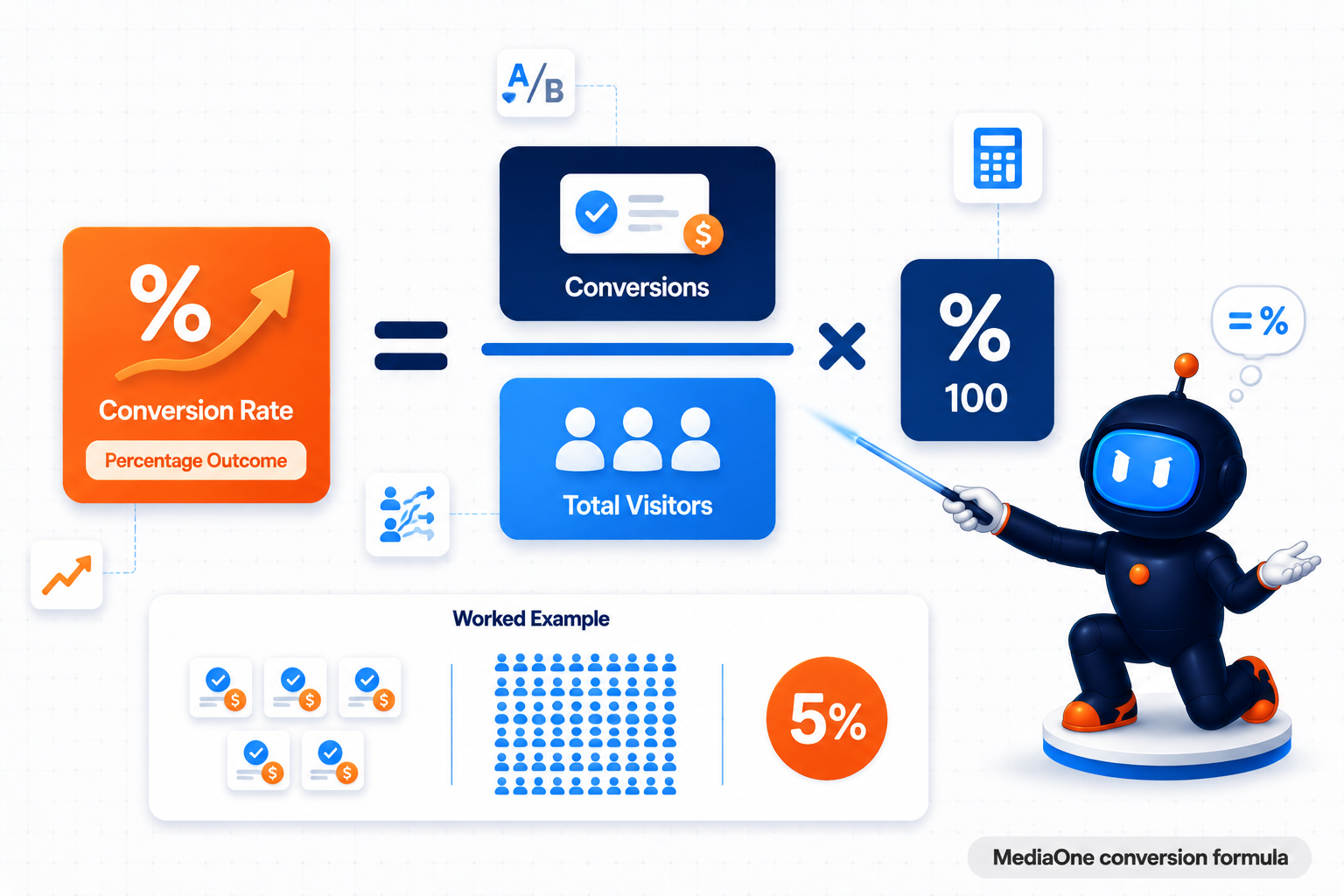
Formula:
Conversion Rate = (Conversions ÷ Total Visitors) × 100
If 1,000 visitors land on your page and 30 convert, your conversion rate is 3%. Raising this to 4% delivers a 33% revenue uplift without raising ad spend.
Most websites struggle from misalignment, even with healthy visitor numbers. Messaging mismatches intent. Pages lag. Calls to action confuse. Trust signals falter. Conversion rate optimisation strategies systematically repair these leaks.
The cost of leaving these leaks unaddressed is sharper than most teams realise. Our breakdown of 5 digital marketing challenges in converting clicks into customers sets out the recurring failure patterns we see across enterprise audits. The Baymard Institute’s cart abandonment research tracking 14 years of checkout behaviour shows that the global average online cart abandonment rate sits at 70.19%, with most abandonment caused by friction that disciplined CRO work removes entirely.
5 Core Pillars Of High-Performing Conversion Rate Optimisation Strategies
High-performing CRO strategies are structured rather than cosmetic. They rely on five pillars that improve user experience, cut friction, and boost revenue per visitor. With all five pillars working as a system, optimisation becomes predictable and scalable.
1. Intent Matching And Traffic Alignment
Every visitor arrives with a specific intent. Some research. Some compare options. Others are ready to buy. High-performing conversion rate optimisation strategies begin by aligning page experience with that intent.
When a user searches for a high-intent keyword and lands on a generic page, conversions drop. The messaging, offer, and call to action must match the visitor’s stage in the buying journey. This is especially critical for traffic generated through SEO services in Singapore, where intent segmentation determines how effectively organic traffic converts. The fundamentals of building pages that match search intent live in our landing page optimisation strategies for maximum conversions guide.
Traffic alignment involves:
- Mapping keywords to funnel stages.
- Segmenting visitors by source.
- Customising landing page messaging.
- Ensuring continuity between ad copy and page content.
- Matching post-click experience to the implied promise of the search query.
Intent clarity reduces bounce rates and increases engagement depth.
2. User Experience And Friction Removal
Friction is the hidden conversion killer. Even high-traffic pages with compelling messaging underperform when usability barriers exist.
High-performing strategies focus on:
- Fast loading speed.
- Mobile-first responsiveness.
- Clean visual hierarchy.
- Clear navigation pathways.
- Short, simplified forms.
- Prominent and specific calls to action.
Each unnecessary step in the conversion path reduces completion rates. Removing friction increases momentum. Momentum increases conversions.
UX optimisation is about guiding user behaviour toward a single, clear objective.
3. Persuasion Architecture And Trust Engineering
Users convert when they feel confident. Conversion rate optimisation strategies must reduce perceived risk and increase perceived value.
This involves structured persuasion elements such as:
- Testimonials and case studies.
- Industry certifications.
- Client logos.
- Guarantees and risk reversals.
- Transparent pricing or process clarity.
Principles of behavioural psychology also play a role. The Behavioral Economics Guide 2026 covering current applications of behavioural science sets out how social proof leverages herd behaviour, authority signals increase credibility, and scarcity encourages urgency. These mechanisms influence decision-making subconsciously.
Persuasion architecture transforms passive visitors into active buyers.
4. Data-Driven Testing And Experimentation
Optimisation without data is speculation. High-performing CRO relies on structured experimentation cycles.
A useful starting reference for teams new to structured experimentation is our case study on the button colour A/B test where red beat green, which illustrates how disciplined testing produces counter-intuitive results that opinion-led teams routinely miss.
Effective testing frameworks include:
- Hypothesis-based A/B testing.
- Multivariate testing for complex layouts.
- Heatmap analysis.
- Session recording reviews.
- Funnel drop-off diagnostics.
Each test must be tied to a measurable objective such as lead volume, purchase rate, or revenue per visitor. Statistical significance prevents false conclusions and ensures that improvements are real.
Data transforms conversion rate optimisation strategies from opinion-based changes into revenue-driven decisions.
5. Full-Funnel Optimisation And System Integration
Conversion does not happen in isolation. It is influenced by every interaction before and after the landing page.
High-performing strategies extend beyond single-page tweaks and include:
- Email nurturing sequences.
- Retargeting campaigns.
- Post-purchase optimisation.
- Lead qualification processes.
- Customer journey mapping.
When CRO integrates with broader digital marketing services in Singapore, it strengthens the entire revenue ecosystem. SEO drives visibility. Paid campaigns generate reach. CRO converts that attention into measurable growth. Optimisation at the funnel level produces exponential impact compared with isolated improvements.
Untapped Opportunities In Conversion Rate Optimisation
Most CRO programmes operate inside what could be called the Red Ocean of optimisation. Every team tweaks button colours, runs the same A/B tests, and pursues incremental landing page wins while the bigger commercial opportunity sits untouched.
The Blue Ocean of CRO sits in the territory most brands ignore. These are the leverage points that compound across thousands of visitors and reshape revenue economics rather than producing marginal lift.
Where the opportunities sit in 2026 CRO:
| Opportunity | Why It Is Uncontested | How To Claim It |
| Revenue density optimisation | Most brands measure conversion rate alone, ignoring revenue per visitor | Layer in average order value, upsells, and lifetime value as core KPIs |
| Funnel velocity engineering | Most teams measure conversion in isolation rather than as a journey speed | Track how quickly visitors move from first touch to qualified customer |
| Behavioural triggering at depth | Most websites rely on static CTAs and generic timing | Build triggers tied to scroll depth, return visits, and engagement signals |
| Predictive lead scoring | Most B2B teams treat all leads as equal | Use historical data to identify the signals that correlate with high lifetime value |
| AI-driven dynamic personalisation | Most sites still serve the same content to every visitor | Adapt headlines, recommendations, and offers based on referral source and behaviour |
This is what we internally call The Conversion Density Approach, the principle that scaling brands should optimise for revenue extracted per visitor rather than the percentage of visitors who convert. The economic difference compounds quickly at meaningful traffic volumes.
| Strategic Suggestion | Rationale |
| Audit your current CRO programme for over-reliance on landing page tweaks | Reveals whether your optimisation effort is stuck in the Red Ocean of cosmetic tests |
| Commit to one Blue Ocean experiment per quarter | Funnel velocity, revenue density, or predictive scoring all qualify, and any one of them outperforms 12 button-colour tests |
| Track revenue per visitor as a primary KPI alongside conversion rate | Reframes the entire CRO conversation around commercial outcome |
Advanced Conversion Rate Optimisation Strategies For Scaling Businesses
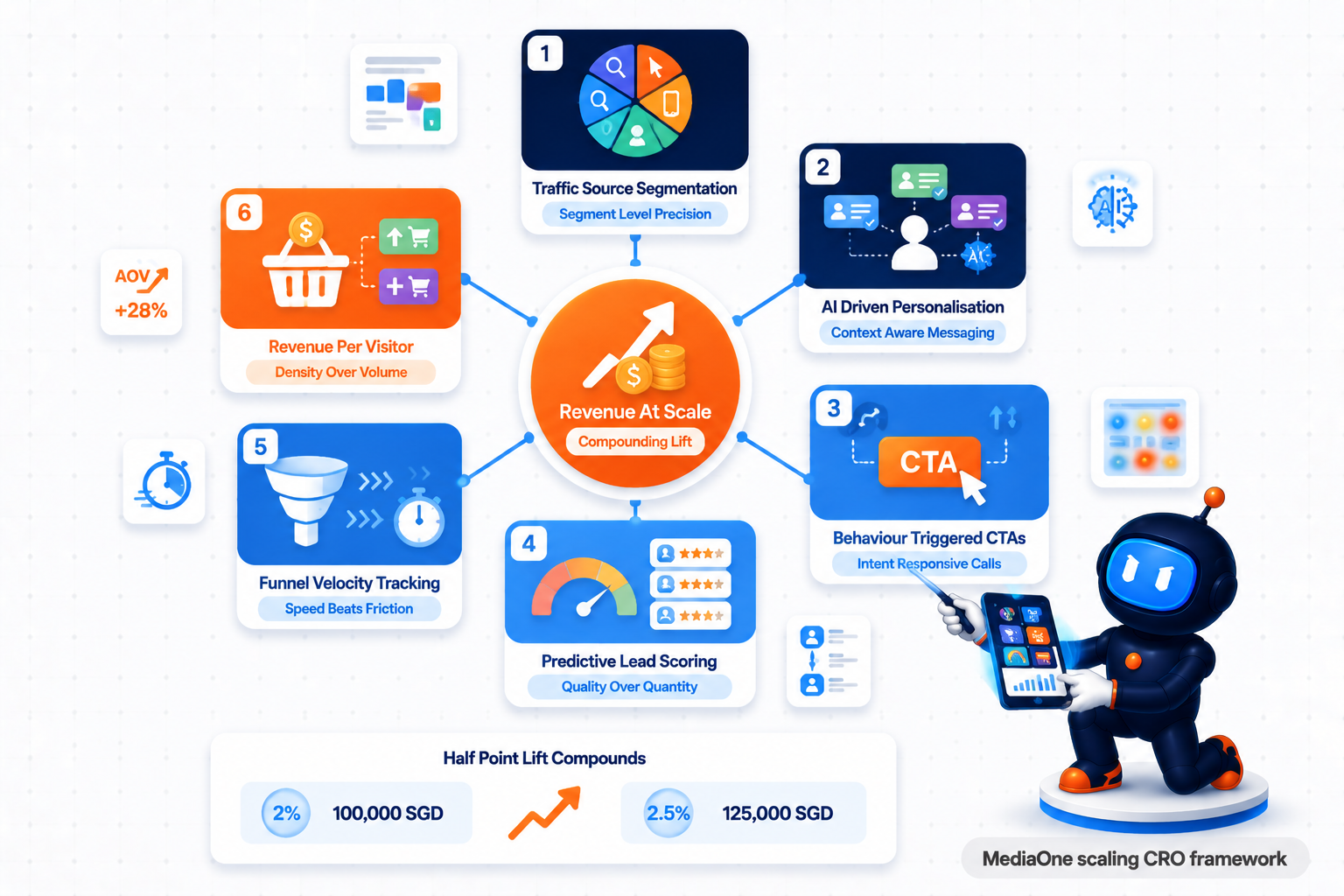
Scaling businesses operate in a different optimisation environment. Traffic generation is rarely the problem. The challenge is extracting more revenue from existing demand.
At this stage, even small improvements create significant impact.
Revenue modelling makes this clear. A website generating S$100,000 monthly at a 2% conversion rate can generate S$125,000 monthly with a 2.5% rate. That half-percentage lift produces a 25% revenue increase without increasing acquisition spend. At scale, incremental conversion gains compound across thousands of visitors, dramatically improving profitability.
Below are advanced conversion rate optimisation strategies designed specifically for scaling businesses.
Traffic Source Segmentation Analysis
Not all traffic converts equally. A common mistake among scaling companies involves analysing aggregate conversion rates instead of segment-level performance.
Break down performance by:
- Organic search vs paid ads.
- Brand vs non-brand keywords.
- Desktop vs mobile.
- First-time vs returning visitors.
- Geographic regions.
- Device type and operating system.
This segmentation reveals hidden opportunities. For example, paid search traffic may convert at 4% while organic blog traffic converts at 1%. Optimisation efforts should prioritise high-intent segments first.
When traffic is driven through structured digital marketing services in Singapore, segmenting by keyword intent enables businesses to identify which clusters warrant landing page upgrades, stronger CTAs, or personalised messaging. Optimisation at scale begins with precision.
AI-Driven Dynamic Content Personalisation
Static websites treat every visitor identically. Scaling businesses cannot afford that inefficiency.
AI-driven personalisation adapts content based on behaviour, referral source, or demographic signals. Examples include:
- Custom headlines based on keyword intent.
- Personalised product recommendations.
- Dynamic testimonials based on industry segment.
- Location-specific offers.
- Returning-visitor messaging that picks up where the last session ended.
When visitors see messaging aligned to their context, engagement increases. Engagement increases conversion probability. Personalisation shifts optimisation from general improvement to individual relevance.
Behaviour-Triggered CTAs
Traditional calls to action remain static regardless of user behaviour. Advanced conversion rate optimisation strategies introduce behavioural triggers.
Examples include:
- Exit-intent pop-ups offering incentives.
- Scroll-triggered CTAs after engagement depth.
- Time-based offers for returning visitors.
- Cart abandonment prompts.
- Inactivity-based assistance offers within long forms.
These triggers respond to behavioural signals instead of arbitrary timing. The website responds intelligently to intent indicators. For scaling businesses with substantial traffic volume, even small behavioural adjustments produce significant conversion uplift.
Predictive Lead Scoring And Qualification
Not all conversions hold equal value. Scaling businesses must optimise for revenue impact alongside volume.
Predictive lead scoring uses historical data to identify which user characteristics correlate with higher lifetime value. The top 10 lead generation tools for 2026 breakdown covers the platforms that combine A/B testing with predictive scoring inside a single workflow. Signals may include:
- Pages visited.
- Time spent on high-value content.
- Download behaviour.
- Company size or industry indicators.
- Email engagement frequency.
Instead of treating every lead equally, the system prioritises high-probability prospects. Sales teams focus on qualified opportunities, improving close rates while reducing acquisition costs.
This transforms conversion rate optimisation strategies from quantity-driven to quality-driven growth.
Funnel Velocity Tracking
Most businesses measure conversion rates in isolation. Advanced scaling companies measure velocity across the entire funnel.
Funnel velocity tracks how quickly users move from:
Visitor → Lead → Qualified Lead → Customer
If leads are generated quickly while taking too long to convert into paying customers, the bottleneck may sit somewhere other than the landing page. It may exist in nurturing flows, onboarding, or follow-up processes.
Tracking velocity highlights friction beyond surface-level metrics. When integrated within comprehensive digital marketing services, funnel velocity analysis strengthens the entire revenue system. Speed influences profitability.
Revenue Per Visitor Optimisation
Beyond increasing conversion rate, scaling businesses should optimise revenue per visitor. This metric incorporates:
- Upsells.
- Cross-sells.
- Average order value.
- Subscription upgrades.
- Bundle attachment rates.
A small increase in average order value, combined with marginal improvements in conversion, significantly compounds revenue. For example, increasing conversion rate from 2% to 2.3% while increasing average order value by 10% produces exponential revenue growth compared with focusing on just one variable.
Scaling businesses optimise for revenue density alongside conversion percentage.
Conversion Rate Optimisation Strategies By Business Type
Not all conversion rate optimisation strategies work the same way across industries. The buying journey, decision timeline, risk tolerance, and average order value differ significantly between business models. A high-performing CRO approach must reflect these differences.
E-commerce Businesses
E-commerce conversion is often immediate and transaction-driven. The objective is to reduce friction between product discovery and checkout completion.
High-impact strategies include:
- Optimising product pages with clear benefits, specifications, and high-quality visuals.
- Displaying reviews and user-generated content for social proof.
- Highlighting shipping costs, return policies, and delivery timelines early.
- Reducing checkout steps and enabling guest checkout.
- Implementing cart abandonment email recovery.
Trust and transparency play a crucial role. Even minor uncertainties around pricing or delivery cause drop-offs. Baymard Institute research confirms that hidden costs surfacing at checkout sit among the top three reasons shoppers abandon their carts.
For e-commerce brands investing in traffic through SEO services in Singapore, product-level intent matching becomes critical. Visitors searching for specific product terms expect immediate relevance from the page that loads.
B2B Lead Generation Businesses
B2B conversions rarely happen instantly. Decision cycles are longer and often involve multiple stakeholders. The goal of conversion rate optimisation strategies in this context is generating qualified leads.
Effective B2B CRO tactics include:
- Authority-driven landing pages with case studies and measurable results.
- Multi-step forms that reduce psychological friction.
- Clear explanation of process and deliverables.
- Educational resources such as whitepapers or webinars.
- Value-based messaging focused on ROI and business impact.
- Account-based messaging for high-value enterprise segments.
B2B visitors are risk-averse. They require reassurance, credibility, and clarity. The full approach for Singapore B2B teams sits in our lead generation strategies that work in Singapore guide, including how to qualify enquiries before they hit the sales team. Optimisation should focus on positioning expertise alongside urgency-based persuasion.
Forrester’s 2026 B2B marketing predictions on AI-powered buyer agents and counteroffers highlight how B2B buying journeys are becoming more compressed and more automated, making CRO at the consideration stage more decisive than ever.
When integrated into broader digital marketing services, CRO ensures that traffic acquisition efforts generate high-quality pipeline opportunities alongside low-intent enquiries.
Service-Based Businesses
Service businesses rely heavily on trust and perceived competence. Visitors often evaluate credibility before taking action.
High-performing conversion rate optimisation strategies for service providers include:
- Prominent testimonials and client success stories.
- Detailed service breakdowns to reduce ambiguity.
- Clear consultation booking processes.
- Visible contact information.
- Authority signals such as certifications or partnerships.
- Transparent pricing frameworks where possible.
The primary friction in service-based conversion is uncertainty. Prospects want to know what happens next, how pricing works, and whether results are achievable. Removing ambiguity increases enquiries significantly.
Clear, benefit-driven calls to action such as “Book a Consultation” or “Request a Proposal” typically outperform generic CTAs.
SaaS And Subscription-Based Businesses
For SaaS companies, the goal often revolves around trial sign-ups or demo bookings. Conversion rate optimisation strategies must minimise entry barriers while demonstrating product value quickly.
Effective tactics include:
- Clear product walkthrough videos.
- Highlighting key features above the fold.
- Transparent pricing tiers.
- Free trial options with low commitment.
- Onboarding flow optimisation.
- Activation-focused email sequences during the trial window.
The first interaction determines retention probability. Conversion optimisation should not focus only on sign-ups, while activation rates deserve equal attention. A sign-up without product engagement is rarely a true conversion.
Local And SME Businesses
Local businesses typically depend on enquiry forms, calls, or in-store visits. Here, conversion rate optimisation strategies must emphasise accessibility and immediate action.
Key improvements include:
- Click-to-call functionality on mobile.
- Local trust signals and reviews.
- Clear location information and maps.
- Simplified enquiry forms.
- Strong value propositions tailored to local demand.
- WhatsApp and instant messaging integration for the Singapore market.
For SMEs with limited budgets, optimisation often delivers higher ROI than traffic expansion. Improving conversion efficiency allows smaller businesses to compete effectively while keeping ad spend steady.
CRO Mistakes to Avoid for Higher Website Conversions
Even well-intentioned conversion rate optimisation strategies fail when executed without structure or clarity. Many businesses invest time and budget into redesigns, tools, or tests, only to see minimal improvement. The issue is rarely effort. It is usually misalignment.
Avoiding the following mistakes prevents wasted resources and accelerates measurable results.
Testing Without A Clear Hypothesis
One of the most common mistakes involves running A/B tests without a defined reason. Randomly changing button colours, headlines, or layouts does not constitute a strategy.
Every experiment should begin with a hypothesis grounded in user behaviour data. For example: “Reducing form fields from eight to four will decrease friction and increase submissions.” Without this clarity, test results lack actionable insight.
High-performing conversion rate optimisation strategies rely on structured experimentation alongside cosmetic changes.
Focusing On Traffic Instead Of Conversions
More traffic does not automatically mean more revenue. Businesses often prioritise expanding visibility while ignoring conversion inefficiencies.
If a website converts at 2%, doubling traffic still leaves 98% of visitors unconverted. Optimising conversion rates first increases return on investment from existing acquisition efforts, including traffic driven through SEO services in Singapore. Conversion efficiency amplifies the value of every marketing dollar spent.
Ignoring Mobile Experience
Mobile traffic now represents a significant share of website visits. Many websites are still optimised primarily for desktop.
Slow mobile load times, difficult navigation, small tap targets, and complex forms dramatically reduce conversions. Our mobile vs desktop usage insights for Singapore research shows how device-specific behaviour shapes the right CRO approach for each platform. Effective conversion rate optimisation strategies prioritise mobile-first design and testing. A frictionless mobile experience has become foundational rather than optional.
Making Decisions Based On Opinions Instead Of Data
Internal preferences often override data insights. Stakeholders may favour certain design styles or messaging approaches without behavioural validation.
Heatmaps, session recordings, funnel analytics, and conversion tracking exist to remove guesswork. For Singapore retailers specifically, our 5 ecommerce analytics tools every retailer should use walkthrough covers the platforms that surface revenue-level diagnostics in a single dashboard.Data-driven decisions consistently outperform subjective assumptions. When CRO becomes opinion-led, performance stagnates.
Overcomplicating Page Design
Clutter reduces clarity. Too many calls to action, excessive information above the fold, and distracting visuals overwhelm visitors. High-converting pages guide users toward one primary action.
Simplified design improves focus, increases engagement, and reduces cognitive load. Minimalism in structure often outperforms complexity.
Treating CRO As A One-Off Project
Many teams approach CRO as a project with an end date. The brands that win treat it as an ongoing discipline.
Conversion rates drift, audiences evolve, and competitive landscapes shift. CRO programmes that run continuously, with quarterly review cycles, compound advantage over time. Programmes that pause after the first wave of wins quietly lose ground.
Each mistake creates hidden inefficiencies. Over time, those inefficiencies compound into lost revenue, higher acquisition costs, and lower marketing ROI.
MediaOne’s Best Practices for Conversion Rate Optimisation
Most agencies talk about CRO as a checklist of page tweaks. The brands actually compounding revenue treat CRO as a revenue system that connects acquisition, engagement, conversion, and retention into a single loop.
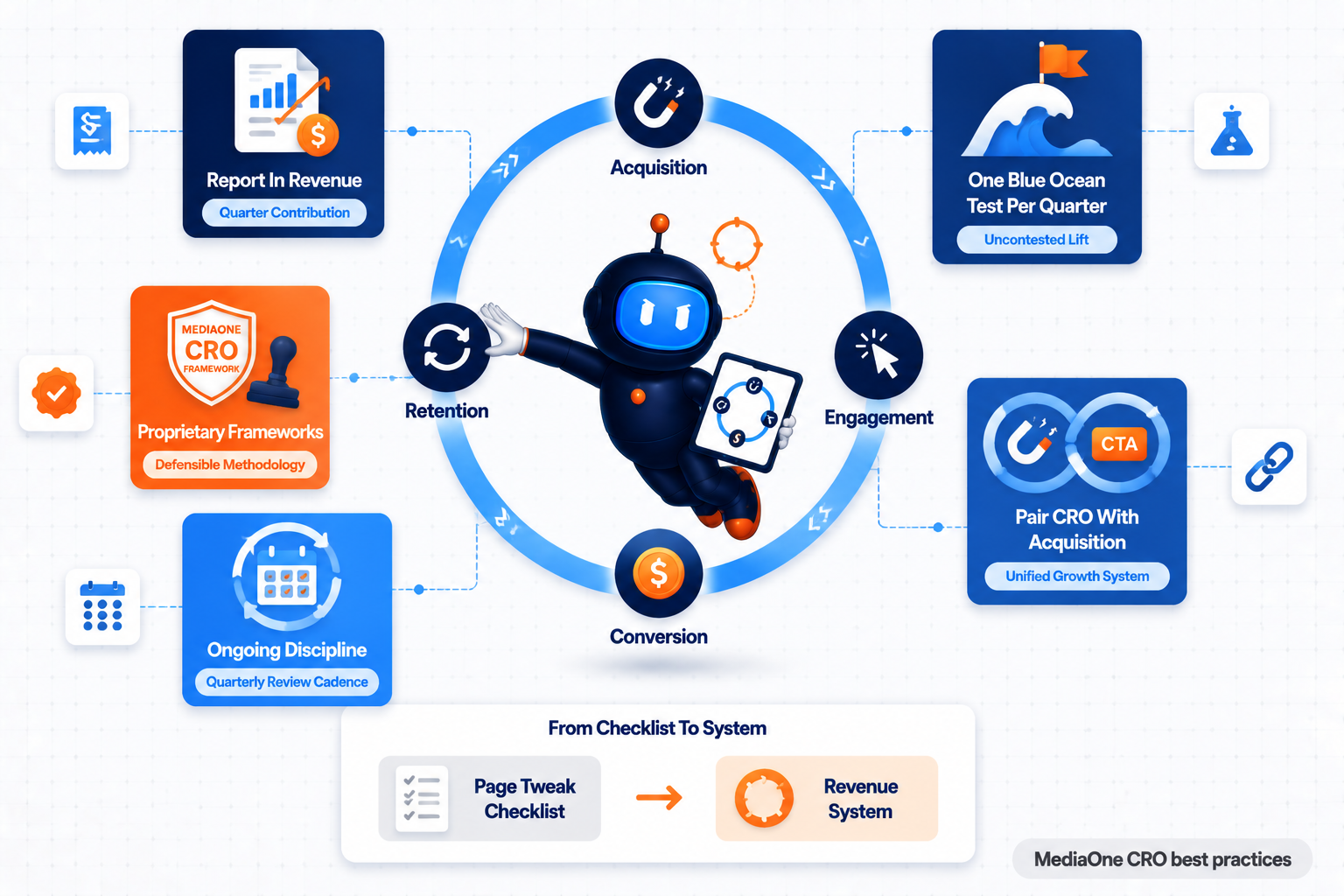
| Habit | What It Looks Like In Practice |
| Reporting in revenue, not conversion rate | Performance reports answer the question “what did CRO contribute this quarter” |
| Running one Blue Ocean experiment per quarter | Funnel velocity, revenue density, or predictive scoring all qualify |
| Pairing CRO with traffic acquisition strategy | The biggest gains happen when conversion work informs SEO and paid campaigns simultaneously |
| Treating CRO as an ongoing discipline | Quarterly review cycles instead of one-off project sprints |
| Building proprietary frameworks the team can defend | Named methodologies create internal alignment and external authority |
The brands MediaOne works with do not buy “CRO services” as a commodity. The wider methodology sits across our 9 ways to improve website conversions for Singapore businesses, which connects the conversion work back to broader business outcomes. They buy a system that turns existing traffic into a measurable revenue engine.
From Traffic To Revenue Growth
Optimising your conversion rate has moved beyond optional marketing tactic territory. It is a revenue engine. In today’s landscape, even incremental improvements in conversion efficiency lead to substantial financial gains without increasing acquisition budgets.
By implementing structured conversion rate optimisation strategies, businesses strengthen funnel performance, boost ROI, and maximise the value of every visitor.
If your team is ready to accelerate conversion performance and turn more clicks into customers, MediaOne can help. From in-depth CRO audits to integrated optimisation execution alongside your broader digital strategy, we provide tailored solutions that drive measurable results. Our website design and development services and broader digital programmes are built around the same revenue-first principles described throughout this guide. Request a quote to start turning your traffic into higher revenue and business growth.
Frequently Asked Questions
How do you prioritise which pages to optimise first?
Prioritisation should be based on potential revenue impact alongside traffic volume. Focus on high-traffic pages with below-average conversion rates or critical funnel steps where users drop off. A data-driven scoring model that weighs traffic, conversion gap, and business value ensures resources are allocated efficiently.
How often should conversion rate optimisation strategies be reviewed?
CRO performance should be reviewed continuously, with structured evaluation cycles every quarter. User behaviour, competitor positioning, and traffic sources evolve, making ongoing optimisation essential. Treat CRO as a recurring growth initiative alongside one-time projects.
Can conversion rate optimisation strategies improve paid advertising performance?
Yes. Improving conversion rates lowers cost per acquisition and increases return on ad spend. When landing pages convert more efficiently, paid campaigns become more profitable while budgets stay steady. CRO strengthens the financial efficiency of all acquisition channels.
What tools are commonly used for conversion rate optimisation?
Common tools include analytics platforms, heatmapping software, session recording tools, A/B testing platforms, and CRM systems for funnel tracking. Tools alone do not guarantee results. Strategic interpretation of data determines success.
How do you measure the true ROI of conversion rate optimisation strategies?
ROI should be measured by revenue uplift, reduced cost per acquisition, and improved customer lifetime value. Comparing revenue before and after, using statistically significant tests, provides clearer insight than relying on percentage changes in conversion rates alone. Financial metrics provide the most accurate picture of optimisation impact.
What is a good conversion rate in 2026?
Average e-commerce sites convert at 2.5% to 3% globally, with the top performers reaching 11% or more. B2B benchmarks vary significantly by deal size, with enterprise B2B converting at 0.5% to 1.5% and mid-market at 1.5% to 3%. The honest answer involves benchmarking against your specific industry, channel, and audience segment.
How can untapped opportunities apply to conversion rate optimisation?
Untapped opportunities in CRO sit in the leverage points most brands ignore, including revenue density optimisation, funnel velocity engineering, predictive lead scoring, and AI-driven personalisation. While most teams test button colours, the brands compounding revenue invest in these uncontested territories.
How long does it take to see results from conversion rate optimisation?
Initial improvements often appear within four to eight weeks, while compounding gains accumulate over six to twelve months. The discipline rewards consistency. Programmes that run continuously outperform programmes that pause after early wins.