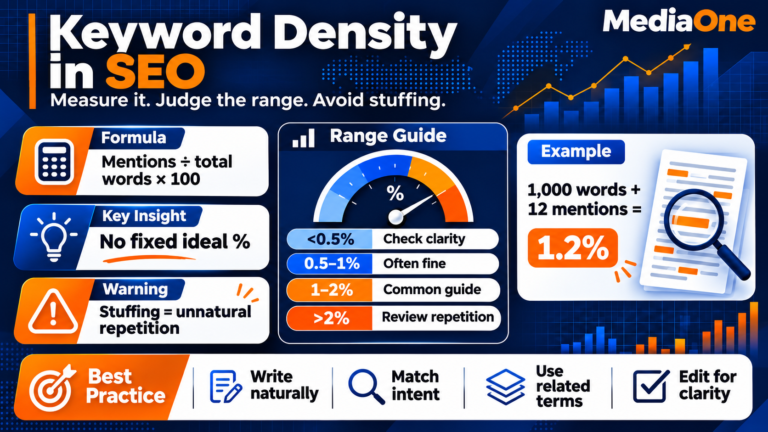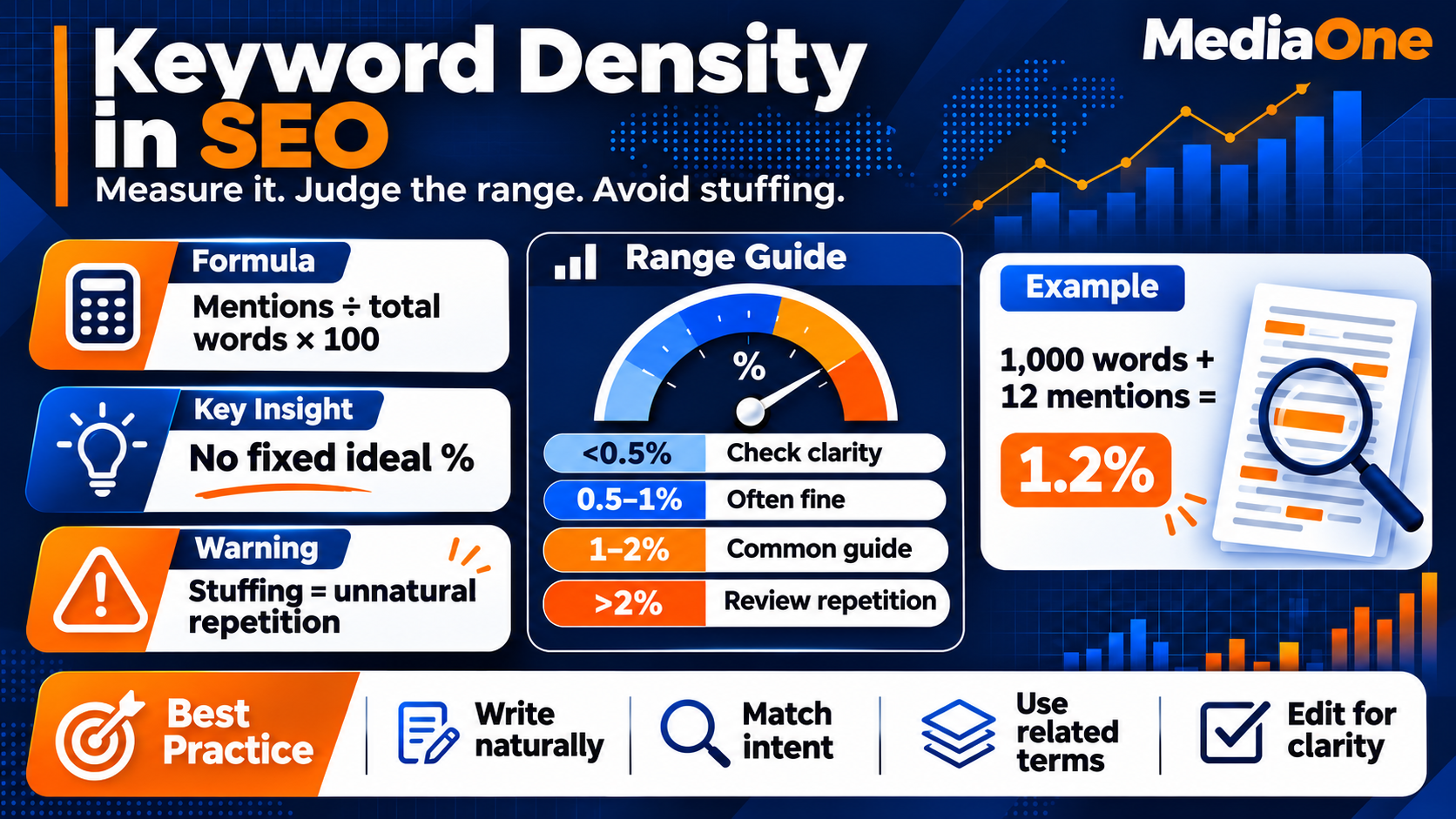
| AI Summary Keyword density measures how often a target phrase appears in content. Learn how to calculate it, assess SEO benchmarks and avoid keyword stuffing to improve readability, content relevance and search performance. |
Keyword density measures how often a target word or phrase appears in a piece of content relative to its length. It can flag repetitive writing, but Google has no ideal keyword density percentage. A page that answers the searcher’s question clearly is usually better served by natural language than a fixed repetition target.
For Singapore businesses, the practical approach is simple: use your primary keyword where it helps explain the page, check for awkward repetition, and improve the information readers actually need. We explain how to calculate it, interpret benchmarks and prevent stuffing.
Key Takeaways
- There is no Google-approved percentage. Google explicitly rejects the idea of an optimal keyword density.
- The familiar 1–2% range is a rule of thumb, not a search ranking requirement. Yoast uses different thresholds for its content-analysis feedback.
- A low reading is not automatically a problem. Missing answers, vague wording and poor structure deserve attention first.
- Keyword stuffing violates Google’s spam policies. Serious cases can affect search visibility and may receive a manual action.
- Use checkers to diagnose repetition, then edit for clarity, relevance and search intent.
What Is Keyword Density in SEO?
Keyword density is the frequency of a selected keyword relative to the number of words in the content being measured. It is usually presented as a percentage. The related term keyword frequency refers simply to the number of appearances.
For example, a 1,000-word article containing the exact phrase “keyword density” 10 times has a simple phrase-frequency ratio of 1%. That does not mean the phrase occupies only 1% of the actual words. Because it contains two words, its occurrences account for 20 individual word positions.
This distinction matters when comparing tools. Some report exact phrase matches against total words. Others apply rules for multiword phrases, word forms or sentence-level matches. A percentage without its counting method can mislead.
We use the measure as an editing check, not a measure of content quality. It cannot measure how well an article answers a customer question.
Keyword Density Formula: How to Calculate It
The common basic calculation is:
Keyword density (%) = (Number of keyword occurrences ÷ Total words analysed) × 100
Suppose a blog post contains 1,000 words and the selected phrase appears 12 times:
(12 ÷ 1,000) × 100 = 1.2%
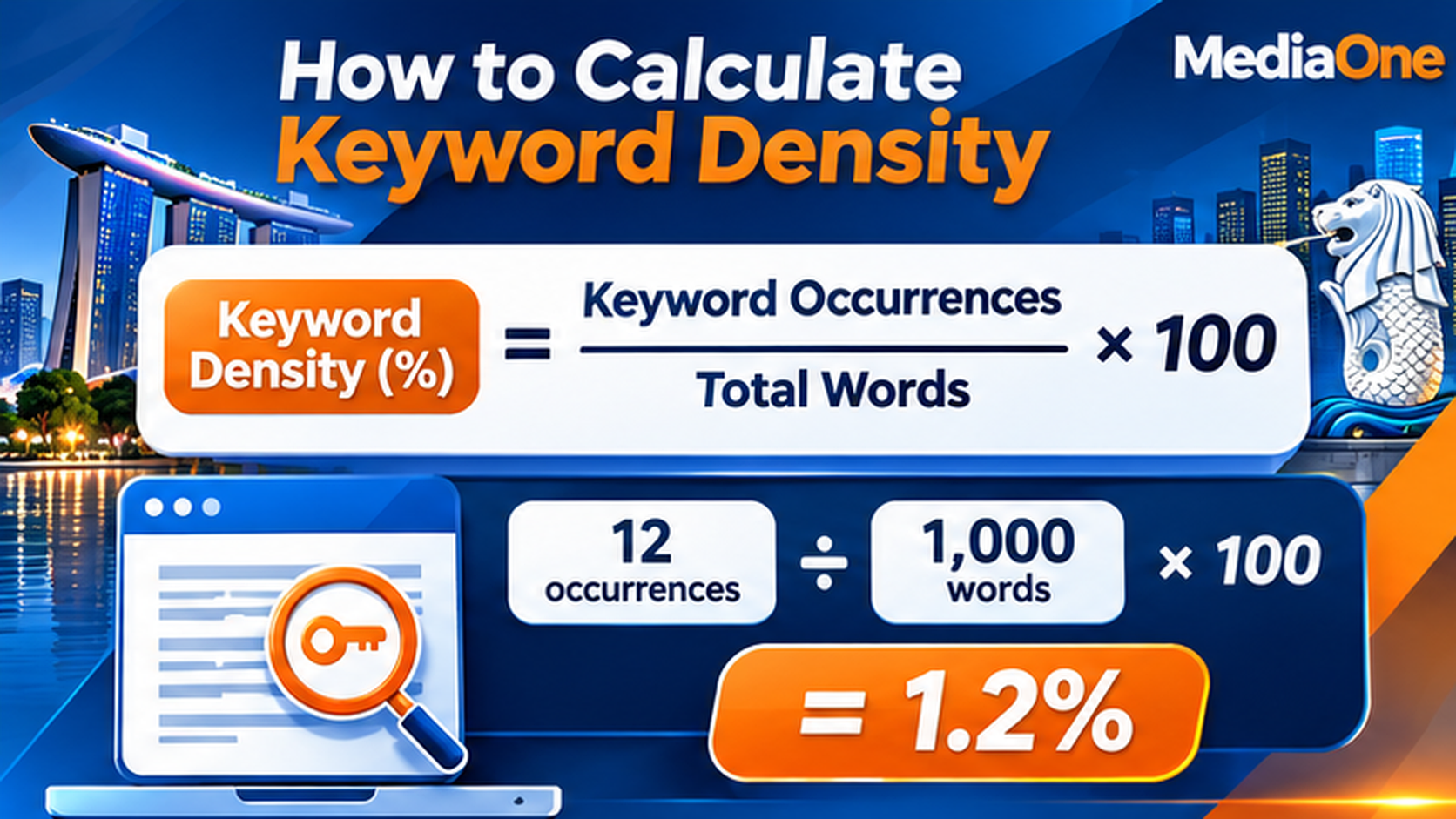
That is a straightforward phrase-occurrence ratio. It helps compare drafts but is not universal across SEO plugins.
Single keywords versus multiword phrases
For a single word such as “insurance”, the arithmetic is relatively simple. With a phrase such as “business insurance Singapore”, the result depends partly on what counts as a match.
An exact-match checker may recognise only those three words in that order. A more flexible plugin may also recognise the same important words appearing together in another order. This complicates comparisons between tools.
Yoast’s keyphrase density documentation says it considers phrase length and can identify matches when the words occur in one sentence, even in a different order. Always check the tool’s definition before treating its result as an instruction.
What should count towards the total word count?
For a fair editorial comparison, analyse the main article or page copy consistently. Include relevant headings and visible text if your chosen tool does so. Exclude navigation menus, repeated footer links and unrelated sidebar content when checking pasted copy.
A live-page scanner may analyse a different selection of text from a pasted-text tool. Do not assume a checker includes title tags or meta descriptions. Consistency matters when reviewing changes over time.
Worked example: why phrase length matters
Consider two 1,000-word pages. The first uses “insurance” 12 times, while the second uses “business insurance Singapore” 12 times. A basic occurrence-based calculation reports 1.2% for both, even though the longer phrase occupies 36 word positions rather than 12.
This does not make the longer phrase three times as valuable or three times as risky. It shows why density percentages are not directly comparable across keywords of different lengths. If an SEO plugin adjusts for phrase length, its reading may differ from a manual calculation without either result being an arithmetic mistake.
What Is a Good Keyword Density? Understanding the Benchmarks
You will often encounter advice to keep keyword density between 1% and 2%. SE Ranking presents this as a common recommendation while also saying that a reading below 1% need not be a concern.
Yoast takes a different approach. Its WordPress keyphrase density check uses a 0.5–3% green range for the standard assessment, with adjustments for longer phrases and certain word-form matching. That range describes Yoast’s software feedback, not Google’s ranking rules.
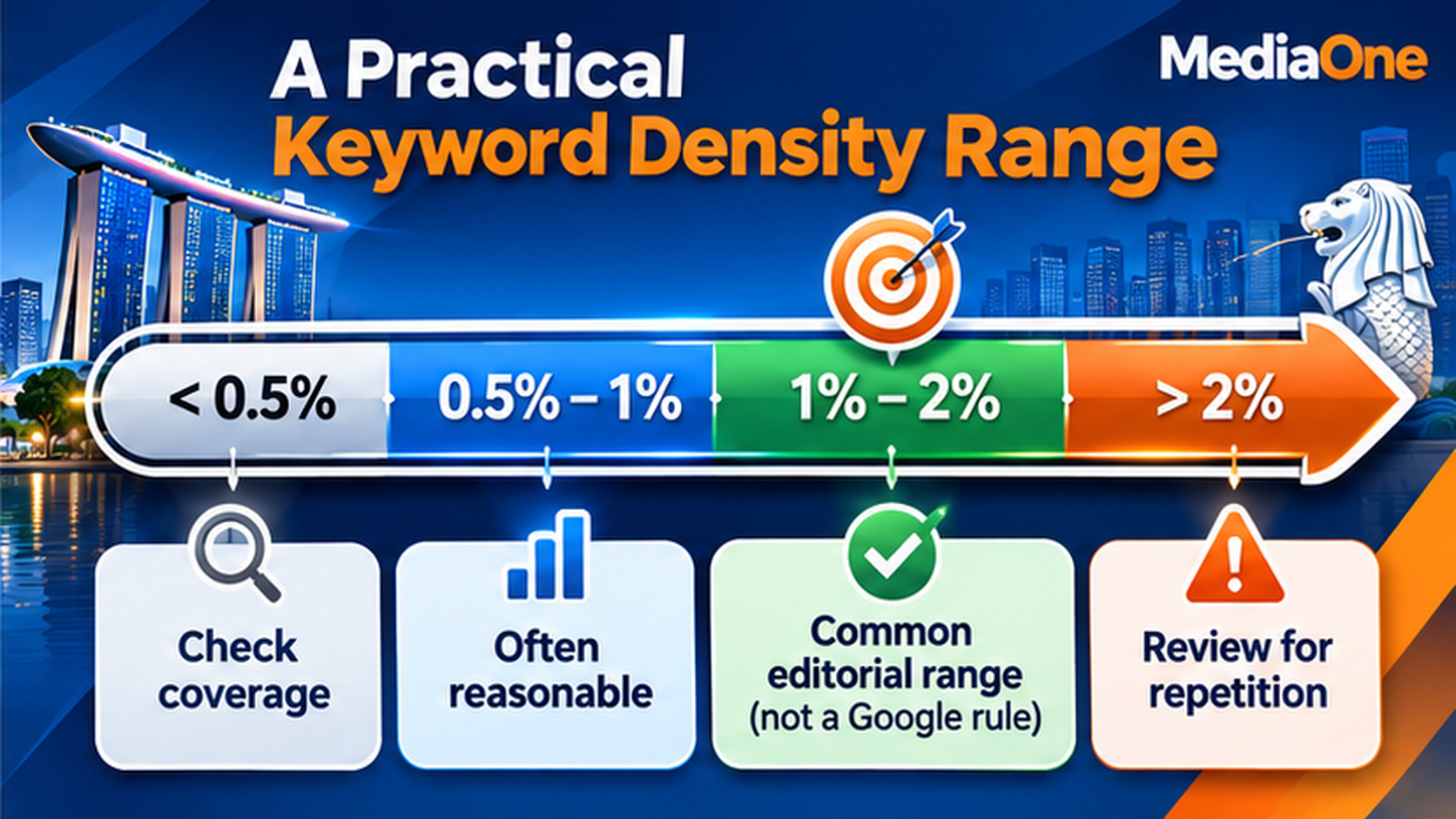
| Density reading | How we would interpret it |
|---|---|
| Below 0.5% | Check whether the subject is clear. Do not add keywords purely to raise the number. |
| 0.5–1% | Often reasonable when the page uses clear wording and covers the topic well. |
| 1–2% | A frequently quoted editorial guideline, not an ideal Google target. |
| Above 2% | Review repeated passages carefully. The number alone does not prove stuffing. |
Why there is no universal ideal percentage
Google addressed this directly in its January 2023 SEO office hours. Its representative said Google has no concept of optimal keyword density. The advice was to describe the subject explicitly instead of expecting search engines to guess.
Different pages also need different amounts of repetition. A product specification naturally repeats a product name. An explanatory guide can use examples, related concepts and alternative wording. Neither benefits from forcing the same phrase into every paragraph.
Treat percentages as review prompts. Do not rewrite effective sentences purely to satisfy a score.
Why a short page may show an inflated percentage
Suppose a service page contains 200 words and uses its service name six times. The simple density is 3%. Add a genuinely useful 200-word explanation of pricing factors, service boundaries and booking arrangements without adding more occurrences, and the reading falls to 1.5%.
Nothing about those numbers proves the longer page will rank better. However, they demonstrate how adding valuable information can change the percentage without removing a single relevant phrase. Before cutting repeated keywords, check whether the content is simply too brief to answer the query properly.
Does Keyword Density Affect Google Rankings?
Keyword density is not an optimisation target used by Google. Its SEO Starter Guide advises site owners to write organised, useful content and warns against excessive repetition.
That does not make keywords irrelevant. Clear terminology tells readers what a page covers. It also gives search systems helpful context. A plumber’s service page should say “emergency plumbing” if that accurately describes the service, rather than relying only on vague promotional phrases.
Google’s people-first content guidance asks whether pages provide substantial answers, original information and a satisfying experience. These questions reveal weaknesses that a frequency calculation cannot detect.
Neither a high nor low percentage establishes relevance. Search performance also depends on factors beyond wording, including whether Google can access the page and whether the content satisfies the intended query.
Keyword Density Versus Keyword Stuffing
Keyword stuffing means repeating keywords or numbers unnaturally to manipulate search rankings. Google’s spam policies specifically identify repetitive phrases, out-of-context lists and blocks of locations as examples.
Consider a Singapore cleaning service trying to rank for “office cleaning Singapore”.
Stuffed copy: “Need office cleaning Singapore? Our office cleaning Singapore team offers office cleaning Singapore services. Book office cleaning Singapore today.”
Revised copy: “Our office cleaning team helps Singapore businesses maintain hygienic workplaces. Choose a schedule that suits your premises, from regular maintenance to a one-off deep clean.”
The revision states the service and location without repeating the same search phrase. It also provides a clearer reason for a customer to continue reading.

Can keyword stuffing cause a Google penalty?
Yes, serious violations can affect search visibility, but there is no published percentage that automatically triggers a penalty. Google uses automated spam detection and may also apply manual actions after human review.
Its Manual Actions report guidance includes a category for hidden text and keyword stuffing. Affected pages may rank lower or disappear from results. There is no automatic penalty threshold.
If Search Console reports this issue, inspect the affected pages, remove manipulative repetition and follow Google’s reconsideration process. Do not assume every traffic decline is caused by keyword density.
Watch for repetition outside the main paragraphs
Overuse is not limited to normal body copy. A business may repeat an exact-match city phrase in every heading, image description or call-to-action button. The main paragraphs could sound natural while the full page still feels engineered for search engines.
Review each element according to its actual function. Headings should clarify the structure, image alternatives should describe images, and calls to action should tell readers what happens next. When the same phrase appears across several elements, ask whether the wording would make sense without a search engine involved.
How to Check Keyword Density on a Page
A checker helps diagnose repetitive drafts. We recommend this process.
- Choose one primary phrase. Use the term that best matches the page’s purpose. Avoid checking dozens of loosely related phrases at once.
- Define the content being tested. For an article, use the main body and relevant headings. Keep that scope consistent for future reviews.
- Run the check. SE Ranking’s free checker provides options for checking text or a URL. Yoast offers a keyphrase assessment within its WordPress SEO analysis.
- Inspect where matches appear. Ten mentions spread naturally across a long guide are different from ten packed into two paragraphs.
- Edit awkward passages. Replace repetition with useful explanation, a specific example or a more natural term. Recheck only to confirm that the problem has improved.
Do not treat coloured indicators as editorial approval. Read the introduction, headings and calls to action; a good score can still accompany weak writing.
Why two checkers may show different percentages
Tools can differ in how they count headings, linked text, singular and plural forms, punctuation or capitalisation. Some count exact phrases; others recognise variations. Published-page crawlers may even capture navigation text that another tool ignores.
Compare results only when tools analysed the same text using similar rules.
How to Optimise Keyword Usage Without Stuffing
A practical keyword strategy begins with search intent. Once the page has a clear purpose, keyword placement becomes easier to judge.
1. Match the page to the searcher’s question
Someone searching “keyword density formula” wants a calculation and an example. Someone searching “keyword stuffing penalty” needs to understand the risk and what to fix. A page that answers neither query will not improve simply by repeating the phrases.
Check the questions your audience is trying to resolve. Then organise the page so readers can find the answers quickly. Headings should describe the content underneath them, not act as extra spaces for repetitive keywords.
2. Use the primary keyword in prominent, relevant places
Include the main phrase in the H1 when it describes the page accurately. Use it naturally in the opening explanation and, where appropriate, in a descriptive title tag. These placements help users recognise the topic.
Avoid inserting the phrase into every subheading. Keep URLs short and descriptive. Google’s title-link guidance favours concise, descriptive titles.
Useful coverage introduces terminology readers genuinely need. An article about keyword density may discuss search intent, keyword frequency, on-page SEO, readability, semantic relevance and keyword stuffing. Include these terms only where they clarify a concept or support an example.
4. Improve the substance before increasing repetition
If a 700-word article feels incomplete, identify what readers still need to know. Could it explain a calculation, distinguish two methods or show how to correct a real example? Adding these details strengthens the page without forcing the keyword.
Google also states that there is no preferred word count for rankings. Make the article as long as needed to answer its promise, then remove unnecessary filler during editing.
5. Write metadata and image text for their own purposes
A title tag should identify the page clearly. A meta description should summarise its value for a potential visitor. Neither benefits from a string of repeated keywords; Google may use the description when generating a search snippet.
Write image alt text to describe meaningful visual content. If a chart shows a calculation, describe the calculation rather than repeating the primary phrase without context. Keep accessibility and accuracy ahead of keyword frequency.
How to revise a paragraph with excessive repetition
Start by identifying the information each repeated sentence contributes. Keep the first clear mention of the primary phrase, then remove later mentions that merely restate it. Replace a repeated claim with a useful detail only if that detail is accurate and relevant.
For example, a renovation contractor may repeat “kitchen renovation Singapore” in the headline, first sentence and every service description. A stronger section would state the service once, then explain the quotation process, the types of work covered and what affects project timelines. Readers gain answers instead of another copy of the target phrase.
After editing, read the section independently. If customers can immediately understand the service and the next action, the wording is probably doing its job. Run the checker again to catch accidental clusters, but do not keep rewriting to force a particular result.
How Keyword Use Changes Across Page Types
The same density target should not govern every page. A Singapore ecommerce site, a service business and an educational publisher have different content needs.
| Page type | Main priority | Practical keyword approach |
|---|---|---|
| Product page | Identify the item, specifications and buying details | Use the product name where needed; avoid repeating it in every feature sentence. |
| Local service page | Explain the service, area covered and next step | Mention the service and location clearly; add genuine details about availability and scope. |
| Long-form guide | Answer related questions thoroughly | Introduce the main topic early, then use precise terms throughout each section. |
| Category page | Help visitors compare and choose | Name the category naturally; make filters, descriptions and product information useful. |
For example, a tuition centre in Singapore may need to mention its subject, level and location several times because those details help families decide. Repeating “best tuition Singapore” across every heading would add little value.
We would assess each page against its intended audience and conversion goal before considering a percentage. A low-density page with vague service information needs better facts, not an arbitrary number of extra mentions.
Common Keyword Density Mistakes to Avoid
Chasing a green SEO score. Plugin indicators can highlight issues, but they do not certify that a page will rank. Review their suggestions against the actual text.
Adding keywords to every heading. This produces monotonous navigation and obscures the differences between sections. Use headings to tell readers what each part delivers.
Mistaking variations for required repetitions. There is no need to force plurals, reordered words or every city variation into one page. Use the terms that make sense for your audience.
Ignoring the rest of the page. Thin explanations, outdated facts, weak calls to action and confusing layouts remain problems even when density appears acceptable.
Treating competitors’ percentages as instructions. A competitor may rank for reasons unrelated to phrase frequency. Copying its ratio does not recreate its usefulness or authority.
A Practical Keyword Density Audit Example
Imagine a Singapore accounting firm reviewing a page about corporate tax filing. The phrase “corporate tax filing Singapore” appears repeatedly, yet the page says little about who must file, what documents are needed or how the service works.
Our first edit would remove awkward repetition. Next, we would add a clear explanation of the service, link to relevant official tax guidance where appropriate and describe the firm’s actual process. We would check that every claim matches current Singapore requirements before publication.
The final density may change. Useful answers and qualified enquiries are stronger business outcomes than a particular percentage.
How to measure results after revising keyword usage
Do not judge an edit by its new density score alone. In Google Search Console, compare the page’s search impressions, clicks and queries over suitable periods. Keep a record of the revision date so the comparison has context.
Changes in performance can also reflect seasonality, competitors and other site updates. Avoid claiming that a density adjustment caused a ranking improvement without stronger evidence. For business pages, also review relevant enquiries or conversions where reliable measurement is available.
Frequently Asked Questions
Is keyword density a Google ranking factor?
Google says it has no optimal keyword density. Use relevant terms clearly, but judge a page by its usefulness and fit with search intent rather than a target percentage.
What is the best keyword density for SEO?
There is no universally best figure. The commonly quoted 1–2% range is an editorial convention, while Yoast’s standard green assessment spans 0.5–3%.
Is keyword density below 1% too low?
Not necessarily. If the page clearly explains its topic and answers the reader’s question, there is no reason to add repetitions simply to cross 1%.
Can keyword stuffing hurt rankings?
Yes. Google prohibits manipulative repetition and can reduce search visibility through spam enforcement. Keyword stuffing is also listed among its manual-action categories.
Does the title tag count towards keyword density?
It depends on the tool and what text it analyses. A pasted-body check normally excludes the HTML title tag, but a page crawler may assess additional elements separately.
What is the difference between keyword frequency and density?
Frequency is the number of times a term appears. Density expresses that count relative to the amount of text, usually as a percentage.
Can I use synonyms instead of repeating my keyword?
Yes, when they make the explanation clearer. Relevant synonyms and precise related terms improve readability, but they should not be inserted solely to manipulate a checker.
Make Keyword Density Work for Readers, Not a Percentage
Keyword density is a useful warning light, not a content strategy. Start by identifying the page’s purpose. Explain the subject using the words customers recognise, then remove repetitions that interrupt the reading experience.
For new content, check repetitions during editing. For existing pages, examine intent, accuracy and gaps before changing keyword counts.
If your Singapore business needs a wider assessment, our SEO services cover on-page content and search strategy. We focus on whether the page helps the right people find useful information and take the next step.