| AI Summary
Keyword stuffing can affect body copy, headings, page titles, image descriptions and links. This guide explains how to separate normal repetition from wording added to influence rankings. Examples and a page review checklist show what to keep, rewrite or remove, while the final checks cover search performance and customer actions after editing. |
Keyword stuffing means filling a page with keywords or numbers to manipulate search rankings. Common examples include unnatural repetition, unrelated search terms and blocks of place names. Google treats the practice as spam. A repeated word alone does not prove stuffing; the context and purpose of the wording determine whether it belongs.
Key Takeaways
- A sentence can need the same term more than once, especially when it names a product or explains a technical subject.
- A lower keyword count does not repair a page that still fails to answer the reader’s question.
- Image descriptions, link text and shared website templates deserve attention alongside the visible article.
- Search traffic changes need investigation. A drop alone does not prove a spam violation.
- A content review should preserve accurate facts, remove empty claims and leave readers able to make a decision.
Keyword stuffing can creep into a draft during ordinary editing. A writer adds the target phrase, an editor adds it again, and a search plugin asks for another mention. Soon, a helpful paragraph sounds like a sales script.
The solution starts with understanding what each sentence contributes. This guide shows how to recognise the problem, correct it and keep the topic easy to identify without forcing the same phrase into every section.
What Counts as Keyword Stuffing?
Keyword stuffing happens when search terms take over a page without helping the person reading it. Google’s spam policies cover keywords or numbers placed unnaturally, out of context or in repeated groups to manipulate rankings.
A page about coffee grinders needs the words “coffee grinder”. The problem begins when those words replace the information a buyer came for.
| Normal keyword use | Wording that needs editing |
| A heading names the product being compared. | Every heading repeats the same sales phrase. |
| A service page explains where the company works. | A footer repeats dozens of places without service details. |
| A product description repeats its name when needed. | Several sentences repeat the name but add no features. |
| A technical explanation keeps one accurate term. | Synonyms cycle through the paragraph without adding meaning. |
A repeated phrase is a reason to inspect the copy, not an automatic reason to delete it. Google’s SEO Starter Guide supports natural writing and explains that its systems can connect a page with searches that use different wording.
Where Keyword Stuffing Appears on a Website
Keyword stuffing can appear in several parts of the same page. A review that checks only the main paragraphs may miss repeated wording added through a template or image field.
Repeated Phrases in Body Copy
A stuffed paragraph often repeats its promise without explaining it. The target phrase appears again, but the reader learns nothing new.
Example needing revision:
“Our office cleaning Singapore service provides office cleaning Singapore for businesses needing office cleaning Singapore.”
Revised example:
“Our office cleaning service covers desks, meeting rooms and shared areas for businesses in Singapore.”

The revision identifies the service and adds a practical detail. Real business copy should list only the tasks that the company actually provides.
Lists of Places Without Service Information
Location names belong on a page when they help customers understand coverage. Problems arise when a business adds long strings of towns or neighbourhoods simply to attract searches.
A local SEO page can answer questions about service areas, booking arrangements and local contact details. A location list cannot replace those answers.
For a repair company, the difference might look like this:
- Empty repetition: “Plumber Tampines, plumber Bedok, plumber Pasir Ris, cheap plumber Tampines.”
- Relevant information: “The company serves Tampines, Bedok and Pasir Ris. Customers can confirm appointment availability before booking.”
Hidden Text Added for Search Engines
Hidden text becomes a spam concern when its purpose is to influence search engines while keeping it away from visitors. Examples include words coloured to match the background or text placed outside the visible page.
Normal design features need separate treatment. Expandable answers, tabs and text intended for screen readers can serve legitimate purposes. Their content should not be removed simply because it is not visible at first glance.
Crowded Page Titles and Meta Descriptions
A page title identifies the page in browser tabs and can influence the title shown in search results. Google’s title recommendations warn against repeating the same words and their variations.
“Office Cleaning Singapore | Commercial Office Cleaners Singapore | Singapore Office Cleaning” gives a reader little extra information. “Office Cleaning in Singapore | Company Name” states the subject without the repeated phrases.
A meta description summarises the page. Google’s examples of better descriptions favour page details over keyword lists. The description can mention the service, audience and relevant feature in ordinary sentences.
Image Descriptions Packed With Keywords
Alt text describes an image for people who cannot see it and helps search engines understand the image. Google’s image SEO documentation warns against filling this field with search terms.
A photograph of a cleaner wiping a meeting table might use “Cleaner wiping a meeting table.” “Office cleaning Singapore cheap office cleaners best office cleaning” does not describe what the image shows.
The same photo may need different wording in another context. The description should reflect its role on that page.
Links With Forced Anchor Text
Anchor text is the clickable wording in a link. A link labelled “office cleaning checklist” should lead to content about that checklist.
Google’s link text recommendations support concise, descriptive wording that suits both the sentence and the destination. A string such as “best cheap office cleaning Singapore cleaning company” interrupts both.
A sensible internal linking strategy connects related pages at relevant points. It gives readers context without turning each link into a list of search terms.
Why Keyword Stuffing Hurts Rankings and Reader Trust
Keyword stuffing creates two problems: it can violate search policies, and it can leave visitors without the information they need. Those outcomes deserve separate attention.
Automated Systems and Manual Actions
Google uses automated systems and human review to identify spam. Policy violations can lead to lower rankings or exclusion from search results.

A manual action has a specific meaning. A human reviewer has found a violation, and the Manual actions report identifies the issue in Search Console.
A ranking drop alone does not establish that keyword stuffing caused it. Other explanations include competing pages, indexing problems, changing demand or wider ranking changes. An editor should correct poor copy without claiming to know the cause of a traffic loss from repetition alone.
Missing Details Can Cost Enquiries
A visitor comparing services needs information that supports a decision. Repeated claims such as “best office cleaners” cannot explain what the booking includes.
A service page may need:
- The tasks covered and any exclusions.
- The areas served.
- How customers request a quote.
- Any verified requirements before work begins.
- A relevant way to contact the business.
These details give customers something to assess. Empty repetition makes them work harder to understand the offer.
The commercial risk is practical: a page can attract a visitor and still fail to answer a basic buying question. No conversion percentage can be assumed without the business’s own results.
A cleaning company’s page, for example, might mention “professional cleaning” throughout but never say whether customers supply equipment. A buyer with that question still has to contact the company or leave the page. One factual sentence about equipment could answer it immediately.
That example illustrates the editing priority. The replacement for repeated wording should be information the customer needs. Another claim about quality would leave the original gap untouched.
Does Keyword Density Reveal Keyword Stuffing?
Keyword density describes how often a term appears within a piece of text. Some tools show a percentage, but their counting methods can differ, especially for phrases containing several words.
Google has stated that it has no optimal keyword density. A plugin’s preferred range is therefore not a Google requirement.
A count can help an editor find a passage to review. It cannot explain whether the wording is accurate, necessary or readable.
| Situation | Editorial judgement |
| A technical term appears throughout an explanation. | Repetition may preserve accuracy. |
| A target phrase appears once but breaks the sentence. | The wording still needs revision. |
| Several synonyms repeat the same sales claim. | The idea may be repetitive despite varied words. |
| A specification table repeats a product name. | The label may help readers compare entries. |
A rule such as “one mention per 100 words” can produce unnecessary edits. A paragraph about a medical term, legal phrase or named product may need that wording several times.
The better test examines the role of the phrase. A sentence should name its subject precisely, then explain something about it. Word counts cannot make that decision for the writer.
How to Spot Keyword Stuffing Before Publishing
A review starts with the page’s purpose. A service page should help someone assess a service; a comparison should explain differences; a how-to article should explain a task.
That purpose comes from search intent, meaning what someone wants to accomplish through a search.
A Page Review Checklist
The same review can cover both visible copy and less obvious fields.
| Area | Question to ask | Sign of a problem |
| Introduction | Does the opening answer the main question? | Several sentences announce the topic without explaining it. |
| Headings | Does each heading introduce a different answer? | The target phrase replaces a meaningful section title. |
| Paragraphs | Does each paragraph add information? | The same claim returns in new wording. |
| Lists | Does each item help the reader compare or act? | Items are search variations with no explanation. |
| Images | Does the description match the image? | Alt text lists services or places absent from the picture. |
| Links | Does the wording describe the destination? | Each link contains the same crowded phrase. |
| Shared elements | Does the footer serve visitors? | Keyword lists appear across unrelated pages. |
The Keyword Necessity Test
A flagged phrase deserves three questions:
- Does it identify something the reader needs to distinguish?
- Does the sentence add a fact, explanation or relevant example?
- Would a shorter version preserve the meaning?
A shorter version may improve the sentence, but removable wording is not proof of spam. Most prose contains words that an editor could cut.
A technical noun may also be better than a pronoun. In a comparison of two products, “it” can leave readers uncertain which product the sentence describes. Precision should survive the edit.
A Short Example of the Review
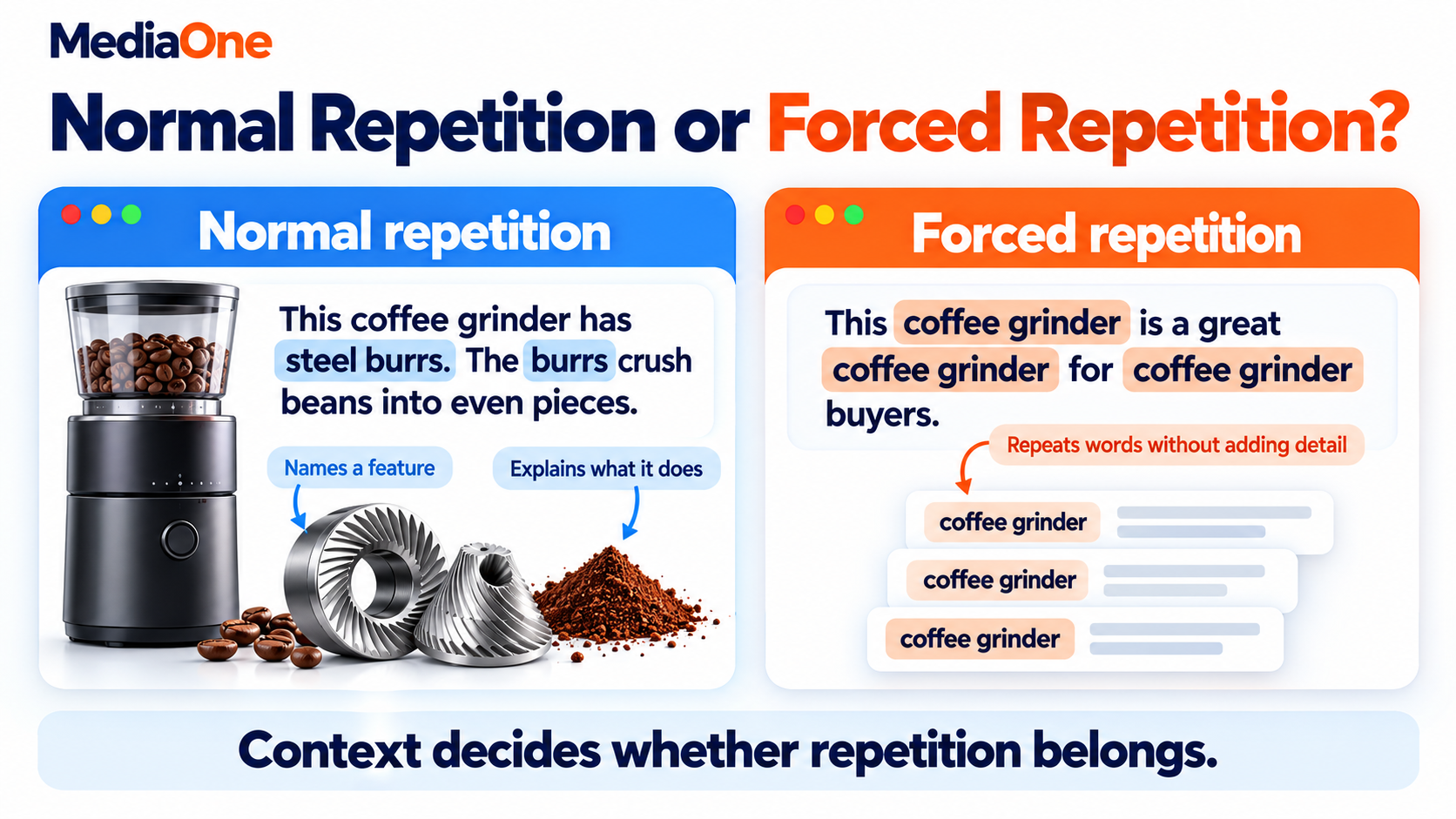
A sentence such as “The grinder has steel burrs” identifies a feature. The next sentence might explain how the burrs work. Repeating “burrs” can help the reader follow that explanation.
By contrast, “This coffee grinder is a great coffee grinder for coffee grinder buyers” repeats the label without explaining the product. The editor needs a fact about the machine, such as its controls or capacity. A new adjective would not solve the problem.
The test protects both readability and meaning. It gives the editor a reason for each change.
How to Fix Keyword Stuffing Without Losing Meaning
Keyword stuffing needs a content edit, not a round of automatic synonym replacements. A useful correction keeps the subject recognisable and restores the information that repetition crowded out.
1. Establish What the Reader Needs
A one-sentence brief can keep the rewrite focused: “This page helps an office manager compare cleaning services before requesting a quote.”
Each section should support that task. An unrelated history of cleaning products would not belong unless the reader needs it to make the decision.
2. Rewrite the Weakest Paragraph
The laptop example below shows how to keep the topic while removing repeated claims. Both versions are fictional.
Before:
“Our best gaming laptops under $1,500 are the best gaming laptops for buyers who want gaming laptops under $1,500. These gaming laptops offer the best gaming laptop value.”
After:
“This comparison covers gaming laptops under S$1,500. Each entry lists the processor, graphics hardware, memory and warranty, so buyers can compare what the price includes.”
The revised paragraph promises a comparison with specific information. The finished page would need to provide those details and verify the prices.
3. Keep Accurate Terms and Add Missing Answers
A replacement word should mean the same thing. “Laptop”, “desktop” and “gaming device” are not interchangeable.
An editor can improve the paragraph through:
- A shorter sentence.
- A pronoun with an obvious subject.
- A specific product or service name.
- An explanation of a feature.
- Removal of a claim already made elsewhere.
A fresh synonym cannot rescue a sentence that adds nothing. Sometimes the best edit is to delete the whole sentence.
A page edit may leave the same problem in its title, image descriptions or footer. A shared footer can also carry the wording onto many pages.
A technical SEO audit can help identify repeated elements across a site. The content review then decides which wording serves visitors and which wording should be removed.
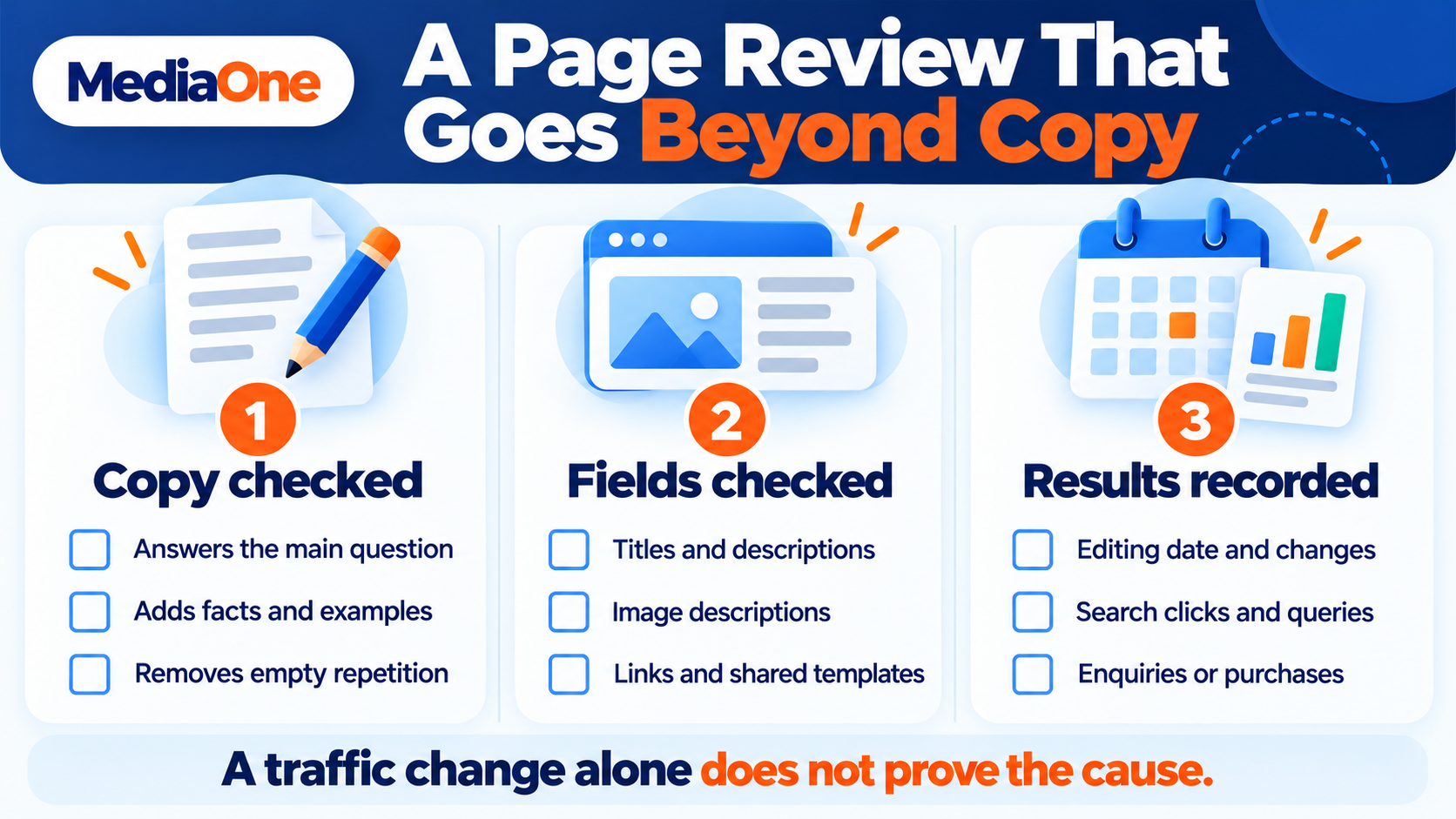
A small change log can record the location of each problem: article text, page title, image field or shared template. That prevents a writer from correcting a paragraph while the repeated text remains elsewhere.
The person responsible for each field should also be identified. A content editor may manage the article, while a website developer manages the footer. A saved screenshot or copied passage gives both people the same example to work from.
5. Check the Published Page
An editor should review the live page after saving changes. A heading may repeat through a template, or an old description may remain in a separate field.
A mobile check also helps reveal paragraphs that look short in the editor but become long blocks on a phone. The final version should preserve working links, readable tables and an obvious next action.

How to Use Keywords Naturally in Future Drafts
Keyword stuffing is easier to prevent when the brief describes the reader’s needs instead of setting a repetition target.
A practical brief can include:
- The main question the page answers.
- The audience and its level of knowledge.
- The main term readers use for the subject.
- Supporting questions that belong on the page.
- Facts, examples or evidence needed.
- The action readers may take after the answer.
That approach gives SEO content writing a purpose beyond placing phrases. The writer knows what information the page must deliver.
Headings Should Name the Answer Below Them
A subheading such as “What Does the Cleaning Service Include?” helps readers find an answer. “Best Office Cleaning Singapore Benefits” forces a phrase into a label without describing the section well.
A practical heading review checks:
- Whether the wording matches the paragraphs below it.
- Whether another section already answers the same question.
- Whether the heading makes sense without the target phrase.
- Whether a new reader understands the words.
The main keyword can appear where it names the subject naturally. Every heading does not need it.
Editorial Rules Should Avoid Repetition Targets
A white hat SEO approach gives the team a stronger basis for approval than a required keyword count. A brief can ask for accurate terminology, relevant answers and readable sentences without specifying how often a phrase must appear.
The final reviewer should also check additions made after approval. A last-minute request for more keywords can undo an otherwise sound edit. Each addition still needs a purpose in the sentence and a connection to the page’s main question.
Evidence Should Replace Empty Claims
Google’s people-first content assessment asks whether a page provides original information, accuracy and value beyond a rewritten summary.
For a service business, that could mean verified service details, an explanation of the process or an example that illustrates a customer’s choice. A product article could compare measurable specifications.
A claim such as “every laptop was tested” needs evidence that testing occurred. A writer should remove that claim when the page only compares published specifications.
Does Repeating Keywords Help AI Overviews?
Google’s requirements for AI features do not introduce a special keyword formula. Standard SEO practices remain relevant, and eligibility does not guarantee inclusion.
Answer engine optimisation, or AEO, focuses on making answers easy to identify and understand. A heading can state the question, and the next sentence can answer it before adding detail.
For example:
Question: “What is included in an office cleaning quote?”
Answer: “The quote should state the tasks, visit frequency, price and exclusions.”
The explanation can then cover those points. Repeating “office cleaning quote” in every sentence adds no missing detail.
A page written for this format should still read naturally from beginning to end. Definitions, examples and source links help readers assess an answer; short sections alone do not prove expertise or guarantee an AI citation.
What to Check After Removing Keyword Stuffing
A rewrite needs a record of what changed. That record helps the team compare outcomes without attributing every movement to the edit.
The Search Console Performance report shows clicks, impressions, click-through rate and average position. Those measures can be reviewed alongside enquiries or sales tracked elsewhere.
| Check | What it helps assess |
| Editing date and changes made | When the revision went live. |
| Queries associated with the page | Whether relevant searches still bring visibility. |
| Impressions and clicks | How search exposure and visits change. |
| Enquiries, bookings or purchases | Whether visitors complete a business action. |
| Other changes during the period | Whether pricing, design or technical work affected results. |
A like-for-like comparison should consider the same page, similar periods and seasonal demand. A quieter sales month cannot establish that an edit failed.
Google’s recrawl information explains that processing changes takes time. A crawl request does not guarantee indexing, and repeated requests do not speed up crawling.
A manual action requires separate handling through Search Console. The team should address every issue listed in the notice before requesting review.
A Simple Record for One Edited Page
A team reviewing an office cleaning page could record the original problem as “opening repeats the service name without listing tasks”. Its change record could then note “opening now states the tasks covered and links to booking information”.
The follow-up review would consider whether relevant queries still bring visitors and whether those visitors submit enquiries. A rise in enquiries would deserve attention, but the team would also check whether an offer, form or advertising campaign changed during the same period.
That record keeps the conclusion tied to evidence. The team can explain what it edited, when it edited it and what happened afterwards. An unexplained movement in one chart would leave much more room for error.
Remove Keyword Stuffing and Keep the Information Readers Need
Keyword stuffing deserves a full page review. The first task is to find wording that crowds out answers, then repair the copy and any repeated template text. Accurate terms should remain where readers need them.
MediaOne’s SEO services can support a wider review of content and search performance. A focused conversation can start with the page’s audience, the questions it must answer and the customer action it should support.
FAQs About Keyword Stuffing
Is keyword stuffing the same as keyword cannibalisation?
Keyword stuffing concerns unnatural keyword use within content. Keyword cannibalisation describes situations where several pages target the same search need and may compete with one another. A site can have either problem without the other. Similar wording across pages alone does not establish cannibalisation.
Can a Google Business Profile name include extra keywords?
A profile name should reflect the business’s real-world name. Google’s business name rules prohibit unnecessary additions and warn that violations could lead to suspension. Services, opening hours and service areas have separate fields; they should not be added to the name simply to attract searches.
Should a page URL change when stuffed copy is rewritten?
A copy edit does not require a new URL. A relevant existing address avoids an unnecessary move. If the address must change, Google’s redirect documentation explains how a permanent redirect points visitors and search engines to the replacement page.
Does filling the meta keywords tag help Google rankings?
Google does not use the meta keywords tag. Adding lists to that field therefore provides no Google ranking benefit. A page’s title and meta description are different fields with different purposes; neither should become a substitute container for the same keyword list.
Can an article quote a keyword-stuffed passage as an example?
A short, labelled example can help readers recognise the problem. The surrounding explanation should show why the wording fails and how an edit improves it. Quoted examples should remain brief and relevant, without expanding into repeated blocks of search terms.