Most SEO content fails because it tries to answer too much. Pages covering five loosely related questions, padded with background, rarely hold a stable ranking. The pages that hold position and get cited by AI tools answer one specific question in their first few lines.


SEO content writing is planning and writing a page so it answers one specific question clearly enough for search engines to rank it and for readers to stay. Search engines and readers both reward a direct early answer, headings that match how people phrase their questions, and enough detail that the reader does not need to return to the results page.
Good SEO writing also helps a website reach the right people, since rankings only matter when the page actually serves the searcher and supports the marketing goals behind it. Writers who learn to match search intent first usually produce pages that both rank and convert. A skilled content writer checks that every section is relevant to the query before adding anything else.
This guide covers how search engines evaluate content, how to read search intent, how to structure a page for readers and AI answer engines, and how to measure results. It ends with a pre-publishing checklist for blog teams. Teams that optimise existing pages often find that a clearer structure does more than adding words, and a clean internal link structure helps both readers and crawlers move through the site.
Key Takeaways
- One question per page. Pages answering one specific question early earn and keep rankings, and AI tools cite them most.
- Score before you publish. Use the Single-Question Page Audit and publish pages scoring 7 or more out of 8 first.
- Split mixed intent. About 49% of traffic for the ‘kiwi’ keyword seeks basic information, while 19% wants health benefits, according to Ahrefs.
- Refresh, then measure. Track weekly impressions and average position in Google Search Console, not just traffic.
- Check live articles first. Before editing a page that already ranks, capture its queries and positions in Search Console, so any dip after the edit is traceable.
What SEO Content Writing Is and Why It Still Matters
SEO content writing means planning and writing a page to answer one specific question. Search engines need to rank it, and readers need to stay. Three principles hold it together: a single clear purpose, an answer given early, and enough supporting detail that the reader does not need to return to the results page. Writers also use the wording people actually type, so the page matches their intent from the first line. A clear structure helps the page signal what it covers and helps readers find the answer quickly.
Keyword density and word count are not the goal. Over 30 days, the pages AI tools cited most from one site were the ones that answered a single, specific question in their first few lines, according to Nathan Ojaokomo’s analysis of SEO content writing. This is one site’s observation, and the sample is small. Writers who learn from such observations should treat them as hypotheses to test, not settled rules.
How SEO content writing differs from regular content writing
Regular content writing often starts from a theme, a brand message or a story. SEO content writing starts from a question a real person types into a search box, then builds the page backwards from it. The page must still read naturally, and the reader’s question comes before the marketing message.
SEO content writer versus SEO copywriter: the practical differences
An SEO content writer usually produces informational pages such as guides and explainers, aiming to earn traffic and citations over months. An SEO copywriter usually focuses on persuasive pages such as landing pages and product descriptions, where the job is to move a reader toward an enquiry or purchase. Pricing pages, for example, fall more naturally to the copywriter. For proof that small wording changes move rankings, see these nine SEO copywriting rewrites from the MediaOne blog.
Keep the briefs and success measures separate, so each page is judged against the goal it was written for.
The importance of SEO content writing today
Many Singapore professionals search in English on their phones and read AI summaries before they click. A clear, direct page is more likely to be read, ranked and quoted, and it keeps working long after publication. Shared on social media or linked from a company website, a relevant guide can keep attracting free visits for years. Tracking page data over time helps a team optimise content that is already performing. Teams that would rather hand the discipline to a specialist agency can see what is included in MediaOne’s SEO services in Singapore, from keyword research to content and technical optimisation.
One article on the same site is estimated to carry $1.6 million a year in traffic value, according to Nathan Ojaokomo’s analysis. That is a vendor-style estimate of search traffic value, not measured revenue, and the method is not published.
How Search Engines Find, Evaluate and Rank Content
Most ranking problems start before a writer touches a sentence. A page that cannot be found, reached or understood never gets a fair chance, and that is where marketing efforts often stall. A well-structured website gives search engines clear paths to every page, which is the first step toward visibility.

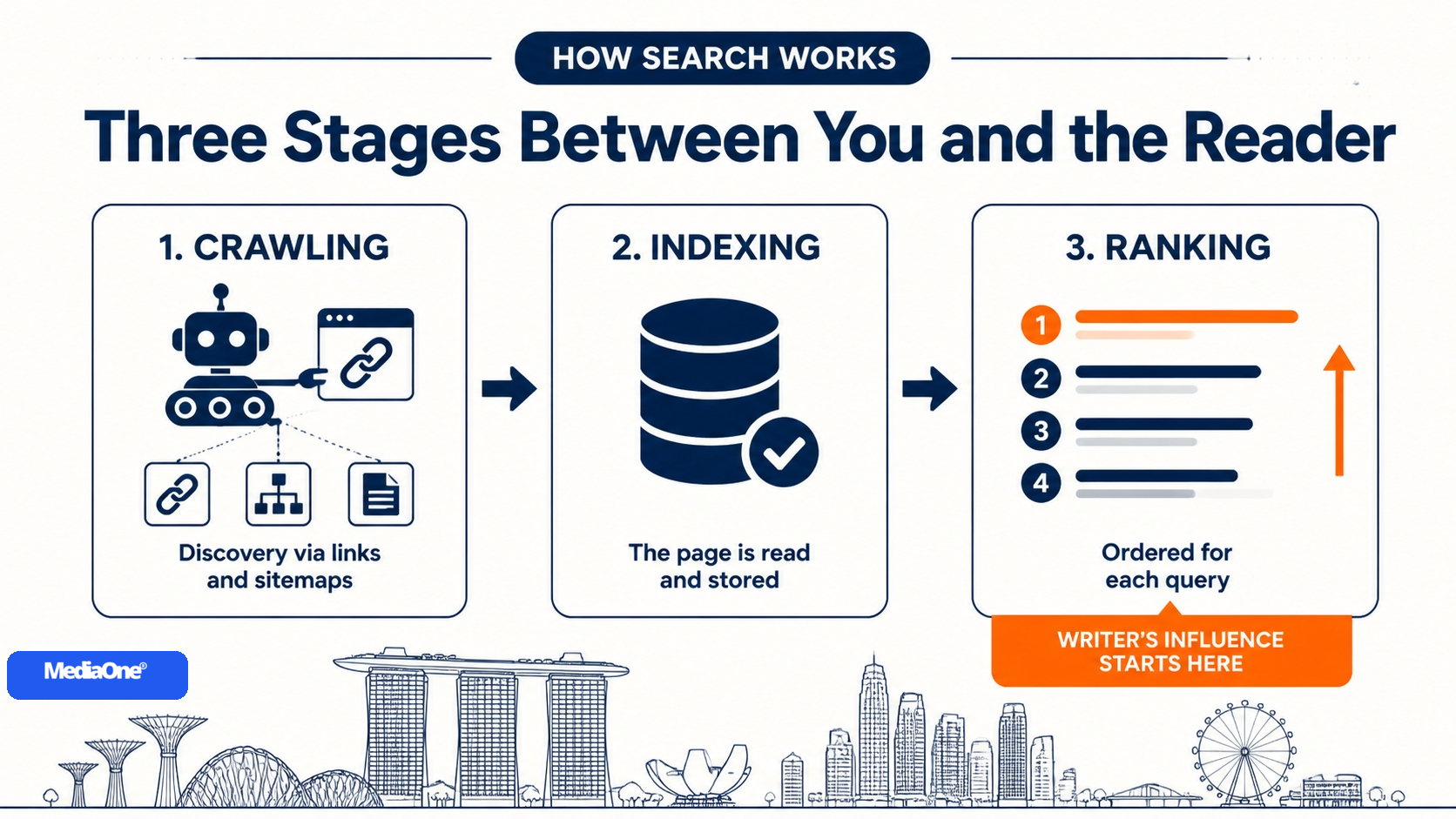
How search engines work: crawling, indexing and ranking
Search engines work in three stages. Crawling is discovery: automated programs follow links and sitemaps to find URLs. Indexing is storage: the engine reads a page and files its content in a database. Ranking is ordering: the engine decides which indexed pages best answer a query. Google’s own documentation describes the same three stages as crawling, indexing and serving search results.
Crawling depends on crawl budget, which Google defines as the set of URLs that Google can and wants to crawl. Duplicate URLs and thin pages can waste it, so keep one preferred address for each page and use canonical tags. Google’s published guidelines explain each stage, and note that crawl budget is mainly a concern for larger sites – most small business sites will not hit a ceiling.
Only ranking is a judgment about your writing. Check that new articles are linked from related pages and listed in your sitemap, and that the service pages you promote can be reached from the same paths. Pages that are easy to reach also make pricing comparisons easier for readers to find. Articles that are shared on social media can also send referral traffic to these pages, which helps them get crawled sooner.
How search engines evaluate content for quality and helpfulness
Once a page is indexed, the engine judges whether it helps the person who searched. Google’s helpful content guidance asks whether content was written for people or for search engines. Plan each page around one reader question, not a list of keywords. Good SEO writing states that question in the first few lines, then answers it in plain text – the same user-first principle behind ethical SEO, where rankings that last are built on content that serves the reader rather than the algorithm.
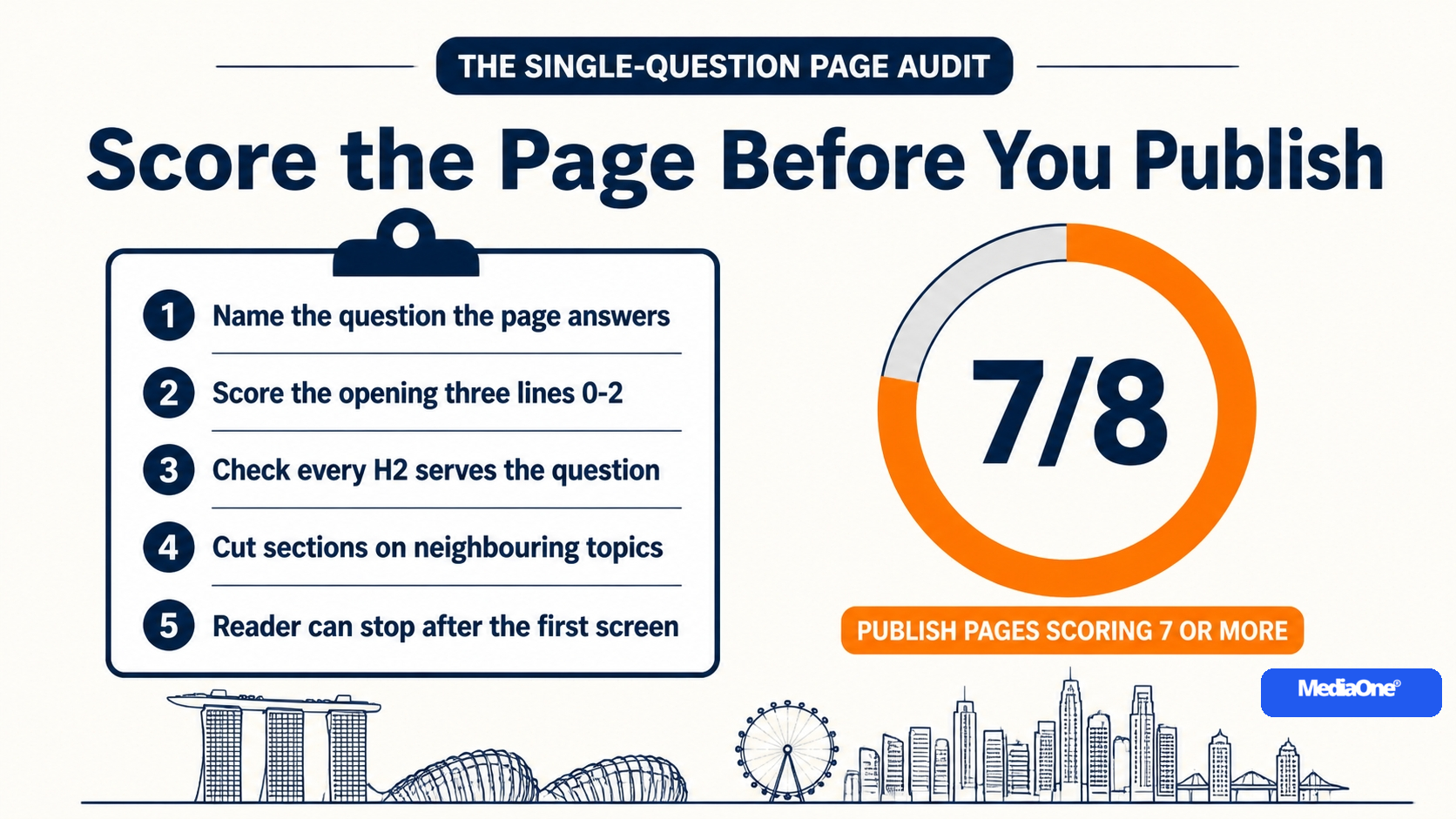
The Single-Question Page Audit is a practical test. Work through these five steps:
- Name the single question the page answers.
- Check that the first few lines answer it directly.
- Confirm each H2 serves that question.
- Remove any section that serves a neighbouring topic.
- Ask whether the reader can stop after the first screen.
If the opening lines answer the query, the page tends to hold its position. If the answer sits under a generic introduction, readers bounce back to the results.
Here is a worked example. A draft on “how to write SEO content” opened with three paragraphs of background, so it failed step 2. The writer moved a four-step method into the first paragraph and cut a section on the history of search. This is an illustrative case, not a documented result.
Why an article can rank and then fall (and what to do about it)
Rankings are not fixed. A decline is usually caused by a mismatch that appears after publication: competitors publish sharper answers, the query’s intent shifts, or the page drifts into several questions at once. Teams that optimise for a single question tend to catch these shifts earlier.
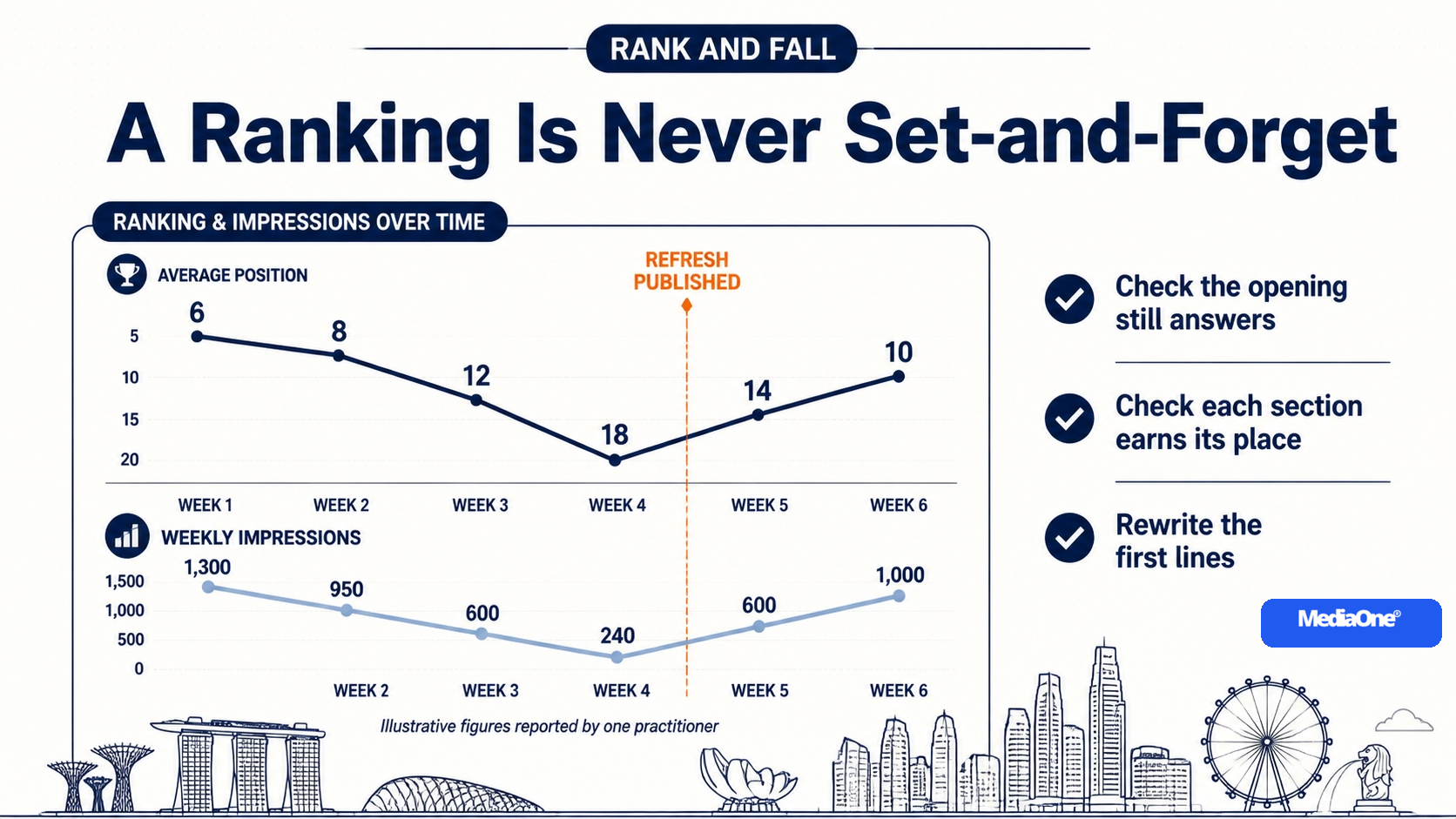
According to Nathan Ojaokomo’s account of an article on Jotform alternatives, the article slipped from about position 6 to position 18 within two months. Recovery came from rewriting the opening to answer one question and cutting sections on a neighbouring topic. Weekly impressions recovered from about 240 to about 1,000, and average position improved from about 18 to 10. This is one author’s reported case, not a verified dataset.
For professionals in Singapore, schedule reviews rather than assume a ranking is permanent. When a page drops, first check whether its opening still answers its question, then whether each section still earns its place. Shared checklists help writers on a team apply the same test consistently – a structured routine such as MediaOne’s four-tier content refresh triage keeps the decision of refresh, merge or retire consistent across the whole blog – and budget conversations about content work should be tied to these review cycles.
Keyword Research and Search Intent Analysis
Keyword research is where most SEO content goes wrong before a word is written. Start with one question and work outward. This section covers how to build a keyword list around a single topic, read intent from the results page, and choose topics that serve both the reader and the business.

Building a keyword list around a single topic
Start with one seed phrase, then collect its close variants, questions and modifiers. A keyword tool such as Ahrefs or Semrush shows volume, difficulty and related terms, but the spreadsheet matters more. Record each term with its volume, difficulty and intent, so the list can be reviewed and shared before any article is commissioned. Share the list with the marketing team so content and campaigns target the same keywords. A shared list also helps the sales team see which questions prospects are already asking. Once the list is stable, you can optimise each page’s headings and opening lines around its main term.
Group terms by the question each one is really asking:
|
Term |
Question it asks |
Group |
|
seo content writing |
What is it? |
Definition page |
|
how to write seo content |
What are the steps? |
Method page |
|
seo writing tips |
What should I improve? |
Method page |
|
seo content writer salary |
What does the job pay? |
Separate career page |
The first three terms may share one page. The fourth asks something different and needs its own page.
For each group, record the search volume, difficulty and dominant intent, then score it:
|
Measure |
1 point |
2 points |
3 points |
|
Intent fit |
Weak match to what you offer |
Partial match |
Direct match to what you offer |
|
Business value |
Little reader action |
Some enquiries or sign-ups |
Clear leads or sales |
|
Gap in results |
Top results are strong and complete |
Some gaps |
Top results miss the question |
Groups scoring 7 or more are worth writing first. Place the main keyword in the heading and opening lines so readers and search engines see it first. Treat the keyword data as a working record that the team revisits, not a one-off export.
Worked example. The group “seo content writing” scores 3 for intent fit, 2 for business value and 2 for gap in results, a total of 7, so it is worth writing first. “seo content writer salary” with a total of 4 would wait.
Reading search intent from the results page
The results page shows what Google already believes the reader wants. Search the keyword in a private window and review the first page. Mostly guides signal informational intent. Service or pricing pages signal commercial intent. Product listings signal transactional intent.
Watch for mixed intent, where one keyword hides several goals. Ahrefs has estimated that for the “kiwi” keyword, about 49% of the traffic goes to basic information about the fruit, while 19% cares specifically about its health benefits. A page written for only one of those readers leaves the other 19% unserved, so the second goal needs its own section or page. Results that mix social media posts with guides can also signal that a topic has more than one audience.
[Suggested image – replace or delete: A horizontal bar chart comparing the estimated traffic split for the keyword ‘kiwi’: about 49% seeking basic information and 19% seeking health benefits, with the remaining share labelled as other intents. Use a neutral palette and cite Ahrefs as the source beneath the chart.]
Choosing topics that match intent and business goals
A topic earns its place when the intent matches what you can offer, the business gains when the reader is satisfied, and the top results leave a gap you can fill. If the intent is informational and your business sells a service, write a guide that links to the service rather than a disguised sales page. Answering the questions prospects already ask – on a company blog or in Q&A spaces – also feeds high-intent traffic, as MediaOne’s Quora SEO strategy shows. A company blog is a practical place to publish these guides, and its services pages should be the destinations those guides point to.
Drop any topic that relies on claims you cannot support with your own experience or a credible source.
What to do next: time, tools and choosing a topic
How long does it take to write? It depends on the topic, the research needed and whether the writer has the source material. Set a deadline for the first draft and review it against the audit below before publishing.
What tools do I need? A keyword tool, a spreadsheet and Google Search Console are enough to start. Before commissioning anything, a free SEO audit shows which pages are already indexed and where the gaps are. Add a monitoring tool later if you need regular AI citation checks.
How do I choose a topic? Use the scoring table above. Start with the group that scores highest, and confirm that you can answer its question well.
Structuring a Page That Answers, Then Earns Its Keep

Writing a direct answer in the first lines
Readers decide within seconds whether a page answers their question. Search engines and AI answer engines pull the clearest passage near the top. The first two or three sentences should state the answer, not set it up. Use plain, professional copy so the answer is easy to scan on any website, and so that the marketing copy does not bury the answer that readers and writers came for. Treat each heading as a relevant question the reader is asking, and write to that question so the answer is free of filler.
Use the Single-Question Page Audit to check this:
- Write down the one question the page must answer.
- Score the opening three lines: 0 if they do not answer it, 1 if they partly do, 2 if they fully do.
- Check that each H2 serves that question, and that the keywords in each heading match what the reader is actually asking.
- Cut any section that does not help the reader decide or act.
- Publish or refresh first the pages scoring 7 or more out of 8.
Here is a worked example on a sample page titled “How to claim a business expense receipt,” written for a Singapore finance professional.
Question: Can I claim this receipt as a business expense, and what do I need to keep?
Before the audit (score 0): The page opened with three sentences on why expense management matters, and the answer appeared in paragraph four.
After the audit (score 2): The first sentence states the rule: a receipt supports a claim when it shows the date, amount, supplier and business purpose. The second names the records to keep.
H2 check: Two headings on tax treatment and expense history were cut or merged because neither helped the reader act.
Result: The score rose from 3 to 7 of 8. Impressions in Google Search Console rose over the following weeks, though this tracked one sample page and is not a benchmark.
Over 30 days, the pages AI tools cited most from one site were those answering a single, specific question in their first few lines. In that test, the top page received 46 citations. This is one site’s observation, and the source does not state its sample size or method, so treat it as a pattern to test rather than a rule. Teams can run similar checks on their own pages to see which opening lines earn citations.
A check against the rule. Pillar pages covering many questions have a place. A buyer’s guide to accounting software, for example, must cover several products and needs. In those cases, make sure each section answers its own heading completely and does not drift into a neighbouring topic, and that the text in each link points to the section it describes.
The on-page elements to set around the answer
The answer is the core; a few surrounding elements make it usable. Set a title tag and meta description written to earn the click – MediaOne’s meta description best practices cover the formulas – plus descriptive alt text on every image, internal links to related pages, and one clear next step for the reader. Google’s SEO starter guide covers each of these in plain terms, and its advice on writing good link text is worth applying to every internal link.
The Role and Responsibilities of an SEO Content Writer
An SEO content writer owns one page end to end: the question it answers, the evidence behind it, and the numbers that judge it later. In practice, that means defining the single question with the brief, researching the intent behind the target keyword, studying the pages that already rank, writing the draft with the answer in the first lines, running the Single-Question Page Audit, and setting the title tag, meta description and internal links before publishing. After publication, the writer watches the page’s impressions and position and leads the refresh when they slip. A working list of these duties, drawn from one practitioner’s own process, includes competitor studies, expert interviews and scheduled refreshes every six to twelve months.
|
The writer owns |
The writer hands off |
|
The single question and the brief |
Canonical tags, sitemaps, site speed |
|
Keyword and search-intent research |
Link earning and digital PR |
|
The draft and the Single-Question Audit |
Ad spend and paid targeting |
|
Title tag, meta description, internal links |
Design and development work |
|
Weekly impressions and position checks, refresh |
Final pricing and legal claims |
The role does not own everything. Technical fixes such as canonical tags, sitemaps and site speed belong to the web developer or SEO specialist; link earning belongs to outreach; paid media belongs to the ads team. Writing the briefs separately – one measure per page type – keeps each of these judged fairly.
If you are hiring or assigning, test for three things: can the writer find the question behind a keyword, can they cut a section that serves a neighbouring topic, and can they read a Search Console line without panicking at one week’s noise. Writers who pass all three usually need less supervision than writers with longer portfolios. Where the goal is persuasion rather than information – service pages, pricing, product descriptions – compare the role with MediaOne’s copywriting services and brief them separately.
Measuring the Benefits and ROI of SEO Content

SEO content is easy to justify on paper and hard to prove in a spreadsheet. The clearest proof comes from one page’s numbers over time, not from a blended dashboard.
Business benefits of SEO content beyond rankings
Rankings are a means, not the outcome. A well-built page on a website can bring qualified visitors, shorten sales conversations because prospects arrive informed, and get cited by AI answer engines. In Singapore, a page that answers one question quickly often converts better than a long guide that buries the answer. A clear, helpful page can also support marketing and reduce repeat questions to the services team.
Name the outcome before publishing, such as leads from a service page or fewer repeat questions to support staff. Pages that are free to read and easy to navigate tend to earn trust faster, and they also make it simpler to optimise the next version.
Tracking traffic, impressions, position and citations
Track four measures for each target page, reviewed weekly:
|
Measure |
Where to find it |
What it tells you |
|
Impressions |
Google Search Console |
Whether the page is shown for the question |
|
Average position |
Google Search Console |
Whether visibility is rising or slipping |
|
Clicks and conversions |
Analytics |
Whether searchers act once they arrive |
|
AI citations |
Manual checks or a monitoring tool |
Whether answer engines are quoting the page |
Impressions and average position often move before visits do. Read them as trend lines over several weeks, since one week’s figure can be noise. Treat each figure as a data point in that trend, not a verdict on its own.
AI citations need a manual routine. Run the same five or six questions in AI tools each month and record which sources are named.
Estimating the value of a single high-performing article
Estimate value with a simple formula: monthly visits, multiplied by conversion rate, multiplied by the average value of a conversion. A page drawing 400 visits a month, converting at 2%, with a lead worth S$300, is worth about S$2,400 a month in pipeline value. State the assumptions alongside the result, and link each one to the search engine traffic it depends on. Framed this way, the estimate slots straight into an SEO marketing budget plan, so content spend is judged like any other channel.
Some articles earn far more. One article on one site carries an estimated $1.6 million a year in traffic value, according to a single practitioner’s own estimate. The source does not give its method, so treat it as an illustration rather than a benchmark. A few pages often produce most of the return, so protecting them matters more than publishing volume. Writers should check these pages first when traffic dips.
Pre-Publishing Checklist for Blog Teams
Run every page through this list before it goes live. A page that fails item 1 or 2 is not ready, however polished the writing looks.
- The page answers one specific question, named in the brief.
- The first two or three sentences state the answer.
- Every H2 serves that question; neighbouring topics are cut or moved to their own page.
- Every claim carries a credible source, and every figure has a date.
- The target keyword appears naturally in the title, the opening and a few headings.
- The title tag and meta description are written to earn the click.
- Images have descriptive alt text.
- Internal links point to related articles and to the relevant service page.
- The reader’s next step is obvious: enquire, read the next guide, or use the tool.
- The opening reads cleanly on a phone screen.
- Someone other than the writer has checked the page for accuracy.
- The Single-Question Page Audit scores 7 or more out of 8.
Writing SEO Content for Search, Readers and AI
SEO content writing comes down to one habit: each page should answer one specific question in its first few lines. Use the Single-Question Page Audit: write the question, score the opening three lines from 0 to 2, check that every H2 serves it, and cut any section that does not help. Publish or refresh pages scoring 7 or more of 8 first.
Read the opening paragraph on a phone, as a commuter would. If it does not answer the question, fix that first. Then put the habit on a calendar:
|
Week |
Action |
|
Week 1 |
Pick one question and one keyword group; score it with the three-point table; check the top five results for gaps. |
|
Week 2 |
Draft the page with the answer in the first two lines; cut every section serving a neighbouring topic; run the audit. |
|
Week 3 |
Set the title tag, meta description and alt text; add internal links in both directions; publish. |
|
Week 4 |
Record the impressions and average position baseline in Search Console; book the weekly review and the first monthly AI citation check. |
Then repeat the loop on the next question – one page, one answer, measured weekly.
Frequently Asked Questions
What is SEO content writing in simple terms?
SEO content writing answers one specific search question clearly enough for search engines to rank and recommend the page, while staying useful to the reader. It pairs keyword research with clear, well-structured writing that answers early and completely. The aim is a page readers finish satisfied, not one packed with keywords.
How long does SEO content take to rank?
There is no fixed timeline, and anyone promising one is guessing. In one nathanojaokomo.com case, a Jotform alternatives article slipped from about position 6 to 18 within two months of publishing, then recovered after a refresh. Track weekly impressions and average position over several months, not a few days.
Do I need to be an SEO expert to write SEO content?
No. A writer needs to understand what the reader wants, answer that question directly, and organise the page so it is easy to scan. Basic familiarity with keyword research and search intent helps. Most marketing teams learn the essentials on the job, and Google’s published guidelines cover the rest.
How is SEO content different from keyword stuffing?
Keyword stuffing repeats a phrase until the text reads unnaturally – and it is not merely ineffective, as keyword stuffing is against Google’s spam policies. SEO content uses the terms people actually search for, placed where they fit, with one clear answer in focus. A page that answers its question in the first few lines usually does better than a longer page that repeats the keyword.
Does SEO content writing still work with AI search?
Yes, and it matters more now. In a 30-day review reported on nathanojaokomo.com, the pages AI tools cited most answered one specific question in their first few lines. This is one site’s observation, not a general rule. Clear definitions and question-led headings still make answers easier for AI engines to lift and attribute.