Search rankings built on manipulation do not last. Reported cases show black-hat tactics typically face detection within a predictable timeframe, after which websites using these methods face algorithmic penalties that can erase years of traffic overnight. Ethical SEO takes longer to compound, but it survives algorithm updates, regulatory changes, and competitive pressure because it is built on what Google actually rewards: user satisfaction, demonstrated expertise, and transparent business practices.


This guide clarifies technical concepts and what ethical SEO actually means, why it outperforms shortcuts financially, and how to audit and rebuild your site if you have drifted into unethical territory. Whether you run a Singapore SME, manage an agency, or build a competitive online presence, the five pillars covered here form the foundation of rankings that compound rather than collapse. This guide prioritises the Singapore legal and market context; please adjust it for your jurisdiction as needed.
Key Takeaways
- Ethical SEO prioritises user satisfaction over search engine manipulation, creating rankings that can survive algorithm updates and regulatory changes.
- Black-hat tactics, defined as manipulative practices like private blog networks (fake sites created only to rank), keyword stuffing, and link buying, deliver short-term gains followed by penalties; ethical SEO builds compounding authority over 12-24 months.
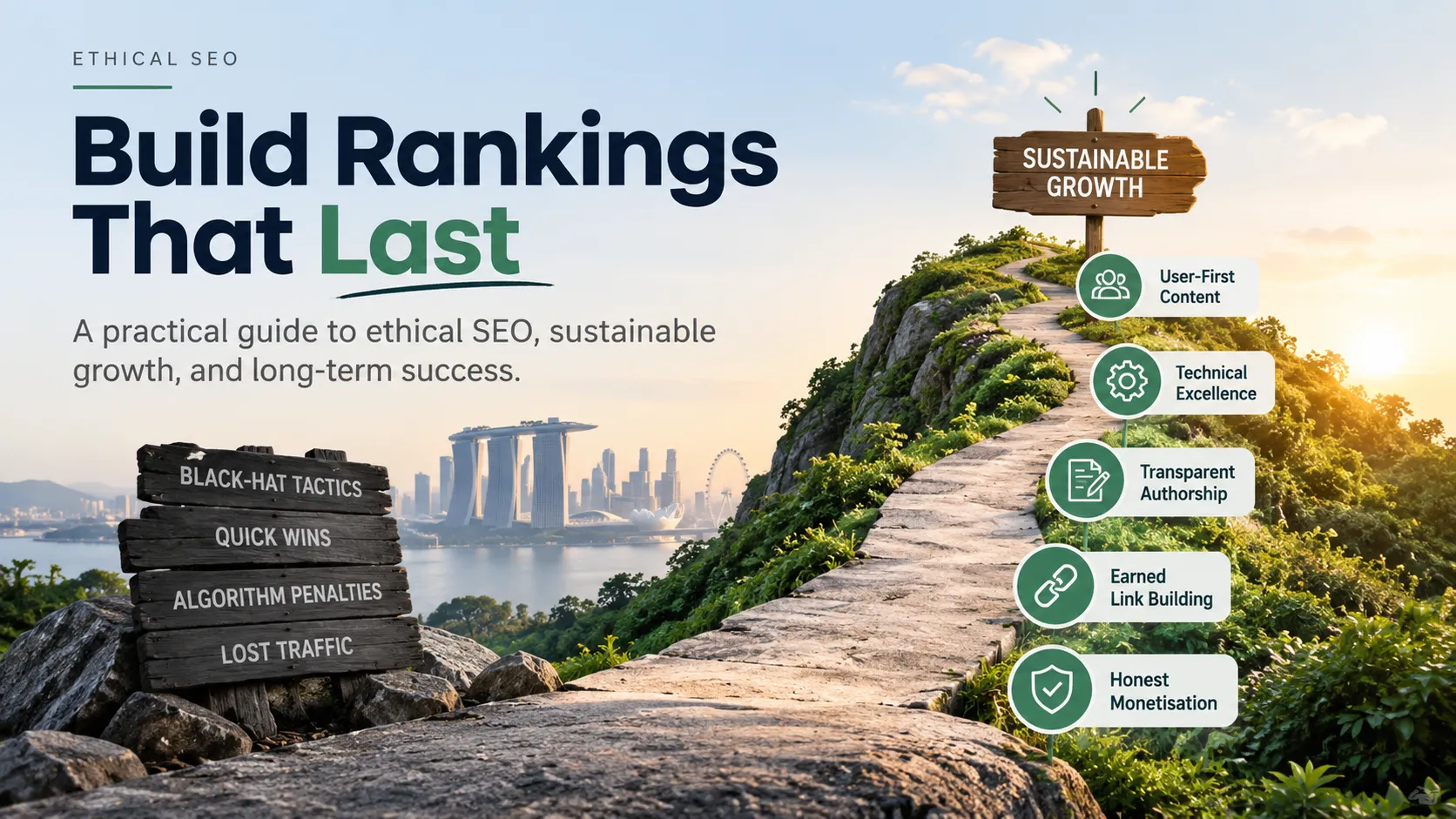
- Five pillars guide ethical practice: user-first content, technical foundations for humans, transparent authorship, earned link building, and honest monetisation.
- Singapore businesses face legal requirements under the Personal Data Protection Act (PDPA) and Advertising Standards Authority guidelines, making transparent, ethical SEO a compliance baseline, not optional.
- Recovering from unethical tactics typically takes much longer than building sustainable rankings ethically from the start.
What Ethical SEO Actually Means
The Core Difference Between Ethical and Unethical SEO
Ethical SEO prioritises human users first and search engines second. This distinction matters because Google’s ranking updates in 2023-2024 have increasingly rewarded user satisfaction as a primary ranking signal.
The core principle is transparency. Every tactic you use (from how you build links to how you monetise content) should be something you would be comfortable explaining to a user or a regulator. If you hide how something works or deceive someone to gain rankings, it is unethical.
Black-hat SEO refers to manipulative tactics that violate Google’s Webmaster Guidelines. These include private blog networks (fake sites created only to rank), keyword stuffing, cloaking, doorway pages, and link schemes. Unethical SEO is a broader term encompassing both black-hat tactics and practices that comply technically with Google’s guidelines but prioritise business interests over user welfare, such as misleading claims or transparent but predatory monetisation.
Why does this distinction exist? Google is increasingly penalising manipulative tactics. According to official announcements from Google Search Central, the company’s ranking system now prioritises content quality and user satisfaction over traditional SEO signals. A site might rank well on page one using black-hat methods temporarily, then drop to page five or disappear entirely after a core update.
In Singapore specifically, the Personal Data Protection Act (PDPA) requires transparent data handling and user consent. The Advertising Standards Authority guidelines require honest claims in content and advertising. Unethical SEO that involves data misuse, hidden affiliate links, or misleading content violates these regulations beyond just Google’s guidelines.
Why This Distinction Exists in 2024
Google’s shift from keyword-matching to expertise and user satisfaction has accelerated dramatically. The search engine’s recent ranking updates aim to surface helpful, original content and bury thin, manipulative pages.
Google released core updates in March 2024 and October 2024 that penalised AI-generated filler content, keyword-stuffed pages, and material that exists only to rank, not serve users. Websites built on genuine substance survived these updates with minimal traffic loss. Competitors who relied on outdated black-hat methods became clear targets for penalties.
Search intent is now the foundation of ranking signals, not keyword density. Google asks, “Does this page answer what the user actually wanted?” If the answer is no, the page ranks poorly, regardless of keyword optimisation. This shift rewards ethical, user-focused content by design.
The Business Case for Ethical SEO
Why Unethical Shortcuts Fail
Black-hat tactics fail because Google detects them. Reported cases show these manipulative methods face detection and penalty within a predictable timeline.
Consider a documented case study: a UK fitness website ranked page one for “best supplements” using private blog networks (fake sites created only to link to it). When Google’s core updates identified and deindexed the private blog network (PBN), the main site lost significant traffic in a single month. Recovery required rewriting dozens of thin articles and disavowing toxic links, which substantially extended the process.
The cost of recovery is steep. Rebuilding trust with Google after a penalty takes significantly longer than building rankings ethically from scratch. A site penalised for link schemes faces an extended recovery period, requiring sustained clean activity before Google re-ranks it fairly. Timelines vary based on violation severity and site history.
Beyond traffic loss, unethical practices damage brand reputation. When users discover hidden text tactics, doorway pages, or bought reviews, they lose trust in the brand. Media outlets and competitors publicise these findings, amplifying the damage across social channels and review platforms.
Long-Term Revenue Stability
Ethical rankings outlast algorithm updates. Websites built on user-focused content, transparent authority, and genuine links survive core updates with minimal volatility.
This stability compounds into higher revenue. A sustainable SEO strategy builds authority that attracts earning opportunities: partnership offers, higher-quality customer leads, and opportunities to charge premium prices, as users recognise your brand.
Ethical SEO typically generates leads with higher conversion rates compared to some alternative channels. Organic users who discover your content through search are already convinced before they arrive because they chose to read your material.
In Singapore, local SMEs that build genuine authority in their niche attract repeat customers and word-of-mouth referrals at scale. A dental practice ranking ethically for “cosmetic dentistry Singapore” generates patient enquiries from people who have already researched the practice online and found real reviews and credentials.
Legal and Compliance Advantages
Singapore’s Personal Data Protection Act (PDPA) requires consent before collecting personal data. Ethical SEO avoids consent violations by being transparent about data collection and respecting user choices.
The Advertising Standards Authority (ASA) guidelines, while not law, set standards for advertisers and require truthful, non-misleading claims. The PDPA, by contrast, is law and carries penalties for non-compliance. Ethical SEO aligns with both by avoiding hidden affiliate links, exaggerated product claims, and fake reviews.
This creates a competitive advantage. Businesses that rely on unethical data practices face regulatory action, fines, and reputational damage. Those operating transparently build a moat that competitors cannot copy because they build compliance into their systems, not bolt it on afterwards.
The Five Pillars of Ethical SEO Practice
Sustainable SEO rests on five interconnected practices that align search visibility with genuine user value and business integrity. These pillars work together: strong content without a technical foundation fails users; technical excellence without authority earns no trust; and authority without transparency invites scepticism.
Pillar 1: Build Content Users Actually Need
Create material because users need it, not because keywords exist. This is the foundational principle of ethical SEO content.
Test yourself with one question: Would you create this content if search engines did not exist? If the answer is no, reframe the piece or do not publish it.
Practical steps to implement this strategy:
- Research actual user questions where they ask them. Monitor Google Suggest, Reddit, Quora, and your support tickets. Listen to real problems, not assumed ones.
- Answer the question fully on the first read. Do not fragment your answer across multiple linked articles to inflate page views. A user should feel satisfied without clicking away.
- Include opposing viewpoints or limitations where relevant. If you are recommending a tool, mention its limitations. This builds trust and distinguishes ethical content from promotional fluff.
What to avoid: keyword-stuffing, thin content expanded with filler paragraphs, topic clusters designed only to rank rather than to serve users.
Pillar 2: Design Technical Foundations for Humans
Technical SEO matters for ranking, but ethical SEO prioritises the human experience. A speedy, accessible, mobile-friendly site respects users’ time and ability.
Core Web Vitals alignment is essential. Pages should load quickly (under 2.5 seconds for Largest Contentful Paint per Google Core Web Vitals guidance), have zero unexpected layout shift, and have no annoying pop-ups on entry. These aren’t just ranking factors; they are baseline respect for the user’s device and data allowance.
Accessibility standards offer important guidance for inclusive design. WCAG 2.1 AA is an international best practice standard; Singapore has no statutory accessibility mandate as of 2024, but following these guidelines ensures people with disabilities can use your site. Readable fonts, sufficient colour contrast, and keyboard navigation are essential for reaching all users.
Mobile-first responsiveness is critical in Singapore. Industry data suggests mobile traffic represents a substantial portion of overall internet usage in the region. A broken mobile experience harms both ranking and the actual user experience.
Practical checklist:
- Run PageSpeed Insights monthly. Target a desktop performance score of 80 or higher; mobile varies by device capability. Use tools that identify specific optimisation opportunities, not just vanity metrics.
- Test keyboard navigation and screen-reader compatibility quarterly. If you cannot navigate your site without a mouse or read it aloud, neither can users with disabilities.
- Remove auto-playing audio and video. Allow users to start media, not the other way around.
Pillar 3: Establish Transparent Authority and Authorship
E-E-A-T (Experience, Expertise, Authority, Trustworthiness) is Google’s framework for evaluating content quality. Ethical SEO makes this transparent.
Every article needs a named author with credentials. Create author pages that include:
- Real name and professional headshot.
- Published work history (link to LinkedIn, portfolio, or byline archive).
- Relevant certifications or degrees.
Source attribution matters. Cite studies, data, and quotes with direct links to original sources. A user should be able to verify your claims by following your links.
What to avoid: anonymous articles, unattributed data (“studies show…”), ghostwritten content presented as first-person expertise.
Pillar 4: Pursue Link Building as Earned Endorsement
Ethical linking means pursuing backlinks only from sites with genuine editorial interest in your topic. A link is a vote of confidence; it should feel earned, not bought.
Red flags that indicate unethical link building:
- Paid link networks or link brokers offering volume links at fixed prices.
- Reciprocal link schemes (linking to someone just because they will link back).
- Press release spam sent to thousands of unrelated sites.
- Forum spam, comment spam, and directory submission farms are all examples of unsustainable link-building practices.
Sustainable link-building approach:
- Create research, original data, or tools that competitors naturally link to. If you publish the first analysis of an industry trend, journalists and competitors will cite you.
- Pitch genuine media outlets with story angles that serve their readers, not angles that serve your ranking. A journalist writing about fintech regulation is interested in expert insight, not backlinks.
- Build relationships with editors over time. These relationships generate links from high-quality sources, not volume links from low-quality sites.
Pillar 5: Practice Honest Monetisation and Business Practices
Disclose sponsored content, affiliate links, and promotional material clearly. Advertising Standards Authority guidelines require “Ad” or “Sponsored” labels that are impossible to miss. Place these labels at the start of content, not buried in footers.
Explain what data you collect, how you use it, and who you share it with. This is a PDPA requirement in Singapore, but it is also basic transparency. A user should never wonder why they are seeing targeted ads.
Implement cookie banners and preference centres that let users opt out of non-essential tracking, rather than just clicking through to continue. Track and honour users’ preferences.
If you are using affiliate links, disclose them in every article where they appear, not just in a footer privacy notice. The reader should know you are earning commission before they click.
Red Flags That Indicate Unethical SEO
Black-hat tactics persist because they deliver rapid, visible results in the first 2-8 weeks. A site using private blog networks might see 50+ new backlinks in a month. Keyword-stuffed pages can rank for high-volume search terms almost immediately. The problem isn’t visibility in week one; it is invisibility in week 52, after Google’s algorithm or a manual review catches the manipulation.
| Tactic | Why It Is Unethical | What Happens | Ethical Alternative |
|---|---|---|---|
| Private Blog Networks (PBNs) | Fake sites created only for links deceive search engines | Penalty and deindexation of all sites once discovered | Build real authority in your niche; earn genuine editorial links from relevant publications |
| Keyword Stuffing | Ranks for keywords but makes content unreadable; manipulates relevance signals | Algorithm penalty + user bounce; traffic drops substantially after core update | Write for readability; use keywords naturally where the topic requires them, not artificially |
| Doorway Pages | Thin pages optimised for one keyword, redirect users elsewhere | Core update penalty; loss of indexing | Create full, user-focused guides that answer multiple related questions comprehensively |
| Hidden Text/Cloaking | Show different content to search engines vs. users | Manual action penalty; site removal from Google index | Write honest, transparent content visible to all users equally |
| Link Buying/Exchange Schemes | Buy links from brokers or swap links insincerely | Google penalty on both sites; loss of backlink value; manual action | Earn links through content quality and genuine relationship-building with editors |
| Spun Content | Auto-generate variations of articles with thesaurus tool | Unreadable, low-quality content that fails to rank and wastes resources | Research and write original perspectives on your topic; cite sources and add new insight |
Recognising Unethical Tactics in Your Own Site
If you have inherited a website or took it over from a previous SEO provider, run this quick check.
Backlink inspection: Use Ahrefs, Moz, or SEMrush to review your top 100 backlinks. Are 20% or more from low-authority directories, comment spam sites, or domains with obvious auto-generated content? Those are PBN or spam signatures. Disavow them immediately in Google Search Console.
Content sampling: Review 10 random pages from your site. Ask if sentences flow naturally or if keyword phrases repeat in awkward patterns. Can you find the same article published on five other sites with only synonyms changed? Are there hidden sections in the page source that do not display to users? Do pages redirect to a different URL or topic? If yes to any, you have inherited unethical content needing rewriting or removal.
Link scheme check: Have you been offered links in bulk, asked to link back to a partner in exchange for their link, or sent unsolicited press releases to thousands of sites asking for links? Stop immediately. These are link schemes that violate Google’s Webmaster Guidelines.
Recovery Timeline
A site penalised for black-hat tactics faces a predictable recovery path. Stop the unethical practice immediately. Audit every page and backlink; remove or rewrite unethical content; disavow spam backlinks. Submit a reconsideration request to Google via Search Console explaining the changes. Wait for Google’s manual review (typically 2-12 weeks). Expect gradual traffic recovery over subsequent weeks as pages re-index and re-rank.
Timelines vary based on violation severity and site history. Recovery typically spans several months depending on the scope of unethical activity. During this time, your site generates minimal organic traffic. Compare this to an ethical site that takes 12-18 months to reach the same traffic level while keeping it. The ethical route is slower upfront but irreversible. The unethical route is faster upfront but ends in severe traffic loss.
How to Audit Your Own Site for Unethical Practices {#audit-your-site}
Content Audit Checklist
Export your 50 most-visited pages into a spreadsheet. For each page, answer these questions:
- Would this page exist if there were no search engines?
- Can I trace every claim to a source I have linked?
- Have I disclosed all affiliate links and sponsorships?
- Does the page answer the user’s question in full, or does it link away to make them click through?
Flag any page failing two or more criteria for rewrite or removal. This isn’t abstract; unethical or thin content actively harms your site’s ranking after updates and trains users to distrust your brand.
Technical and Link Audit Checklist
Use Digimetrics.ai, Ahrefs, Moz, or SEMrush to inspect your top 100 backlinks.
Ask for each link: Are they from sites in my industry? Do the anchor texts look natural or over-optimised? Are any from known PBN networks or spam directories? Disavow links from unrelated, low-quality, or suspicious domains.
Check your top five competitors’ backlinks. Where are legitimate links coming from? What topics are earning those links? Can you pitch the same outlets with a better story? This reveals real linking opportunities, not shortcuts.
PDPA and Privacy Audit
Do you have a clear privacy policy published and linked from every page? Are third-party tools (analytics, ads, tracking) listed and justified? Can users opt out of non-essential cookies without losing functionality? Do you have user consent recorded before collecting personal data?
Schedule an annual PDPA audit. Have a lawyer or compliance officer sign off. This is not optional in Singapore; it is a legal requirement that also builds user trust.
Troubleshooting Common SEO Issues
| Penalty Symptom | Likely Cause | Recommended Recovery Action |
|---|---|---|
| Sudden 50%+ traffic drop after algorithm update | Thin content, keyword stuffing, or manipulated links identified as unethical | Rewrite all thin pages to full, user-focused guides; disavow spam backlinks via Search Console; submit reconsideration request. Timeline: 4-8 weeks |
| Multiple pages removed from index | Cloaking, hidden text, doorway pages, or manual action triggered by spam detection | Remove all hidden or duplicate content; restore original URLs if applicable; audit entire site for cloaking; resubmit in Search Console. Timeline: 2-6 weeks |
| Rankings drop despite no visible changes to content | Inherited PBN links from previous owner; backlink profile flagged as suspicious | Audit backlinks in Ahrefs/Moz; disavow all low-quality, unrelated links; submit disavow file to Search Console. Timeline: 4-12 weeks |
| High bounce rate and low time-on-page despite top 3 ranking | Content is keyword-stuffed, reads unnaturally, or answers a different question than the title promises | Audit content against user search intent; rewrite for natural language and readability; ensure the title matches page content. Timeline: 2-4 weeks for update; 4-8 weeks to see ranking stabilisation |
| Manual action notice in Search Console for unnatural links | Link scheme discovered (bought links, reciprocal exchanges, press release spam) | Identify all unnatural links; contact site owners to request removal; disavow remaining links; submit a reconsideration request with an explanation of corrective action. Timeline: 2-12 weeks for review |
| Affiliate links causing conversion failure and user complaints | Disclosure missing or unclear; users trust damaged by undisclosed commercial relationship | Add a clear “Affiliate Link” disclosure in the opening sentence of every recommendation; review disclosure compliance across the entire site; test page load and transparency. Timeline: Immediate; traffic recovery over 4-6 weeks |
Building an Ethical SEO Culture in Your Team {#ethical-culture}
Setting Standards with Freelancers and Agencies
Specify in writing that all work must comply with Google’s Webmaster Guidelines and local regulations (PDPA). Make this part of your contract, not a suggestion.
Reject statements like these:
- “Guaranteed #1 ranking in 30 days.”
- “We will use white-label links no one will notice.”
- “We will hide your keywords using CSS tricks.”
Track performance metrics that matter: organic traffic growth (not just keyword ranking position), user engagement (time on page, scroll depth, return visits), conversion rate (not just clicks), and rankings for long-tail, user-intent-matched keywords (not high-volume irrelevant terms).
Educating Your Team
Assign team members to read one Google Search Central article per month. These are free, official resources that prevent bad practices from creeping into your workflow.
Study 2-3 penalty recovery case studies per quarter. Search for published recovery analyses to find real examples. This teaches through consequence, not just principle.

Write down your SEO ethics policy in a one-page guide accessible to all team members. Make it concrete, not aspirational: “We disclose all affiliate links in the first sentence of every recommendation” is better than “We are transparent”.
Hire an independent SEO auditor every 18-24 months. An outside perspective catches practices you have missed or normalised over time.
Ethical SEO in Competitive Industries
Health, Finance, and E-Commerce: Where Ethics Become Critical
These sectors face strict scrutiny from Google and regulators.
Health: E-E-A-T requirements are highest here. Every health claim must cite peer-reviewed research or come from a qualified healthcare professional. A post about diabetes management should be written by an endocrinologist or linked to studies published in medical journals.
Finance: ASA and regulatory guidelines require accuracy in interest rates, returns, and risk disclosures. Affiliate links must be disclosed. A post recommending investment products must be clear about what you are earning from the recommendation.
E-Commerce: Consumer protection laws require accurate product descriptions, true pricing (no hidden fees), and clear refund policies. A product photo should represent the actual product; misleading images violate consumer law in most countries.
Staying Ahead of Algorithm Changes
Core Web Vitals are already a ranking factor and increasingly a tiebreaker in competitive niches. Invest in speed and user experience, not just keyword optimisation.
Build topical authority by publishing at least 50-100 high-quality pieces on a topic cluster before expecting top rankings. A site with 15 posts on productivity apps will not outrank a site with 150 posts if both are equally well-written.
Brand search signals matter more each year. Build your brand name on the broader web: press mentions, speaking engagements, and social media. Mentions outside your own site now influence how Google evaluates your authority.
Actively respond to reviews, comments, and support tickets. Google monitors these signals as indicators of real user satisfaction, not just algorithmic metrics.
Common Misconceptions About Ethical SEO
“Ethical SEO Is Slower Than Black-Hat”
Early gains from black-hat tactics (weeks 1-6) feel faster. You buy links or spin content and see rankings move in weeks. But penalties erase months of work in days. Ethical SEO compounds over 12-24 months into sustainable, penalty-proof rankings. The time horizon is longer, but the payoff is permanent.
“Google Only Cares About Algorithms, Not Ethics”
Google’s business model depends on user trust. Algorithmic penalties exist specifically to remove unethical sites that erode search quality. When algorithms miss obvious manipulation, manual actions follow. Google employs teams of humans to review suspicious sites and apply manual penalties via Search Console notices.
“My Industry Is Too Competitive for Ethical SEO”
Competitive niches are where ethical SEO wins hardest. Competitors cutting corners get penalised; those building genuine authority outlast them. Singapore property, finance, and e-commerce leaders who focus on authority see substantial ROI over 18 months compared to competitors using shortcuts.
Frequently Asked Questions {#faq}
How long does ethical SEO take to show results?
Most sites see meaningful organic traffic growth within 4-6 months of consistent, high-quality publishing. Ranking positions for competitive keywords typically take 12-18 months. This timeline varies with niche competition and existing domain authority.
Can I use SEO tools if I am pursuing ethical SEO?
Yes. Tools like Ahrefs, SEMrush, and Google Search Console help you understand user search behaviour and optimise for it. Avoid tools marketed as “automated ranking” or “instant backlinks”. Ethical tools show you what to improve; unethical tools do the manipulation for you.
What should I do if I have used black-hat tactics in the past?
First, stop immediately. Second, identify which pages or links are problematic and either rewrite the content or disavow the links via Google Search Console. Third, submit a reconsideration request to Google explaining the changes. Recovery takes 2-4 weeks to six months, depending on severity.
Is buying expired domains ethical if I am going to publish good content?

Buying an expired domain with existing authority is ethical; using an expired domain’s backlinks without publishing relevant content is not. If you buy a domain, publish 20+ original, topical pieces before expecting significant ranking benefit. Thin content on an aged domain looks suspicious to Google.
How do I know if an SEO agency is ethical?
Ask them directly: What is your policy on paid links, private blog networks, and content spinning? Ethical agencies will show you their contracts and client case studies with real traffic data. Red flags include guarantees of #1 rankings, vague monthly reports, reluctance to name clients, or pressure to approve changes without your input.
What is the common misconception about ethical SEO and cost?
Many assume ethical SEO costs more. In reality, ethical SEO costs less long-term because you avoid penalty recovery. Unethical tactics create hidden costs: recovery labour, lost revenue during penalty periods, and brand damage. Ethical SEO spreads investment over a longer, more predictable timeline.
Does ethical SEO work for Singapore-specific businesses competing against international sites?
Yes, and it works better. Local searches favour relevant, geographically focused content. By publishing content specific to Singapore (laws, pricing, cultural context), you can outrank international competitors for Singapore users. Combine local ethical SEO with backlinks from Singapore media, and you will dominate local search results.
What is the difference between white-hat and ethical SEO?
White-hat SEO follows Google’s guidelines technically but may still prioritise search engines over users. Ethical SEO goes further: it prioritises user satisfaction, regulatory compliance, and business integrity even when Google’s guidelines do not explicitly require it. All ethical SEO is white-hat, but not all white-hat SEO is ethical.
How do I balance keyword optimisation with ethical content writing?
Keywords are research signals, not targets. Use keyword research to understand what users are searching for and what questions they want answered. Then write naturally to answer those questions. If a keyword appears organically 2-3 times in a 2,000-word article, you have balanced it correctly. If you are forcing keywords into every paragraph, you have lost the balance.
What happens to my rankings if Google’s algorithm changes?
Ethical sites see minimal ranking volatility during core updates because they are already aligned with what Google rewards. Black-hat sites experience sharp drops during updates. If your content is genuinely useful, well-researched, and transparent, algorithm changes are opportunities to gain on competitors, not threats to your visibility.
Can I rank for high-volume keywords ethically?
Yes, but it requires deeper expertise and more comprehensive content. High-volume keywords are competitive because many publishers want them. You outrank them by publishing the most useful, authoritative, and trustworthy resource on that topic. This takes longer but creates a durable ranking advantage that shortcuts cannot replicate.
Is guest posting on other sites an ethical link-building tactic?

Guest posting is ethical if the host site has genuine editorial interest in your topic and their audience benefits from your expertise. It becomes unethical if you pay for placements, publish low-quality content just to get a link, or target sites with no thematic relevance. Google penalises low-quality guest posting networks, so prioritise quality over quantity.
How do I handle competitor websites using unethical tactics?
Report them to Google via the spam report form in Search Console or use Google’s webspam reporting tool. Google investigates credible reports and takes manual action when warranted. However, do not expect immediate results. Focus on building your own authority rather than waiting for competitors to be penalised. Good content and honest practices always outlast shortcuts.